Sample Category Title
USDJPY Extends Bounce At 109 Above SMAs
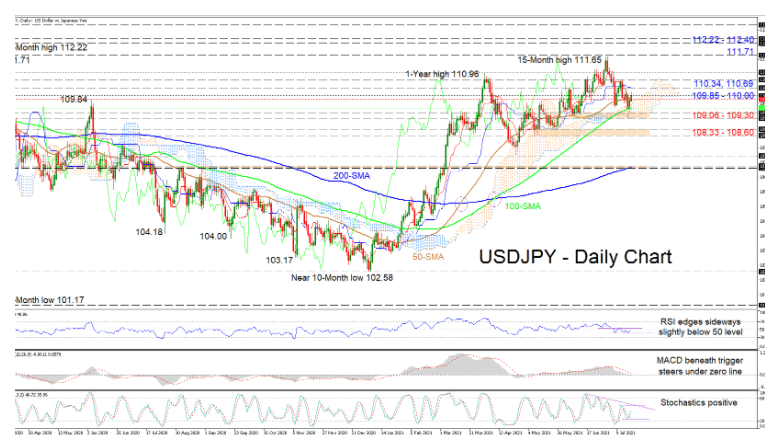
USDJPY has managed to find a foothold around the 109.00 handle, lifting the price back above the simple moving averages (SMAs) and the 110.00 hurdle. The persistent bullish bearing in the SMAs is nurturing the positive structure, in spite of the retracement in the pair.
That said, the active negative charge in the Ichimoku lines is endorsing the pullback from the 15-month high of 111.65 but the sideways bearing of the blue Kijun-sen line suggests buyers are countering downside pressures. On top of that, the short-term oscillators are currently conveying conflicting messages in directional momentum. The MACD is beneath its red trigger line and has slid a tad below the zero mark, while the RSI is struggling to advance, presently ranging just south of the 50 level. Additional upside price action is also being promoted in the stochastic oscillator.
Maintaining control of the reins, buyers may face early constraints from the 110.34 and 110.69 nearby highs respectively, which could soften upside momentum ahead of the 111.00 key border. However, if bullish forces secure a lead, the price may jump towards the 111.65 obstacle and the critical March 2020 peak of 111.71. Successfully navigating above 111.71 may then cement buyers as the frontrunners, driving the price to challenge the 112.22-112.40 resistance belt, shaped by the April 2019 high and the February 2020 rally peak.
Alternatively, for sellers to regain control they would need to dip the price below the area of 109.85-110.00 (previous resistance-now-support) and into the Ichimoku cloud. Next support could arise from the 100-day SMA at 109.48 before the 109.06-109.30 boundary comes into play. From here, a price dive under the 109.00 level could direct sellers towards the support section of 108.33-108.60.
Summarizing, for USDJPY to retain its positive tone, the price would need to endure above the SMAs and the 109.00 barrier.
NAS 100 Recovers From Moving Average
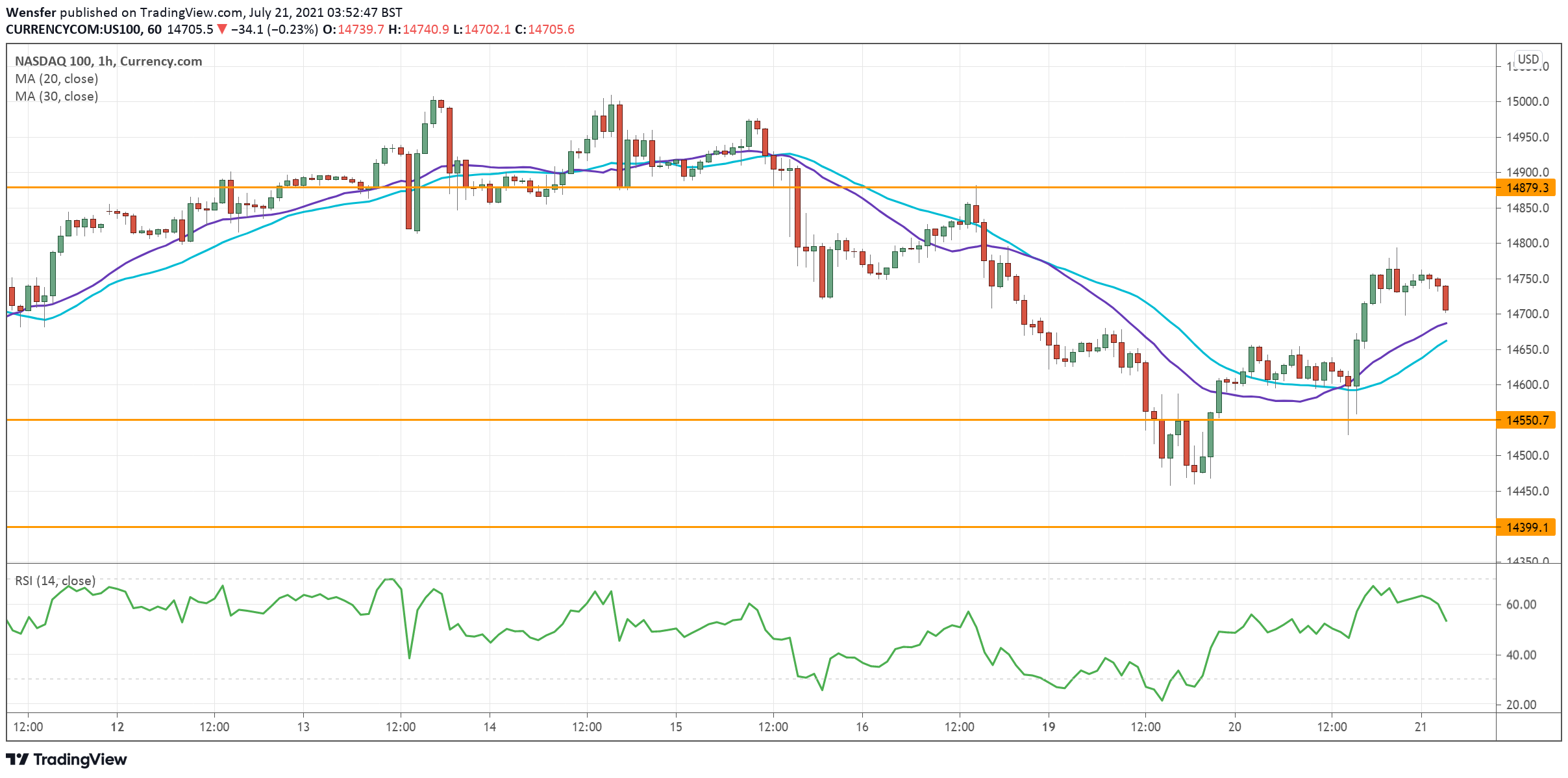
The Nasdaq index seeks support as investors grow wary of the Delta sell-off. The bearish breakout below the key short-term support at 14550 has put buyers under pressure.
Price action has so far bounced off the 30-day moving average but buyers will need more assurance to commit again. 14550 is the first support after a rebound above 14680.
A high RSI may slow down the pace of the rally. A recovery may only see the light of day if the bulls succeed in pushing above the major hurdle at 14880.
USD/CAD Breaks Above Major Resistance
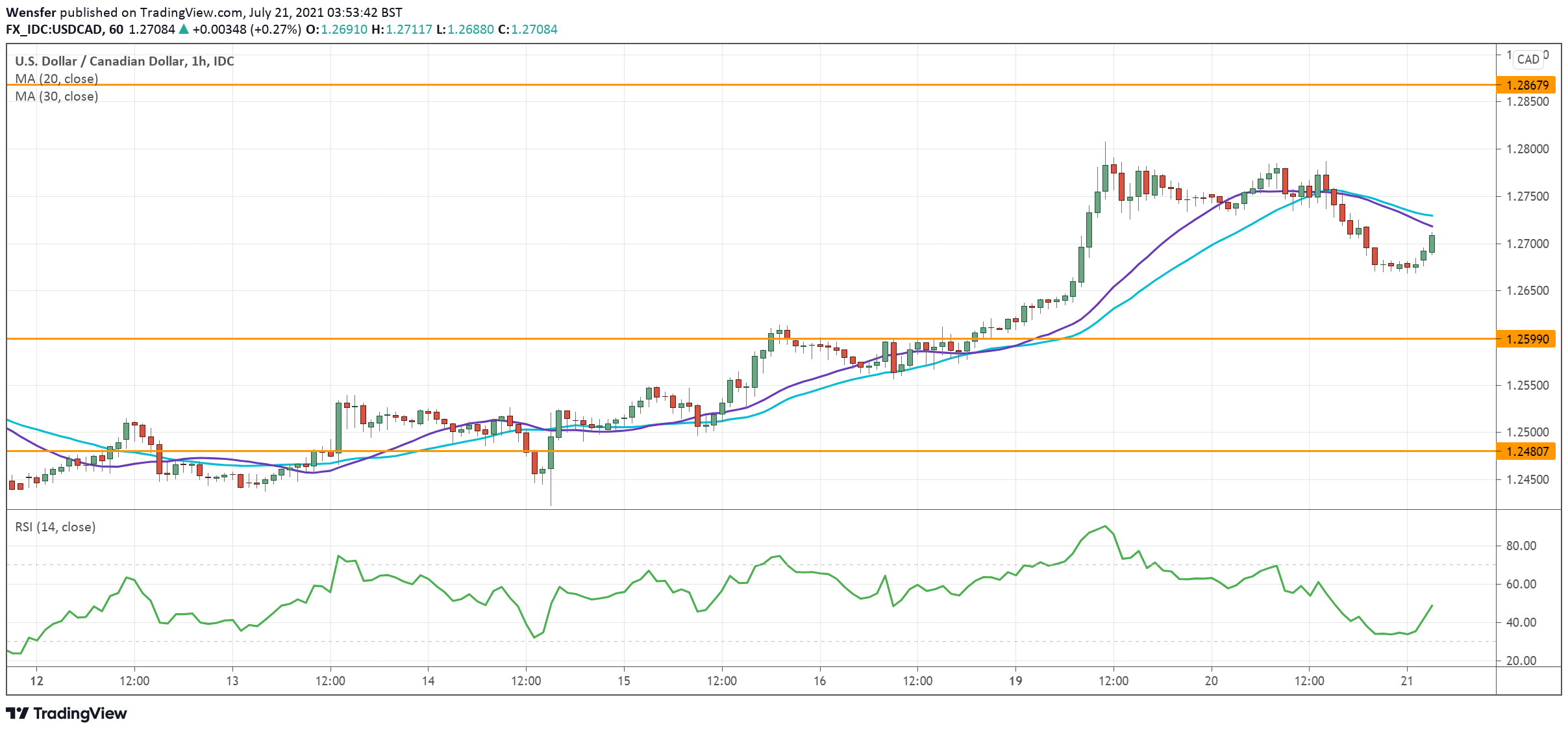
The commodity-linked Canadian dollar took a hit after risk appetite receded. The pair saw strong momentum plays after it cleared 1.2650, a major resistance from last April.
Short-covering in a crowded bearish trend may have contributed to high volatility. This could be an inflection point for the greenback in the medium term.
In the meantime, February’s high at 1.2870 is the next target. Meanwhile, the RSI is back to the neutral area, and the direction is up as long as the price stays above 1.2600.
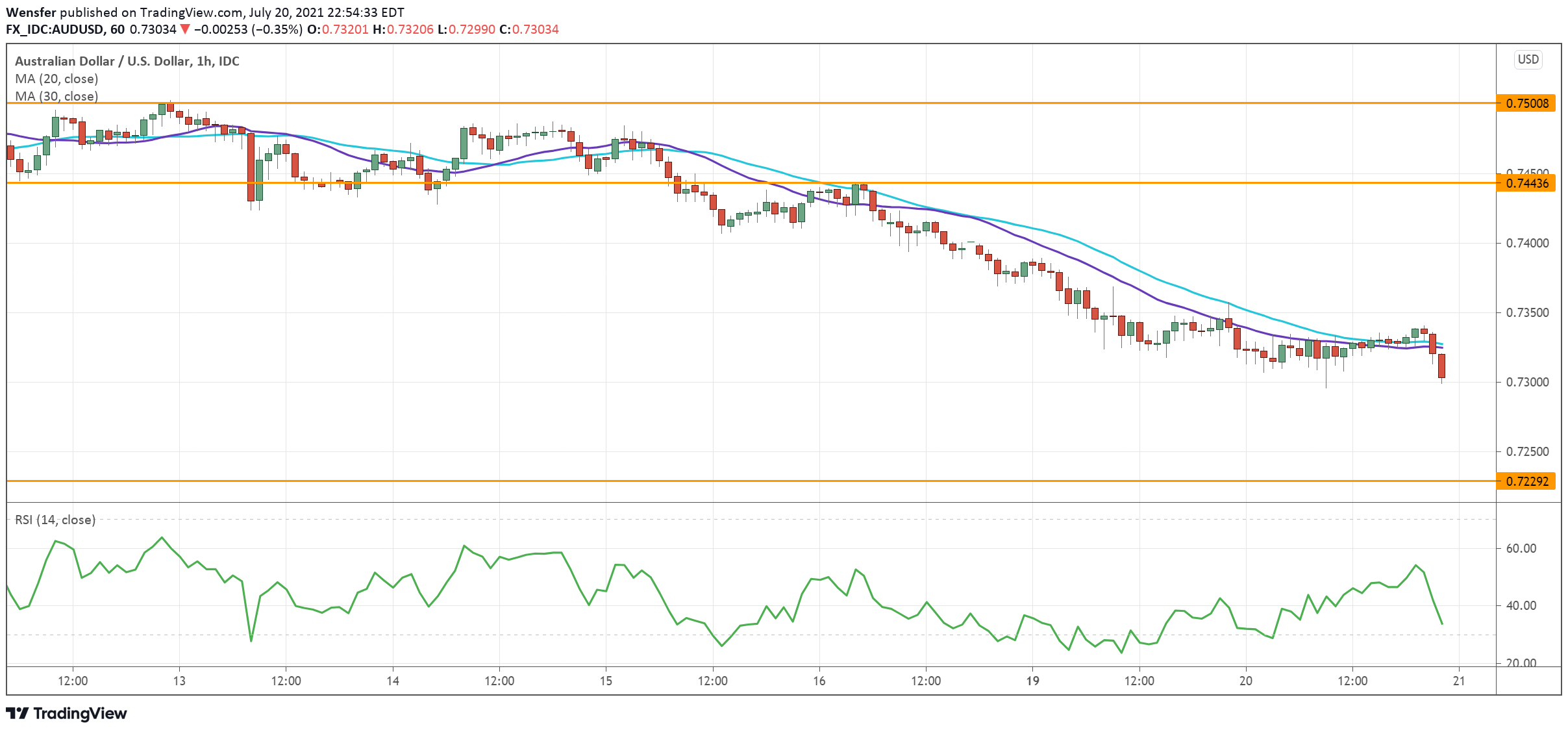
AUD/USD Drops Along Moving Average
The Australian dollar remains underwater as the RBA minutes say no to a rate hike before 2024.
The sell-off has accelerated after the Aussie fell through 0.7410, the last stronghold from a previous bounce. The pair is sliding along the 20-day moving average, and the downtrend is heading towards the next support at 0.7230 from the daily chart.
However, a repeatedly oversold RSI may prompt sellers to take some chips off the table, causing a temporary rebound. 0.7440 is likely to cap the buyers’ push.
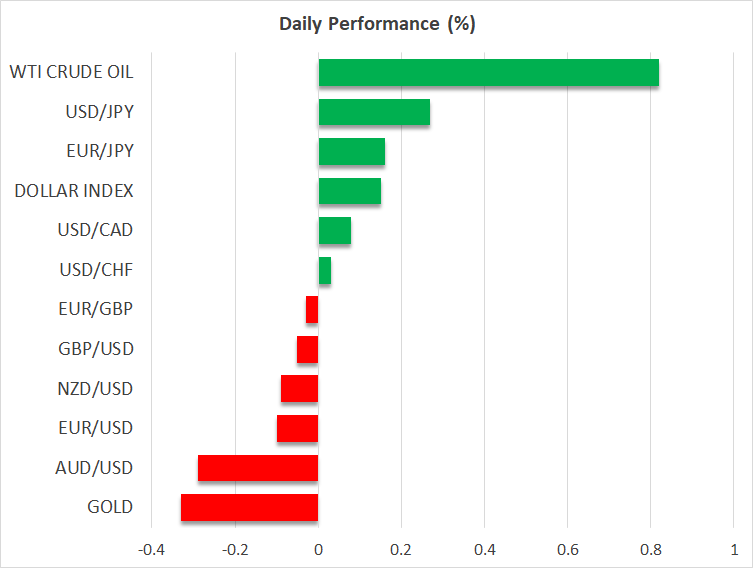
Wall Street Bounces Back, Dollar Powers Higher
- Stock markets claw back losses as dip buyers return
- Dollar cruises higher with a little help from recovering yields
- But commodity currencies remain under pressure
Dip buyers win again
Wall Street staged a fierce comeback on Tuesday, without any particular catalyst behind this impressive recovery. Markets have been grappling with virus concerns lately, the fear being that new variants might be an endless phenomenon that doesn’t allow the world economy and especially developing economies to go back to normal.
Nothing has changed on this front, but traders were happy to put those worries aside for now and go bargain hunting in the stock market. This highlights that covid fears are a self-correcting dynamic for stocks. If the world will be tormented by covid for longer, that means more central bank medicine for longer.
Overall, it’s difficult for stocks to bleed as long as there is no alternative. Bonds are loss-making assets in a positive inflation environment and commodity markets are far too volatile for big players to have any real exposure to. Dip buying will probably remain a winning strategy until this paradigm changes.
Dollar shines in all weathers
But the relief in the equity and bond markets didn’t really spill over into the FX arena. Risk-sensitive currencies like the aussie and the kiwi are still under pressure, while the British pound has been unable to capitalize on this serenity.
Even more striking is the US dollar, which continues to advance regardless of the market mood. This is a testament to the greenback’s unique role as an ‘all-weather currency’. It can gain both when markets are fearful thanks to its reserve currency status and when the mood music improves, amid expectations of US economic outperformance.
Indeed, market pricing for Fed rate increases over the coming years has not budged much lately, suggesting that the Delta variant is not really a US problem. About half a rate hike has been priced out in recent days, leaving two and a half hikes still priced in by the end of 2023.
Markets are essentially saying that a deceleration in global growth could slow down the Fed’s normalization plans a little, but it won’t derail them. The US has one of the highest vaccination uptake rates, the quality of vaccines is better than elsewhere so new variants are less of a threat, and more federal spending is on the horizon.
Australian data hammer aussie, ECB eyed
The Australian dollar is the main underperformer on Wednesday, following some disappointing data. Retail sales surprisingly fell in June, before the latest lockdowns started, which implies that the July numbers will be even worse.
Aside from that, there isn’t much news to speak of. The price action is the narrative these days. The market mood is calmer for now, with Wall Street futures and Treasury yields both recovering, taking the shine off the defensive yen.
Looking ahead, the next major event will be tomorrow’s ECB meeting. President Lagarde promised new policy signals, so it should be interesting. The ECB wants to demonstrate it is serious about hitting its new inflation target, which means committing to cheap money policies for longer.
That would underscore the divergence with other major central banks that are headed towards higher rates, which is bad news for the euro over the longer term.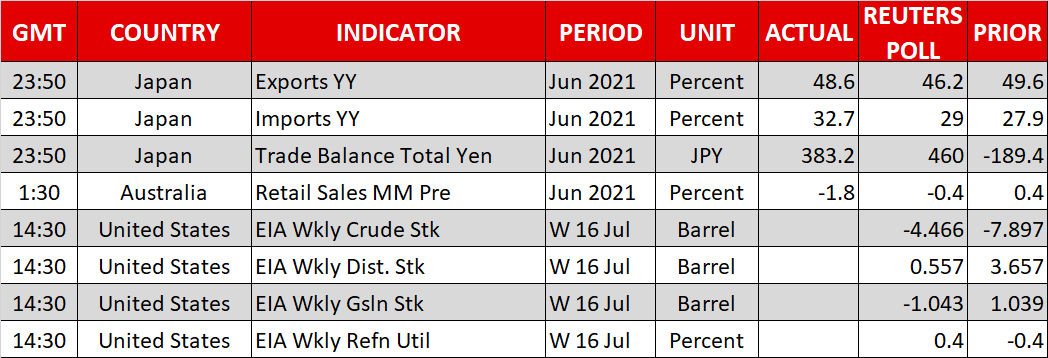
Inventories Limit Oil Gains, Gold Yawns
API Crude Inventories halt oil recovery
After Monday’s price meltdown, oil prices consolidated nervously at their recent lows overnight. Brent crude finished the session 0.20% lower at USD 68.60 a barrel, while WTI edged 0.25% lower to USD 66.40 a barrel. Although risk appetite showed signs of recovery in other asset classes, notably equities, gains by oil were limited after the US API Crude Inventories rose unexpectedly by 0.8 million barrels, versus an expected drawdown of 4.17 million barrels.
The rise in API inventories was the first in some time. If official US Crude Inventories were to rise tonight, instead of fall by a forecast 4.5 million barrels, oil prices could be vulnerable to further losses. Indeed, oil remains very susceptible to intraday swings in risk sentiment and will remain so for the rest of the week.
Physical buyers in Asia have bought the dip today, pushing Brent crude 0.50% higher to USD 68.95 a barrel and WTI higher by 0.60% to USD 66.80 a barrel. Both contracts are flirting with their 100-day moving averages (DMAs) at these price levels, though, and today’s rally in Asia is not signalling a change of sentiment; more likely, a case of bargain hunting in thin liquidity.
Brent crude has resistance at USD 70.00 a barrel with the loss of support at USD 67.50 a barrel, signalling more losses targeting USD 64.50 a barrel. WTI has resistance at USD 67.50 a barrel with a failure of USD 65.00, signalling deeper losses to USD 62.00 a barrel.
Gold watches from the sidelines
Gold prices consolidated overnight, the yellow metal edging 0.15% lower to USD 1810.50 an ounce. Any gold rally is capped by a firm US dollar, while the downside remains supported in this week’s heightened global risk environment.
The loss of upside momentum has shifted the risks for gold to the downside. For now, though, and despite the noisy price action, gold remains hemmed in by its 100 and 200 DMAs at USD 1792.00 and USD 1826.00 an ounce, respectively.
Some short-covering has seen gold rise slightly to USD 1813.00 an ounce in Asia, with investors’ minds regionally clearly focused more on equity markets. A daily close below USD 1790.00 an ounce would signal a deeper correction targeting USD 1750.00. However, this is a week for patience, and with momentum shifting on sentiment, investors should respect the 100-and 200-DMAs and avoid getting caught out by whipsaw price action.
The US Dollar Remains Strong
US dollar higher as investors seek safety
Safe-haven flows appear to be continuing to flow into US bond markets, with yields falling once again overnight. Those inflows are seeing US dollar buying by international investors, which sees the remaining greenback firm, despite the fall in US yields. Until nerves calm sufficiently about the impact of the delta variant on the global recovery, that strength should continue, especially if the ECB is dovish at tomorrow’s policy meeting.
The dollar index climbed 0.15% to 92.96 overnight, edging higher to 93.03 in Asia. The dollar index has now closed above previous resistance at 92.85 for two consecutive sessions, which signals a further rally targeting resistance at 93.45, its 2021 high.
EUR/USD remains treading water at 1.1775, as the single currency awaits tomorrow’s ECB policy meeting. A move to a fixed 2.0% inflation target by the ECB tomorrow would be a dovish evolution, suggesting more easing ahead. That would see support at 1.1750 tested, opening up a potentially sizeable downward correction that could target 1.1600 and then 1.1400. Reopening concerns and spiralling virus cases has kept GBP/USD well offered this week, and it remains vulnerable to a deeper correction, potentially reaching 1.3200.
Today’s soft Retail Sales data from Australia has seen AUD/USD fell 0.30% to 0.7310, dragging NZD/USD lower to 0.6910. With widening virus restrictions in Australia and global risk sentiment still fragile, AUD/USD is vulnerable to a deeper correction to 0.7200 and NZD/USD to 0.6800. A new asynchronous global recovery reality is also ensuring that regional Asian currencies stay offered. USD/MYR, USD/SGD, USD/THB, USD/IDR and USD/KRW remain near recent highs, and with downgraded recovery expectations now, I expect Asia FX to underperform in H2.
Asia Markets Up But Caution Prevails
Tentative rally by Asian equities
US stock markets staged a tail-chasing buy-the-dip rally overnight, but Asian markets, although mostly higher, have been far more circumspect. Much of the difference can be laid at the door of Covid-19. While the US is enduring surging cases, the economy continues to fire on all cylinders with their vaccination programme limiting an economic fallout. In contrast, much of Asia remains under a virus cloud compounded by slow vaccination rollouts. The price action in Asia today perhaps reflects the new realities of an asynchronous global recovery.
Overnight, the S&P 500 rose 1.52%, with the Nasdaq climbing 1.57% and the Dow Jones leaping 1.62%. Notably, the Dow Jones retraced to its March 2020 support line perfectly before rallying. Both the S&P 500 and Nasdaq remain well clear of their March 2020 support lines, and it seems that buy-the-dip remains the go-to strategy for investors on any material price dips. With the US earning’s session progressing nicely, despite being lost in the delta-noise this week, I shall not argue that point. Futures on all three indexes are hovering at unchanged in Asia.
The Nikkei 225 has risen 0.60% today, with the Kospi edging 0.40% lower after recording rising new virus cases today, raising lockdown fears. In China, the Shanghai Composite has risen by 0.60%, with the CSI 300 0.65% higher. Mainland stocks have been rock-sold this week as the blood flowed elsewhere, and I suspect that China’s “national team” have been at work this week. Hong Kong has fallen 0.50% with the China tech-clampdown and increasing credit concerns among mainland property developers capping gains.
Singapore is reinitiating virus restrictions once again, and that sees the Straits Times unchanged for the session. Kuala Lumpur is also unchanged, with Jakarta climbing 0.45% after the President hinted at easing virus restrictions. Taipei has fallen 0.30%, while Manila is down 1.50%, and Bangkok is flat for the session. Australia’s ASX 200 and All Ordinaries have ignored the Retail Sales disappointment and followed Wall Street higher, both rising by 1.20%.
European markets should open higher today despite the inconclusive Asian session. Asian markets are reflecting an asynchronous viral-recovery reality, while Europe is much further along that road, like the United States. An ECB expected to be dovish tomorrow should also support Eurozone equities today.
Running Around In Circles
Returning from a public holiday yesterday and looking at the fallout across financial markets over the past two sessions, I am reminded of Monday’s words, which turned out to be oddly prescient. Given the lack of data releases this week, it might be a good one for investors to watch from the sidelines.
Asian markets rebound
So it came to pass, with Monday’s Covid-19, we’re all doomed, meltdown being quickly replaced by a buy the dip frenzy yesterday. The FOMO gnomes of the stock markets led the way, of course, with Wall Street retracing much of its losses on Monday, helped along by a US bond market where yields have well and truly thrown in the inflationary towel.
To be sure, the retracement overnight and this morning in Asia have not been a perfectly binary outcome. Oil and industrial metals have only bounced modestly. Some Asian equity markets remain lower by some margin versus their opening levels on Monday. Perhaps the biggest lesson of the past two days is that the global recovery trade will not be a perfectly synchronised one. There will be haves and have nots, with the North American and European region powerhouses having, and most of Asia and all the developing world have-not-ing.
The delta variant will undoubtedly force the hand of the most optimistic forecasters in the Asia-Pacific now. With much of the region in lockdowns or semi-lockdowns or just a mess, the recovery will inevitably be slower here until the world gets its vaccination act together. I even wonder how China will reopen to the world, given that the delta-variant mashed its way through Mrs Halley’s and my vaccination with such ease, as it has across vaccinated persons in Indonesia.
That will be a story for another day, I am sure, possibly 2022. In the meantime, I am no longer expecting ASEAN to be the value-trade of 2021, and I believe its currencies will also underperform into H2. The region as a whole will also be vulnerable to the Fed blinking on inflation, although those fears are now overblown if the US bond market is to be believed.
In the bigger picture, monetary policy rules and I believe the virus tantrum of Monday will be the low point for the week. US bond yields continue to plummet; monetary policy globally remains ultra-loose, etcetera. In that environment, asset price inflation is inevitable as oceans of capital look for a home in a zero per cent world. Buy-the-dip is not a beaten concept. Given the lightness of the global data calendar this week, with only the ECB tomorrow to make things exciting, we probably haven’t seen the end of the headless tail chasing. As I said earlier, sensible investors should probably heat some popcorn, reach for the remote, and watch the circus from the sidelines.
In other news, the US infrastructure package’s passage through the US Senate is looking shakier by the day, with the procedural voting kicking off tomorrow. Like US Q2 earnings, though, it has been relegated to the bench as the delta variant steals screen time. There is perhaps a sense of inevitability, though, that the Senate Republicans and Democrats would ever agree on anything.
In Asia, South Korea recorded firm 20-day exports for July, while imports also rose above expectations. Higher imports also swung Japan’s trade surplus to a deficit in June, driven, no doubt, by higher energy and commodity prices. The Bank of Japan minutes highlighted that the Board wouldn’t hesitate to ease more if needed, still impressively consistent after 20+ years. The Tokyo Olympics have kicked off, with the biggest surprise being an athlete failing a drugs test instead of a Covid test. All-in-all, there was nothing in the data to shift market sentiment regionally.
Australian Retail Sales plummeted by 1.80% for June, led by the Victoria lockdowns. Inevitably, the New South Wales virus restrictions, which have now spread to Victoria and South Australia, will impact the data for July. Various institutions are now also downgrading Australian growth for the rest of 2021, and rightly so. It will stay the hand of the RBA, and I expect the Australian dollar to remain under pressure this week, especially if global risk sentiment also shifts south once again.
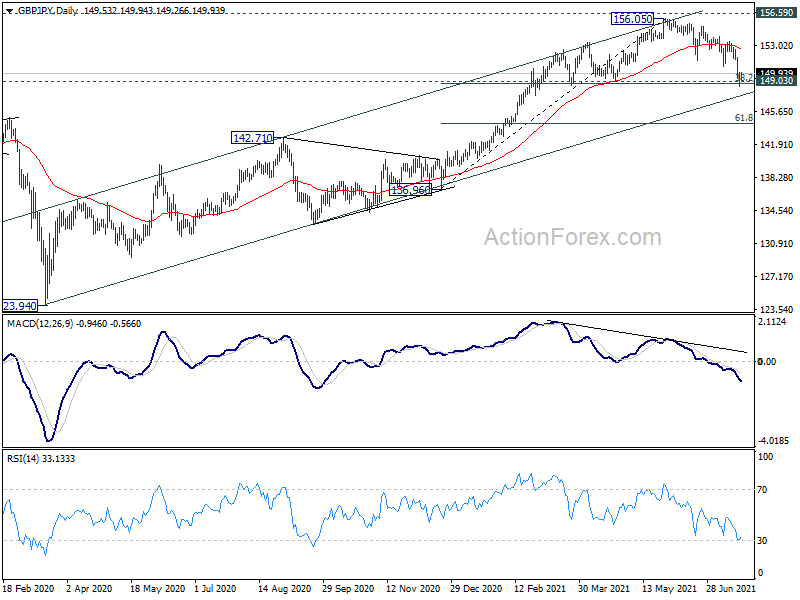
GBP/JPY Daily Outlook
Daily Pivots: (S1) 148.79; (P) 149.38; (R1) 150.31; More...
Intraday bias in GBP/JPY is turned neutral first with 4 hour MACD crossed above signal line. On the downside, sustained break of of 38.2% retracement of 136.96 to 156.05 at 148.75 will argue that it's correcting whole up trend from 123.94, and target 142.71 resistance turned support next. On the upside, though, break of 151.28 support turned resistance will suggest that correction form 156.05 has completed after defending 148.75. Stronger rise should then be seen back to retest 156.05 high.
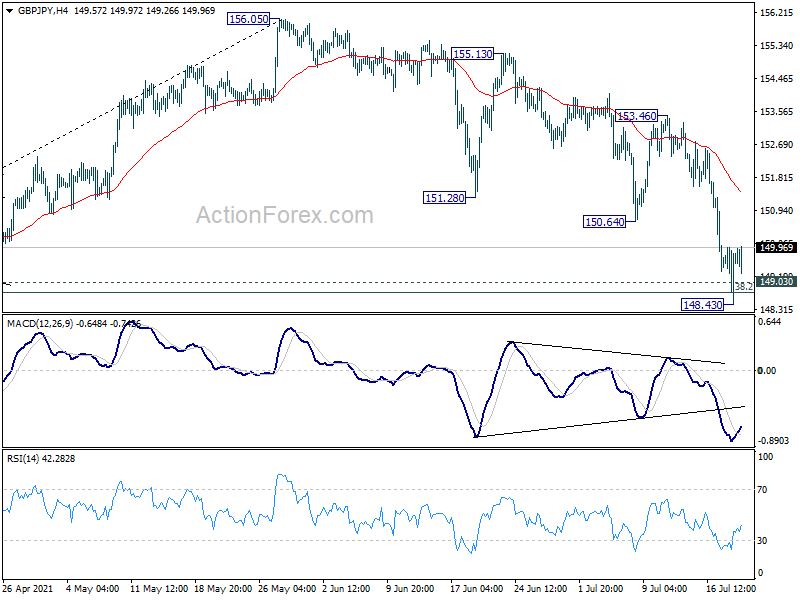
In the bigger picture, rise from 123.94 is seen as the third leg of the pattern from 122.75 (2016 low). Focus remains on 156.59 resistance (2018 high). Sustained break there should confirm long term bullish trend reversal. Next target is 61.8% retracement of 195.86 (2015 high) to 122.75 at 167.93. On the downside, sustained break of 149.03 support, however, will argue that rise from 123.94 has completed. Further break of 142.71 would open up the bearish case for retesting 122.75 low.