

Sample Category Title
Market Morning Briefing: Dollar Index Did Rise To 93.03 But Has Fallen From There Back To Levels Below 93
STOCKS
Sharp fall in equities across the globe. Equities are now under pressure as the increasing concerns of the delta variant Covid-19 spread and a slowdown on the back of it is weighing high on the sentiment. There is room for further fall from here. However, crucial supports are there for the indices which have to be broken to become bearish from a long-term perspective. Dow has tumbled below 34500 and has room to test the crucial support level of 33000. DAX has important support at 15000 which has to hold to avoid a much deeper fall. Similarly Nikkei has immediate support in the 27200-27000 region which will need a close watch to see if that is holding well and producing a strong bounce. Shanghai is retaining its 3500-3625 range for now. Sensex and Nifty can fall on the back of the sell-off in other markets. But strong support are there at 52000-51000 (Sensex) and 15600-15500 (Nifty) while above which the broader view remains still bullish.
Dow (33962.04, −725.81, -2.09%) has tumbled below the support at 34400. As mentioned yesterday this break can now pave way to test 33500 on the downside and even 33000 in the coming days. For now 33000-35100 is still the consolidation range within the overall uptrend. But, incase of a break below 33000, we may have to allow for a much deeper fall to 32000 before the resumption of the uptrend is seen.
DAX (15133.20, −407.11, -2.62%) has broken the 15300-15800 range on the downside. This has negated our view of seeing 16000-16200 on the upside immediately. 15000 is the next crucial support which if broken can drag DAX to 14800 in the coming days. Thereafter a fresh rise is possible.
Nikkei (27564.52, −88.22, -0.32%)) has declined further but has immediate support in the 27200-2700 region which will need a close watch. While this support holds, a bounce to 29000 can be seen again. That will keep Nikkei inside the 27000-29500 range within the broader uptrend. But as cautioned yesterday, we may have to allow for a deeper fall to 26000 in case if Nikkei breaks below 27000 just now.
Shanghai (3520.83, −18.29, -0.52%) is managing to hold above 3500 and retain the 3500-3625 range. However, the danger of breaking below 3500 and seeing a fall to 3450-3400 is still there which will then delay the expected rise to 3700-3800. As mentioned yesterday while above 3400, the long-term trend is up.
Sensex (52553.40, −586.66, -1.10%) fell back sharply into the 52000-53000 range yesterday as expected and can test 52000 in the coming days. As mentioned yesterday, 52000 and 51000 are strong supports while above which the broader trend will continue to remain up. Only a break below 51000 will turn the view bearish.
Nifty (15752.40, −171, -1.07%) has also come back into the 15600-15900 range as mentioned yesterday. The broader trend will still remain up as long as Nifty stays above its 15600-15500 support zone. The bullish view of seeing 16000-16200 on the upside will come under threat of getting negated only on a break below 15500.
COMMODITIES
The impact of the increase in production by OPEC+ continues on crude prices as a sharp fall was seen overnight. Also adding to this is fears of surplus as the COVID19 infection coming in from the Delta variant seems to be increasing in many countries. Some countries have cut on crude imports as they see reduced demand and fear oversupply. Crude prices could continue to fall in the near term although some recovery is seen just now as the Dollar comes off a bit. Gold, Silver and Copper too see some recovery on slight weakness in the US Dollar.
Brent (69.01) can fall towards 64 before bouncing back from there. The expected fall is intact while the price remains below 70 in the near term. WTI (66.85) on the other hand can fall to test 62/60 if it sustains a fall below 68/66 in the near term. Although both prices have bounced back a bit after falling sharply overnight, we need to see if the bounce sustains.
Gold (1818.50) has bounced back well unable to break below 1800. The rise looks positive and a break above 1820 could increase momentum for a test of 1840/60 on the upside in the medium term.
Silver (25.28) is bullish while above 25. A range of 25-26.50 may hold for now.
Copper (4.2135) is trading near the lower end of the 4.20-4.40 region and if a break below 4.20 is seen, the price can be vulnerable to a fall towards 3.8. Preference is to see a bounce from current support.
FOREX
Dollar Index has recovered a bit after coming down from 93.03. While the fall sustains, Euro can head towards 1.1830/50. EURJPY can rise to 130 before declining again from the in the medium term. Aussie and Pound have bounced a bit but it is not clear if it is a reversal or short lived corrective upmove. USDJPY tested 109.06 but has bounced back well from there. It could test 109.80-110 on the upside. USDCNY may face rejection from 6.49/50. USDINR may face rejection from 75
Dollar Index (92.813) did rise to 93.03 but has fallen from there back to levels below 93. We need to watch if the current dip extends down to 92 or if it is short lived and could soon rise back to 93+ in the near term. The view is still unclear as chances of a rise past 93 still remains high.
Euro (1.1796) has bounced a bit but we need to see if it manages to rise sharply from here or continue to hover within the 1.1750-1.1850 region. Unless a sustained break above 1.1850 is seen, it may be difficult to expect a bullish move in the medium term.
EURJPY (129.25) tested 128.89 yesterday before bouncing back from there. While the bounce sustains, it can test 130 before again falling from there.
Dollar-Yen (109.55) did test 109.06 before bouncing back sharply from there. 109.0-109.50 is an immediate support which if holds could keep the pair higher and take it towards 109.85/110 in the near term before another fall is seen.
Aussie (0.7347) has bounced a bit from 0.7322 but we need to see if this can take Aussie past 0.74 or keep it lower in the near term. We cannot fully negate a possible fall again in the medium term towards 0.73.
Pound (1.3679) has fallen well and may see a short corrective dip in the near term before again extending towards 1.36. Overall trend is down.
USDCNY (6.4844) may face rejection at 6.49/50 and is likely to come down towards 6.46/44. Overall range of 6.44-6.50 may hold for now.
USDINR (74.8750) tested 74.9150 today but may hold below 75 today while Dollar has weakened a bit and Euro and Chinese Yuan may strengthen a bit against the Dollar. Any rise above 75 could turn bullish for the pair towards 75.25/50. Watch price action closely near 75 today.
INTEREST RATES
The US Treasury yields have declined sharply especially at the far-end. Increasing concerns on the economic slowdown and a sharp fall in equities are weighing on the yields. The 10Yr is at the crucial support while the 30Yr has broken the support contrary to our expectation. The 10Yr also looks vulnerable to break its supports and see a deeper fall as against our earlier view of seeing a corrective bounce from the current support itself. We will have to wait and watch. The German yields also look vulnerable for a deeper fall from here. The expected bounce from the immediate supports may not happen. The 10Yr and the 5Yr GoI may remain stuck in a narrow range for some time.
The US 2Yr (0.22%) Treasury yield remains stable while the 5Yr (0.71%), 10Yr (1.21%) and 30Yr (1.84%) have declined sharply. The 10Yr is at the crucial support level of 1.20%. A strong break below it will negate the chances of seeing a corrective bounce to 1.45%-1.5% that we have been expecting. Such a break will drag the 10Yr down to 1.1% and even 1% in the coming days. The 30Yr has already declined below the support at 1.9% contrary to our expectation. While below 1.9%, the 30Yr has room to test 1.8% and even 1.7% in the coming days.
The German 2Yr (-0.70%) and 5Yr (-0.66%), 10Yr (-0.39%) and 30Yr (0.08%) have come down further as expected and keeps our bearish view intact. The 30Yr is at a key support and a break below it can drag it to 0%. That will negate our earlier view of seeing a bounce from here. The 10Yr on the other hand has more room to test -0.45% and -0.5% on the downside in the coming days. Thereafter a fresh bounce is possible.
The 10Yr GoI (6.1918%) oscillated around 6.2% with muted trades. 6.18%-6.22% can be a near-term range. The 5Yr on the other is oscillating between 5.64%-5.7% range as expected. The bias is bearish to see a downside break of this range and test 5.6% eventually.
The Delta Hedge
The pattern in markets is growing increasingly clear and tougher to separate from covid worries. Risk went from aversion on Friday to the sharpest decline in over 9 months amid surging worries that the Delta virus variant may not be sufficiently contained by the ongoing vaccines, especially as countries look to further re-open their economies. Flows continued to bleed out of equities, seeking refuge in bonds, driving down the US 10 yr yield under 1.20% and lifted the yen above all other currencies, while gold remained stable and silver plunged. Surging geopolitical tensions between the US and China slowed the USD rally. Keep a close eye on the S&P500's 55-DMA near 4230/35.
For the past year, the trade has been to ignore covid and look towards the reopening but now that the US, UK and others are open, the price action is reversing. Perhaps that's the typical 'sell the fact' move with a strong economic recovery already priced in and risks surrounding the Fed and spending creeping in.
What's puzzling is that some of those concerns should have eased last week on a number of strong data points. One of them was Friday's US retail sales report, which showed sales up 0.6% compared to a -0.4% reading expected. Digging deeper, the reopening themes like food services and restaurants were strong, rising another 2.3%.
To be fair, everyone has been scratching their heads since Treasury yields sank in late June. What's staring right back is the virus, which is killing a record number of people in Russia, Indonesia and elsewhere.
In the Netherlands, cases were at 500 per day in late June as they reopened and have exploded to 11,000 per day, which is higher than all-but-a-few days from December. The delta variant is wreaking havoc.
We're sympathetic to arguments about lower hospitalizations and economies adapting to curbs but fear the market is turning its focus to long-term covid worries and the chance possibility it will be endemic but with ever-more dangerous variants emerging. The picture might be a new normal that is further from the old normal we're all hoping for than anticipated.
Moreover, traditional vaccines are losing traction and acceptance. Shares of Moderna have surged in the past week. Hopefully that's a signal of the wonderful potential of MRNA drugs but it can be read as a sign that only MRNA vaccines will be effective against covid and that we will need repeated booster shots.
For now, it remains early to be making judgement calls but the price action is making a more-compelling case by the day.
GBP/USD Resumes Decline, Dollar Gains Strength
Key Highlights
- GBP/USD extended its decline below the 1.3750 support zone.
- A major bearish trend line is forming with resistance near 1.3850 on the 4-hours chart.
- EUR/USD is also following a bearish path below 1.1850.
- AUD/USD and NZD/USD are slowly moving lower below 0.7400 and 0.7000 respectively.
GBP/USD Technical Analysis
The British Pound struggled to recover above the key 1.3900 resistance zone against the US Dollar. As a result, GBP/USD started a fresh decline and it even settled below 1.3800.
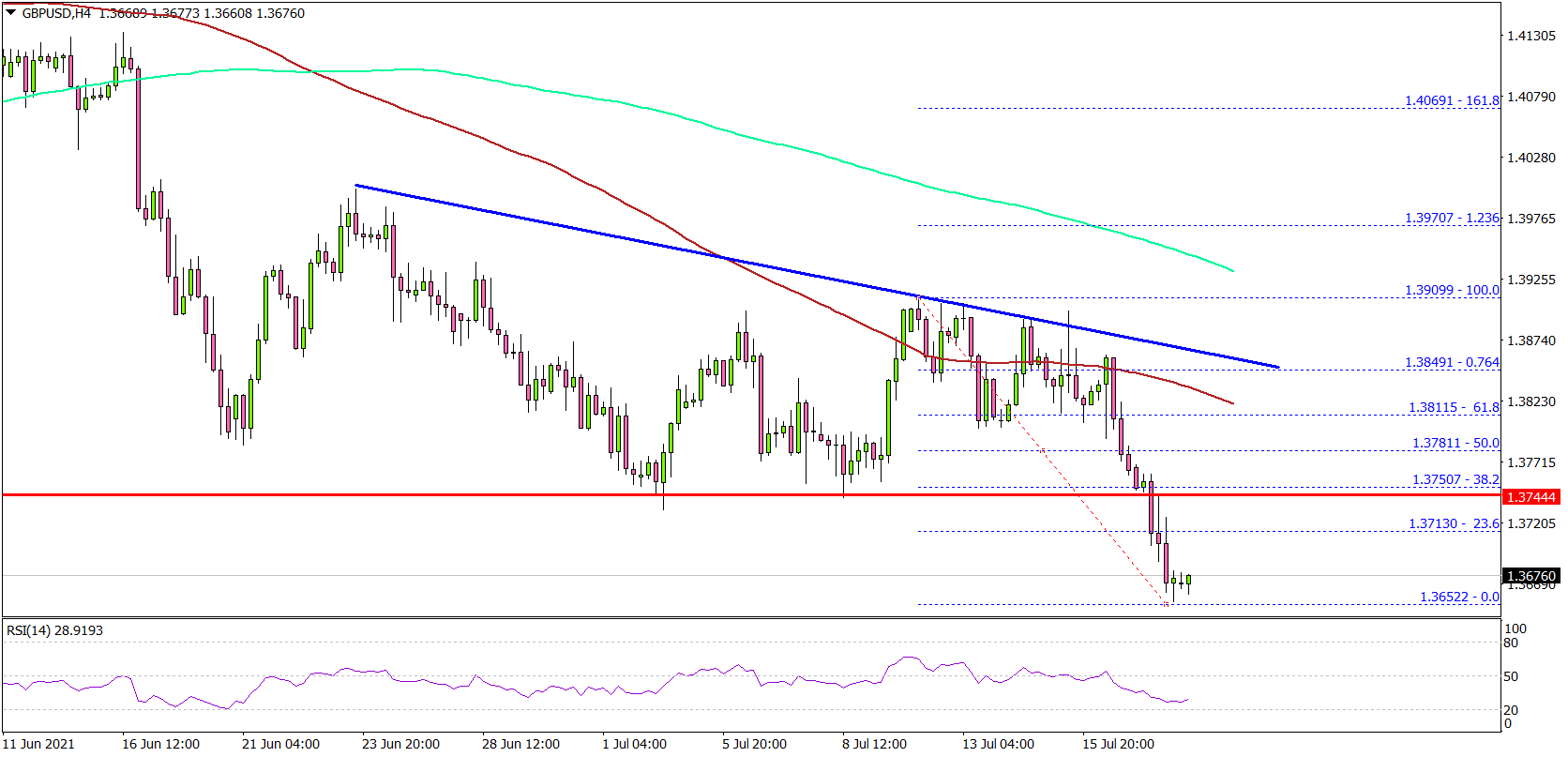
Looking at the 4-hours chart, the pair broke the 1.3750 support level. There was also a close below 1.3800, the 100 simple moving average (red, 4-hours), and the 200 simple moving average (green, 4-hours).
The pair traded below the last swing low and broke the 1.3720 support. It broke the 1.236 Fib extension level of the last key upward move from the 1.3741 swing low to 1.3909 high.
If the pair continues to move down, the pair could even trade below 1.3650. The next key support is near the 1.3620 level. On the upside, the bears are likely to remain active near 1.3820 and 1.3850.
There is also a major bearish trend line forming with resistance near 1.3850 on the same chart. A close above 1.3850 is needed to initiate a decent recovery.
Looking at EUR/USD, the pair is struggling below 1.1850 and it seems like the pair could even test the 1.1720 support zone in the near term.
Economic Releases
- US Housing Starts for June 2021 (MoM) – Forecast 1.597M, versus 1.572M previous.
- US Building Permits for June 2021 (MoM) – Forecast 1.70M, versus 1.683M previous.
EUR/JPY Daily Outlook
Daily Pivots: (S1) 128.70; (P) 129.35; (R1) 129.81; More....
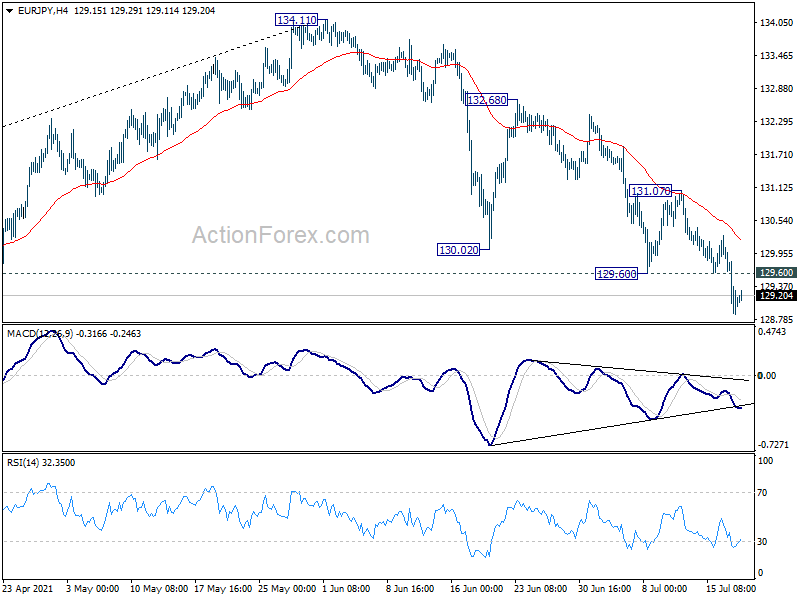
EUR/JPY's fall from 134.11 resumed by breaking through 129.60 and hit as low as 128.87 so far. Intraday bias is back on the downside for deeper fall. Sustained trading below 38.2% retracement of 121.63 to 134.11 at 129.34 will argue that it's already corrective the whole up trend from 114.42. Deeper decline would be seen back to 127.07 resistance turned support. On the upside, above 129.60 minor resistance will turn intraday bias neutral first. But risk will stay on the downside as long as 131.07 resistance holds.
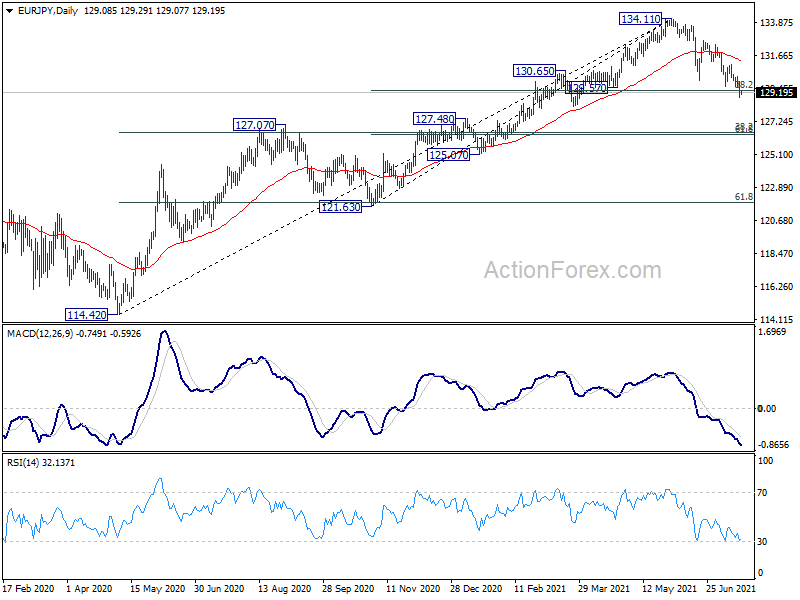
In the bigger picture, rise from 114.42 is seen as a medium term rising leg inside a long term sideway pattern. As long as 127.07 resistance turned support holds, further rise is still expected to retest 137.49 (2018 high) However, firm break of 127.07 will argue that the medium term trend has reversed, and open up the case for retesting 114.42.
Markets Stabilized after Massive Risk-Off, Yen Remains Firm
Overall market sentiments stabilized in Asia, after the massive risk-off trades in the US overnight. While Asia indexes are still down, losses are limited. Yen and Swiss franc are paring some gains but remain the overwhelmingly strongest ones. Commodity currencies are the weakest as led by Canadian Dollar. Dollar and Euro are mixed for now, stuck in between. Focuses will remain on whether concerns over delta variants of COVID-19 would spread further.
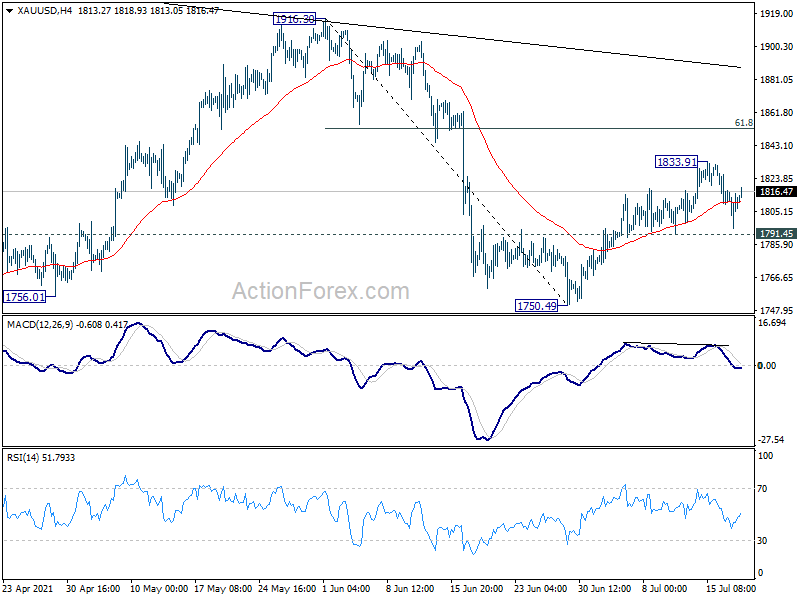
Technically, one development to note is that Gold has rebounded notably after defending 1791.45 support. Rise from 1750.49 might not be over yet and is still in slight favor to resume through 1833.91 at a later stage. That also indicates some uncertainty over Dollar's strength, which is also reflected in lack of follow through selling in EUR/USD. We'd continue to monitor developments in Gold to double confirm the next move in the greenback.
In Asia, at the time of writing, Nikkei is down -0.32%. Hong Kong HSI is down -0.39%. China Shanghai SSE is down -0.64%. Japan 10-year JGB yield is down -0.0072 at 0.011. Overnight, DOW dropped -2.09%. S&P 500 dropped -1.59%. NASDAQ dropped -1.06%. 10-year yield dropped -0.119 to 1.181.
RBA Minutes: Conditions for rate hike won't be met until 2024
In the minutes of July 5 meeting, RBA reiterated that the "central scenario implied that the conditions for an increase in the cash rate would not be met until 2024". However, "fast-than expected" recovery over the course of 2021 had "widened the range of alternative plausible scenarios for the economic outlook", and thus, "the cash rate over the period to November 2024". Hence, it decided to retain April 2024 bond as the target bond, rather than extending the horizon to November 2024 bonds.
On the decision on the size of weekly bond purchases, it noted that "the economic outcomes had been materially better than earlier expected and the outlook had improved". And, "in light of these improvements and the agreed decision-making framework, members decided to adjust the weekly purchases from $5 billion to $4 billion and agreed to review the rate of purchases at the November 2021 meeting."
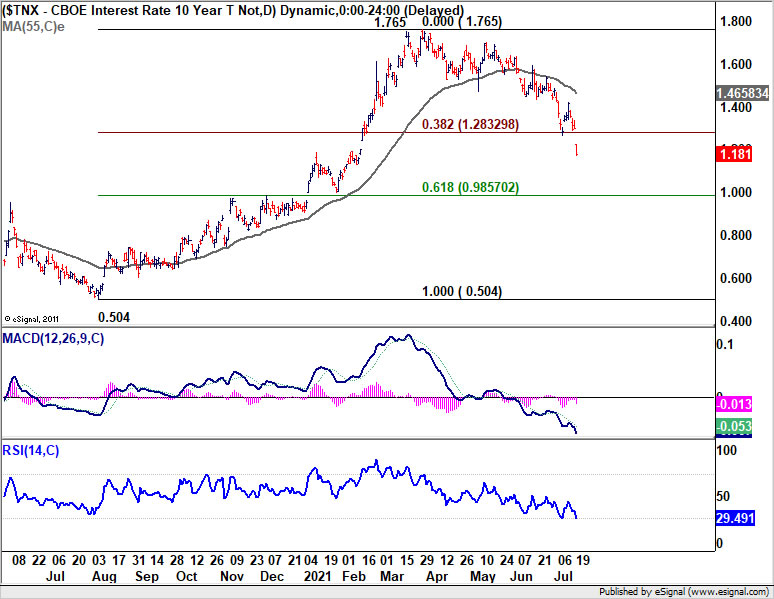
US 10-year yield dropped to 1.18 on delta variant worries
As worries over the impact of delta variant grew, US stocks and treasury yields tumbled sharply overnight. Markets appeared to be pricing out some of the more optimistic growth scenarios for the quarters ahead. Instead, investors turned cautious as restrictions could still come back, which is happening in some countries like Australia already, even though the economy is more adapted to it after more than a year of "drills".
10-year yield closed down -0.119 at 1.181, breaking 1.2 handle for the first time since February. The strong break of 38.2% retracement of 0.504 to 1.765 at 1.28 was a surprise to us, which indicates rather pessimistic developments too. The fall from 1.765 would now be targeting 61.8% retracement at 0.9857, which is close to 1% handle. We'd expect strong support from there to finish the correction, as we're just back to reality.
On the data front
Japan CPI core rose to 0.2% yoy in June, up from 0.1% yoy, matched expectation. Swiss trade balance, Germany PPI and Eurozone current account will be released in European session today. US will release housing starts and building permits.
EUR/JPY Daily Outlook
Daily Pivots: (S1) 128.70; (P) 129.35; (R1) 129.81; More....
EUR/JPY's fall from 134.11 resumed by breaking through 129.60 and hit as low as 128.87 so far. Intraday bias is back on the downside for deeper fall. Sustained trading below 38.2% retracement of 121.63 to 134.11 at 129.34 will argue that it's already corrective the whole up trend from 114.42. Deeper decline would be seen back to 127.07 resistance turned support. On the upside, above 129.60 minor resistance will turn intraday bias neutral first. But risk will stay on the downside as long as 131.07 resistance holds.
In the bigger picture, rise from 114.42 is seen as a medium term rising leg inside a long term sideway pattern. As long as 127.07 resistance turned support holds, further rise is still expected to retest 137.49 (2018 high) However, firm break of 127.07 will argue that the medium term trend has reversed, and open up the case for retesting 114.42.
Economic Indicators Update
| GMT | Ccy | Events | Actual | Forecast | Previous | Revised |
|---|---|---|---|---|---|---|
| 23:30 | JPY | National CPI Core Y/Y Jun | 0.20% | 0.20% | 0.10% | |
| 01:30 | AUD | RBA Minutes | ||||
| 06:00 | CHF | Trade Balance (CHF) Jun | 5.12B | 4.95B | ||
| 06:00 | EUR | Germany PPI M/M Jun | 1.20% | 1.50% | ||
| 06:00 | EUR | Germany PPI Y/Y Jun | 8.50% | 7.20% | ||
| 08:00 | EUR | Eurozone Current Account May | 24.3B | 22.8B | ||
| 12:30 | USD | Housing Starts Jun | 1.59M | 1.57M | ||
| 12:30 | USD | Building Permits Jun | 1.69M | 1.68M |
US 10-year yield dropped to 1.18 on delta variant worries
As worries over the impact of delta variant grew, US stocks and treasury yields tumbled sharply overnight. Markets appeared to be pricing out some of the more optimistic growth scenarios for the quarters ahead. Instead, investors turned cautious as restrictions could still come back, which is happening in some countries like Australia already, even though the economy is more adapted to it after more than a year of "drills".
10-year yield closed down -0.119 at 1.181, breaking 1.2 handle for the first time since February. The strong break of 38.2% retracement of 0.504 to 1.765 at 1.28 was a surprise to us, which indicates rather pessimistic developments too. The fall from 1.765 would now be targeting 61.8% retracement at 0.9857, which is close to 1% handle. We'd expect strong support from there to finish the correction, as we're just back to reality.
RBA Minutes: Conditions for rate hike won’t be met until 2024
In the minutes of July 5 meeting, RBA reiterated that the "central scenario implied that the conditions for an increase in the cash rate would not be met until 2024". However, "fast-than expected" recovery over the course of 2021 had "widened the range of alternative plausible scenarios for the economic outlook", and thus, "the cash rate over the period to November 2024". Hence, it decided to retain April 2024 bond as the target bond, rather than extending the horizon to November 2024 bonds.
On the decision on the size of weekly bond purchases, it noted that "the economic outcomes had been materially better than earlier expected and the outlook had improved". And, "in light of these improvements and the agreed decision-making framework, members decided to adjust the weekly purchases from $5 billion to $4 billion and agreed to review the rate of purchases at the November 2021 meeting."
(RBA) Minutes of the Monetary Policy Meeting of the Reserve Bank Board
Videoconference – 6 July 2021
Members participating
Philip Lowe (Governor and Chair), Guy Debelle (Deputy Governor), Mark Barnaba AM, Wendy Craik AM, Ian Harper AO, Carolyn Hewson AO, Steven Kennedy PSM, Carol Schwartz AO, Alison Watkins
Others participating
Luci Ellis (Assistant Governor, Economic), Christopher Kent (Assistant Governor, Financial Markets), Mark Chambers (Senior Manager, Economic Analysis Department)
Anthony Dickman (Secretary), Penelope Smith (Deputy Secretary), Alexandra Heath (Head, International Department), Bradley Jones (Head, Economic Analysis Department), Marion Kohler (Head, Domestic Markets Department)
International economic developments
Members commenced their discussion of international economic developments by noting that the global economic recovery was well under way and that risks to the outlook had become more evenly balanced. Policy settings remained highly accommodative. The rollout of vaccinations had been progressing well in many advanced economies and some large emerging market economies, although in some countries progress had been hindered by limited supplies, logistical issues and vaccine hesitancy. As vaccinations had increased and hospitalisations remained at low levels, population mobility had recovered considerably in many countries, including in the North Atlantic, where stringent restrictions that had been in place earlier in the year had been relaxed.
This relaxation of containment measures had expanded opportunities for the consumption of discretionary services, including contact-intensive activities such as dining out and domestic air travel. There had been a tentative restart to international tourism in some countries, particularly within Europe. Global goods trade and surveyed conditions in the global manufacturing sector had remained strong because of ongoing strength in the consumption of goods in advanced economies. The high level of new export orders, along with backlogs of existing orders that were still to be filled, indicated that the pipeline of work would continue to support global production and goods trade in the months ahead. Delivery times had lengthened further and global shipping costs were very high.
Members noted that, despite these positive developments, the global economic recovery remained uneven. Ongoing outbreaks of the virus, including of more transmissible variants, had hampered the recovery in many economies. A significant resurgence in cases in Asia over preceding months was contributing to ongoing complications in global supply chains.
Consistent with the global supply chain pressures and higher commodity prices, upstream producer prices had continued to increase in many countries. This was more apparent for goods than services, although producer prices were generally increasing at a faster pace than downstream consumer prices. Headline consumer price inflation had increased in advanced economies, although price pressures were generally narrowly concentrated and expected to be transitory; they were also less evident in most measures of underlying inflation. Medium-term inflation expectations had increased in many advanced economies, but only to rates consistent with, or a little below, central banks' targets.
Labour markets had continued to recover in the major advanced economies and leading indicators of labour demand, such as job ads and employment intentions, remained strong. However, employment and hours worked generally remained below pre-pandemic levels, in contrast to the position in Australia. Labour force participation rates were also still lower than before the pandemic in most advanced economies. Health concerns, ongoing school closures and considerable household income support had contributed to this. In countries where the recovery in labour supply had lagged behind labour demand, pockets of wage pressures had emerged. The prospect of a quick return to tight labour market conditions was most salient for the United States, where substantial fiscal stimulus continued to support demand.
Australia's terms of trade were expected to have reached near record levels in the June quarter, led by high iron ore prices and a sharp rebound in the price of coal. Strong underlying demand from China and steel producers in other countries had continued to underpin high iron ore prices, although prices had been volatile of late in response to intermittent supply concerns and efforts of Chinese authorities to contain prices by dampening speculation. The decline in Chinese imports of Australian coal had been largely offset by a pick-up in demand from elsewhere, and thermal coal prices had surged in recent weeks to their highest level in 10 years, as a warmer-than-expected summer had increased energy demand in parts of Asia.
Domestic economic developments
Turning to domestic economic developments, members noted that the Australian economy was transitioning from recovery to expansion. GDP had increased by a stronger-than-expected 1.8 per cent in the March quarter to be almost 1 per cent above its pre-pandemic level. The solid momentum in growth had continued into the early part of the June quarter. Recent COVID-19 outbreaks in many parts of the country, and associated restrictions, were considered likely to weigh on household consumption through the middle of the year. However, as observed following earlier lockdowns, spending was expected to rebound when containment measures were eased, supported by highly accommodative policy settings, the strengthened balance sheets of many households and firms, and an increase in the pace of vaccinations.
Household consumption had increased by a little over 1 per cent in the March quarter, supported by growth in labour and financial income, and the household saving ratio remained around 12 per cent. Consumption growth in the June quarter as a whole was expected to have moderated, as restrictions on activity in Melbourne and the Greater Sydney region restrained spending. Looking forward, households had scope to increase spending further as restrictions were eased.
Members noted that private investment had been stronger than expected in the March quarter, and that the outlook was positive. Business investment had responded to policy measures, including the temporary full expensing of asset purchases. The outlook for investment was supported by the recovery in demand and high capacity utilisation, the increase in corporate profits over the preceding year and accommodative financing conditions. Surveyed measures of business conditions were also very strong. The near-term outlook for dwelling investment was underpinned by low interest rates and the large pipeline of construction work facilitated by the HomeBuilder program and state-based fiscal programs.
Members discussed the continuing strength in established housing markets. Nationally, housing prices had increased by more than 10 per cent in the first half of the year; a similar pace of growth had been recorded in other advanced economies. Conditions were strong in both capital cities and regional areas, and across different price segments. Over the first half of the year, there had been increases in prices of units alongside further rises in prices of houses. Demand over the preceding year had been led by owner-occupiers, although investors had become more active in recent months. As had been the case for some time, the flow of new listings for sale remained similar to pre-pandemic levels but total listings were much lower, implying that dwellings were being sold at a rapid pace. Rental markets had also tightened noticeably in most parts of the country compared with a year earlier; rents for units in Melbourne had been the main exception, though even there the pace of decline in rents had eased over prior months.
Turning to the labour market, members noted that the unemployment rate had declined further and faster than expected earlier in the year, to pre-pandemic levels. Job vacancies had increased significantly and had reached multi-decade highs as a share of the labour force. Some industries where temporary visa holders had accounted for a sizeable share of employment in prior years, such as hospitality, had high levels of vacancies while employment remained below pre-pandemic levels. This suggested that the closure of Australia's international borders was contributing to the difficulties faced by some firms in attracting workers at prevailing wages. However, new advertised positions were still being filled at a pace consistent with pre-pandemic patterns.
Members held a detailed discussion of the drivers of wages growth over the preceding decade and the factors likely to affect wage outcomes in the period ahead. With indicators of future labour demand remaining strong and the participation rate around record high levels, it was likely that spare capacity in the labour market would continue to decline in subsequent quarters. Consistent with this, members noted that there were some signs of wages growth picking up from the historically low levels recorded following the onset of the pandemic. In many cases, this reflected a recovery to the 2–2½ per cent average annual growth rate seen before the pandemic, rather than a shift to a materially faster pace. Information from the Bank's liaison program suggested that firms were not expecting to make up for the period of wage freezes earlier in the pandemic. Further, the outlook for public sector wages, and rates of wages growth featuring in new enterprise bargaining agreements, suggested aggregate wage outcomes were unlikely to increase materially beyond pre-pandemic rates in coming quarters. Nevertheless, there were ongoing reports of firms using bonuses and other non-wage incentives to attract and retain labour, within a general environment of subdued wages growth.
Members discussed the evidence that wages growth was stronger in local labour markets with an unemployment rate below 5 per cent. They also discussed the timing of the reopening of Australia's international borders and its implications for labour supply. The decline in the number of temporary visa holders in Australia over the preceding year was consistent with reports of tightening labour market conditions in some sectors and regions.
In considering developments in labour supply, members also noted that labour force participation had increased over recent years and that a further increase was likely. This would contribute to available labour supply and supplement the additional hours sought by underemployed workers. Members therefore agreed that, ultimately, a tighter labour market would be required to overcome the inertia in wage- and price-setting norms and the focus on cost control established over much of the prior decade in Australia. Although there were plausible alternative paths for the economy in the period ahead, the central scenario remained one where wages growth and underlying inflation were expected to increase only gradually over the subsequent 2 years.
Members concluded their discussion of the domestic economy by focusing on longer-term developments relating to productivity covered in the recently published 2021 Intergenerational Report. Compared with the 1990s, productivity growth in Australia and other advanced economies had slowed, reflecting a complex interplay of demographic trends, technological change, regulatory developments and other structural shifts. Business dynamism, including the pace of new innovations and their adoption throughout the economy, would be central to lifting Australian living standards over time.
International financial markets
Members commenced their discussion of developments in international financial markets by noting that markets had interpreted the communications from the US Federal Reserve in June as being less dovish than expected. In particular, participants in the Federal Open Market Committee (FOMC) meeting had revised upwards their projections for economic growth and inflation in the near term, and in some cases had brought forward their expected timing of the first increase in the federal funds rate. This led to increases in US policy-rate expectations and shorter-term government bond yields. Longer-term US government bond yields had been volatile in response to the FOMC meeting and had declined over the preceding month, reflecting a decline in longer-term inflation expectations.
Similar moves in sovereign yields had occurred across a number of advanced economies, including Australia. Even so, across advanced economies, central banks had continued to emphasise that near-term inflation pressures were likely to be temporary and that they remained committed to providing significant monetary policy support until there was evidence of sustained progress towards their inflation and employment goals. Most central banks had maintained the pace of their government bond purchases over the preceding month, although some had indicated that a slowing in the pace of purchases was likely in the period ahead. Members observed that central bank holdings of government bonds, including in Australia, were expected to continue to increase as a share of the total stock outstanding for some time. Equity markets had remained around their recent record highs in most major markets, and conditions in corporate bond markets remained highly accommodative. Overall, financial conditions remained very accommodative.
There had been a broad-based appreciation of the US dollar following the FOMC meeting, to be slightly above its level at the start of the year against other major currencies. The Australian dollar correspondingly had depreciated to its lowest level against the US dollar in the current year; in trade-weighted terms, the Australian dollar had also declined to be a little below its level at the start of the year. Members noted that the depreciation had occurred despite commodity prices rising over the course of the year. In part, this had suggested that recent increases in commodity prices were not expected to persist.
Financial conditions in emerging market economies had been relatively stable in preceding months, despite the prospect of rising policy rates in advanced economies and central banks in some emerging market economies having increased policy rates in response to rising inflationary pressures domestically. Financial conditions remained accommodative in China, although credit growth had slowed, consistent with the authorities' goal of managing financial stability risks.
Domestic financial markets
In Australia, the Bank's policy measures had continued to underpin very low interest rates and support the availability of credit. There had been little reaction in financial markets to the recent COVID-19 outbreaks and new restrictions imposed in many parts of the country in late June.
Yields on Australian Government Securities (AGS) with a maturity of 3 to 5 years had risen in June, following the FOMC meeting, the strong domestic labour force release for May and a bring-forward of expectations on the part of some market economists of the first increase in the cash rate. The yield on the April 2024 Australian government bond dipped below 10 basis points for a time in early June, but had risen to be close to 10 basis points subsequently. Prior to the Board meeting, the yield on the November 2024 bond had risen sharply, implying that market participants did not expect the Board to extend the yield target to this next 3-year bond.
Yields on longer-term AGS had declined in June alongside similar moves in US Treasury yields, reflecting lower longer-term inflation expectations in both countries. Members noted that yields for longer-term AGS had been moving broadly in line with US Treasury yields for much of the year. Members also noted that spreads of yields on bonds issued by the states and territories (semis) to AGS had widened a little following the announcement of a larger-than-expected debt funding task for New South Wales, and that yields on semis had been highly correlated across the states and territories. The Bank's bond purchase program had continued to run smoothly and bond markets had continued to function well.
Bank funding costs and lending rates had drifted down to historic lows. At the closure of the draw-down window for the Term Funding Facility (TFF) at the end of June, banks had accessed $188 billion, or almost 90 per cent of the total allowances, with the major banks and mid-sized Australian banks having drawn down all of their allowances. TFF funding had accounted for around 4 per cent of all bank funding. Members noted that banks had also issued some bonds of late, but issuance remained below average.
Demand for housing finance had strengthened further in May, with stronger growth in credit to both owner-occupiers and investors. While bank lending to businesses had been little changed over preceding months, growth in broader measures of business debt had picked up to around the average of prior years. This pick-up had reflected lending to large businesses, including by entities that do not report to the Australian Prudential Regulation Authority as well as through corporate bond issuance. Lending to small businesses had also been little changed, although refinancing activity remained higher than usual as small businesses took advantage of the lower interest rates on offer.
Considerations for monetary policy
In considering the policy decision, members observed that the economic recovery in Australia had been stronger than earlier expected and that this was forecast to continue. Domestic financial conditions remained very supportive and the exchange rate had depreciated a little. Household and business balance sheets were generally in good shape. The effect of the recent virus outbreaks and the lockdowns had created additional uncertainty, but the experience to date had been that the economy bounced back quickly once outbreaks were contained and restrictions eased.
The recovery in the labour market had continued to be faster than expected and more Australians had jobs than before the pandemic. The unemployment rate had declined further. Job vacancies were high and more firms had been reporting shortages of labour.
Members observed that outcomes for the nominal side of the economy had not been as positive. Despite the strong recovery in jobs and reports of labour shortages, inflation and wage outcomes remained subdued. While a pick-up in inflation and wages growth was expected, it was likely to be only gradual and modest. Year-ended CPI inflation was expected to rise to be temporarily above the target in the June quarter owing to the reversal of some COVID-19-related price reductions in the previous year, but would subsequently decline.
In view of the environment of rising housing prices and low interest rates, members continued to emphasise the importance of monitoring trends in housing borrowing and ensuring that lending standards are maintained.
Members discussed the 3-year yield target for government bonds. They noted that, when the 3-year target was introduced in March 2020, the Board had judged that the probability of the cash rate increasing over the subsequent 3 years was extremely low. Since that time, the maturity date for the 3-year bond had been extended from April 2023 to April 2024 and would soon move to November 2024. The Bank's central scenario implied that the conditions for an increase in the cash rate would not be met until 2024. Even so, the faster-than-expected recovery in economic conditions over the course of 2021 had widened the range of alternative plausible scenarios for the economic outlook and therefore the cash rate over the period to November 2024. In view of these considerations, the Board decided to retain the April 2024 bond as the target bond, rather than extend the horizon to the bond with a maturity date of November 2024.
Members also discussed the future of the existing bond purchase program after the second $100 billion tranche of purchases is completed in early September. They noted the previously agreed framework for making decisions about bond purchases. This framework took into account the effectiveness of the bond purchases to date, the decisions of other central banks and, most importantly, progress towards the Board's goals for inflation and employment. Members agreed that the bond purchase program had lowered risk-free rates across the yield curve in Australia, and in doing so had reduced borrowing costs for households and businesses, supported asset values and contributed to a lower exchange rate than would otherwise have been the case. Through these channels, the bond purchase program had been one of the factors underpinning the accommodative conditions necessary for economic recovery from the pandemic. Given the high degree of uncertainty about the economic outlook, members agreed that there should be flexibility to increase or reduce weekly bond purchases in the future, as warranted by the state of the economy at the time, rather than a commitment to a specific rate of purchases over an extended period.
Members then discussed the appropriate pace of future bond purchases. In particular, members considered whether to continue with the current pace of $5 billion per week or reduce purchases to $4 billion per week. Both amounts were within the range of market expectations. Members noted the evidence that central bank bond purchases had their effect through the total stock of bonds purchased, not the flow of those purchases.
Members acknowledged that an argument could be made to retain the pace of bond purchases at $5 billion per week, given that economic outcomes were still well short of the Bank's goals for inflation and employment. However, the economic outcomes had been materially better than earlier expected and the outlook had improved. In light of these improvements and the agreed decision-making framework, members decided to adjust the weekly purchases from $5 billion to $4 billion and agreed to review the rate of purchases at the November 2021 meeting.
The Board remained committed to maintaining highly supportive monetary conditions for a return to full employment in Australia and inflation consistent with the 2 to 3 per cent target. It will not increase the cash rate until actual inflation is sustainably within the target range. The Bank's central scenario for the economy is that this condition will not be met before 2024. Meeting it will require the labour market to be tight enough to generate wages growth that is materially higher than it was at the time of the meeting.
The decision
The Board decided upon the following policy settings:
- retain the April 2024 bond as the bond for the yield target and retain the target of 10 basis points
- continue purchasing government bonds after the completion of the current bond purchase program in early September 2021 – these purchases will be at the rate of $4 billion per week until at least mid November 2021
- maintain the cash rate target at 10 basis points and the interest rate on Exchange Settlement balances of zero per cent.
Eco Data 7/20/21
[php_everywhere instance="1"]
Yen Jumps as Risk Appetite Slides
The Japanese yen has posted considerable gains in Monday trade. In the North American session, USD/JPY is trading at 109.50, down 0.47% on the day. Earlier in the day, the pair dropped as low as 109.05, its lowest level since May.
Yen shines as Covid fears spook markets
With the Delta Covid variant spreading ominously across the globe, investors are responding by fleeing to safety. The Japanese yen is a traditional safe-haven asset, and investors have been dumping risky assets such as the Australian dollar and snapping up yen. There are concerns that the Delta variant will have a sharp negative impact on global growth. This could accelerate the move away from risk and towards safe havens such as the yen.
In addition to the worsening Covid picture, tensions between the US and China have ratcheted higher, with telecom and cybersecurity issues being added to Hong Kong and human rights. If the rhetoric between the two giant economies gets harsher, risk appetite is likely to weaken even further.
The yen was slightly lower on Friday after the Bank of Japan revised lower its growth forecast for the current fiscal year to March. The BoJ quarterly report stated that the economy would grow 3.8%, down from the previous estimate of 4.0%. The bank attributed the downgrade to the “impact of Covid-19”. At the same time, the BoJ revised upwards its inflation forecast for the current fiscal year to March to 0.6%, up from 0.1%, due to rising energy prices.
The BoJ also announced details of a climate change fund (green fund), taking a page from the ECB and Bank of England, which have already made climate change part of their monetary policy strategy.
USD/JPY Technical
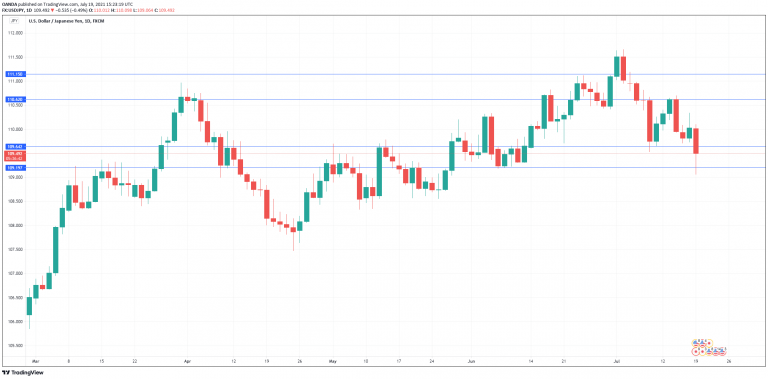
- USD/JPY faces resistance at 110.62 and 111.15
- On the downside, there is support at 109.64. Below, we find support at 109.19