Sample Category Title
Canada: Retail Sales Rise in April But Q2 Outlook Remains Murky
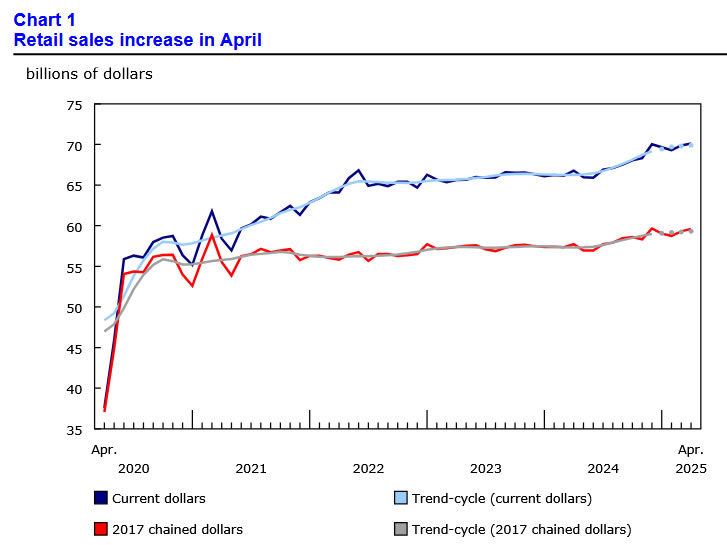
Retail sales edged up 0.3% in April month-on-month (m/m), slightly below the Statistics Canada's advanced estimate.
After adjusting for inflation, the volume of retail sales increased 0.5% m/m.
For the second straight month, strength in motor vehicles and parts sales (+1.9% m/m) was the primary driver of headline growth. Ex-autos, sales were down 0.3% m/m.
Receipts at gas stations and fuel vendors plunged by -2.7% as gas prices tumbled 18.1% as the consumer carbon tax ended.
Excluding auto sales and receipts at gas stations, core retail sales edged up by 0.1% m/m. The marginal increase was supported by strong growth at miscellaneous store retailers (+2.0% m/m). Most other categories either made minimal contributions or weighed on overall sales.
E-commerce sales rose by 3.6% m/m in April.
Statistics Canada's advanced estimate points to a 1.1% m/m contraction in May.
Key Implications
As expected, consumers continued front-load vehicle purchases in anticipation of price increases that are likely to come due to tariffs. However, core sales may be an early signal of broader consumer hesitancy in the face of trade policy headwinds. According to a supplementary by Statistics Canada survey, 36% of retail businesses reported being affected by trade tensions in April. The most commonly cited impact included price increases, change in demand, and supply chain disruptions.
The advance estimate sets a somber tone for the second quarter. In addition, our internal credit and debit card spending data shows a meaningful softening in spending through May, suggesting that consumers tightened their purse strings. As a result, we expect real personal consumption expenditures to be flat this quarter, with consumer spending likely to contract in Q3 if U.S. tariffs continues to weigh on sentiment and job prospects.
Crypto Traders Hedging Risks of Correction
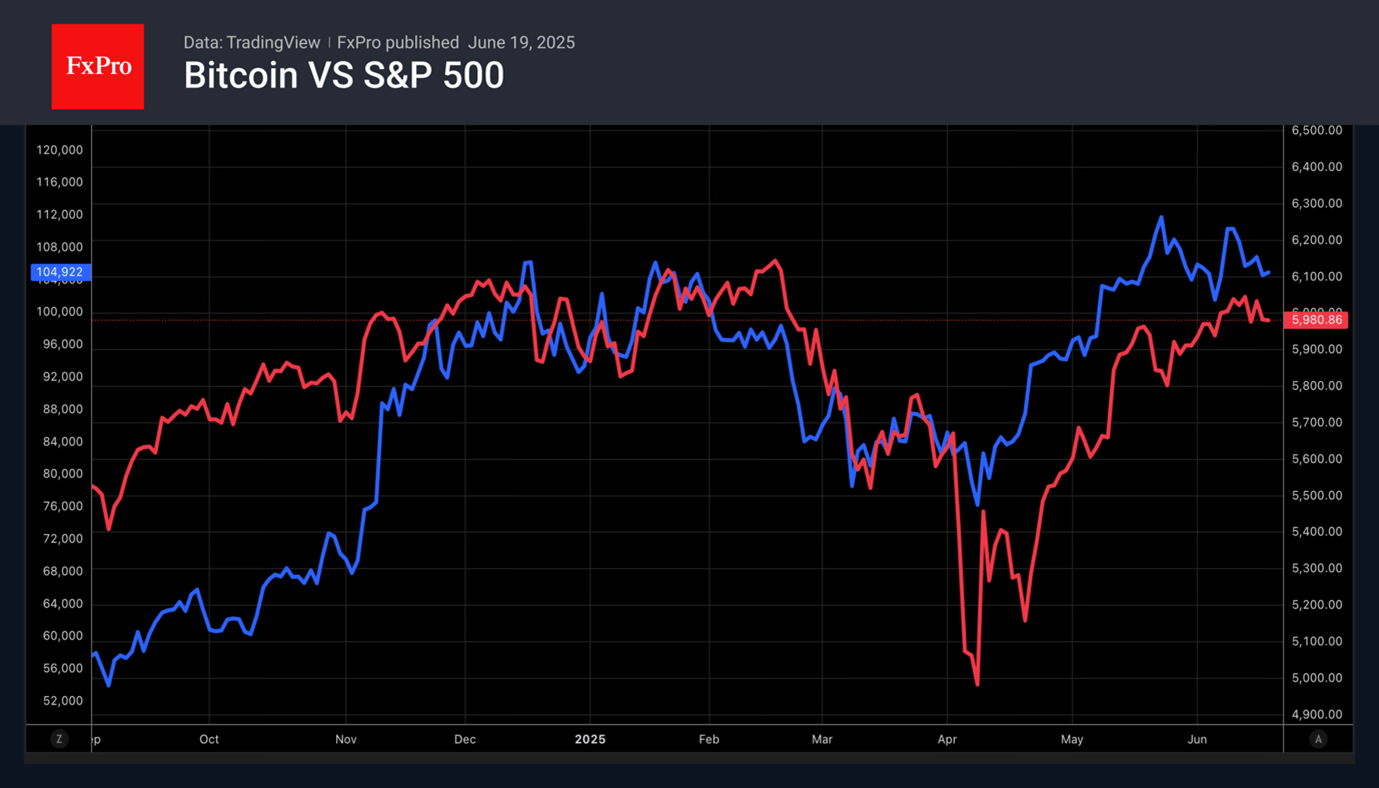
While Bitcoin is consolidating in the spot market, the futures market is signalling growing risks of a Bitcoin correction. Traders are hedging against the risk of a pullback to $100,000 and below against the backdrop of escalating geopolitical conflict. This significantly worsens global risk appetite and increases uncertainty in the Fed’s monetary policy. Jerome Powell expects a significant acceleration in inflation in the US. This is not good news for US stocks and income assets in general.
The ratio between put and call options on Bitcoin on the Deribit cryptocurrency derivatives exchange jumped to 2.17 in one day, signalling high investor demand for protection.
The news of Congress passing legislation on stablecoins failed to help Bitcoin. The United States, led by the president, is confirming its loyalty to the crypto industry. Since Donald Trump’s victory in the presidential election, Bitcoin has risen by 50%.
Its future largely depends on developments in the Middle East. Escalation in the form of other countries getting involved and Iran blocking the Strait of Hormuz could lead to a further deterioration in global risk appetite and a rollback of the upward trend in the coin.
EUR/USD Mid-Day Outlook
Daily Pivots: (S1) 1.1463; (P) 1.1481; (R1) 1.1517; More...
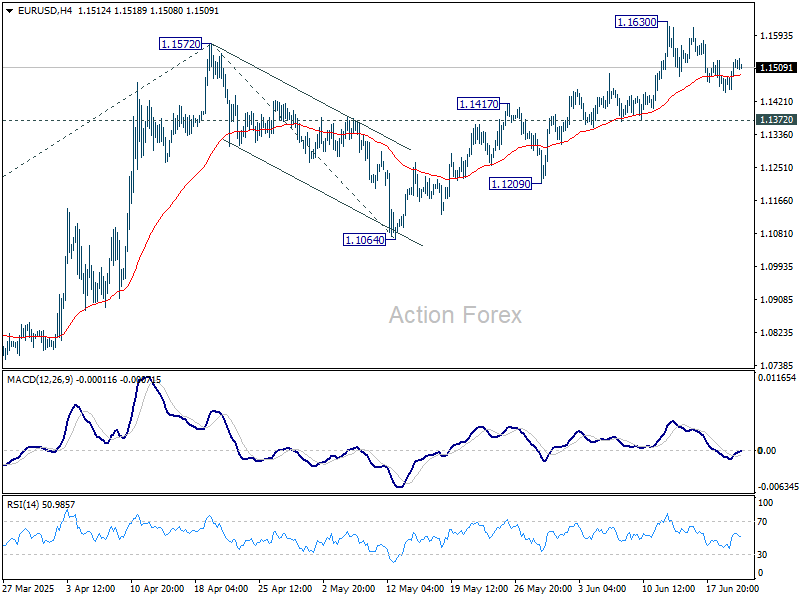
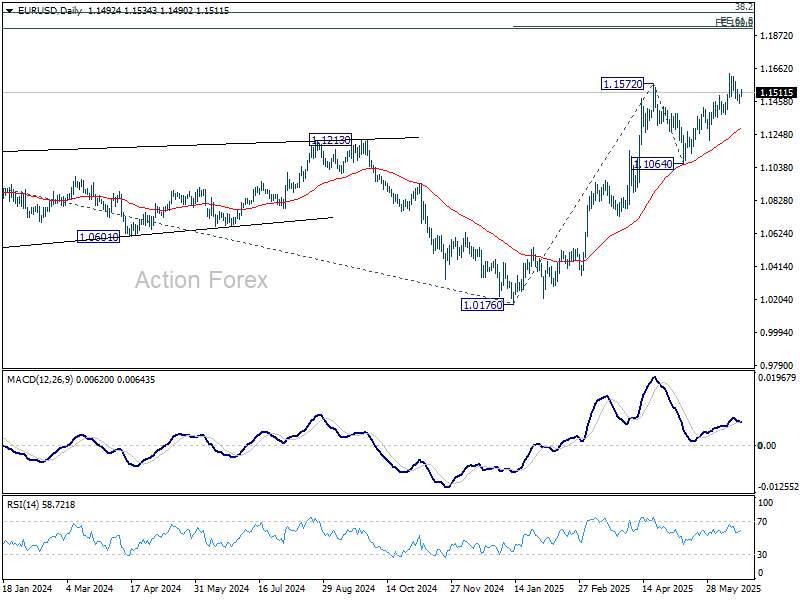
Intraday bias in EUR/USD stays neutral for the moment. Consolidations from 1.1630 could extend. With 1.1372 support intact, further rally is expected. Break of 1.1572 will extend the rise from 1.0176. Next target is 61.8% projection of 1.0176 to 1.1572 from 1.1064 at 1.1927. However, break of 1.1372 support will indicate short term topping, and turn bias to the downside for deeper pullback.
In the bigger picture, rise from 0.9534 long term bottom could be correcting the multi-decade downtrend or the start of a long term up trend. In either case, further rise should be seen to 100% projection of 0.9534 to 1.1274 from 1.0176 at 1.1916. This will now remain the favored case as long as 1.1604 support holds.
USD/CHF Mid-Day Outlook
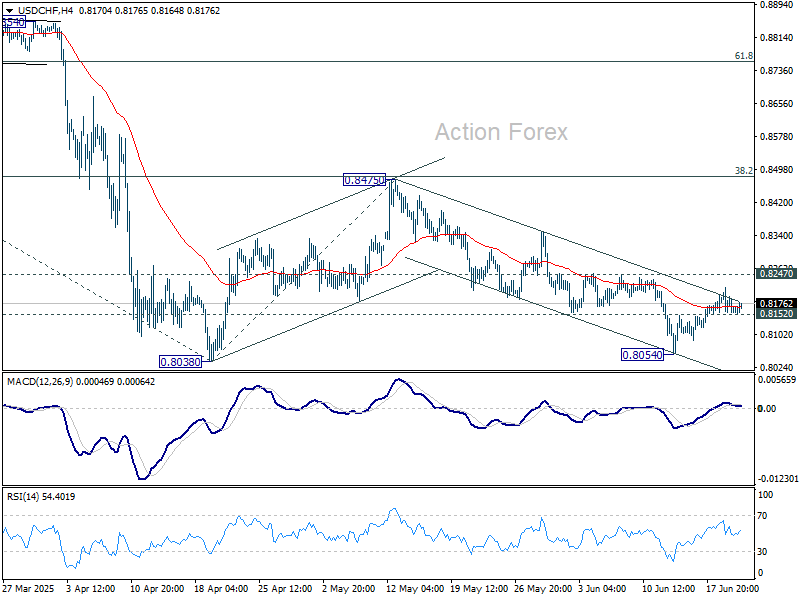
Daily Pivots: (S1) 0.8143; (P) 0.8180; (R1) 0.8203; More….
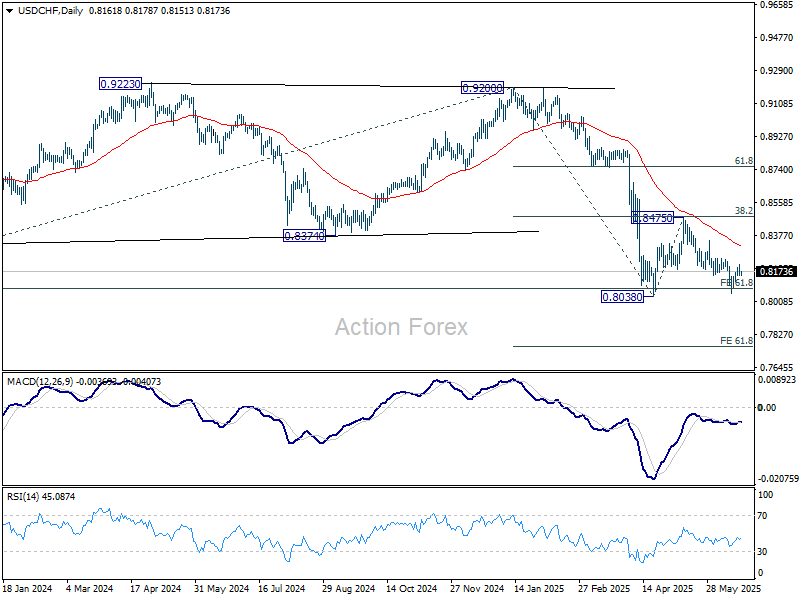
No change in USD/CHF's outlook and intraday bias stays neutral. On the downside, break of 0.8152 minor support will argue that recovery from 0.8054 has completed after failing 0.8247 resistance. Deeper fall should be see to 0.8038/54 support zone. Firm break there will resume larger down trend to 61.8% projection of 0.9200 to 0.8038 from 0.8475 at 0.7757. Nevertheless, break of 0.8247 resistance will argue that corrective pattern from 0.8038 is starting the third leg. Bias will be turned back to the upside for 0.8475 resistance again.
In the bigger picture, long term down trend from 1.0342 (2017 high) is still in progress and met 61.8% projection of 1.0146 (2022 high) to 0.8332 from 0.9200 at 0.8079 already. In any case, outlook will stay bearish as long as 55 W EMA (now at 0.8656) holds. Sustained break of 0.8079 will target 100% projection at 0.7382.
USD/JPY Mid-Day Outlook
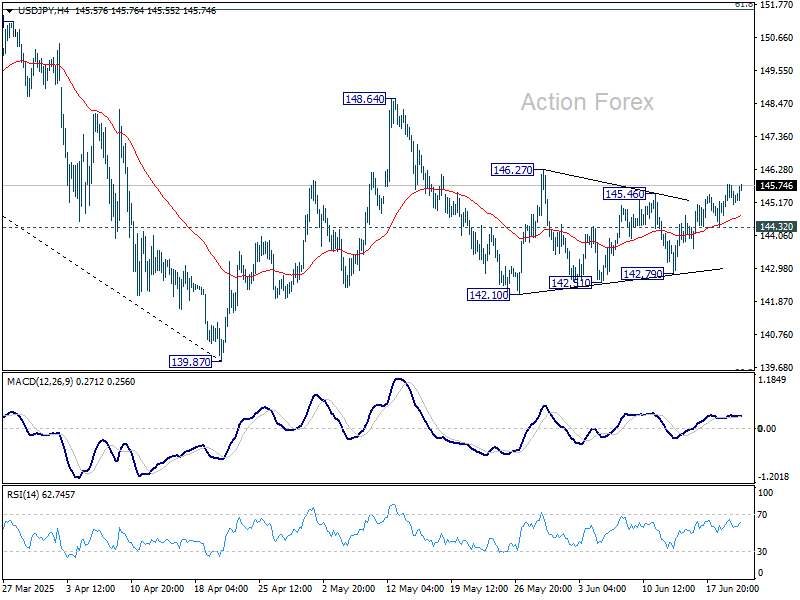
Daily Pivots: (S1) 144.88; (P) 145.32; (R1) 145.91; More...
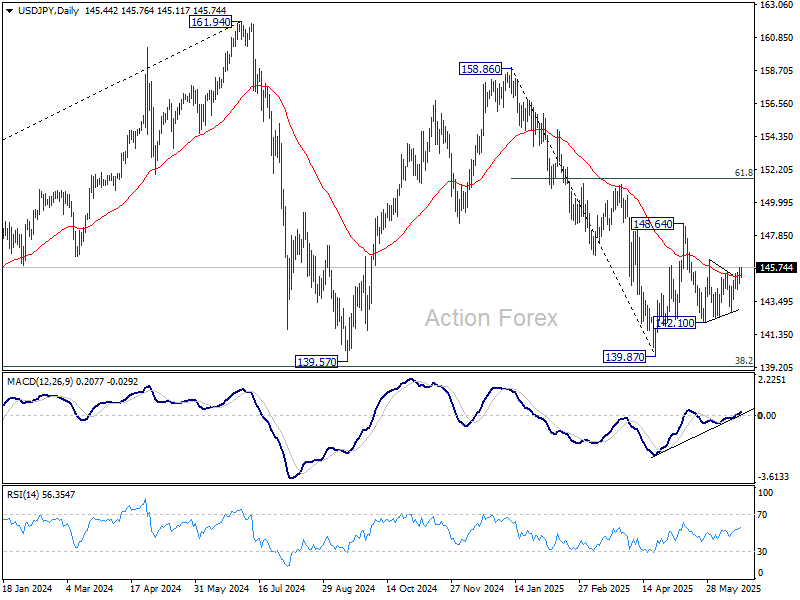
Intraday bias in USD/JPY remains mildly on the upside for 146.27. Firm break there will target 148.64 next. On the downside, below 144.32 minor support will turn intraday bias neutral again. Overall near term outlook is mixed, focus is on whether price actions from 139.87 would eventually develop into a corrective pattern, or completely reversing the decline from 158.86.
In the bigger picture, price actions from 161.94 are seen as a corrective pattern to rise from 102.58 (2021 low), with fall from 158.86 as the third leg. Strong support should be seen from 38.2% retracement of 102.58 to 161.94 at 139.26 to bring rebound. However, sustained break of 139.26 would open up deeper medium term decline to 61.8% retracement at 125.25.
GBP/USD Mid-Day Outlook
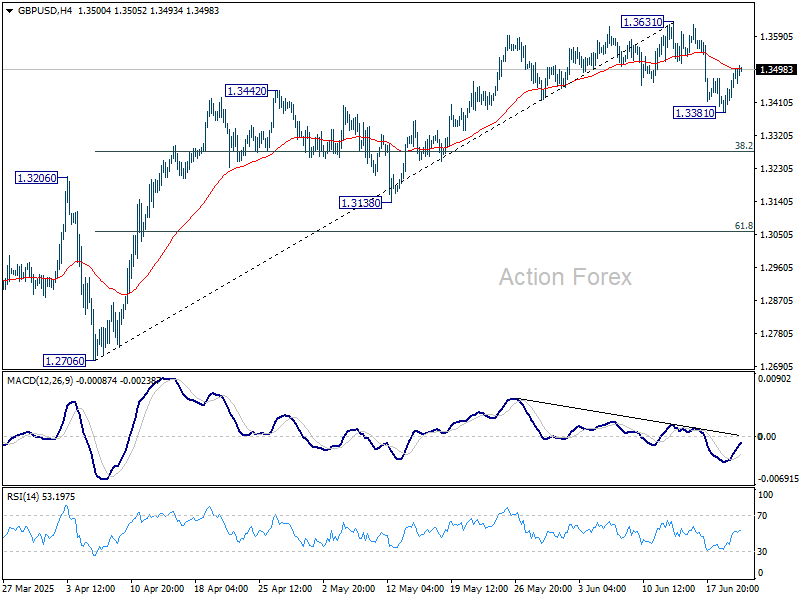
Daily Pivots: (S1) 1.3411; (P) 1.3440; (R1) 1.3498; More...
GBP/USD's recovery from 1.3381 extends today, but upside is kept well below 1.3631 resistance. Intraday bias remains neutral first. Correction from 1.3631 short term top could still extend. Break of 1.3381 will bring deeper fall to 38.2% retracement of 1.2076 to 1.3631 at 1.3278. Nevertheless, firm break of 1.3631 will resume larger up trend.
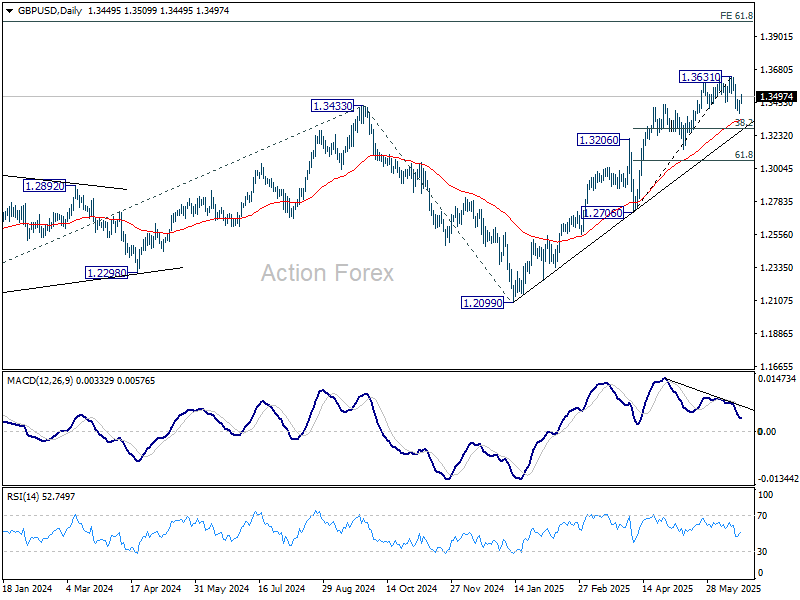
In the bigger picture, up trend from 1.3051 (2022 low) is in progress. Next medium term target is 61.8% projection of 1.0351 to 1.3433 from 1.2099 at 1.4004. Outlook will now stay bullish as long as 55 W EMA (now at 1.2937) holds, even in case of deep pullback.
Middle East Diplomacy Calms Nerves; Sterling Rises, Loonie Lags
Markets are showing tentative optimism today as signs of potential diplomatic engagement in the Middle East ease investor concerns. European foreign ministers are meeting Iran’s Abbas Araghchi in Geneva—marking the first direct discussions with Western officials since Israel’s strike on Iran last week. This also reflects the highest level of European involvement in the crisis so far, feeding hopes that tensions could de-escalate through dialogue rather than force.
Adding to the calm, the immediate threat of US military action appears to have diminished. President Donald Trump noted that he would defer his decision on whether to proceed “within the next two weeks,” citing a “substantial chance” of negotiations. That pause has helped stabilize global sentiment, at least temporarily, even as underlying geopolitical risks remain elevated.
Currency markets are reacting accordingly. Sterling is outperforming, brushing off weak retail data as risk appetite improves. Aussie and Euro are also gaining modest ground. Meanwhile, Loonie is underperforming, trailing behind Yen and Franc, both of which are also softer as safe-haven flows ease. Dollar and Kiwi are positioning in the middle.
In Europe, at the time of writing, FTSE is up 0.38%. DAX is up 1.48%. CAC is up 1.01%. UK 10-year yield is up 0.011 at 4.544. Germany 10-year yield is up 0.003 at 2.526. Earlier in Asia, Nikkei fell -0.22%. Hong Kong HSI rose 1.26%. China Shanghai SSE fell -0.07%. Singapore Strait Times fell -0.28%. Japan 10-year JGB yield fell -0.009 to 1.403.
Fed's Waller: Should consider rate cut as early as July
Fed Governor Christopher Waller signaled openness to a rate cut as early as July, citing minimal inflation risks from U.S. tariffs and mounting concerns over the labor market.
In an interview with CNBC, Waller said, “I think we’re in the position that we could do this and as early as July,” while acknowledging it’s uncertain whether the broader committee will align with that view.
Waller emphasized the risks of delaying action, warning against waiting for a clear downturn in employment. “If you’re starting to worry about the downside risk labor market move now don’t wait,” he argued.
Regarding tariffs, Waller dismissed concerns that they would create sustained inflationary pressure, reiterating that the price effects should be limited and one-off.
“Even if the tariffs come in later, the impacts are still the same,” he said, calling for the Fed to “start thinking about cutting the policy rate at the next meeting", after pausing the easing cycle for six months.
Canada's retail sales rise 0.3% mom in April, but May outlook weakens on trade tensions
Canada’s retail sales rose 0.3% mom in April to CAD 70.1B, falling short of market expectations of a 0.5% mom rise. Growth was supported by increases in six of nine subsectors, particularly in motor vehicle and parts dealers. However, sales excluding autos and fuel—rose just 0.1% mom. In volume terms, sales rose a healthier 0.5%, but the strength may not carry forward. Statistics Canada’s advance estimate for May suggests a -1.1% mom decline.
Trade tensions between Canada and the US are emerging as a key drag on the retail sector. Statistics Canada reported that 36% of retail businesses were affected in April, citing price increases, shifting demand, and supply chain disruptions. While most subsectors recorded sales growth, all nine reported some degree of negative impact.
UK retail sales plunge -2.7% mom in May, led by sharp drop in food spending
UK retail sales volumes slumped -2.7% mom in May, far worse than expectations of a -0.5% decline, marking the steepest monthly fall since December 2023.
The downturn was driven by a sharp -5.0% mom drop in food store sales, reversing April’s 4.7% mom gain and registering the largest fall in this category since May 2021. Non-food store sales also retreated, down -1.4% mom on the month, as department and household-related purchases weakened amid cautious consumer sentiment.
Despite May’s setback, retail sales volumes rose by 0.8% in the three months to May compared to the prior three-month period ending February.
BoJ's Ueda eyes future hikes on labor-driven inflation
BoJ Governor Kazuo Ueda said today that Japan’s underlying inflation could "stagnate" in the short term as economic growth slows. But he remains confident it will "accelerate thereafter".
He pointed to "intensifying labor shortages" as a source of upward pressure on medium- to long-term inflation expectations.
Ueda emphasized that BoJ stands ready to hike rates further, contingent on sustained improvements in the economy.
BoJ minutes reflect extremely high uncertainties, stresses need to judge without preconceptions
BoJ’s May policy meeting minutes reveal a board wary of “extremely high uncertainties” stemming from global trade tensions. While BoJ left its short-term interest rate unchanged at 0.5%, it sharply downgraded its growth and inflation outlooks, largely due to the expected hit on Japan’s economy from higher US tariffs.
Members reiterated that “if the outlook for economic activity and prices was realized,” further rate hikes would still be appropriate, aligning with gradual normalization. However, A key theme was the need to remain flexible and data-dependent, with many members emphasizing the importance of “carefully examining” the evolving outlook before acting.
Many members warned that it was crucial “to judge whether the outlook… would be realized, without any preconceptions.” One policymaker admitted that the probability of the forecast materializing was “not as high as before,” while another stressed that both upward and downward risks must be weighed.
The minutes also captured divergent internal views. One board member said that “while the Bank would enter a phase of pausing,” policy must remain “nimble and more flexible.” Another warned of the risk that simultaneous supply-chain disruptions and inflation spikes would leave Japan in a difficult position, especially given that “inflation expectations were not as anchored as in the United States.”
Japan's CPI core jumps to 3.7% as rice prices more than double
Japan’s core consumer inflation (ex-fresh food) accelerated from 3.5% yoy to 3.7% yoy in May, beating expectations of 3.6% yoy and marking the fastest pace since January 2023. The gain was driven by soaring rice costs, which jumped over 100% amid supply shortages. The core-core inflation measure, excluding both fresh food and energy, also quickened to 3.3% yoy from 3.0% yoy, reflecting broadening price pressures.
While the headline CPI edged down slightly from 3.6% yoy to 3.5% yoy, underlying inflation trends continue to exceed BoJ’s 2% target, where they have remained since April 2022.
Also, service prices rose 1.4% yoy in May, up from 1.3% yoy in April, with dining and travel costs gaining momentum—an important sign for BoJ, which monitors this segment closely as a proxy for wage-driven inflation.
GBP/USD Mid-Day Outlook
Daily Pivots: (S1) 1.3411; (P) 1.3440; (R1) 1.3498; More...
GBP/USD's recovery from 1.3381 extends today, but upside is kept well below 1.3631 resistance. Intraday bias remains neutral first. Correction from 1.3631 short term top could still extend. Break of 1.3381 will bring deeper fall to 38.2% retracement of 1.2076 to 1.3631 at 1.3278. Nevertheless, firm break of 1.3631 will resume larger up trend.
In the bigger picture, up trend from 1.3051 (2022 low) is in progress. Next medium term target is 61.8% projection of 1.0351 to 1.3433 from 1.2099 at 1.4004. Outlook will now stay bullish as long as 55 W EMA (now at 1.2937) holds, even in case of deep pullback.
Fed’s Waller: Should consider rate cut as early as July
Fed Governor Christopher Waller signaled openness to a rate cut as early as July, citing minimal inflation risks from US tariffs and mounting concerns over the labor market.
In an interview with CNBC, Waller said, “I think we’re in the position that we could do this and as early as July,” while acknowledging it’s uncertain whether the broader committee will align with that view.
Waller emphasized the risks of delaying action, warning against waiting for a clear downturn in employment. “If you’re starting to worry about the downside risk labor market move now don’t wait,” he argued.
Regarding tariffs, Waller dismissed concerns that they would create sustained inflationary pressure, reiterating that the price effects should be limited and one-off.
“Even if the tariffs come in later, the impacts are still the same,” he said, calling for the Fed to “start thinking about cutting the policy rate at the next meeting", after pausing the easing cycle for six months.
US Dollar Fights to Regain Safe-Haven Status
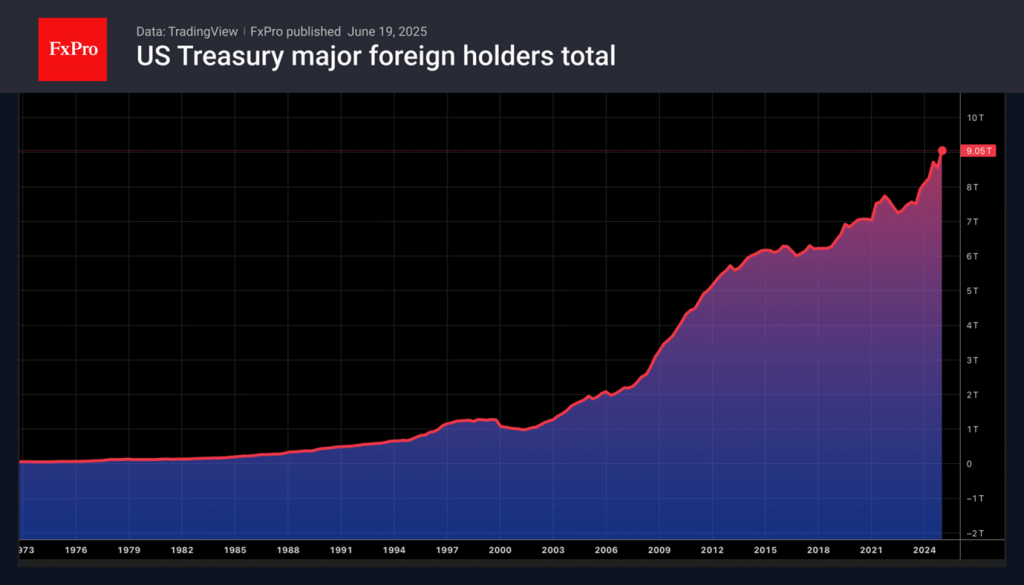
The US dollar has managed to recover, backed by the Middle East conflict. Until now, all the troubles for the global economy originated in America, from trade tariffs to the US fiscal problems that undermined confidence in the greenback and deprived it of its status as the main safe-haven currency.
However, as soon as the epicentre of turmoil shifted, everything changed. The Middle East conflict is about to make the US dollar great again. The stability of foreign investors’ holdings of Treasury bonds indicates continued interest in the American currency. While China was getting rid of Treasuries in April, Japan and Britain were buying them.
Rising oil prices are helping to shore up the USD index. As a result, the risks of inflation accelerating in the US and the chances of the Fed keeping interest rates high for a long time are increasing. Rumours are circulating on Forex that without de-escalation of the Israel-Iran conflict, the US dollar will not weaken significantly.
Canada’s retail sales rise 0.3% mom in April, but May outlook weakens on trade tensions
Canada’s retail sales rose 0.3% mom in April to CAD 70.1B, falling short of market expectations of a 0.5% mom rise. Growth was supported by increases in six of nine subsectors, particularly in motor vehicle and parts dealers. However, sales excluding autos and fuel—rose just 0.1% mom. In volume terms, sales rose a healthier 0.5%, but the strength may not carry forward. Statistics Canada’s advance estimate for May suggests a -1.1% mom decline.
Trade tensions between Canada and the US are emerging as a key drag on the retail sector. Statistics Canada reported that 36% of retail businesses were affected in April, citing price increases, shifting demand, and supply chain disruptions. While most subsectors recorded sales growth, all nine reported some degree of negative impact.