Sample Category Title
Silver (XAGUSD) Elliott Wave View: $61.02 Level Holds Key to Potential Bearish Extension
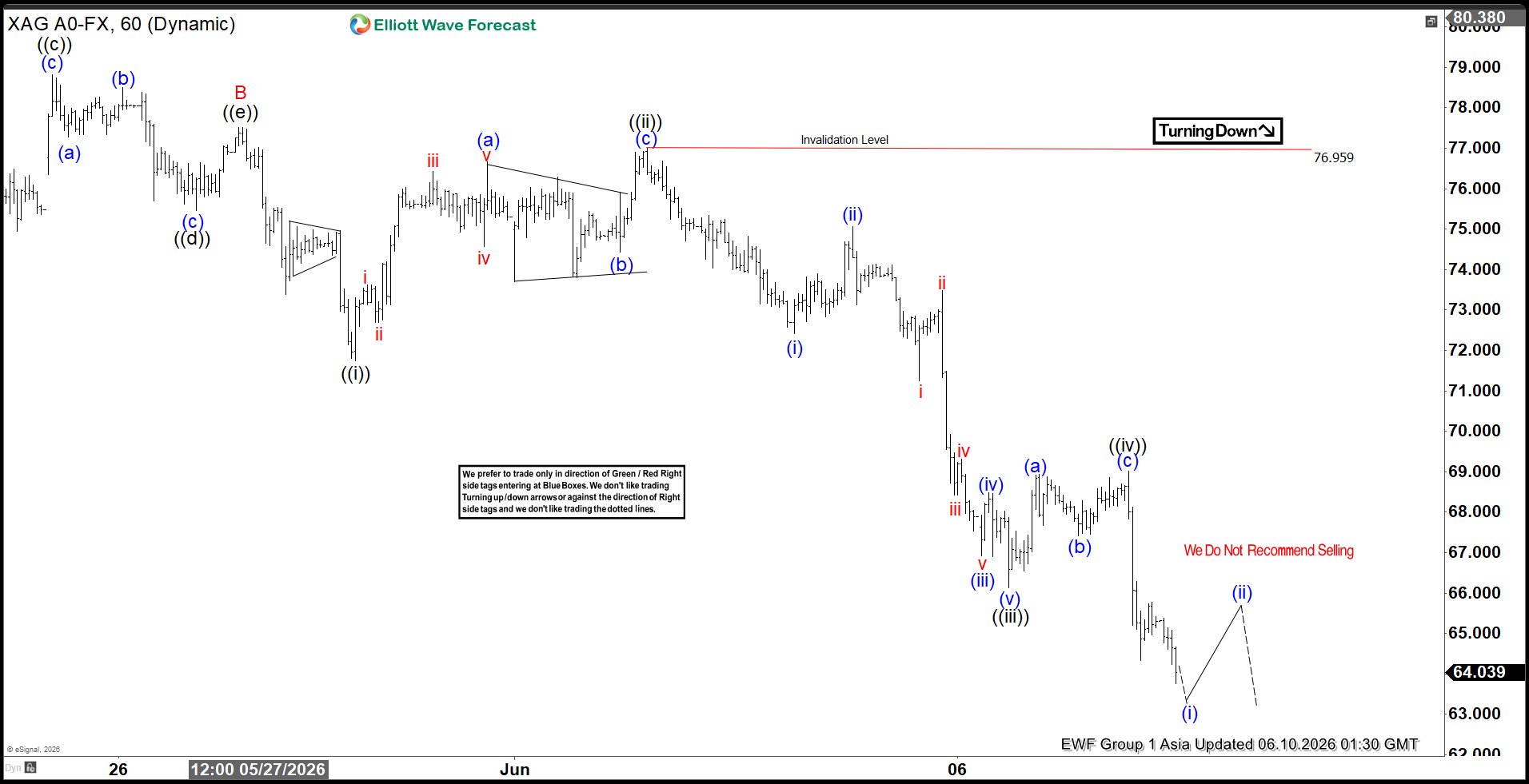
Silver (XAGUSD) is approaching a decisive test as price nears the March 23, 2026 low at $61.02. A break beneath this level could trigger a deeper decline, potentially extending toward the 100% measured move from the January 29, 2026 all‑time high. If the sequence unfolds without truncation, the projected target may reach as low as $38.70.
The decline from the March 2, 2026 high is developing as a double three corrective pattern. Wave ((W)) concluded at $61.02, while wave ((X)) terminated at $89.37. The subsequent wave ((Y)) is unfolding as another double three of lesser degree. From the peak of wave ((X)), wave A ended at $73.81, followed by a rally in wave B that reached $77.51. The market is now extending lower in wave C of (W), which is forming as a five‑wave impulse.
On the hourly chart, wave ((i)) of C ended at $71.75, while wave ((ii)) retraced higher to $77. Wave ((iii)) then drove price down to $66.13, and wave ((iv)) is proposed complete at $69.02. Near term, while price remains below $76.96, rallies are expected to fail in either three or seven swings. This structure suggests that silver retains considerable downside risk, with corrective rallies offering limited relief before the metal resumes lower.
Spot Silver (XAGUSD) 60-Minute Elliott Wave Chart
XAGUSD Elliott Wave Video:
https://www.youtube.com/watch?v=x6QIrOp6aBk
Asia Open: Tech Rout and Geopolitical Volatility Ignite Risk-Off
Key takeaways
- Technology stocks remain under pressure as the AI trade undergoes a valuation reset. Semiconductor shares led another volatile session, with investors rotating capital away from existing tech winners amid concerns over stretched valuations and a growing pipeline of mega-sized IPOs, including SpaceX and OpenAI.
- Geopolitical uncertainty continues to drive market sentiment. Renewed US-Iran tensions following President Trump’s comments reinforced concerns over energy security and global supply chains, keeping investors highly sensitive to geopolitical headlines.
- Central banks are increasingly focused on financial stability and currency defence. Bank Indonesia’s surprise rate hike and reports of a potential Bank of Japan taper pause highlight policymakers’ growing willingness to intervene amid mounting pressure on currencies and sovereign bond markets.
- Chart of the day: Gold (XAU/USD) looking to extend further potential losses below $4,100 with key short-term resistance at $4,268/285.
Chart of the day - Gold (XAU/USD) eyeing a bearish breakdown below $4,100
Fig. 1: Gold (XAU/USD) minor trend as of 10 Jun 2026 (Source: TradingView). The information presented is historical information, and past performance is not indicative of future performance.
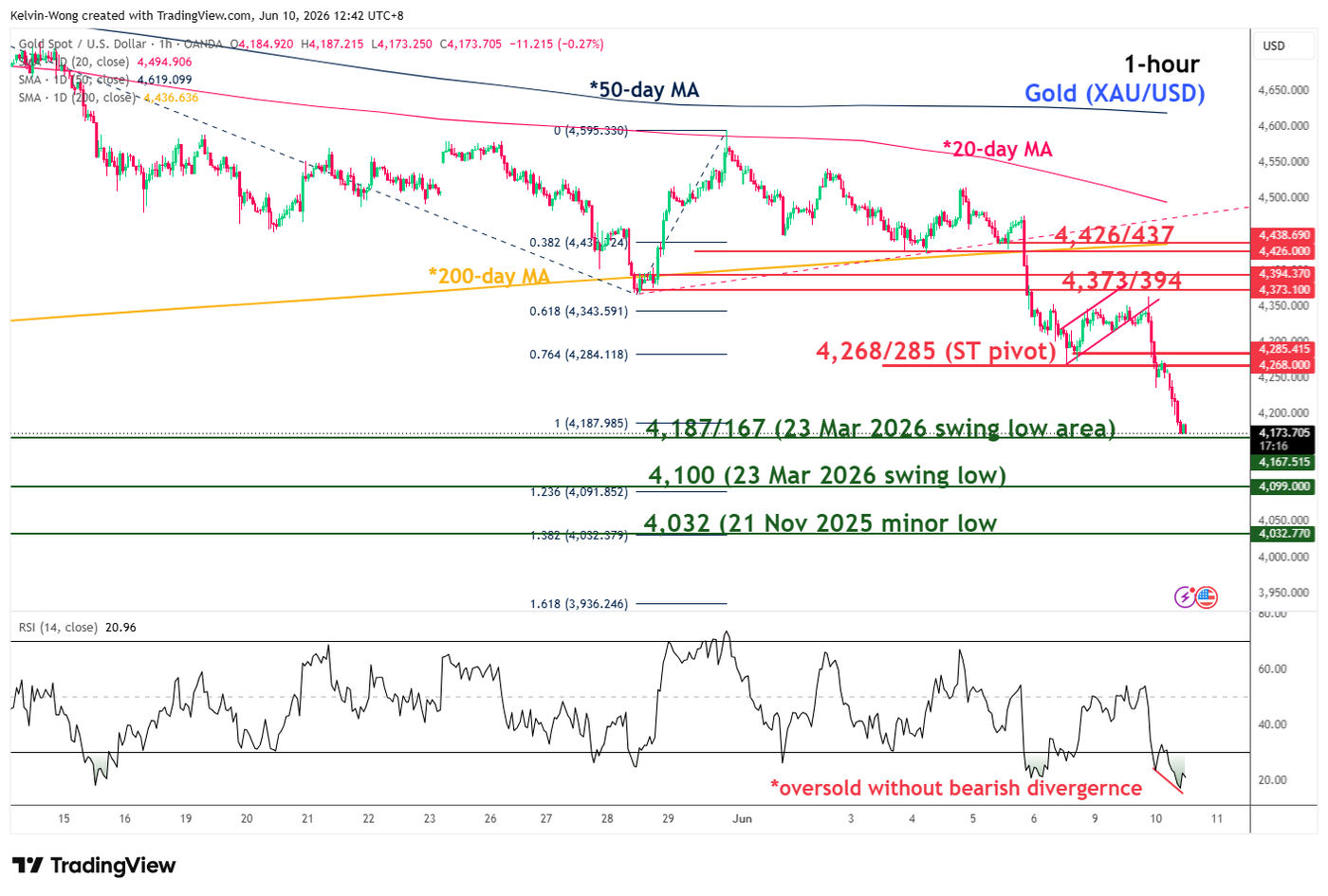
Gold (XAU/USD) has extended its losses by 2% in today’s Asia session to trade at an intraday level of $4,174, just a whisker away from the 23 March 2026 medium-term swing low of $4,100. Given that the price action of gold (XAU/USD) is firmly entrenched below the 20-day, 50-day, and 200-day moving averages, its medium-term downtrend from the 29 January 2026 all-time high remains intact (see Fig. 1).
Watch the $4,268/285 key short-term pivotal resistance to hold, as it maintains the ongoing minor bearish impulsive down move sequence, exposing the next intermediate supports at $4,187/167 and $4,100. Breaking below $4,100 may see a further deceleration towards $4,032 next in the first step.
However, a clearance with an hourly close above $4,285 negates the bearish tone, opening the door for another minor corrective rebound to retest the next intermediate resistance at $4,373/394 in the first instance.
Top macro headlines
- Global tech rout intensifies as chipmakers tumble 9%: A heavy wave of selling battered technology sectors worldwide on Tuesday. The semiconductor gauge (SOX), which had initially attempted a fragile bounce, fell 9% intraday before trimming losses to 1.9% at the close on Tuesday, dragging the Nasdaq 100 down 1.1% and erasing prior efforts to scale back toward recent peaks.
- US-Iran friction spikes over helicopter strike: Hopes for a quick resolution to Middle East geopolitical conflicts faded after U.S. President Donald Trump publicly declared that the United States must actively respond to an Iranian attack on an American helicopter. The comments triggered immediate volatility across commodities and energy equities.
- Mega-cap tech IPO pipeline crowds public liquidity: Capital desks note that extreme equity volatility is being exacerbated by a massive pipeline of new tech listings. Following news that SpaceX’s landmark initial public offering is drawing extensive institutional oversubscription, OpenAI has formally filed a confidential U.S. IPO registration, aiming to chase rivals Anthropic and SpaceX toward historic multi-billion- and trillion-dollar public valuations.
- Bank of Indonesia taps emergency controls via surprise hike: In regional foreign exchange management, Bank Indonesia delivered an unannounced, surprise interest rate hike early Tuesday. The emergency monetary intervention successfully arrested a historic slide in the Indonesian Rupiah, triggering a strong short-covering bounce. The IDR extended its gains in today’s Asia session by 0.8% to trade at 17,990 per US dollar.
- Bank of Japan reportedly mulls taper pause: Fixed-income desks reacted aggressively to circulating reports that the Bank of Japan is actively considering a temporary pause or deceleration of its previously signalled bond-buying taper. The news triggered an immediate localised rally in Japanese Government Bonds (JGBs), the 10-year JGB yield dipped by 3 bps on Tuesday to close at 2.68%, still holding above its 50-day moving average at around 2.55%.
Key macro themes
- The great funding drainage and valuation recalibration: The intensifying rotation out of richly priced technology names is evolving beyond a simple narrative shift. Institutional desks are increasingly highlighting a fundamental funding dilemma across global equities. With SpaceX seeking a massive $75 billion capital raise, Anthropic progressing through its listing path, and OpenAI targeting a public valuation of up to $1 trillion, large institutional allocators are being forced to trim existing liquid technology winners to make way for these massive generational private-market entries. This liquidity drain is actively structuring a ceiling on near-term public tech momentum.
- Geopolitical spillover into supply chain assets: Global markets continue to trade within a hyper-reactive geopolitical premium structure. While temporary halts in direct Israel-Iran strikes initially gave risk assets a brief window to capture a "dip-buying" bounce early in the Asian session, the subsequent U.S. rhetoric surrounding direct Iranian operations quickly reinforced the fragile baseline of global energy networks and shipping routes. The resulting cross-asset landscape remains structurally pinned to headlines, preventing standard macroeconomic or corporate fundamentals from asserting sustained price authority.
- Central banks locked in maximum-smoothing interventions: Emerging and developed monetary authorities across the Asia-Pacific region are navigating severe ceilings on currency depreciation. The surprise interest rate action out of Jakarta and the tactical JGB policy floating from Tokyo demonstrate that regional policymakers have reached structural boundaries where the absolute defence of financial stability supersedes long-term tightening blueprints. This interventionist posture is keeping sovereign yield curves highly compressed and prone to violent intraday gaps.
Global markets impact (last 24 hours)
Equities: The S&P 500 closed down 0.3%, while the tech-concentrated Nasdaq 100 plunged 1.1% as semiconductor giants lost 1.9%. The Dow Jones Industrial Average finished slightly higher, with a meagre 0.2% gain on Tuesday, insulated by a deep institutional rotation into defensive, value-oriented blue chips. In today’s Asia session, the S&P 500 and Nasdaq 100 E-mini futures extended their losses by 0.3% and 0.4%.
Fixed Income: U.S. sovereign debt caught a mild haven bid on the back of Trump’s Middle East remarks, pushing the benchmark 10-year Treasury yield down 5 bps to 4.52%, still above its 20-day moving average at 4.52%, ahead of today’s highly watched US CPI release.
FX: The US Dollar Index finished little changed. The euro remained stable at $1.1544, while the British pound climbed 0.3% to finish at $1.3379. The Japanese yen grinded lower by 0.1% towards the prior intervention zone, closing at 160.36 per US dollar. The risk-sensitive Aussie continued its descent by 0.3% to hit a 2-month low of 0.7028 against the greenback.
Commodities: WTI crude oil slumped 2.8% to close at $88.71/bbl, paring its sharpest intraday drop late in the session amid geopolitical updates. Safe-haven liquidation hit precious metals, pushing spot gold down 1.6% to settle at $4,260/oz.
Asia Pacific impact
- Equity rebound thwarted by US tech contagion: While Asian indices like Japan's Nikkei 225 bounced 2.2% on Tuesday, overnight weakness in US technology stocks triggered a negative feedback loop into Asian bourses today. Almost a sea of red at the start of today’s Asia session; Nikkei 225 (-1.9%), KOSPI (-5.1%), Hang Seng Index (-1.1%), China A50 (-0.3%), CSI 300 (-1%), and STI (-1%), while Australia’s ASX 200 managed to buck the trend with a minor gain of 0.1%.
- Indonesian rupiah rebounds on shock rate action: The Indonesian Rupiah emerged as a top regional outperformer, rallying sharply against the U.S. dollar after Bank Indonesia executed a surprise, emergency rate hike to defend its capital account against persistent capital flight and ongoing emerging market macro pressures.
- JGBs catch a wave of re-buying capital: Japanese Government Bonds rallied aggressively, driving domestic yields lower following formal reports indicating that the Bank of Japan is actively leaning toward a pause in its sovereign bond-purchase tapering program to stave off broader debt network illiquidity.
Top 5 events to watch today
- US Core Inflation Rate (May) - 8:30 pm SGT (consensus: 2.9% y/y Apr: 2.8% y/y) Impact: All asset classes
- BoC Interest Rate Decision - 9:45 pm SGT (consensus: 2.25%/unchanged) Impact: USD/CAD, CAD crosses
- EIA Weekly Crude Oil Inventories Report -10.30 pm SGT Impact: WTI and Brent crude
- SpaceX Pre-IPO Bookbuilding Adjustments Impact: US stock indices
- US-Iran developments over peace deal negotiations Impact: All asset classes
Gold Approaches Make-or-Break $4,000 Zone as US-Iran Tensions Escalate
Gold's selloff accelerated again as fresh headlines from the Middle East suggest the US and Iran are moving further away from a peace deal rather than closer to one. With the Strait of Hormuz still constrained and energy markets facing prolonged disruption, investors continue to focus on the inflation fallout. Persistent fears of higher-for-longer interest rates have pushed Gold toward the critical $4,000 support zone. It is now make-or-break time for the metal.
The United States launched targeted airstrikes against Iran after the downing of a US Army Apache helicopter over the Strait of Hormuz, marking a significant escalation in the conflict and further reducing the likelihood of a near-term US-Iran agreement. Yet oil prices have remained surprisingly contained, with Brent holding around the $92-$93 area rather than surging back toward $100. Oil, markets appear to be treating the situation as an extension of an existing "status quo" rather than the start of a new crisis.
What investors have not accepted is the inflation fallout. Every additional week of disruption keeps energy prices elevated and reinforces expectations that central banks will need to maintain restrictive policy settings for longer. That is the force driving Gold lower. The market focused on what the conflict means for inflation, interest rates and yields.
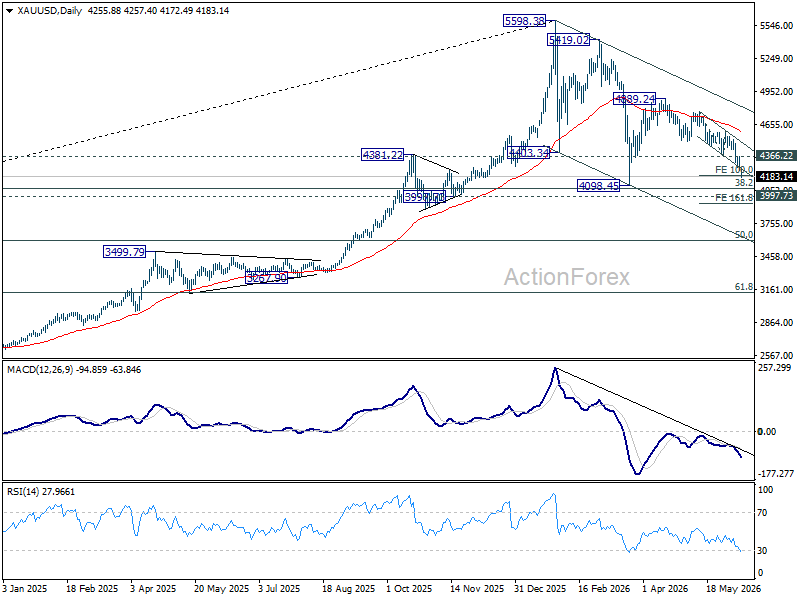
The technical damage has been substantial. Gold has already reached 100% projection of 4,773.50 to 4,366.22 from 4,595.14 at 4,187.86 on downward acceleration. With 4,366.22 now firmly acting as resistance, sellers remain in control and the next downside target stands at 161.8% projection at 3,936.16 . Momentum suggests that a test of the key $4,000 area is no longer a question of if, but when.
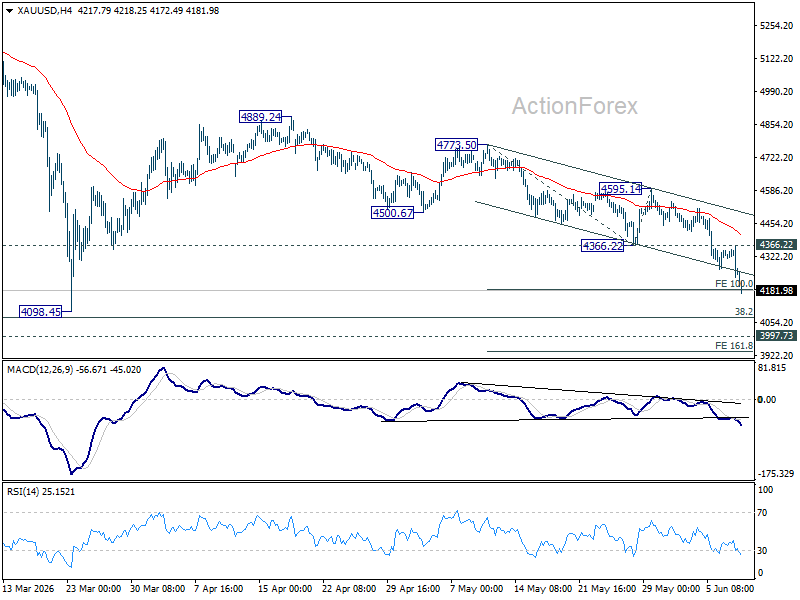
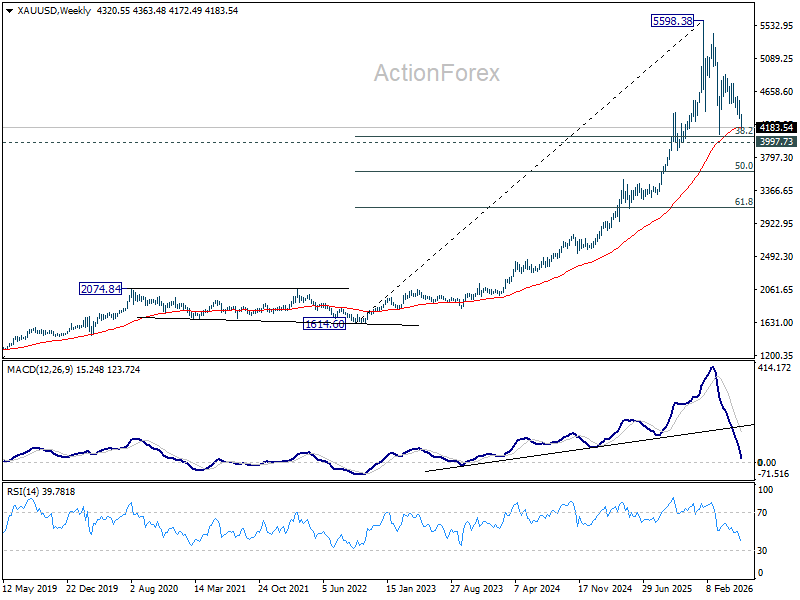
That is where the story becomes interesting. The area around $4,000 is not just another psychological level. It is one of the most heavily reinforced support zones on the chart. The March low sits at 4,098.45. There is 38.2% retracement of 1,614.60 (2022 low) to 5,598.38 at 4,076.57. Structural support comes in at 3,997.73. Together, they form a cluster that is likely to attract intense attention from both buyers and sellers.
The critical question is whether the current macro environment is strong enough to force a sustained break lower. While markets are increasingly pricing tightening from ECB and potentially Fed, the broader economy is showing signs of slowing. This is not a replay of 2022 when central banks were forced into an aggressive inflation-fighting campaign. It is a stagflationary environment where policymakers have limited room to keep raising rates before growth begins to buckle.
Unless the global economy is heading into a much more aggressive tightening cycle than currently anticipated, $4,000 should ultimately hold as the floor of this correction.
If $4,000 fails decisively, however, the narrative changes completely. The market would no longer be debating how deep the correction becomes. It would be debating whether the entire uptrend from the 2022 lows is undergoing a major reversal, with 50% retracement of 1,614.60 to 5,598.38 at 3,606.49 emerging as the next major downside objective.
China CPI unchanged at 1.2%, PPI Climbs to Highest Since 2022
China's consumer inflation remained steady in May even as producer price pressures continued to build. CPI held unchanged at 1.2% yoy, falling slightly short of expectations for a 1.3% yoy increase, while core CPI edged down from 1.2% yoy to 1.1% yoy. The data suggest that despite rising costs at the factory gate, underlying consumer demand remains relatively restrained.
A major factor holding down consumer inflation was food prices, which fell -1.7% yoy. Pork prices, a key component of China's food basket, plunged -16.1% yoy, offsetting broader inflationary pressures elsewhere in the economy. The softer core CPI reading also indicates that businesses are still facing challenges passing higher costs on to consumers, despite stronger economic activity and improving trade performance in recent months.
In contrast, producer prices accelerated sharply from 2.8% yoy to 3.9% yoy, matching expectations and reaching their highest level since July 2022. The National Bureau of Statistics attributed the increase to higher commodity prices and stronger demand in selected industries.
The energy shock linked to disruptions in global oil markets has played a major role in lifting China's factory-gate inflation, helping PPI return to positive territory in March for the first time since September 2022.
| Indicator | April | May | Forecast |
|---|---|---|---|
| CPI Y/Y | 1.2% | 1.2% | 1.3% |
| Core CPI Y/Y | 1.2% | 1.1% | |
| PPI Y/Y | 2.8% | 3.9% | 3.9% |
| PPI M/M | 1.7% | 0.5% |
Japan Producer Inflation Jumps to 6.3% as Energy Shock Drives Costs Higher
Japan's producer prices accelerated sharply in May, with PPI rising from 5.3% yoy to 6.3% yoy, well above expectations of 5.5% yoy and marking the fastest annual increase since March 2023. On a monthly basis, wholesale prices rose 0.9%, following a revised 2.8% gain in April. The data highlight how the Middle East energy shock is increasingly feeding into upstream inflation pressures across the Japanese economy.
The latest increase was driven primarily by higher prices for nonferrous metals, chemicals and petroleum products as the effective closure of the Strait of Hormuz pushed up crude oil and naphtha costs. The surge in import prices was even more striking. Japan's yen-based import price index jumped 25.5% yoy in May, accelerating from 21.0% yoy in April and recording its strongest increase since November 2022.
At the same time, strong overseas demand for AI-related semiconductors continued to provide an important offset. Export prices climbed 20.6% yoy in May, supported by robust shipments of technology products. While the surge in export earnings helps cushion the deterioration in Japan's terms of trade, the broader picture remains one of mounting inflation pressure.
| Indicator | April | May | Forecast |
|---|---|---|---|
| PPI Y/Y | 5.3% | 6.3% | 5.5% |
| PPI M/M | 2.8%* | 0.9% | N/A |
Hotter US Inflation Numbers Could Further Bolster Fed Hike Bets
- Middle East tensions keep inflation risks elevated.
- Fed hike fully priced in by year end amid strong NFP report.
- US CPI data on Wednesday (12:30 GMT) to enter the spotlight.
- Further acceleration in inflation could drive the dollar higher.
Middle East Tensions and NFP Data Bolster Fed Hike Bets
With tensions in the Middle East escalating once again over the weekend, hopes vanished that the Strait of Hormuz will reopen at some point soon, giving room to heightened inflation concerns as oil prices opened this week with a positive gap. Although it pulled back following headlines that Iran ended its military operations against Israel, the pullback was far from reflecting hope about permanent ceasefire soon. After all, Iranian officials warned that they would resume hostilities if attacks against Lebanon continue.
On Sunday, Iran fired missiles at Israeli military targets in retaliation for Israel’s attacks on Lebanon. Israel responded by attacking Iran, defying US President Trump’s call for restrain. The new hostilities came on top of a robust US jobs report on Friday, keeping inflation fears elevated and allowing investors to bring forward their Fed rate hike bets.
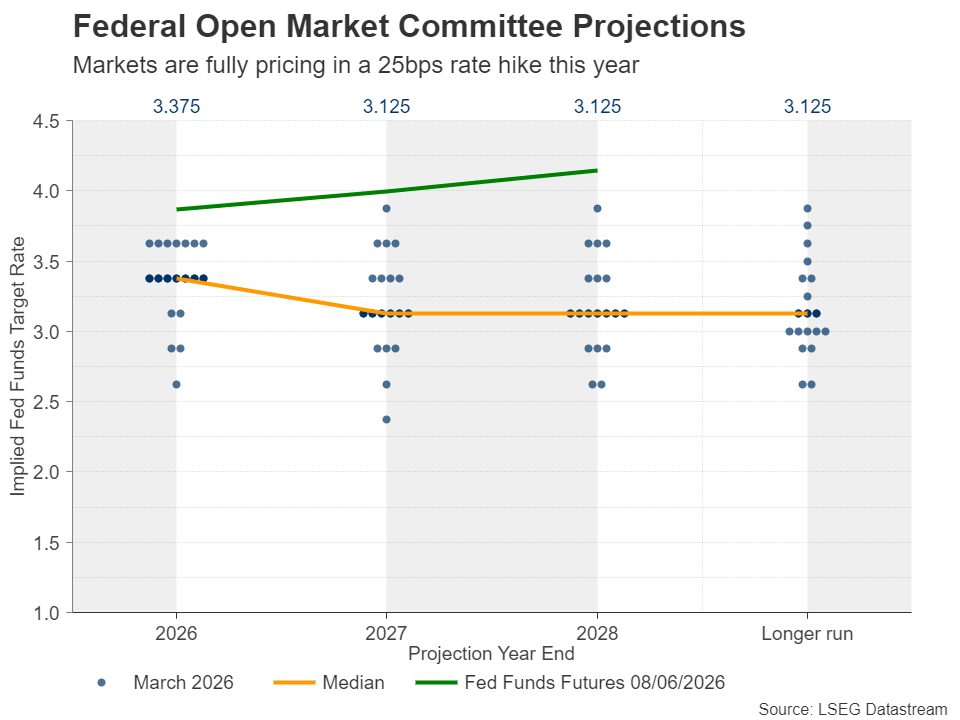
According to Fed funds futures, a quarter-point rate hike is now fully priced in for this year, the probability of it being delivered in September resting close to 50%. With the upcoming meeting being the first of the new Chair, Kevin Warsh, it is unlikely that the Fed will press the hike button before September. After all, Warsh was appointed by US President Trump, on the premise that he holds a less hawkish view than his predecessor Jerome Powell.
US CPI and PPI Data Could Reveal Further Acceleration
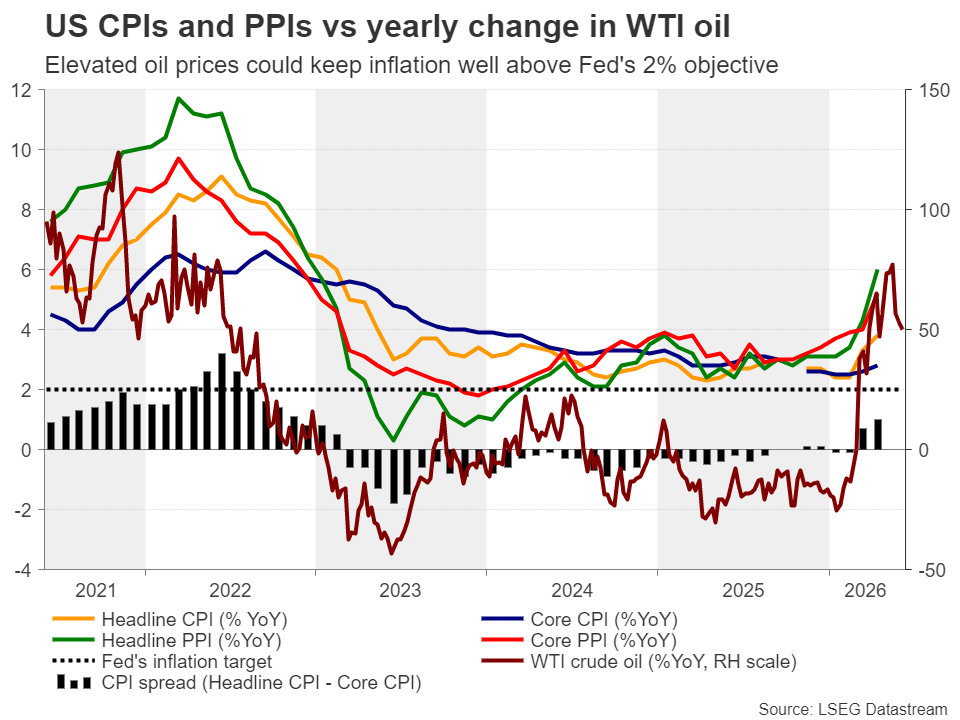
On Wednesday, the spotlight is likely to turn to the US CPI data for May, while on Thursday, the PPI figures will be released. In April, the headline CPI rate accelerated to 3.8% y/y from 3.3% amid the surge in oil prices due to the Middle East tensions, and although the rise in the core rate was smaller, the headline PPI rate surged to 6%. This means that products that were produced in April were set to arrive on store shelves at higher prices over the following months.
What’s more, although the year-on-year rate of change of WTI crude oil declined lately, it is hovering at April levels, which leaves little room for a material slowdown in inflation. All this poses upside risks to this week’s data. Indeed, the forecasts point to further acceleration, with the headline CPI rate expected to climb to 4.2% y/y from 3.8%, and the core to tick up to 2.9% y/y from 2.8%.
Another month of hotter-than-expected prints could drive the probability of a September hike higher, thereby pushing Treasury yields higher and adding more fuel to the dollar’s engines. At the same time, gold could extend its slide as the opportunity cost for holding the precious metal increases.
Euro/Dollar Rebounds, but Outlook Remains Bearish
From a technical standpoint, euro/dollar tumbled on Friday following the better-than-expected NFP report, breaking below the 1.1585 barrier and hitting support near the 1.1505 zone. Although the pair is now recovering, the short-term outlook remains negative.
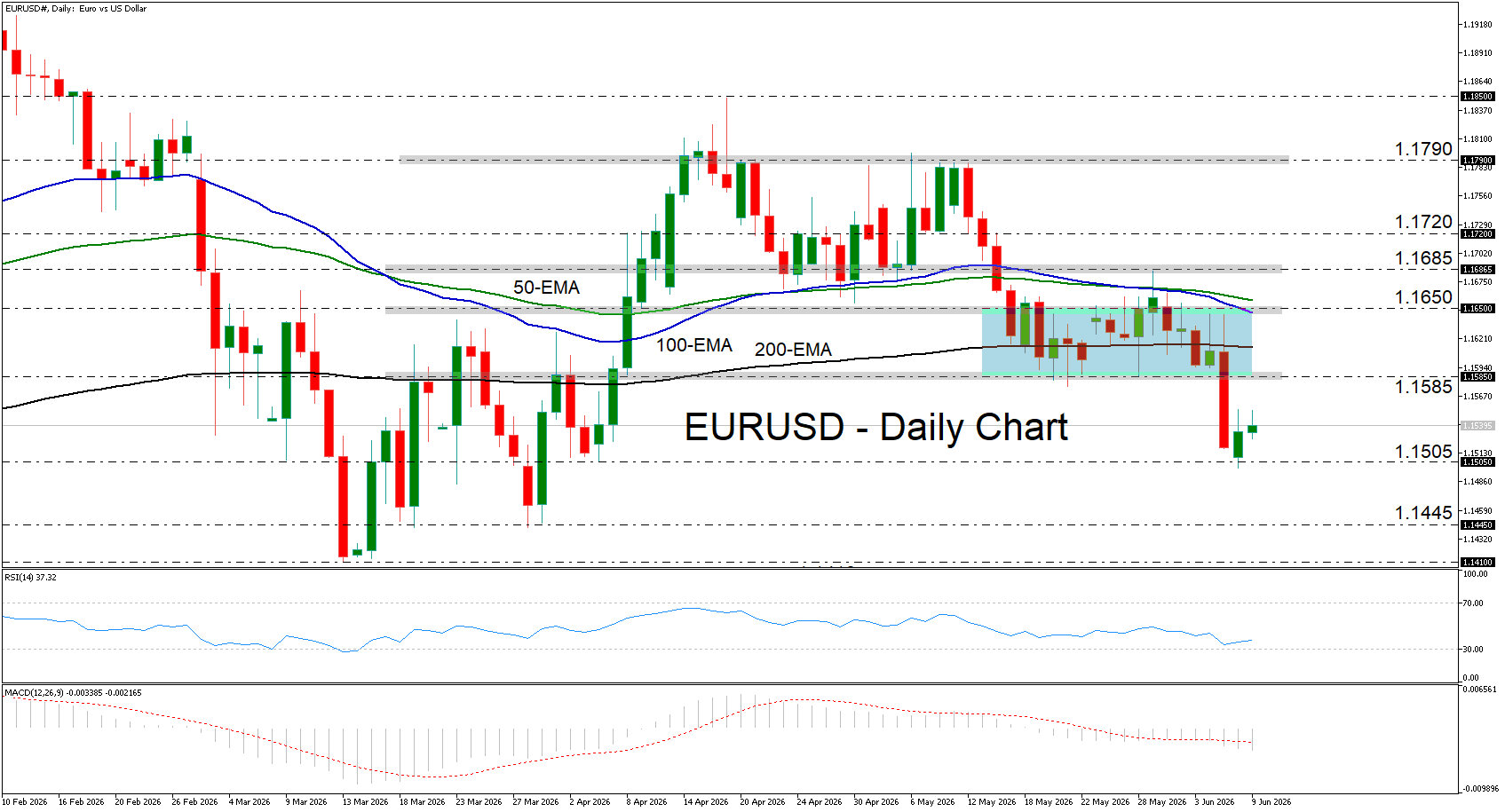
Even if the rebound stretches a bit more, the bears could re-charge from near the 1.1585 zone and shoot for another text near 1.1505. A break lower could set the stage for declines towards the 1.1445 area, marked by the lows of March 30 and 31. On the upside, a clear close above 1.1585 could signal the pair’s return within a sideways range, while a decisive move above 1.1650 may shift the outlook to bullish.
Gold Loses Ground with a Major Inflation Test Just Ahead
Key Highlights
- Gold started a fresh decline below the $4,400 support.
- A major bearish trend line is forming with resistance at $4,480 on the 4-hour chart.
- WTI Crude Oil extended losses and traded below $92.
- EUR/USD started a minor recovery wave above 1.1520.
Gold Price Technical Analysis
Gold failed to surpass $4,600 and started a fresh decline against the US Dollar. The price dipped below $4,550 and $4,500 to enter a bearish zone.
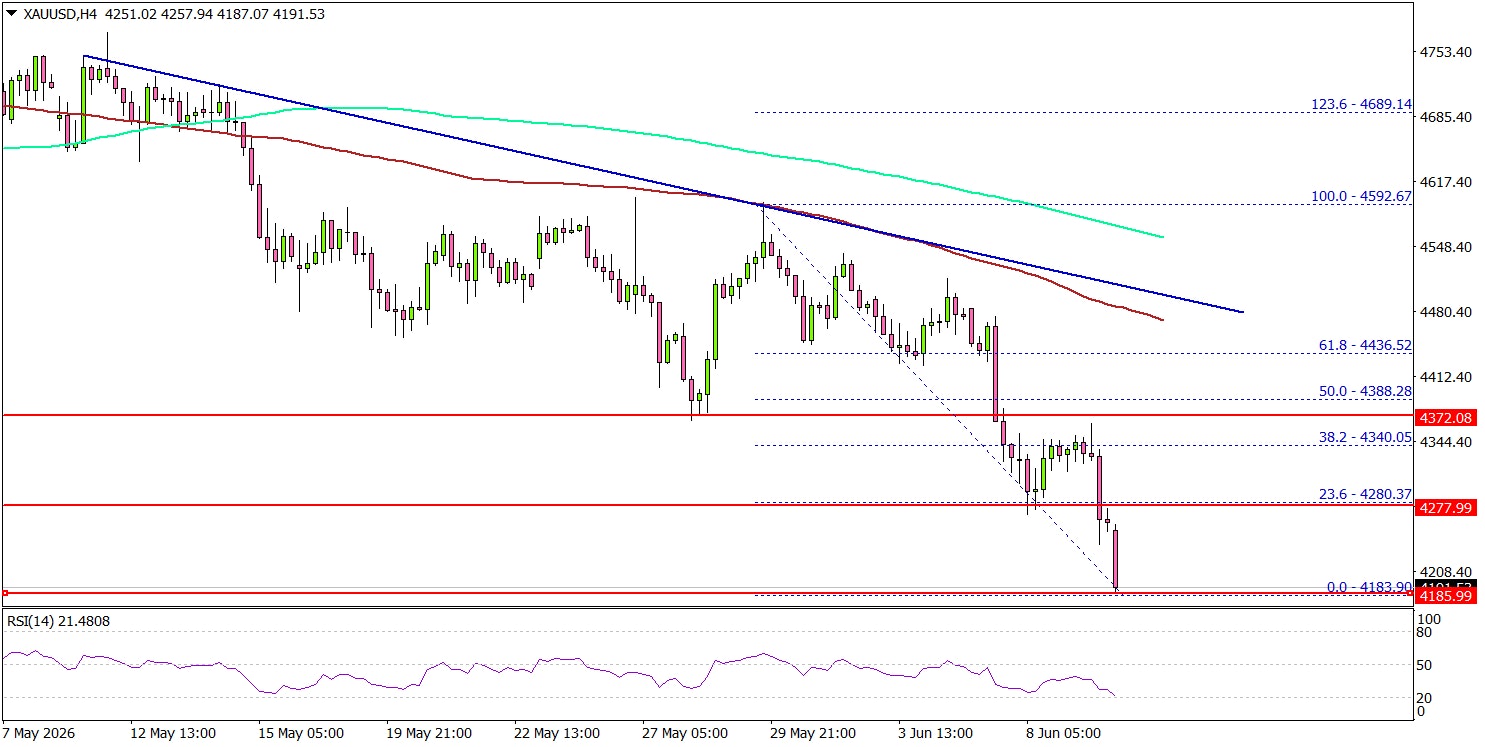
The 4-hour chart of XAU/USD indicates that the price even declined below $4,400, the 100 Simple Moving Average (red, 4 hours), and the 200 Simple Moving Average (green, 4 hours). A low was formed at $4,183, and the price is now showing many bearish signs.
On the upside, immediate resistance is $4,250. The next major resistance sits near $4,280 and the 23.6% Fib retracement level of the downward move from the $4,592 swing high to the $4,183 low.
The main resistance could be near $4,285 or the 50% Fib retracement level. A close above $4,285 could send the price toward $4,500. There is also a major bearish trend line forming with resistance at $4,480. A clear move above $4,480 could open the doors for more upside. In the stated case, the bulls could aim for a move toward $4,550 or even $4,600.
If there is another decline, Gold might find bids near the $4,150 level. The first major support sits at $4,065. The next support could be $4,000, below which the price might slide to $3,800. The main support sits at $3,550. Any more losses might call for a test of $3,300 or even $3,200 in the coming days.
Looking at WTI Crude Oil, the price started a fresh decline and there are chances of more losses below the $90 zone.
Economic Releases to Watch Today
- US Consumer Price Index for May 2026 (MoM) – Forecast +0.5%, versus +0.6% previous.
- US Consumer Price Index for May 2026 (YoY) – Forecast +4.2%, versus +3.8% previous.
- US Consumer Price Index Ex Food & Energy for May 2026 (YoY) – Forecast +2.9%, versus +2.8% previous.
USDJPY Steadies Above 160 on Looming Intervention
USDJPY remains firm and holds above 160 level for the third consecutive day, despite repeated warnings from Japan’s officials about intervention.
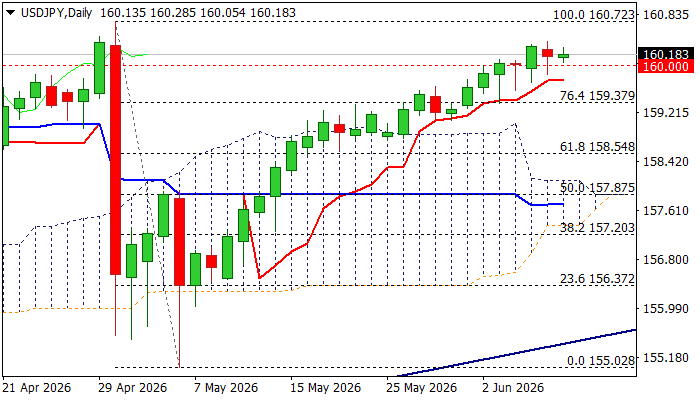
Growing speculations about Fed rate hike this year continue to underpin the dollar that keeps the pair elevated and on track to retest 2026 high (160.72), where intervention in late Apri started.
Traders focus on US CPI release (Wednesday) as inflation is expected to rise further in May (4.2% f/c vs 3.8% Apr) that may further pressure the US central bank, although Fed is widely expected to stay on hold in next week’s policy meeting under new Chairman Warsh.
Technical picture on daily chart is bullish but overbought, suggesting that bulls may pause, with 160 marking initial support and daily Tenkan-sen (159.74) expected to contain and keep bulls intact.
However, daily Ichimoku cloud is narrowing and will twist on Friday, which may attract deeper pullback.
Res: 160.45; 160.72; 161.00; 161.95
Sup: 160.00; 159.74; 159.30; 159.00
Platinum Wave Analysis
Platinum: ⬇️ Sell
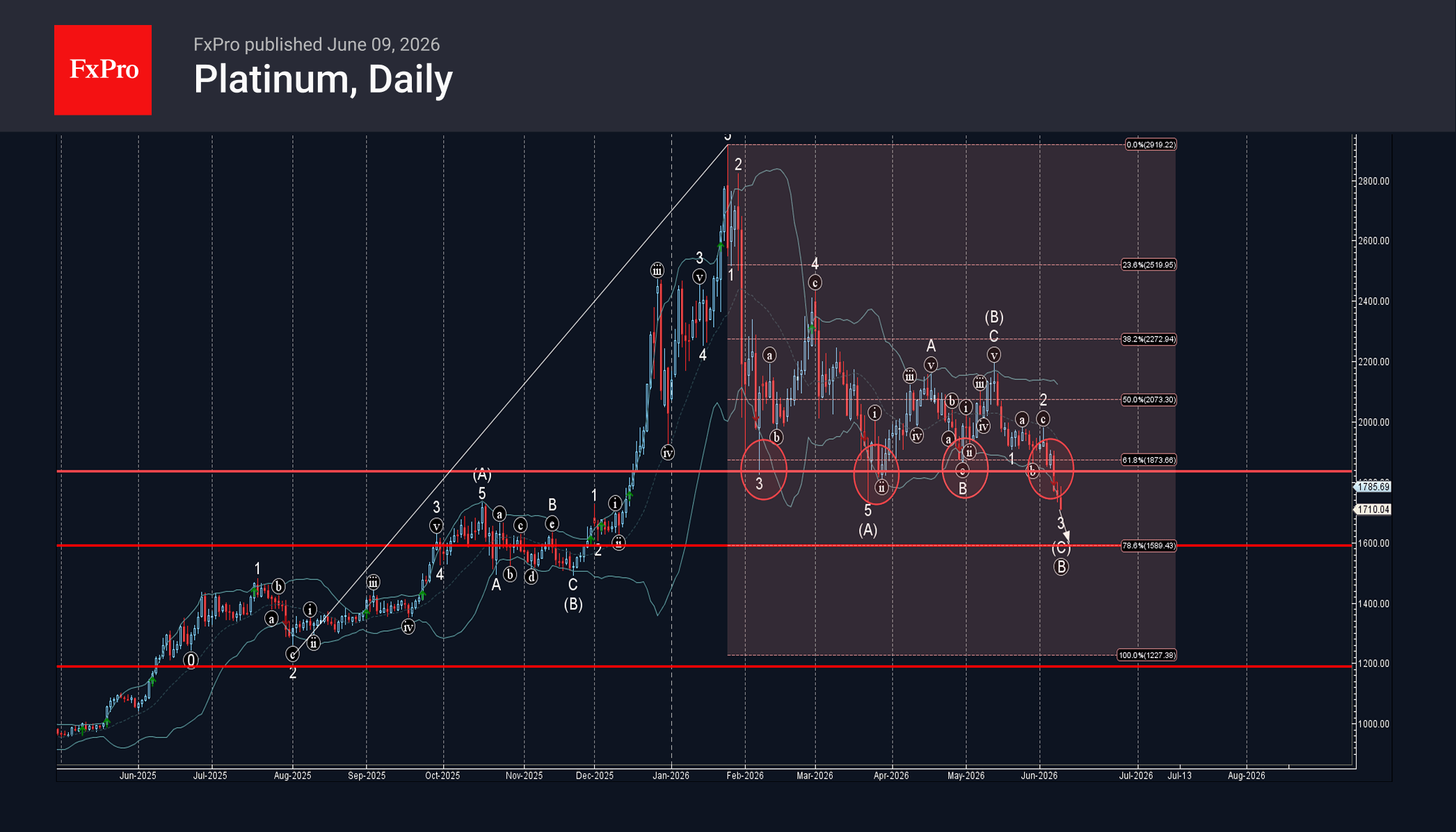
– Platinum broke key support level 1835.00
– Likely to fall to support level 1660.00
Platinum recently broke the support zone between the key support level 1835.00 (which has been reversing the price from the start of February) and the 61.8% Fibonacci correction of the upward impulse from last August.
The breakout of this support zone accelerated the impulse wave 3 of the medium-term impulse wave (C) from May.
Platinum can be expected to fall to the next support level 1660.00 – target price for the completion of the active impulse wave (C).
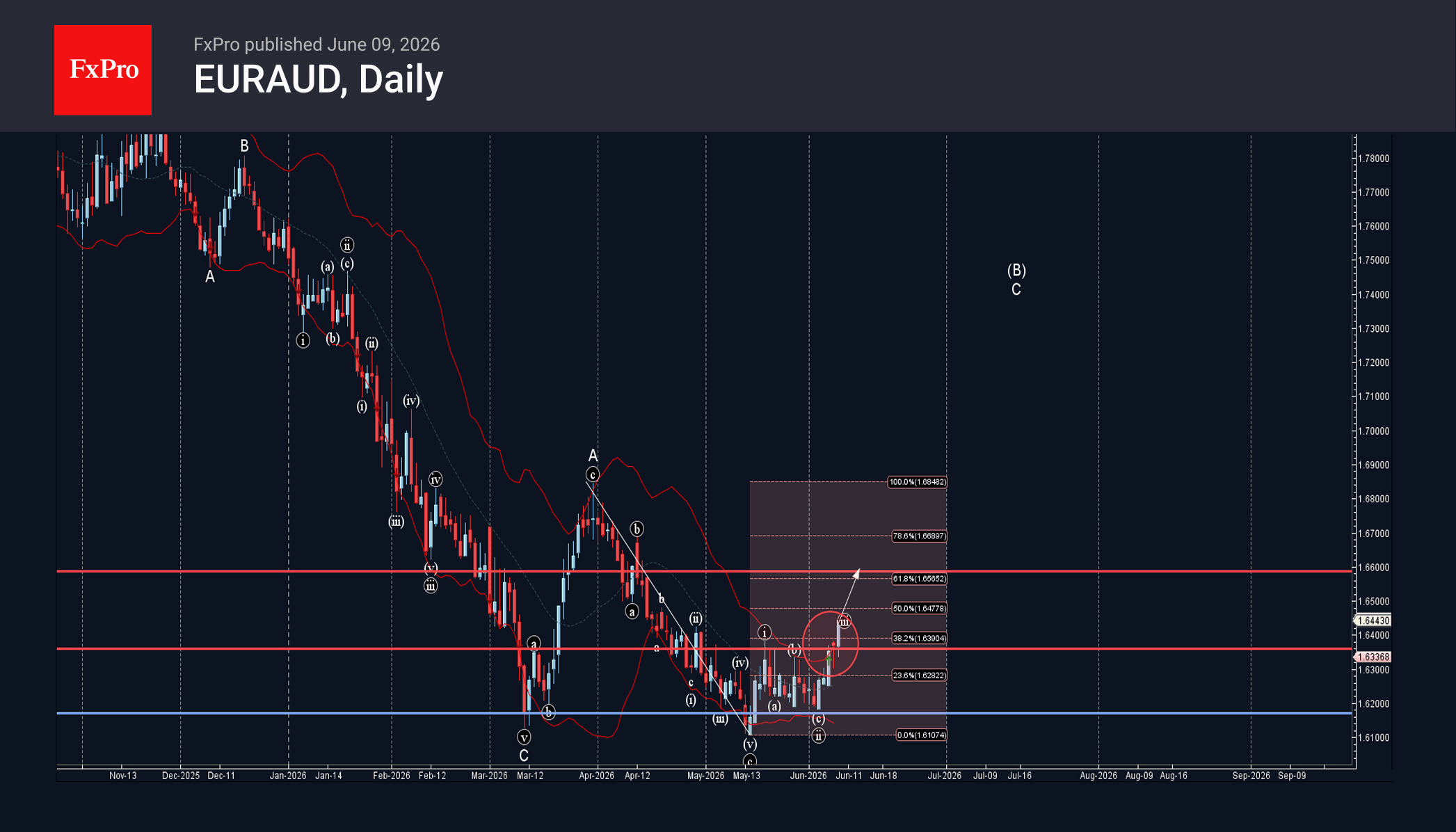
EURAUD Wave Analysis
EURAUD: ⬆️ Buy
– EURAUD broke resistance zone
– Likely to rise to resistance level 1.6600
EURAUD currency pair recently broke the resistance zone between the resistance level 1.6360 (which has been reversing the price from the start of May) and the 38.2% Fibonacci correction of the downward impulse from May.
The breakout of this resistance zone accelerated the C-wave of the active ABC correction (B) from March.
Given the strongly bearish Australian dollar sentiment seen today, EURAUD currency pair can be expected to rise to the next resistance level 1.6600.