Sample Category Title
USD/CAD Ascending Scallop Pattern
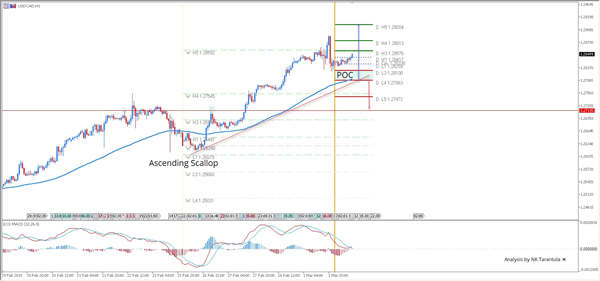
The USD/CAD has formed a bullish ascending scallop pattern after breaking out from the double top (red horizontal line). At this point the price is trying to reach D H3 pivot that indicates bullish pressure. However as today is Friday, we might see profit taking.
Traders should pay attention to POC zone 1.2790-1.2810. We could see a rejection if the price gets to POC zone. Spike above 1.2860 might target 1.2880 and 1.29290.
However if the price drops below 1.2785 targets are 1.2754 and 1.2713, and the pair will be back in consolidation mode again.
W H3 -Weekly Camarilla Pivot (Weekly Interim Resistance)
W L3 - Weekly Camarilla Pivot (Weekly Interim Support)
W H3 - Weekly Camarilla Pivot (Weekly Interim Resistance)
W H4 - Weekly Camarilla Pivot (Strong Weekly Resistance)
D H4 - Daily Camarilla Pivot (Very Strong Daily Resistance)
D L3 – Daily Camarilla Pivot (Daily Support)
D L4 – Daily H4 Camarilla (Very Strong Daily Support)
POC - Point Of Confluence (The zone where we expect price to react aka entry zone)
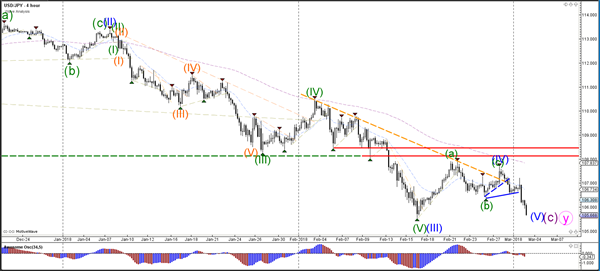
Daily Wave Analysis: USD/JPY Downtrend Continues After Breaking Support And Completing Wave-4
Currency pair USD/JPY
The USD/JPY completed a wave 4 (blue) and is confirming a wave 5 (blue) pattern with its bearish break below the support trend lines (dotted blue). A bearish continuation towards the 105 round level now seems likely.
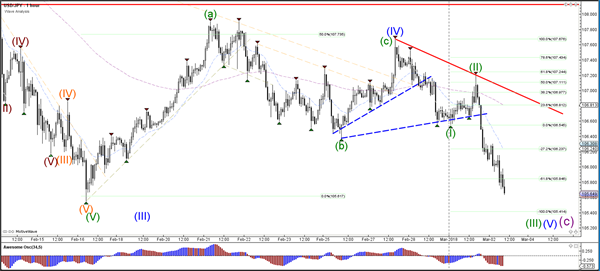
The USD/JPY could be building bearish wave 3 (green) pattern.
Currency pair EUR/USD
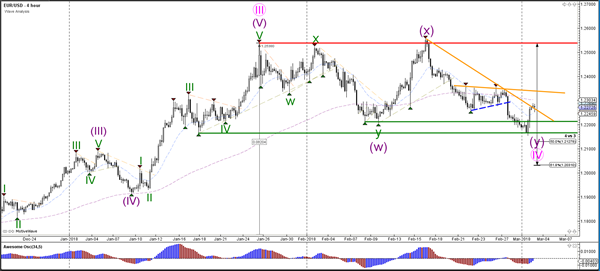
The EUR/USD bounced at the larger support zone around 1.22 which is indicated by the green lines. Price is now challenging the resistance trend lines. A bullish break could start a new uptrend whereas a bearish break below support makes a wave 4 (pink) less likely.
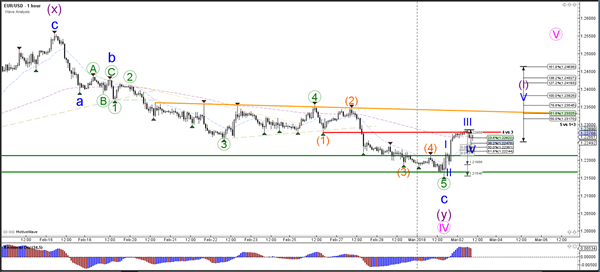
The EUR/USD could be building 5 bullish waves (blue) if price manages to break above the resistance line (red).
Currency pair GBP/USD
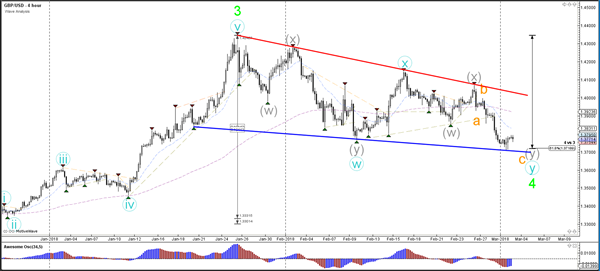
The GBP/USD is testing the support at the 61.8% Fibonacci level. This Fib is a new bounce or break spot. A bearish break invalidates the wave 4 (green) pattern.
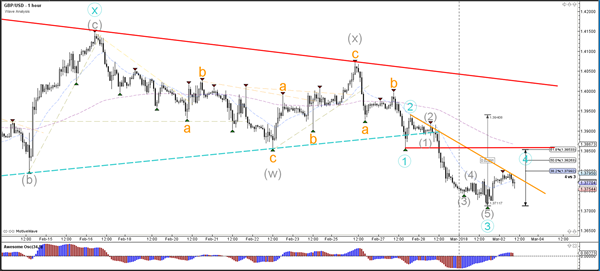
The GBP/USD bearish momentum yesterday is most likely a wave 3 (blue), unless price breaks above the bottom of the wave 1 (red line). A lower low could create divergence and complete 5 waves (blue).
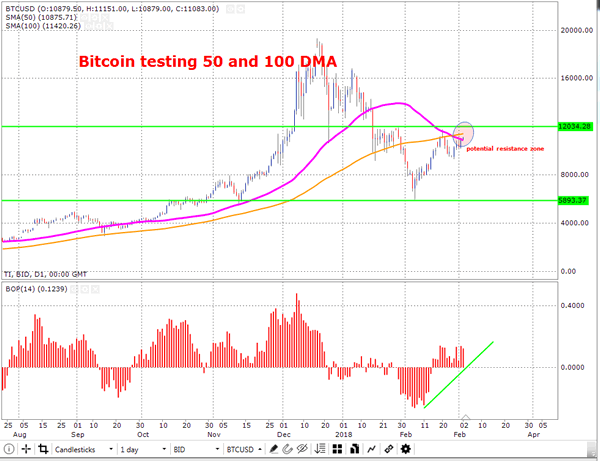
Bitcoin Above 11K
Bitcoin gained its momentum back
Major resistance level could push Bitcoin price lower
Bitcoin, the king of cryptocurrency has waned its popularity if you compare the sentiment to where it was back in December 2017. The biggest question among investors is if the cryptocurrency would make a comeback? Well, technically, speaking as long as the February low remains intact, the path of the least resistance is firmly skewed to the upside. The trade volume on any downward is decreasing and this is more of a positive sign for the Bitcoin price because as a trader you want to see the volume fading on any downward move. A break of 15K would really send the signal that cryptocurrency is back in the business but we are far off from that level for level.
Moreover, the fall in Bitcoin transaction has also a lot to do with the ban of the Bitcoin adds on Facebook. However, we have seen a sift of platform, as the number of adds for ICO and Bitcoin on Instagram and on Twitter have increased.
On the regulatory front, the new wave of bullish momentum arrives amidst the former FDIC Chief making a plea to authorities not to ban cryptocurrencies and Credit Suisse starting to use block chain to make payments. Bitcoin has raced back above the $11000 mark. This is a critical area as traders have failed to break above the 11K mark and we will be watching the price action closely.
US Futures Ready To Extend Decline | Risk Off Trade On
The Dow Jones index closed more than 400 points lower
The upcoming US consumer sentiment reading will be closely watched
Gold price bounded from its lows
Growing fears of oversupply are pushing the price of oil lower
Oops Trump did it again. The protectionism sound beat is highly un-liked by investors. They have shown their reaction and it is an ugly one. The Dow Jones index closed more than 400 points lower yesterday after rising more than 150 points earlier in the day.
The US futures are looking weak today as well. Yesterday, President Trump announced that the US will set tariffs of 25 percent for steel and 10 percent for aluminium, clearly putting America first and opened the door wide open for a trade war. Chinese officials are not going to remain reticent about this, we think there will be a reaction; a tit for tat and this is worrying the markets.
Forex
The dollar traders paid close attention to the testimony of the new Fed Chairman and his comments on the wage growth were the most intriguing one. The Fed chairman is know for his hawkish stance but he balanced the approach yesterday by mentioning that the wage growth still not at a point where he thinks it should be. This is influencing the dollar index today and after an initial upward move, traders have taken the profit off the table.
Having said this, it is a little too early to say what side the new chairman is going to choose but we do understand that he could influence other Committee members’ stance on the dollar by using his position.
The upcoming consumer sentiment reading will be closely watched and we are expecting a slightly soft reading. However, a number which is higher than 99.5 would send a strong signal to the dollar bulls that consumers are extra confident about the economy despite the Trump administrations’ protectionism stance.
Gold
Gold prices have rebound from their lows as the risk averse trade has finally kicked in. The protectionism stance by Donald Trump has encouraged traders to look at the risk at an asset which provides safety. Having said that, we do think that there may be some more rough days ahead this is due to the feeling that Fed may hike the interest rate more aggressively that initially anticipated. The New York Fed president, William Dudley’s comments are of particular interest as he thinks that four interest rate hike mean gradual tightening. Although, we are not sure if consumers are ready for that kind of tightening.
Oil
Growing fears of oversupply are pushing the price of oil lower. Oil is set to post first weekly loss since early February. Higher oil prices have brought more US shale oil production online and there is nothing the OPEC cartel can do about it. This continues to hunt traders and the positive momentum. Simply put, it is difficult to sell the idea how the US will curb its supply.
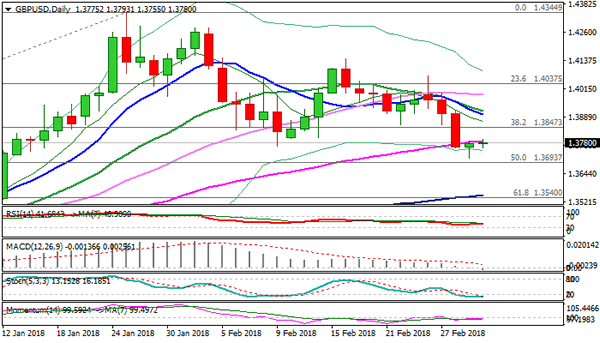
Technical Outlook: GBPUSD Awaiting Fresh News About Brexit, Overall Picture Is Bearish
The pair is holding within tight range in early Friday's trading ahead of much anticipated speech of UK PMI May, in which she will bring her plan about country's future after Brexit.
Threats of Brexit talks stall on a dispute over the border with Northern Ireland and comments from EU Brexit negotiator Barnier who said that a free trade agreement between the EU and Britain was the only option left, kept the strong pressure on pound.
Strong four-day bearish acceleration hit new low at 1.3711 on Thursday, where bears found temporary footstep, taking a breather ahead of fresh news from Brexit negotiations.
Slight recovery off 1.3711 low formed Hammer candle on Thursday, but little positive impact was seen so far, as recovery attempts remain capped by broken ascending 55SMA (1.3787).
Firm break and close above 55SMA is needed to validate reversal signal and open way for further recovery.
However, bearish setup of daily MA's and momentum holding in negative zone, continue to weigh along with increased Brexit concerns.
Fresh bearish acceleration through initial supports at 1.3703/1.3698 (daily cloud base / Fibo 50% of 1.3042/1.4344 ascend) could extend towards next targets at 1.3550/40 zone (rising 100SMA / Fibo 61.8%).
Bears need firm break below cracked pivot at 1.3764 (09 Feb low) to complete failure swing pattern on daily chart and spark fresh extension of pullback from 1.4344 (2018 high, posted on 25 Jan).
Res: 1.3787, 1.3847, 1.3900, 1.3918
Sup: 1.3755, 1.3700, 1.3674, 1.3618
EUR/USD – Euro Climbs As Trump Talks Tariffs
The euro is unchanged in the Friday session, after posting gains on Thursday. Currently, EUR/USD is trading at 1.2276, up 0.07% on the day. On the release front, German retail sales dropped 0.7%, well off the estimate of a 0.8% gain. This marked a third decline in four months. Later in the day, we’ll get a look at Eurozone PPI, which is expected to improve to 0.4%. In the US, the UoM Consumer Sentiment report is expected to jump to 99.4 points.
The euro posted considerable gains in the Asian session, after US President Trump announced that he would be imposing stiff tariffs on steel and aluminum, in order to protect domestic producers. Under the new scheme, foreign steel will be taxed at 25% and aluminum at 10%. The response to the move was overwhelmingly negative, but abroad and in the US. China and the EU immediately denounced the move US auto makers and oil and gas producers also condemned the tariffs, saying they could get caught in the middle of a nasty trade war if other countries retaliate. In imposing the tariffs, Trump relied on a provision which allows such measures for national security, but clearly, US trading partners will not quietly accept these protectionist measures.
Recent indicators show that inflation in the eurozone is steady, but remains well below the ECB target of around 2 percent. Eurozone CP dipped to 1.2% in February, down from 1.3% in January. Economic growth has rebounded, led by a robust German economy. Still, there is plenty of slack in the eurozone economy and the ECB is not under pressure to tighten policy. The Bank will meet on March 8, and no major changes are expected. Policymakers could deliberate the possibility of removing the Bank’s easing bias towards increasing bond purchases if needed. A removal of the easing bias would likely be interpreted as a plan to tighten policy and would be bullish for the euro.
Dollar Declines On Tariffs Decision, Theresa May’s Brexit Speech Eyed
Here are the latest developments in global markets:
FOREX: The dollar declined versus a basket of currencies on Thursday after previously rising to a six-week high. Negative momentum for the US currency, which came on the back of a trade tariff decision by the US administration, is carrying through into today's trading, with losses being limited though.
STOCKS: US markets experienced another day of sharp declines on Thursday, as worries over President Trump's new tariffs on steel and aluminum imports amplified concerns that the situation could escalate into a retaliatory tit-for-tat trade war. The Dow Jones led the decline, falling by 1.7%, while both the S&P 500 and the Nasdaq Composite closed 1.3% lower. Moreover, futures tracking the Dow, S&P and Nasdaq 100 are all flashing red at the moment, pointing to a negative open. Asian markets felt the heat of the trade concerns as well, with practically every major benchmark being in negative territory. In Japan, the Nikkei 225 and the Topix fell by 2.5% and 1.8% respectively, while in Hong Kong, the Hang Seng was lower by 1.6%. Europe did not escape unscathed either, as futures tracking all the major indices were a sea of red today.
COMMODITIES: In energy markets, oil prices were slightly lower, with WTI and Brent crude both falling by roughly 0.1%. Today, oil traders will turn their sights to the release of the US Baker Hughes oil rig count for fresh signs of whether US production continues to accelerate or is slowing down. In precious metals, gold was higher by 0.1%, extending some of the gains it posted yesterday as concerns over a potential trade war brought the safe-haven “back in fashion”. It is currently trading near $1317 per ounce, not far from the $1320 resistance zone.
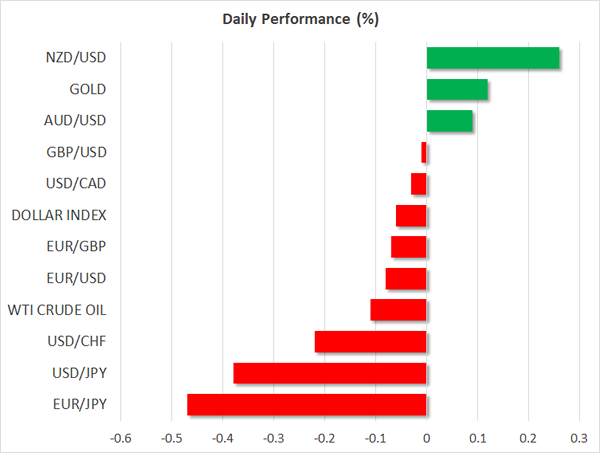
Major movers: Dollar retreats as trade protectionism is back on the table
US President Donald Trump's decision to impose tariffs on imported steel and aluminum led to a shift in momentum for the dollar, with the currency reversing the gains that saw the dollar index record a six-week high of 90.93 on Thursday and instead finishing the day lower by 0.3%. The dollar index is also down during Friday's trading, though not by much.
Equity markets also responded negatively to the administration's decision, with Wall Street's three major indices all shedding more than 1% to record their third straight day of notable losses. Concerns for a trade war are back on the table.
The implication is that companies will have to raise prices in the face of higher costs of materials due to the tariffs and subsequently pass the cost onto the consumers, thus weighing on consumption and consequently the outlook for growth in the world's largest economy. This is seen as the reason behind the dollar's decline.
Before the news on tariffs, the dollar seemed to be firmly on a positive footing as Fed chief J. Powell's comments were interpreted by market participants as leaving the door open for even four quarter percentage point interest rate increases by the US central bank in 2018. Markets have now fully priced in three such moves, with a fourth now also being partially priced in. Before Powell's remarks less than three hikes were expected by markets.
Dollar/yen was 0.4% down at 105.85, not far above the near 16-month low of 105.52 that was recorded on February 16. The Japanese currency tends to gain at times of uncertainty and risk aversion such as the one the markets are currently experiencing.
Euro/dollar was not much changed at 1.2259 after also posting gains to bounce from a multi-week low versus the greenback on Thursday. Risk events for the common currency are Sunday's Italian elections and the German SPD's decision on whether to revive its “grand coalition” with Chancellor Merkel's conservative bloc also due on Sunday. Euro/yen was notably lower, specifically by 0.5%, falling to 129.65 at its lowest, a level last experienced last September.
Pound/dollar was roughly flat at 1.3765. This compares to Thursday's near two-month low of 1.3710. A speech by PM Theresa May due later on Friday on how she sees the future relationship between the UK and the EU after Brexit will be in focus.
In commodity-linked currencies: the aussie and the kiwi were rising versus their US counterpart, with the loonie being little changed. The Canadian dollar initially recorded considerable declines versus the US currency after the tariff announcement as Canada stands to lose more from such a decision, though it later managed to rebound.
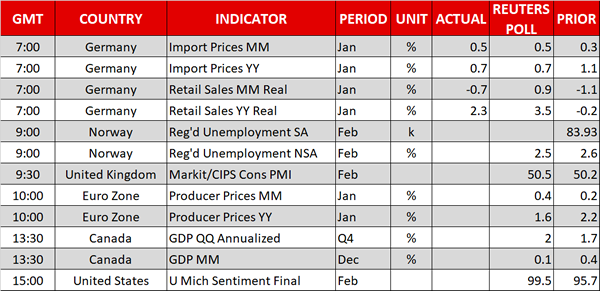
Day ahead: Theresa May's keynote Brexit speech in focus; UK and Canadian data eyed; euro awaits for political risk events
The economic calendar is relatively light today, with the most noteworthy data releases coming out of the UK and Canada. Moreover, speeches by the UK Prime Minister and the Governor of the Bank of England will also attract the attention of sterling traders.
In the UK, the construction PMI for February is due out at 0930 and expectations are for the index to have risen to 50.5 from 50.2 previously. Such an increase would signal that the sector has picked up some momentum and may thus be a pleasant development for sterling bulls. That said, investors trying to gauge whether the economy has picked up steam will pay more attention to the services PMI that is due on Monday, as the service sector accounts for a far larger portion of UK GDP.
Staying in the UK, Prime Minister Theresa May is expected to deliver a speech outlining what she seeks to achieve on the crucial issue of free trade between the UK and EU. Some parts of this speech have already been leaked and suggest the PM will continue to call for an ambitious UK-specific trade deal.
Developments on this front are worth monitoring closely. The negotiations seem to have hit a brick wall lately, with the UK rejecting the EU's proposals on the Irish border, and the EU expressing dissatisfaction with the slow pace of the talks. On top of these, PM May's scarce political capital seems to be eroding further, as recent reports suggest her Cabinet and the Tory party are heavily divided on what kind of deal the UK should seek. Sterling has tumbled as these concerns came back to the forefront, and unless May can provide some clarity today, the currency may continue to feel the heat from political uncertainties.
In the eurozone, producer prices for January are projected to have slowed to 1.6% in yearly terms, from 2.2% previously.
In Canada, all eyes will be on the GDP data for the final quarter of 2017. On an annualized basis, the economy is anticipated to have grown by 2.0%, an acceleration from the 1.7% in Q3. Such an acceleration could help the loonie to recover some of its recent losses, ahead of the Bank of Canada's policy meeting next week.
Out of the US, the final University of Michigan consumer sentiment index for February is due out and expectations are for the final figure to be revised notably higher.
In energy markets, the Baker Hughes oil rig count for the week ended February 23 is scheduled for release at 1800 GMT. While the number of active US rigs has increased notably in recent months alongside US oil production, the pace at which rigs are rising slowed last week, perhaps due to the decline in oil prices throughout February. Any fresh signs that US production is slowing down would probably help to alleviate some downward pressure on oil prices.
In equity markets, movements are likely to continue to be dictated by trade concerns and any updates in that narrative. Investors will be looking at how major economies like China and the EU will respond to the US tariffs, with any signs of further escalation in trade tensions likely to provide more pain for stocks.
As for policymaker appearances, besides UK PM May, Bank of England Governor Mark Carney will deliver remarks to the inaugural Scottish Economics Conference at 1000 GMT.
Looking ahead, euro pairs could well open with gaps on Monday, as there are two significant political events taking place on Sunday. In Italy, citizens will head to the polls to elect their new leader while in Germany, the SPD will announce whether it will enter in a coalition with Merkel's conservatives and finally form a government.
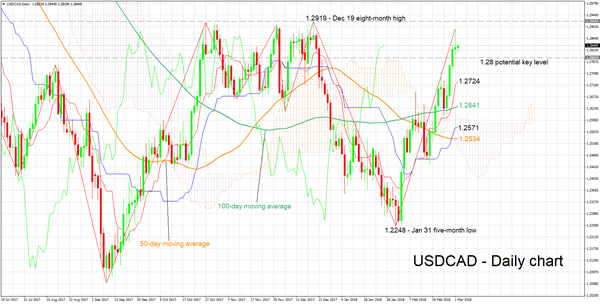
Technical Analysis: USDCAD looking bullish in short-term after recording 2½-month high
USDCAD has advanced considerably after hitting a five-month low of 1.2248 on January 31. During Thursday's trading it touched 1.2895, its highest in around two-and-a-half months. The Tenkan-sen line remains above the Kijun-sen line, continuing to project a positive picture in the short-term. However, the Chikou Span might be pointing to an overextended market, rendering a pullback in the near-term possible.
Stronger-than-projected growth figures out of Canada later on Friday are anticipated to push the pair lower, with support potentially coming around the 1.28 handle. The area around this level was congested in the past. Steeper declines would turn the attention to the current level of the Tenkan-sen at 1.2724.
On the upside and in case of weak Canadian GDP numbers, the pair is likely to continue advancing. Resistance could come around yesterday's high of 1.2895, with the range around it also encapsulating the eight-month high of 1.2919 from December 19.
Lastly, it should be mentioned that developments on the trade front (this being mentioned within the context of the latest tariff decision by the US administration) also have the capacity to spur movements in the pair.
Technical Outlook: EURUSD Bounced After Politics Overshadowed Positive Economic Data And Sent Dollar Lower
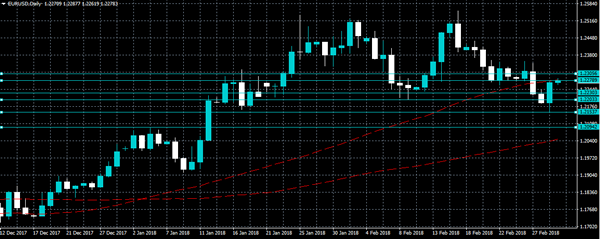
The Euro is consolidating under fresh recovery high at 1.2287 on Friday, following previous day’s strong bounce.
The single currency benefited from fresh weakness of the dollar which pulled away from six-week highs.
This time politics overshadowed bullish outlook after President Trump announced plans of impose tariffs on imported metals.
Increased concerns about possible trade war deflated the greenback, previously boosted by hawkish stance of Fed chief Powell, with US data released on Thursday, adding to bullish sentiment. Strong US Manufacturing numbers in Feb, rising consumer income and spending and jobless claims at the lowest since 1969, were insufficient to maintain dollar’s bullish sentiment, as Fed Chairman Powell slightly toned down hawkish stance from the testimony two days ago but kept positive tone and rising fears on trade war prompted investors out of dollar.
The pair bounced after hitting new nearly two-month low at 1.2154, failing to penetrate ascending daily cloud, which continues to underpin.
Another negative signal for Euro bears was failure to close below cracked pivotal support at 1.2173 (Fibo 38.2% of 1.1553/1.2555 / 55SMA).
Yesterday’s bounce generated bullish signal on formation of bullish Outside Day, validation of which shows minimum requirement on close above Thursday’s recovery high at 1.2173, while further bullish signal will be generated on firm break above falling 10SMA (1.2292).
Overall picture is still negative (10/20/30SMA in bearish setup / 14-d momentum returning to negative territory) and keep in play risk of fresh weakness, while the price remains below 10SMA.
Break and close above 10SMA is needed to sideline existing downside risk, while lift above falling 20 SMA (1.2321) would generate stronger reversal signal.
Res: 1.2292, 1.2321, 1.2345, 1.2360
Sup: 1.2251, 1.2205, 1.2173, 1.2154
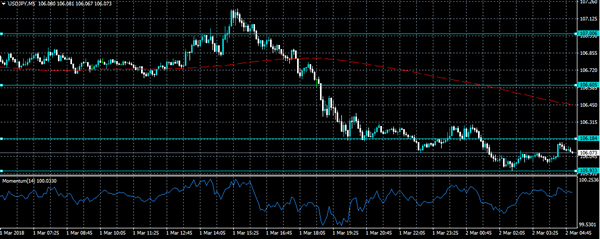
USDJPY Pair Testing 106.00 Handle
The U.S dollar has moved sharply lower against the Japanese yen currency during Friday’s Asian session, hitting 105.93, after President Donald Trump announced plans to place tariffs on Aluminum and Steel imports. The USDJPY pair easily broke below the key 106.60 support level, and currently trades close to the price-low of the week around the 106.00 handle. Traders now look towards the U.S dollar index’s reaction to the news in the upcoming European session, and yearly USDJPY price-low, found at 105.50.
The USDJPY pair is likely to experience further losses below the 105.93 level, key technical support is then found at the 105.50 and 105.00 levels.
Key intraday USDJPY resistance is now found at the 106.18 and 106.60 technical levels.
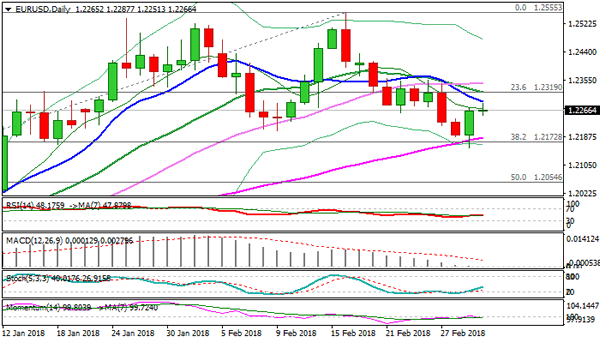
Euro Testing Pivotal 1.2278 Level
The euro has reversed losses against the U.S dollar, hitting 1.2280, as investors fear a possible Trade War between the U.S and Asia may harm the overall American economy. The EURUSD quickly bounced from the 1.2153 support level, with euro buyers now testing the pairs key 50-day moving average again, around the 1.2278 level. Traders now look towards the release of German Retail Sales figures and the European market's reaction to President Trump proposed trade tariffs.
The EURUSD pair retains a bearish bias whilst trading below the 1.2278 level, further losses towards 1.2230 and 1.2205 seem possible
Should the EURUSD pair move back above the key 1.2278 level, further intraday resistance is found at the 1.2305 and 1.2351 levels.