Sample Category Title
USD/CHF Daily Outlook
Daily Pivots: (S1) 0.9388; (P) 0.9439; (R1) 0.9468; More...
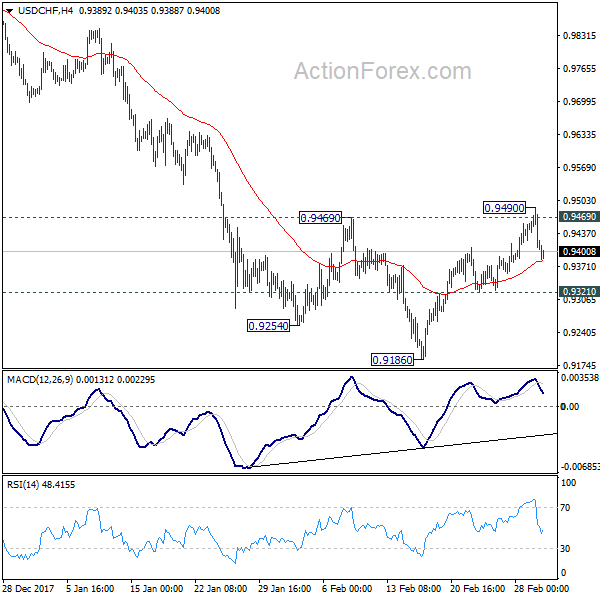
Despite reaching as high as 0.9490, USD/CHF failed to stay above 0.9469 resistance and retreated. Intraday bias remains neutral at this point. On the upside, firm break of 0.9469 will indicate near term reversal and turn outlook bullish for 55 day EMA (now at 0.9511) and above. On the downside, below 0.9321 minor support will bring retest of 0.9186. Break there will extend the larger down trend to 0.9115 medium term projection level next.
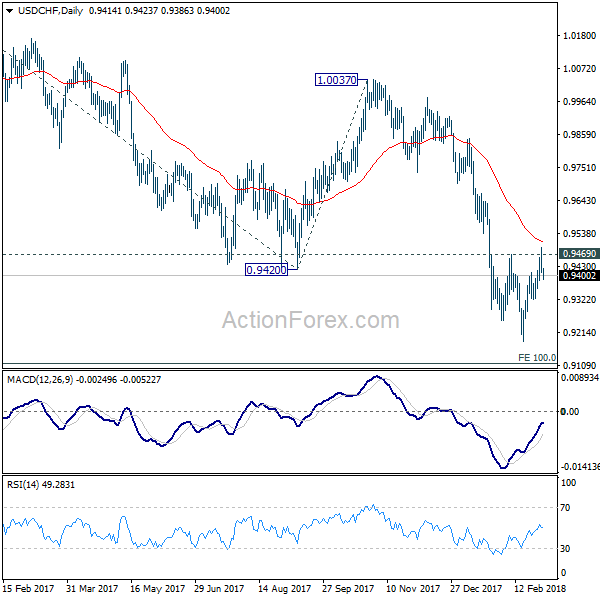
In the bigger picture, fall from 1.0342 is seen as a medium term down trend. Deeper decline should be seen to 100% projection of 1.0342 to 0.9420 from 1.0037 at 0.9115. Break will target 161.8% projection at 0.8545. In any case, sustained trading above 55 day EMA is needed to be the first sign of medium term reversal. Otherwise, outlook will stay bearish even in case of strong rebound.
GBP/USD Daily Outlook
Daily Pivots: (S1) 1.3729; (P) 1.3756; (R1) 1.3802; More....
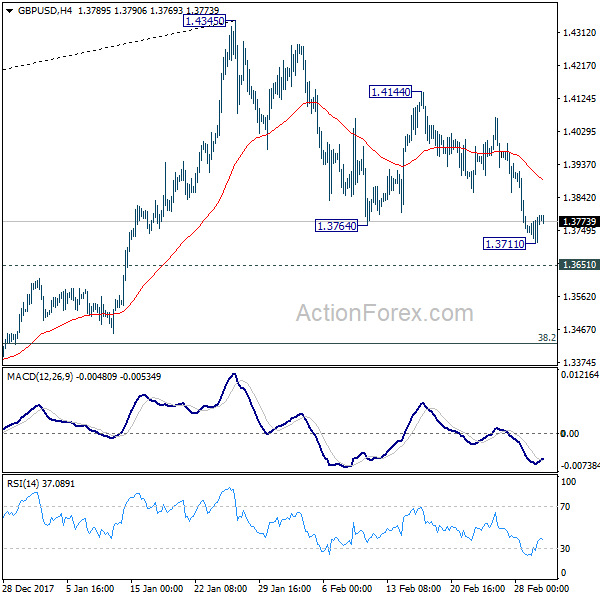
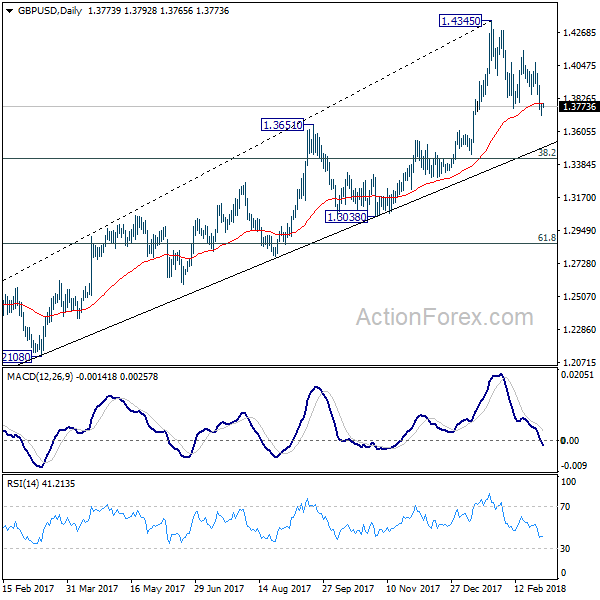
A temporary low is formed at 1.3711 in GBP/USD and intraday bias is turned neutral first. Further fall is still expected as long as 1.4144 resistance holds. Below 1.3711 will target 1.3651 resistance turned support and below. At this point, such fall is viewed as a corrective move. Hence, we'll look for strong support from 38.2% retracement of 1.1946 to 1.4345 at 1.3429 to contain downside and bring rebound.
In the bigger picture, as long as 1.3038 support holds, medium term outlook in GBP/USD will remains bullish. Rise from 1.1946 is at least correcting the long term down from 2007 high at 2.1161. Further rally would be seen back to 38.2% retracement of 2.1161 (2007 high) to 1.1946 (2016 low) at 1.5466. However, GBP/USD fails to sustain above 55 month EMA (now at 1.4279) so far. Break of 1.3038 support, will suggests that rise from 1.1946 has completed and will turn outlook bearish for retesting this low.
Aussie Trading A Tad Lower In The Morning Session
For the 24 hours to 23:00 GMT, the AUD rose 0.40% against the USD and closed at 0.7759.
LME Copper prices declined 1.5% or $101.0/MT to $6852.0/MT. Aluminium prices fell 0.7% or $15.5/MT to $2143.0/MT.
In the Asian session, at GMT0400, the pair is trading at 0.7756, with the AUD trading slightly lower against the USD from yesterday’s close.
The pair is expected to find support at 0.7721, and a fall through could take it to the next support level of 0.7687. The pair is expected to find its first resistance at 0.7782, and a rise through could take it to the next resistance level of 0.7809.
Moving ahead, Australia’s AiG performance of service index, building approvals, services PMI, retail sales, gross domestic product and trade balance all slated to release next week, would keep investors on their toes.
The currency pair is trading above its 20 Hr and showing convergence with its 50 Hr moving average.

Euro-Zone’s Manufacturing Activity Expanded At A Slower Pace In February
For the 24 hours to 23:00 GMT, the EUR rose 0.64% against the USD and closed at 1.2270.
On the macro front, Euro-zone's final Markit manufacturing PMI eased to a 4-month low level of 58.6 in February, compared to market expectations for a drop to a level of 58.5. In the prior month, the PMI had recorded a reading of 59.6. The preliminary figures had recorded a fall to 58.5. Additionally, the region's unemployment rate remained unchanged at a rate of 8.6% in January, reaching its lowest level since December 2008 and in line with market expectations. Separately, Germany's final Markit manufacturing PMI declined to a level of 60.6 in February, lower than the preliminary print indicating a drop to a level of 60.3. Market anticipation was for the PMI to ease to 60.30. The PMI had registered a reading of 61.1 in January.
The US dollar declined against a basket of currencies, after President, Donald Trump stated that US would impose steel and aluminium tariffs, thereby raising concerns of trade war.
In the US, data indicated that the ISM manufacturing unexpectedly rose to a level of 60.8 in February, hitting its highest level in 14 years and compared to market expectations for a drop to 58.7. In the prior month, the ISM manufacturing activity index had recorded a reading of 59.1. Meanwhile, the nation's final Markit manufacturing PMI eased to a level of 55.3 in February, lower than market expectations for a rise to 55.9. In the prior month, the Markit manufacturing PMI had registered a level of 55.5. The preliminary figures had indicated an advance to 55.9.
Another set of data showed that construction spending in the US remained flat on a MoM basis, lower than market expectations for a rise of 0.30%. Construction spending had advanced by a revised 0.80% in the previous month. Furthermore, the nation's initial jobless claims unexpectedly dropped to 210.00 K, recording its lowest level since December 1969 and compared to market expectations for an advance to a level of 225.00 K. Initial jobless claims had recorded a revised reading of 220.00 K in the prior week.
In the Asian session, at GMT0400, the pair is trading at 1.2285, with the EUR trading 0.12% higher against the USD from yesterday's close.
The pair is expected to find support at 1.2198, and a fall through could take it to the next support level of 1.2112. The pair is expected to find its first resistance at 1.2328, and a rise through could take it to the next resistance level of 1.2372.
Moving ahead, investors would closely monitor Eurozone's producer price index and Germany's retail sales both for January scheduled to release in a few hours. Later in the day, the US Michigan consumer sentiment index for February, would garner significant amount of market attention.
The currency pair is trading above its 20 Hr and 50 Hr moving average.

May’s Speech, Due Later Today, Will Be Closely Monitor
For the 24 hours to 23:00 GMT, the GBP rose 0.16% against the USD and closed at 1.3773.
Data showed that UK's Markit manufacturing PMI dropped slightly to 55.2 in February, reaching its lowest level in 8 months and lower than market expectations for a drop to a level of 55.0. The manufacturing PMI had recorded a reading of 55.3 in the previous month. Moreover, the nation's net consumer credit recorded a rise of GBP1.4 billion in January, meeting market expectations. In the prior month, net consumer credit had advanced by a revised GBP1.6 billion. Further, the number of mortgage approvals for house purchases registered a rise to 67.5 K in January, compared to market expectations for an advance to 62.0 K. In the previous month, number of mortgage approvals for house purchases had recorded a revised reading of 61.7 K.
Other data indicated that Britain's seasonally adjusted Nationwide house prices unexpectedly fell by 0.3% MoM in February, compared to a revised gain of 0.8% in the prior month. Market participants had anticipated for a rise of 0.1%.
In the Asian session, at GMT0400, the pair is trading at 1.3788, with the GBP trading 0.11% higher against the USD from yesterday's close.
The pair is expected to find support at 1.3736, and a fall through could take it to the next support level of 1.3683. The pair is expected to find its first resistance at 1.3817, and a rise through could take it to the next resistance level of 1.3845.
Trading trend in the Pound today is expected to be determined by UK Prime Minister's Brexit speech due later today which is likely to decide UK's future with the European Union.
The currency pair is trading above its 20 Hr and showing convergence with its 50 Hr moving average.

Japanese Yen Trading On A Stronger Footing This Morning
For the 24 hours to 23:00 GMT, the USD declined 0.54% against the JPY and closed at 106.13.
Overnight data revealed that unemployment rate in Japan unexpectedly dropped to 2.40% in January, compared to a rate of 2.80% recorded in the previous month.
In the Asian session, at GMT0400, the pair is trading at 106.01, with the USD trading 0.11% lower against the JPY from yesterday’s close.
The pair is expected to find support at 105.57, and a fall through could take it to the next support level of 105.12. The pair is expected to find its first resistance at 106.83, and a rise through could take it to the next resistance level of 107.64.
Going ahead, market participants would focus on the Bank of Japan’s rate decision along with Japan’s GDP data, trade balance and leading index all set to release next week.
The currency pair is trading below its 20 Hr and 50 Hr moving average.

Swiss Franc Extends Its Gains In The Morning Session
For the 24 hours to 23:00 GMT, the USD declined 0.37% against the CHF and closed at 0.9418.
The Swiss Franc gained against the USD yesterday, following upbeat economic growth data for the fourth quarter.
Data showed that gross domestic product (GDP) in Switzerland recorded a rise of 1.90% in 4Q 2017, compared to a rise of 1.20% in the previous quarter. Markets were expecting GDP to advance 1.70%. Moreover, the SVME manufacturing PMI registered an unexpected rise to 65.5 in February, compared to market expectations of a fall to 64.0. In the previous month, the SVME manufacturing PMI had recorded a level of 65.3. However, real retail sales fell 1.40% on an annual basis in January, compared to a revised rise of 0.70% in the previous month.
In the Asian session, at GMT0400, the pair is trading at 0.9401, with the USD trading 0.18% lower against the CHF from yesterday’s close.
The pair is expected to find support at 0.9370, and a fall through could take it to the next support level of 0.9340. The pair is expected to find its first resistance at 0.9461, and a rise through could take it to the next resistance level of 0.9522.
Amid no macroeconomic releases in Switzerland today, investor sentiment would be governed by global macroeconomic factors.
The currency pair is trading below its 20 Hr and 50 Hr moving average.

Loonie Trading A Tad Lower, Ahead Of Canada’s GDP Data
For the 24 hours to 23:00 GMT, the USD declined 0.09% against the CAD and closed at 1.2832.
Data indicated that Canada's Markit manufacturing PMI declined to a level of 55.6 in February, on the back of a fall in new orders. The PMI had registered a level of 55.9 in the prior month.
In the Asian session, at GMT0400, the pair is trading at 1.2829, with the USD trading marginally lower against the CAD from yesterday's close.
The pair is expected to find support at 1.2794, and a fall through could take it to the next support level of 1.2758. The pair is expected to find its first resistance at 1.288, and a rise through could take it to the next resistance level of 1.2930.
Ahead in the day, investors would await the release of Canada's gross domestic figures for December.
The currency pair is trading below its 20 Hr and above its 50 Hr moving average.

Elliott Wave View: CADJPY Correction Expected Before Lower Again
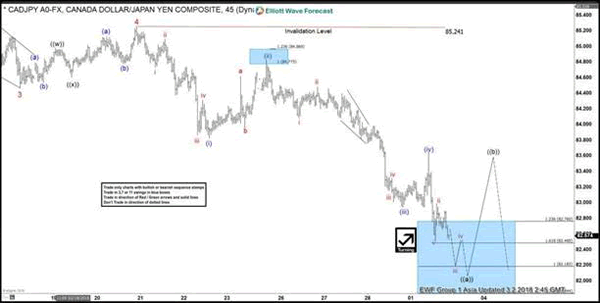
Short Term CADJPY Elliott Wave view suggests that the decline from 1/5/2018 high (91.58) is unfolding as an impulse Elliott Wave Structure where Minor wave 1 ended at 87.785, Minor wave 2 ended at 89.439, Minor wave 3 ended at 84.468, and Minor wave 4 ended at 85.24. Minor wave 5 remains in progress as an impulse Elliott Wave structure where Minute wave ((a)) of 5 is expected to end soon.
Minute wave ((a)) of 5 is unfolding as an impulse Elliott Wave structure where Minutte wave (i) ended at 83.82, Minutte wave (ii) ended at 84.82, Minutte wave (iii) ended at 82.94, and Minutte wave (iv) ended at 83.65. Pair has reached the minimum target in price and swing to end Minutte wave (v) of ((a)) although another extension lower can’t be ruled out. Expect pair to bounce in Minute wave ((b)) soon to correct cycle from 2/21 peak (85.24) in 3, 7, or 11 swing before the decline resumes. We don’t like buying the proposed bounce.
CADJPY 1 Hour Elliott Wave Chart
EUR/USD Daily Outlook
Daily Pivots: (S1) 1.2173; (P) 1.2207 (R1) 1.2227; More....
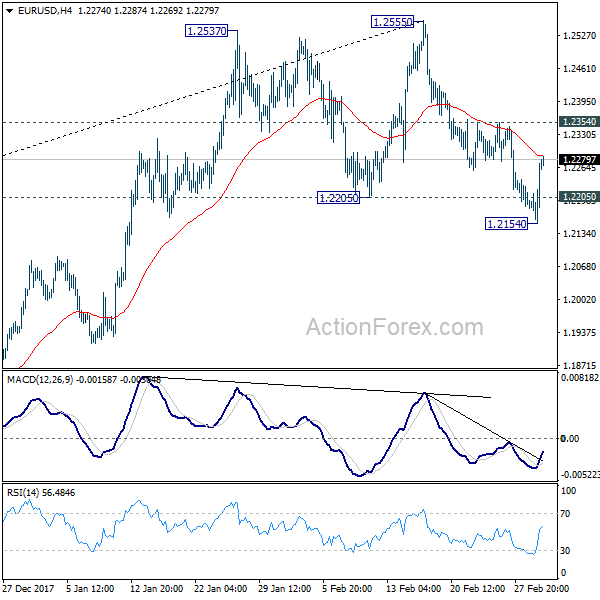
Despite dipping to 1.2154, EUR/USD could not sustain below 1.2205 key support and recovered. Intraday bias is turned neutral first. With 1.2354 resistance intact, we're still favoring the case of trend reversal. That is, EUR/USD has topped at 1.2555 and was rejected by 1.2516 key fibonacci level. But sustained trading below 1.2205 is needed to confirm. Break of 1.2154 should send EUR/USD lower to 38.2% retracement of 1.0339 to 1.2555 at 1.1708. On the upside, above 1.2354 minor resistance will invalidate this bearish case and bring retest of 1.2555 high instead.
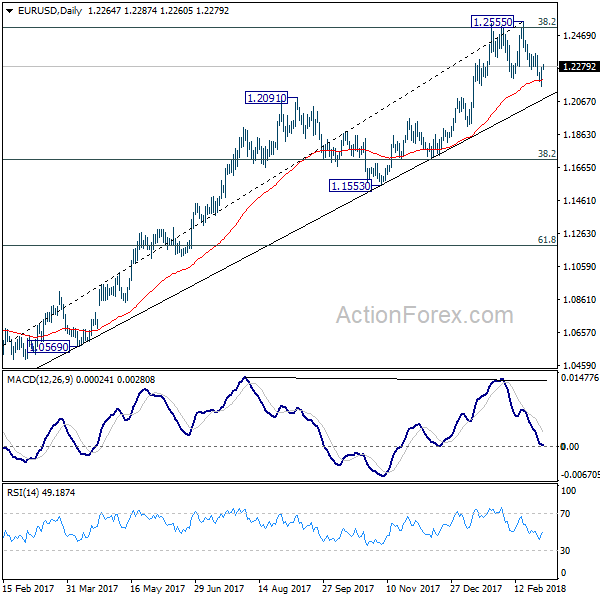
In the bigger picture, key fibonacci level at 38.2% retracement of 1.6039 (2008 high) to 1.0339 (2017 low) at 1.2516 remains intact despite attempts to break. Hence, rise from 1.0339 medium term bottom is still seen as a corrective move for the moment. Rejection from 1.2516 will maintain long term bearish outlook and keep the case for retesting 1.0039 alive. Firm break of 1.5553 support will add more medium term bearishness. However, sustained break of 1.2516 will carry larger bullish implication and target 61.8% retracement of 1.6039 to 1.0339 at 1.3862.