Sun, Apr 12, 2026 13:15 GMT
More

    Sample Category Title

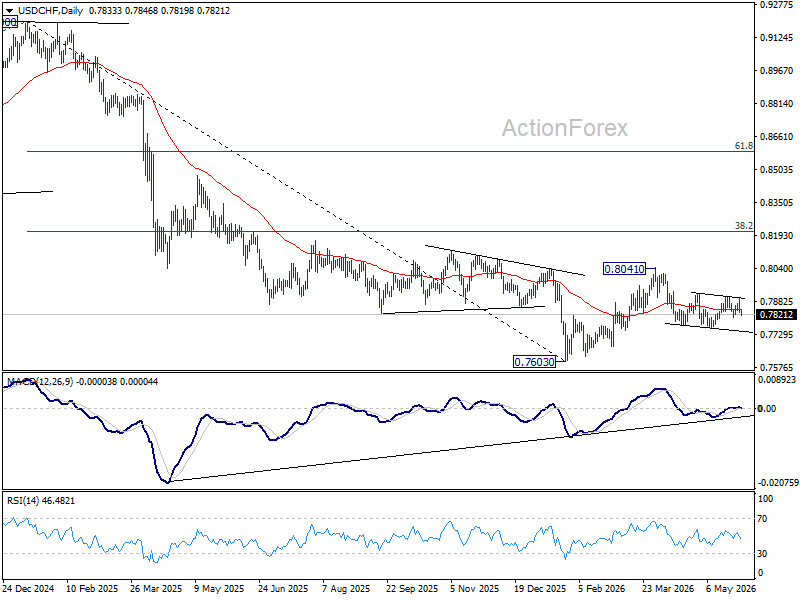
    USD/CHF Daily Outlook

    ActionForex

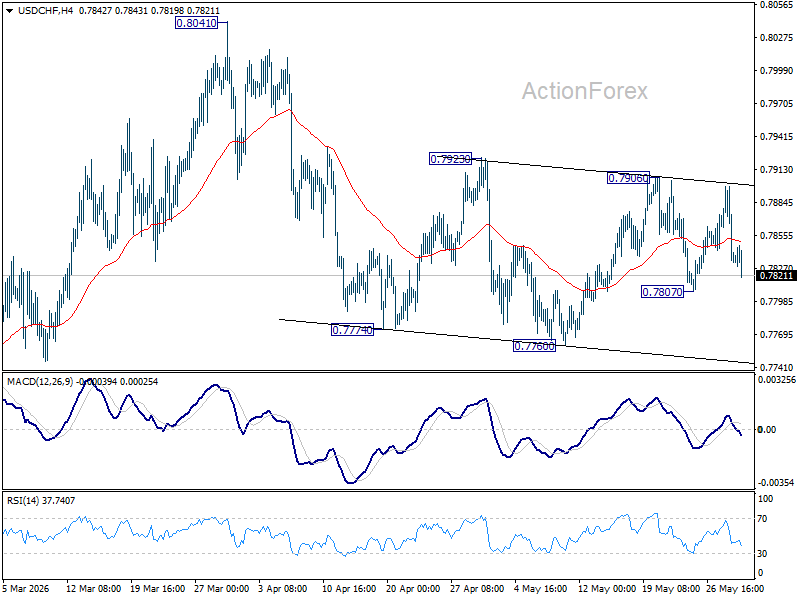
    Daily Pivots: (S1) 0.7717; (P) 0.7742; (R1) 0.7775; More….

    Intraday bias in USD/CHF stays neutral for the moment and consolidation pattern from 0.7603 is still in progress. In case of stronger rise, upside upside should be limited by 55 D EMA (now at 0.7832) to complete the pattern. On the downside, below 0.7627 will bring retest of 0.7603. Firm break there will resume larger down trend, and target 0.7382 projection level next. However, sustained break of 55 D EMA will indicate that a larger scale corrective bounce in underway and target 0.8039 resistance next.

    In the bigger picture, down trend from 1.0342 (2017 high) is still in progress. Next target is 100% projection of 1.0146 (2022 high) to 0.8332 from 0.9200 at 0.7382. In any case, outlook will stay bearish as long as 0.8123 resistance holds.
    USD/CAD Daily Outlook

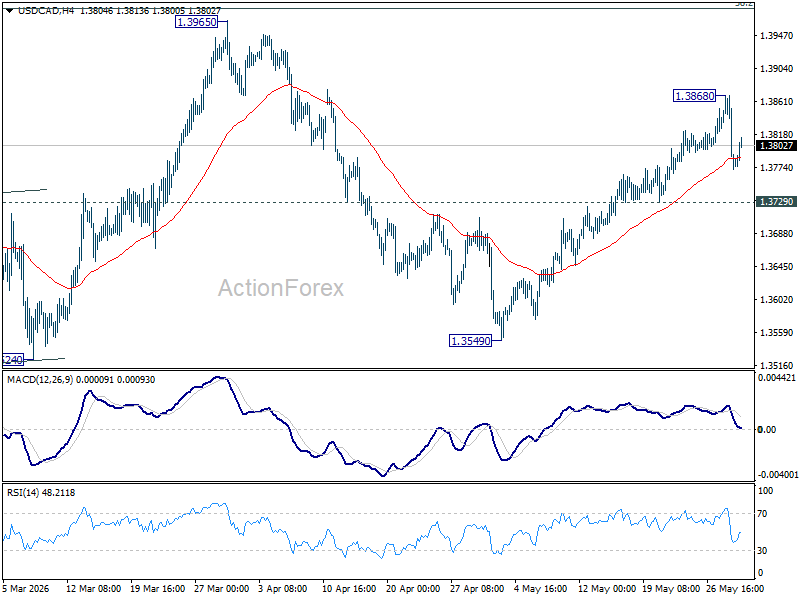
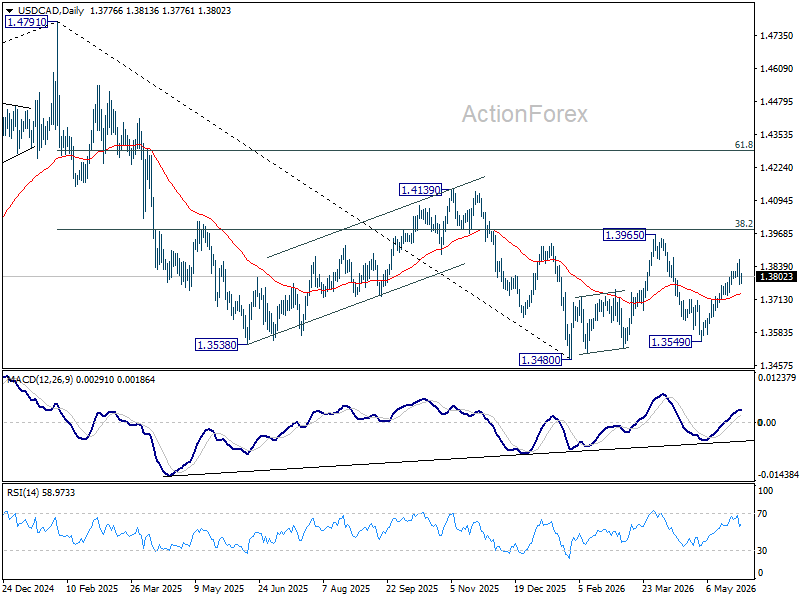
    Daily Pivots: (S1) 1.3663; (P) 1.3683; (R1) 1.3718; More...

    No change in USD/CAD's outlook and intraday bias stays neutral. Consolidations from 1.3480 is in progress and stronger rebound might be seen. But upside should be limited by 55 D EMA (now at 1.3735) to complete the pattern. On the downside, below 1..3502 will bring retest of 1.3480 low. Firm break there will resume larger down trend from 1.4791 to 61.8% projection of 1.4791 to 1.3538 from 1.4139 at 1.3365. However, sustained break of 55 D EMA will bring further rise to 1.3927 resistance and above.

    In the bigger picture, price actions from 1.4791 are seen as a corrective pattern to the whole up trend from 1.2005 (2021 low). Deeper fall could be seen as the pattern extends, to 61.8% retracement of 1.2005 to 1.4791 at 1.3069. For now, medium term outlook will be neutral at best, until there are signs that the correction has completed, or that a bearish trend reversal is confirmed.

    Falling Knives

    Markets on both sides of the Atlantic kicked off the week on a sour note, as Donald Trump’s latest tariff shake-up offered little for businesses and investors to cheer. European carmakers were among the hardest hit after EU leaders decided to freeze ratification of the trade deal signed last summer. They want clarification on the proposed 15% global tariff — what it covers and how long it would last — before moving forward. The US President expressed frustration, but signing an agreement without fully understanding the details is not the European way. As a result, the deal risks unravelling before it is even implemented — a significant waste of time and political capital.

    Elsewhere, the AI fear trade spilled over into delivery and payment stocks after research from Citrini outlined a hypothetical — not predictive — scenario in which rapid AI disruption could trigger mass white-collar unemployment within two years, leading to weaker spending, software-loan defaults and broader economic contraction. DoorDash fell more than 6%, American Express more than 7%, Mastercard and Visa lost around 4–5%, and Uber dropped over 4%.

    Yet if we follow that scenario to its logical conclusion — that AI destroys jobs and demand — it would ultimately undermine the very incentive to invest in AI. If no one is employed and no one can consume, there is little reason to produce, whether you are Adobe or McDonald’s. The narrative sounds apocalyptic.

    Markets appear to be entering a phase where extreme scenarios generate outsized reactions — with one notable exception that warrants genuine caution: capital flows within the software-financing ecosystem.

    Software stocks continue to look like falling knives — hardly inviting buyers to step in. But more concerning is that investors are seeking liquidity from instruments tied to software companies, including private credit vehicles.

    This is where Blue Owl enters the picture. Blue Owl Capital, a major US alternative asset manager specialising in private credit, including loans to software companies, announced last week that it would halt redemptions and sell more than $1 billion in loans to insurers and large pension funds to manage liquidity pressures. The core issue is a classic liquidity mismatch: as private credit became more accessible to smaller investors with shorter time horizons, the risk of redemption pressure increased. When capital retreats amid rising leverage concerns, inflows and outflows no longer align. Private markets are not designed for sudden exits.

    However, selling software-backed loans to insurers and pension funds effectively transfers that leverage — and that risk — to institutions that safeguard long-term household savings. While these are long-horizon investors, their broad exposure means that any mispricing of risk could have far-reaching consequences.

    The comparison with past credit cycles is uncomfortable: when leverage migrates rather than disappears, vulnerabilities can resurface elsewhere in the system (think of subprime crisis). If such stress were to build, AI would not be the culprit — financial structuring would.

    In short, when a heavyweight such as Blue Owl — focused on supposedly resilient enterprise software debt — restricts redemptions, it signals that leverage may be catching up with slowing growth, leaving broader economy vulnerable.

    At the same time, heavy AI-related capital expenditure by Big Tech is no longer unequivocally reassuring investors. As AI fears spill into non-technology sectors, the rotation trade comes under pressure.

    In this environment, gold appears to be reclaiming its safe-haven status. The price of an ounce rose more than 2% as the Nasdaq 100 fell 1%, restoring a healthier negative correlation after gold had recently been caught in broader risk selloffs. US 10-year Treasuries also saw demand, despite concerns that shifting trade policies could weigh on tariff revenues.

    Elsewhere, China returned from the Lunar New Year holiday to a mixed backdrop, as the new tariff regime lowers effective tariff costs for countries such as Brazil, India, Canada, Mexico and Vietnam. By contrast, the EU and the UK — which believed they had secured favourable trade arrangements — now appear more exposed under the latest reshuffle. With uncertainty high and markets near record levels, the risk of a correction is rising. A correction, however, would also create opportunities once volatility subsides.

    Finally, crude oil continues to advance on rising speculation about a potential US military operation involving Iran, even as nuclear talks persist. US crude is approaching the $68 per barrel level on geopolitical concerns. Further escalation could push prices beyond $70 and potentially toward $80 per barrel. However, geopolitically driven rallies tend to prove temporary, suggesting that any sharp upside move may eventually give way to a correction. Timing will be critical. In the meantime, energy stocks continue to outperform sectors pressured by AI fears. If one sector is structurally insulated from AI anxiety, it may well be energy: AI infrastructure is power-intensive, and the rapid expansion of data centres implies sustained demand for energy providers.

    US Consumer Confidence Takes Centre Stage

    In focus today

    From the US, the Conference Board's February consumer confidence index is due for release. The previous edition showed a clear weakening in household sentiment. ADP's weekly private sector employment estimate will also be released. In the afternoon, Chicago Fed's Austan Goolsbee, Atlanta Fed's Raphael Bostic and Boston Fed's Susan Collins will be on the wires. Overnight European time, US president Trump will give the annual State of the Union speech.

    In Hungary, the Central Bank of Hungary is expected to deliver its rate decision. We forecast a cut to 6.25% in line with consensus.

    Economic and market news

    What happened overnight

    In China, the People's Bank of China held its 1-year and 5-year loan prime rates unchanged at 3% and 3.5%, respectively, as widely expected.
    What happened yesterday

    In Germany, the Ifo index surprised on the upside in February like the PMIs in another positive signal for the economy. Both the assessment of the current situation and expectations rose. The current situation is now back at the levels seen last summer painting a picture of a slowly rebounding economy.

    In Brussels, the European Parliament postponed ratification of the EU-US trade deal amid concerns that Trump's new unilateral 15% tariff breaches the 'Turnberry accord' agreed last summer. Meanwhile, China has urged Washington to remove unilateral tariffs, India has delayed planned trade talks, and the UK has warned that "nothing is off the table" if the US fails to honour their 10% tariff deal. Today, the global tariff will start at 10%, with the administration working towards raising it to 15% under a separate order that Trump has yet to sign.

    In the US, Fed Governor Waller stated that recent productivity growth is unrelated to AI. He noted that falling vacancy rates without rising unemployment would be unusual and pointed to declining labour demand outpacing supply over the past year. This would imply a weakening labour market balance, which supports the case for further rate cuts.

    Equities: Global equities were on the backfooting yesterday declining 0.8%, with the onset of the decline starting on US open. S&P500 declined 1.0%, Nasdaq, 1.1% while Russell2000 was down 1.6%. Stoxx600 was down 0.5%. The biggest declines were in the financials and consumer discretionary, where the asset management companies and banks were hit the most in the former category and automobiles in the latter. Consumer stables and health care were the biggest winners yesterday. That said, when looking across the equity space, the cross-moving theme for yesterday's decliners were amongst AI exposed companies. Overnight, futures are up, and Asia mixed.

    FI and FX: Negative risk-sentiment with renewed AI fears pushed US stocks lower with AI exposed companies being among the largest losers. US treasury rates declined and cryptocurrencies experienced once more a negative day. EUR/USD fell back below the 1.18 level yesterday in line with the broader risk sentiment as the rally following US Supreme Court's ruling against IEEPA tariffs faded. EUR/SEK and NOK/SEK traded both higher during yesterday's session, consistent with historic patterns where scandies tend to weaken in a risk-off environment. Today's focus will be on President Trumps State of the Union speech which is supposed to start at 9:00 p.m. ET.

    AUD/USD Daily Report

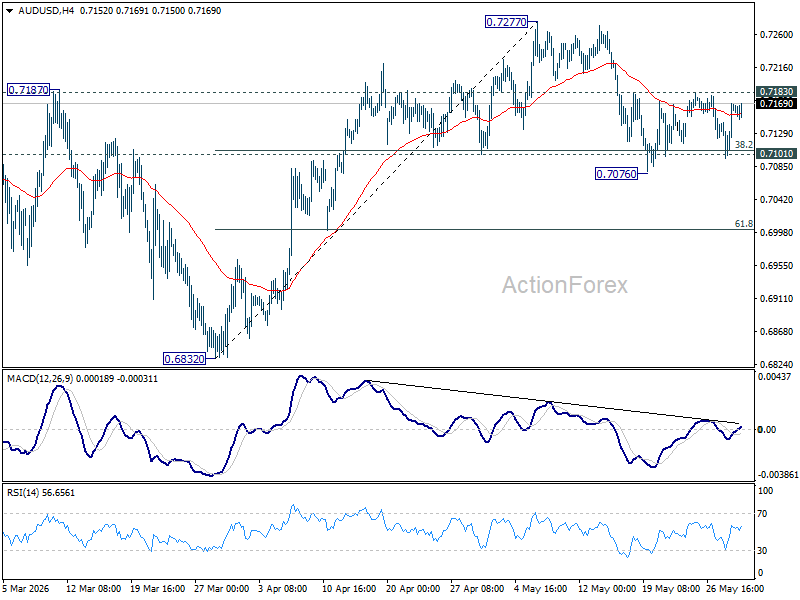
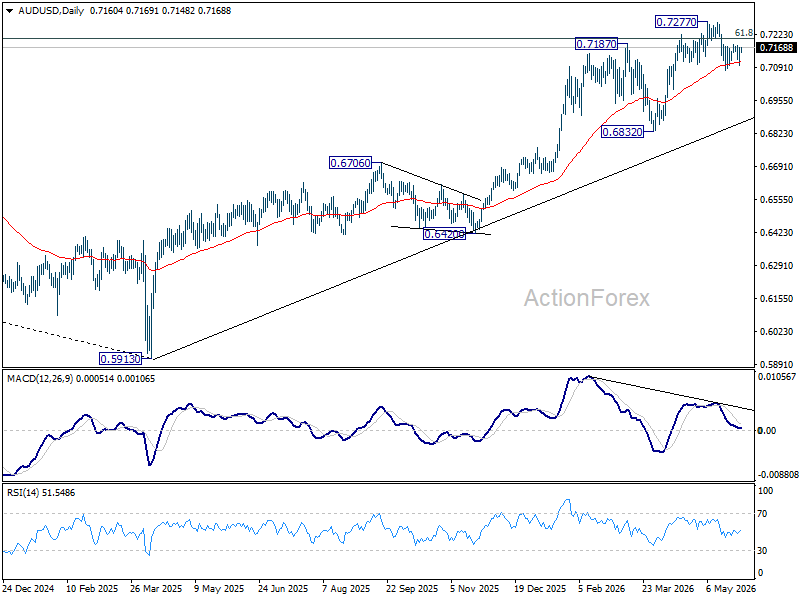
    Daily Pivots: (S1) 0.7033; (P) 0.7072; (R1) 0.7096; More...

    AUD/USD continues to gyrate in familiar range below 0.7146 and intraday bias remains neutral. Consolidations would continue and deeper retreat cannot be ruled out. But downside should be contained above 0.6896 support. On the upside, above 0.7146 will resume larger up trend to 100% projection of 0.5913 to 0.6706 from 0.6420 at 0.7213.

    In the bigger picture, current development argues that rise from 0.5913 (2024 low) is reversing whole down trend from 0.8006 (2021 high). Further rally should be seen to 61.8% retracement of 0.8006 to 0.5913 at 0.7206. This will remain the favored case as long as 0.6706 resistance turned support holds, even in case of deep pullback.

    Relief Bid in China; Korea and Japan’s “Picks and Shovels” Lead Asia Away from US Weakness

    Asian markets traded mixed despite a softer US session overnight. In particular, regional tech stocks showed resilience, with hardware names outperforming on the view that supply-chain positioning remains intact even if US software valuations reset. South Korea’s Kospi notched a fresh record high for a third straight session, powered by a rally in chipmakers. In Japan, the Nikkei also advanced, led by “picks and shovels” AI beneficiaries—equipment makers and component suppliers—on bets that Asian hardware firms will continue to monetize global AI capex. The regional divergence is clearer when contrasted with India, where software services names underperformed.

    In China, equities strengthened as markets reopened for the Year of the Horse. Sentiment was buoyed by belief that the recent US Supreme Court ruling striking down sweeping reciprocal tariffs could ease near-term export pressure. The shift from “reciprocal” levies to a flat 15% surcharge has been read as a relative improvement for China. Although US President Donald Trump subsequently announced a temporary 15% global tariff, analysts argue the reset may translate into lower effective rates for China compared with prior proposals under country-specific frameworks. That relative repricing explains the relief bid in onshore shares.

    Hong Kong, however, was a regional outlier, slipping as international investors reassessed implications of the new tariff regime. The selloff may reflect “fade the rally” positioning, with global funds cautious that the 150-day surcharge window represents only a temporary pause before more permanent measures are unveiled.

    The reconfiguration from reciprocal tariffs to a flat surcharge has produced accidental winners and losers. China, India, and Brazil—previously facing potentially punitive bilateral rates—now fall under the 15% umbrella. Traditional allies such as the UK, Italy, and Australia, which had lower baseline exposure, now face a higher effective floor.

    Still, the framework remains fluid. The 15% rate is legally defined as a temporary surcharge with a hard 150-day sunset. The administration is sure to use this period to prepare a more durable tariff architecture, limiting conviction in the relief trade.

    Currency markets reflect a mild risk-off tilt. Sterling leads gains, followed by Dollar and Swiss Franc. Australian Dollar is the weakest, trailed by Kiwi and Loonie, while Yen and Euro sit mid-pack. Yet price action lacks follow-through. Major pairs and crosses remain bounded within last week’s ranges, signaling hesitation rather than decisive repositioning. Traders appear reluctant to commit ahead of Trump’s upcoming State of the Union address today, which could clarify what's next regarding tariffs.

    In Asia, at the time of writing, Nikkei is up 0.90%. Hong Kong HSI is down -2.16%. China SHanghai SSE is up 0.87%. Singapore Strait Times is down -0.57%. Japan 10-year JGB yield is down -0.005 at 2.105. Overnight, DOW fell -1.66%. S&P 500 fell -1.04%. NASDAQ fell -1.13%. 10-year yield fell -0.57 to 4.029.

    RBA stays focused on quarterly trimmed mean during CPI transition

    In a speech today, Michael Plumb, head of economic analysis at the RBA, said the central bank welcomes the introduction of a complete monthly CPI, noting that more frequent and comprehensive data will materially improve the timeliness of its inflation assessment.

    However, Plumb cautioned that it will "take us some" time to understand the properties and seasonal patterns of the new monthly series. During the transition, the RBA will continue to "focus on the quarterly data", particularly the quarterly trimmed mean measure, for forecasting and evaluating underlying inflationary pressures.

    While maintaining its quarterly focus, the RBA has begun analyzing underlying inflation measures constructed from monthly data. Plumb said policymakers will assess potential biases, seasonal differences, responsiveness to economic conditions, and usefulness as a leading indicator.

    The central bank intends to engage widely and communicate transparently before any shift in preferred measures in what he described as a gradual move toward a “post-quarterly CPI world.”

    ECB’s Lagarde: Rates in “good place”, Europe can capture AI gains through application

    Speaking at a conference in Washington, ECB President Christine Lagarde reiterated that Eurozone monetary policy is in a “good place,” repeating guidance that the current rate setting remains appropriate. The remarks signal that the ECB is not actively considering a policy shift, as inflation stabilizes and growth remains resilient.

    Lagarde emphasized that the ECB will continue to assess incoming data and remain "agile", but her tone suggested confidence in the existing stance. The message reinforces expectations of stability in near-term meetings, with policy adjustments contingent on material changes in inflation or financial conditions.

    Turning to structural growth, Lagarde argued that Europe can still capitalize on artificial intelligence even if it does not dominate the development of cutting-edge models. She noted that history shows economic value often lies in broad application rather than invention alone, particularly in manufacturing and industrial sectors.

    PBoC extends pause in LPR, USD/CNH downtrend slows

    The People's Bank of China left its benchmark lending rates unchanged, keeping the 1-year Loan Prime Rate at 3.00% and the 5-year LPR at 3.50%. The decision marks the tenth consecutive month of steady policy.

    For now, policymakers are seen favoring targeted structural tools—supporting sectors such as technology and green energy—rather than deploying broad-based rate cuts. Holding benchmark rates also helps anchor the Yuan, which has been hovering near a 34-month high, buoyed in part by broad Dollar weakness.

    USD/CNH has been trending lower since early 2025, reflecting persistent Dollar softness. However, technically, downside momentum appears to be fading, with bullish convergence emerging on D MACD. That suggests selling pressure may be losing traction in the near term.

    Support may emerge near 200% projection of 7.2224 to 7.0840 from 7.1381 at 6.8613 to bring rebound. Firm break above 6.9105 resistance would indicate short-term bottoming and open the way toward the 55 D EMA (now at 6.9629).

    Still, renewed broad-based Dollar weakness could quickly push the pair through 6.8613 toward 261.8% projection at 6.7758, and possibly revive medium term downside momentum along the way.

    AUD/USD Daily Report

    Daily Pivots: (S1) 0.7033; (P) 0.7072; (R1) 0.7096; More...

    AUD/USD continues to gyrate in familiar range below 0.7146 and intraday bias remains neutral. Consolidations would continue and deeper retreat cannot be ruled out. But downside should be contained above 0.6896 support. On the upside, above 0.7146 will resume larger up trend to 100% projection of 0.5913 to 0.6706 from 0.6420 at 0.7213.

    In the bigger picture, current development argues that rise from 0.5913 (2024 low) is reversing whole down trend from 0.8006 (2021 high). Further rally should be seen to 61.8% retracement of 0.8006 to 0.5913 at 0.7206. This will remain the favored case as long as 0.6706 resistance turned support holds, even in case of deep pullback.


    Economic Indicators Update

    GMT CCY EVENTS Act Cons Prev Rev
    01:00 CNY 1-Y Loan Prime Rate 3.00% 3.00% 3.00%
    01:00 CNY 5-Y Loan Prime Rate 3.50% 3.50% 3.50%
    14:00 USD S&P/CS Composite-20 HPI Y/Y Dec 1.50% 1.40%
    14:00 USD Housing Price Index M/M Dec 0.30% 0.60%
    15:00 USD Consumer Confidence Feb 88.2 84.5
    15:00 USD Wholele Inventories Dec F 0.20% 0.20%


    EURCAD Riding Sell for a Move Lower

    EURCAD Sell Trade Setup

    1. Bearish divergence market patterns. (Red lines)
    2. Bearish supply zones respected. (Gray & Green boxes)
    3. Price reacting lower from the boxes.
    4. Entered SELL trade at 1.6148 with Stop Loss at 1.6168 and minimum target 1.5R 1.6118 maximum target 3R 1.6088

    EURCAD 15 Minute Chart February 23 2026

    A trader should always have multiple strategies all lined up before entering a trade. Never trade off one simple strategy. When multiple strategies all line up it allows a trader to see a clearer trade setup. We at EWF never say we are always right. No market service provider can forecast markets with 100% accuracy. Only thing we at EWF 100%, is that we are RIGHT more than we are WRONG.

    Of course, like any strategy/technique, there will be times when the strategy/technique fails so proper money/risk management should always be used on every trade. Hope you enjoyed this article and follow me on social media for updates and questions> @AidanFX

    At Elliottwave-Forecast we cover 78 instruments (Forex, Commodities, Indices, Cryptos, Stocks and ETFs) in 4 different time frames and we offer 5 Live Session Webinars everyday. We do Daily Technical Videos, Elliott Wave Trade Setup Videos and we have a 24 Hour Chat Room. Our clients are always in the loop for the next market move.

    Is Gold Ready to Extend Higher? Elliott Wave Perspective

    Spot Gold (XAUUSD) reached an all-time high of $5598.75 on January 29 before undergoing a sharp correction to $4402.40 on February 2. From that low, the metal began a recovery that can be characterized as a nesting impulse. This structure reflects a sequence of advancing waves, each building upon the prior move to sustain upward momentum.

    From the February 2 low, wave ((1)) concluded at $5091.95, while the subsequent decline in wave ((2)) found support at $4655.30, as illustrated on the one-hour chart. Following this, the market advanced into wave ((3)), which itself nested higher. Within wave ((3)), wave (1) terminated at $5119.16, and the corrective pullback in wave (2) ended at $4841.32. The internal subdivision of wave (2) unfolded as a double three Elliott Wave pattern. Specifically, wave W declined to $4877.75, wave X rallied to $5053.11, and wave Y completed at $4841.32. This sequence finalized wave (2) at a higher degree, setting the stage for renewed strength.

    Since then, the metal has resumed its upward trajectory. In the near term, as long as the pivot at $4841.32 remains intact, pullbacks are expected to attract buyers. This condition supports the view that gold will continue advancing, with corrective moves offering opportunities for accumulation rather than signaling deeper weakness.

    Gold (XAUUSD) 1-Hour Elliott Wave Chart From 2.24.2026

    XAUUSD Elliott Wave Video:

    https://www.youtube.com/watch?v=VhIIOTrZO80

    WTI Crude Oil Holds Near Highs, Bulls Eye Fresh Upside Extension

    Key Highlights

    • WTI Crude Oil prices started a decent increase above $65.00.
    • The bulls could aim for more gains above $68.00 and $68.80.
    • Gold started a fresh increase above $5,050 and $5,120.
    • EUR/USD found support near 1.1740 and corrected some losses.

    WTI Crude Oil Price Technical Analysis

    WTI Crude Oil prices started a decent increase above $63.50 against the US Dollar. The price settled above $65.00 to enter a positive zone.

    Looking at the 4-hour chart of XTI/USD, the price cleared a key bearish trend line with resistance at $65.35. The price settled above $65.00, the 100 simple moving average (red, 4-hour), and the 200 simple moving average (green, 4-hour).

    On the upside, immediate resistance is near the $67.20 level. The first key hurdle for the bulls could be $68.00. A close above $68.00 might send Oil prices toward $68.80. Any more gains might call for a test of $70.00 in the near term.

    On the downside, the first major support sits near the $65.50 zone. The next support could be $65.00, below which the price could dive and test the 100 simple moving average (red, 4-hour) at $63.95.

    A daily close below $63.95 could open the doors for a larger decline. In the stated case, the bears might aim for a drop toward $62.00 and the 200 simple moving average (green, 4-hour).

    Looking at Gold, the bulls remained in action, and the price started a fresh increase above the $5,120 resistance.

    Economic Releases to Watch Today

    • US Housing Price Index for Dec 2025 (MoM) - Forecast +0.3%, versus +0.6% previous.
    • Fed's Waller speech.
    • Fed's Cook speech.

    PBoC extends pause in LPR, USD/CNH downtrend slows

    The People's Bank of China left its benchmark lending rates unchanged, keeping the 1-year Loan Prime Rate at 3.00% and the 5-year LPR at 3.50%. The decision marks the tenth consecutive month of steady policy.

    For now, policymakers are seen favoring targeted structural tools—supporting sectors such as technology and green energy—rather than deploying broad-based rate cuts. Holding benchmark rates also helps anchor the Yuan, which has been hovering near a 34-month high, buoyed in part by broad Dollar weakness.

    USD/CNH has been trending lower since early 2025, reflecting persistent Dollar softness. However, technically, downside momentum appears to be fading, with bullish convergence emerging on D MACD. That suggests selling pressure may be losing traction in the near term.

    Support may emerge near 200% projection of 7.2224 to 7.0840 from 7.1381 at 6.8613 to bring rebound. Firm break above 6.9105 resistance would indicate short-term bottoming and open the way toward the 55 D EMA (now at 6.9629).

    Still, renewed broad-based Dollar weakness could quickly push the pair through 6.8613 toward 261.8% projection at 6.7758, and possibly revive medium term downside momentum along the way.