Sample Category Title
Eco Data 5/29/26
| GMT | Ccy | Events | Act | Cons | Prev | Rev |
|---|---|---|---|---|---|---|
| 23:30 | JPY | Tokyo CPI Y/Y May | 1.40% | 1.50% | ||
| 23:30 | JPY | Tokyo CPI Core Y/Y May | 1.30% | 1.50% | 1.50% | |
| 23:30 | JPY | Tokyo CPI Core-Core Y/Y May | 1.60% | 1.90% | ||
| 23:30 | JPY | Unemployment Rate Apr | 2.50% | 2.70% | 2.70% | |
| 23:50 | JPY | Industrial Production M/M Apr P | 0.80% | -0.30% | -0.40% | |
| 23:50 | JPY | Retail Trade Y/Y Apr | 2.10% | 1.30% | 1.70% | 1.40% |
| 01:00 | NZD | ANZ Business Confidence May | 10 | -10.6 | ||
| 01:00 | NZD | ANZ Activity Outlook May | 25.6 | 19.6 | ||
| 05:00 | JPY | Housing Starts Y/Y Apr | 11.40% | 14.70% | -29.30% | |
| 05:00 | JPY | Consumer Confidence Index May | 33.6 | 32.5 | 32.2 | |
| 06:45 | EUR | France GDP Q/Q Q1 | -0.10% | 0.00% | 0.00% | |
| 07:00 | CHF | KOF Leading Indicator Apr | 98 | 98 | 97.9 | 97.8 |
| 07:55 | EUR | Germany Unemployment Change Apr | -12K | 10K | 20K | |
| 07:55 | EUR | Germany Unemployment Rate Apr | 6.30% | 6.40% | 6.40% | |
| 12:00 | EUR | Germany CPI M/M May P | -0.20% | 0.10% | 0.60% | |
| 12:00 | EUR | Germany CPI Y/Y May P | 2.60% | 2.80% | 2.90% | |
| 12:30 | CAD | GDP M/M Mar | -0.10% | 0.10% | 0.20% | |
| 12:30 | USD | Goods Trade Balance (USD) Apr P | -82.4B | -88.6B | -87.9B | -85.3B |
| 13:45 | USD | Chicago PMI May | 62.7 | 51.3 | 49.2 |
| 23:30 | JPY |
| Tokyo CPI Y/Y May | |
| Actual | 1.40% |
| Consensus | |
| Previous | 1.50% |
| 23:30 | JPY |
| Tokyo CPI Core Y/Y May | |
| Actual | 1.30% |
| Consensus | 1.50% |
| Previous | 1.50% |
| 23:30 | JPY |
| Tokyo CPI Core-Core Y/Y May | |
| Actual | 1.60% |
| Consensus | |
| Previous | 1.90% |
| 23:30 | JPY |
| Unemployment Rate Apr | |
| Actual | 2.50% |
| Consensus | 2.70% |
| Previous | 2.70% |
| 23:50 | JPY |
| Industrial Production M/M Apr P | |
| Actual | 0.80% |
| Consensus | -0.30% |
| Previous | -0.40% |
| 23:50 | JPY |
| Retail Trade Y/Y Apr | |
| Actual | 2.10% |
| Consensus | 1.30% |
| Previous | 1.70% |
| Revised | 1.40% |
| 01:00 | NZD |
| ANZ Business Confidence May | |
| Actual | 10 |
| Consensus | |
| Previous | -10.6 |
| 01:00 | NZD |
| ANZ Activity Outlook May | |
| Actual | 25.6 |
| Consensus | |
| Previous | 19.6 |
| 05:00 | JPY |
| Housing Starts Y/Y Apr | |
| Actual | 11.40% |
| Consensus | 14.70% |
| Previous | -29.30% |
| 05:00 | JPY |
| Consumer Confidence Index May | |
| Actual | 33.6 |
| Consensus | 32.5 |
| Previous | 32.2 |
| 06:45 | EUR |
| France GDP Q/Q Q1 | |
| Actual | -0.10% |
| Consensus | 0.00% |
| Previous | 0.00% |
| 07:00 | CHF |
| KOF Leading Indicator Apr | |
| Actual | 98 |
| Consensus | 98 |
| Previous | 97.9 |
| Revised | 97.8 |
| 07:55 | EUR |
| Germany Unemployment Change Apr | |
| Actual | -12K |
| Consensus | 10K |
| Previous | 20K |
| 07:55 | EUR |
| Germany Unemployment Rate Apr | |
| Actual | 6.30% |
| Consensus | 6.40% |
| Previous | 6.40% |
| 12:00 | EUR |
| Germany CPI M/M May P | |
| Actual | -0.20% |
| Consensus | 0.10% |
| Previous | 0.60% |
| 12:00 | EUR |
| Germany CPI Y/Y May P | |
| Actual | 2.60% |
| Consensus | 2.80% |
| Previous | 2.90% |
| 12:30 | CAD |
| GDP M/M Mar | |
| Actual | -0.10% |
| Consensus | 0.10% |
| Previous | 0.20% |
| 12:30 | USD |
| Goods Trade Balance (USD) Apr P | |
| Actual | -82.4B |
| Consensus | -88.6B |
| Previous | -87.9B |
| Revised | -85.3B |
| 13:45 | USD |
| Chicago PMI May | |
| Actual | 62.7 |
| Consensus | 51.3 |
| Previous | 49.2 |
Fed’s Musalem Rejects AI Optimism as Substitute for Vigilant Monetary Policy
St. Louis Federal Reserve President Alberto Musalem pushed back against growing optimism that artificial intelligence-driven productivity gains could eventually solve the inflation problem and justify easier monetary policy. Speaking at an economic conference in Reykjavik, Musalem warned that it would be dangerous for the Fed to rely on hypothetical future productivity improvements while inflation remains well above target and inflation expectations continue drifting higher. “I believe it would be risky to rely on the prospect of higher productivity growth in the future to solve our inflation problem today,” he said.
Musalem argued that the better approach is to maintain “a vigilant monetary policy focused on restoring price stability.” His remarks highlight an increasingly important debate emerging inside the Federal Reserve between policymakers who believe AI could eventually become structurally disinflationary and officials who insist the Fed cannot base current policy on uncertain future technological gains. Musalem acknowledged that AI could eventually improve productivity, but stressed that “the jury is out” on how much benefit it will ultimately generate. In the meantime, he noted that AI investment is already contributing to stronger demand for chips, data centers, and infrastructure, potentially adding to inflation pressures rather than reducing them.
The St. Louis Fed president also warned that prematurely easy monetary policy could damage the Fed’s inflation-fighting credibility. “Moving or holding policy rates too low could actually cause longer-term interest rates to rise,” Musalem said, if investors begin questioning whether the central bank is truly committed to returning inflation to the 2% target.
Sunset Market Commentary
Markets
In the ‘glass half full, glass half empty’ dynamics, markets this morning titled to a more risk averse bias as mutual attacks and accusations of breaching the ceasefire between the US and Iran suggested that there was little progress on the way to a sustainable deal. Applying the standard reaction function, oil prices, yields and the dollar gained. Equities ceded some ground. Even so, moves were very modest and even evaporated throughout the session. Brent oil at $96.3 stays below the $100 barrier. A tentative USD rebound was also (more than) reversed (DXY currently 99.15, EUR/USD rebounded from sub 1.16 to currently 1.1635). The Eurostoxx 50 cedes 0.4%. (US) yields opened higher but already traded off intraday ‘highs’ at time of the US data releases. These data were mixed. Headline April durable goods orders were strong (7.9% M/M) but shipments (non-defense ex aircraft) were less impressive (0.4% M/M). Weekly jobless claims stayed low (215k). April spending/income data and price deflators also were a mixed bag. Income was unchanged M/M (negative 0.5% in real terms), but spending held up (0.5%, real 0.1% real). April price deflators rose further (headline 0.4% M/M & 3.8% Y/Y from 3.5%, core 0.2% M/M and 3.3% Y/Y from 3.2%) but at least didn’t surprise to the upside. It was enough for markets to further return the initial yield rise to trade with changes less than 1 bp.
The ECB published accounts of the April 30 Policy meeting. Inflation data available at that time mostly only showed a direct energy-related rise in inflation. Even so, policymakers then were already aware of the dilemma to manage both lower growth and upside inflation risks. Already at the end April meeting the policy makers assessed, ‘it had become increasingly likely that adopting a “looking through” approach was not appropriate’ and ‘that the primary focus (shifted) to determining the most appropriate timing for a rate increase’. All members were reported to have rallied behind the decision to keep the policy rate unchanged as there was no urgency to yet to act against second round effects and as it would allow the MPC to gather further information. Even so, a number of members noted ‘that the decision was a close call and that they would not have opposed raising rates at the current meeting had this been on the table’ as this could have sent an even stronger signal of the termination to bring inflation to target in a timely manner. ECB’s Lane in a speech indicated that, even if the initial energy shock starts to reverse the second round, including the impact on the labour market will be with us for a while. ECB president Lagarde in a speech in Cambodia, mostly addressed aspects related to central bank independence. The ‘ECB headlines’ only had limited impact as markets apparently have made up their mind in the run-up to the June 11 ECB meeting. A 25 bps hike is still 90% discounted. EMU swap yields today also change less than 2 bps across the curve.
News & Views
Belgian inflation accelerated to 4.08% y/y (0.08% m/m) in May from 4.01% last month, Statbel data showed today. It’s the second fastest (after January 2025’s 4.09%) in nearly three years. Core CPI (ex. energy products and unprocessed food) quickened to 3.59% from 3.55% while services inflation picked up to 5.88% from 5.28%. Some of the most significant price increases in May were registered for package holidays, private rents, domestic heating oil and veterinary services. In the Iranian war-related category, energy prices stood at 11.2% y/y, further up from May’s 10.58%. Motor fuels cost 27.3% more than in May 2025 but decreased by 0.6% m/m. Natural gas came in at 10.1% y/y and -7.3% m/m, making it one of the top negative contributors this month, along with electricity & the purchase of cars. Belgian inflation measures according to the European rules (HICP) amounts to 4.1%.
The Norwegian mainland economy (excluding petroleum & shipping activity) grew by 0.2% q/q in Q1, missing the 0.3% consensus view as well as the central bank’s 0.4% point estimate. It also followed a downwardly revised 2025Q4 to 0.2% from 0.4%. Including the energy-related activities, the economy expanded by 0.4% q/q with these offshore activities having logged a 1% expansion. General government consumption advanced 0.4% while household consumption expenditure declined 1.1%. Investments fell notably by 7.2%. Both exports and imports dropped, by 1.4% and 1.1% respectively. The Norwegian krone shrugged after the release with EUR/NOK hovering around 10.8. Neither have the lower-than-expected numbers a meaningful impact on markets’ view on central bank policy. The Norges Bank surprised some with a rate hike earlier this month and kept the prospect for another move later this year. Money markets assume such follow-through action to take place in September.
Bitcoin Accelerates Lower and Cracks Important Supports
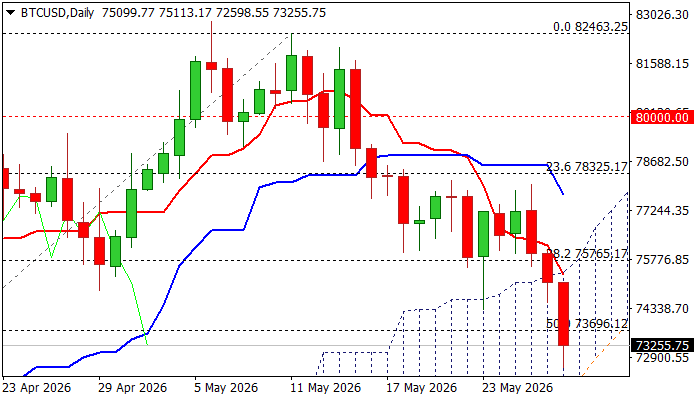
BTCUSD fell to the lowest in six weeks on Thursday, with daily loss of over 3% seen on acceleration of the bear-leg that extends into third consecutive day.
Fresh rise in oil prices on renewed tensions in the Middle East, was mainly behind today’s drop, which cracked 100DMA (73017) and pressured next significant support at 72221, provided by the base of daily Ichimoku cloud.
Bearish daily studies (strengthening negative momentum; 1055DMA and 20/30DMA bear crosses) contribute to negative near term outlook, with sustained break below 100DMA, daily cloud and nearby Fibo 61.8% of 64929/82463 (71627), to unmask psychological 70K support.
Meanwhile, bears may take a breather before final push lower, with limited upticks on partial profit-taking to provide better levels to re-enter bearish market.
Cloud top, reinforced by falling Tenkan-sen (75400) should cap upticks and keep bears in play.
Res: 73696; 75400; 75765; 77709
Sup: 72221; 71627; 70000; 69067
US: Consumer Spending Remains Soft in April Amid High Gas Prices
Personal income edged lower by 0.1% month-over-month (m/m) in April, coming in below market expectations for a 0.4% gain. After adjusting for inflation, taxes and transfers, real personal disposable income declined by 0.5% m/m.
Consumer spending rose 0.5% m/m in nominal terms – in line with market expectations. Consumers continued to spend more on gas amid high prices at the pump, which rose 5.7% last month, on top of a 19.0% increase seen in March due to higher prices.
After adjusting for inflation, spending growth remained tepid at 0.1%. Consumers spent less on goods in real terms (-0.1% m/m), cutting back on durables, such as motor vehicles and parts (-1.1% m/m) and recreational goods and vehicles (-0.5%). Spending was also weaker on clothing (-0.9%). Services spending fared better, rising 0.2% m/m. Recreational services rebounded by 1.1% and spending on food services and accommodation edged up by 0.2% after a flat reading the prior month. Spending on housing and utilities was flat, while outlays on transportation services edged lower 0.2%.
The personal saving rate continued to edge lower, dropping to 2.6%, from the downwardly revised 3.2% in the prior month and the lowest rate since June 2022.
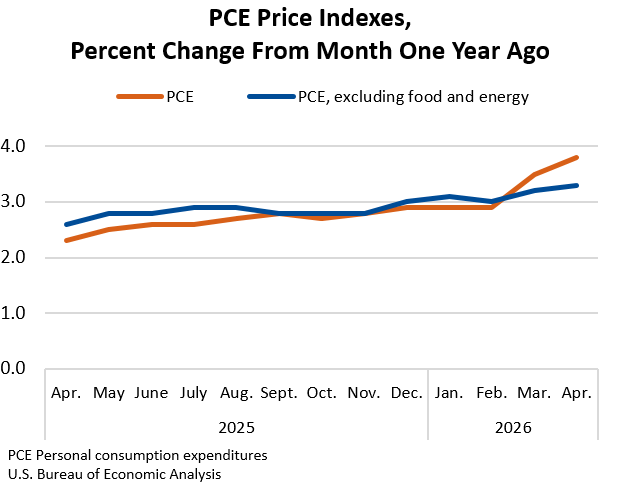
Inflationary pressures eased slightly relative to the previous month, even as inflation accelerated on a year-over-year basis. Core PCE—the Fed’s preferred inflation gauge—rose 0.2% m/m, slightly slower relative to 0.3%-0.4% monthly increases seen over the last four months. However, the twelve month change accelerated to 3.3%, slightly up from 3.2% last month.
Key Implications
The impact of higher gas prices was once again front and center in this report. Spending increased in nominal terms, but gains were modest after adjusting for inflation, with the squeeze of higher gas prices—which have remained above $4 per gallon since the end of March—weighing on consumption. Even with the boost from higher tax refunds this year, disposable income is not keeping pace with spending, prompting households to tap into their savings, indicated by a notable decline in savings rate.
Rising equity prices, a stable labor market, and larger tax refunds have provided support to the consumer through the early days of the energy shock. However, high gas prices and slower wage growth among low-income workers will reinforce the K-shaped dynamics in consumer spending. Low- and middle-income households—who allocate a larger share of their budgets to food and fuel—are likely to scale back discretionary purchases. We are already seeing some signs of this in declining volumes of gas sales, as well as softer demand for durable goods and clothing. Overall, we expect U.S. consumer spending growth to run closer to 2% this year, down from our "pre-war" forecast of 2.5%.
U.S. Economy Expands by 1.6% in Q1
According to the Bureau of Economic Analysis's second estimate, the U.S. economy expanded by 1.6% quarter-on-quarter (q/q, annualized) in the first quarter – a bit lower than 2.0% reported in the advance estimate. The downgrade was largely due to a weaker pace of consumer spending and inventory investment.
- Major contributors to Q1 growth included investment, exports, consumer spending, and government outlays, which were partially offset by a sharp rise in imports.
Consumer spending rose by 1.4% q/q (previously reported at 1.6%), a modest deceleration from Q4's 1.9%. Goods spending was largely flat on the quarter, while services rose by a respectable 1.8% (previously 2.4%).
Business investment grew by 10.1% q/q, led by a sharp acceleration in equipment spending (+17.2%) and another solid gain in intellectual property products (+11.6%). Meanwhile, spending on structures (-5.4%) declined for the nineth consecutive quarter. Residential investment (-6.3%) also fell sharply, amid a further softening in home sales and little growth in construction activity.
Government spending (+4.4%) rebounded following a sharp drop in Q4 due to the 43-day government shutdown.
International trade shaved 1.3 percentage points (pp) from growth, as a surge in imports (+21.1%) was only partly offset by a solid gain in exports (13.1%). Most of the gain in imports was driven by a pick-up in goods. Inventory investment added a modest 0.1pp (down from the advanced estimate's 0.4pp contribution) to Q1 GDP.
Final sales to private domestic purchasers, a better gauge of underlying demand as it includes only household consumption and fixed investment rose by a healthy 2.4%, an acceleration from Q4's gain of 1.8%.
Real Gross Domestic Income (GDI) – an alternative measure of economic output – rose 0.9% after rising a similar 1.6% in Q4-2025. Corporate profits were up a modest 3.8% (annualized) or $40.4 billion (unannualized) after accounting for inventory valuation and capital consumption adjustments. Personal income was up 3.3%, led by decent growth in employee compensation (+3.2%) and personal income receipts on assets (+3.9%).
Key Implications
The second estimate of Q1 real GDP did little to change the underlying narrative. The U.S. economy remained resilient through the first three-months of the year, with growth improving after a sluggish end to 2025. In part, the uptick was driven by a rebound from Q4's sharp decline in federal outlays, stemming from the record-long government shutdown. Business investment remained a bright spot, with gains driven by further investments in AI and some broadening in capital expenditures to non-AI driven expenditures.
Consumer spending was a soft spot in Q1 (as evidenced by the further downgrade in this morning's second estimate), though that appears to be largely related to a series of weather-related events that caused widespread disruptions from the Northeast down to the South through late-January and early-February. Spending has since rebounded and has (so far) remained reasonably resilient through the first few months of the energy shock, in part due to higher tax refunds which have provided households some cushion to absorb the jump in energy costs. We see the economy expanding around a 2% pace in Q2, aided by continued investments in AI and moderate growth in consumer spending.
Dollar Drifts Lower After Inflation Data, But Iran Risks Limit Selloff
Dollar weakened broadly in early US trading today, though price action remained largely rangebound against most major currencies as markets struggled to find a decisive macro direction. Elevated Treasury yields, with the US 10-year yield holding near 4.5%, continued offering support to the greenback even as softer-than-expected monthly PCE inflation data eased immediate fears of sharp near-term inflation acceleration. At the same time, ongoing uncertainty surrounding the US-Iran conflict prevented investors from aggressively rebuilding short Dollar positions.
The latest inflation figures were generally viewed as modestly reassuring for markets. Both headline and core monthly PCE readings came in slightly below expectations, reinforcing the recent message from Federal Reserve officials that policymakers are not rushing toward tightening despite increasingly vocal concerns over persistent oil-driven inflation risks.
With the federal funds rate already sitting in a mildly restrictive 3.50–3.75% range, many policymakers appear comfortable maintaining a wait-and-see approach while assessing whether the energy shock develops into broader second-round inflation pressure. Unlike Europe, the United States also retains a relative advantage through greater energy independence, allowing the Fed more flexibility to treat recent oil volatility as a temporary supply-side distortion rather than an immediate monetary-policy emergency.
Nevertheless, the geopolitical backdrop remains highly fragile. The United States and Iran continue exchanging direct military strikes even while negotiations toward a potential interim agreement remain alive. Markets still appear to view diplomacy as the most likely endgame, however, with Brent crude unable to sustain rallies toward the key $100 psychological level despite renewed escalation headlines. That relatively restrained oil behavior suggests investors are not yet pricing a full regional energy shock scenario, even if confidence in a rapid agreement has faded.
In currency markets, Kiwi remained the week’s strongest performer following the hawkish hold from the Reserve Bank of New Zealand, which sharply increased expectations for another rate hike in coming meetings. Euro stayed firmly supported after the latest European Central Bank meeting accounts revealed policymakers were already debating hikes aggressively back in April, reinforcing expectations for tightening in June. Aussie remained surprisingly resilient despite softer domestic inflation data, suggesting broader risk sentiment remains constructive.
Meanwhile, Swiss Franc lagged as elevated global yields continued weighing on traditional low-yielding defensive currencies. Loonie remained pressured by the sharp collapse in oil prices earlier in the week. Sterling and Dollar are trading near the middle of the weekly performance rankings.
Oil Holding Below $100 Suggests Markets Still See Room for a US-Iran Deal
Fresh US strikes and Iranian retaliation pushed oil prices sharply higher again, but Brent crude’s failure to break above $100 suggests markets still believe diplomacy survives. Read More.
Iran Peace Hopes Collapse After New Strikes as Gold Eyes 4,000 and Silver Tests 70
The market’s “imminent Iran peace deal” narrative collapsed after fresh US strikes reignited inflation fears across global markets. Oil and Dollar surged together while Gold and Silver came under heavy liquidation pressure. Read More.
ECB Minutes Reveal June Rate Hike Momentum Growing Rapidly
The ECB is increasingly abandoning the idea of “looking through” the Middle East energy shock as policymakers prepare markets for a likely June rate hike. Read More.
US Core PCE Inflation Stays Hot as Annual Price Pressures Accelerate to 3.3%
April’s US PCE report showed softer monthly inflation readings, but annual headline and core inflation both moved higher, reinforcing the Fed’s concern about persistent price pressures. Read More.
US Durable Goods Orders Smash Forecasts as Transportation Demand Jumps
Strong transportation equipment demand pushed US durable goods orders sharply higher in April, while underlying business spending also beat forecasts. Read More.
US Jobless Claims Edge Higher to 215k as Continuing Claims Rise Too
US jobless claims rose above expectations while continuing claims kept trending higher, reinforcing signs of gradual labor-market cooling. Read More.
USD/CHF Daily Outlook
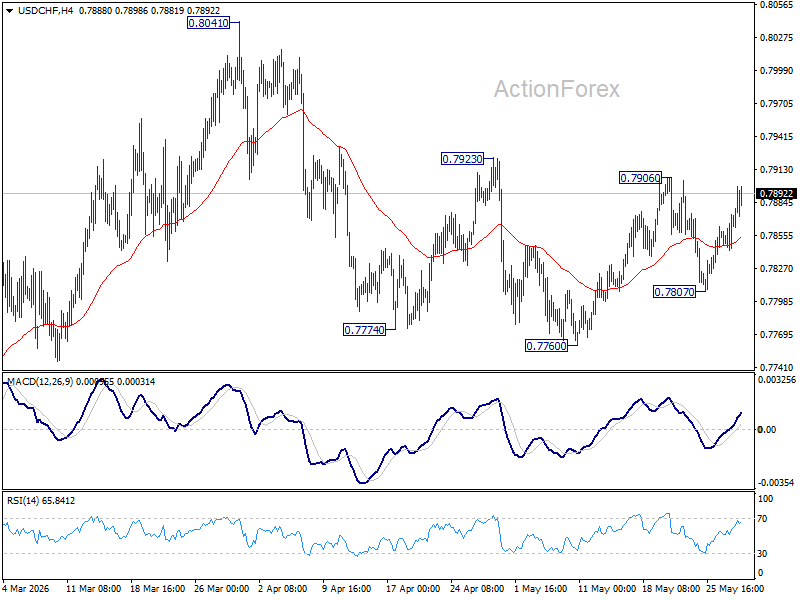
Intraday bias in USD/CHF remains neutral first. Firm break of 0.7906/23 will indicate that fall from 0.8041 has already completed as a correction. Further rally should be seen to retest 0.8041. On the downside, though, below 0.7807 will resume the fall from 0.8041 through 0.7760.
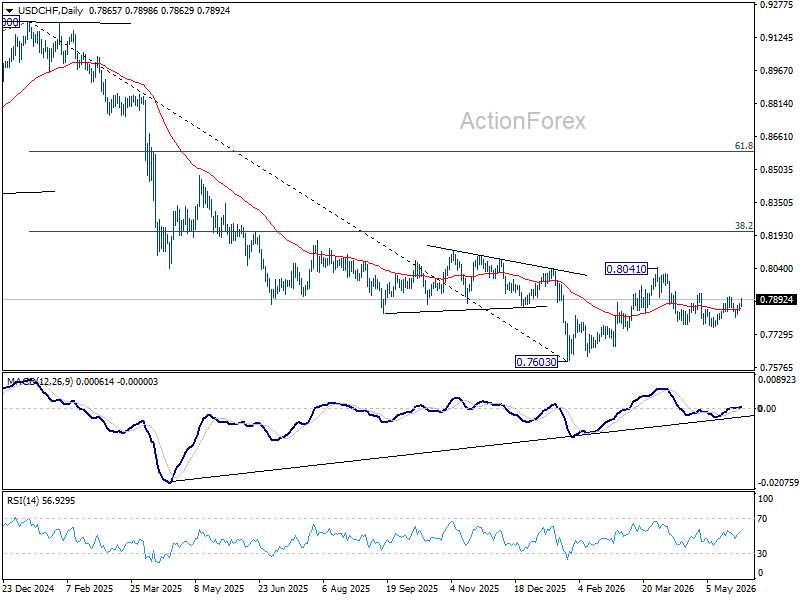
In the bigger picture, as long as 55 W EMA (now at 0.8035) holds, fall from 0.9200 is expected to continue, as part of the larger down trend. Firm break of 0.7603 will target 100% projection of 1.0146 (2022 high) to 0.8332 from 0.9200 at 0.7382.
US Jobless Claims Edge Higher to 215k as Continuing Claims Rise Too
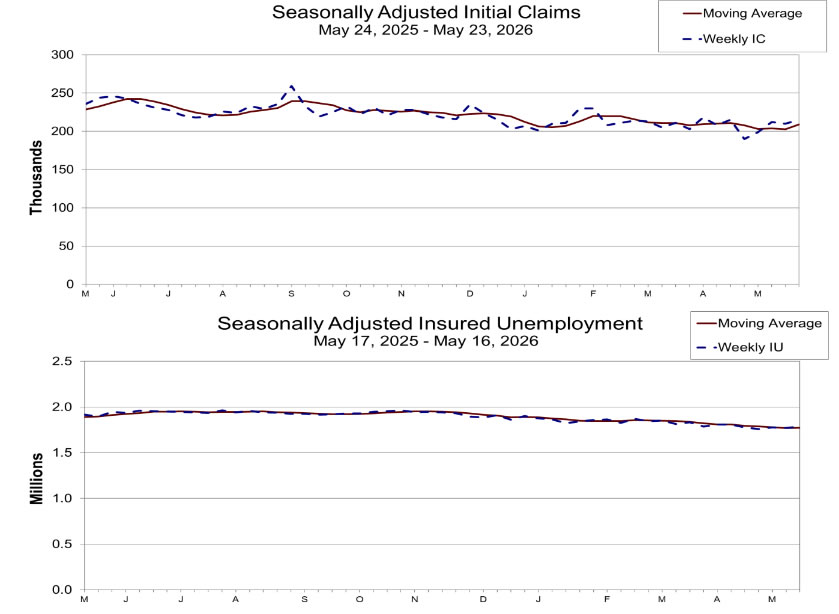
US initial jobless claims rose by 5k to 215k in the week ending May 23, coming in slightly above expectations of 210k. The four-week moving average of initial claims also climbed to 209k.
Continuing claims increased by 15k to 1.786m in the week ending May 16, while the four-week moving average rose to 1.773m. The continued rise in continuing claims may indicate unemployed workers are taking longer to find new jobs, pointing to some cooling in labor-market momentum.
| Indicator | Previous | Forecast | Actual |
|---|---|---|---|
| Initial Jobless Claims | 210k | 210k | 215k |
| 4-Week Avg Initial Claims | 202.75k | 209k | |
| Continuing Claims | 1.771m | 1.786m | |
| 4-Week Avg Continuing Claims | 1.770m | 1.773m |
US Durable Goods Orders Smash Forecasts as Transportation Demand Jumps
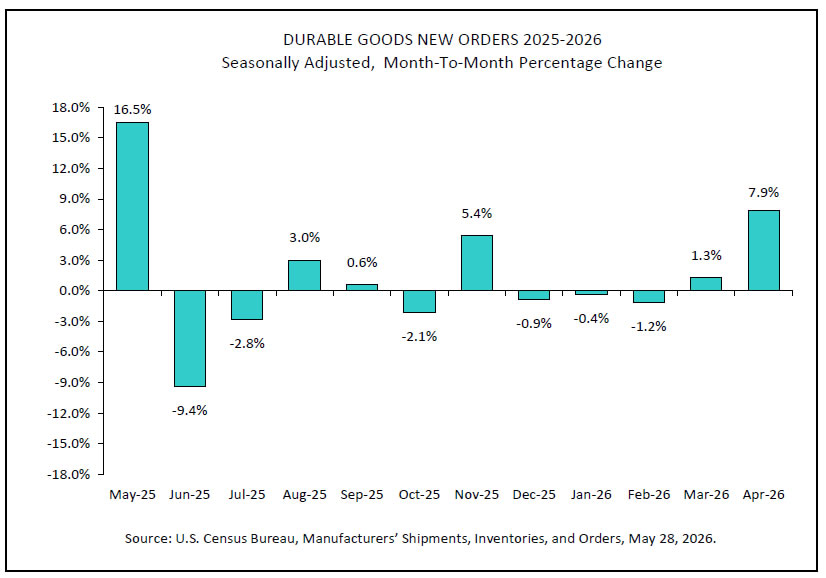
US durable goods orders posted much stronger-than-expected growth in April, highlighting continued resilience in business investment and manufacturing demand despite elevated interest rates and growing inflation concerns. Headline durable goods orders jumped 7.9% mom to USD 346.0B, far above expectations for a 3.3% mom increase. The sharp gain was led by transportation equipment orders, which surged 21.5% mom to USD 130.9B.
Underlying demand also showed broad improvement beyond the volatile transportation category. Durable goods orders excluding transportation rose 1.1% mom to USD 215.1B, beating expectations of 0.5% mom. Meanwhile, ex-defense orders climbed 8.1% mom to USD 320.3B, suggesting private-sector business demand remained relatively firm.
The data indicates that corporate spending momentum has not deteriorated significantly despite tighter financial conditions and uncertainty tied to higher energy costs and the Middle East conflict.
| Indicator | Forecast | Actual |
|---|---|---|
| Durable Goods Orders (MoM) | 3.3% | 7.9% |
| Durable Goods Ex-Transportation (MoM) | 0.5% | 1.1% |
| Durable Goods Ex-Defense (MoM) | N/A | 8.1% |
| Transportation Equipment Orders (MoM) | N/A | 21.5% |
US Core PCE Inflation Stays Hot as Annual Price Pressures Accelerate to 3.3%
US inflation data for April showed some moderation in monthly price pressures, though the broader annual trend continued pointing higher as the Federal Reserve remains focused on persistent inflation risks. The headline PCE price index rose 0.4% mom, slightly below expectations of 0.5% mom. The Fed’s preferred inflation gauge, Core PCE, which excludes food and energy, increased 0.2% mom, also softer than the expected 0.3% mom reading.
However, annual inflation measures continued accelerating. Headline PCE rose from 3.5% yoy to 3.8% yoy, while core PCE edged up from 3.2% yoy to 3.3% yoy, both matching expectations.
The data reinforces the Fed’s growing concern that higher energy costs tied to the Middle East conflict are continuing to filter through broader inflation dynamics even as monthly momentum shows occasional moderation.
Elsewhere in the report, personal income unexpectedly slipped slightly in April, missing expectations for a solid 0.4% mom increase, while consumer spending remained relatively firm with a 0.5% mom gain.
| Indicator | Previous | Forecast | Actual |
|---|---|---|---|
| Headline PCE (MoM) | 0.3% | 0.5% | 0.4% |
| Core PCE (MoM) | 0.2% | 0.3% | 0.2% |
| Headline PCE (YoY) | 3.5% | 3.8% | 3.8% |
| Core PCE (YoY) | 3.2% | 3.3% | 3.3% |
| Personal Income (MoM) | 0.2% | 0.4% | -0.1% |
| Personal Spending (MoM) | 0.6% | 0.5% | 0.5% |