

Sample Category Title
Hawks 1 Doves 0
Hawks 1 Doves 0
Jay Powell testified before the U.S. House of Representatives’ Financial Services Committee stressing the Fed needs a policy anchor grounded in continuity. Indeed, the tone of Chair Powell’s written testimony suggests that on the whole, the Fed policy isn’t about to shift abruptly under his leadership and that the pace of gradual rate hikes will continue to be the mainstay of the Fed narrative. However, his pointer at the topside potential for both inflation and growth suggests the risks as skewed for a bolder montery policy response.
The shifting balance of risks has the market considering the possibility of more 2018 rate hikes than expected given his outlook on both growth and inflation. The Fed’s December economic outlook pointed to three rate increases this year, but with two surprisingly strong inflation prints between then and now, they have likely tipped the scales on the Feds inflation outlook.
In the aftermath, we are in the midst of vintage cross-asset rotation as front-end treasuries sell-off, stock markets are discernably lower, and commodities are tanking in response to Powell hawkishness. Denuded of any significant fireworks, however, the message from Powell’s testimony was clear. With the economy in full swing, monetary policy needs to get back in the game. In fact, he’s not too concerned about risk aversion but factoring the economic upside from fiscal policy
After day one of the two-day policy test: Hawks 1 Doves 0
Equity Markets
US equity markets closed in a sea of red which is expected to engulf Asia markets today. No need to sugar coat this analysis as there was no rabbit out of the hat just the big bad bear. Investors may have been expecting some response to equity market volatility, but that was apparently of little concern to Powell. Indeed, no sign of a “Powell Put” in play, which is trading well out of the money at this stage. . With that in mind, the odds of four rates in 2018 rose to 33% from about 20% on Monday, according to CME Group’s data.
Oil Markets
The asset rotation out of commodity markets on the stronger USD narrative combined with the oil traders refocusing on shale production output as the US on course to be the worlds largest oil producer has prices convincingly moving lower.
Also, suggestions OPEC could taper production cuts early 2019 is weighing on sentiment this morning. Given that OPEC compliance is responsible for 40-50 % of recent oil price appreciation, Saudi oil minister Khalid al-Falih comments are not going without notice.
It’s a typical trader reaction, when markets flip upside down, all the negatives come to the fore.
Gold Markets
Gold found fresh session lows post-Powell testimony bottoming around 1313.5 before finding a bid and consolidating around the 1318 levels. All part and parcel of the classic asset rotation as the strong dollar pressured gold lower. While traders will wait for confirmation in tomorrows senate testimony which tends to be more telling, today’s discussion suggests we could see a higher interest rate profile and recovering dollar near term which could trigger a more profound move lower on Gold. Not the best of outcomes for Gold bulls
Currency Markets
The Euro
The combination of a hawkish Powell and uber ECB hawk Weidmann coming out dovish has convincingly toppled the Euro. Weidmann is in the running for the ECB president and likely becoming more moderate given that its ECB hawkishness that sends the Euro soaring which panics most ECB members.But let’s not lose sight that the recent German CPI missed expectation suggestion inflation in the EU largest economy is not an issue and no immediate need to raise rates
The Japanese Yen
Only moderate upward pressure on USDJPY and almost as everyone wants to stay away given that recent ranges continue to hold firm. Perhaps uncertainty over month-end flows or caught between equity sell-off vs higher US rate dynamics, but the balance of risk suggest a test of the 107.50-75 levels sooner than later
The Australian Dollar
Commodity currencies took it on the chin overnight, but the Aussie remains tentatively supported above the primary .7775 level. But one thing that tends to hold true for the A$, and hardly a scientific metric mind you, buy Aussie when you can’t find a bull
The Malaysian Ringgit
The Ringgit is holding up well this morning in pre-open trades despite the market increasing bets on an addition US rate hike in 2018 and oil prices moving lower.
The Ringgit external position remains very favourable and given market positioning is not excessive, one other Fed fund rate hike in 2018 is less impact the MYR than regional peers. Also, the BNM raised interest early this year and will do so again if inflation warrant. While a faster pace of US interest rate normalisation is not an ideal platform for region currencies, it’s not all doom and gloom for the Ringgit.
GBP/USD – Pound Dips As Powell Pushes Dollar Higher
The British pound has posted losses in the Tuesday session. In North American trade, GBP/USD is trading at 1.3925, down 0.28% on the day. In economic news, Federal Reserve Chair Jerome Powell made his first appearance before Congress. Meanwhile, durable goods reports were dismal. Core Durable Goods declined 0.3%, short of the estimate of +0.4%. This marked the second decline in three months. Durable Goods plunged 3.7%, missing the estimate of -2.4%. This reading was the sharpest decline since July. There was better news from CB Consumer Confidence, which improved to 130.8, well above the estimate of 126.2 points. Later in the day, the UK releases BRC Shop Price Index and GfK Consumer Confidence. On Wednesday, the US releases Preliminary GDP, with an estimate of 2.5%.
There were no dramatic moments during Jerome Powell’s testimony before a congressional committee on Tuesday. Powell was cautious, saying that the Fed planned to continue its current policy of gradual rate increases, despite the stimulus of government spending and recent tax reform. Powell sounded optimistic about economic conditions, noting that the US economy was benefiting from the global recovery as well as changes in fiscal policy. Importantly, Powell did not address the question of an acceleration of rate hikes. Currently, the Fed has projected three rate hikes in 2018, with a March hike priced in at 87%, according to the CME’s Fed Watch. However, with inflation moving higher and the economy continuing to perform well, many analysts expect the Fed to raise rates four or more times this year. Any hints at an increased pace of rate hikes could send the US dollar broadly higher.
Brexit negotiations have been bumpy from the start, but matters seem to be deteriorating almost daily. Prime Minister May is in a tough spot, with the Europeans dismissing her latest proposals on a trade deal after Brexit, and many members of her party supporting playing hard with Europe. May has proposed that a trade deal would allow some divergence with EU regulations in certain industries, but the Europeans have dismissed this as ‘cherry picking’, which they say is a non-starter. May will lay out her post-Brexit vision of relations with the EU in a speech on Friday and if the Europeans pour cold water on her plan, the markets could react negatively.
Gold Slides As Powell Says Gradual Rate Hikes To Continue
Gold has posted sharp losses in the Tuesday session. In North American trade, the spot price for an ounce of gold is $1314.53 down 1.40% on the day. In economic news, Federal Reserve Chair Jerome Powell made his first appearance before Congress. Meanwhile, durable goods reports were dismal. Core Durable Goods declined 0.3%, short of the estimate of +0.4%. This marked the second decline in three months. Durable Goods plunged 3.7%, missing the estimate of -2.4%. This reading was the sharpest decline since July. There was better news from CB Consumer Confidence, which improved to 130.8, well above the estimate of 126.2 points. On Wednesday, the US releases Preliminary GDP, with an estimate of 2.5%.
There were no dramatic moments during Jerome Powell’s testimony before a congressional committee on Tuesday. Powell was cautious, saying that the Fed planned to continue its current policy of gradual rate increases, despite the stimulus of government spending and recent tax reform. Powell sounded optimistic about economic conditions, noting that the US economy was benefiting from the global recovery as well as changes in fiscal policy. Importantly, Powell did not address the question of an acceleration of rate hikes. Currently, the Fed has projected three rate hikes in 2018, with a March hike priced in at 87%, according to the CME’s Fed Watch. However, with inflation moving higher and the economy continuing to perform well, many analysts expect the Fed to raise rates four or more times this year. Any hints at an increased pace of rate hikes could send the US dollar broadly higher.
Gold often moves higher when key US indicators point downward, but that has not been the case in the Tuesday session. Despite very soft durable goods reports for January, the dollar has posted gains against other major currencies and has surged against gold. Investors have given the greenback a thumbs-up after Jerome Powell’s testimony earlier, in which he pointed to solid economic conditions and reiterated the need for further rate hikes. Gold has dropped to a 2-week low, and the slide could continue if sentiment over the dollar remains positive.
USD/JPY – Japanese Yen Dips On Powell Testimony
The Japanese yen has lost ground in the Tuesday session. In North American trade, USD/JPY is trading at 107.45, up 0.48% on the day. On the release front, BoJ Core Inflation edged up to 0.8%, beating the forecast of 0.6%. In the US, durable goods reports were dismal. Core Durable Goods declined 0.3%, short of the estimate of +0.4%. This marked the second decline in three months. Durable Goods plunged 3.7%, missing the estimate of -2.4%. This reading was the sharpest decline since July. There was better news from CB Consumer Confidence, which improved to 130.8, well above the estimate of 126.2 points. In Washington, Federal Reserve Chair Jerome Powell made his first appearance before Congress. Later in the day, Japan releases Preliminary Industrial Production and Retail Sales. On Wednesday, the US releases Preliminary GDP, with an estimate of 2.5%.
All eyes were on Jerome Powell on Tuesday, and the new Fed chair played it safe in his written testimony before a congressional committee. Powell said that the Fed would maintain its policy of gradual rate increases, despite the stimulus of government spending and recent tax reform. Powell sounded optimistic about economic conditions, noting that the US economy was benefiting from the global recovery as well as changes in fiscal policy. Importantly, Powell did not address the question of an acceleration of rate hikes. Currently, the Fed has projected three rate hikes in 2018, with a March hike priced in at 87%, according to the CME’s Fed Watch. However, with inflation moving higher and the economy continuing to perform well, many analysts expect the Fed to raise rates four or more times this year. Any hints at an increased pace of rate hikes could send the US dollar broadly higher.
Bank of Japan Governor Harohiko Kuroda was recently reward with a second 5-year term, and has lost no time in defending his monetary policy. Speaking in parliament on Monday, Kuroda said he had no plans to conduct a review as to why the Bank’s massive stimulus program had failed to raise inflation to the target of just under 2 percent. Kuroda said it was “unfortunate” that the target had not been met, but argued that the BoJ’s “powerful” monetary easing had eliminated deflation. Kuroda’s comments were another clear message that the BoJ will not be reducing its massive stimulus program anytime soon. The Japanese economy has rebounded, but inflation has not kept pace, with BoJ core consumer inflation climbing just 0.8% in January.
Powell Paints The Dots
In one breath Fed Chair Powell said he wouldn't prejudge changes to the Fed dot plot but in the next he made it clear it's going higher. The US dollar was the top performer on Tuesday while commodity currencies lagged. All eyes will be on China later, before Eurozone Feb preliminary CPI and US revised Q4 GDP on Wednesday. Below is the Premium video outlining the existing shorts in selected indices. A detailed update/revision has been added to the EURUSD trade.
Powell spent more than three hours answering questions in the US House of Representatives and will do it again in the US Senate on Thursday, but the most important question in markets was posed to him directly: Will the Fed hike three times this year or more?
He was diplomatically non-committal on the forecast but then added a list of reasons why the outlook improved. That included better data, the tax cut, stronger global growth and consumer sentiment.
The final one on the list was underscored by the Conference Board, whose consumer confidence indicator rose to the best since 2001 at 130.8 versus 126.5 expected.
The headlines came at short time apart and gave the US dollar a lift. In turn, EUR/USD dropped to 1.2222 from 1.2320 at the start of US trading. Cable fell more than 100 pips with Brexit worries also contributing to the decline.
Commodity currencies were particularly hard hit with USD/CAD climbing to a fresh 2018 high and the first close above the 200-day moving average since June.
Looking ahead, top Chinese Communist officials are wrapping up meetings on Wednesday that focus on high-level appointments. One of those is likely to be at the PBOC where governor zhou xiaochuan is expected to announce his retirement. It would be unusual to get a quick announcement on the Zhou's replacement but any leak or other statements from the meeting could move markets. Early headlines include forecasts for growth to stay above 6.5% this year and next.
Other China news includes the official manufacturing and non-manufacturing PMIs. Both are due at 0100 GMT and forecast to edge lower to 51.1 and 55.0, respectively.
EURUSD Loses Traction after Weak German Inflation, Powell; Probes Below N/T Congestion Floor
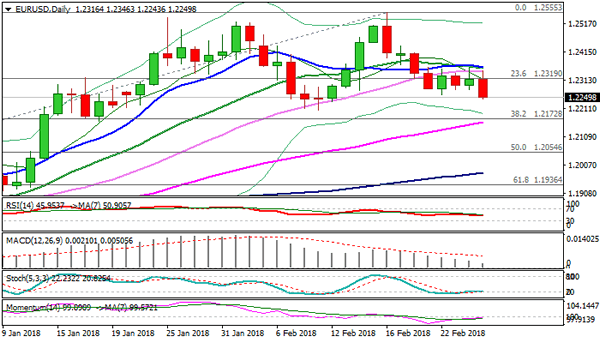
The Euro lost traction after repeated test of near-term congestion tops and fell below range low at 1.2260 on Tuesday.
Downbeat German inflation data (German inflation slowed more than expected and hit 15-month low in Feb) were initial trigger for bearish acceleration, which was further inflated by stronger dollar on Fed Powell's testimony.
Today's fall could be initial signal of fresh weakness after 30SMA repeatedly capped rallies, but bears still need a catalyst.
Close below 1.2260 would be negative signal to maintain fresh bearish sentiment for extension towards key supports at 1.2205 (09 Feb low) and 1.2173 (Fibo 38.2% of 1.1553/1.2555 rally) with sustained break here to generate strong bearish signal for deeper correction.
Alternative scenario would require lift above 30SMA (1.2344) and converged 10/20SMA's (1.2355/59) to neutralize and shift focus higher.
Res: 1.2277; 1.2310; 1.2346; 1.2360
Sup: 1.2247; 1.2205; 1.2173; 1.2160
Eurozone’s Last Inflation Input before ECB Meeting Due
Eurozone flash inflation figures for the month of February are scheduled for release on Wednesday at 1000 GMT. Price pressures are anticipated to ease on an annual basis, with market participants potentially extrapolating from the numbers to what European Central Bank policymakers will likely decide on when they next meet in March.
Headline CPI is projected to grow by 1.2% y/y and core CPI – the measure that excludes volatile food and energy items from its calculations – is forecast to expand by 1.1%. These compare to January's figures of 1.3% and 1.2% respectively, and should they materialize, they would stand at a distance to the ECB's target for inflation of below but close to 2% on an annual basis.
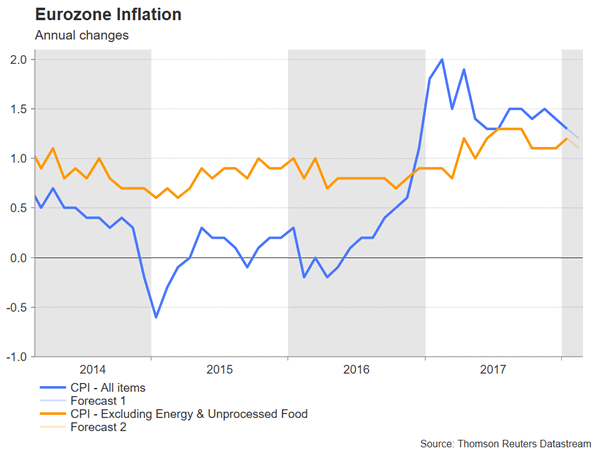
Softening oil prices in February are acting as a drag on headline inflation. The core rate, while not targeted by the ECB, has received considerable attention under a Draghi-led ECB and will also be closely monitored by market participants; last month's acceleration in core CPI was viewed as an encouraging sign.
Tomorrow's numbers will constitute the last inflation input ahead of the ECB meeting concluding on March 8 and thus the markets might assign a larger weight on them than would otherwise have been the case.
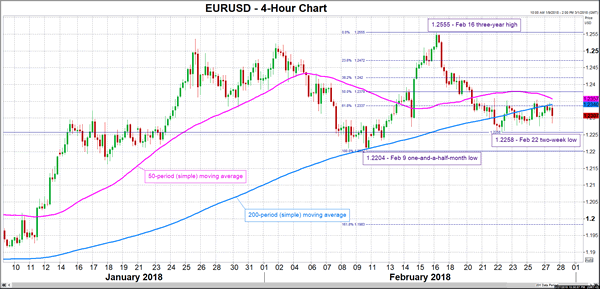
An upside surprise in the readings is expected to lend support to euro/dollar. In this case, the range from 1.2337 to 1.2357, which encapsulates the 61.8% Fibonacci mark of the February 9 to February 16 upleg on the lower bound and the 50-period moving average on the upper, might act as resistance. A data miss though could lead market participants to push further back in time their expectations for further monetary policy tightening by the ECB, spurring short positioning in the euro. Under such a scenario, euro/dollar might find support around the two-week low of 1.2258 that was recorded on February 22. The area around this level was congested in the past and also includes Monday's near one-week low of 1.2276.
Ahead of tomorrow's release, Germany, the eurozone's largest economy, has released its respective figures earlier on Tuesday. Those came in softer than expected and led to euro weakness, though the sell-off in the eurozone's common currency was fairly limited. Meanwhile, Spain's inflation numbers came in stronger than analysts projected.
On the policymaking front, it is worthy of mention that in a talk on Monday, ECB President Mario Draghi said that recent volatility in currency markets justifies close monitoring, adding that eurozone economies are expanding at a robust pace, though officials must persistently continue to provide stimulus.
Other risk events for the common currency as the week unfolds are the Italian national elections and the outcome of the vote by the German SPD on whether to revive the party's "grand coalition" with Chancellor Merkel's conservative bloc. Both outcomes will be known on March 4, with the odds for the latter being in favor of an endorsement of the coalition deal that was struck a few weeks ago.
Lastly, it should be mentioned that US-related developments and economic releases on the horizon also have the capacity to lead to positioning in the euro/dollar pair. For example, the world's largest economy will see the release of revised Q4 2017 growth figures on Wednesday, while January's core personal consumption expenditures (PCE) price index – the Fed's preferred inflation measure – will be made public on Thursday.
USD INDEX – Powell Did Not Provide Any Signal of a Pace of Tightening But Somewhat Hawkish Tone Inflated...
The dollar was higher across the board as Fed Chairman Powell stayed in line with existing stance regarding monetary policy, but somewhat hawkish tone firmed the greenback, which lacked spark for stronger rally, expected on more hawkish tone from the testimony.
Powell said that economic outlook remains balanced, but inflation is still a problem. As expected, he did not hint any change in pace of rate hikes this year, favoring gradual tightening, which will depend on inflation and labor.
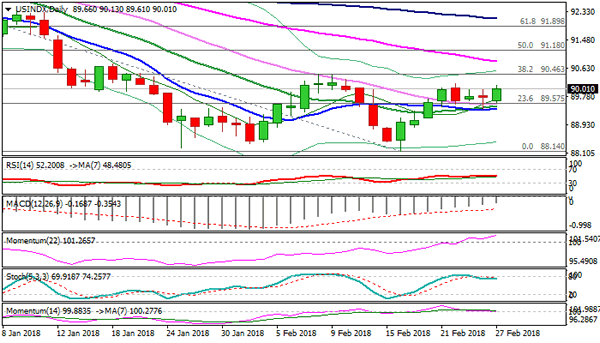
The dollar index spiked above 90.00 barrier and came ticks ahead of last week's recovery high at $90.16.
Fresh rally after shallow pullback from 90.16 high which was completed in two-day consolidation, turns focus higher again, as daily MA's (10/20/30) are in bullish setup, but weakening momentum studies on daily chart warn of recovery stall.
The index is still holding within consolidation range after the latest bear-leg from 94.22 (12 Dec lower top of broader downtrend from Jan 2017 high) found footstep at 88.14 (16 Feb low) and firm break above range top and pivotal barrier at 90.44 ( 09 Feb recovery high/Fibo 38.2% of 94.22/88.14) is needed to generate stronger bullish signal for extension of recovery and confirm double-bottom at 88.24/14 (25 Jan/16 Feb lows).
However, dollar's recovery attempts may run out of steam as Powell did not provide any signal of more significant steers in the US monetary policy, regarding increasing pace of tightening in 2018 and from technical point of view, the price remains weighed by falling daily Ichimoku cloud.
Failure at initial 90.16 barrier would signal extended consolidation, while stronger negative signal could be expected on break below congestion floor and Monday's low at 89.41
Res: 90.16; 90.44; 90.82; 91.18
Sup: 89.61; 89.41; 89.15; 88.91
US: Durable Goods Point to Slower Equipment Spending
Durable goods orders fell 3.7 percent in January amid a drop in aircraft and defense orders. Core capital goods orders, however, were down 0.2 percent and the weakening trend points to slower business spending in Q1.
Back to Reality
Last year's moonshot in business spending is showing some signs of returning to earth. After increasing at a double-digit pace in both the third and fourth quarter of 2017, private equipment spending looks to be cooling according to the latest durable goods report. Durable goods orders fell 3.7 percent in January (we were expecting a 3.5 percent pullback). That came on the heels of a slight downward revision to December's now 2.6 percent gain.
The weakness in orders can be partly traced to the often volatile transportation sector. After two months of strong gains, nondefense aircraft orders fell 28 percent in January. Meanwhile, motor vehicles and parts posted a scant increase of 0.1 percent, which was just enough to offset December's decline. Orders for new vehicles are still rising at an impressive 11.9 percent pace on a three-month average annualized basis, although this is a bit softer from the pace set in December.
Orders for defense aircraft also fell sharply (down 46 percent). This led to a 26.3 percent decline in total defense orders, but excluding this category, private orders still looked weak, having declined 2.7 percent. Most disappointing in today's report was the 0.2 percent drop in orders when excluding aircraft and defense orders, or "core" orders. That followed a 0.6 percent decline in December and the trend in core capital goods orders has weakened noticeably from an impressive run in the fall; core capital goods orders are up at a 3.7 percent three-month average annualized pace, compared to over 18 percent as recently as November.
Converge They Must
With survey data still confirming soaring confidence in the business sector and the boost to after-tax corporate earnings just beginning to benefit from the tax cuts, there are plenty of silver linings for business spending. That said, the softening in core orders is beginning to look more at odds with soft survey data like the ISM manufacturing index, and consecutive declines in core capital goods orders cannot be ignored.
As we have previously written, we expect to see the hard data for orders converge with soft survey data. In times of such pronounced survey strength, however, the gap between hard and soft data is usually narrowed by business surveys getting reined in, rather than the hard orders data which feed into GDP experiencing a marked acceleration.
Therefore, we expect to see some softening in the ISM index when the February report is released on Thursday. Prior to this morning's release we also had already anticipated the lagged effects of the tax cuts and we had penciled-in a slower pace of equipment spending in the first quarter. Remarkably, against this backdrop of euphoria and favorable fiscal policy, the hard data suggest downside risk to our already-tempered forecast for capital goods spending in the first quarter.
Sunset Market Commentary
Markets
Global core bonds traded with a small downward bias in the first half of European dealings despite mixed EMU eco data. EC confidence remains very strong. Spanish inflation rose faster than expected, but German CPI disappointed. Volatility on markets increased after the release Fed chairman's Powell first address to US Congress. The written statement suggest that he is bullish on the economy. Inflation is expected to move up this year and stabilize around the Fed's 2% target. Last month's spike in volatility won't derail the Fed from further gradually increasing its policy rate. Overall, the written statement resembled the statement from after the January policy meeting and the Minutes. The declaration offered no insight on a possibly increasing the neutral rate or on the exact amount of hikes to be expected this year. A spike lower in US Treasuries was rapidly undone because of simultaneously published weaker-than-forecast US eco data. US durable goods orders fell by the most in 6 months (-3.7% Y/Y). Orders for non-defense capital goods excl. aircraft, a proxy for business investment fell by 0.2% Y/Y instead of a 0.5% Y/Y increase. The US trade deficit widened more than forecast to the largest since 2008. This indicator is reappearing on investors' radar as the US's twin deficit problem gains more traction. The data currently have the upper hand on markets, but Powell's actual testimony still needs to start. US yields trade up to 1.4 bps (30-yr) lower at the time of writing. The German curve is up to 0.7 bps higher. 10-yr yield spreads vs Germany narrow up to 2 bps.
The dollar traded indecisive this morning as investors looked forward to the speech of Fed Powell before the House's financial committee. EUR/USD hovered in the 1.2320/40 area. USD/JPY held close to the 107 big figure. German regional inflation data came in on the softer side of expectations. Initially the data had little impact on markets. However, European yields and the euro declined slightly as the global figure was reported at 1.2% Y/Y this afternoon (1.3% expected). The written statement of Powell's testimony was published at 14.30 CET. The Fed Chairman expects ongoing solid growth and indicated to continue Yellen's approach of gradual further rate hikes. He also said that recent volatility was no reason for the Fed to change tactics. The text was in line with the Minutes of the January Fed meeting. US yields rose marginally upon the release of the text, but the rise is already undone. EUR/USD tries to decline below the 1.23 handle despite poor US eco data (cf supra). USD/JPY is still going nowhere in the 107 area. Will the Q&A session finally be able to trigger some more pronounced directional moves?
There were no data in the UK today, but there was still plenty of Brexit noise as the political debate continues. UK PM May will present the 'official UK Brexit approach' on Friday. However, recent steps/signs from the UK government and from the opposition (Labour party leader Corbyn favouring a customs union) didn't unlock the UK political stalemate. At the same time, Scotland, Wales & Northern Ireland still question the division of power between London and the local authorities post-Brexit. Earlier this week, investors saw tentative signs of a potential shift to a softer Brexit. However, for now, this proves to be unjustified. Sterling ceded again slightly ground. EUR/GBP trades in the 0.8840 area. cable hovers in the 1.3950 area.
News Headlines:
The ECB could end bond purchases this year while an interest rate hike in 2019 is not unrealistic if the euro zone's economic upswing continues, Bundesbank President Weidmann said.
Hungary's central bank left its main interest rates unchanged at record lows, as expected, holding onto its set of unconventional tools aimed at curbing long-term interest rates.