Sample Category Title
Germany’s Annual Inflation Slowed In February
For the 24 hours to 23:00 GMT, the EUR declined 0.77% against the USD and closed at 1.2236, after Germany's annual inflation growth missed market expectations in February.
Data revealed that Germany's flash consumer price index (CPI) registered a rise of 1.4% on an annual basis in February, falling short of market expectations for a gain of 1.5%, thus suggesting that persistently sluggish inflation readings will weigh on the European Central Bank's (ECB) decision to pare back its extraordinary stimulus anytime soon. The CPI had recorded an advance of 1.6% in the previous month.
Separately, the Euro-zone's final consumer confidence index eased to a level of 0.1 in February, confirming the preliminary print. In the previous month, the index had registered a revised level of 1.4.
Other data showed that the region's economic sentiment indicator dropped to a 3-month low level of 114.1 in February, compared to market consensus for a fall to a level of 114.0. In the prior month, the index had registered a revised reading of 114.9. Additionally, the region's business climate indicator fell to a level of 1.48 in February, hitting its lowest level since October 2017. The index had registered a revised level of 1.56 in the prior month, while markets were expecting it to ease to a level of 1.47.
The US Dollar advanced against its major peers, after the Federal Reserve Chair, Jerome Powell, conveyed an upbeat picture of the US economy and signalled that the Fed remains on course for gradual interest rate hikes.
The new Fed Chairman, in a testimony before Congress, noted that the US economic outlook had brightened in the past few months, on the back of stronger economic fundamentals and the passage of a $1.5 trillion tax cut plan. Further, he pledged to “strike a balance” between the risk of an overheating economy while sticking with a plan to gradually raise short-term interest rates as recent data has strengthened prospects of higher inflation. Commenting on the latest stock market rout, Powell stated that these developments would not weigh heavily on the US economy.
On the macro front, the preliminary durable goods orders in the US slid 3.7% on a monthly basis in January, dropping by the most in 6 months and higher than market expectations for a fall of 2.0%. In the previous month, durable goods orders had climbed 2.8%. Further, the nation's advance goods trade deficit surprisingly widened to $74.4 billion in January, while investors had envisaged the nation's advance goods trade deficit to remain steady at a revised level of $72.3 billion registered in the prior month.
On the other hand, the US CB consumer confidence index jumped more-than-estimated to a level of 130.8 in February, surging to a 17-year high level, as optimism over employment prospects improved. Market participants had anticipated the index to rise to a level of 126.5, after recording a revised reading of 124.3 in the prior month.
In the Asian session, at GMT0400, the pair is trading at 1.2224, with the EUR trading 0.1% lower against the USD from yesterday's close.
The pair is expected to find support at 1.2177, and a fall through could take it to the next support level of 1.2131. The pair is expected to find its first resistance at 1.2308, and a rise through could take it to the next resistance level of 1.2393.
Going ahead, traders would focus on the Euro-zone's flash inflation numbers for February as well as Germany's GfK consumer confidence index for March and unemployment rate data for February, all slated to release in a few hours. Moreover, the second estimate of the US 4Q GDP and pending home sales data for January, will pique significant amount of market attention.
The currency pair is trading below its 20 Hr and 50 Hr moving averages.

EUR/JPY Daily Outlook
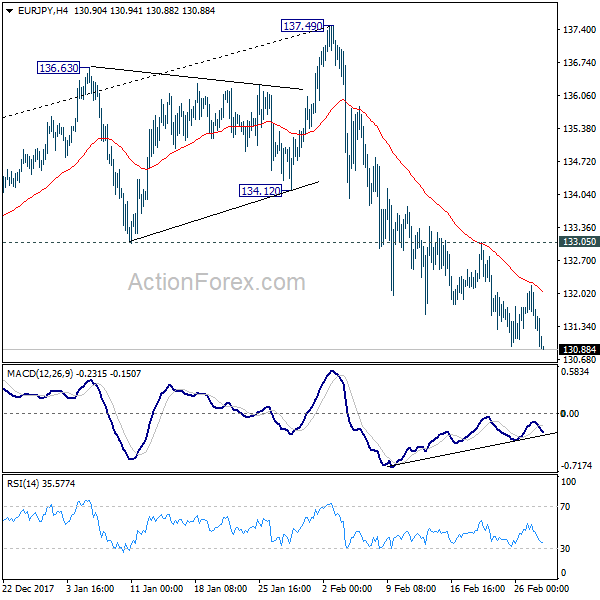
Daily Pivots: (S1) 131.29; (P) 131.52; (R1) 131.96; More....
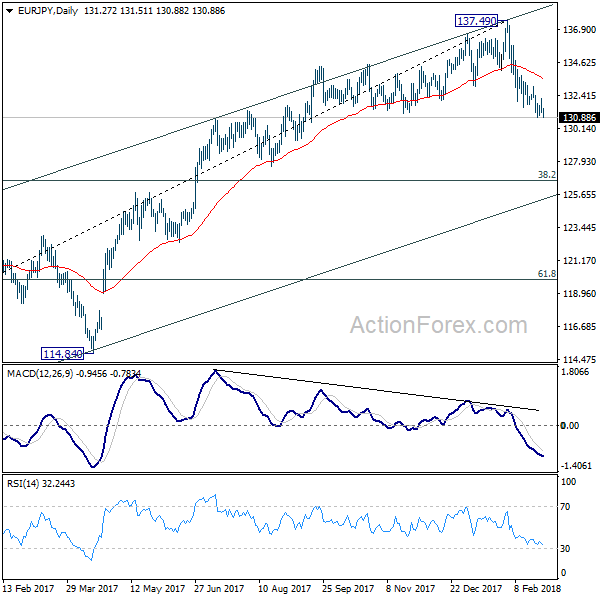
EUR/JPY's decline continues today and intraday bias stays on the downside. Current development indicate medium term topping at 137.49, on bearish divergence condition in daily MACD. Deeper fall should be seen to 126.61 medium term fibonacci level next. On the upside, though, break of 133.05 will indicate short term bottoming and bring stronger rebound.
In the bigger picture, current development argues that rise from 109.03 has completed at 137.49, on bearish divergence condition in weekly MACD. Deeper fall should be seen to 38.2% retracement of 109.03 to 137.49 at 126.61 first. On the upside, break of 137.49 is needed to confirm medium term rise resumption. Otherwise, risk will now stay on the downside even in case of strong rebound.
UK’s GfK Consumer Confidence Deteriorated In February
For the 24 hours to 23:00 GMT, the GBP declined 0.39% against the USD and closed at 1.3910.
In the Asian session, at GMT0400, the pair is trading at 1.3901, with the GBP trading 0.06% lower against the USD from yesterday's close, after overnight data revealed that Britain's GfK consumer confidence index declined to a level of -10.0 in February, at par with market expectations, amid concerns over Brexit uncertainty. In the previous month, the index had registered a level of -9.0.
Also, the nation's Lloyds business barometer eased to a level of 33.0 in February, compared to a reading of 35.0 in the prior month.
The pair is expected to find support at 1.3840, and a fall through could take it to the next support level of 1.3780. The pair is expected to find its first resistance at 1.3979, and a rise through could take it to the next resistance level of 1.4058.
With no further macroeconomic releases scheduled in UK today, investor sentiment would be determined by global macroeconomic events.
The currency pair is trading below its 20 Hr and 50 Hr moving averages.

EUR/GBP Daily Outlook
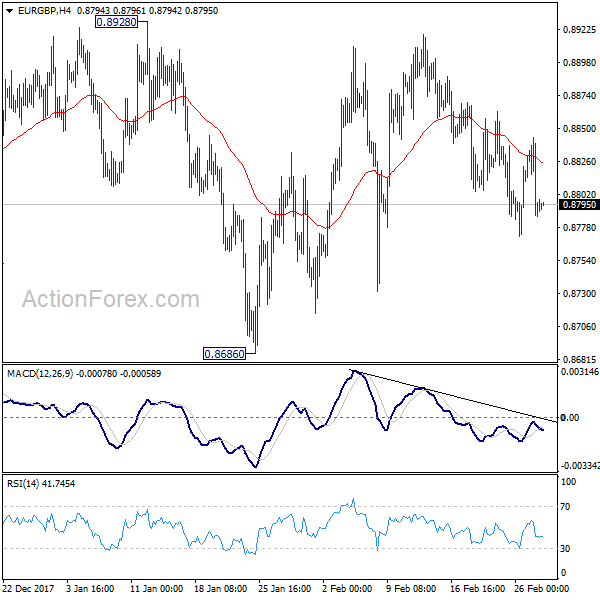
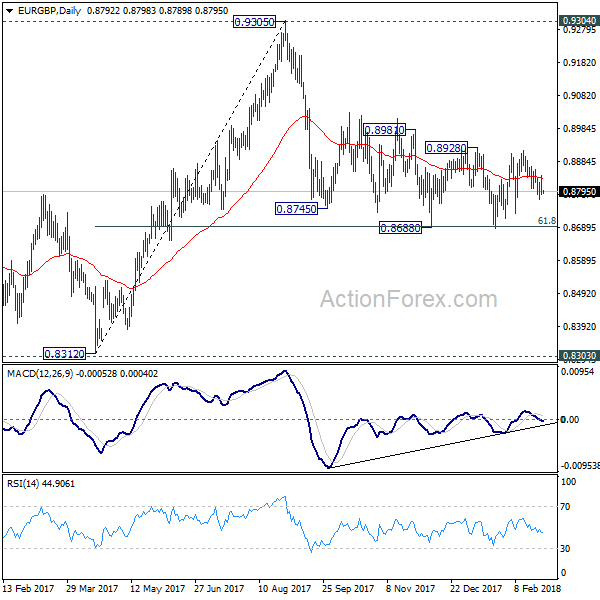
Daily Pivots: (S1) 0.8772; (P) 0.8808; (R1) 0.8830; More...
Range trading continues in EUR/GBP inside 0.8686/8928. Intraday bias remains neutral. Also, outlook stays mildly bearish with 0.8928 resistance intact. On the downside, firm break of 0.8686 will resume whole decline from 0.9305. As 61.8% retracement of 0.8312 to 0.9305 should then be taken out too, deeper decline would be seen to retest 0.8303/8312 support zone. Nonetheless, on the upside, break of 0.8928 will indicate near term reversal and turn outlook bullish for 0.9304 resistance.
In the bigger picture, there are various ways to interpret price actions from 0.9304 high. But after all, firm break of 0.9304/5 is needed to confirm up trend resumption. Otherwise, range trading will continue with risk of deeper fall. And in that case, EUR/GBP could have a retest on 0.8303. But we'd expect strong support from 0.8116 cluster support (50% retracement of 0.6935 to 0.9304 at 0.8120) to contain downside.
Japan’s Industrial Output Tumbled By The Most In Nearly 6 Years In January
For the 24 hours to 23:00 GMT, the USD rose 0.36% against the JPY and closed at 107.36.
In the Asian session, at GMT0400, the pair is trading at 107.2, with the USD trading 0.15% lower against the JPY from yesterday's close.
The Japanese Yen gained ground against the USD, after the Bank of Japan (BoJ) reduced the amount of super-long Japanese government bonds (JGBs) it offered to buy at its regular debt buying operation.
On the macro front, Japan's preliminary industrial production retreated more-than-anticipated by 6.6% on a monthly basis in January, dipping to its lowest level since March 2011. In the previous month, industrial production had registered a rise of 2.9%, while investors had envisaged for a fall of 4.0%.
Further, the nation's retail trade registered a fall of 1.8% on a monthly basis in January, higher than market expectations for a drop of 0.6%. In the previous month, retail trade had climbed 0.9%. On the contrary, the nation's large retailers' sales rose 0.5% MoM in January, exceeding market expectations for an advance of 0.4%. In the prior month, large retailers' sales had risen 1.1%.
The pair is expected to find support at 106.77, and a fall through could take it to the next support level of 106.35. The pair is expected to find its first resistance at 107.65, and a rise through could take it to the next resistance level of 108.11.
Going ahead, traders would eye Japan's final Nikkei manufacturing PMI and the consumer confidence index, both for February, due to release tomorrow.
The currency pair is showing convergence with its 20 Hr moving average and trading above its 50 Hr moving average.

Swiss Franc Extends Its Losses In The Morning Session
For the 24 hours to 23:00 GMT, the USD rose 0.18% against the CHF and closed at 0.9388.
In the Asian session, at GMT0400, the pair is trading at 0.9399, with the USD trading 0.12% higher against the CHF from yesterday’s close.
The pair is expected to find support at 0.9366, and a fall through could take it to the next support level of 0.9334. The pair is expected to find its first resistance at 0.9424, and a rise through could take it to the next resistance level of 0.9450.
Looking ahead, Switzerland’s ZEW economic expectations index and the KOF leading indicator, both for February, set to release in a few hours, will be on investors’ radar.
The currency pair is trading above its 20 Hr and 50 Hr moving averages.

EUR/AUD Daily Outlook
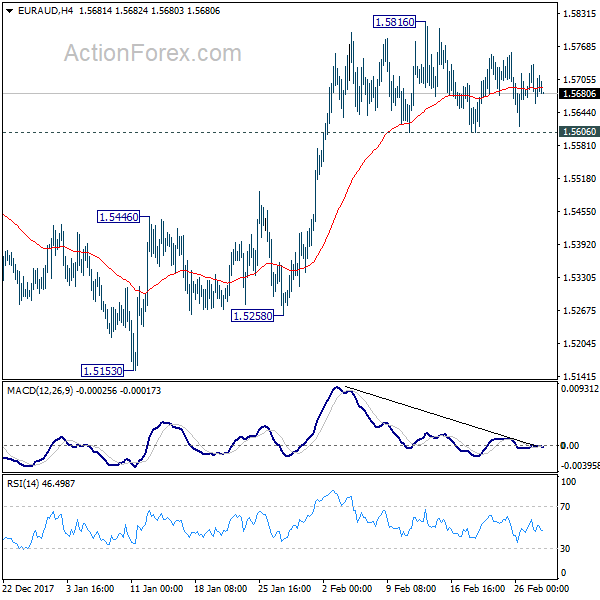
Daily Pivots: (S1) 1.5663; (P) 1.5699; (R1) 1.5737; More....
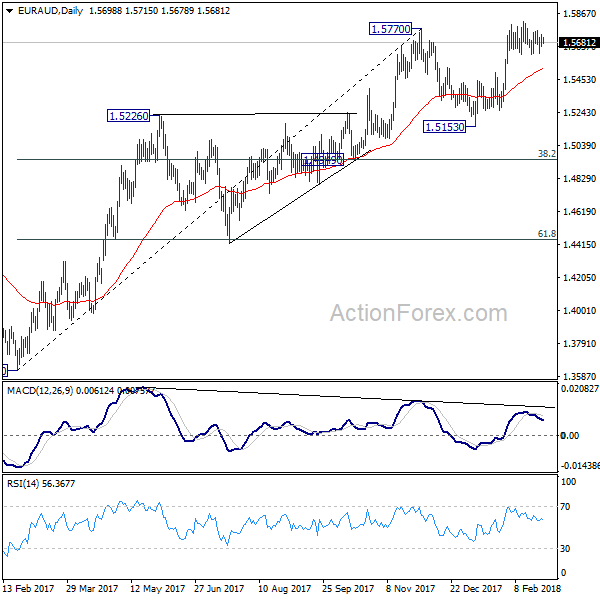
EUR/AUD is still bounded in the consolidation pattern from 1.5816. Intraday bias stays neutral. Also, near term outlook will remain cautiously bullish with 1.5606 support holds. On the upside, break of 1.5816 should now confirm resumption of medium term rise from 1.3264. In that case, EUR/AUD should target 1.6587 key long term resistance. Meanwhile, firm break of 1.5606 will argue that a short term top is formed. Intraday bias will be turned back to the downside for 55 day EMA (now at 1.5520) and below.
In the bigger picture, medium term rise from 1.3624 is not completed yet. Sustained break of 1.5770 will extend the rise to retest 1.6587 (2015 high). However, considering bearish divergence condition in daily MACD, break of 1.4949 cluster support (38.2% retracement of 1.3624 to 1.5770 at 1.4950) will indicate medium term reversal. And there is prospect of retesting 1.3624 low in that bearish case.
Loonie Trading Marginally Lower This Morning
For the 24 hours to 23:00 GMT, the USD rose 0.73% against the CAD and closed at 1.2772.
In the Asian session, at GMT0400, the pair is trading at 1.2773, with the USD trading a tad higher against the CAD from yesterday’s close.
The pair is expected to find support at 1.2707, and a fall through could take it to the next support level of 1.2641. The pair is expected to find its first resistance at 1.2809, and a rise through could take it to the next resistance level of 1.2845.
With no key macroeconomic releases in Canada today, investors would await Canada’s GDP data for December, due to release on Friday.
The currency pair is trading above its 20 Hr and 50 Hr moving averages.

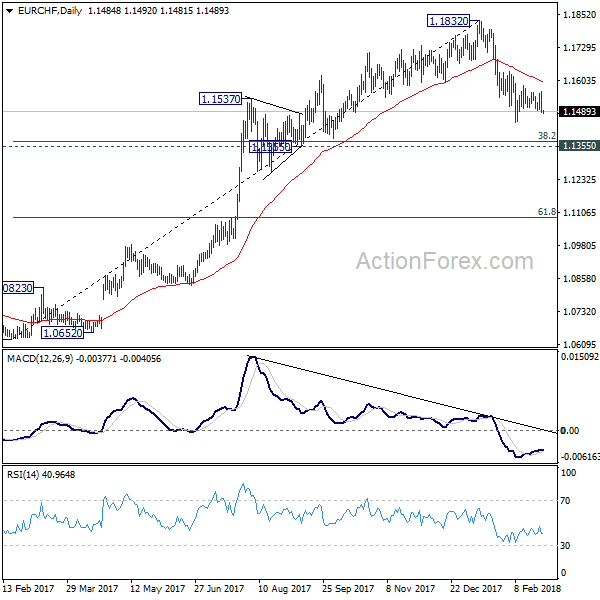
EUR/CHF Daily Outlook
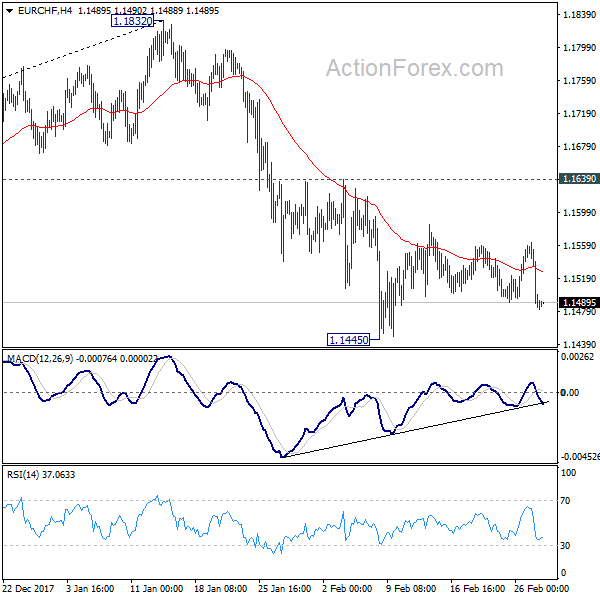
Daily Pivots: (S1) 1.1459; (P) 1.1510; (R1) 1.1537; More...
Intraday bias in EUR/CHF remains neutral as the consolidation from 1.1445 is still in progress. Outlook stays mildly bearish with 1.1639 resistance intact and deeper decline is expected. Break of 1.1445 will resume the corrective fall from 1.1832 and target 1.1355 cluster support (38.2% retracement of 1.0629 to 1.1832 at 1.1372.) At this point, we'd expect strong support from there to contain downside and bring rebound.
In the bigger picture, a medium term top should be in place at 1.1832 on bearish divergence condition in daily MACD. But there is no indication of long term reversal yet. As long as 1.1198 resistance turned support holds, we'd still expect another rise through prior SNB imposed floor at 1.2000.
Elliott Wave View: Gold In Double Correction
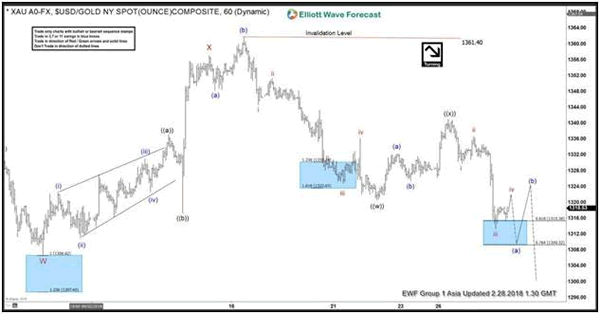
Revised Short Term Elliott Wave view in Gold suggests that the yellow metal is still correcting cycle from 12/13/2017 low ($1236.3) as a double three Elliott Wave structure. Up from 12/13/2017 low, Intermediate wave (W) ended at $1366.06 at 1/25/2018, and Intermediate wave (X) pullback remains in progress as a double three. Down from $1366.06, Wave W of (X) ended at $1306.80 and wave X of (X) ended at $1357.12. Near term, while bounces stay below $1361.4, expect Gold to extend lower in wave Y of (X) towards $1288.1 – $1302.11 before the rally resumes. We don’t like selling the yellow metal and expect buyers to appear from the above area for at least a 3 waves bounce if not an extension to new high.
Gold 1 Hour Elliott Wave Chart