

Sample Category Title
At The Edge Of A Cliff
At the Edge of a Cliff
Was it the mixed data, skewed positioning or merely a lack of confidence that has the USD dollar precariously perched at the edge of the cliff.
Everyone one to a tee went all in on a dollar buying frenzy after the CPI number, but the lack of follow-through was very telling, and the quick rebound stopped out all those newly minted positions and then some. The markets sold AUD, NZD heavily at the lows and then got summarily spanked when traders started to factor in the conflicting data prints.
While the Strong CPI reading does present a hawkish risk for the Feds dot plots in March, the miss in the US retail sales data has the street scrambling to revise GDP estimates lower.The divergent data stream has escalated the market debate of critical importance, specifically is it inflation or growth that will dictate the Fed pace of interest rate normalisation?
But the bottom line for the US dollar in my view, amidst rising inflation the prospect of increasing deficits, both trade and budget, should weigh like an anvil around the dollar bulls neck
Equity markets
In seemingly absurd fashion, US equity investors ignored the inflationary signals and focused on weaker-than-expected US retail sales report. There is an increasing possibility that the Powell may blink and the Feds will be more hesitant to guide monetary policy hawkish given the waning growth narrative.
Gold Markets
Higher US inflation combined with the USD exhibiting zero correlation to higher interest rates amidst burdening duel deficits should play out favourably for Gold markets. The weaker dollar narrative is playing out most favourably across the broader commodity space and gold demand could surge and push above this year’s highs. Also, the sustainability of the frothy equity market given the weak retail sales print suggest increasing gold equity hedges is a practical move.
Oil Markets
A weaker dollar and verbal intervention from Saudi Energy minister who suggested significant oil producers would prefer tighter markets than end supply cuts too early has seen oil prices do an about-face. The Suadi signal is reasonably convincing suggesting OPEC and their partners are committed to maintaining an absolute floor on oil prices
As indicated earlier in the week, the battle lines are forming around this key WTI 60.00 bpd as the Shale oil gusher will continue to weigh heavily on OPEC effort to blow out the worldwide glut.
However physical demand remains weak globally so traders will continue to monitor the USD /Oil price correlation and at first sign of flutter, it could signal a downdraft.
Currency Markets
Japanese Yen
With the Interest rate to FX correlation is in “Neverland”, It could be open season on USDJPY after convincingly crossing the 107 USDJPY Rubicon. If the market focus aggressively shift to the US’s duelling deficit amid higher inflation, the dollar days are numbered in the 107’s if we factor in an expected Exporter flow panic which could be exacerbated by a push from Japanese investors to raise their hedge ratios on US investments fearing a further fall in the greenback.
While we should expect the usual verbal lashing from Japan’s currency officials, I suspect we are still ways off from overt intervention
The Austrailian Dollar
It’s always good to go into critical economic data with a plan B even if it’s from outer space. Expect the unexpected and today we see Aussie is benefiting from resurgent Commodities and US dollar weakness as the greenback is showing no correlation to higher US rates.
Malaysian Ringgit
A weaker US dollar, rebounding commodity prices have the MYR sitting well supported by yesterday’s robust GDP print adding good measure
Dollar weakness is seeping in the USDJPY and USDCNH which will provide a positive backdrop for regional currency markets, and we should expect the MYR to be one of the keys go to currencies as positions remain under positioned post-January monetary policy meeting. Higher US interest rates are showing little obstacle for regional currency appreciation so the MYR should benefit
Not to weave a cautionary tales but liquidy is a bit thin given in regional markets given the proximity of China Lunar New Year so best to be nimble in these conditions
Gold Jumps As Strong CPI And Weak Retail Sales Spook Markets
Gold prices have posted strong gains in Wednesday's North American session. Currently, the spot price for an ounce of gold is $1348.04, up 1.41% on the day. On the release front, January consumer inflation beat expectations. CPI jumped 0.5%, above the estimate of 0.3%. Core CPI remained steady at 0.3%, edging above the forecast of 0.2%. Consumer spending reports in January were dismal. Retail Sales was flat at 0.0%, short of the estimate of 0.5%. Core Retail Sales declined 0.3%, well off the forecast of +0.2%.
A strong CPI release for January has sent the US dollar lower against the major currencies, and gold has jumped on the bandwagon. Concerns of high inflation was a catalyst for the market sell-off last week, and fears of a resumption in the downward spiral are weighing on the dollar. If investors react negatively and ditch the markets yet again, safe-haven assets like gold will likely be the big winners. Gold prices were down in the first half of February, but gold has recovered these losses, after posting strong gains of 2.4% this week.
What about the Federal Reserve? Currently, the Fed is planning three hikes this year, but that could change to four or even five hikes, if inflation continues to head upwards and the robust US economy maintains its strong expansion. The new head of the Federal Reserve, Jerome Powell, received a rude welcome from the stock markets, as he started his new position last week. Powell sought to send a reassuring message on Tuesday, saying that the Fed is on alert to any risks to financial stability. However, it is clear that the Fed's hand is limited when it comes to stock markets moves, and the volatility which we saw last week could resume at any time.
Pound Jumps As US Inflation Drags Down Dollar
The British pound has posted gains in the Wednesday session. In North American trade, GBP/USD is trading at 1.3867, up 0.53% on the day. On the release front, January consumer inflation beat expectations. CPI jumped 0.5%, above the estimate of 0.3%. Core CPI remained steady at 0.3%, edging above the forecast of 0.2%. Consumer spending reports in January were dismal. Retail Sales was flat at 0.0%, short of the estimate of 0.5%. Core Retail Sales declined 0.3%, well off the forecast of +0.2%. The sole British event, CB Leading Index, declined 0.2%.
The US dollar has posted broad losses in the North American session, as CPI indicators were higher than expected. Concerns of high inflation was a catalyst for the market sell-off last week, and fears of a resumption in the downward spiral are weighing on the dollar. What about the Federal Reserve? Currently, the Fed is planning three hikes this year, but that could change to four, or even five hikes, if inflation continues to head upwards and the robust US economy maintains its strong expansion. The new head of the Federal Reserve, Jerome Powell, received a rude welcome from the stock markets, as he started his new position last week. Powell sought to send a reassuring message on Tuesday, saying that the Fed is on alert to any risks to financial stability. However, it is clear that the Fed’s hand is limited when it comes to stock markets moves, and the volatility which we saw last week could resume at any time.
There were no surprises from British inflation numbers on Tuesday. CPI, the primary gauge of consumer spending, was unchanged at 3.0% in January. CPI has hovered around the 3% level since August, well above the BoE target of 2.0%. Wage growth has not kept up with the brisk clip of inflation, putting a further squeeze on the British consumer. This could dampen consumer spending, a key driver of the economy. High inflation is putting pressure on the Bank of England to raise interest rates, and last week the Bank said that it was considering faster and larger rate increases than it had projected back in November. Many analysts have circled May as the date of the next rate increase.
No Love For The Dollar
The US dollar has been a dog for more than a year but the trade on Valentine's Day showed just how unloved it is. The dollar was a major laggard despite strong inflation data while commodity currencies soared. Australian jobs numbers are up next. A 2nd Aussie trade has been issued today to gear up for Aussie jobs figures due at 19:30 ET, 00:30 GMT/London, one of the trades is long AUD other is short AUD with the idea that both will move towards target over time based on the relationship between the cross currency relationship. Gold and silver were the stars of the day. Here is my reasoning 20 mins prior the release of US CPI & retail sales on why gold should rally regardless of the outcome.
All eyes were on US inflation numbers Wednesday as worries about inflation derailing corporate earnings and growth continue to circulate. The worst happened as CPI rose 0.5% m/m compared to +0.3% expected. Core numbers were equally hot.
The dollar shot higher on the headlines in 50-80 pip moves across the board but the highs were within moments. From there the US dollar embarked on an epic reversal that included a rally in cable to 1.40 from 1.3800 and in the euro to 1.2455 from 1.2275.
Part of the story was a dismal retail sales report. It was down 0.3% compared to the +0.2% consensus. Holes were also poked in the high CPI number because of a handful of jumps in odd categories.
Stock markets also made a major turnaround with the S&P 500 finishing 36 points higher after falling 40 points in the aftermath of the CPI print. Despite that and despite a march in US 10-year yields to 2.91%, USD/JPY finished at a 15-month closing low, breaking a major support level.
On a technical basis alone, the dollar is looking increasingly dismal. Wednesday's trade was a clear sign of how the market has lost faith in the dollar. We will continue to watch for a shift in the dollar-selling paradigm as US 10-year yields rise to 3% and beyond but the price action Wednesday spoke volumes.
One trade that will be in particular focus in the hours ahead is AUD/USD with the Aussie employment report due out at 0030 GMT. The consensus estimate is for a +15.0K print following a +34.7K rise in December. A strong number would put AUD/USD back on a path to the January high of 0.8130.
EURGBP Penetrates above Downward Sloping Channel
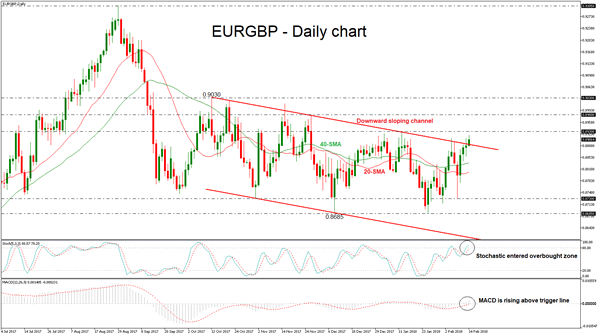
EURGBP has jumped above the downward sloping channel which was holding since October 2017. The price broke the 0.8900 handle and is trading above the 20 and 40 simple moving averages in the short-term timeframe. When looking at the bigger picture the pair lacks a clear tendency and the next days could be significant in case of a continuation of the slight upward movement.
In the daily timeframe, prices rebounded on the 0.8730 support level and based on the technical indicators, momentum is strong to provide a sustained move higher. The stochastic oscillator entered the overbought zone, while the MACD oscillator entered the positive territory and is holding above its trigger line.
If price action remains above the sloping channel, there is scope to test the 0.8930 resistance level. This is considered to be a strong resistance area which has been rejected a few times in the past. Rising above it could see prices re-testing the 0.8980 barrier.
On the flip side, in case of a failure to end the day above the upper band of the channel, the focus could shift to the downside towards the 20 and 40 SMAs near 0.8810 and 0.8840 respectively. If this level is breached, it could increase downside pressure and the price could move towards the 0.8730 support.
Sunset Market Commentary
Markets:
Bunds and US Treasuries traded in a sideways range in the run-up to the US CPI and retail sales data. Headline (2.1%) and core (1.8%) CPI were unchanged from December while a decline was expected. At the same time, US retail sales delivered a ' big miss' for January and a downward revision for December. (Bond) markets are currently more sensitive to inflation rather than to activity data. US yields jumped higher even as risk sentiment turned negative. In volatile trade, US yields are rising up to 7bps+ with the belly of the curve underperforming (5y + 7.3 bps; 2yr +5.1 bps). German bunds outperform, with yields rising between 1 and 2 bps. 10-y intra-EMU spreads are little changed with Portugal outperforming (-4 bps) and Greece still underperforming (+10 bps).
Dollar weakness still dominated FX trading in Asia. EUR/USD trended to the high 1.23 area. USD/JPY dropped temporary below 107. Calm returned during the European morning session. The dollar rebounded off the overnight lows as investors awaited the US CPI and retail sales data. The data brought the worst possible outcome from a market point of view. Inflation printed higher than expected. Both core (1.8% Y/Y) and headline (2.1%) inflation were unchanged from December while a decline was expected. At the same time, retail sales unexpectedly declined. US yields rose and equities nosedived. The data were also mixed for the dollar, but the inflation story dominated. The dollar gained a few ticks against the yen, but the risk-off sentiment blocked any sustained gains. USD/JPY trades again in the low 107 area. EUR/USD spiked temporary below 1.23, but the jury is still out whether there is room for further USD gains. Key question now is whether today's data mark the start of another risk-off correction and whether this will be supportive for the dollar (ex USD/JPY). EUR/JPY is also nearing the key 132/131 support area.
There were no important eco data in the UK. EUR/GBP traded with a slight upward bias near 0.89. Around noon, sterling lost slightly ground as the headlines of the 'Road to Brexit' speech of Boris Johnson hit the screens. Johnson's speech didn't bring much clarity on what the EU-UK relationship should look like after Brexit. He indicated that the UK should have the right to make its own rules and he also downplayed the benefits of being member of the single market/customs union. EUR/GBP filled offers in the 0.8920 area on the Johnson headlines, but a break of the 0.8928 intermediate resistance didn't occur. EUR/GBP trades in the 0.89 area. Cable trades in the mid 1.38 area.
News Headlines:
The Swedish Riksbank kept its policy rate unchanged at -0.50% and said it still expected to start hiking from the second half of 2018, despite slightly downgrading 2018/2019 inflation forecasts. One policymaker broke ranks and said they should be raised immediately.
EMU Q4 GDP growth was confirmed at 0.6% Q/Q and 2.7% Y/Y. December industrial production rose more than forecast, by 0.4% M/M and 5.2% Y/Y, while November readings faced an upward revision (to 1.3% M/M & 3.7% Y/Y).
US January inflation was substantially higher than expected. Headline inflation rose 0.5% M/M and 2.1% Y/Y (0.3% M/M and 1.9% Y/Y was expected). Core inflation was also above consensus at 0.3% M/M and 1.8% Y/Y. At the same time, January retail sales unexpectedly declined 0.3% M/M. A rise of 0.2% was expected. The December figure was also downwardly revised. Core measures of the report were also well below consensus. The combination of higher inflation and disappointing retail sales triggered a spike lower in US equity futures. In volatile trade, US indices opened about 0.5% lower, but for now there are no follow-through losses.
Retail Sales: Let’s Recap! Not as Rosy as Originally Reported
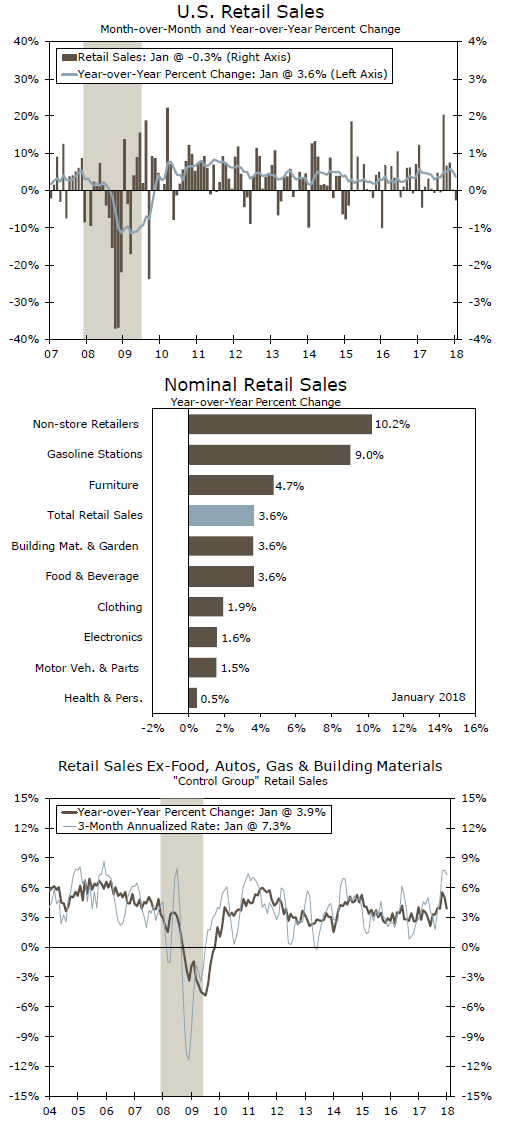
Retail sales dropped 0.3 percent in January. Markets were expecting a 0.2 percent increase. Furthermore, control group sales were revised down from an increase of 0.3 percent to a drop of 0.2 percent in December.
Disappointing Start to the Year for Retail Sales
Retail sales disappointed at the start of 2018 by dropping 0.3 percent while markets were expecting them to grow 0.2 percent. Excluding automobile and gasoline stations' sales, retail sales were down 0.2 percent versus market expectations of a 0.3 percent increase. December's 0.4 percent increase for the overall index remained unchanged, but retail sales ex-automobile sales was revised down from an increase of 0.4 percent to just 0.1 percent.
Even the 1.6 percent increase in gasoline stations' sales was not enough to push retail sales higher in January. The biggest culprits for the decline in retail sales during the month was a 1.3 percent decline in motor vehicle & parts dealers' sales; a 0.4 percent decline in furniture & home furniture stores' sales; a 2.4 percent drop in building material & garden equipment & supplies dealers' sales; a 1.2 percent decline in health & personal care stores' sales and a 0.8 percent decline in sporting goods, hobby, book & music stores' sales.
Growth sectors were sales at electronics & appliance stores, up 0.5 percent, clothing & clothing accessories stores' sales, up 1.2 percent and miscellaneous store retailers' sales, which increased 1.6 percent. Even the "mighty" nonstore retailer sector had issues in January, as it posted flat month-on-month growth. Meanwhile, on the service side of the report, food services & drinking places was also flat in January.
Although we were expecting a relatively strong performance for retail sales in January following the strong end of 2017 performance for the sector, it is relatively clear that there may once again be some seasonal factors at play. This is something that has been a staple for the first quarter economic numbers since the recovery from the Great Recession.
Revision to December Control Group Sales
Control group sales, which are the part of the retail sales report that go directly into the calculation of GDP, was flat in January while markets were expecting a strong 0.4 percent increase. However, the bad news is that inflation was also very strong in January while it was revised up for December. Furthermore, the strong downward revision to control sales for December, which were originally reported up 0.3 percent and were revised down to a decline of 0.2 percent, will probably make analysts revise down the strong print for personal consumption expenditures in the final quarter of 2017.
We remain positive on the consumer this year even though the first look at consumption in January was not what we were expecting. As we have pointed out before, perhaps the biggest risk for consumers, as well as for the U.S. economy this year, is higher inflation, which has the potential to cut into the purchasing power of income and push consumers to the sidelines. For now, credit is flowing and consumers are using it.
Retail Sales Start the Tear on the Back Foot
Retail sales fell 0.3% in January according to the advance Census Bureau report – well shy of expectations for a 0.2% rise.
Sales at gasoline stations rose by 1.6%, but the gain was more than offset by a 1.3% decline at motor vehicle & parts dealers. Excluding autos and gas, retail sales were down by 0.2% on the month, widely missing the expected 0.5% gain.
After several strong months, spending on building materials (-2.4%) pulled back. This decline was only half made up for by a 0.7% rise in spending at restaurants and bars. Excluding gas, autos, building materials, and food services, the so-called 'control group' used in calculating GDP was flat on the month – shy of the 0.5% gain expected. Gains in the control group were led by miscellaneous (+1.6%), clothing (+1.2%) and electronics (+0.5%). On the other hand, health & personal care (-1.2%), sporting goods (-0.8%) and furniture (-0.4%) noted declines. Most other categories were little changed.
Key Implications
This was not the kind of report we were expecting. After a string of solid retail spending reports to cap off 2017, the decline in January is a bit of a headscratcher. The latest figures point to a weaker performance of consumer spending in the first quarter – around 2.4% (down from 2.8%), with the downgrade flowing through to real GDP, which is expected to increase by around 2.5%.
The one encouraging factor was that the entire decline was attributed to a single category: autos. But, sales at motor vehicle dealers have been declining due to the dissipation of the boost related to replacement of damaged/destroyed vehicles during Harvey and Irma. The same can be said for building materials and furniture, which were previously boosted by replacement. From that standpoint, the pullback is natural and not overly alarming. The fact that many discretionary spending categories saw gains offers further evidence that the decline is transitory and not the beginning of a new trend.
Ultimately the January decline in retail sales appears to be more of a transitory blip, with spending likely to return to a stronger performance in the following month. This is especially the case given the strong payroll growth, rising wages, and and tax reform that will leave more disposable income in consumers' pockets.
CPI: Reflation Is Upon Us
Inflation is strengthening, as evidenced by the solid gains in headline and core CPI in January. Core inflation is rising at a 2.9 percent pace over the past three months and will lead to further Fed hikes in the coming months.
Rising Costs of Consumer Staples
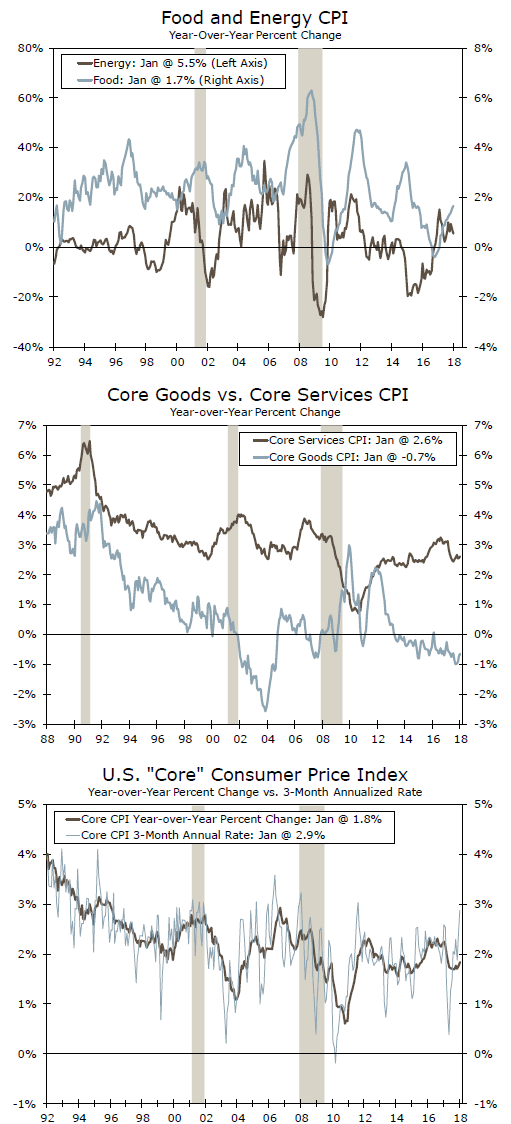
Consumer price inflation is turning up again. The CPI advanced ahead of expectations in January, rising 0.5 percent. That pushed inflation up 2.1 percent from a year earlier, but prices over the past three months have increased at a 4.4 percent annualized rate.
Headline inflation was lifted by higher energy costs in January. Gasoline prices rose 5.7 percent, which more than offset a 0.8 percent pullback for energy services even as colder weather gripped more populated parts of the country. The rebound in oil prices over the past couple years has been an important factor pulling inflation higher; the energy index is up 5.5 percent since last January.
Food prices have been less supportive of the pickup in inflation, but prices are also moving higher. Grocery prices increased 0.1 percent, which was enough to push the year-over-year rate to its highest reading since early 2015. Food away from home posted an even larger gain of 0.4 percent, as higher labor costs finally look to be pushing restaurants to raise prices.
Has Pricing Power Finally Arrived?
The real strength in today's report came from the core index, where prices rose 0.3 percent. That was the largest gain since last January. Core goods prices rose for a second consecutive month amid a rebound in apparel and used vehicle prices. Services posted widespread gains, led by higher medical and insurance costs.
In recent years, January readings of core inflation seemed to get a bump from "residual seasonality" (the inability for adjustments to fully account for typical seasonal patterns). However, updated seasonal factors released last week better capture the tendency for firms to raise prices early in the year. Therefore, we are more inclined to take today's increase at face value as a sign of genuine strengthening in inflation.
Over the past year, core inflation has increased 1.8 percent. That is unchanged from December, but the recent trend is stronger. Over the past three months, core CPI has increased at a 2.9 percent annualized rate, suggesting the year-over-year rates will be picking up in the coming months. We look for core CPI to move back up to 2 percent on a year-ago basis as early as March, when last year's drop in cell phone services makes for an easier base comparison.
The core PCE deflator, more closely watched by the Fed, will take longer to return to 2 percent, but should also rise in the coming months. Even though core PCE will still be undershooting the FOMC's target in the coming months, the upward trend should be enough for the Fed to continue on with its tightening campaign. We continue to look for the FOMC to raise rates in March, followed by two additional hikes later in the year.
Inflation Pressures Perking up in U.S. Economy
The headline consumer price index (CPI) jumped 0.5% in January. That left inflation on a year-on-year basis at 2.1%, steady versus December.
Higher energy prices contributed to the pop in the headline (+3.0% m/m). An increase in the gasoline index (+5.7%) offset declines in other energy components. Food prices rose 0.2% on the month.
Core inflation posted a hearty 0.3% monthly gain. Along with shelter (+0.2%), apparel (+1.7%), and medical care (+0.4%), the indexes for motor vehicle insurance (+1.3%), personal care (+0.5%), and used cars and trucks (+0.4%) also rose in January. The indexes for airline fares and new vehicles were among those that declined over the month.
Despite the hearty monthly gain, unfavorable base effects kept the year-on-year pace of core inflation at 1.8%, unchanged from December. Core inflation has hovered in the 1.7-1.8% range for nine consecutive months now.
Key Implications
Today's report should give more confidence that inflation pressures are perking up in the U.S. economy. Core inflation may be below 2% for now, but that in part is due to comparisons to hot inflation readings at the beginning of 2017. Even modest increases in core inflation over the next couple of months will see it rise above two percent.
While there were some sizeable jump ups in categories like apparel, which are unlikely to be repeated in February, more persistent categories of services inflation are starting to show upward momentum. That gives us greater confidence that inflation pressures are likely to be sustained.
Inflation has been the missing piece in the puzzle for rate hikes over the past several months, which had led some members of the FOMC to dissent on rate hike decisions over the past year. Today's report increases our confidence that the Fed will raise rates in March.