Sample Category Title
Canadian Dollar Ticks Higher, Markets Await US Inflation Reports
The Canadian dollar continues to trade sideways this week. In the Wednesday session, the pair is trading at 1.2576, down 0.14% on the day. On the release front, there are no Canadian indicators for a third straight day. In the US, the markets are expecting mixed inflation numbers. Core CPI is expected to expected to edge lower to 0.2%, while CPI is forecast to improve to 0.1%. The US will also release retail sales reports. Retail Sales is forecast to slow to 0.2%, while Core CPI is forecast to accelerate to 0.5%. Traders should be prepared for movement on the currency markets during the North American session.
It's been a rough February for the Canadian dollar, which has declined 2.4%. The loonie lost ground during last week's massive sell-off in the stock markets, as nervous investors lost their risk appetite and scurried away from minor currencies such as the Canadian dollar. However, the country's economic fundamentals remain solid, and the Bank of Canada is expected to raise rates twice more this year, after hiking rates in January. If oil prices remain high and the economy remains strong, there is room for the Canadian dollar to gain ground. However, there are some worrying clouds not too far off. These include uncertainties over the NAFTA trade agreement and the possibility that the Federal Reserve will accelerate the pace of its rate hikes, putting more pressure on the Canadian dollar.
Global stock markets have steadied after last week's turbulence, but investors remain wary. Wednesday's US inflation numbers will be closely watched, as inflation fears was a key catalyst of the massive sell-off. The new head of the Federal Reserve, Jerome Powell, sought to send a reassuring message on Tuesday, saying that the Fed is on alert to any risks to financial stability. However, it is clear that the Fed's hand is limited when it comes to stock markets moves, and the volatility which we saw last week could resume at any time.
CAC Climbs on Strong German, Eurozone GDP Reports
The CAC index has posted strong gains in the Wednesday session. Currently, the index is at 5,155.30, up 0.91% on the day. It's a busy day on the release front, with key releases in Germany, the eurozone and the US. In Germany Preliminary GDP posted a gain of 0.6%, matching the estimate. Eurozone Flash GDP for Q4 remained steady at 0.6% for a third straight quarter, matching the estimate. In the US, the markets are expecting mixed inflation numbers. Core CPI is expected to expected to edge lower to 0.2%, while CPI is forecast to improve to 0.1%.
It's been a rough ride for the CAC, which declined 3.6% last week and has plunged 6.9% so far this month. However, the index has steadied this week, and is in green territory on Wednesday. The CAC is up almost 1%, and the strong gains have been pared by sharp losses in the banking sector, as Credit Agricole is down 3.33%. Much of the recent sell-off can be attributed to investor concern over higher inflation in the US, which could lead to raise hikes from the Federal Reserve and other central banks. Inflation has also moved higher in the eurozone, although with plenty of slack in the economy, the ECB is not contemplating any rate hikes. Investors across the globe, who endured a massive sell-off last week, will be keeping a close eye on US inflation indicators. If these releases are higher than expected, global stock markets could resume their downward spiral.
ECB President Mario Draghi said last week that he is more confident that eurozone inflation is moving closer to the ECB target of just below 2 percent, due to improving economic growth. However, Draghi listed currency market volatility as an obstacle to the inflation target, and added that the ECB would carefully monitor the euro's exchange rates. Draghi's concerns about the exchange rate have been underscored by last week's stock market turbulence, which boosted the dollar and sent the euro lower by 1.6 percent. The ECB tapered its massive stimulus program from EUR 60 billion to 30 billion/mth in January, and the markets are looking for hints as to whether the ECB will normalize policy and wind up stimulus in September.
EURGBP: Bullish, Eyes Further Upside Pressure
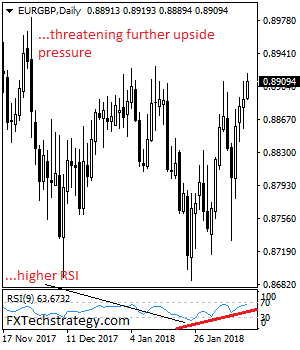
EURGBP - The pair continues to hold on to its upside pressure as it looks to breach the 0.8927 zone. Support lies at the 0.8850 level where a violation will turn focus to the 0.8800 level. A break will expose the 0.8750 level. Conversely, resistance resides at the 0.8950 level where a violation if seen will turn risk towards the 0.9000 level. Further up, resistance resides at 0.9050 level followed by the 0.9100 level. Its daily RSI is bullish and pointing higher suggesting more strength. All in all, EURGBP remains biased to the upside on more strength
Dollar Struggles ahead of US CPI; European Stocks Bounce Up
Here are the latest developments in global markets:
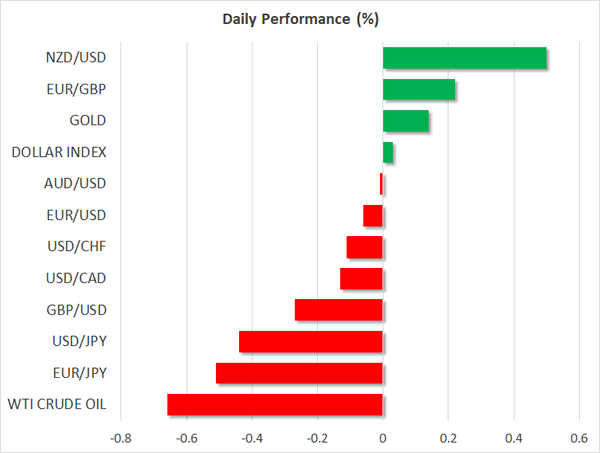
FOREX: The dollar was struggling to pare today's losses, after touching a more than a year-low of 106.83 versus the yen and reaching a one-week-low of 89.37 against a basket of major currencies earlier today. Dollar/yen crawled slowly up to 107.47 (-0.36%) and the dollar index recovered modestly towards 89.65 (-0.06%) ahead of the US CPI figures which have the potential to shake the currency. Meanwhile, the Japanese government argued during the Asian session that a "stable currency is important", signaling a potential intervention in the FX markets. Euro/dollar weakened to 1.2350 remaining flat on the day, unable to gain from encouraging GDP growth and industrial data out of the Eurozone. Pound/dollar stretched lower to 1.3846 as traders were expecting the UK Foreign Secretary and a Brexit-supporter, Boris Johnson, to use a speech to warn that an exit from the EU "provides ground for hope not fear". Euro/pound climbed to a one-month high of 0.8918. The Swedish krona gained ground versus the dollar after the Riksbank – Sweden's central bank – hinted that rates will probably go up in the second half of 2018 but its cautious stance over the inflation outlook pushed the currency back down. The Riksbank kept benchmark rates steady as expected at -0.50%.
STOCKS: European stocks reversed yesterday's downtrend after the Eurozone's GDP growth figures and in particular Germany's prints showed that the block was set to start the year with a strong foot, while positive earnings outcomes were also supportive. The pan-European STOXX 600 was up by 0.74% at 1030 GMT, with all sectors except energy being in the green. The blue-chip Euro STOXX 50 rose by 0.61%. The German DAX 30 jumped by 0.83%, lifted by gains mainly in utilities and technology, the French CAC 40 increased by 0.70% and the Spanish IBEX 35 climbed by 0.50%. The British FTSE 100 gained 0.67%, while the US stock futures were all pointing to a positive open.
COMMODITIES: Oil prices headed lower during early European trading as concerns of a potential US oversupply loomed in the background despite the Saudi Arabian Energy Minister saying that the country will cut its output and keep exports restricted in March. A weaker US dollar was also weighing on the market. WTI crude and Brent were down at $58.81/barrel (-0.60%) and $62.53/barrel (-0.30%) respectively at 1100 GMT. In precious metals, gold pulled back to $1,332/ounce but remained up on the day (+0.17).
Day ahead: US CPI figures awaited to make headlines; jittery stocks on edge
US data will dominate Wednesday's economic calendar in the remainder of the day and particularly US consumer prices (CPI) are anticipated to attract the most attention as investors are eagerly looking for clues to justify their rising inflation expectations that triggered the recent turmoil in stock markets.
The CPI report delivered by the US Bureau of Labour Statistics at 1330 GMT is expected to be a significant clue on inflation as it is the first evidence on prices since the start of the stock market correction. The headline US CPI is forecasted to slow down from 2.1% to 1.9% y/y in January, whereas on a monthly basis the measure is expected to climb by 0.2 percentage points to 0.3%. Excluding food and energy, the core measure is said to inch down to 1.7% y/y from 1.8% seen in December. Although the Fed prefers to use the Personal Consumption Expenditure index (PCE) to adjust its monetary policy, any positive or negative CPI surprises could change the sentiment on the dollar during the day.
Monthly US retail sales, published along with the above data, could bring some volatility to the greenback as well. Forecasts are for retail sales to grow at a slower pace of 0.2% m/m in January compared to 0.4% in the preceding month, while core retail sales, which exclude automobiles, are anticipated to increase by 0.5% m/m, above the previous mark of 0.4%.
In other data out of the US, markets will see the release of business inventories at 1500 GMT and then focus on the EIA oil report at 1530 GMT. Analysts believe that the US crude oil inventories have risen by 2.825 million barrels in the week ending February 9, posting the third straight week of gains.
Before the day-end, Japan will publish December's readings on core machinery orders at 2350 GMT. At midnight, Australian employment figures will also come into the light, probably showing that the employment change has narrowed even further in January, leaving the unemployment rate unaffected.
In stock markers, earnings releases will continue to be in the spotlight. Tripadvisor and Barrick Gold, the world's biggest gold producer, will be among companies releasing quarterly results on Wednesday.

Futures Higher But Market Remains Vulnerable
Inflation and Retail Sales Data Eyed Markets Gradually Stabilize
US futures are pointing to a stronger open on Wednesday, building on the small gains posted at the start of the week and offering some hope that stability is slowly returning to the markets.
Given the volatility that we've seen over the last week or so, which was initially attributed to higher interest rate expectations following the January jobs report, traders will be closely monitoring the US inflation and retail sales releases today. Both numbers will be released shortly before the open on Wall Street and could be the trigger for further volatility, especially if the CPI exceeds expectations.
While the CPI number isn't the Federal Reserve's preferred inflation measure – which could impact how traders respond to it – it is released a couple of weeks earlier than the core PCE price index and so is seen as being indicative of inflationary trends. This means markets can be sensitive to the release, particularly during times of increases sensitivity, like we're seeing at the moment.
Markets Still Appear Vulnerable to Downside Shocks
Volatility has remained since the initial spike last Monday although the VIX has more than halves since then, so things are calming down a little. That said, investors still appear jittery and equity markets remain some way off their highs. Yields are back at last Monday's levels and have pushed above them in recent days so this blip hasn't had any lasting impact on medium-term interest rate expectations, although that could change if we see further episodes.
The dollar has been one of the beneficiaries of the recent volatility, with the increased US interest rate expectations lifting the greenback off its lows after months of significant downside pressure. The dollar index rose briefly above 90 late last week before some profit taking set in and while it remains vulnerable to further selling, I wonder whether we're going to see more of a bounce in the near-term, particularly if we get some decent numbers today.
Bitcoin Making Steady Gains But More Pain May Lie Ahead
Bitcoin has been making steady improvements over the last week, having fallen below $6,000 briefly, roughly 70% from its high reached in December. While cryptocurrency enthusiasts will be encouraged by the period of stability in price and gradual gains during that time, I think it still looks vulnerable to near-term pain before a bottom can be claimed.
I think $9,000 to $10,000 will pose some real challenges for bitcoin but if it can overcome these levels, it will be a very encouraging sign for those bullish on the cryptocurrency. Negative news flow has been a major test for bitcoin so far this year and if that keeps coming, I struggle to see how it can gain any real upside momentum.
As BoE Takes Hawkish Turn, Brexit Risks Come Back to Haunt Sterling
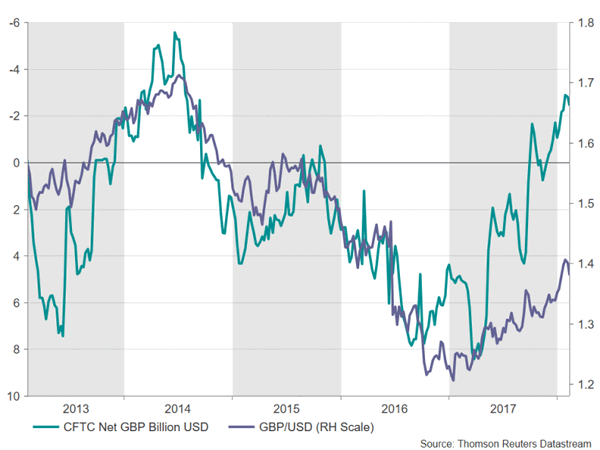
After starting 2017 around $1.22 - levels last seen in the 1980s - few would have believed that the British pound would end the year at $1.35. The currency's gains didn't stop there as cable went on to top the 1.43 level in January for the first time since the day after the Brexit referendum on June 23, 2016. However, renewed Brexit concerns have since pulled the pound back to around $1.38 even as the Bank of England flags an earlier-than-anticipated rate hike.
While the weakness of the US dollar certainly gave sterling a hand up during 2017, a better-than-expected performance of the British economy has also contributed to net speculative positions in the pound turning long in October for the first time in two years. The Bank of England has been quick to acknowledge the economy's resilience in the face of the Brexit uncertainty. Last week, the Bank upgraded its forecasts for both growth and inflation for 2018 and 2019 in its February inflation report, saying that "monetary policy would need to be tightened somewhat earlier and by a somewhat greater extent over the forecast period than anticipated at the time of the November Report".
However, despite the British economy managing to stave off a recession, growth is lagging those of other advanced economies, notably the Eurozone and the United States, leading some to question the BoE's stance. In addition, although an agreement between the UK and the EU on the Brexit divorce terms in December did add some much-needed positive momentum to the negotiations, downside risks are far from having abated. The EU's chief negotiator, Michel Barnier, reminded investors on Friday that more bumps lie ahead on the journey to a final Brexit deal as he warned the UK that an agreement on a transition period was "not a given" due to ongoing differences between the two sides.
Sterling slid to a 3-week low of $1.3763 after Barnier's comments, which come amid fresh criticism of the Prime Minister, Theresa May's Brexit strategy by both the public and members of her own party, fuelling yet again talk of a leadership challenge. The BoE's own projections are based on the assumption of the UK and the EU striking a post-Brexit trade deal, so any fresh setback in the negotiations would likely prompt a revision of those forecasts, and in turn on the expected path of interest rates.
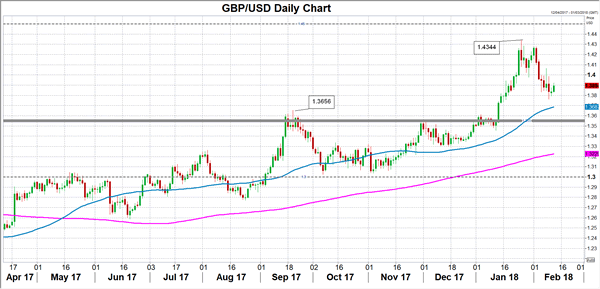
Currently, markets are pricing in a full 25 basis point rate hike by August, earlier than November that was being predicted just a few weeks ago. Some analysts have brought forward their expectations of a rate hike even earlier to May, though markets aren't fully convinced, with the odds standing around 65%.
In the event of the UK and the EU missing the March deadline to strike a deal on a transition period by the end of March, a May rate hike would become even less likely. But should an agreement be reached, it would remove a major layer of uncertainty for British businesses and could boost confidence in the short term. The Bank of England would feel far more confident to raise rates under such circumstances and could decide to move as early as May.
Sterling could also garner support in the coming weeks from a series of six speeches by senior UK politicians, including the prime minister, outlining the "Road to Brexit" as it has been dubbed. Previous keynote speeches delivered by May on Brexit had a tendency to boost the pound as they provided clarity to investors about the government's plans.
The Foreign Secretary, Boris Johnson will kick off the latest round of charm offensive with a speech on Wednesday. It will be followed by a speech on the future security relationship between the UK and the EU by May on Saturday in Munich, Germany, with speeches by the Brexit Secretary David Davis, the Trade Secretary Liam Fox and the Cabinet Office Minister David Lidington to come in the week after. Mrs. May will give a second and final address, detailing the future partnership the UK is seeking with the EU, the date of which has yet to be announced. This will likely be the highlight of the series, and if all goes well and the talks proceed to the future trade relationship in March, the pound could target $1.45, as such an outcome would raise the prospect of two rate hikes by the BoE over the next year.
But with many contentious details still to be worked out, including aspects of the divorce terms such as the Northern Irish border that have yet to be resolved, a delay in reaching a transition deal as well as protracted trade talks are a strong possibility. A prolonged period of uncertainty would be bad for the British economy and could send sterling into reverse. The pound should be able to halt any sharp decline in the $1.35-1.36 area were the negotiations to run into trouble. A major setback though could push the currency further down towards the key $1.30 level.
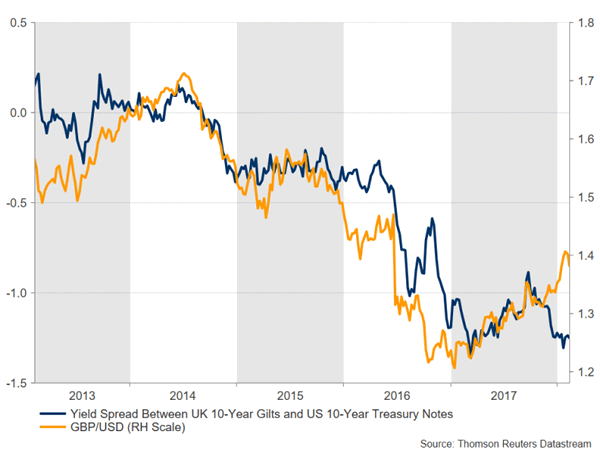
Sterling could become especially vulnerable in a scenario where negative developments in the Brexit negotiations coincide with a strengthening US dollar. The pound's recent gains are already looking unjustified when looking at the yield spread between 10-year UK gilts and US Treasury notes, which has been falling since September 2017, while cable has been rising. If as expected, US growth accelerates further over the coming quarters but UK growth picks up only marginally, the declining spread could be the trigger for a major correction.
SPOT GOLD Holds Positive Near-Term Tone ahead of US Inflation Data
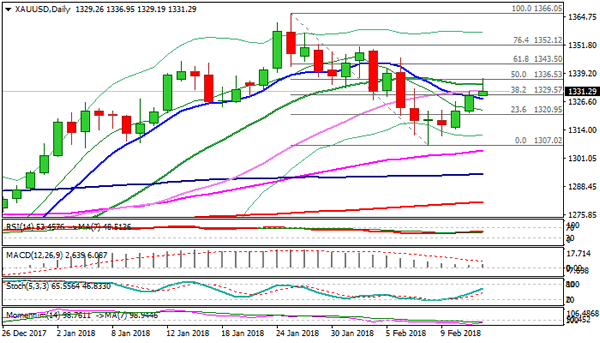
Spot Gold extended recovery leg and hit one-week high at $1336 on Wednesday, maintaining positive near-term tone on weaker dollar.
Tuesday's close above falling 10SMA and today's probe above sideways-moving 20SMA ($1334) were positive signals as daily techs are bullishly aligned.
However, the yellow metal failed to hold break above 20SMA at first attempt, due to lack of momentum.
Focus turns towards US inflation data, due later today, which is expected to generate clearer signal about Fed's view on monetary policy in coming months.
Stronger than expected inflation numbers in January could be a catalyst for the Fed to speed up tightening policy and put gold price under increased pressure.
Conversely, inflation miss today would disappoint those advocating for more aggressive monetary policy and boost gold price.
Bullish scenario would open targets at $1343 (Fibo 61.8% of $1366/$1307 bear-leg) and $1350/51 (01/01 Feb double-top).
Conversely, weaker tone could be expected on close below 10SMA ($1327) which would risk bearish acceleration towards 1321 (Tuesday's low) and $1314 (Monday's low) in extension.
Res: 1331; 1334; 1337; 1343
Sup: 1327; 1321; 1316; 1314
Bitcoin Making Steady Gains But More Pain May Lie Ahead
- Inflation and Retail Sales Data Eyed Markets Gradually Stabilise;
- Markets Still Appear Vulnerable to Downside Shocks;
- Bitcoin Making Steady Gains But More Pain May Lie Ahead.
Inflation and Retail Sales Data Eyed Markets Gradually Stabilise
US futures are pointing to a stronger open on Wednesday, building on the small gains posted at the start of the week and offering some hope that stability is slowly returning to the markets.
Given the volatility that we’ve seen over the last week or so, which was initially attributed to higher interest rate expectations following the January jobs report, traders will be closely monitoring the US inflation and retail sales releases today. Both numbers will be released shortly before the open on Wall Street and could be the trigger for further volatility, especially if the CPI exceeds expectations.
While the CPI number isn’t the Federal Reserve’s preferred inflation measure – which could impact how traders respond to it - it is released a couple of weeks earlier than the core PCE price index and so is seen as being indicative of inflationary trends. This means markets can be sensitive to the release, particularly during times of increases sensitivity, like we’re seeing at the moment.
Markets Still Appear Vulnerable to Downside Shocks
Volatility has remained since the initial spike last Monday although the VIX has more than halves since then, so things are calming down a little. That said, investors still appear jittery and equity markets remain some way off their highs. Yields are back at last Monday’s levels and have pushed above them in recent days so this blip hasn’t had any lasting impact on medium-term interest rate expectations, although that could change if we see further episodes.
The dollar has been one of the beneficiaries of the recent volatility, with the increased US interest rate expectations lifting the greenback off its lows after months of significant downside pressure. The dollar index rose briefly above 90 late last week before some profit taking set in and while it remains vulnerable to further selling, I wonder whether we’re going to see more of a bounce in the near-term, particularly if we get some decent numbers today.
Bitcoin Making Steady Gains But More Pain May Lie Ahead
Bitcoin has been making steady improvements over the last week, having fallen below $6,000 briefly, roughly 70% from its high reached in December. While cryptocurrency enthusiasts will be encouraged by the period of stability in price and gradual gains during that time, I think it still looks vulnerable to near-term pain before a bottom can be claimed.
I think $9,000 to $10,000 will pose some real challenges for bitcoin but if it can overcome these levels, it will be a very encouraging sign for those bullish on the cryptocurrency. Negative news flow has been a major test for bitcoin so far this year and if that keeps coming, I struggle to see how it can gain any real upside momentum.
Japan 225 Stock Index Finds Support At 200-DMA After Slumping To 4-Month Low
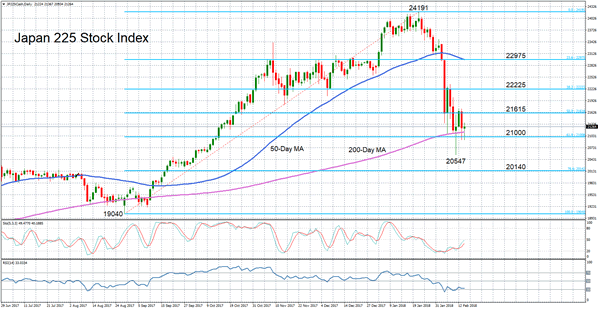
The Japan 225 stock index has suffered a sharp sell-off over the past three weeks, tumbling by around 15% from its 26-year high of 24191 on January 23 to a 4-month low of 20547 on February 9. The index appears to have found support around the 200-day moving average, with prices so far managing to close above it.
Momentum indicators are mixed with the RSI flat just above the 30 oversold level, suggesting that the next near-term trend could move in either direction. But the stochastics are pointing to some upside momentum, with both the %K and %D lines trending higher this week and approaching the 50 neutral level.
Immediate support can be found at the 21000 area but a continuation of the downslide could see the index targeting the 78.6% Fibonacci retracement level of the upleg from 19040 to 24191 as its next support around 20140. Deeper losses could open the way towards the August 2017 low of 19040.
However, should the weak upside momentum gather some further strength, the index could head higher before meeting resistance at the 50% Fibonacci level around 21615. A successful break above this level is needed for a stronger push up and to bring into scope the 38.2% and 23.6% Fibonacci levels at 22225 and 22975 respectively. The 23.6% Fibonacci is also where the 50-day moving average (MA) is currently converging at.
Looking at the medium-term picture, the index appears to be entering a bearish phase after prices reached the 200-day MA. However, with the 50-day MA still holding a large gap with the 200-day one, there is the possibility of a return to a bullish outlook if the current sell-off proves to be a correction and not a broader downtrend.
EURJPY Bears Take The Lead, 23.6% Fibonacci Support Level Still Holding
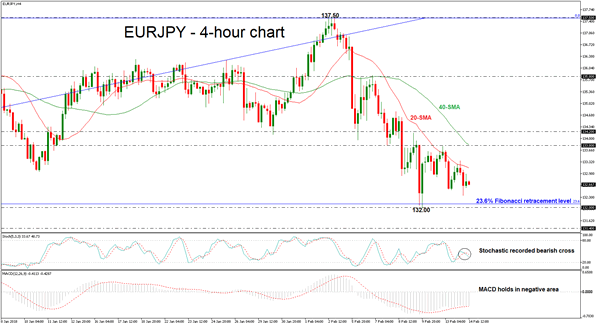
EURJPY has been trading sharply lower since the previous week, following the pullback from the more than a 2-year high of 137.50. Prices broke below the 133.00 handle over the last couple of sessions in the 4-hour chart and are trading below their moving averages. The bearish picture in the short-term is further supported by the technical indicators.
Looking at the 4-hour chart, momentum indicators are also pointing to a continuation of the bearish bias despite that the pair is moving slightly higher at the time of writing. The stochastic oscillator posted a bearish crossover within its moving averages, while the MACD oscillator is still holding in the negative territory. As a side note, in the daily timeframe, the 20-simple moving average is ready to create a cross to the downside with the 40-SMA, suggesting a downward pressure.
If price continues the sell-off, the next level to have in mind is the 23.6% Fibonacci retracement level of the up-leg from March 2017 to January 2018, which is slightly above the 132.00 significant psychological level and served as support only last week. Below that, the 131.40 level – another previous support area – comes into view.
Conversely, in case of an upward correction of the last aggressive bearish move, the price could re-challenge the 133.80 resistance level, which is near the 40-SMA. A break above the aforementioned obstacle, could open the door for the next immediate resistance of 134.20.