Sample Category Title
US Stock Market Fall Sends DAX Lower
The DAX index has posted sharp losses in the Thursday session. Currently, the index is trading at 12,453.53, down 1.09% on the day. On the release front, Germany’s trade surplus narrowed to EUR 21.4 billion, just shy of the estimate of EUR 21.5 billion.
Global stock markets have shown strong volatility this week, and the DAX continues to see red. February has been awful, with the DAX shedding 5.9 percent. The week started with the Dow Jones posting its biggest one-day loss, and losses in US stock markets have pushed European markets lower. Earlier this week, the DAX dropped to its lowest level since early September. The catalyst for the current turbulence is investor concern that inflation could rise in the US, which in turn would trigger additional rate hikes from the Federal Reserve. This would make dollar-denominated assets more attractive and weigh on the European stock markets.
After months of political uncertainty, Germany appears on the verge of forming a new government. On Wednesday, the socialist SDP and Angela Merkel’s conservatives announced that they had finalized a coalition agreement. In the last government, the SDP was the junior partner of the conservatives, but this time around the SDP has extracted major concessions from Merkel, notably control of the powerful finance ministry. This will likely mark a shift in Germany’s eurozone policy, which had been marked by a conservative stance under former finance minister Wolfgang Schaeuble. The weaker members of the eurozone, such as Greece, will likely find a more sympathetic ear for financial help from the SDP than they did from Schauble. The coalition agreement still requires the consent of a majority of the 464,000 members of the SDP, but is expected to pass this final hurdle.
Euro Slips To 2-Week Low As Stock Market Turmoil Continues
The euro has edged downwards on Wednesday. Currently, the pair is trading at 1.2228, down 0.29% on the day. On the release front, Germany’s trade surplus narrowed to EUR 21.4 billion, just shy of the estimate of EUR 21.5 billion. In the US, the key event is unemployment claims, which is expected to edge up 232 thousand. On Friday, France releases Industrial Production.
The euro has been under pressure for most of the week, and is down 1.8 percent against the dollar. The greenback has benefited from sharp volatility in global stock markets this week. The week started with the Dow Jones posting its biggest one-day loss, and the markets have been choppy throughout the week. US markets were in the red on Wednesday, and this has weighed on European stock markets and the euro in the Thursday session. Investors are concerned that inflation could rise in the US, which in turn would trigger additional rate hikes from the Fed. This would make the US dollar more attractive against the euro and other currencies.
After months of political uncertainty, Germany appears on the verge of forming a new government. On Wednesday, the socialist SDP and Angela Merkel’s conservatives announced that they had finalized a coalition agreement. In the last government, the SDP was the junior partner of the conservatives, but this time around the SDP has extracted major concessions from Merkel, notably control of the powerful finance ministry. This will likely mark a shift in Germany’s eurozone policy, which had been marked by a conservative stance under former finance minister Wolfgang Schaeuble. The weaker members of the eurozone, such as Greece, will likely find a more sympathetic ear for financial help from the SDP than they did from Schauble. The coalition agreement still requires the consent of a majority of the 464,000 members of the SDP, but is expected to pass this final hurdle.
Technical Outlook: AUDUSD – Bears Focus Daily/Weekly Cloud Tops, Dovish Tone From RBA Gov Lowe Increases Pressure
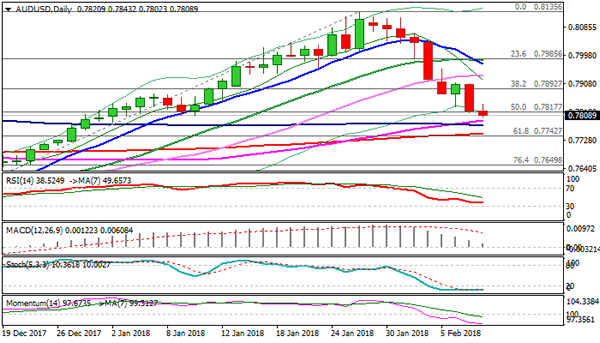
The Australian dollar remains in red on Thursday and pressures supports at 0.7800 zone (psychological support/rising 55SMA), in extension of strong fall on Wednesday. Dovish tone from RBA governor's speech Lowe on Thursday, kept the Aussie under pressure. Lowe said that the central bank does not see strong case rate hike in the near term, pointing at lowering unemployment and raising inflation in order to create stronger support for raising interest rates. Lowe also highlighted that the RBA does not need to closely follow other major central banks which have started or being on the way to tighten monetary policies. The Aussie is trading in steep downtrend from 0.8135 (26 Jan peak) which so far retraced over 50% of 0.7500/0.8135 Dec-Jan rally) and showing scope for extension towards very strong supports at 0.7748/42 (200SMA/Fibo 61.8% of 0.7500/0.8135/top of rising daily/weekly clouds). South-heading daily slow stochastic in deep negative territory and freshly formed 10/20 SMA and daily Tenkan-sen/Kijun-sen bear-crosses maintain bearish pressure, however bears may show stronger hesitation ahead of key 0.7748/42 supports, as slow stochastic is deeply oversold on daily chart and moved into sideways mode. Broken Fibo 38.2% level at 0.7892 and double rejection at 0.7907/10, mark significant barriers which are expected to keep the upside protected.
Res: 0.7817, 0.7843, 0.7892, 0.7910
Sup: 0.7790, 0.7775, 0.7748, 0.7742
CRUDE OIL Skewed To The Downside
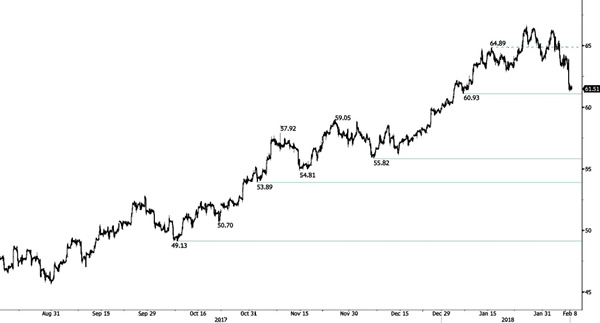
Crude oil gives signs of weakness following yesterday's sideways moves, heading towards strong support at 60.93 (05/01/2018 low). Expected to keep increasing as demand remains strong.
In the long-term, crude oil has recovered after its sharp decline last year. However, we consider that further weakness is very likely. For the time being the pair lies in an upside trend since June 2017. Support lies at 42.20 (16/11/2016) while resistance is located at 77.83 (20/11/2014). Crude oil is trading largely above its 200 DMA.
SILVER Selling Pressures Continue
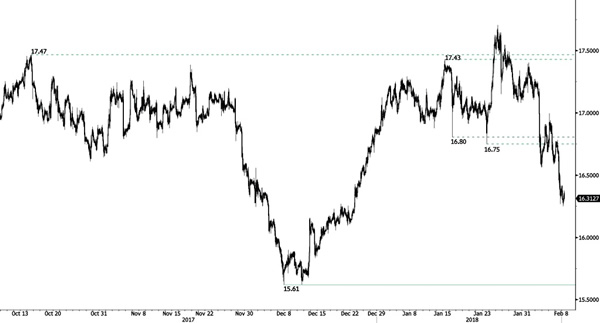
Silver keeps heading lower and trades now below 16.50. The short-term technical structure is turning negative. Hourly resistance lies at 18.21 (08/09/2017 high). The technical structure suggests further short-term decrease.
In the long-term, the trend remains negative/ sideways. Further downside is very likely. The pair is trading below its 200 DMA. Resistance is located at 21.58 (10/07/2014 high). Strong support can be found at 11.75 (20/04/2009).
GOLD Bearish Momentum
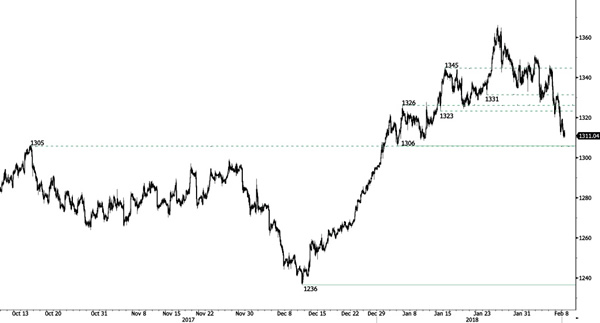
Gold continues trading lower. Hourly support is now at 1'306 (12/01/2018 low). The technical structure suggests however further downside moves.
In the long-term, the technical structure suggests that there is a growing upside momentum. A break of 1'392 (17/03/2014) is required to confirm it. A major support can be found at 1'045 (05/02/2010 low).
BITCOIN Pushing Higher
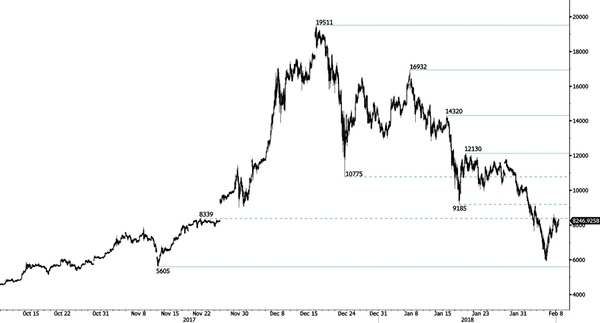
Bitcoin is now retracing above 8'200, approaching 8'339 (21/11/2017 high). Hourly support at 5'605 (13/11/2017 low) is distanced. Hourly resistance remains at 12'130 (18/01/2018 high). The short-term technical structure suggests further upside moves.
In the long-term, the digital currency has had an exponential growth but also presented important downturns. There is decent likelihood that the currency could stabilize between 7'000 - 12'000 in 2018. Bitcoin is trading above its 200 DMA (6'000 range).
EUR/CHF Consolidation At 1.1575 Maintained
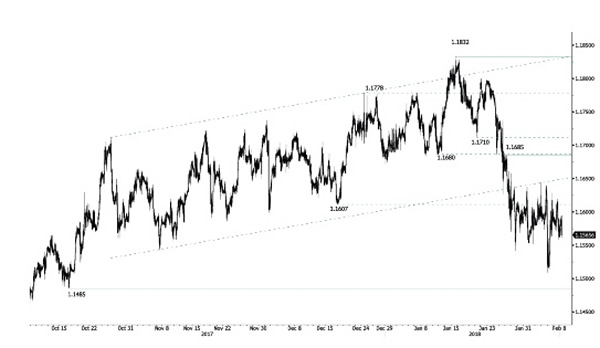
EUR/CHF stabilizes. Hourly resistance is given at 1.1685 (26/01/2018 high). Expected to show further short-term sideways moves.
In the longer term, the technical structure has reversed. Strong resistance is given at 1.20 (level before the unpeg). Yet, the ECB's slowing QE program is likely to cause buying pressures on the euro, which should weigh in favour of the EUR/CHF. Supports can be found at 1.0184 (28/01/2015 low) and 1.0082 (27/01/2015 low).
EUR/GBP Short-Term Downward Trend
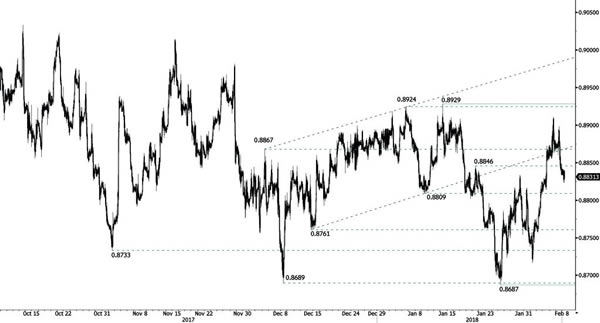
EUR/GBP is trading lower and moves away from resistance at 0.8929 (12/01/2018 high). Hourly support is at 0.8687 (25/01/2018). The technical structure suggests further short-term downside move.
In the long-term, the pair has largely recovered from lows in 2015. The technical structure suggests further upside pressure. The pair is trading above the range of its 200 DMA. Strong resistance can be found at 0.9500 (psychological level).
AUD/USD Declining
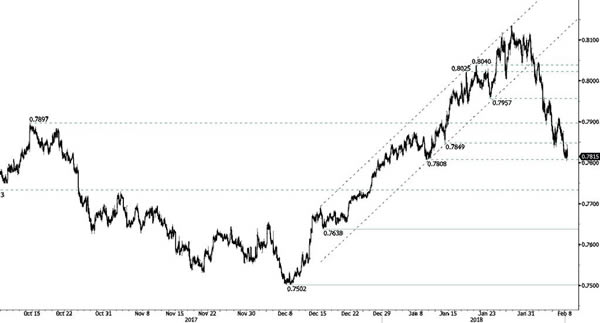
AUD/USD is weakening. Hourly resistance at 0.7808 (01/09/2018) is now outpaced. The technical structure suggests further short-term weakness.
In the long-term, the trend is turning flattish and fails reaching key resistance at 0.8164 (14/05/2015 low). Key support stands at 0.6009 (31/10/2008 low). A break of the key resistance at 0.8164 (14/05/2015 high) is needed to invalidate our long-term bearish view.