

Sample Category Title
EUR/GBP Daily Outlook
Daily Pivots: (S1) 0.8734; (P) 0.8783; (R1) 0.8813; More...
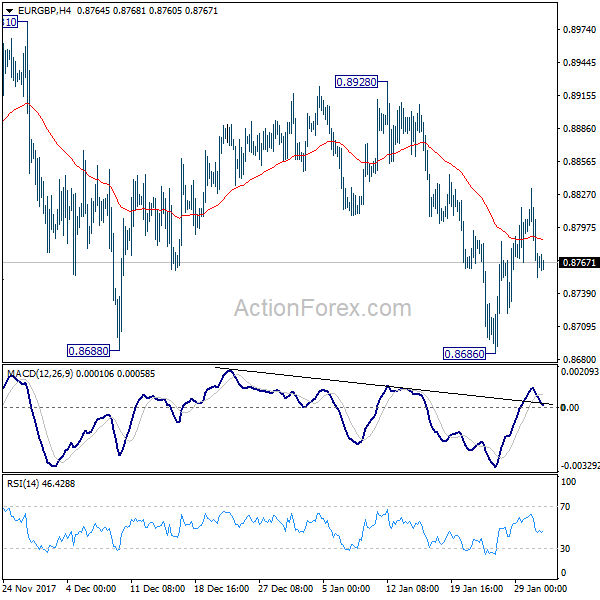
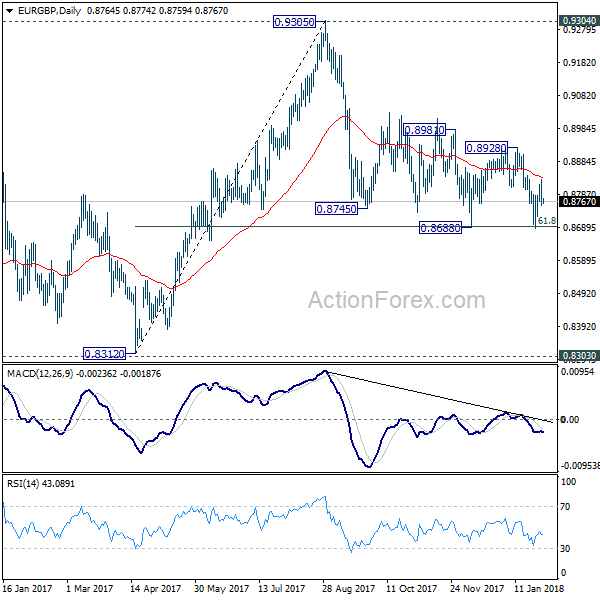
Intraday bias in EUR/GBP remains neutral as range trading continues. Still, near term outlook stays bearish as long as 0.8928 resistance holds and another fall is expected. Firm break of 0.8686 support will resume whole decline from 0.9305. As 61.8% retracement of 0.8312 to 0.9305 should then be taken out too. Deeper decline would be seen to retest 0.8303/8312 support zone.
In the bigger picture, there are various ways to interpret price actions from 0.9304 high. But after all, firm break of 0.9304/5 is needed to confirm up trend resumption. Otherwise, range trading will continue with risk of deeper fall. And in that case, EUR/GBP could have a retest on 0.8303. But we'd expect strong support from 0.8116 cluster support (50% retracement of 0.6935 to 0.9304 at 0.8120) to contain downside.
EUR/AUD Daily Outlook
Daily Pivots: (S1) 1.5284; (P) 1.5331; (R1) 1.5385; More....
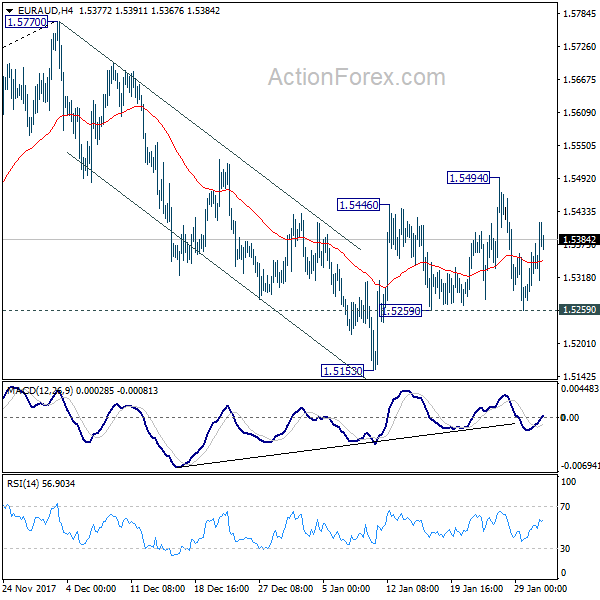
Intraday bias in EUR/AUD remains neutral at this point. Current development argues that correction from 1.5770 is not completed yet. On the downside, below 1.5259 will turn intraday bias to the downside for 1.5153. Break will target 1.4949 cluster support (38.2% retracement of 1.3624 to 1.5770 at 1.4950). Above 1.5494 will bring stronger rebound. but for the moment, we do not expect a break of 1.5770 at first attempt.
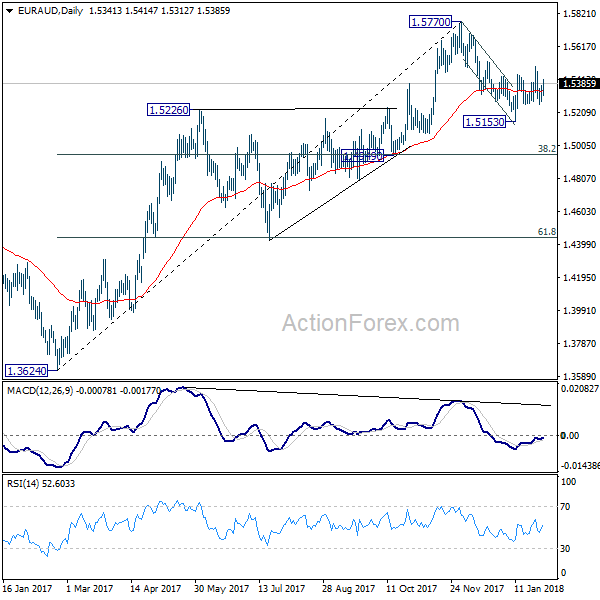
In the bigger picture, price actions from 1.5770 so far suggests that it's corrective in nature. That is, medium term rise from 1.3624 is not completed yet. Break of 1.5770 will extend the rise to retest 1.6587 (2015 high). However, considering bearish divergence condition in daily MACD, sustained break of 1.4949 cluster support (38.2% retracement of 1.3624 to 1.5770 at 1.4950) will indicate medium term reversal. And there is prospect of retesting 1.3624 low in that bearish case.
EUR/CHF Daily Outlook
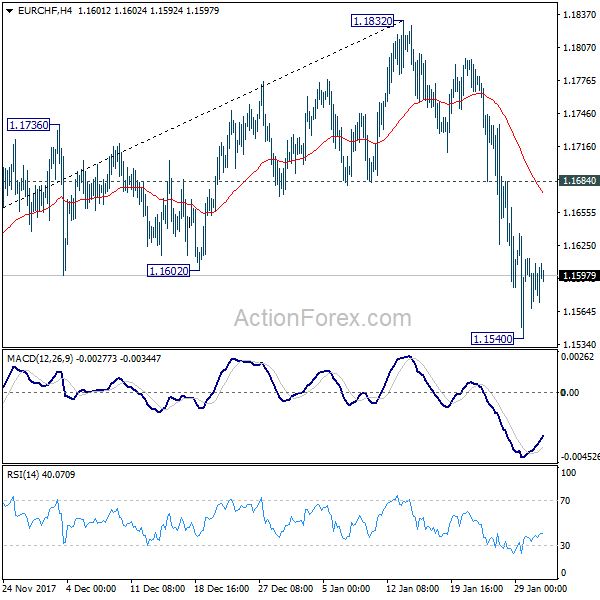
Daily Pivots: (S1) 1.1563; (P) 1.1588; (R1) 1.1609; More...
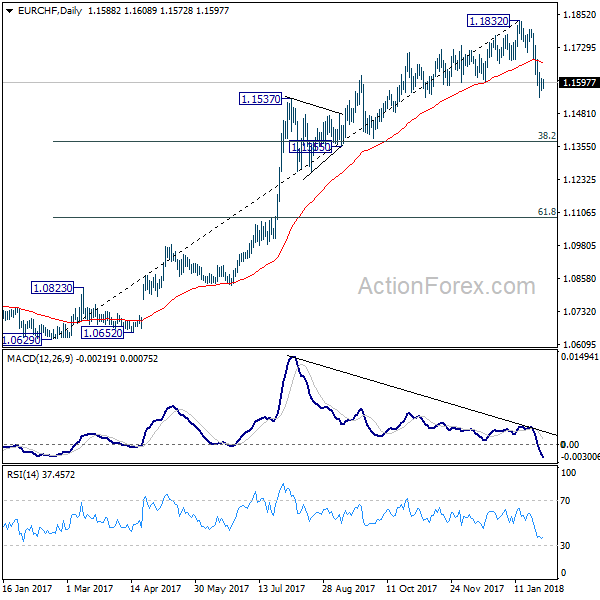
A temporary low is in place at 1.1540 and intraday bias is turned neutral first. Recovery should be limited by 1.1684 resistance to bring another decline. fall from 1.1832 is correcting medium term rise from 1.0629. Below 1.1540 will target 1.1355 cluster support (38.2% retracement of 1.0629 to 1.1832 at 1.1372.)
In the bigger picture, a medium term top should be in place at 1.1832 on bearish divergence condition in daily MACD. But there is no indication of long term reversal yet. As long as 1.1198 resistance turned support holds, we'd still expect another rise through prior SNB imposed floor at 1.2000.
USD/CAD Daily Outlook
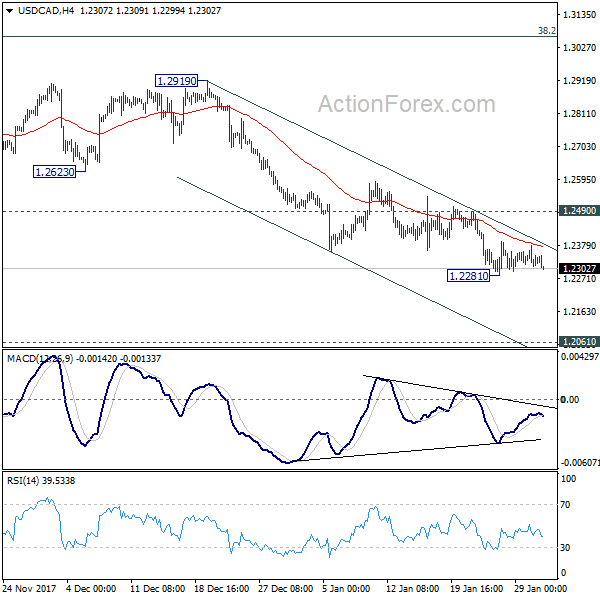
Daily Pivots: (S1) 1.2304; (P) 1.2341; (R1) 1.2375; More...
USD/CAD is staying in range above 1.2281 temporary low and intraday bias stays neutral. As long as 1.2490 resistance holds, near term outlook remains bearish and deeper decline is expected. On the downside, break of 1.2281 will extend the decline from 1.2919 and target a test on 1.2061 low. However, considering bullish convergence condition in 4 hour MACD, break of 1.2490 will indicate short term bottoming and bring stronger rebound.
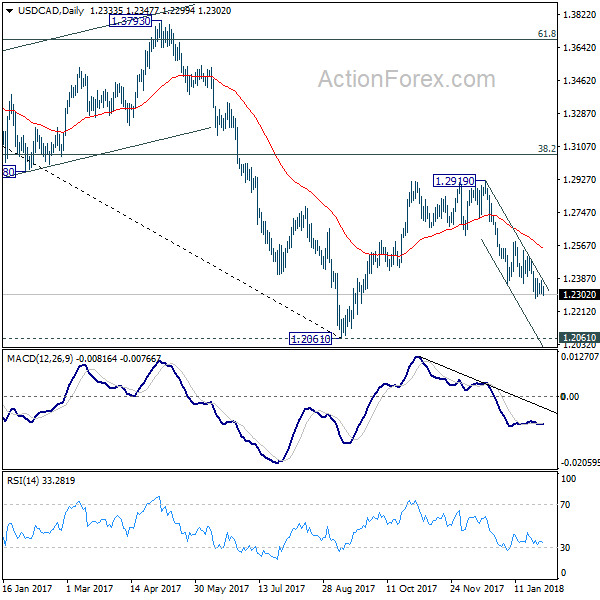
In the bigger picture, rebound from 1.2061 is likely completed completed at 1.2919, rejected by 55 week EMA and kept below 38.2% retracement of 1.4689 to 1.2061 at 1.3065. The development also suggests that long term fall from 1.4689 is not completed yet. Decisive break of 1.2061 low will target 61.8% retracement of 0.9406 to 1.4689 at 1.1424. This will now be the favored case as long as 1.2919 resistance holds.
AUD/USD Daily Outlook
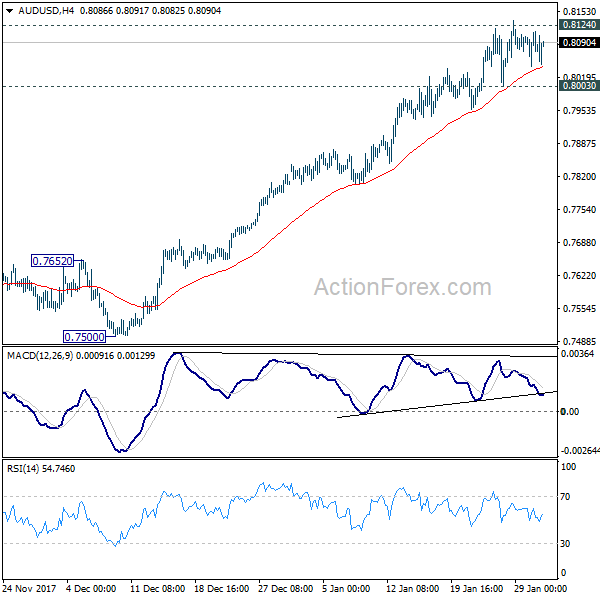
Daily Pivots: (S1) 0.8047; (P) 0.8080; (R1) 0.8118; More...
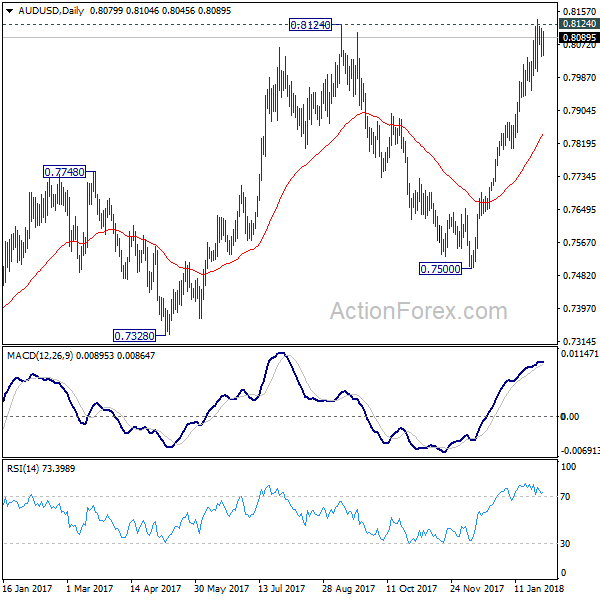
Intraday bias in AUD/USD remains for the moment. As long as 0.8003 support holds, further rally is expected. Sustained break of 0.8124 resistance will resume whole medium term rebound from 0.6826 and target key fibonacci level at 0.8451. However, on the downside, break of 0.8003 support will indicate short term topping, likely with bearish divergence condition in 4 hour MACD. And in such case, intraday bias will be turned back to the downside for 55 day EMA (now at 0.7845).
In the bigger picture, current development suggests that medium term rebound from 0.6826 is still in progress and could be resuming. Such rise could target 38.2% retracement of 1.1079 (2011 high) to 0.6826 (2016 low) at 0.8451. As such rise is seen as a corrective move, we'd expect strong resistance from 0.8451 to limit upside and bring reversal.
Australia’s Inflation Came In Weaker-Than-Anticipated In 4Q 2017
For the 24 hours to 23:00 GMT, the AUD rose 0.04% against the USD and closed at 0.8084.
LME Copper prices declined 0.2% or $13.0/MT to $7049.0/MT. Aluminium prices declined 1.0% or $22.5/MT to $2229.0/MT.
In the Asian session, at GMT0400, the pair is trading at 0.8076, with the AUD trading 0.1% lower against the USD from yesterday's close, following weaker-than-expected inflation data from Australia.
Data revealed that Australia's consumer price index (CPI) advanced 0.6% on a quarterly basis in the three months to December 2017, against market expectations for a rise of 0.7%, making it less likely for the central bank to hike interest rate in the near-term. The CPI had registered a similar rise in the previous quarter.
Elsewhere in China, Australia's largest trading partner, the NBS manufacturing PMI dropped more-than-expected to a level of 51.3 in January, hitting an 8-month low level, affirming that economic growth in the world's second largest economy is beginning to moderate. Market participants expected the PMI to drop to a level of 51.5, compared to a level of 51.6 in the prior month. On the contrary, the nation's NBS non-manufacturing PMI surprised to the upside, climbing to a 4-month high level of 55.3 in January, compared to a level of 55.0 in the prior month and defying market estimates for a fall to a level of 54.9.
The pair is expected to find support at 0.8041, and a fall through could take it to the next support level of 0.8007. The pair is expected to find its first resistance at 0.8112, and a rise through could take it to the next resistance level of 0.8149.
Going ahead, traders would eye the release of Australia's AiG performance of manufacturing index for January and building approvals for December, scheduled to release overnight.
The currency pair is showing convergence with its 20 Hr and 50 Hr moving averages.

Euro-Zone’s Economy Grew As Expected In 4Q 2017, While German Inflation Missed Expectations In January
For the 24 hours to 23:00 GMT, the EUR rose 0.27% against the USD and closed at 1.2404, after data showed that the common currency region posted another quarter of strong growth.
The Euro-zone's seasonally adjusted flash gross domestic product (GDP) rose 0.6% on a quarterly basis in the three months to 2017, meeting market expectations. In the prior quarter, GDP had registered a revised rise of 0.7%.
Other economic data revealed that the final consumer confidence index climbed to a level of 1.3 in January, confirming the preliminary print. In the previous month, the index had recorded a reading of 0.5. Moreover, the region's economic confidence posted an unexpected drop to a level of 114.7 in January, after recording a 17-year high level of 115.3 in the prior month. Market participants had expected for a rise to a level of 116.2.
Separately, Germany's preliminary consumer price index (CPI) advanced less-than-anticipated by 1.6% YoY in January, justifying the European Central Bank's (ECB) cautious approach as price growth remains weak despite strong growth in the Eurozone's largest economy. The CPI had climbed 1.7% in the prior month, while market participants had anticipated for a gain of 1.7%.
In the US, data revealed that the CB consumer confidence index registered an unexpected rise to a level of 125.4 in January, defying market estimates for a fall to a level of 123.0. The index had recorded a revised level of 123.1 in the prior month.
In the Asian session, at GMT0400, the pair is trading at 1.2421, with the EUR trading 0.14% higher against the USD from yesterday's close.
The pair is expected to find support at 1.2353, and a fall through could take it to the next support level of 1.2284. The pair is expected to find its first resistance at 1.2472, and a rise through could take it to the next resistance level of 1.2522.
Moving ahead, investors would be paying close attention to the Euro-zone's flash inflation figures for January and unemployment rate for December as well as Germany's unemployment rate for January and retail sales for December, all slated to release in a few hours. Later in the day, the Federal Reserve is scheduled to announce its monetary policy decision. Investors would focus on the central bank's policy statement for fresh hints on the outlook for interest rates this year.
The currency pair is trading above its 20 Hr and 50 Hr moving averages.

EUR/USD Daily Outlook
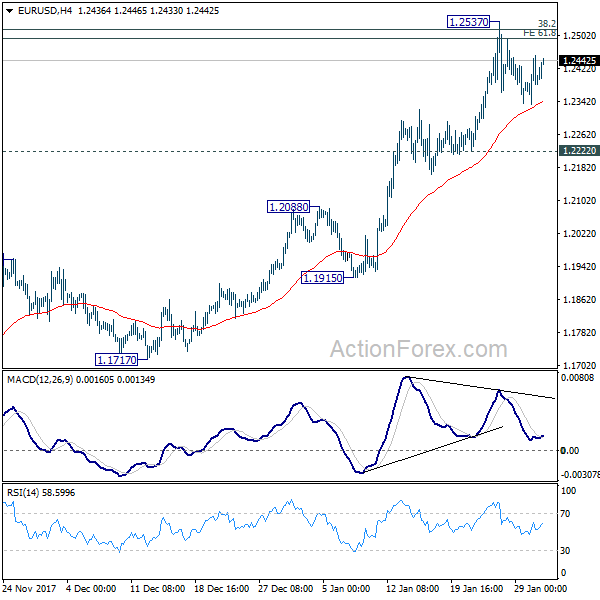
Daily Pivots: (S1) 1.2335; (P) 1.2383 (R1) 1.2431; More....
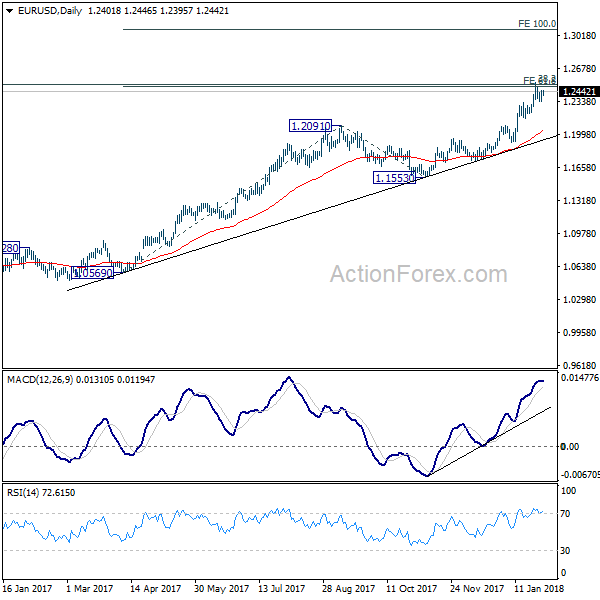
EUR/USD is still bounded in consolidation from 1.2537 and intraday bias remains neutral. As long as 1.2222 support holds, near term outlook remains bullish. On the upside, sustained break of 1.2494/2516 resistance zone will extend recent rally to 100% projection of 1.0569 to 1.2091 from 1.1553 at 1.3075 next. However, break of 1.2222 will indicate rejection from 1.2494/2516, on bearish divergence condition in 4 hour MACD, and turn near term outlook bearish for 1.1915 support first.
In the bigger picture, rise from 1.0339 medium term bottom is still seen as a corrective move for the moment. But key fibonacci level at 38.2% retracement of 1.6039 (2008 high) to 1.0339 (2017 low) at 1.2516 is looking vulnerable. Sustained break of 1.2516 will carry larger bullish implication and target 61.8% retracement of 1.6039 to 1.0339 at 1.3862. Nonetheless, rejection from 1.2516 will maintain long term bearish outlook and keep the case for retesting 1.0039 alive.
Brexit Battle Is Switching To Tackle Inflation, Says BoE’s Carney
For the 24 hours to 23:00 GMT, the GBP rose 0.72% against the USD and closed at 1.4148, after the Bank of England's (BoE) Governor, Mark Carney, stated that the central bank can now focus increasingly on combating inflation and bringing it near to its target, as the drag from the historic Brexit vote on the broader economy and investment has started to recede, with signs of a pick-up in wage growth as the labour market strengthens.
On the data front, UK's number of mortgage approvals for house purchases fell to a nearly 3-year low level of 61.0K in December, highlighting that housing market took a further hit after the BoE raised the key interest rate for the first time in a decade in November. In the previous month, mortgage approvals had registered a revised reading of 64.7K, while investors had expected for a drop to a level of 63.5K. On the other hand, the nation's net consumer credit rose £1.5 billion in December, beating market estimates for a rise of £1.4 billion. In the previous month, net consumer credit had registered a revised similar rise.
In the Asian session, at GMT0400, the pair is trading at 1.4177, with the GBP trading 0.2% higher against the USD from yesterday's close.
Overnight data revealed that UK's GfK consumer confidence index unexpectedly climbed to a level of -9.0 in January, confounding market anticipations for the index to remain steady at a level of -13.0. Additionally, the nation's Lloyds business barometer rose to a level of 35.0 in January, compared to a reading of 28.0 in the prior month.
The pair is expected to find support at 1.4043, and a fall through could take it to the next support level of 1.3910. The pair is expected to find its first resistance at 1.4247, and a rise through could take it to the next resistance level of 1.4318.
The currency pair is trading above its 20 Hr and 50 Hr moving averages.

Few Officials Call For Loosening Monetary Conditions In Future: BoJ Summary Of Opinions
For the 24 hours to 23:00 GMT, the USD declined 0.27% against the JPY and closed at 108.79.
In the Asian session, at GMT0400, the pair is trading at 108.89, with the USD trading 0.09% higher against the JPY from yesterday's close.
The Japanese Yen lost ground against the USD, after the Bank of Japan (BoJ) increased its buying of medium-term Japanese government bonds (JGBs).
Separately, according to the summary of opinions report from the BoJ's January monetary policy meeting, several policymakers shared the view that the central bank needs to consider hiking interest rates or scale-back purchases of risky assets, if Japan's economic fundamentals continue to recover. However, other board members believed that it was appropriate to stick to the central bank's current accommodative policy as inflation remains far from its 2.0% target.
On the economic front, Japan's preliminary industrial production advanced 2.7% on a monthly basis in December, compared to a gain of 0.5% in the prior month. Market anticipation was for industrial production to increase 1.5%.
The pair is expected to find support at 108.51, and a fall through could take it to the next support level of 108.13. The pair is expected to find its first resistance at 109.18, and a rise through could take it to the next resistance level of 109.47.
Moving ahead, Japan's final Nikkei manufacturing PMI for January, slated to release overnight, will be on investors' radar.
The currency pair is trading above its 20 Hr moving average and showing convergence with its 50 Hr moving average.
