Sample Category Title
Trump Versus Mnuchin
Currency war talks make headline amid Mnuchin comments
EUR/USD took a roller coaster ride over the last 24 hours as US Treasury Secretary Mnuchin and President Trump made opposite comments about the greenback, while the ECB was holding its first press conference of the year. On Wednesday, The former said that a weak dollar was good for US trade, while on Thursday the latter said "The dollar is going to get stronger and stronger and ultimately I want to see a strong dollar". During the press conference, Mario Draghi made a remark about Mnuchin’s comments, saying that EUR/USD has increased not only because of the improvement of the Eurozone’s economy but also 'in part due to exogenous reasons that have to do with communication. But not by the ECB, but by someone else. This someone else’s communication doesn’t comply with the agreed terms of references.'
During the press conference, the single currency printed a new multi-year high at $1.2537, the highest level since December 16th 2014. Shortly after the ECB press conference, EUR/USD eased to 1.2370 as Trump showed its support for a strong dollar during an interview at the World Economic Forum in Davos Switzerland. On Friday, the currency pair extended gains and climbed back to 1.2494 as the US dollar fell across the board, losing ground against its peers.
It is quite uncommon for Draghi to mention 'currency war' during an ECB press conference. It shows that some tensions persist and that international competitiveness through monetary policy is more than ever a hot topic that every single country use it to its benefit but that it is not allow to mention explicitly. Backing publicly competitive devaluation is similar to show support to protectionism in trade policy, you don’t talk about it but you try to use it at your own benefits.
Britain’s economy remains resilient for now
Recently providing December 2017 CPI Y/Y at 3.0% (on line with expectations), December Retail Price Index at 278.1 (consensus: 277.6), December PPI at 0.4% (consensus: 0.2%) and November Unemployment Rate at 4.3% (lowest rate since 1975 and maintained for three months in a row), UK is presenting strong economic data and remains in a comfortable position lately: equities rather present steady numbers (FTSE 100: +20.16% since referendum and -0.42% YTD; FTSE 250: +18.39% and -0.77% YTD); the GBP/USD pair is almost at its level before Brexit referendum (-4.94% since its fall in June – July 2016, at 1.42) and stays admissible for GBP/EUR (-12.73% since referendum, at 1.14), providing valuable exchange rate pass-through advantage; inflation is also stabilizing for the first time in six months (valued at 3.0% in 2017); on the other side however, we observe a sharp decrease in UK GDP growth on a Y/Y basis, valued at 1.70% as of September 30th 2017.
Officially leaving the European Union in March 29th 2019, plan that was confirmed yesterday by Philip Hammond, Chancellor of the Exchequer at the WEF, UK is facing serious difficulties in the coming Brexit negotiation. Firms in the banking industry are also hesitant as to shifting their headquarter out of Britain, a sector that represented GBP 124.20 billion in 2016, 7.2% of total UK gross value added.
Though the UK economics for the 2017 period are positive and give signs of recovery, we prevail a prudent stance, as economic conditions can change very quickly. We are expecting today’s December 2017 GDP Y/Y growth rate to be at 1.50%, among the lowest growth rate within the G20. In our scenario, uncertainty surrounding Brexit outcomes could strongly hamper UK business and household consumption in 2018.
Technical Outlook: AUDUSD – Renewed Strength Turns Near-Term Focus Higher, US GDP Data Eyed For Fresh Signals
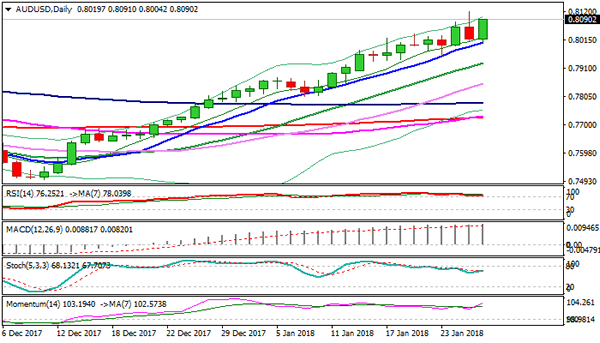
The Aussie regained strength on Friday and pressuring 0.81 barrier which was cracked on Thursday's short-lived spike to 0.8118.
Dollar's rally on President Trump's comments favoring strong US currency failed to sustain gains and was limited at psychological 0.80 level which marked our initial support.
Fresh rally today signal that the pair could eventually test key barrier at 0.8124 (08 Sep peak) and signal continuation of steep uptrend from 0.7500 base on completion of 0.8124/0.7500 correction of broader uptrend from 0.6825 (Jan 2016 low).
Bullish techs continue to support advance as rising 10SMA tracks and keeps the downside protected, marking initial support at 0.8006 today and reinforcing psychological 0.80 support. US GDP data are due later today and eyed for fresh signals, with near-term focus turning towards Australian Q4 CPI data, due next Wednesday.
The pair is on track for the seventh straight bullish weekly close, which marks strong bullish signal for further advance.
Alternative scenario would see increasing downside risk on loss of 0.8000 handle (10SMA / Fibo 38.2% of 0.7807/0.8118 upleg) which would generate initial reversal signal.
Res: 0.8124, 0.8161, 0.8200, 0.8242
Sup: 0.8045, 0.8000, 0.7956, 0.7926
Euro Gains Ground Despite Dovish Mario
The euro has resumed its rally in the Friday session. Currently, EUR/USD is trading at 1.2463, up 0.51% on the day. On the release front, there are no major events in the eurozone. It’s a busy day in the US, highlighted by Advance GDP, which is expected to post a strong gain of 3.0%. As well, Core Durable Goods is forecast to rebound to 0.5%, but Durable Goods is expected to slow to 0.9%.
The ECB maintained interest rates at a flat 0.00%. and ECB President Mario Draghi was dovish in his follow-up remarks, which kept the euro in check on Thursday. Draghi said that interest rates would not rise until well after the ECB’s asset-purchase program (QE) was over. The QE program will not end until September at the earliest, so Draghi essentially ruled out any rate hikes before early 2019. Draghi added that the ECB was prepared to increase QE in “size or duration”, a reminder to the markets that it is premature to expect normalization anytime soon. A new headache for Draghi is the streaking euro, which has hit 3-year highs against the US dollar. Investors are worried that a stronger euro could hurt exports and company earnings. EUR/USD has jumped 3.6% in January, as the dollar continues to struggle.
There will be a changing of the guard next month at the Federal Reserve, as Jerome Powell is set to replace Janet Yellen as chair of the powerful central bank. On Tuesday the Senate confirmed Jerome Powell as the next head of the Fed. The vote of 84-13 was a cakewalk, reflecting strong bipartisan support for Powell. The new chair is expected to continue Yellen’s monetary stance, which was marked by small, incremental rate hikes during a period of economic expansion. The Fed has started to trim its massive balance sheet, another vote of confidence in the strength of the economy. At the same time, Fed policymakers are divided over how to approach inflation, which remains below the Fed target of 2 percent, despite a strong economy and a red-hot labor market. The markets will be watching to see how the Fed, under Powell’s watch, responds to recent tax reform legislation, which is sure to have a significant impact on the US economy.
EURUSD Analysis: Regains Some Losses After Trump’s Comments
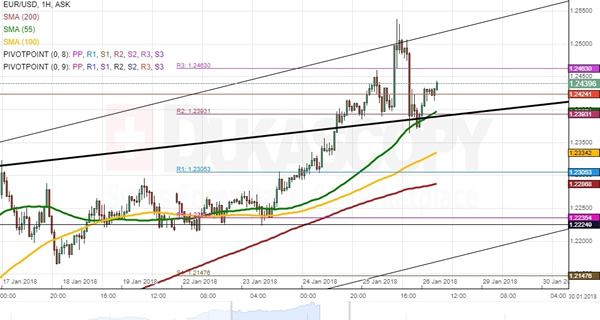
Even though the losses of EUR/USD were limited solely to 11 pips on Thursday, the pair made two massive leaps throughout the day. During the first one, the Euro started to appreciate during the ECB Press Conference when the lack of comments by Draghi about the strong currency was interpreted as a buying signal. Meanwhile, the rate edged in the opposite direction in the wake of Trump's comment about Greenback's upside potential in the future. The pair has managed to appreciate in the Asian session; however, it should not exceed the 1.25 mark. Given that the US is to release two sets of important fundamentals in this session, these releases are likely to guide the rate's subsequent direction. In case of strong bearish sentiment, the downside potential should be halted at the 200-hour located near 1.2250.
GBPUSD Analysis: Edges Higher Prior To Data Releases
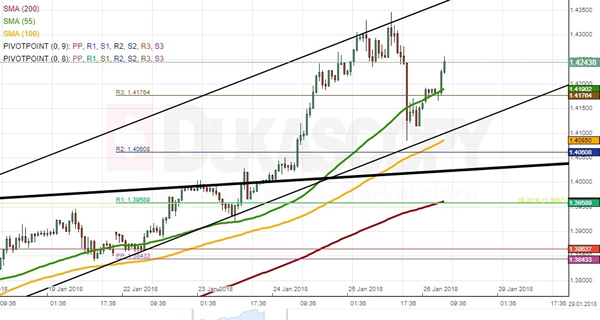
Despite strong signals of reversal, the Sterling managed to maintain its high position against the US Dollar on Thursday, as it was trading slightly below the 1.43 mark —its 1,5-year high—during most of the session. This still movement was disrupted by Trump’s comments on stronger US Dollar which sent the pair for a 117-pip hourly plunge. This fall was supported by the 55-hour SMA which allowed for a subsequent appreciation towards 1.4250. As apparent on the chart, the previously-drawn ascending channel still holds; however, its steep positioning points to a soon breakout south. By and large, this session should offer high volatility due to important data releases from both the UK and the US. A strong support should be provided by the 200-hour SMA, the 38.2% Fibo and the weekly R1 circa 1.3960.
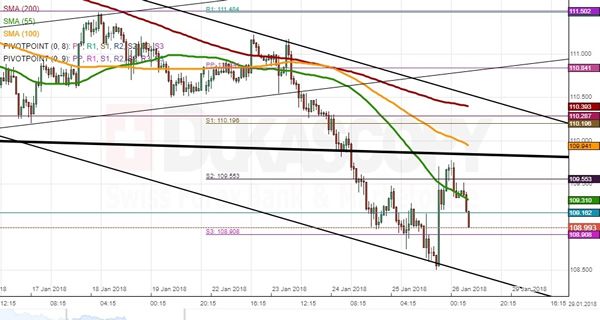
USDJPY Analysis: Reverses From Medium-Term Channel
The US Dollar was confidently moving lower against the Yen on Thursday prior to being boosted by Trump’s comments later in the session. As a result, the Greenback strengthened 88 pips and managed to push even higher for several hours after the event. This bullish sentiment was reversed during the Asian session when downside risks took the upper hand once again. The pair might slide lower within the following hours towards the lower boundary of a five-week descending channel circa 108.50 . However, the US is to release it Advance GDP and Core Durable Goods Orders at 1330GMT that are likely to cause volatility in the market. The southern side is supported solely by the weekly S3 at 108.90, while strong resistance is located near the 110.20 mark.
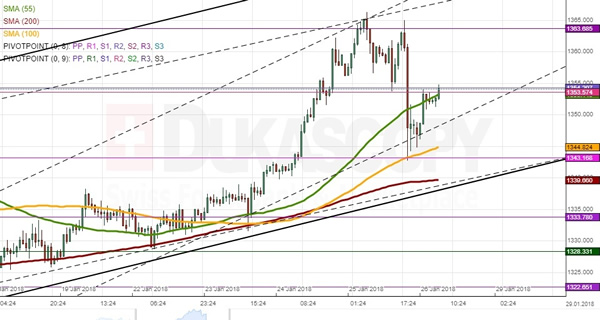
XAUUSD Analysis: Tries To Regain Upside Momentum
The first part of Thursday's trading session was relatively calm for Gold, as it was trading in a 1,365.00/1,353.00 range between the weekly R3 and the weekly and monthly R2s. This slight period of consolidation was disrupted by Trump's comments on stronger US Dollar which strengthened the American currency by 0.94%. This bearish momentum reversed in the Asian session, as the yellow metal was supported by the 100-hour SMA near 1,345.00. It is likely that the pair tries to re-located itself near the weekly R1 which is also a 2017 high. Meanwhile, the US is to release its Advance GDP and Core Durable Goods Orders at 1330GMT. In the event of sluggish data, the pair could remain near the 200-hour SMA at 1,340.00.
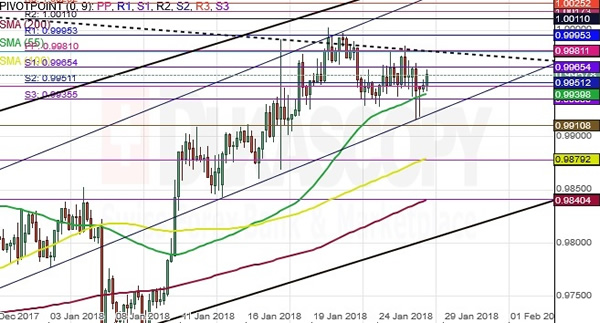
AUD/CAD 4H Chart: Continue Bullish
The Bull has taken over the AUD/CAD pair since December 2017. Since it touched the monthly pivot point support at 0.9599, the pair has been trading in a channel up and reached a new high level.
A new junior channel has been mapped, and the pair has tested the daily dominant channel's upper trend line. Overall, the AUD/CAD pair is likely to breach the weekly pivot point's resistance level at 1.0040.
In regards to the future trading, the pair is likely to continue bullish until it breaches the weekly PP, and afterwards there might be a temporary retracement to the south.
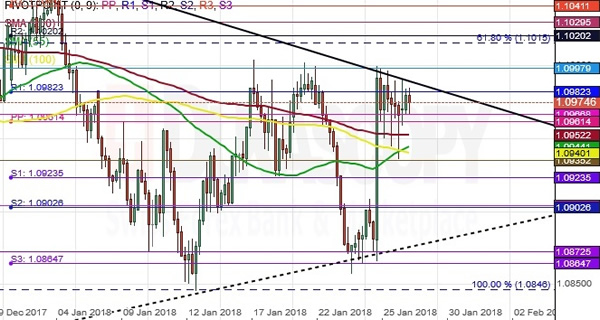
AUD/NZD 4H Chart: SMAs Providing Support
A review was made for the AUD/NZD pair, as previously drawn pattern was broken. The pair has been volatile since the last time it was reviewed.
The pair tested the 50.00 % Fibonacci retracement level and dropped back south. The bears continued to grow stronger and a new higher low has been formed. The retracement can be measured by connecting the high level of 1.1292 touched in October with the January low level of 1.0846.
The combination of 55-hour, 100-hour and 200-hour SMAs is providing support near 1.0944 mark. If this support holds, the pair is likely to breach the dominant channel upwards.
USD/CAD: Canadian Retail Sales
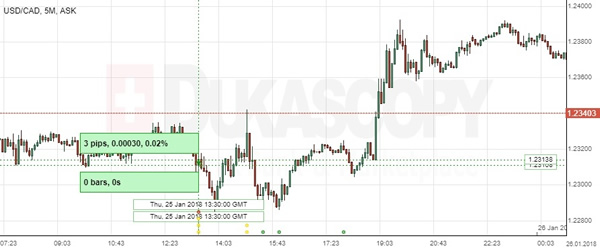
The Canadian Dollar showed a weak post-reaction against the Greenback, following the country's retail sales data. USD/CAD flustiated within the 1.2300-1.2320 range, until Donald Trump's comments caused an increase, temporary putting the pair above the 1.2360 level.
Canada's retail sales grew less than anticipated in November, as higher gasoline and electronics prices were restrained by weak new car purchases. Statistics Canada stated that retail sales rose 0.2% in November, less than economists anticipated, following the prior month's upwardly revised 1.6%. The expansion in volumes of retail sales over the course of both October and November is likely to imply that it would be stronger in the Q4 as a whole.