

Sample Category Title
Yen Higher as BoJ Turned Slightly More Optimistic, But No Follow Through Buying
Yen spikes higher after BoJ turned slightly optimistic over the country's inflation outlook. But there is no follow through buying seen. USD/JPY is kept in middle of range of 110.18/114.17. Dollar also recovers mildly after US government reopens. But overall, the greenback is staying in near term down trend against all major currencies. In other markets, risk appetite stays strong. DOW hit another record by gaining 0.55% to 26214.60. S&P 500 and NASDAQ were even stronger, closed up 0.81% and 0.98% at record highs. 10 year yield extended recent rally by rising 0.028 to 2.665. A take on 3% handle is now having realistic possibility.
BoJ stands pat, kept economic forecasts unchanged
BoJ left monetary policies unchanged today as widely expected. The short term policy rate is held at -0.10%. And under the yield curve control framework, BoJ will continue with the JPY 80T a year asset purchase to keep 10 year JGB yield near zero. The vote was made with 8-1 vote with Goushi Kataoka dissented again. Kataoka continued to push for targeting yields on longer JGBs too. As noted in the accompanying statement, the members suggested that "inflation expectations have moved sideways recently", compared with previous reference that "inflation expectations have remained in a weakening phase".
In the quarterly outlook, BoJ pledged again to continue with "quantitative and qualitative monetary easing with yield curve control" for "as long as it is necessary" to achieve the 2% inflation target. Core CPI is projected to climb to 1.4% in fiscal 2018 and 1.8% in fiscal 2019, excluding effects of consumption tax hike. Real GDP is projected to grow 1.4% in fiscal 2018 and 0.8% in fiscal 2019. These projections are unchanged from October 2017 forecasts.
Also from Japan, all industry activity index rose 1.0% mom in November.
US government reopened through Feb 8
In the US, the Congress has finally passed the measures to reopen the government, but only through February 8. The breakthrough came after Senate Majority Leader Mitch McConnell agreed to address the demands of Democrats on the "dreamers" program. Senate Democratic Leader Chuck Schumer said afterwards that "the Republican majority now has 17 days to prevent the dreamers from being deported."
Marvin Goodfriend, a Carnegie Mellon University professor, attended a nomination hearing as Fed Governor before Senate Banking Committee. Goodfriend said that "guided by the goals of maximum sustainable employment, price stability, and financial stability, and with lessons from its past, the Federal Reserve must be alert to future challenges." And, "I intend to draw on my academic and professional experience to promote policies that would further increase transparency and accountability at the Federal Reserve." Goodfriend is President Donald Trumps' third nomination after Jerome Powell and Randal Quarles. He is also a former Richmond Fed policy adviser.
CBI urged to stay in EU customs union
In UK, the Confederation of British Industry heavily criticized the government Brexit approach and call for staying in EU customs union. CBI director general Carolyn Fairbairn also said yesterday that "there may come a day when the opportunity to fully set independent trade policies outweighs the value of a customs union with the EU; a day when investing in fast-growing economies elsewhere eclipses the value of frictionless trade in Europe. But that day hasn't yet arrived."
Fairbairn also called for having a clear transitional EU trade deal by April, or "firms will have no choice but to trigger their plan Bs". Also "more jobs and investment will leave our shores and future generations will pay the price."
IMF raised global growth forecasts
At its latest forecasts, the IMF raised the 2018 global growth forecast by 0.2 percentage point to 3.9%, led by acceleration in the US (GDP growth up by 0.4 percentage point to 2.7%) and Eurozone (up by 0.3 percentage point to 2.2%). While the world lender upgraded US growth because of the tax reform plan, it warned that the deal is negative to growth in the long term.
The IMF downgraded UK's growth outlook, by -0.1 percentage point, to 1.5% for 2019, while leaving the growth forecast for this year (also at 1.5%) unchanged. The main reason is the uncertainty of Brexit negotiations and the future trade relations between the UK and the EU after the "divorce". However, this has not affected the pound. Rather, GBPUSD has rallied to a post-referendum high as French President Emmanuel Macron noted that the might be "special deal" for Britain.
Looking ahead
German ZEW economic sentiment is the main feature today. Eurozone consumer confidence, UK public sector net borrowings will also be released.
USD/JPY Daily Outlook
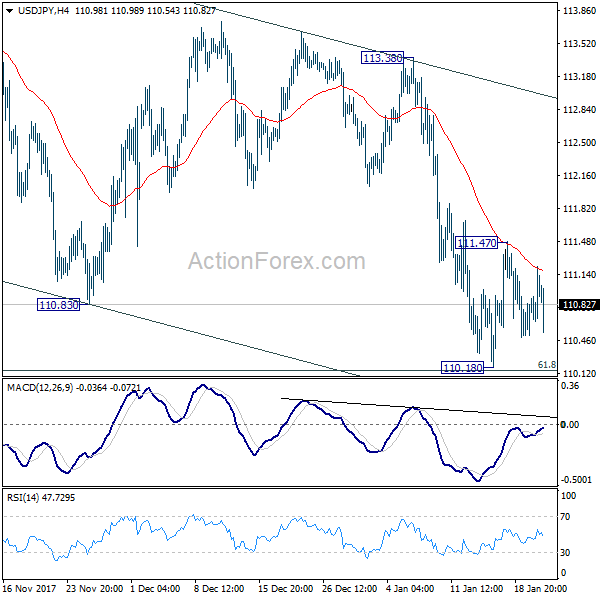
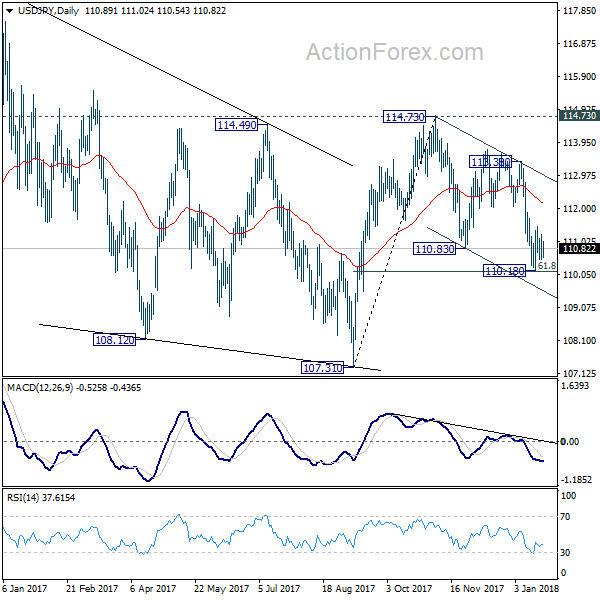
Daily Pivots: (S1) 110.54; (P) 110.88; (R1) 111.27; More...
Intraday bias in USD/JPY remains neutral as it continues to stay in range of 110.18/111.47. On the upside, break of 111.47 will affirm the case that correction from 114.73 is finished with three waves down to 110.18. Intraday bias should then be turned back to the upside for 113.38 resistance for confirmation. However, below 110.18 will extend the correction lower. But we'd again look for bottoming signal in next fall.
In the bigger picture, we're holding on to the view that correction from 118.65 is completed at 107.31. And medium term rise from 98.97 (2016 low) is going to resume soon. Sustained break of 114.73 should affirm our view and send USD/JPY through 118.65. However, break of 107.31 will dampen this view and extend the medium term fall back to 98.97 low.
Economic Indicators Update
| GMT | Ccy | Events | Actual | Forecast | Previous | Revised |
|---|---|---|---|---|---|---|
| 3:15 | JPY | BoJ Rate Decision | -0.10% | -0.10% | -0.10% | |
| 4:30 | JPY | All Industry Activity Index M/M Nov | 0.90% | 0.30% | ||
| 9:30 | GBP | Public Sector Net Borrowing Dec | 4.2B | 8.1B | ||
| 10:00 | EUR | German ZEW (Economic Sentiment) Jan | 17.9 | 17.4 | ||
| 10:00 | EUR | German ZEW (Current Situation) Jan | 89.5 | 89.3 | ||
| 10:00 | EUR | Eurozone ZEW (Economic Sentiment) Jan | 29.7 | 29 | ||
| 11:00 | GBP | CBI Trends Total Orders Jan | 12 | 17 | ||
| 15:00 | EUR | Eurozone Consumer Confidence Jan A | 1 | 1 |
USD/CAD: US Dollar Consolidating Above 1.2360
Key Highlights
- The US Dollar remains in a downtrend below 1.2540 against the Canadian Dollar.
- There is a key bearish trend line forming with resistance at 1.2480 on the 4-hours chart of USD/CAD.
- A 4-hour close above the 1.2540 level is needed for the greenback to move back in the bullish zone.
- Canada’s Wholesale Sales increased 0.7% in Nov 2017, less than the forecast of +1.0%.
USDCAD Technical Analysis
The US Dollar traded lower during the past three weeks against the Canadian Dollar and tested the 1.2350-60 support. The USD/CAD pair is currently consolidating above 1.2360 and is preparing for the next move.
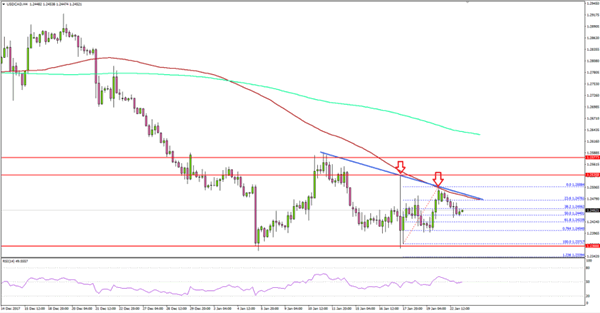
Looking at the 4-hours chart of USD/CAD, there was a major decline from well above 1.2900 to 1.2350. Later, the pair started a decent recovery, but the upside move was capped by the 1.2580 resistance and the 100 simple moving average (red, 4-hour).
The pair declined and retested the 1.2350-60 support. At the moment, it seems like USD/CAD is consolidating above the mentioned 1.2350-60 support. On the upside, there is a key bearish trend line forming with resistance at 1.2480 on the same chart.
The trend line resistance at 1.2480 is positioned along with the 100 SMA. Therefore, a proper break above the 1.2480 level and 100 SMA is needed for buyers to control.
The next major resistance on the upside is at 1.2540, followed by the 1.2580 swing high. On the downside, the 1.2350-60 support zone is very significant. Should the pair decline below 1.2350, there could be heavy selling pressure on USD/CAD.
Recently, Canada’s Wholesale Sales figure for Nov 2017 was published. There was an increase of 0.7% in sales, less than the forecast of +1.0%. However, the market sentiment was not impacted and USD/CAD remained below the 1.2480 resistance.
Looking at the other majors, EUR/USD is holding ground above the 1.2200 support, and GBP/USD looks set for more gains in the near term.
Elliott Wave View: GBPUSD More Upside Expected
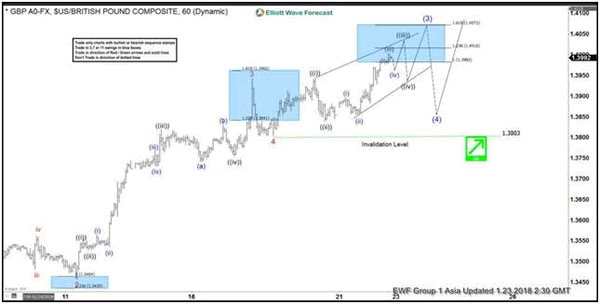
GBPUSD Short Term Elliott Wave view suggests that rally from 16 December 2017 low is unfolding as 5 waves impulse Elliott Wave structure. Up from 16 December 2017 low (1.33), Minor wave 1 ended at 1.3613, Minor wave 2 ended at 1.3456, Minor wave 3 ended at 1.3943, and Minor wave 4 ended at 1.3803. Pair has broken above Minor wave 3 at 1.3943, confirming that Minor wave 5 higher has started.
Internal of Minor wave 5 is unfolding also as a 5 waves impulse where Minute wave ((i)) ended at 1.3945 and Minute wave ((ii)) ended at 1.3838. As far as pivot at 18 January 2018 low (1.3803) stays intact, expect the pair to extend higher to end Minor wave 5 of (3) towards 1.40s area. Afterwards, pair should pullback in Intermediate wave (4) to correct cycle from 16 December 2017 low in 3, 7, or 11 swing before the rally resumes. We do not like selling the pair.
GBPUSD 1 Hour Elliott Wave Chart
Government Reopens But Might Shut Down Again Early February
Today the Republicans and the Democrats agreed on a short-term funding bill expiring on 8 February in an attempt to get more time to negotiate the immigration reform. The deal means that the government opens on Tuesday. It seems like the Democrats were concerned about losing support, as a shutdown is very unpopular among voters and the mid-term election is coming up in November.
The question is now whether the two sides can reach a bipartisan deal on immigration, something we have to follow over the coming weeks. At the moment it seems merely like kicking the can down the road but clearly US politics is difficult to predict, even when President Trump is not the centre of attention.
As the shutdown only lasted a few days, there are no real economic costs and thus we still believe the Fed is on track to deliver a hike in March. Given that we might face another shutdown beyond 8 February, we stress that the longer a shutdown lasts, the greater the consequences. For more on the economic consequences of a shutdown
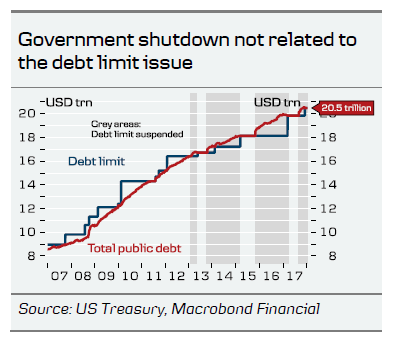
Remember that a government shutdown is not related to the debt limit issue. The suspension of the debt limit expired on 8 December and the debt limit was reinstated at USD20,456bn. The reason why the US Treasury can still issue government bonds is that it is using so-called ‘extraordinary measures’, which basically means swapping non-marketable debt (held by the government itself) to marketable debt (held by the public) so that total debt is unchanged. The extraordinary measures will be exhausted in the spring and if the debt limit is not lifted, re-suspended or removed altogether, the US will default on its debt. Neither the Democrats nor the Republicans want a US default (which would result in a major financial crisis with much greater real economic costs than during a government shutdown) and we expect a solution to be found eventually, not least now the Republicans have passed a government deficitfinanced tax reform.
Market Morning Briefing: Euro As Per Expectation Is Consolidating Currently At Levels Near 1.225
STOCKS
Dow (26214.60, +0.55%) moved up again yesterday and could continue to rise towards 26400-26500 in the next few sessions.
Dax (13463.69, +0.22%) may take support near 13400 (earlier resistance, now turned into support) and possibly try to move up towards 13600 in the coming sessions. While above 13400, view remains bullish.
Nikkei (24037.86, +0.93%) is trading above 24000 and is likely to move up towards 24200 in the coming sessions.
Shanghai (3530.32, +0.84%) has moved up to test 3530 and would soon move up to 3550 in the next few sessions. Note that 3550 is an important resistance and could come off from there back towards 3500 in the medium term.
Nifty (10966.20, +0.66%) and Sensex (35798.01, +0.81%) moved up sharply yesterday. The markets are currently driven by liquidity flow into the emerging markets, India being a beneficiary of that. As news suggests, foreign institutional investors have bought Indian shares worth $993.16mln so far in Jan'18.
Equity allocation seems to be at the highest levels since Mar'15. While the fows keep coming in, the index could be moving higher for some more time in the near term.
Targets for Nifty remains at 11000 and for Sensex near 36500 for the coming sessions.
COMMODITIES
Our expected correction from respective resistances near 70 and 65 have not yet materialised keeping both Brent (69.37) and WTI (63.94) at levels just below the resistances. While the rise continues, a re-test of the upside resistances could be seen in the next couple of sessions. While we still expect the crude prices to see a short corrective fall, it would be important to note the price action near resistance levels.
Gold (1335.60) has moved up a bit but has scope of eventually moving up towards 1345-1350 levels in the coming sessions.
Copper (3.2020) may again try to move up towards 3.25. Narrow movements within 3.25-3.15 is likely in the next few sessions.
FOREX
Dollar Index (90.377) is currently near support (90.3-90.4; earlier mentioned as 90.4-90.5) on the daily line chart. It should respect this support and stay above it, or, at max, go down further to test support near 90 on the 3 day candles. However, in either case, there should be a bounce for the index towards 91.5 in the near term.
Euro (1.2257) as per expectation is consolidating currently at levels near 1.225. Ranging between 1.21 and 1.2325 might continue for the Euro for some more sessions. We have a preference for a correction towards 1.21 in the near term followed by a rise back towards 1.225-1.23 again.
As mentioned yesterday, Dollar-Yen (110.63) should stay above support near 110.5 on the 3 day candles and make another attempt at a rise towards 112 in the near term.
Euro-Yen (135.65) is trading in a very narrow range of 135.5 and 136.2 currently and with some Yen strength in the past couple of days, it is struggling to move beyond 136. The anticipated upmove towards resistance near 137 on the daily candles might extend into next week.
Pound (1.3982) is currently testing resistance near 1.4 on the daily line charts. However there is some room on the weekly candles for it to move further up towards resistance near 1.41 in this week before dipping again.
Aussie (0.7994) is continuing its ranging near 0.7990-0.8030 as it struggles to move past resistance near 0.80 on the weekly line charts.
Dollar-Rupee (63.87) could extend to 64.20 also. The strong Support to watch out for now is 63.70. The bigger question is whether the Dollar will try to rise past 64.20 in the medium term, or not.
INTEREST RATES
US 10 Yr (2.65%), 30 Yr (2.9122%), 5 Yr (2.4476%) & 2 Yr (2.0608%) are all slightly below the highs which were seen yesterday. The 30 Yr is testing resistance near 2.92% on both short term and medium term charts. In the absence of further volatility this week, we might see the 30 Year consolidate below this level for the time being.
A consolidation in the 30 Yr yield could mean no improvement in the yield curve flattening situation, unless the shorter term yields also consolidate. US 10 Yr – 5 Yr (0.2024%) & US 30Yr – 10Yr (0.2622%) for now continue to stay above supports near 0.19% and 0.24-0.25% respectively.
Now For Some Real Action
Overview
The end of the US government shutdown was to some degree ‘risk positive’ but hardly a pivotal moment. And more to the point the bipartisan deal is first and foremost a matter of kicking the can down the road to February 8. Which sets up another funding clash and given the level of partisan politics, which will likely remain as stubbornly intense and polarising as ever, we should expect another contentious affair if both parties don’t resolve the critical stumbling blocks between now and then.
With a very light economic calendar to start the week, overnight markets were more than happy to respect new ranges heading into some critical central bank meetings. This series of Central Bank meetings will be a crucial catalyst for bond and currency markets as traders will focus on inflation rhetoric and critical signals that either the Bank of Japan or European Central Bank could signal that extraordinary monetary accommodation will soon be wound back.
But for the most part, the dollar weakened overnight, but a small knee-jerk briefly tempered its decline after the Senate voted to turn the US government’s lights on again
US Equity Market
While investors didn’t extrapolate a great deal of uncertainty from this government shutdown as GDP impacts from prior closures were negligible, but they still celebrated the stopgap deal pushing the Dow back into record territory and wiping earlier losses. Which speaks volumes for both the underlying momentum and equity investor voracious appetite as on even the most minuscule risk catalyst they are willing to pay top side asking price for a meal of equities. However, let’s not pop the champagne corks just yet as there’s a substantial likelihood we’ll go down this road again Feb 8.
Asian Equity Market
Yesterday markets were a mixed bag as the US government shutdown tempered investor appetite. But with the US shut down temporarily behind us and the political stalemate in Germany nearing a resolution, Risk sentiment will move to the front foot taking its lead for surging US markets While catch up is in play no reason why local markets will not extend gains in a very flexible Asia EM space.
Oil Markets
Not unexpectedly the past 24 hours have been choppy, but at the start of the Asian session oil markets remain buttressed by Saudi and Russian flowery language indicating their willingness to cooperate beyond 2018. Of course, the jump in the first mentality suggests this to be an extension of production cuts, but even if it proves to be a loss leader type headline, any hint of compliance between these two oil supper power beyond 2018, is a positive sign
As far as the NY session Oils were trading with a higher correlation to the US dollar after traders digested the news that Libyan Wintershall oil fields will restart production and caused Brent prices to wobble.
With currency markets on central bank watch, in the absence of any oil related specific headlines, Oil’s could be more or less pinballed around by broader USD dollar sentiment today.
Gold Market
A muted overnight session with most traders watching US Senate vote, although there was little for Gold traders to glean from the proceedings. Traditionally US yields fall in shutdowns, but with UST 10y rising to 2.65+ it was undoubtedly throwing a spanner into traditional markets correlations.
With the spate of central banks on tap and by extension, even the slightest shift in language could send bond yields soaring; traders will remain cautious until a clear-cut dollar trend emerges. But not to further confuse the issue, there could be two idiosyncratic dollar storylines with the BoJ erring dovish sending the USDJPY to 112 while having the ECB shifts from an of a neutral bias triggering a move to 1.25 EUR USD as EU bond yields move higher.
G-10
The Euro
The Euro should remain quiet within the 1.22-1.23 range ahead of the ECB
The Japanese Yen
While not expecting any change, it would be silly not to expect the unexpected. But even if the BoJ wanted to announce a taper there is little chance Kuroda will take that leap of faith today as the market would hammer USDJPY mercilessly lower. But with the Japanese economy firing on all cylinders and signs of deflationary pressures abating, traders my continues to buy JPY post-decision regardless fo whatever dovish lean Kuroda puts on the proceedings.
The Australian Dollar/Commodity Bloc
The Aussie dollar underperformed the rest of the commodity block as the market focus is on next week CPI
In Canada higher oil prices and the resumption of NAFTA talks had traders paring back short. But in general, everyone is waiting for the NAFTA headlines and this week’s CPI before re-engaging positions in size
The New Zealand dollar continued to benefit from the political risk premium unwind as longer-term structural shorts pair back.
The Chinese Yuan
AS the weaker dollar narrative unfolds a test of 6.40 again is in the offing. Indeed over the past 24-48 hours, traders have been banging around a lot of theory and what if’s. With some out of left field ideas. Indeed the general weaker US trend was helping Yuan sentiment, and we should be able to test the Pboc resolve if the dollar drops further as expected. It will go a long way to clearing the air as only through price discovery can we determine if the Pboc are no longer single-mindedly focused on the USDCNY exchange rates, but have the confidence to use the more comprehensive basket of currencies as the central signpost.
Asia FX
Regional
On the contrary front, the first salvo was launched today in would may develop into a long drawn out tit for that trade battle between US and China. Trump administration slapped a tariff on cheap solar panels which has driven the rapid expansion of solar energy in the US. Any escalation of trade battle could dampen enthusiasm for regional currencies as exports make up a significant portion of local GDP/s
The Korean Won
Appears to be more stealthy currency intervention as regulators are reports are circulating that the government has asked banks to refrain from overseas bond sales. But my view is that equity is driving the bus, so more inclined to ignore this ominous headlines
The Malaysian Ringgit
The pick up on global risk sentiment after the US Senate ended the government shutdown along with higher Oil prices bodes well for the MYR today.
Talk of OPEC and Russian policy compliance beyond 2018, suggest higher for longer oil prices. Not only a boon to the government budget coffers but bodes well for oil and gas constituents on the KLCI
The US equity market celebrated government workers reporting back to work by lifting the Dow to new record territory, and this positive momentum should carry into Asia
The US dollar weakness is starting to re-emerge which should play out well for local currencies
Gold Unchanged As Investors Look For Cues
Gold is unchanged in the Monday session. In North American trade, the spot price for an ounce of gold is $1331.91, unchanged on the day. On the release front, there are no US events on the schedule. On Tuesday, the US releases the Richmond Manufacturing Index.
Will US lawmakers shut down the shutdown? With government non-essential services a standstill for a third day, the Senate is expected to vote on a stopgap spending bill later on Monday. Democrats and Republicans are now playing the ‘blame game’ and pointing fingers at who is responsible for the crisis. The Democrats refused to vote for the spending measure until a deal is hammered out over Daca, a program for children who are illegal immigrants that Trump has threatened to deport. On Sunday, Senate majority leader, Mitch McConnell suggested that he would allow a vote on immigration reform in February if Democrats agree to fund the government. With congressional elections looming, both parties will not want to anger voters, so we could see the crisis resolved this week.
The Federal Reserve was busy in 2017, raising interest rates three times. In January, the Fed began to trim its balance sheet, to the tune of $10 billion/mth. Next up is a policy meeting on January 31. A rate hike is a virtual certainty, with CME Fed Watch pegging the odds of a quarter-point hike at 98.5%. Although this means that a rate hike has been priced in by the markets, the dollar could nevertheless gain ground after a hike, as a rate increase would signify an important vote of confidence in the economy by the Fed Reserve. If the US economy continues to expand at a clip of around 3 percent, there is a strong likelihood of a second rate hike in the first half of 2018.
Yen Subdued Ahead Of BoJ Rate Announcement
The Japanese yen is showing little movement at the start of the week. In Monday's North American session, USD/JPY is trading at 110.83, up 0.02% on the day. On the release front, the Bank of Japan will announce its interest rate later on Wednesday. The Bank is expected to maintain rates at -0.10%. Investors will be carefully monitoring the Bank's monetary policy statement. There are no US releases on the schedule. On Tuesday, the US releases the Richmond Manufacturing Index.
The Bank of Japan is not expected to make any dramatic moves at its policy meeting, which concludes on Wednesday. Still, there has been speculation that the BoJ could change its monetary stance and taper its massive stimulus program. The economy showed considerable improvement in 2017, and inflation has moved higher, although it remains well below the BoJ's target of around 2 percent. Still, the Bank made no change to policy last year, and any moves are likely to be small and incremental. Investors will be combing through the monetary statement, and any hints at a change in policy could have a strong impact on the yen.
It's Day Three of the US government shutdown, which began Friday at midnight when the Senate failed to approve a short-gap spending bill. Without funding, many non-essential government services have been forced to shut down. Democrats and Republicans are now playing the ‘blame game' and pointing fingers at who is responsible for the crisis. The Democrats refused to vote for the spending measure until a deal is hammered out over Daca, an program for children who are illegal immigrants that Trump has threatened to deport. Lawmakers are scrambling to reach common ground, and on Sunday, Senate majority leader, Mitch McConnell suggested that he would allow a vote on immigration reform in February if Democrats agree to fund the government. With congressional elections looming, both parties will not want to anger voters, so we could see the crisis resolved this week.
Streaking Pound Closing In On 1.40
The British pound has resumed its upward movement to kick off the week. In Monday's North American session, GBP/USD is trading at 1.3939, up 0.60% on the day. In economic news, there are no British or US events on Monday. On Tuesday, the UK releases Public Sector Net Borrowing, and the US will publish the Richmond Manufacturing Index.
The US government shutdown has entered its third day, and lawmakers are trying to find a solution, with a vote in Senate expected later on Monday. Without funding, many non-essential government services have been forced to shut down. Democrats and Republicans are now playing the ‘blame game' and pointing fingers at who is responsible for the crisis. The Democrats refused to vote for the spending measure until a deal is hammered out over Daca, a program for children who are illegal immigrants that Trump has threatened to deport. On Sunday, Senate majority leader, Mitch McConnell suggested that he would allow a vote on immigration reform in February if Democrats agree to fund the government. With congressional elections looming, both parties will not want to anger voters, so we could see the crisis resolved this week.
The financial sector in the UK is expected to take a hit when Britain departs the European Union, and many foreign banks with operations in London are looking at setting up shop on the continent. The Bank of England is trying to help, and in December, the Bank said that it would exempt European bank branches in London from costly capital rules after Brexit, if the EU co-operated with the BoE. The BoE wants more clarity on Brexit, warning that foreign banks could accelerate their departure if there is no Brexit transition deal in place by the end of March. Given that the negotiations have not gone well until now, it appears overly optimistic to expect the sides to reach a transition deal in the next few weeks.
IMF Joins The Party, BOJ Next
The global growth story got a big supporter Monday as the IMF upgraded its estimates for 2018 and 2019. The pound was the top performer Monday while the yen lagged. The Bank of Japan decision is next. The Premium Insights closed the EURUSD short at a 200-pip gain.
The IMF ratcheted up its growth forecast to 3.9% from 3.7% for this year and next. It was widely anticipated but helps to underscore the upbeat theme that's rampaging through markets and giving a tremendous lift to global currencies.
Another spot that shows the optimism is the Citi economic surprise index. Every major country and region is positive with the US and Europe well high up the scale, except for Latin America trailing behind.
It's increasingly clear that global markets are entering some kind of euphoric phase and that the animal spirits are primed. Ashraf wrote last week about how yen-correlations have disconnected and that's something we're watching closely. At the moment, virtually all global markets are winners but at some point bonds will have to crack if this continues and that will make the FX landscape much more volatile.
One spot bonds are unlikely to crack is Japan as the BOJ attempts to stick to its annual 80 trillion yen in JGB purchases. Kuroda is likely to underscore the status quo in today's policy decision but there is a risk he signals a step away from bond buying or something that will allow Japanese yields to move higher. Recall, the current objective is to keep the yield of the 10-year bond at or near 0%. It is now near 0.1%.
Watch carefully because even the slightest hint may be enough to send USD/JPY down to 110.00 and below. There is no set time but the headlines usually cross shortly after 0230 GMT.