Sample Category Title
Summary 1/22 – 1/26
Monday, Jan 22, 2018
[php_everywhere] [/php_everywhere]
Tuesday, Jan 23, 2018
[php_everywhere] [/php_everywhere]
Wednesday, Jan 24, 2018
[php_everywhere] [/php_everywhere]
Thursday, Jan 25, 2018
[php_everywhere] [/php_everywhere]
Friday, Jan 26, 2018
[php_everywhere] [/php_everywhere].
Euro Climbs Higher, But ECB Could Provide a “Reality Check”
The euro started the year with a bang, buoyed by expectations that the European Central Bank (ECB) is likely to begin scaling back its massive stimulus program later this year. Can the single currency continue to gain, or have markets discounted too much too early, setting the stage for a near-term correction?
While the financial community widely anticipates the euro to continue its winning streak in 2018, few expected the currency to gain so rapidly in the first few days of the year. Interestingly enough though, while euro/dollar currently rests near 3-year highs, spreads between the yields of German and US bonds are actually declining, which suggests that the pair's gains are not being driven by movements in the bond market or relative interest rates.
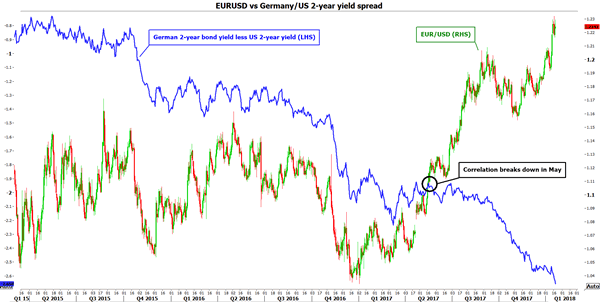
The euro began moving higher after the minutes of the ECB's December policy meeting showed the Bank could begin adjusting its forward guidance in early 2018, lending further credibility to expectations that it will unwind its massive QE program this year. What caught investors by surprise was the potential timing of such a move. Considering that QE is intended to run at least until September, one would have expected the Bank to begin calibrating its language around QE around the middle of 2018, not early in the year.
Unsurprisingly, the gains the euro posted following the minutes made the ECB nervous. So much so, that several key policymakers - including Vice President Constancio - soon "jawboned" the currency, causing it to correct lower by indicating that sudden FX moves that do not reflect fundamentals are a source of concern. Of course, this is a typical reaction by the ECB. The Bank is unlikely to sit idle and allow the euro to appreciate rapidly, as that could make it more difficult for inflation to reach its target in a sustainable manner.
This could also be a taste of what is to come. The ECB is due to hold its policy meeting next week and although no change in either policy or guidance is expected, President Draghi could take the opportunity to echo his colleagues' concerns regarding the exchange rate. Even if he does not mention the euro specifically, the ECB chief will probably want to maintain a cautious tone and downplay hawkish expectations - perhaps by focusing on the still-subdued core inflationary pressures - as anything other than that could trigger another wave of appreciation in the euro. In such a scenario, euro/dollar could drift lower, and potentially test the 1.2080 territory as a support. Politics are another factor arguing for a near-term downward correction in the euro, with Italy's upcoming election in March and the political uncertainty in Germany posing downside risks for the single currency over the next weeks.
On a longer-term horizon, however, the outlook for the euro remains largely positive. Even if the currency corrects lower in the coming weeks on ECB jawboning or politics, any dips could remain short-lived, amid heightened expectations for a QE-tapering announcement later this year and a strengthening Eurozone economy. A realistic timeline of how events may unfold is one where the Bank adjusts its forward guidance at either the March or April policy meetings, thereby paving the way for a June/July announcement that QE purchases will begin to be scaled back by September. Thus, barring some major surprise, such as a sharp slowdown in Eurozone's inflation or Germany heading to elections again, euro/dollar could challenge 1.2570 resistance zone even before the end of the year.
BoJ Tightening or Markets Running ahead of Themselves?
The Japanese currency posted gains versus the US dollar, reaching four-month highs - equivalently the dollar/yen pair fell to four-month lows - with the yen appreciating on the back of what market participants interpreted as a form of tapering by the Bank of Japan. Such an evaluation though may not be justified, with the market potentially running ahead of itself in terms of placing long yen positions and at the same time offering opportunities for traders who can manage to correctly decipher what is really happening.
News of the BoJ reducing the volume of purchases of longer-dated bonds in early January acted as the catalyst for yen appreciation, not just versus the dollar but also against other currencies such as the euro - though it should be stated that euro/yen has since managed to recover its losses, being up overall year-to-date, albeit not by much.
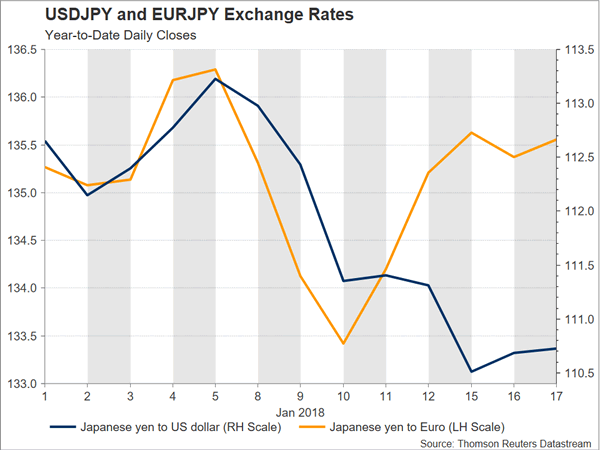
Remarks by BoJ Governor Haruhiko Kuroda about the potentially adverse effects of low interest rates on the economy in November 2017 may have led - potentially misled, at least this is the argument being pushed forward - investors to piece together a puzzle pointing to a BoJ that is entering a path of policy normalization.
However, one should acknowledge that ever since 2016 the BoJ has shifted its strategy of attempting to spur inflationary pressures from quantitative and qualitative easing to one where it also targets the 10-year Japanese Government bond (JGB) yield, this being dubbed as "yield curve control" (YCC) management. Specifically, the goal is to keep the yield on 10-year JGBs at around zero percent, or to be more specific zero percent plus/minus 10 bps. The BoJ's action to buy fewer bonds than the declaratory 80 trillion yen does not mean the bank is tapering, but simply that achieving the target for a yield of around zero percent requires the purchase of a smaller number of securities.
Unlike other central banks, including the Federal Reserve and the European Central Bank, the BoJ is not committed to reinvesting proceeds from maturing issues; the amount of bond buying 'simply' depends on meeting the aforementioned target, without it being easy to predict ahead of time. Also, despite cutting the amount of purchases of long-dated bonds, the BoJ maintained its purchases of short- and medium-term bonds, as well as other instruments it buys, such as ETFs and REITs. In other words, other elements of monetary policy remain unchanged.
An interesting analogy can be made to further clarify things: The primary tool for monetary policy for the US central bank is the fed funds target range. Although expanding the size of the balance sheet during the Global Financial Crisis was about monetary policy, at this point in time and with the economy at its current state, reducing it is not much linked to monetary policy; this is also the reason that rate hikes are linked to the path of inflation, whereas balance sheet shrinking seems to have decoupled from that reality. Similarly, the amount of purchases of long maturity bonds by the BoJ does not say much about a shift in policy. The gauge - the "primary tool of monetary policy" if you like - in this case is the target of around zero percent yield on 10-year JGBs, which happens to be the case that under current conditions it can be sustained with fewer purchases than in the past. A change of that target would be the factor reflecting monetary policy taking a different direction, with a rise in the target expected to lead to yen strength.
Lending support to the view that talk of BoJ tightening is premature is the fact that the measure of inflation that excludes fresh food and which is targeted by the bank was last recorded well below its 2% target; 0.9% on an annual basis in November, though it should also be stated that this was the highest rate since March 2015. BoJ policymakers have been vocal that they intend to continue pursuing ultra-easy monetary policies to boost price pressures to reach the target. (As a side note, it is interesting to mention that taking energy prices, which have been on the rise, out of the calculation - apart from just excluding fresh food - and inflation is considerably weaker than the aforementioned 0.9%. Although the following falls outside the scope of the current analysis, some argue gains in energy items will not be sustained for long.)
For the time being though, the Fed firmly remains on a path of policy normalization with that likely to begin taking place in Japan quite some time from now - Kuroda himself, time after time, said that it is too early to talk about an exit strategy from ultra-easy monetary policy - this supporting the case for a strengthening dollar/yen pair moving forward in 2018 and interpreting the yen's recent gains as simply an exhibit of markets running ahead of developments.
In addition, the dot plot from the Federal Reserve's latest meeting is projecting three quarter percentage point interest rate hikes to be delivered during the year, with market participants at the moment pricing in less than that. Should the Trump administration's stimulative fiscal policies enable price pressures to make a strong comeback during the year- as some analysts anticipate - then the markets will start revising their hiking expectations towards the Fed policymakers' projections, leading to further gains in dollar/yen.
Moreover, one cannot discount the Japanese Finance Minister's recent concerns on a bolstered yen. Worries might have been mild in nature, but they still show the overall unease over a stronger currency.
Haruhiko Kuroda's term as BoJ Governor ends in early April. Modern Japanese history 'dictates' the appointment of a new Governor rather than the one whose term ends serving a second one. However, some market observers expect that Kuroda will be offered another term. What's important though, is that even if he is not, a high level of continuity is expected to be maintained within the BoJ; the Japanese central bank's board is at the moment comprised of individuals sharing a general philosophy that does not seem to differ much. In addition, Japanese Prime Minister Shinzo Abe is the one who will decide on who will be appointed as central bank head and he has in the past - and not long ago - urged the bank to continue supporting the economy through its policies.
The Bank of Japan will be completing a two-day meeting on monetary policy on January 23. No policy change is expected by analysts.
Weekly Economic and Financial Commentary: Manufacturing Cooling from a Breakneck Pace
U.S. Review
Cooler Weather and Cooler Data
- Industrial production jumped 0.9 percent in December, although about half the gain can be attributed to a surge in utilities output. Manufacturing production rose 0.1 percent after increasing 0.3 percent in November.
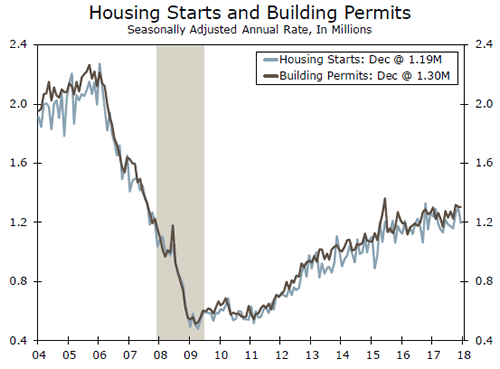
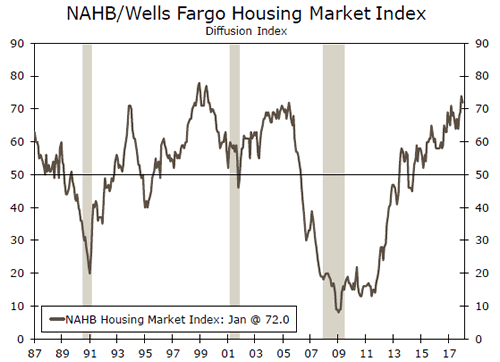
- Housing data released this week showed some moderation in activity. Housing starts fell 8.2 percent in December after unseasonably mild weather in November, while homebuilder confidence fell 2 points on lower homebuyer traffic.
Manufacturing Cooling from a Breakneck Pace
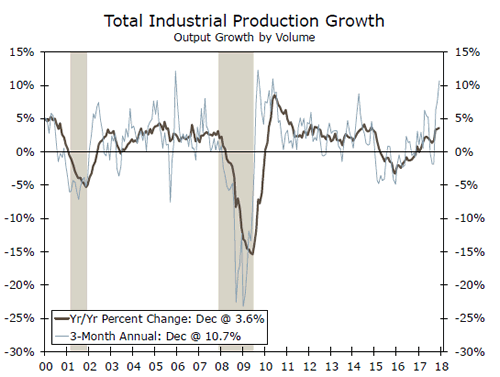
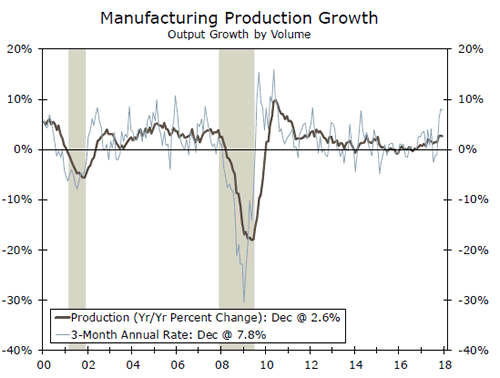
The industrial side of the economy has put up an impressive performance in recent months, and that trend continued in December. Industrial production rose 0.9 percent last month, which was stronger than expected. Part of the beat stemmed from a 5.6 percent jump in utilities output, as cooler weather blanketed much of the country. Utilities output accounts for a little over 10 percent of industrial production.
Mining activity also posted a solid gain, increasing 1.6 percent. The sector has benefitted from the rebound in oil prices over the past year, which has helped fuel new drilling and production. Output is up 11.5 percent since last December when oil prices were more than 10 percent lower.
Growth in the manufacturing sector, which accounts for about three-quarters of industrial output, was more restrained. Production rose just 0.1 percent in December. That followed an upwardly revised gain in November and sharp upturn in October (following the unwind of hurricane distortions), leaving manufacturing output rising at a 7.8 percent annualized pace over the past three months.
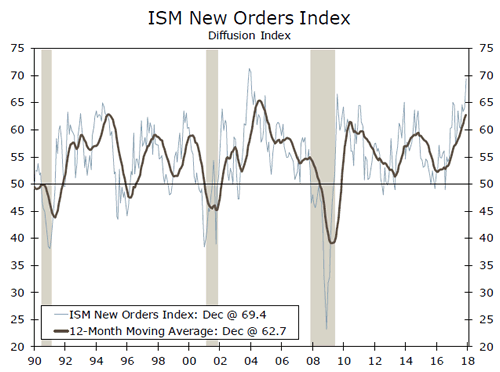
Despite December's scant increase, we believe manufacturing growth will remain strong in the near term. After a tough few years, the sector is now benefiting from much higher levels of business confidence, stronger global growth and a weaker dollar. Yet December's modest increase along with the first of the January purchasing managers' indices (PMIs), suggests activity may be cooling from the exceptionally strong levels implied by the latest ISM readings. Both the Philadelphia and New York Feds' regional PMIs came in lower in January, although both remained solidly in expansion territory.
Housing Starts Fall, But Poised for Improvement
New residential construction also appeared to cool a bit in December. Housing starts fell 8.2 percent in the final month of the year after rising 12 percent over the prior two months. December's drop largely reflected a return to more typical winter weather. With relatively little new construction occurring late in the year, seasonal adjustment can exaggerate month-to-month changes, and this December followed an unusually mild November. In December, permits were 9.2 percent higher than starts and suggest new construction will trend higher over the next few months. Builder confidence also remains at an exceptionally high level even after edging back two points in January.
Recent tax changes will provide some hurdles to the housing market, but the market will benefit from the broader economy strengthening. Lowering the mortgage interest deduction, capping state and local tax deductions and doubling the standard deduction will likely push back the timing and size of homes purchased for some households. Lower tax rates for homebuilders, on the other hand, should help profitability and support construction of more entry-level and mid-tier homes. For a more detailed discussion of the effects the tax bill is likely to have on the housing sector, see our report "Tax Reform and Housing" (January 17, 2018).
U.S. Outlook
Existing Home Sales • Wednesday
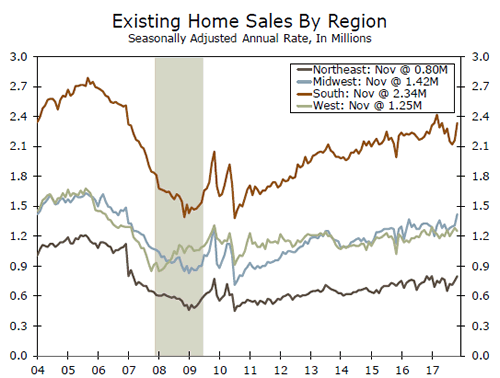
Existing home sales jumped 5.6 percent in November to a 5.81 million-unit pace. Wednesday's release for December is expected to show a slight slowing, but still-solid performance for existing home sales. Sales continue to be the strongest in the South, which accounts for roughly 40 percent of existing home sales. The recent increase in buyers is consistent with the stronger run of growth the economy has seen in recent months.
November's surge in existing home sales came despite the continued drop in the inventory of homes available for sale. Year over year, inventories are down 9.7 percent. With inventories tight and demand increasing, home prices are being bid higher. The median price of an existing home continues to rise, and is up 5.8 percent over the past year. We may see a surge in closings of higher-priced homes in December, which would enable buyers to be grandfathered in with the current more favorable mortgage-interest deduction.
Previous: 5.81M Wells Fargo: 5.78M Consensus: 5.70M
New Home Sales • Thursday
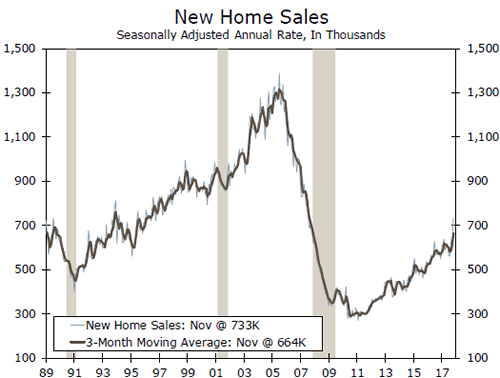
December new home sales are slated to be released this coming Thursday. New home sales will be coming off a red-hot November in which sales surged 17.5 percent (733K unit pace). Much like existing home sales, stronger economic growth and unseasonably mild winter weather has propelled new home sales to cycle highs. Development activity has also ramped up, giving builders a little more inventory to sell.
The recent strength in sales is not surprising given that homebuilder confidence has surged, as buyer traffic and sales have also ramped up. The South and West accounted for the bulk of November's increase, a trend we believe will continue in the December data. A lack of inventory will continue to be a limitation on home sales. We look for new home sales to increase at a 699K unit pace, a modest reprieve from November's breakneck pace.
Previous: 733K Wells Fargo: 699K Consensus: 675K
GDP • Friday
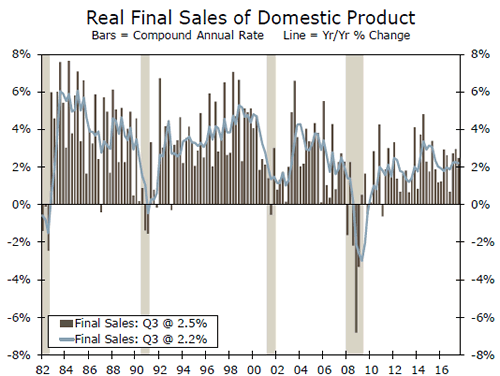
This coming Friday we will see the first look at Q4 GDP as well as data for 2017 as a whole. On an annualized basis, we expect growth to be 2.9 percent – continuing the recent string of strong quarterly readings. For 2017, we expect 2.3 percent year-over-year growth, a marked improvement from the 1.5 percent growth rate notched in 2016. We project personal consumption and business fixed investment to improve on the quarter based on encouraging monthly data, which continue to point to high levels of confidence in each sector. Residential construction should also provide a boost to topline GDP following consecutive quarters of dragging the headline figure lower. Net exports are likely to exert a drag on GDP growth in Q4 after adding positively to the headline throughout 2017.
Incorporating the newly passed tax reform package, the U.S. economy appears to be on the upswing as 2018 kicks off. The balance of risks looks to be to the upside.
Previous: 3.2% Wells Fargo: 2.9% Consensus: 3.0% (Annualized Quarter-over-Quarter)
Global Review
Manufacturing Cooling from a Breakneck Pace
- The Brazilian economic activity index increased 0.5 percent sequentially, slightly above the 0.4 percent analysts were expecting. On a year-over-year basis the economy improved at a 2.8 percent rate.
- The Bank of Canada increased its benchmark interest rate 25 basis points, from 1.00 percent to 1.25 percent, following a very strong employment number in December.
- The Chinese economy grew 6.8 percent on a year-earlier basis in Q4, while it printed a rate of growth of 1.6 percent sequentially and not annualized.
Brazilian Economic Growth Continued in November
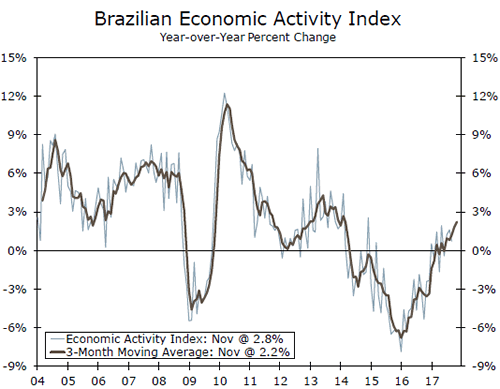
The Brazilian economy continued its march toward recovery in November according to the economic activity index, a monthly proxy for the behavior of gross domestic product. The index increased 0.5 percent sequentially, slightly above the 0.4 percent analysts were expecting. On a year-over-year basis the economy improved at a 2.8 percent rate, slightly below the upwardly revised 3.1 percent year-over-year rate reported for October.
Still, it is important to note that comparisons are being made against very low base numbers as the economy experienced the longest period of recession in recorded history. Nevertheless, it is clear that domestic consumption as well as foreign consumption, i.e., exports, have been trending up, which means that the economy seems to be, finally, hitting in all cylinders. And this is good news for the immediate future, even though uncertainties remain high as the country prepares to go to the polls later in the year and ex- President Lula da Silva, who continues to lead in the polls, is still facing serious legal troubles in several corruption cases.
Canada's Central Bank Pulls the Trigger Again
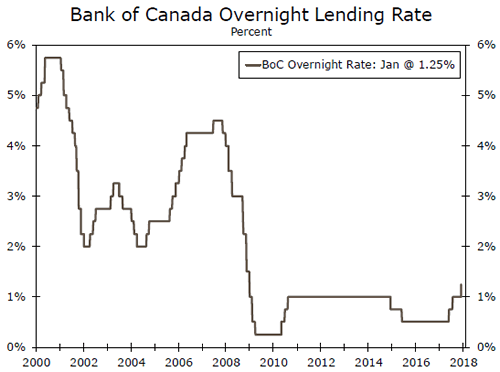
Once again, the Central Bank of Canada increased its benchmark interest rates by 25 basis points, from 1.00 percent to 1.25 percent, following a very strong employment number in December and the lowest unemployment rate, at 5.7 percent, in 40 years. As we explain in our recent report "The Bank of Canada Hikes Rates" (January 17, 2018), we still expect the Bank of Canada to increase interest rates just once more in 2018 to close the year at 1.50 percent, although we acknowledge upside risk to this forecast.
China's Economy Steady as it Goes
The Chinese economy grew 6.8 percent on a year-earlier basis in Q4 compared to expectations of a 6.7 percent growth rate, while it printed a rate of growth of 1.6 percent sequentially and not annualized. The sequential rate was a bit lower than what markets were expecting, 1.7 percent, but the reason for the lower-thanexpected sequential rate was that the rate for Q3 was upwardly revised from 1.7 percent to 1.8 percent. The fourth quarter GDP growth rate meant that the Chinese economy grew 6.9 percent during the whole of 2017, which was marginally better than what the consensus forecast was expecting, up 6.8 percent. The result for 2017 shows that economic growth in China has stabilized and the economy continues to grow at a relatively strong rate (for more on Q4 results see "Chinese Economic Outlook: Further Slowing in Store?" (January 18, 2018).
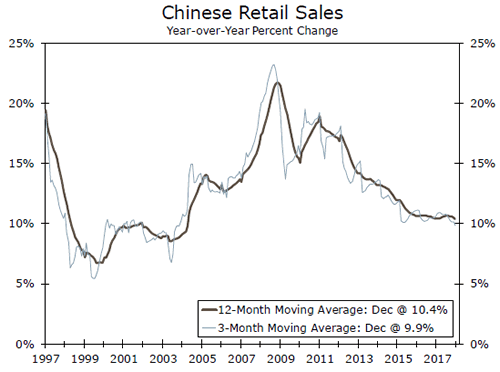
However, December numbers for retail sales and industrial production were mixed. Retail sales increased only 9.4 percent year over year in December after a 10.2 percent growth rate in the previous month and markets expectations of a similar 10.2 percent rate in December. Still, while December retail sales were weak, the index managed to grow 10.2 percent for the year as a whole. Meanwhile, industrial production was up a higher-thanexpected 6.2 percent in December, year over year, a bit higher than markets expectations of a 6.1 percent rate. For the year as a whole, industrial production increased as expected, up 6.6 percent.
Global Outlook
Eurozone PMIs • Wednesday
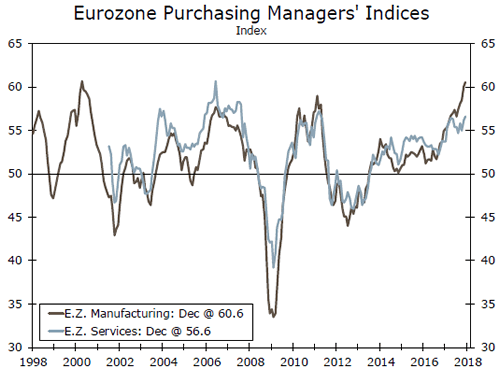
Business confidence in the Eurozone, as measured by the purchasing managers' indices, is flying high right now. The manufacturing PMI rose to 60.6 in December, which is just shy of a record high. Although not as stratospheric, the service sector PMI stands at a very respectable level of 56.6. PMI data for January are slated for release on Wednesday. Separately, the Ifo index of German business sentiment is on the docket on Thursday. France releases its comparable business confidence index on Friday.
The European Central Bank will hold a regularly scheduled policy meeting on Thursday. Although nobody looks for a change of policy at the meeting—the Governing Council has stated that it will keep its QE program in place through at least September—market participants will scrutinize the statement for hints about potential policy changes later this year.
Manufacturing PMI: 60.6 Consensus: 60.3 Services PMI: 56.6 Consensus: 56.4
U.K. GDP • Friday
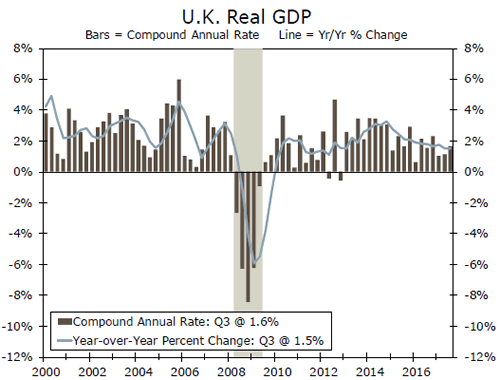
The U.K. economy has decelerated in recent quarters due, at least in part, to slower growth in consumer spending. The sharp depreciation of sterling in the immediate aftermath of the Brexit referendum caused inflation to shoot up. Higher inflation eroded growth in real income, which has weighed on growth in consumer spending. Investment spending has also taken a hit due, at least in part, to uncertainty related to Brexit. Preliminary data for Q4-2017 will be released on Friday.
Earlier in the week, the labor market report will print. The unemployment rate in the United Kingdom currently stands at 4.3 percent, the lowest rate in 42 years. Much like the United States, however, a low unemployment rate has not yet translated into significant wage acceleration. Average weekly earnings (excluding bonuses) were up only 2.3 percent in the August-October period on a year-ago basis.
Previous: 0.4% Wells Fargo: 0.4% Consensus: 0.4% (Not Annualized)
Canada CPI • Friday
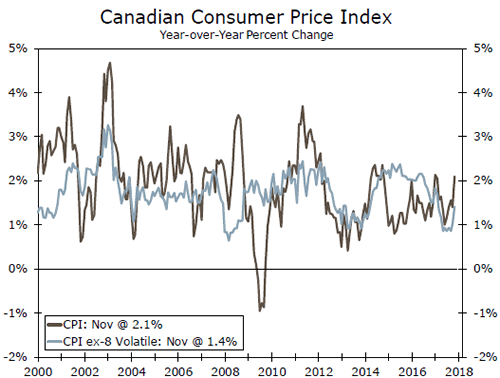
The Bank of Canada (BoC) conducts monetary policy in order to maintain the CPI inflation rate in a range of 1 percent to 3 percent. At 2.1 percent, inflation is essentially at the midpoint of the range at present. However, citing stronger-than-expected economic growth in the context of an economy that is already operating close to potential, the BoC decided to hike rates 25 bps at the policy meeting on January 17. The BoC has hiked rates three times since last summer. We look for CPI inflation to rise to 2.5 percent in December which, if realized, would be the highest rate in nearly six years. The CPI data will be released on Friday.
Consumer spending has generally been strong in Canada recently. Indeed, the value of retail spending shot up 1.5 percent in October, which pulled the year-over-year growth rate up to 6.7 percent. Retail sales data for November are slated to print on Thursday.
Previous: 2.1% (Year-over-Year) Wells Fargo: 2.5%
Point of View
Interest Rate Watch
Three Observations
In recent weeks, several hypotheses have been advanced about the fundamentals behind any move in rates for the year ahead. In this note, we focus on the evidence for retail demand, bank perceptions of credit demand and the case for higher inflation.
Retail Demand? Unlikely
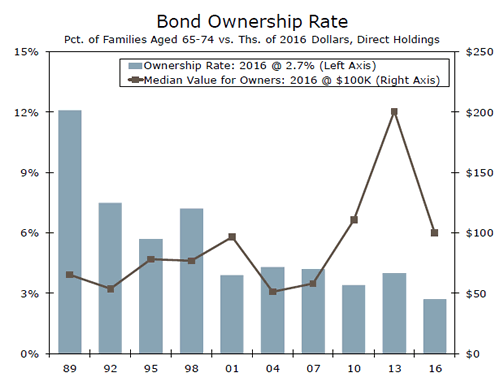
One concern in the market has been the focus on the Fed's shrinking balance sheet and the rise in Treasury debt issuance. There has been an argument that retail investors will pick up the slack. We find that unlikely. First, investors will review their positions and see that equities have delivered excellent performance while interest rates are expected to continue to rise in the year ahead. Second, as illustrated in the top graph, the percentage of families aged 65-74 that own bonds has declined steadily over the past 17 years. This pattern is also repeated for 55-64 year olds and 45-54 year olds. Given these two factors, we believe it unlikely that households will pick up the ball and, therefore, there is an upward bias to our interest rate outlook.
Loan Demand: Will Tax Cuts Boost Demand?
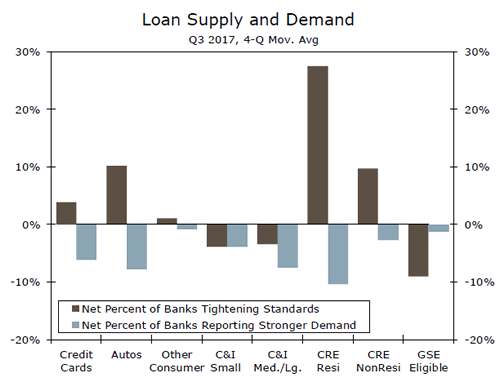
In the latest Fed Senior Loan Officer survey, the net percent of banks reporting stronger demand in Q3-2017 was uniformly down over the four quarters up to that third quarter (middle graph). This indicates a delicate balance in the demand for shortterm credit. If the tax cuts boost current and expected profits for businesses, then the demand for bank loans should rise. However, we also know the Fed is on a path to raise rates and thereby increase the cost to borrow. We will watch how carefully this balance plays out in the year ahead.
Above FOMC inflation Outlook
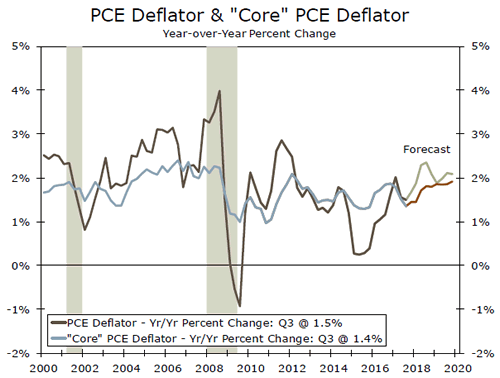
Our PCE inflation outlook for 2018 is above that for the FOMC. We expect 2.1 percent compared to 1.7-1.9 percent for the FOMC. As illustrated in the bottom graph, the trend is definitely upward relative to the meandering pattern of recent years. Why? The pickup is driven by the unwinding of what we believe were largely one-offs in 2017—declines on wireless phone services and physician services. In addition, higher labor costs as the job market tightens and capacity utilization rates rise should put upward pressure on wages. Finally, the weaker dollar will bias import prices up.
Credit Market Insights
Change in Consumer Expectations
The New York Fed's Survey of Consumer Expectations showed inflation expectations were gaining ground in December, though consumers were also more uncertain about that call. Notably, inflation expectations at the end of 2017 were even with where they were at the end of 2016. The uptick in actual inflation in recent months combined with higher prices at the gas pump may be convincing consumers that inflation will finally pick up.
The survey also provides insight into views about income and credit availability over the next year. Views on income and spending growth softened in December. Income growth expectations were the same as they were last year. That marks a recovery from a large dip in September that may have resulted from extreme weather events.
Expected spending growth was much lower in December 2017 relative to this time last year. Expected credit availability may have played a role. A year ago, a larger share of respondents expected easier access to credit than they did in December 2017. Nearly half of the respondents experienced no change in credit access last year, and now half expect the same to happen this year. Consumers may have found the goldilocks level of credit access. The share expecting they will default on a debt payment is also lower. It also appears they plan to spend closer to their income-provided means this year. That fits with the larger share of Americans expecting interest rates to rise.
Topic of the Week
The Case for Stronger Cap-Ex
"What can we do to boost capital spending?" That has been a top-of-mind question for our political leaders, as well as for fiscal and monetary policymakers in this expansion. Any informed discussion about below-trend economic growth focuses on chronically weak productivity. Since capital spending can boost productivity, it is often considered one of the most important missing links that could lift GDP growth.
Yet, aside from the initial post-recession recovery and a lot of energy-related investment in the middle part of the current expansion, businesses have been more interested in alternative uses for capital such as share buybacks, increased dividend payouts or mergers and acquisitions, than they have in ratcheting up capital expenditures.
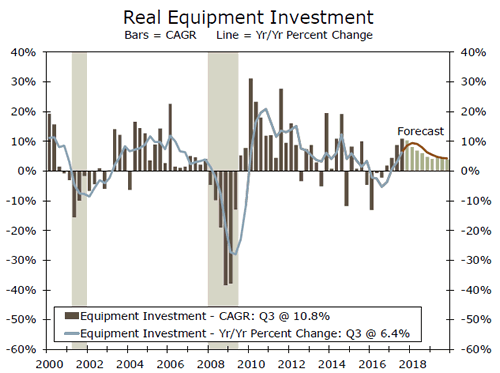
A number of headwinds earlier in this cycle like the value of the dollar, global growth and energy prices have simultaneously switched in a direction more favorable to cap-ex more recently. That has occurred alongside a surge in business confidence that has been missing since roughly 2004. Our analysis finds that with all those improving dynamics already in the mix, the new tax cuts and associated capital spending incentives it contains will help lift the trend rate of cap-ex. On balance, our upward revisions to the equipment spending outlook could add a tenth of a percentage point to GDP growth in 2018 and 2019, all else equal.
That said, in these days of sky-high confidence and record-breaking highs in the stock market, it is easy to get carried away. We would be remiss not to acknowledge that we are late in the economic cycle and that a number of downside risks could still derail the expected pick-up. Stronger business spending also suggests a faster rate of growth in imports which means an offset in GDP when taking trade into consideration. Bigger trade deficits also mean increased current account deficits. Taking all these factors into account, our base case is for full-year equipment spending growth of roughly 8 percent next year, up from 6.2 percent in our prior forecast.
The Weekly Bottom Line: Headed for a Shutdown?
U.S. Highlights
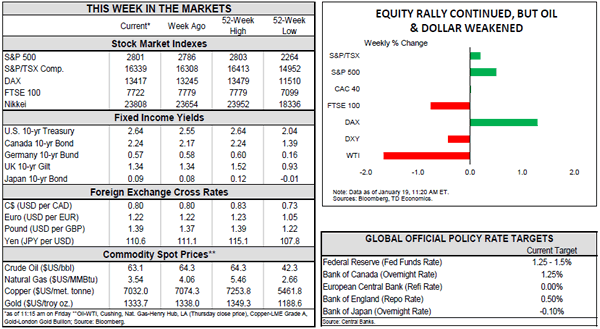
- Not even a looming government shutdown could dampen market optimism this week. More evidence of strong momentum in the economy saw equities gain ground, while Treasuries and the U.S. Dollar continued to fall.
- It remained a coin toss at time of writing whether Congress will reach a funding deal to avert a government shutdown at midnight. If government shuts down, many non-essential services won't operate, and employees will not be paid.
- For markets, shutdowns have been modest negatives in the past. However, markets rallied in the last three. All told the U.S. economy has very solid momentum heading into 2018. A closure would be a slight hit to growth, but not derail the U.S. expansion.
Canadian Highlights
- As expected, the Bank of Canada this week raised its key interest rate by 25 basis points, putting the overnight policy rate at 1.25%. However, the decision was accompanied by a dovish tone, justified by the downside risks to the outlook.
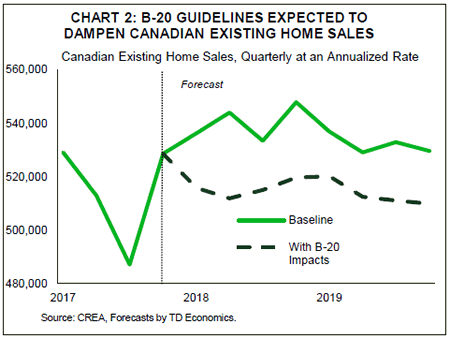
- It appears that homebuyers pulled forward purchases into last fall, ahead of the B-20 guidelines that took hold at the start of this year. We anticipate that existing home sales will be dampened by the new guidelines, particularly as the qualifying mortgage rate rises further above 5%.
- All told, the key message from this week's interest rate decision is that interest rates are headed higher. However, downside risks warrant a gradual pace of increase.
U.S. - Headed for a Shutdown?
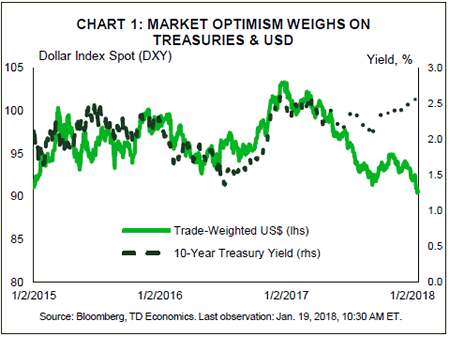
Not even a looming government shutdown could dampen market optimism this week. Equities continued to rally, and Treasury yields rose as the bond market becomes increasingly convinced that the improved momentum in the global economy is for real, and that inflation pressures may be starting to build.
As for that looming shutdown, the House passed a stop gap spending bill that would fund the government until February 16th, but it faces an uphill battle in the Senate. Any continuing resolution to fund the government needs 60 votes in the Senate, and the GOP only has 51 seats so it needs Democratic votes. Dems are opposed to the bill because they want it to deal with the fate of "Dreamers" – people who were brought to the U.S. illegally as children – whose protection from deportation expires in March. Congress has until then to pass a bill to address the Dreamers, but Dems are trying to use their leverage in the Senate to force the issue now. It is a political game of chicken, and at time of writing it is unclear whether a compromise can be reached by midnight tonight.
So, what happens if they don't reach a deal? Well, we have a fair bit of experience with shutdowns – there have been 18 "funding gaps" since 1976, and three full shutdowns. The most recent shutdown in 2013 led to about 40% of federal government workers being furloughed, the equivalent of about 850,000 people.
In the event of a shutdown, essential services will remain in place, including roles like air-traffic controllers, armed forces, and law enforcement. The Federal Reserve is not funded by Congress, so it too would remain open for business. But, many "non-essential" operations would be closed, like national parks, statistical agencies and the IRS, causing disruption in the lives of many Americans, particularly those federal employees who will not be paid during the shutdown.
This would have a negative effect on growth in Q1. The Bureau of Economic Analysis (BEA) estimated that the last 16-day shutdown lowered real GDP by 0.3 percentage points (annualized) in Q4 2013. If the shutdown were to drag on, for example, for four weeks, it is estimated it would lower real GDP growth by 1.5 percentage points (annualized). Right now, first quarter growth is tracking just shy of 2 ½% annualized, strong enough to withstand the hit.
In the past, shutdowns have not been catalysts for market downturn. On average, markets have shown modest weakness, with the S&P 500 down 0.6% over the period of the closure. However, the index rose in 44% of past government shutdowns. In fact, during the last three, under Clinton & Obama, markets rallied. Given current market optimism on strong global growth, it seems unlikely that a shutdown would derail the rally.
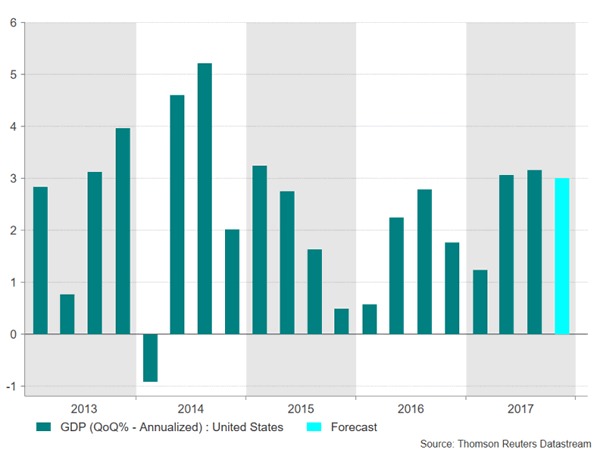
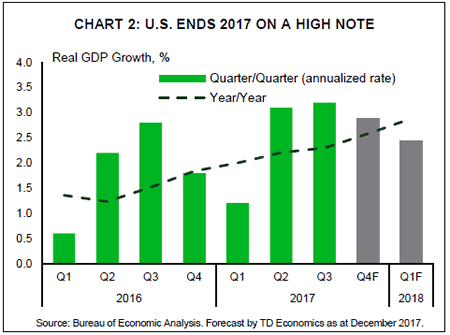
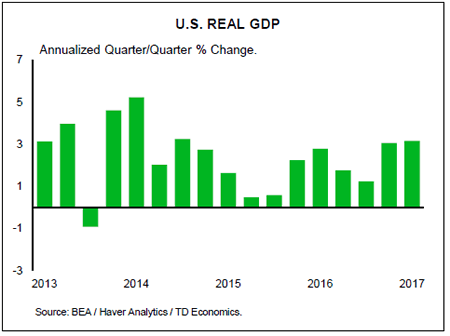
Markets do have solid economic reasons for optimism. Next week we see the first estimate of fourth quarter growth. We expect the U.S. economy ended 2017 with solid momentum at a near 3% annualized pace (Chart 2). That would corroborate the recent Beige Book, which showed widespread momentum across the country.
Canada - One Rate Hike Done, One or Two More Still to Come
As expected, the Bank of Canada this week raised its key interest rate by 25 basis points, putting the overnight policy rate at 1.25%. However, the dovish tone accompanying the decision in both the monetary policy statement, press conference, and a later interview with BNN, was apparent. Indeed, the Bank of Canada sees trade policy uncertainty, together with the elevated sensitivity of highly-indebted households to interest rates, as factors that justify the need for at least some ongoing monetary accommodation.
Although the Canadian outlook was largely unchanged, it was clear that Bank of Canada staff had done a lot of work estimating what ultimately became offsetting impacts from U.S. tax reform on the business investment outlook. It was a similar story for exports, where trade policy uncertainty offset a stronger U.S. outlook, leaving the Bank's forecast effectively unchanged. Lastly, stronger momentum heading into 2018 lifts the outlook for household consumption in 2018, but spending is still expected to fall back through 2019 as higher interest rates and inflation begin to eat away at purchasing power.
Overall, despite some uncertainty on potential growth, Canada's economy is forecast to continue expanding at an above trend pace again this year, with wage and price pressures firming up. This suggests that the Canadian economy will be running a little hot, and is consistent with at least one more rate hike this summer, possibly two, particularly if NAFTA uncertainty diminishes or consumer spending continues to defy expectations.
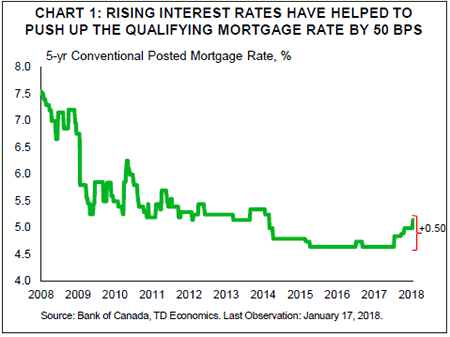
.With the policy rate set to rise to 1.50% or 1.75% this year, consumer and business rates will also rise in tandem. Although still historically low, higher mortgage rates could work to exacerbate an expected decline in housing activity this year. Indeed, regulatory underwriting guidelines that require mortgage applicants to pass an income stress test at a qualifying rate that is now over 5% (Chart 1) and rising should have a negative impact on activity (Chart 2). The last time posted mortgage rates were this high was in February 2014.
In anticipation of these changes that took effect at the start of this year, homebuyers appeared to have rushed to buy at the end of last year. Existing home sales rose 4.5% in December, the fifth consecutive monthly gain. The sales slowdown that followed provincial housing actions this past spring is now in the rearview mirror. Although new listings rose strongly in December, the sales to new listings ratio rose to 58%, right on the edge of a sellers' market. Home prices also continued to recover, rising for the fifth consecutive month as well, but the average Canadian home price remains about 3% below its April 2017 peak.
All told, the key message from the Bank of Canada's decision this week is clear: interest rates are on the rise. The economy is no longer in recovery mode, but in full-on expansion, operating near full capacity. It's no longer a question of if, but when the Bank of Canada will be raising interest rates next. Moreover, the pace of increases will be governed by three factors: the progress of underlying inflation toward target; trade-related uncertainty; and the degree to which higher interest rates impact economic activity.
U.S.: Upcoming Key Economic Releases
U.S. Real GDP - Q4 Advance Estimate
Release Date: January 26, 2018
Previous Result: 3.2%
TD Forecast: 2.9%
Consensus: 2.9%
We expect Q4 real GDP to clock in at a 2.9% rate, reflecting a robust advance in consumer spending. Other positive details include solid growth in business investment. One wildcard is net exports, which we expect to be a significant drag, but markets should take a hawkish signal from strong domestic demand components.
Canada: Upcoming Key Economic Releases
Canadian Retail Sales - November
Release Date: January 25, 2018
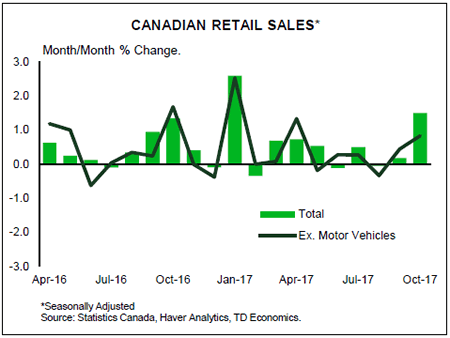
Previous Result: 1.5% m/m, ex-auto: 0.8% m/m
TD Forecast: 0.8% m/m, ex-auto: 0.7% m/m
Consensus: N/A
November retail sales are forecast to rise 0.8% m/m on a broad advance. Auto sales should make a positive contribution on stronger commercial vehicle sales while a surge in gasoline prices will provide a nominal tailwind to gasoline station receipts. While auto sales should outperform the headline print, we expect the ex-autos metric to come in just slightly weaker at 0.7% m/m while core (ex-autos and gas) retail sales should see a more modest advance. Employment data (jobs, hours) is consistent with a solid headline print and strong Black Friday sales should also provide a tailwind. Real retail sales are likely to come in just below the nominal print due to a modest increase in CPI, which would be consistent with Q4 consumer spending near a 3% pace.
Canadian CPI - December
Release Date: January 26, 2018
Previous Result: 0.3% m/m
TD Forecast: -0.3% m/m
Consensus: N/A
We expect headline CPI inflation to ease back to 1.9% y/y in December on a reversal in gasoline prices. Food prices have scope for a sustained rebound helped by stabilization in the Canadian dollar. In addition, vehicle prices could also hold firm on the back of better price gains in the US. Exclusion based core indexes (CPIXFE or CPIX) should pick up on balance but the BoC core metrics (CPI common, trimmed mean and median) have more limited scope for a further acceleration given the sharp improvement in prior months. We thus expect stabilization in the latter. One source of downside risk this month is cellphone services, as the Big 3 telecoms temporarily offered cheaper data plans in December in response to Freedom Mobile's offering. The apparel category is also exposed to a large drop. Overall, risks are skewed to the downside in our forecast.
Week Ahead – All Eyes on BoJ and ECB; First Gimpse of UK and US Q4 GDP
The Bank of Japan and the European Central Bank will follow in the footsteps of the Bank of Canada to hold their first policy of 2018 in the next seven days. With speculative trade on the timing of the eventual stimulus withdrawal by both central banks driving the euro and the yen higher over the past couple of weeks, markets will be ultra-sensitive to the language spoken by policymakers. Economic data will also be at the forefront next week as preliminary estimates of fourth quarter growth are released in the UK and the US, as well as inflation numbers in Canada, Japan and New Zealand.
Another headliner next week will be the World Economic Forum in Davos. This year's theme for the event, which is taking place between January 23-26, is "Creating a Shared Future in a Fractured World". However, the big talking point will likely be President Trump's keynote speech on Friday. President Trump, who surprised many when he announced his attendance, could use the event to promote his protectionist ideology, potentially putting him on a collision course with other world leaders such as Germany's Angela Merkel, the UK's Theresa May and France's Emmanuel Macron, who are also expected to attend.
Bank of Japan unlikely to shift tone
Japan's central bank meets on Monday and Tuesday to decide whether an adjustment to its massive monetary stimulus program is required as the economy goes from strength to strength. Such a move is not expected to come anytime soon but there have been some indications recently that the BoJ is setting the ground to begin discussions on winding back its Quantitative and Qualitative Monetary Easing (QQE) with Yield Curve Control. A small reduction in the purchase of long-dated Japanese Government Bonds (JGB) by the BoJ on January 9 at a regular market operation spooked investors, raising fears that the Bank is about to join its European counterpart in announcing a cut in its asset purchase target. Markets were also alarmed when Bloomberg reported this week that some BoJ policymakers see the need to begin discussions on policy normalization soon.
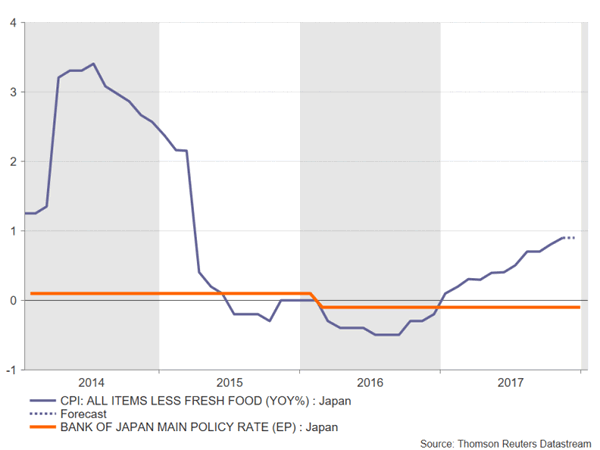
More such signals, either in Tuesday's announcement or Friday's December meeting minutes could send the yen above this week's 4-month high of 110.18 per US dollar. However, the Bank will likely stress that inflationary pressures are still elusive in Japan despite impressive growth in recent quarters. Core CPI, which excludes fresh foods and is targeted by the BoJ, remains below 1%. It was 0.9% in November and is forecast to stay unchanged in December when the data is released on Friday. Also to watch from Japan are Wednesday's trade figures, which will include export numbers.
Inflation in focus in Canada and New Zealand
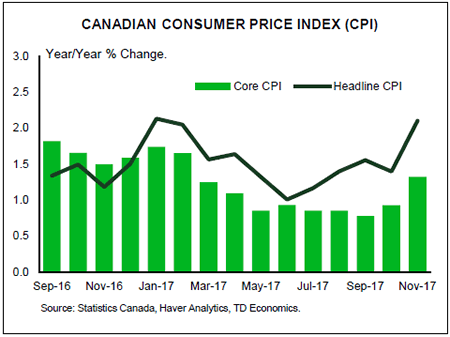
There will be more inflation data next week as New Zealand and Canada publish their latest figures on Thursday and Friday respectively. Canada's inflation rate rose to 2.1% in November – a 10-month high. It is expected to ease slightly to 2.0% in December. A day earlier, retail sales numbers for the same month will be released, giving the first indication as to how well Canadian consumer spending held up towards the end of the year. Weaker-than-expected figures would likely further weigh on the Canadian dollar, which found itself back above C$1.24 to the US dollar after the Bank of Canada signalled future rate increases will be more gradual than the recent ones. The BoC hiked rates for a third time since July on Wednesday but struck an unexpectedly cautious tone, adding downside pressure on the loonie.
In contrast, the New Zealand dollar remains firmly on an uptrend that's been in progress since November 2017. It hit a 4-month high of $0.7331 this week as the kiwi retraces its post-election losses. However, fourth quarter inflation data due in New Zealand on Thursday could spoil the rally if it points to an ongoing subdued outlook for consumer prices. The annual CPI rate rose to 1.9% in the third quarter, just below the middle of the Reserve Bank of New Zealand's 1-3% target band. It is expected to stay at that level in the fourth quarter.
UK growth stuck in slow lane
Upward revision to previous GDP figures showed the UK economy performed slightly better post the Brexit referendum than initially estimated. Further optimism was added when growth in the third quarter accelerated slightly to 0.4% quarter-on-quarter from 0.3% in the first six months of 2017. The preliminary estimate of GDP for the final three months of 2017 due on Friday is expected to show another quarter of 0.4% growth. A stronger reading of 0.5% is possible though if manufacturing output receives a bigger-than-expected boost from exports. Ahead of the GDP report, unemployment data will be eyed on Wednesday. Jobs growth in the UK has been slowing in recent months, though average weekly earnings picked up to 2.5% in the three months to October. The Bank of England has based its rate hike projections on further tightening of the labour market over the coming months.
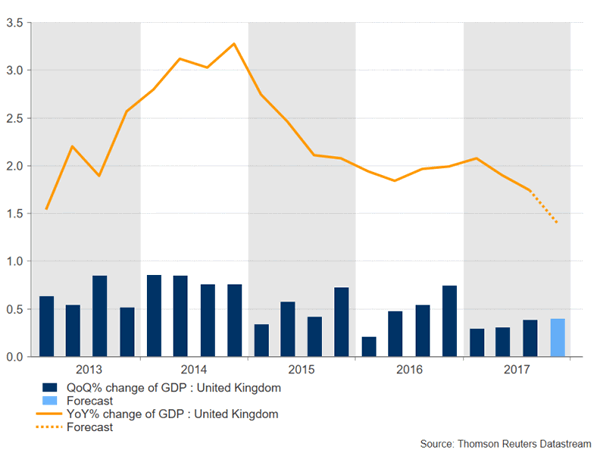
Disappointing readings next week could dampen expectations of a follow-up to last November's 0.25% rate hike by the BoE anytime soon. Sterling, which is up almost 3% against the dollar so far in 2018 and is now looking overstretched, could become susceptible to profit-taking in the event of a data miss, whereas better-than-expected numbers could drive further gains.
Draghi a risk for the euro bulls
The ECB will take centre stage next week as it holds its first policy meeting of the year on Thursday. But before that, traders will be kept busy with a batch of business survey releases, starting with the ZEW economic sentiment index on Tuesday. The German gauge is forecast to rise to 18.0 in January from 17.4 in the prior month. Also on Tuesday is the flash reading of the Eurozone consumer confidence index. It will be followed by the IHS Markit Eurozone PMIs on Wednesday. The flash readings for January are expected to show a slight easing of activity in the manufacturing and services sectors. On Thursday, Germany's closely watched Ifo business climate index is expected to hold at 117.2, just below November's all-time high.
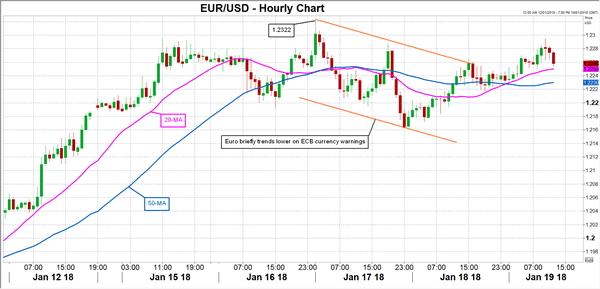
Attention will later shift to the ECB, which is anticipated to stand pat in January, having decided to trim its monthly bond purchases from €60 billion to €30 billion back in October. ECB policymakers have this week been attempting to talk down the euro's recent surge, which hit a 3-year high of $1.2322 on Wednesday. The ECB's chief, Mario Draghi, will likely use his press conference to warn of the negative impact on inflation from a sharp appreciation of the exchange rate. But it will also be interesting to see if he will reveal whether the Governing Council discussed updating their forward guidance on interest rates and giving an end date to the asset purchase program.
The ECB's rate decision will be preceded by the Norwegian central bank's own monetary policy announcement. At its December meeting, the Norges Bank said it expects to start raising interest rates sooner than expected, possibly in the autumn of 2018. The outlook was based on inflation rising more quickly as a result of a weaker krone. However, the Norwegian krone has been heading higher since the December meeting and this could force the Norges Bank to strike a less hawkish tone at its January meeting.
US GDP to maintain 3% growth path
The US calendar will get busier next week, with the highlight coming from the advance GDP reading for the fourth quarter. The first major release will be Wednesday's manufacturing and services PMIs from IHS Markit for January, as well as existing home sales for December. New home sales will follow on Thursday. Both indicators are forecast to dip slightly month-on-month in December. Also on Thursday are December figures on the US trade balance and inventories.
But the big focus will be Friday's durable goods and GDP numbers. Durable goods orders are forecast to increase for the second straight month, by 0.8% m/m in December. GDP growth meanwhile is expected to maintain similar momentum in the final quarter of 2017 as in the September quarter. The US economy is forecast to have expanded at an annualized rate of 3.0%, marginally below the prior 3.2% rate. A surprise strong print could fuel expectations of a more hawkish Fed when it meets on January 30-31 and would provide the greenback with a much-needed lift, having recently fallen to 3-year lows against a basket of currencies.