Sample Category Title
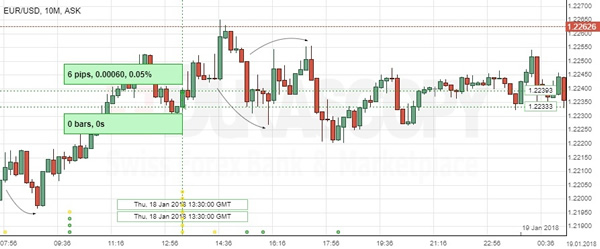
EURUSD – Bullish, Targets Key Resistance At 1.2322 level
EURUSD - The pair continues to retain its upside pressure as it looks to target the 1.2322 level. On the upside, resistance comes in at 1.2300 level with a cut through here opening the door for more upside towards the 1.2350 level. Further up, resistance lies at the 1.2400 level where a break will expose the 1.2450 level. Conversely, support lies at the 1.2200 level where a violation will aim at the 1.2150 level. A break of here will aim at the 1.2100 level. Below here will open the door for more weakness towards the 1.2050. Its daily RSI is bullish and pointing higher. All in all, EURUSD faces further upside move on bullish offensive
Euro On The Move, As U.S. Shutdown Looms
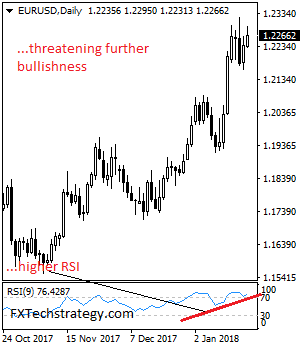
The euro has posted slight gains in the Friday session. Currently, EUR/USD is trading at 1.2270, up 0.26% on the day. In economic news, German PPI ticked higher to 0.2%, matching the forecast. The Eurozone Current Account Surplus widened to EUR improved to 32.5 billion, beating the estimate of EUR 31.3 billion. In the US, today’s key event is UoM Consumer Sentiment, which is expected to rise slightly to 97.0 points.
Investors are keeping a close eye on Capitol Hill, where a Federal government shutdown will take place on Saturday if Congress does not reach agreement on a short-term spending bill. The House of Representatives passed such a bill on Thursday, but the Senate could be a different story. A 60-seat majority is needed for the measure to pass, which means that the Republicans, who have a 51-49 majority, will need substantial support from the Democrats. However, many Democrat lawmakers are incensed over President Trump’s threat to deport young illegal immigrants and his recent inflammatory language against immigrants from poor countries. A government shutdown last occurred in 2013, and resulted in temporary layoffs for 800,000 non-essential Federal workers. With an election year in 2018, lawmakers from both parties will not want to anger voters, so we could see a last minute compromise which prevents a shutdown.
Germany continues to post strong current account and budget surpluses, a result of the booming economy. A strong demand for German products, record low unemployment and the ECB’s expansionary monetary policy have all contributed to the surpluses. What should be done with all these funds? This was a source of disagreement a recent conference in Frankfurt, hosted by the IMF and German Bundesbank. IMF Managing Director Christine Lagarde suggested that Germany should increase public spending. However, Bundesbank President Jens Weidmann acknowledged that the surpluses may be getting too large, but that increasing public expenditures was not the solution. With the German economy far outpacing its eurozone peers, most of them would likely envy Germany’s quandary over what to do with large surpluses.
XAUUSD Analysis: Remains Near Breached Channel
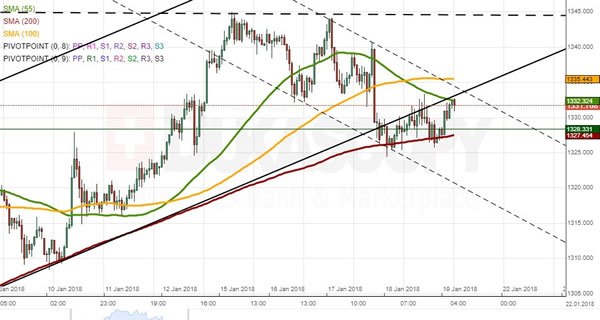
After breaching a six-week ascending channel late on Wednesday, Gold should have moved away from its bottom boundary. However, despite efforts to edge lower on the following day, this fall was stopped by the 200-hour SMA near the 1,325.40 mark. The subsequent surge was also limited, as the northern side was restricted by the bottom channel line and the 55-hour SMA. Technical indicators suggest that the pair should be tended northwards in this session. The bearish sentiment is still likely to prevail within the following hours, thus sending the rate towards 1,325.40. However, its previous failure to breach this area should repeat today, thus putting upwards pressure on Gold. Possible points of resistance are the 100-hour SMA and a four-month high at 1,335.40 and 1,344.01, respectively.
USDJPY Analysis: Points To Possible Decline
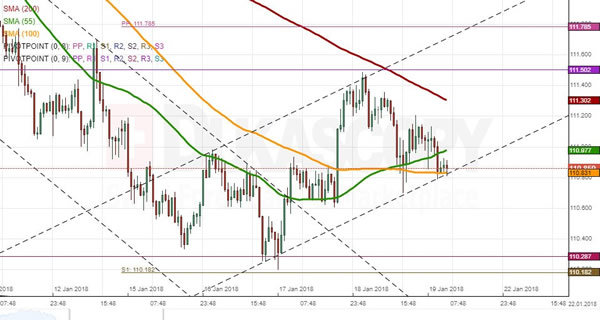
Even though the Greenback was tended southwards on Thursday, it remained stranded between the monthly S2 and the 200-, 55– and 100-hour SMAs for the whole session. The pair was testing the 100-hour SMA and the bottom boundary of a short-term channel circa 110.80 at the time of this analysis. From theoretical point of view, the US Dollar should pick up speed and approach the long-term moving average. This assumption, however, is not supported by technical indicators that suggest a strong decline. This scenario is likely to occur if the 110.80 area is breached. A subsequent fall, however, should not exceed the 110.20 mark where the monthly S2 and the weekly S1 are located. Meanwhile, the upside target for today is the 11.50 mark.
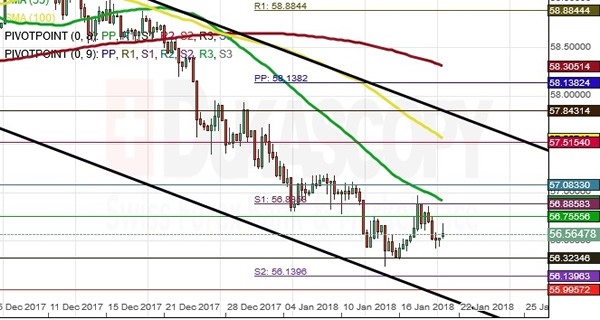
USD/RUB 4H Chart: Continued To Declined
The US Dollar has continued to decline against the Russian ruble, as expected. The currency exchange rate has reached the previously set target of 56.13.
The target was chosen as it represents the low level of August 2017. Moreover, it consists of various other levels of significance. For example, an inverse Fibonacci retracement level of past high and low levels would be located at that level.
Meanwhile, regarding the long term, the movement is likely to continue south until it breached the monthly pivot point's support at 54.88.
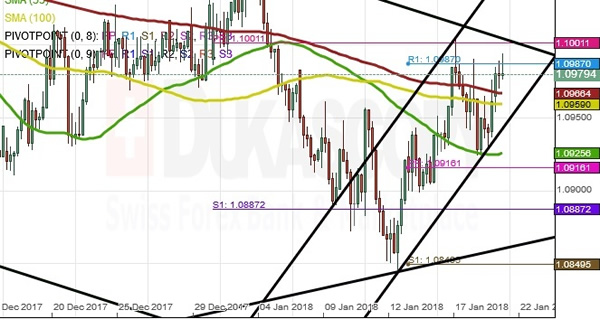
AUD/NZD 4H Chart: The Upwards Channel Continued
After meeting with the lower trend line of a dominant channel up pattern, AUD/NZD currency exchange rate began a surge on January 12.
This movement is likely to continue since it already tested the weekly and monthly pivot point resistance at 1.098. However, the pattern is drawing closer to the dominant downward channel.
Meanwhile, regarding the long term, the movement is likely to continue upward. That is due to all technical indicators confirming the price movement. The 55-hour SMA is providing support at 1.092 and both 100 and 200–hour SMAs are located under the exchange rate.
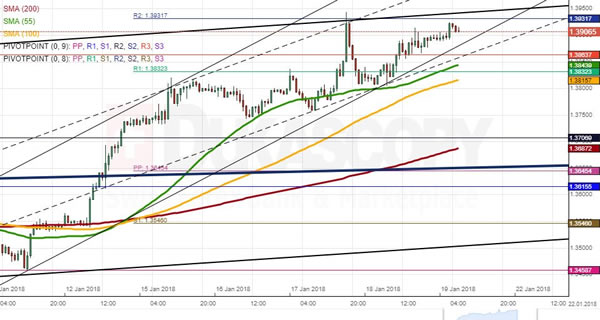
GBPUSD Analysis: Loses Upside Momentum
The Pound continues to appreciate against the US Dollar for the sixth consecutive session. The pair managed to edge higher on Thursday; however, it lost its momentum near the 2017 high of 1.3925. This suggests that bulls might have exhausted their strength, thus paving the way for a possible decline in price. This is likewise apparent from the two short-term channels drawn on the chart, as the Sterling has failed to reach their upper boundaries this week. By and large, it is expected that the pair trades sideways in this session, especially if the southern barrier is provided by the 55– and 100-hour SMAs and the weekly R1 circa 1.3830. In case bears push even lower, the ultimate daily low should be the monthly R2 at 1.3707. Meanwhile, the next notable resistance is the distant weekly R3 at 1.4119.
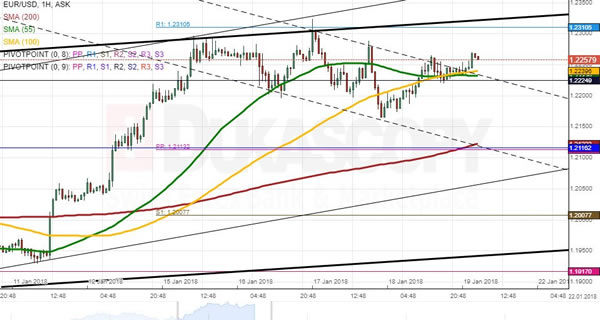
EURUSD Analysis: Supported By Strong Cluster
The common European currency was driven by strong upside momentum on Thursday. As a result, it managed to breach a strong resistance area formed by the 55– and 100-hour SMAs and the monthly R2 circa 1.2235. Subsequently, the pair was stranded in a narrow range between the aforementioned cluster and the upper boundary of a descending channel. The support of the former was enough to breach the given pattern and leave the rate trading near 1.2258 by Friday morning. Given that no major fundamentals are scheduled for this session, the southern barrier is expected to hold strong, thus sending the Euro for slight appreciation towards the weekly R1 at 1.2311. In case this mark is surpassed, the next notable resistance is the distant weekly R2 and the monthly R3 at 1.2420.
NZD/USD: Business NZ Manufacturing Index
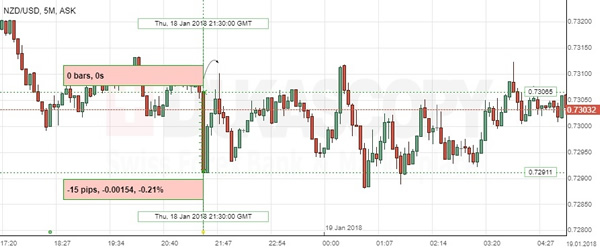
The Kiwi depreciated against the US Dollar on a fading activity in the New Zealand's manufacturing sector. The NZD/USD currency pair dropped 0.21% or 15 base points to the 0.7291 mark, but kept trading in the 0.7300 area.
New Zealand's manufacturing activity grew at its weakest pace in nearly five years in the last month of 2017. The Business NZ survey showed that the seasonnaly adjucted Manufacturing Index decreased to 51.2 from 57.7 in the prior month. The stark downturn in growth was mostly caused by a surprise election results, which ended the era af National Party, providing the helm for the Labour-led governemnt with uncertainties over its decisions on emmigration and foreign investment.
EUR/USD: US Building Permits
The US Dollar was slightly weaker against the Euro in the wake of the country's real estate market data. The EUR/USD exchange rate added 6 pips to touch the intraday high of 1.2265.
Building permits were down 0.1% to a 1.30M units rate in December, adding to a total 4.7% rise to a rate of 1.26M units in 2017, the strongest level in ten years. The reports also revealed that the US homebuilding activity decreased more than anticipated by the end of 2017 to mark its largest drop in just a year, due to a steep fall in the single-family housing units construction. Housing starts dropped 8.2% to a seasonally adjusted yearly rate of 1.19M units, which is expected to be transitory amid solid demand for housing, driven by a strong labour market.