Fri, Apr 17, 2026 19:44 GMT
More

    Sample Category Title

    Australian PMI composite falls to 49.9, bolsters case for early RBA rate cut

    ActionForex

    Australia's December PMI data pointing to a broad-based slowdown. The Manufacturing index fell from 49.4 to 48.2. Services PMI edged down from 50.5 to 50.3. Meanwhile, Composite PMI dropped from 50.2 to 49.9, slipping into mild contraction territory.

    Jingyi Pan, Economics Associate Director at S&P Global Market Intelligence, noted that the data reflects growing strain across sectors, with manufacturing leading the downturn and services beginning to falter.

    Forward indicators presented mixed signals. While business confidence reached its highest level in over two-and-a-half years, new business growth slowed, and unfinished work declined further. Employment gauge showed its first contraction since August 2021.

    Muted selling price inflation provides room for RBA to consider rate cuts in early 2024. However, rising cost pressures remain a concern.

    Full Australia PMI release here.

    NZ BNZ services jumps to 49.5, closer to stability

    New Zealand’s BusinessNZ Performance of Services Index rose significantly from 46.2 to 49.5 in November, signaling a move closer to stabilization. However, the index remains under the no-change threshold of 50.0 and well below its long-term average of 53.1.

    Key subcomponents offered a mixed picture. Activity/sales improved from 44.4 to 48.6, and new orders/business rose to 49.8, nearing expansion territory. Employment showed only a slight uptick, from 46.4 to 46.8, reflecting continued caution among firms. Stocks/inventories and supplier deliveries moved into expansionary territory at 52.2 and 52.5, respectively, signaling some recovery in supply chain dynamics.

    Negative sentiment among respondents eased, with the proportion of unfavorable comments dropping to 53.6% from October’s 59.1%. However, the ongoing concerns over the economic climate and the cost of living remain dominant themes, indicating persistent headwinds for the sector.

    Full NZ BNZ PSI release here.

    GBP/USD Faces Trouble, USD/CAD Builds on Gains

    GBP/USD started a fresh decline below the 1.2720 zone. USD/CAD is rising and might aim for more gains above the 1.4245 resistance.

    Important Takeaways for GBP/USD and USD/CAD Analysis Today

    • The British Pound started another decline from the 1.2800 resistance zone.
    • There is a short-term declining channel forming with resistance at 1.2650 on the hourly chart of GBP/USD at FXOpen.
    • USD/CAD is showing positive signs above the 1.4200 support zone.
    • There is a contracting triangle forming with resistance at 1.4245 on the hourly chart at FXOpen.

    GBP/USD Technical Analysis

    On the hourly chart of GBP/USD at FXOpen, the pair struggled to continue higher above the 1.2840 resistance zone. The British Pound started a fresh decline and traded below the 1.2750 support zone against the US Dollar, as discussed in the previous analysis.

    The pair even traded below 1.2650 and the 50-hour simple moving average. Finally, the bulls appeared near the 1.2610 level. A low was formed at 1.2608 and the pair is now consolidating losses.

    Immediate resistance on the upside is near a short-term declining channel at 1.2650. It is close to the 23.6% Fib retracement level of the downward move from the 1.2787 swing high to the 1.2608 low. The first major resistance is near the 1.2674 zone.

    The main hurdle sits at 1.2720 and the 61.8% Fib retracement level of the downward move from the 1.2787 swing high to the 1.2608 low. A close above the 1.2720 resistance might spark a steady upward move.

    The next major resistance is near the 1.2785 zone. Any more gains could lead the pair toward the 1.2850 resistance in the near term.

    Initial support on the GBP/USD chart sits at 1.2610. The next major support sits at 1.2585, below which there is a risk of another sharp decline. In the stated case, the pair could drop toward 1.2520.

    USD/CAD Technical Analysis

    On the hourly chart of USD/CAD at FXOpen, the pair formed a strong support base above the 1.4100 level. The US Dollar started a fresh increase above the 1.4165 resistance against the Canadian Dollar.

    The bulls pushed the pair above the 1.4200 and 1.4215 levels. The pair cleared the 50-hour simple moving average and climbed above 1.4240. A high was formed at 1.4245 and the pair recently corrected some gains.

    There was a move toward the 23.6% Fib retracement level of the upward move from the 1.4119 swing low to the 1.4245 high. Initial support is near the 1.4215 level.

    The next major support is near the 1.4195 level. The main support sits near the 1.4165 zone on the same USD/CAD chart. It is close to the 61.8% Fib retracement level of the upward move from the 1.4119 swing low to the 1.4245 high.

    A downside break below the 1.4165 level could push the pair further lower. The next major support is near the 1.4120 support zone, below which the pair might visit 1.4050.

    If there is another increase, the pair might face resistance near the 1.4245 level. A clear upside break above 1.4245 could start another steady increase. The next major resistance is the 1.4320 level.

    A close above the 1.4320 level might send the pair toward the 1.4365 level. Any more gains could open the doors for a test of the 1.4420 level.

    Trade over 50 forex markets 24 hours a day with FXOpen. Take advantage of low commissions, deep liquidity, and spreads from 0.0 pips. Open your FXOpen account now or learn more about trading forex with FXOpen.

    This article represents the opinion of the Companies operating under the FXOpen brand only. It is not to be construed as an offer, solicitation, or recommendation with respect to products and services provided by the Companies operating under the FXOpen brand, nor is it to be considered financial advice.

    France Downgraded

    China’s latest efforts to convince investors that it will boost its economy with great stimulus measures had the same reaction than the previous ones: disappointment. On Friday, the Chinese authorities repeated that they will boost consumption but the lack of details reversed the pre-announcement enthusiasm and sent the CSI 300 more than 2% lower. And the Chinese stocks were sold again today on the back of a significant slow down in retail sales growth last month, as confirmation that whatever is done in China is not bearing fruit. Meanwhile, the Chine yields’ nosedive does nothing to motivate investors to come back. That’s a massive problem that reminds investors of Japan which struggled with the famous ‘liquidity trap’ dilemma for decades – where the low rates couldn’t boost consumption and kept the economy in a low gear for decades. The only thing that could make the difference for China is that Japan was already rich when liquidity trap happened, China is not.

    In Korea, the political turmoil continues to weigh on sentiment, while in France, the relief on the appointment of Francois Bayrou – another very established name in French politics – to replace Barnier as the new French PM was clouded by Moody’s downgrading the French credit rating to Aa3 – three levels below the top. Moody’s blamed the political fragmentation, and Bayrou will probably struggle with the same divided government as his predecessor to pass any budget-healing measures.

    Nearby, German politicians will hold a confidence vote to pave the way for a Ferbuary snap election. But the German opposition said that they will maintain their borrowing limit unchanged if they come to power next year – as opposed to the earlier statements from the CDU leader Friedrich Merz about his openness to increase that limit to give more support to the economy – which obviously was not ideal for the budget discipline.

    To summarize, nothing is less clear than the political picture in the eurozone’s two strongest economies, so the bets that the European Central Bank (ECB) must do the heavy lifting remains strong after last week’s cautious 25bp cut. The expectation is that the ECB will deliver another 25bp cut in January. But the dovishness is mostly priced in, therefore, the EURUSD should find enough support near the 1.05 mark and re-challenge the 1.06 offers.

    Across the Channel, Cable is slightly better bid this morning, but Friday’s disappointing set of data – that hinted at surprisingly worse industrial and manufacturing production topped with surprisingly soft services – warned again that the British economy will see the backdrops of tax increases before it starts seeing the benefits of spending. The Bank of England (BoE) is expected to maintain its rate unchanged this week, to make sure to balance out the government’s spending plans, but some officials could sound dovish on the back of weak growth numbers. As per sterling, the selloff could slow on the back of a cautious BoE and an unnecessarily soft Federal Reserve (Fed). But the dream of seeing Cable end the year above the 1.30 is melting by the day.

    In Japan, the USDJPY is gaining traction to the upside as investors trim their bets for a Bank of Japan (BoJ) rate hike this week. Some officials had said earlier this month that waiting for the next hike would make little sense – a hawkish risk that should cap the USDJPY’s ascent near 155 into the decision.

    In the US, the Federal Reserve (Fed) is expected to trim its rates by another 25bp when it meets this week. Last week’s CPI print was eventless, and the jump in the PPI number was mostly wiped out – as egg prices were mostly responsible for the uptick. What the Fed will announce about the next meetings will probably matter more than this week’s cut. On one hand, Powell recognizes that the US economy and jobs market remain resilient. On the other hand, Trump’s pro-growth policies and tariffs could boost inflation again. So, on both hands, there is nothing that justifies the continuation of regular cuts in 2025.

    The S&P500 closed last week near record while Nasdaq advanced to a fresh record high on Friday. This time, it was Broadcom’s turn to shine. The company’s stock price jumped 24% to a record high on Friday after announcing better-than-expected earnings and saying that it expects a booming demand for their custom-made AI chips. Remember, Broadcom and Apple announced to build a chip together a day before. Tech companies’ willingness to build their own chips could be a opening for companies like Broadcom in the AI race – if they succeed in delivering strong, custom-made and cheaper solutions and threaten Nvidia’s share of pie. Nvidia’s ecosystem of software, tools, and AI research infrastructure remains a powerful defense, but its high valuation raises questions.

    Flash PMIs in focus

    In focus today

    Today all eyes are on the euro area December flash PMIs as the very large decline in November caused significant market moves. There was nothing positive in the November report where the services PMI fell below 50 to 49.5 for the first time since January, and the manufacturing PMI remained stuck at 45.2. We expect the economic situation to be little changed since November and forecast negative quarterly GDP growth in Q4. We thus expect the PMIs to decline slightly in December to 44.9 in the manufacturing sector and remain at 49.5 in the service sector.

    We also receive the flash PMIs for November from the US and UK later in the day.

    In France, the National Assembly will debate a "special law", which will allow the 2024 budget to be rolled over to 2025 to avoid a government shutdown. The National Rally has said that it will support the law, thereby allowing the current caretaker government to manage minimal state expenditures until a new government is formed. While it is our base case that the law will pass there is a risk that it is not passed, which will increase uncertainty in French politics. In this case, President Macron will need to use an unprecedented law by the constitution to pass budgetary measures without going through Parliament.

    Economic and market news

    What happened overnight

    In China, activity remains weak as retail sales for November came in weaker than expected at 3.0% y/y (consensus: 5.0%, prior: 4.8%). Coupled with Chinese credit growth slowing and money supply growth posing a drag with M1 at -3.7% y/y, albeit up from -6.1% y/y in October, the data highlights the need for more stimulus from Chinese authorities. Chinese equities edged lower on the data releases out overnight.

    What happened since Friday

    In France, the veteran centrist politician Francois Bayrou was appointed the role as prime minister on Friday. Barou is a long-term ally of president Macron as head of the centrist Democratic Movement (MoDem). Barou has the tacit support from the far-right national rally who said they will not back a no-confidence vote against him by default. However, while the prime minister is new, he will face the same old hurdles as Barnier given the highly divided National Assembly. Because of this, markets did not react to the announcement on Friday. Additionally, Moody's downgraded France to Aa3 from Aa2 over the weekend since the outlook of the country's public finances will be substantially weakened over the coming years.

    In the UK, monthly GDP for October surprised to the downside at -0.1% m/m (cons: 0.1%, prior: -0.1%). There is likely some negative sentiment effects from the Autumn statement as flagged by the past PMI reports. The downside surprise is broad-based but in particular driven by industrial and manufacturing production affected by weather disruptions.

    Equities: Global equities were lower on Friday and throughout last week, though we are talking about smaller movements alongside some indications of Christmas trading commencing, despite being in a busy period for central banks. The most interesting aspect last week was the bond market, with yields rising across all five days. Nevertheless, equities reacted only marginally to the movement in bonds. Growth and technology sectors performed well, despite the increase in yields, while small-cap stocks lost almost 1% relative to large-cap stocks last week. In the US on Friday, the Dow fell by 0.20%, the S&P 500 remained unchanged, the Nasdaq rose by 0.1%, and the Russell 2000 declined by 0.6%. Most Asian markets are in the red this morning. European futures are also lower, while US futures are slightly positive.

    FI: It was another eventful week in the European fixed income market given the bearish reaction to the ECB meeting last week and the unexpected downgrade of France from Moody's from Aa2 to Aa3. The 2Y and 10Y EUR swap rates rose some 10bp after the ECB meeting despite the dovish tone from Lagarde.

    FX: Last week saw a generally stronger USD, only NOK outperformed, while we found JPY and CHF at the bottom. USD/JPY was rejected at 150 and instead closed the week 2.5% higher at above 153.50 as US yields soared. Meanwhile, EUR/USD gyrated between gyrated between 1.0450 and 1.0600, just to close the week around 1.0500. The CHF weakened after the surprise 50bp rate cut. EUR/CHF soared to a 1M high. EUR/SEK remained within a tight range just above 11.50. EUR/NOK dropped from 11.80 to around 11.70. This week, the central bank takes centre stage with five rates decisions within 17 hours on Wednesday and Thursday.

    EUR/USD Wavers: A Tough Road Ahead for The Bulls

    Key Highlights

    • EUR/USD struggled to extend gains above the 1.0620 resistance zone.
    • It traded below a connecting bullish trend line with support at 1.0535 on the 4-hour chart.
    • USD/JPY is attempting to climb above the 154.00 resistance zone.
    • Bitcoin rallied to a new all-time high above $106,000.

    EUR/USD Technical Analysis

    The Euro failed to settle above 1.0620 against the US Dollar. EUR/USD started a fresh decline and traded below the 1.0550 support zone.

    Looking at the 4-hour chart, the pair traded below a connecting bullish trend line with support at 1.0535. There was a move below 1.0480 and the pair traded as low as 1.0453. It is now consolidating losses and trading near the 38.2% Fib retracement level of the downward move from the 1.0629 swing high to the 1.0453 low.

    The pair is now below the 100 simple moving average (red, 4-hour) and the 200 simple moving average (green, 4-hour). On the upside, the pair could face resistance near the 1.0520 level.

    The first major resistance is near the 1.0540 level. It is close to the 50% Fib retracement level of the downward move from the 1.0629 swing high to the 1.0453 low. A close above the 1.0540 level could set the tone for another increase.

    The next major resistance could be the 1.0600 level, above which the price could climb higher toward the 1.0620 resistance.

    On the downside, immediate support sits near the 1.0480 level. The next key support sits near the 1.0450 level. Any more losses could send the pair toward the 1.0410 level.

    Looking at Bitcoin, the price started another increase and there was a move to a new all-time high above $106,000.

    Upcoming Economic Events:

    • Euro Zone Manufacturing PMI for Dec 2024 (Preliminary) – Forecast 45.0, versus 45.2 previous.
    • Euro Zone Services PMI for Dec 2024 (Preliminary) – Forecast 49.9, versus 49.5 previous.

    Eco Data 12/16/24

    GMT Ccy Events Actual Consensus Previous Revised
    21:30 NZD Business NZ PSI Nov 49.5 46 46.2
    22:00 AUD Manufacturing PMI Dec P 48.2 49.4
    22:00 AUD Services PMI Dec P 50.4 50.5
    23:50 JPY Machinery Orders M/M Oct 2.10% 1.20% -0.70%
    00:30 JPY Manufacturing PMI Dec P 49.5 49.2 49
    00:30 JPY Services PMI Dec P 51.4 50.5
    02:00 CNY Industrial Production Y/Y Nov 5.40% 5.30% 5.30%
    02:00 CNY Retail Sales Y/Y Nov 3.00% 5.00% 4.80%
    02:00 CNY Fixed Asset Investment (YTD) Y/Y Nov 3.30% 3.50% 3.40%
    04:30 JPY Tertiary Industry Index M/M Oct 0.30% -0.10% -0.20%
    07:30 CHF PPI M/M Nov -0.60% 0.20% -0.30%
    07:30 CHF PPI Y/Y Nov -1.50% -1.80%
    08:15 EUR France Manufacturing PMI Dec P 41.9 43 43.1
    08:15 EUR France Services PMI Dec P 48.2 46.4 46.9
    08:30 EUR Germany Manufacturing PMI Dec P 42.5 43.8 43
    08:30 EUR Germany Services PMI Dec P 51 49.2 49.3
    09:00 EUR Eurozone Manufacturing PMI Dec P 45.2 45.3 45.2
    09:00 EUR Eurozone Services PMI Dec P 51.4 49.4 49.5
    09:30 GBP Manufacturing PMI Dec P 47.3 48.1 48
    09:30 GBP Services PMI Dec P 51.4 50.9 50.8
    13:15 CAD Housing Starts Y/Y Nov 262K 246K 241K 242K
    13:30 USD Empire State Manufacturing Dec 0.2 6.4 31.2
    14:45 USD Manufacturing PMI Dec P 48.3 49.4 49.7
    14:45 USD Services PMI Dec P 58.5 55.7 56.1
    GMT Ccy Events
    21:30 NZD Business NZ PSI Nov
        Actual: 49.5 Forecast:
        Previous: 46 Revised: 46.2
    22:00 AUD Manufacturing PMI Dec P
        Actual: 48.2 Forecast:
        Previous: 49.4 Revised:
    22:00 AUD Services PMI Dec P
        Actual: 50.4 Forecast:
        Previous: 50.5 Revised:
    23:50 JPY Machinery Orders M/M Oct
        Actual: 2.10% Forecast: 1.20%
        Previous: -0.70% Revised:
    00:30 JPY Manufacturing PMI Dec P
        Actual: 49.5 Forecast: 49.2
        Previous: 49 Revised:
    00:30 JPY Services PMI Dec P
        Actual: 51.4 Forecast:
        Previous: 50.5 Revised:
    02:00 CNY Industrial Production Y/Y Nov
        Actual: 5.40% Forecast: 5.30%
        Previous: 5.30% Revised:
    02:00 CNY Retail Sales Y/Y Nov
        Actual: 3.00% Forecast: 5.00%
        Previous: 4.80% Revised:
    02:00 CNY Fixed Asset Investment (YTD) Y/Y Nov
        Actual: 3.30% Forecast: 3.50%
        Previous: 3.40% Revised:
    04:30 JPY Tertiary Industry Index M/M Oct
        Actual: 0.30% Forecast: -0.10%
        Previous: -0.20% Revised:
    07:30 CHF PPI M/M Nov
        Actual: -0.60% Forecast: 0.20%
        Previous: -0.30% Revised:
    07:30 CHF PPI Y/Y Nov
        Actual: -1.50% Forecast:
        Previous: -1.80% Revised:
    08:15 EUR France Manufacturing PMI Dec P
        Actual: 41.9 Forecast: 43
        Previous: 43.1 Revised:
    08:15 EUR France Services PMI Dec P
        Actual: 48.2 Forecast: 46.4
        Previous: 46.9 Revised:
    08:30 EUR Germany Manufacturing PMI Dec P
        Actual: 42.5 Forecast: 43.8
        Previous: 43 Revised:
    08:30 EUR Germany Services PMI Dec P
        Actual: 51 Forecast: 49.2
        Previous: 49.3 Revised:
    09:00 EUR Eurozone Manufacturing PMI Dec P
        Actual: 45.2 Forecast: 45.3
        Previous: 45.2 Revised:
    09:00 EUR Eurozone Services PMI Dec P
        Actual: 51.4 Forecast: 49.4
        Previous: 49.5 Revised:
    09:30 GBP Manufacturing PMI Dec P
        Actual: 47.3 Forecast: 48.1
        Previous: 48 Revised:
    09:30 GBP Services PMI Dec P
        Actual: 51.4 Forecast: 50.9
        Previous: 50.8 Revised:
    13:15 CAD Housing Starts Y/Y Nov
        Actual: 262K Forecast: 246K
        Previous: 241K Revised: 242K
    13:30 USD Empire State Manufacturing Dec
        Actual: 0.2 Forecast: 6.4
        Previous: 31.2 Revised:
    14:45 USD Manufacturing PMI Dec P
        Actual: 48.3 Forecast: 49.4
        Previous: 49.7 Revised:
    14:45 USD Services PMI Dec P
        Actual: 58.5 Forecast: 55.7
        Previous: 56.1 Revised:

    Inflation Pressures and Yield Surge Anchor Dollar as Top Performer

    Dollar ended as the strongest performer last week, boosted by a surge in U.S. Treasury yields following persistent inflation data. Despite expectations of another 25bps rate cut at the upcoming FOMC meeting, stubborn price pressures are likely to slow the pace of policy easing next year. Adding to the caution, inflation uncertainties under the incoming administration's fiscal and trade policies will keep Fed on guard, discouraging aggressive action. Technically, the Dollar Index’s near-term bullishness remains intact, though another strong rally would hinge on whether 10-year yield can make significant new gains.

    Among commodity-linked currencies, both the Australian and Canadian Dollars finished on firm footing. Aussie overcame RBA’s dovish shift, as robust domestic employment data tempered expectations of an early policy cut in February. Similarly, Canadian Dollar found support after BoC delivered a second 50bps rate cut but signaled a more measured approach moving forward. This shift in tone suggests that both central banks are not in a rush to push rates lower and are more inclined to respond thoughtfully to incoming data.

    In Europe, Euro stood out, benefiting from the ECB’s modest 25bps rate cut and officials’ commitment to gradualism. By contrast, Swiss Franc lagged, ranking as the second weakest currency after SNB delivered a surprising 50bps reduction, raising the prospect of a return to zero or negative rates if inflation weakens further.

    Nevertheless, Yen was the worst performer, weighed down by higher yields in both the US and European markets. Meanwhile, Sterling and New Zealand Dollar found themselves in middle positions.

    Hawkish Fed Undertones Emerge, Treasury Yields Soar and Dollar Gains

    Last week brought significant surge in US Treasury yields, fueled by consecutive inflation prints that reinforced the persistence of price pressures. Headline CPI rose to 2.7%, marking the second straight monthly re-acceleration, while core CPI held steady at 3.3%. Adding to this inflationary backdrop, PPI hit 4.7%, its highest since February 2023.

    Although these figures won’t stop Fed from delivering another 25bps cut at its upcoming meeting, they underscore the likelihood of a "hawkish cut." Markets now anticipate Fed signaling a pause in January and slowing the pace of rate reductions through 2025.

    The need for a measured easing path is becoming increasingly evident. Disinflation has shown little progress in recent months, and inflationary pressures could re-emerge under President-elect Donald Trump’s anticipated fiscal and trade policies, which remain to be fully detailed.

    Current market pricing reflects expectations for just two additional rate cuts in 2025, bringing the federal funds rate to 3.75–4.00%, already higher than Fed’s September median projection of 3.4% for year-end 2025. This represents a marked shift from September when markets anticipated a more aggressive easing cycle. The market’s uncertainty, with roughly a third of participants expecting fewer cuts and a third expecting more, highlights the uncertainty around the outlook.

    Technically, the strong rebound in 10-year yield not makes the dip to 4.126 a false break of 55 D EMA. The development suggests that rise from 3.603 is still in progress. Retest of 4.505 resistance should be seen next, and firm break there will target 61.8% projection of 3.603 to 4.505 from 4.126 at 4.683.

    More importantly, the development in 10-year yield solidifies that case that whole medium term correction from 4.997 has completed with three waves down to 3.603. The strong support from 55 W EMA (now 4.133) also supports this view. There is prospect of resuming the up trend of 0.398 (202 low) through 4.997 to 38.2% projection of 0.398 to 4.997 from 3.603 at 5.359 next year.

    Dollar Index followed yields higher last week, and the development suggest that pull back from 108.07 has completed. While the near term corrective pattern could still extend with another falling leg, it's now looking more likely that downside will be supported by 38.2% retracement of 100.15 to 108.07 at 105.04, which is slightly below 55 D EMA (now at 105.12). Rise from 100.15 should resume sooner or later through 108.07, but that would depends on when 10-year yield would power through 4.505 resistance.

    Also, the next rally in Dollar Index through 108.07 would solidify that case of medium term bullish trend reversal. Upside acceleration could follow through 161.8% projection of 99.57 to 107.34 from 100.15 at 112.72.

    EUR/CHF Rises Sharply Amid SNB's Bold Cut and ECB's Gradualism

    EUR/CHF climbed significantly, driven by divergent monetary policy decisions from SNB and the ECB. SNB delivered a hefty 50bps rate cut, pushing its policy rate down to 0.50%. This move was accompanied by revised inflation projections, which show inflation staying below the mid-point of SNB’s target range throughout the forecast horizon. While somewhat unexpected, the decision aligns with SNB’s historical pattern of bold actions, necessitated by Switzerland’s unique economic challenges as a small, open economy. The cut also brings Switzerland closer to the prospect of 0% rates and potentially negative territory if deflationary pressures continue to build.

    In contrast, ECB implemented a more modest 25bps cut in its deposit rate, bringing it to 3.00%. Euro strengthened in the wake of commentary from ECB officials, who signaled a broad consensus for the gradual approach to easing. Policymakers expressed confidence in inflation returning to target levels without resorting to aggressive rate cuts, even as economic activity data remains weak. ECB’s preference for gradualism signals a desire to balance economic risks without triggering undue market anxiety.

    Technically, EUR/CHF's rebound from 0.9204 resumed with strong acceleration last week. The firm break of 55 D EMA argues that a medium term bottom was already formed. Immediate focus is now on 100% projection of 0.9204 to 0.9343 from 0.9254 at 0.9393. Firm break there will be a strong sign of underlying bullish momentum, and pave the way to 161.8% projection at 0.9479. This level coincides with 38.2% retracement of 0.9928 to 0.9204 at 0.9481. Reaction there would reveal whether the cross is already in medium term trend reversal.

    AUD/CAD Stays Indecisively Bearish after RBA and BoC

    AUD/CAD remains on the defensive last week following developments in Australia and Canada, even though downside momentum has been indecisive.

    RBA’s decision to keep rates unchanged at 4.35% was accompanied by a surprising dovish shift. Key in this shift was the central bank's move to drop the previously language of "not ruling anything in or out" regarding policy adjustments. This subtle but significant change signals a growing inclination toward rate cuts, contingent on further evidence of sustained disinflation. Governor Michele Bullock, when pressed on the likelihood of a February cut, candidly admitted she does not "actually know".

    However, the case for imminent easing faced a setback with robust labor market data released just two days after the RBA meeting. November’s employment figures exceeded expectations, while unemployment rate fell unexpectedly to 3.9% from 4.1%. The persistently tight labor market could keep RBA cautious about prematurely easing policy.

    In contrast, BoC moved decisively with a 50bps rate cut, bringing the overnight rate to 3.25%. This marks the second consecutive 50bps cut, placing policy at the top end of the neutral range. Governor Tiff Macklem signaled a shift toward a more measured easing approach, saying, “With the policy rate now substantially lower, we anticipate a more gradual approach to monetary policy if the economy evolves broadly as expected.” Market expectations for another cut in January stand at 70%, though a pause seems increasingly likely in the near term, as BoC evaluates the impact of its aggressive rate reductions.

    Technically, AUD/CAD is now at a juncture. Near term outlook is staying bearish as the cross is held well below falling 55 D EMA. Yet, it's now in proximity to medium term rising channel support, which could limit downside in case of another fall. Indeed, break of 0.9163 resistance will argue that pull back from 0.9375 has completed, and was merely a correction. Rise from 0.8562 should then be ready to resume. However, sustained break of the channel support will argue that the trend has already reversed.

    The pair’s trajectory in the near term hinges on the timing of RBA rate cuts and a BoC pause. Over the medium term, broader macroeconomic factors, including the impact of the US-China tariff war, will likely play a significant role. RBA Deputy Governor Andrew Hauser has just emphasized Australia’s "unique" vulnerability to global trade disruptions due to its heavy reliance on Chinese markets, a risk that could weigh on Australian Dollar further if tensions escalate.

    USD/JPY Weekly Outlook

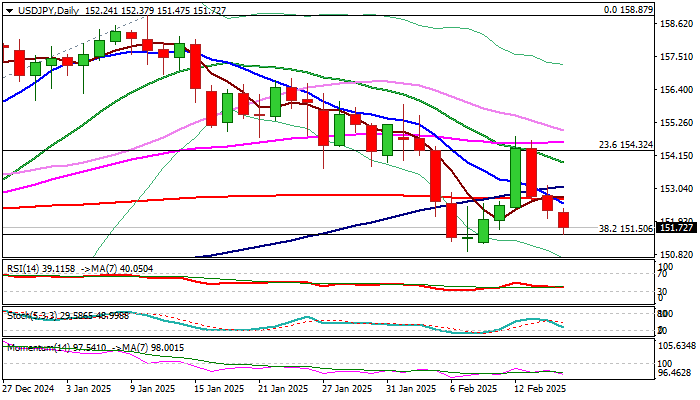
    USD/JPY's stronger than expected rebound last week suggests that correction from 156.74 has completed at 148.64. Initial bias remains on the upside this week for retesting 156.74 first. Firm break there will resume whole rally from 139.57, and target 61.8% projection of 139.57 to 156.74 from 148.64 at 159.25 next. On the downside, below 151.79 minor support will turn intraday bias neutral first. But risk will stay on the upside as long as 148.64 support holds, in case of retreat.

    In the bigger picture, price actions from 161.94 are seen as a corrective pattern to rise from 102.58 (2021 low). The range of medium term consolidation should be set between 38.2% retracement of 102.58 to 161.94 at 139.26 and 161.94. Nevertheless, sustained break of 139.26 would open up deeper medium term decline to 61.8% retracement at 125.25.

    In the long term picture, it's still early to conclude that up trend from 75.56 (2011 low) has completed. However, a medium term corrective phase should have commenced, with risk of deep correction towards 55 M EMA (now at 134.98).

    EUR/USD Weekly Outlook

    EUR/USD gyrated lower last week but recovered again after hitting 1.0452. Initial bias stays neutral this week first. Corrective pattern from 1.0330 might extend further. But outlook will stay bearish as long as 55 D EMA (now at 1.0678) holds. On the downside, below 1.0452 will bring retest of 1.0330 low.

    In the bigger picture, focus stays on 50% retracement of 0.9534 (2022 low) to 1.1274 at 1.0404. Strong rebound from this level will keep price actions from 1.1273 (2023 high) as a medium term consolidation pattern only. However, sustained break of 1.0404 will raise the chance that whole up trend from 0.9534 has reversed. That would pave the way to 61.8% retracement at 1.0199 first. Firm break there will target 0.9534 low again.

    In the long term picture, down trend from 1.6039 remains in force with EUR/USD staying well inside falling channel, and upside of rebound capped by 55 M EMA (now at 1.0979). Consolidation from 0.9534 could extend further and another rising leg might be seem. But as long as 1.1274 resistance holds, downside breakout would be mildly in favor.

    USD/JPY Weekly Outlook

    USD/JPY's stronger than expected rebound last week suggests that correction from 156.74 has completed at 148.64. Initial bias remains on the upside this week for retesting 156.74 first. Firm break there will resume whole rally from 139.57, and target 61.8% projection of 139.57 to 156.74 from 148.64 at 159.25 next. On the downside, below 151.79 minor support will turn intraday bias neutral first. But risk will stay on the upside as long as 148.64 support holds, in case of retreat.

    In the bigger picture, price actions from 161.94 are seen as a corrective pattern to rise from 102.58 (2021 low). The range of medium term consolidation should be set between 38.2% retracement of 102.58 to 161.94 at 139.26 and 161.94. Nevertheless, sustained break of 139.26 would open up deeper medium term decline to 61.8% retracement at 125.25.

    In the long term picture, it's still early to conclude that up trend from 75.56 (2011 low) has completed. However, a medium term corrective phase should have commenced, with risk of deep correction towards 55 M EMA (now at 134.98).