Sample Category Title
EUR/CHF Moving Higher
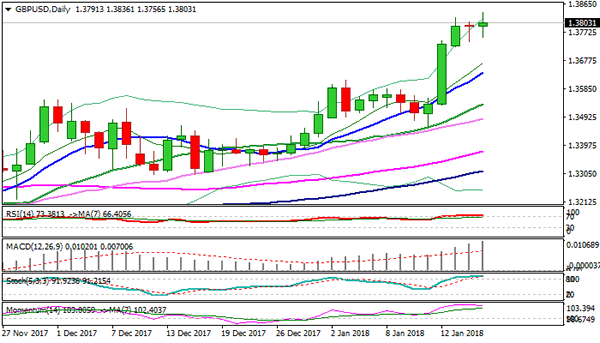
EUR/CHF bullish momentum has paused. Hourly resistance is given at 1.1832 (15/01/2018 high). Expected to show continued short-term increase.
In the longer term, the technical structure has reversed. Strong resistance is given at 1.20 (level before the unpeg). Yet, the ECB's QE programme is likely to cause persistent selling pressures on the euro, which should weigh on EUR/CHF. Supports can be found at 1.0184 (28/01/2015 low) and 1.0082 (27/01/2015 low).
EUR/GBP Consolidating
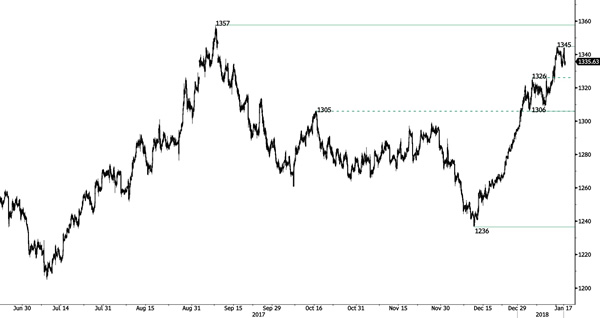
EUR/GBP has contracted after breaking rising channel top. The pair is trading between support at 0.8689 (08/12/2017 low) and resistance is located at 0.9046 (14/09/2017 high). The current mid-term rising channel suggests increasing selling pressures.
In the long-term, the pair has largely recovered from recent lows in 2015. The technical structure suggests a growing upside momentum. The pair is trading above from its 200 DMA. Strong resistance can be found at 0.9500 (psychological level).
AUD/USD Riding Higher
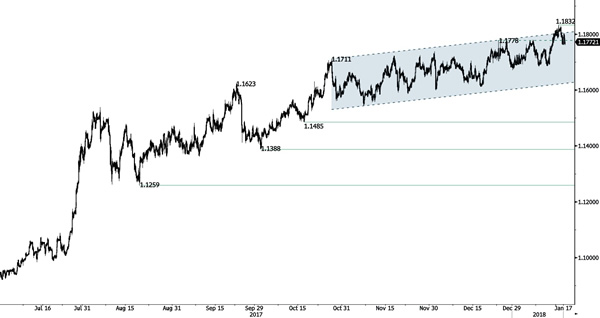
AUD/USD's upside pressures are growing. Hourly resistance is now given at 0.7979 (15/01/2018 high). Support stands at 0.7808 (09/01/2018 low). The road is wide open for further upside.
In the long-term, the trend is turning positive. Key supports stands at 0.6009 (31/10/2008 low) . A break of the key resistance at 0.8164 (14/05/2015 high) is needed to invalidate our long-term bearish view.
USD/CAD Minor Bounce On Support
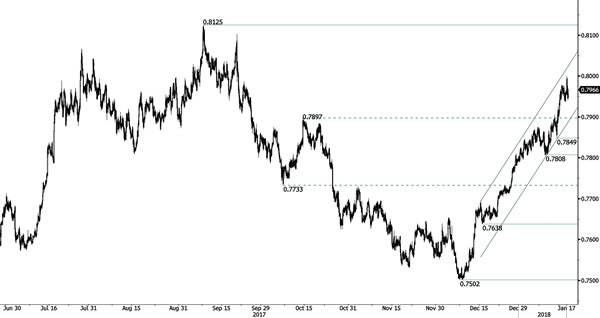
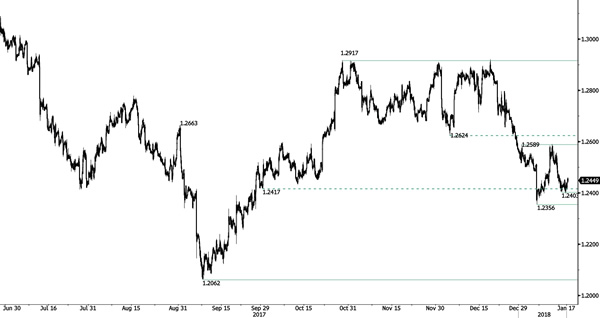
USD/CAD remains weak as long as prices remain below the key resistance at 1.2589. A support stands at 1.240. Another resistance is given at 1.2624, whereas a strong support lies at 1.2356. Expected to show renewed short-term weakness.
In the longer term, the pair has broken longterm support that can be found at 1.2461 (16/03/2015 low). Strong resistance is given at 1.4690 (22/01/2016 high). The pair is likely to head further lower.
USD/CHF Trying To Bounce
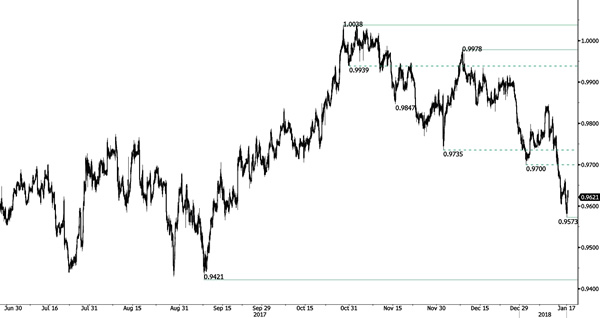
USD/CHF iis trying to bounce. The short-term technical structure is negative as long as prices remain below the hourly resistance at 0.9665 ( 16.01/2018). A key resistance stands at 0.9700 (02.01.2018 low). An hourly support lies at 0.9573 (intraday low).
In the long-term, the pair is still trading in range since 2011 despite some turmoil when the SNB unpegged the CHF. Key support can be found 0.8986 (30/01/2015 low). The technical structure favours nonetheless a long term bullish bias since the unpeg in January 2015.
Technical Outlook: USDJPY – Bears Are Taking A Breather Ahead Of Strong 110.15/00 Supports
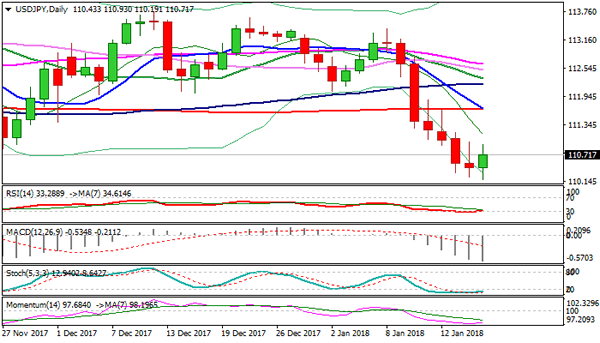
Bears faced strong headwinds from key supports at 110.15/00 (Fibo 61.8% of 107.31/114.73 rally / psychological support) and risk consolidation, possibly extended upticks in the near term.
Oversold daily studies support scenario, with recovery action facing solid resistance from thick hourly cloud, spanned between 110.72 and 111.01.
Limited upside is seen as likely scenario, as overall picture remains firmly bearish, with additional pressure coming from formation of 10/200SMA death-cross (111.68).
Eventual break below 110.15/00 pivots is expected to spark fresh acceleration on triggering significant stops, parked under psychological 110.00 support.
Fresh bears would look for targets at 109.54 (15 Sep spike low) and 109.06 (Fibo 76.4% of 107.31/114.73 rally).
Res: 110.72, 111.01, 111.68, 111.78
BoC Decision Eyed As Bitcoin Tumbles Again
- US Futures Recover After Worrying Sell-Off on Tuesday;
- BoC Rate Hike Almost Fully Priced in;
- Bitcoin Tests $10,000 as Speculators Abandon Ship.
US Futures Recover After Worrying Sell-Off on Tuesday
US investors were left feeling a little anxious on Tuesday after indices wiped out the strong gains seen at the open to end the day a little lower, but these worries may be quickly alleviated with futures pointing to another positive open on Wednesday.
There were some concerns on Tuesday that the prospect of a government shutdown may rattle the markets, with Congress appearing no closer to finding a solution, but I'm not convinced that investors are overly worried at this moment in time. In the past, the can has either been kicked down the road late in the day or shortly after the shutdown begins and right now I don't see any reason to believe this will be any different.
I think investors are far more concerned with earnings season, both in terms of whether companies lived up to high expectations going into the season and the projected benefits of Donald Trump's tax reforms. It's this that will determine whether stock markets can continue the remarkable run they've been on, more so than how long it takes government to reach a budget agreement or pass a temporary spending bill.
BoC Rate Hike Almost Fully Priced in
The Bank of Canada will meet on Wednesday and is expected to raise interest rates for the third time in six months having not raised once in the almost 10 years prior to this. It was generally accepted that the BoC would raise interest rates a couple of times this year having done so twice in 2017 and warned of further tightening but it was the December jobs report that appeared to seal the deal this month, as unemployment fell from 5.9% to 5.7% despite expectations of a small increase.
While some may question the central bank's decision to raise interest rates again so quickly given concerns about household debt and the impact that raising rates so quickly could have, markets see little chance of it not going ahead with it, pricing it any more than 90% with a further two this year. With today's hike priced in so heavily, the Canadian dollar could come under some serious pressure if the central bank holds off for more evidence of a significant tightening of the labour market given that inflation remains low.
Bitcoin Tests $10,000 as Speculators Abandon Ship
Bitcoin is coming under substantial selling pressure once again on Wednesday, falling below $10,000 at once stage, taking the losses to around 50% in the last month. While $10,000 even two months ago would have been seen as a huge success for Bitcoin enthusiasts, the euphoria towards the back end of 2017 saw prices sky rocketing on a daily basis driving many to claim it was in dangerous bubble territory.
While that in itself doesn't mean bitcoin will crash and burn, the warnings have proven to be legitimate in recent weeks. The question now is how long it will take bitcoin – as well as other cryptocurrencies that have had an equally awful month, some worse – to find its feet again. There was clearly a significant speculative component to the rally late last year and the drop will be very discouraging to those that previously thought there was easy money to be made. The recovery, once it begins, will likely be very gradual in comparison the what we saw in November and December. For now, it's just a question of how low it will go, with $10,000 currently providing some reprieve.
Are Crypto-Assets Ready For A Bounce Back?
Crypto-market stabilizes after massive sell-off
The entire crypto-asset market went through a massive sell-off since the beginning of the week with the total market capitalisation shrinking by $262 billion, down to $450 billion, the lowest level since mid-December last year. The sell-off was particularly acute for alt-coins, which suffered even bigger losses. This panic selling was triggered by fears of regulatory crackdown from China and South Korea.
It definitely sounds like an old song. Indeed, those regulations fears have been making the headlines regularly last year, each time triggering a sell-off in crypto-assets. However, every single time this panic movement was followed by a strong recovery that sent the entire market to new heights. We do not expect the outcome to be different this time.
After dipping below the $10,000 level in overnight trading, the price of Bitcoin recovered slightly and stabilized at around $10,500. Even though we do not rule out further weakness in the short-term, we remain confident that the sell-off is over. Alt-coins have already bounced back as fears dissipate; it is just a matter of before the entire market recovers.
Germany owns the biggest current account surplus of the world in 2017
For the second consecutive year, Germany has become the country with the largest current account surplus in the world in 2017 according to the ifo Institute Center for Economic Studies (CES).
Strongly criticized by the IMF and the European Commission for its lack of engagement in stimulating the Euro-Area internal demand, Germany confirms its role as a leader in the European Union. With a current account surplus of USD 287 billion in 2017 (resp. USD 84 billion and USD 152 billion more than Japan and China; equivalent to 7.8% of German GDP in 2017), Germany is by far the most competitive country within the Euro Zone. This also validates the view that the EU works in two different cadences. With regard to recent economic data releases of this year, German January – November 2017 exports correspond to 30% of total EU (ex UK) exports in 2017, amounting to up to EUR 1’181.4 billion according to Eurostat latest release. PMI and CPI indicators are also higher than most Euro Zone countries (on average basis: PMI +3.38% and CPI Y/Y +15.20% compared to Euro Zone data for 2017). German imports from January to November 2017 have also been much higher than its European peers (ex UK) and are valued at EUR 950.60 billion. With regard to intra-European transactions, Germany remains the first European importer, equivalent to 66% of its total imports. For these reasons, we remain dubious as to the fact that Germany does not sufficiently stimulate EU internal market for the time being.
From a monetary policy point-of-view and according to the data provided above, we remain confident that the January 25th 2018 ECB January Interest Rate Decision will stay unchanged, as many countries are expected to catch-up in 2018.
Australian Employment Report Eyed For Rate Clues As Aussie Hits 4-Month High
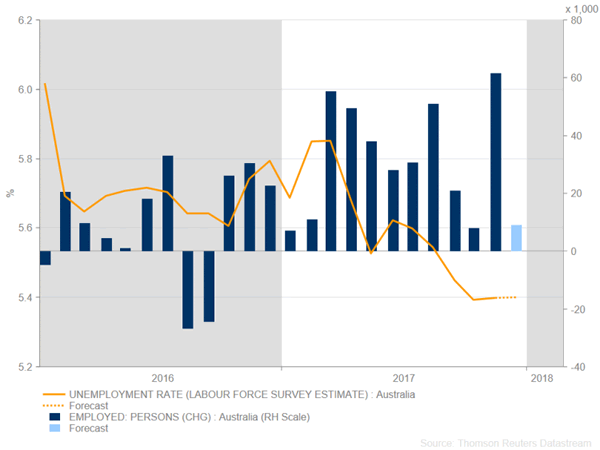
Australia's employment report for December is likely to attract attention and is scheduled for release on Thursday at 0030 GMT. The unemployment rate is forecasted to remain unchanged at 5.4% for the month of December, while the employment change is expected to show that the economy added 9000 jobs, much less from the previous month. Meanwhile, the participation rate is predicted to tick marginally lower to 65.4% in December from 65.5% before. Could a stronger than expected employment data affect the local currency?
The aussie received a boost on January 11 following the release of Australia's retail sales for November, which were much stronger than expected and rose by 1.2% month-on-month from 0.5% in the prior month. Sales rose at the fastest rate since February of 2013, mainly nudged by household goods.
The employment report overnight could drive aussie/dollar higher if the releases beats expectations. It is worth mentioning that Australian employment exceeded all predictions in November, the jobless rate remained at its lowest since February 2013, as the economy added 61,600 jobs while the number of unemployed increased by 4,100. However, weaker releases could push the RBA to be neutral for a longer period.
Turning to monetary policy, the Reserve Bank of Australia will have its interest rate decision on February 6 and is anticipated to keep its rate at 1.5%. The Bank has gone more than seven years without raising rates, the longest span since the official cash rate was introduced in 1990. According to forecasts by one of the major banks, the RBA will raise the official rate by 25 basis points in August and again in November. The central bank will be ready to increase rates when there are reliable signs that wage growth and inflation are moving in the right direction. Consumer prices rose 1.8% through the year to the September quarter of 2017, following a 1.9% increase in the second quarter. It was the lowest inflation rate since the December 2016 quarter. Additionally, if commodity prices continue to rise and Australian data continues to show a strengthening economy, the market may start pricing in more aggressive RBA policy tightening. Thursday could be a good day to start as China growth data will be released along with the Australian employment data.
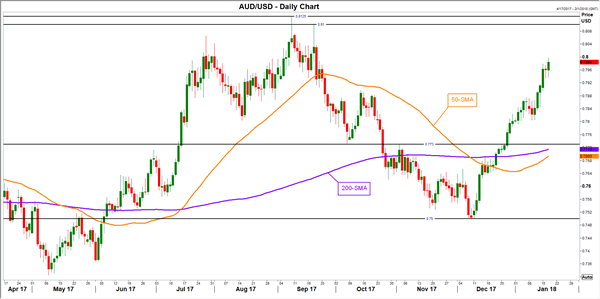
Aussie/dollar edged sharply higher during the past week and outperformed as it successfully surpassed the 0.7900 psychological level. The pair has risen around 5% since last month as the US dollar has come under broad pressure. Moreover, aussie/dollar rebounded on the significant ascending trend line, which has been holding since January 2016 and posted five bullish weeks in a row, surpassing the three-weekly simple moving averages (50, 100 and 200).
If the employment report surpasses the consensus, then the price could create a rally until the 0.8100 strong psychological level. A break above the aforementioned obstacle could open the door towards the next immediate resistance of 0.8125.
A worse-than-expected figure could create a downward pressure for the pair and would retest the 0.7730 support level in the daily timeframe.
Technical Outlook: GBPUSD – Double Doji Signals Indecision And Risk Pullback, Overall Bias Remains Bullish
Bulls are pausing for the second day, with long-legged Doji left on Tuesday and today's action being so far shaped in Doji candle, signaling indecision.
Steep three-day ascend from 1.3457 trough might be running out of steam, despite posting marginally higher high today on spike to 1.3836.
Bulls touched resistance at 1.3837 (Fibo 61.8% of 1.5016/1.1930 fall) but may face stronger headwinds at this strong obstacle, which could result in extended consolidation and possible stronger easing, before continuing.
Overbought daily indicators support the notion.
Top of thick hourly cloud marks solid support at 1.3775, together with today's / Tuesday's spike lows at 1.3756/41 respectively and break here would be a stronger signal of correction.
Otherwise, sustained break through 1.3837 pivot after narrow consolidation, could signal fresh bullish extension and expose psychological 1.4000 barrier.
Res: 1.3837, 1.3900, 1.3950, 1.4000
Sup: 1.3775, 1.3741, 1.3724, 1.3691