Sample Category Title
Slew of Fed Speakers Have the Capacity to Affect Dollar Positioning
The dollar is in recovery mode on Monday after falling on Friday, recording its lowest since January 2 versus a basket of currencies and coming close to hitting a fresh 3½-month low. Dollar selling took place in the aftermath of December's jobs report which showed the US economy adding notably fewer positions than analysts had expected.
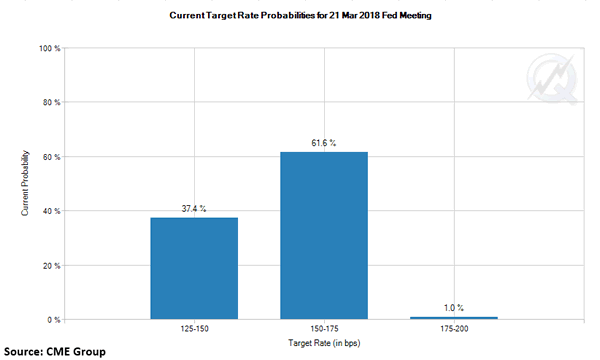
Despite earlier declines, the dollar managed to recover, finishing Friday's trading higher, albeit only slightly so. Dollar bulls eventually taking control was attributed to the fact that last week's NFP report doesn't seem to be changing perceptions among Fed policymakers, with markets continuing to in large part – more than 60% at the moment according to CME futures – pricing in a rate hike during the Federal Reserve's March meeting. Remarks by Fed policymakers late last week also played their role, with positive momentum for the US currency carrying through Monday's trading, as comments by FOMC policymakers were broadly tilted towards the hawkish side. The dollar index is trading in the green during Monday's trading and at a distance to Friday's low, touching 92.36 at its highest, a level last experienced on December 29.
In a Reuters interview over the weekend, San Francisco Fed President John Williams said that the US central bank should raise interest rates three times this year – as projected in December's dot plot – making reference to an already strong economy that will receive a boost from lower taxes and leaving the door open for more hikes (but less tightening as well) depending on economic conditions. John Williams is a hawkish-perceived FOMC member that is holding voting rights in 2018. Later on Monday – at 1835 GMT – he is scheduled to participate in a panel discussion titled "The Options: Keep it, Tweak it, or Replace It" with "It" referring to the Fed's 2% inflation target. Williams' comments will be attracting attention.
Cleveland Fed President Loretta Mester, also an FOMC voting member in 2018, was typically hawkish in her comments late last week, saying she expected four rate hikes in 2018; markets are currently roughly pricing in two 25 bps interest rate hikes in 2018.
Another hawkish-perceived FOMC member, Boston Fed President Eric Rosengren, will be participating in a discussion (2125 GMT) at the same event as John Williams, the topic of which is "Next Steps: Learning from the Bank of Canada". Unlike Williams, Rosengren doesn't hold voting rights in the FOMC in 2018; he will be a voting member next year.
Earlier on Monday – at 1740 GMT – Atlanta Fed President Raphael Bostic will be speaking on the economic outlook and monetary policy before the Rotary Club of Atlanta. Given that Bostic is holding a voting status in 2018 and being viewed as falling neither on the hawkish nor the dovish side of the spectrum, forex market participants will likely be paying attention to his comments.
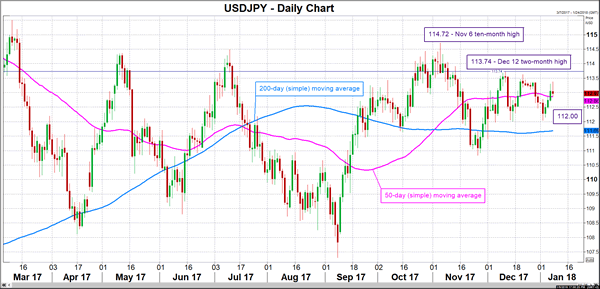
The dollar ended last week with a three-day advance versus the Japanese currency, its longest streak since the end of November. Should Fed-talk continue to be on the hawkish side, the pair is expected to head higher, especially if one takes into account that the Bank of Japan seems in no hurry to begin normalizing policy, even in light of stronger growth in the world's third largest economy. In such an event, a barrier to the upside is expected around December's 12's two-month high of 113.75. A successful break above it would shift focus to early November's ten-month high of 114.72, with the area around this level encapsulating a few other peaks from the relatively recent past.
On the downside and should the greenback fail to find support from comments by Fed officials, the range around the current level of the 50-day moving average at 112.86 might act as support. Price action is at the moment taking place close to this point, with a breach turning attention to the 112.00 handle, a potential psychological level and an area of congestion in recent weeks.
In a week packed with speeches by FOMC members, Minneapolis Fed President Neel Kashari is scheduled to participate in a Q&A session on Tuesday at 1500 GMT. Him and Chicago Fed President Charles Evans, with the latter participating in a discussion on current economic conditions and monetary policy on Wednesday at 1400 GMT, were the two FOMC members voting against an interest rate increase during the Fed's latest meeting in December. They're both thought of as chief doves by markets and they will importantly be losing their voting rights in 2018, a factor that renders some to speculate on a more hawkish-than-currently-priced-in direction by the Fed.
Other Fed speakers making talks this week are Dallas Fed President Robert Kaplan (centrist-viewed and non-FOMC voting member in 2018), St. Louis Fed President James Bullard (viewed as a dove and holding voting rights in 2019) and New York Fed President William Dudley (centrist-perceived with the New York Fed holding permanent voting rights within the FOMC). A few months ago, Dudley announced that he will be stepping down before his 10-year term at the NY Fed expires in January 2019. Speculation on who will replace him is well underway.
Beyond Fed officials, other catalysts could drive the US currency this week: perhaps most important in terms of releases are Friday's inflation and retail sales figures for the month of December, both due at 1330 GMT. Other data also have the capacity to drive positioning on the dollar, including tomorrow's JOLTS job openings report for the month of November to be made public at 1500 GMT.
Sunset Market Commentary
Markets
Global core bonds corrected higher today. The US Note futures tested the 123-12+ contract low early in the session, but a break didn't occur and attracted technically-inspired buying. A strong European equity market opening weighted as well in the early stages of dealings, but stocks couldn't build on that opening momentum. EMU EC confidence data went through the roof, but activity data aren't on investors' minds in this stage of the cycle. The US eco calendar is empty apart from Fed speeches. We particularly eye Atlanta Fed Bostic's view on the economy. Bostic votes on policy this year and today's speech is his first huge public address since being appointed mid last year. Any deviating view from the Fed's median forecast (3 rate hikes this year) has market moving potential. The US yield curve bull flattens at the time of writing with yields 0.4 bps (2-yr) to 1.8 bps (30-yr) lower. German yields drop between 1.3 bps (2-yr) and 2.2 bps (10-yr). On intra-EMU bond markets, 10-yr yield spread changes versus Germany narrow up to 4 bps (Portugal).
The dollar showed a mixed picture today. It gained ground against the euro but struggled against the yen. EMU eco data were strong. EC economic confidence hit the highest level since the autumn of 2000, but it didn't help the euro. German bunds even outperformed US Treasuries, slightly widening the EUR-USD interest rate differential. In combination with the rejected test of EUR/USD 1.2092 after Friday's payrolls, it was enough to trigger some further repositioning out of EUR/USD longs. The pair dropped below the 1.20 mark. USD/JPY initially tried to start a new up-leg, but the move lacked strong momentum. EUR/JPY profit taking after last week's rally and an easing of the equity rally weighed on USD/JPY later in the session. The pair struggles not to drop below the 113 mark.
Sterling trading was still dominated by technical considerations today. EUR/GBP drifted further sought in the 0.88 big figure, mirroring the decline of EUR/USD. The start of PM May's government reshuffle was slightly positive for sterling. EUR/GBP trades in the 0.8840 area. USD strength dominated the intraday price pattern of cable. The pair trades in the 1.3550 area.
European equities initially extended the positive momentum from Asia and from the US on Friday, opening with gains of up to 0.5%. However, there was no follow-through price action. The equity rally gradually ran into resistance. US equity futures indicated most losses. The major US indices opened with losses of about 0.1%/0.2%.
News Headlines
The economic confidence from the European Commission rose further in December to 116.0 from 114.6 in November, confirming a buoyant activity in EMU economy. The indicator touched the highest level since the autumn of 2000. The improvement was visible across all sectors including manufacturing, services, retail and construction. The Euro-zone business climate indicator showed a similar picture rising from 1.49 to 1.66.
November EMU retails sales printed at a strong 1.5% M/M and 2.8% Y/Y in November. The figure to some extent counterbalanced an unexpectedly large decline in October. Even so, the outcome was stronger than expected.
Romania's central bank delivered its first benchmark interest rate hike in a decade today, raising it by a quarter point to 2%, with inflation already above its 2017 forecast. A majority of analysts expected the bank to keep its policy rate unchanged.
AUDUSD Pauses its Bullish Rally; Momentum Indicators Signal Bearish Retracement
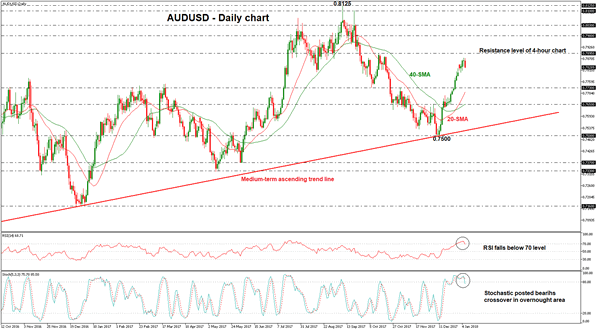
AUDUSD edged sharply higher in the near-term timeframe following the rebound on the 0.7500 significant support level that started on December 12, 2017. The price hit the ascending trend line on the medium-term chart, which has been holding since January 2016 before the upside movement.
However, given that the latest run appears overstretched and having a look at the momentum indicators in the daily chart, a correction setback may take place before buyers decide to push further. The Relative Strength Index (RSI) is pointing south in the overbought zone, which is a signal of a downward retracement, whilst the Stochastic oscillator recorded a bearish crossover with its moving averages as the %K line has moved below the slow %D line and both lines are heading lower.
The price started the day with sharp bearish move and if the bears take control, then the expectation is a pressure to the downside until the 0.7730 support level, which is near the 20-day simple moving average at 0.7710.
On the flip side, if traders manage to overcome the 0.7895 strong resistance level, this could strengthen the upside momentum and push the price perhaps towards the next obstacle of 0.8830. However, going in the 4-hour chart, there is a resistance before 0.8830 at 0.7980 where the price could pause its ascent there.
Turning our attention in the medium-term timeframe, AUDUSD printed the fourth bullish week in a row and surged 4.7%, endorsing the scenario for further gains during the next weeks.
CAC Rally Continues as Eurozone Indicators Beat Estimates
The CAC index has posted gains in the Monday session. Currently, the index is at 5487.50, up 0.31%. On the release front, there are no French events on the schedule. In the Eurozone, the week started on a positive note. Sentix Investor Confidence improved to 32.9, above the estimate of 31.5 points. Retail Sales rebounded with a strong gain of 1.5%, beating the estimate of 1.4%.
Global stock markets have started the New Year with gains. CAC has jumped onto the bandwagon, posted strong gains of 2.9% last week, and has posted three consecutive weekly wins. Investors are giving the eurozone economy a thumbs-up, a the bloc is on track for a solid fourth quarter, as growth continues and unemployment falls. Inflation has also moved higher, although the ECB is unlikely to reconsider its current stimulus program, which ends in September.
The German economy continues to look strong, despite a soft Factory Orders report for December. Retail Sales soared 2.3%, its fastest pace since October 2016. Services and Manufacturing PMIs improved and continue to point to strong expansion. The labor market remains robust, as unemployment rolls dropped sharply. However, the political landscape in the eurozone's largest economy remains cloudy. President Angela Merkel is now looking at the Social Democrats to help her make a new government, and preliminary talks are scheduled to begin on Sunday. The negotiations are likely to be lengthy, and the current caretaker government could remain in office for several more months.
GBPUSD Intraday Bearish 1.3550 Level
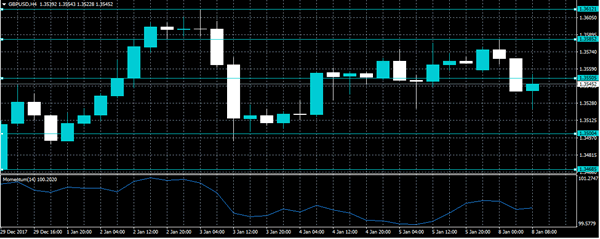
The British pound has started to trade below the key 1.3550 level against the U.S dollar, as the greenback starts to regain upside traction across the board. The GBPUSD pair earlier failed to make a new daily-high above the yearly trading high, found at 1.3613, encouraging traders to turn their attention towards the downside. Price-action currently sits around the 1.3540 level, after an earlier battle between buyers and sellers around the pivotal 1.3550 level. Headed into the U.S session, the directional bias of the U.S dollar index will likely dictate the pairs intraday price movements.
The GBPUSD pair is intraday bearish below the 1.3500 level, key downside targets remain 1.3500 and 1.3467.
Should price-action on the GBPUSD pair trade above the 1.3550 level, attention may shift back toward the 1.3567 and 1.3613 resistance levels.
EURUSD Further Beraish Below 1.1989 Level
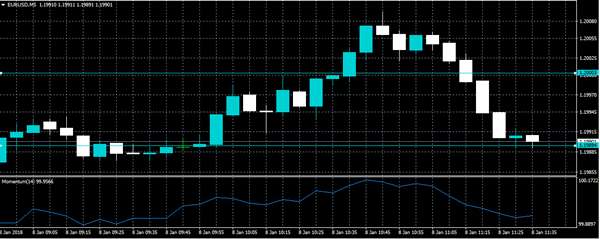
The EURUSD pair has moved below the key 1.2000 level during the European trading session, as the U.S dollar index recovers towards the 92.30 mark. The euro has so far fallen towards the 1.1980 level, with only a tepid recovery as sellers retain control of the pair on Monday. Going forward, the 1.1989 level remains the key daily pivot point with losses towards 1.1958 expected if price-action holds below this key level. Moving into the U.S session, with a lack of macro-economic data, traders will likely focus on the greenbacks recent upside recovery.
The EURUSD pair is further bearish while trading below the 1.1989 level, further downside towards 1.1958 and 1.1910 seems possible.
Should the EURUSD pair start to move above the 1.2000 level, buyers may try to move price-action back towards the 1.2030 and 1.2050 resistance areas.
DAX Moves Higher on Solid Eurozone Reports
The DAX has started the week with slight gains. Currently, the index is at 13,357.00, up 0.27% on the day. On the release front, German Factory Orders disappointed, with a decline of 0.4%. This was well short of the estimate of a 0.1% gain. In the Eurozone, Sentix Investor Confidence improved to 32.9, above the estimate of 31.5 points. Retail Sales rebounded with a strong gain of 1.5%, beating the estimate of 1.4%. On Tuesday, Germany releases Industrial Production and Trade Balance.
World stock markets have been pointing upwards early in the New Year, and the DAX has also looked sharp. The index climbed 3.3% last week, as German and eurozone data continues to please investors. Led by a robust German economy, the eurozone is on track for a strong fourth quarter, as the economy continues to expand and unemployment falls. Inflation has also moved higher, although the ECB is unlikely to reconsider its current stimulus program, which ends in September.
The German economy continues to look strong, despite a soft Factory Orders report for December. Retail Sales soared 2.3%, its fastest pace since October 2016. Services and Manufacturing PMIs improved and continue to point to strong expansion. The labor market remains robust, as unemployment rolls dropped sharply. However, the political landscape in the eurozone's largest economy remains cloudy. President Angela Merkel is now looking at the Social Democrats to help her make a new government, and preliminary talks are scheduled to begin on Sunday. The negotiations are likely to be lengthy, and the current caretaker government could remain in office for several more months.
Sizzling Job Numbers Sends Loonie to 14-Week High
The Canadian dollar has paused in the Monday session, after posting strong gains on Friday. Currently, the pair is trading at 1.2408, down 0.06% on the day. On the release front, the Bank of Canada releases its quarterly Business Outlook Survey. There are no major releases out of the US. On Tuesday, Canada releases Housing Starts and the US publishes JOLTS Jobs Openings.
Canada's labor market continues to look red-hot, posting superb December numbers on Friday. The economy added 78.6 thousand jobs, crushing the estimate of 1.8 thousand. In November, the economy added 79.5 thousand. The unemployment rate dropped to 5.7%, down from 5.9% a month earlier. The strong numbers sent the Canadian dollar stronger on Friday. The currency gained 1.4% last week, which marked a third winning week for the rejuvenated Canadian dollar.
The Canadian dollar climbed 2.5% in December, and continues to move higher early in the New Year. Much of the loonie's climb can be attributed to the rise in oil, which has jumped 6.8% since mid-December. Geopolitical tensions have boosted oil prices, in particular tensions with North Korea and the recent civil unrest in Iran. There is pressure on the Bank of Canada to raise its benchmark rate of 1.0%, which is lagging behind the Federal Reserve rate of between 1.25-1.50%. With the Fed widely expected raise rates in January, the Canadian dollar could lose ground if the BoC fails to respond with a rate hike of its own on January 17. However, the BoC may hold back, as it concerns continue over US threats to dismantle the free trade agreement.
EURJPY: Follows Through Lower, Eyes 134.79 Zone
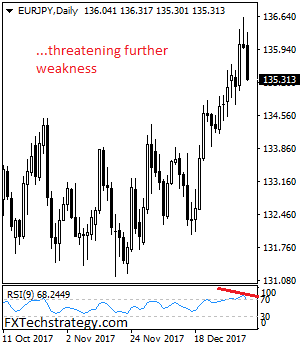
EURJPY: With the pair following through lower to decline further on Monday, more weakness is envisaged towards its key support located at 134.79. On the downside, support comes in at the 134.50 level where a break if seen will aim at the 134.00 level. A cut through here will turn focus to the 133.50 level and possibly lower towards the 133.00 level. On the upside, resistance resides at the 136.00 level. Further out, we envisage a possible move towards the 136.50 level. Further out, resistance resides at the 137.00 level with a turn above here aiming at the 137.50 level. On the whole, EURJPY faces further price weakness.
USD/JPY Mid-Day Outlook
Daily Pivots: (S1) 112.73; (P) 113.02; (R1) 113.32; More...
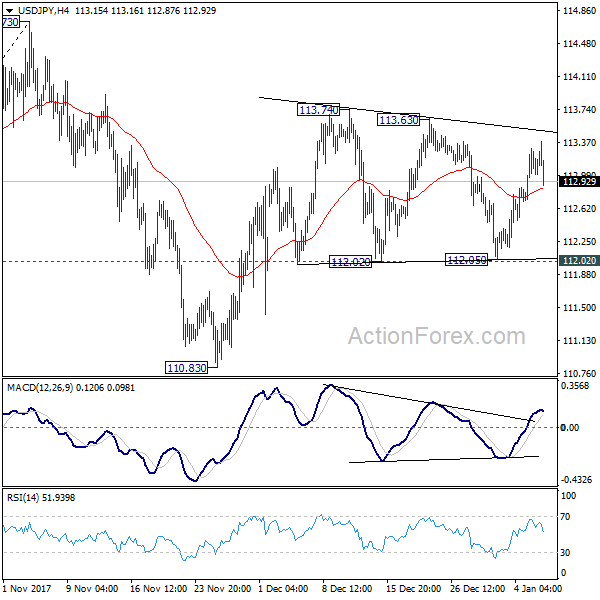
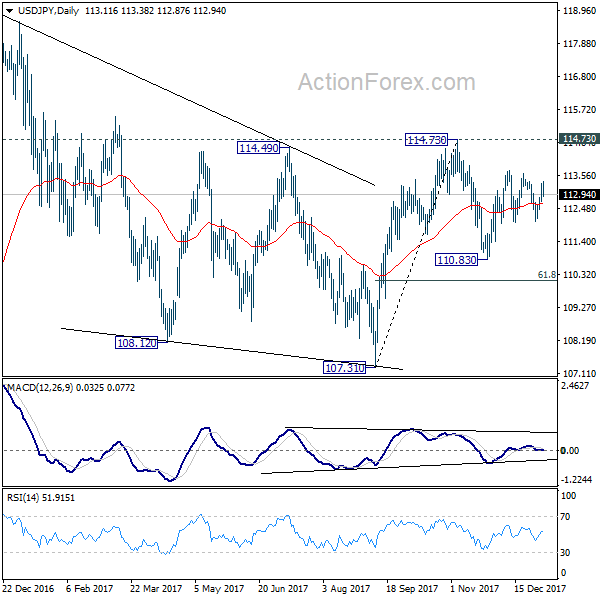
Intraday bias in USD/JPY remains neutral at this point. Outlook remains cautiously bullish as long as 112.02 holds and further rise is in favor. Break of 113.74 will resume the rebound from 110.83 and target 114.73 key resistance. Decisive break there will carry larger bullish implications. However, break of 112.02 will likely extend the corrective pattern from 114.73 with another leg through 110.83 support.
In the bigger picture, we're holding on to the view that correction from 118.65 is completed at 107.31. And medium term rise from 98.97 (2016 low) is going to resume soon. Sustained break of 114.73 should affirm our view and send USD/JPY through 118.65. However, break of 107.31 will dampen this view and extend the medium term fall back to 98.97 low.