Sample Category Title
U.S. Economy Creates 148K Jobs in December and 2.2 Million in 2017 as a Whole
U.S. payrolls rose by 148k in December, disappointing survey expectations for 190k. Private-sector hiring expanded by 146k, below the consensus for 193k. Government payrolls edged up by 2k.
Goods-producing employment rose strongly in December, up 55k and led by a 30k gain in construction employment. Manufacturing employment also did well, rising by 25k. Services employment, on the other hand, decelerated to 91k from 176k in November.
Revisions were relatively minor, subtracting 9k from payrolls in November and October on net. However, the pattern of growth was reversed with November revised up (to 252k from 228k) and October revised down (to 211k from 244k).
The unemployment rate was unchanged at 4.1% in November. Household survey employment rose 104k, while the labor force expanded by 64k.
Average hourly earnings were up a relatively strong 0.3% in December and accelerated to 2.5% year-over-year (from a downwardly revised 2.4% in November).
For 2017 as a whole, the U.S. economy created just under 2.2 million jobs (December to December) slightly above its 2016 performance of 2.1 million. The unemployment rate fell 0.6 percentage points (from 4.7% last December), double the pace of decline in 2016.
Key Implications
The headline may have disappointed, but 148k jobs is a respectable rate of job growth for an economy at this stage of the cycle. As the labor market approaches full employment, analysts will have to adjust down the rate of job growth the economy can achieve. Maintaining a pace of 150k jobs a month would still be sufficient to put downward pressure on the unemployment rate.
Indeed, the challenge in 2018 will be how to continue to add jobs when there are fewer people looking for them. The low unemployment rate should mean faster wage growth as employers offer higher compensation in order to attract and retain talent. They will have more room to do so with the cut in the corporate tax rate.
Still, the rise in pay for those joining and staying in the labor force may not be immediately apparent in aggregate wage data, offset in part by slower wage growth among older worker and the replacement of retiring workers at the top of the pay scale with those joining at lower entry level wages. Ultimately, this may keep the focus on the underlying consumer inflation rate. Should it remain stubborn, the Fed is likely to continue to let the labor market run hot.
U.S Job Growth Slows While Canada Job Numbers Explode
US Job Growth Slows in December
- The U.S economy added +148k in December, almost all of them in the private sector (Previous +239k vs. +193k e).
- The U.S service sector deeply hit.
- Well below the 2017 monthly average of +171k jobs added but is enough to keep up with population growth and chip away at unemployment.
- The labor-force participation didn't budge in 2017 despite the +2m jobs added. Participation rate stands at +62.7% in December.
- The average hourly paycheck for private sector workers grew +2.5% in 2017. That suggests the labor market still has some slack despite the low unemployment.
- Hourly wages grew +9c , or +0.34%, in December from a month earlier.
- U.S yield curve 2/10 see a 'bull' flatter being priced in at +49 bps
Market reaction sell the USD (€1.2059, £1.3564, ¥113.34) and buy U.S treasuries.
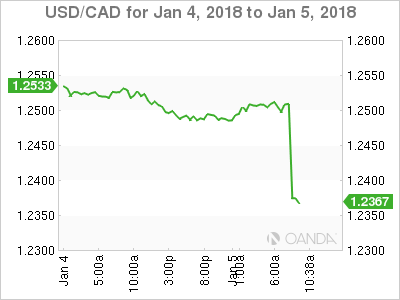
Canadian Job Numbers explode
This morning's strong data would likely increasing pressure on the Bank of Canada (BoC) to hike interest rates much sooner than the market has being calculating. Odd's for a Jan hike next week are currently trading at +50%.
The CAD is up +0.88% at C$1.2369
EUR/USD Mid-Day Outlook
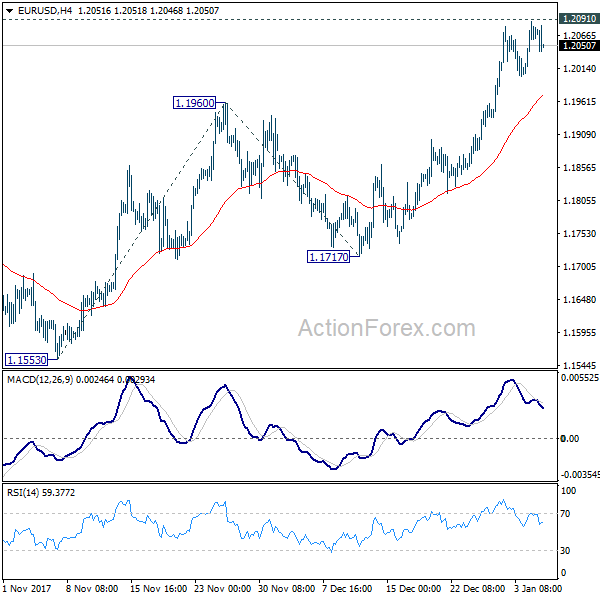
Daily Pivots: (S1) 1.2018; (P) 1.2053 (R1) 1.2102; More....
Intraday bias in EUR/USD remains neutral at this point. Further rise is expected as long as 4 hour 55 EMA (now at 1.1969) holds. Firm break of 1.2091 will confirm medium term rally resumption and target next key fibonacci level at 1.2494/2516. However, sustained break of 4 hour 55 EMA will extend the consolidation pattern from 1.2091 with with another decline through 1.1717 support.
In the bigger picture, rise from 1.0339 medium term bottom is seen as a corrective move for the moment. Therefore, in case of another rally, we'd be expect 38.2% retracement of 1.6039 (2008 high) to 1.0339 (2017 low) at 1.2516 to limit upside and bring reversal. That is also close to 61.8% projection of 1.0569 to 1.2091 from 1.1553 at 1.2494.

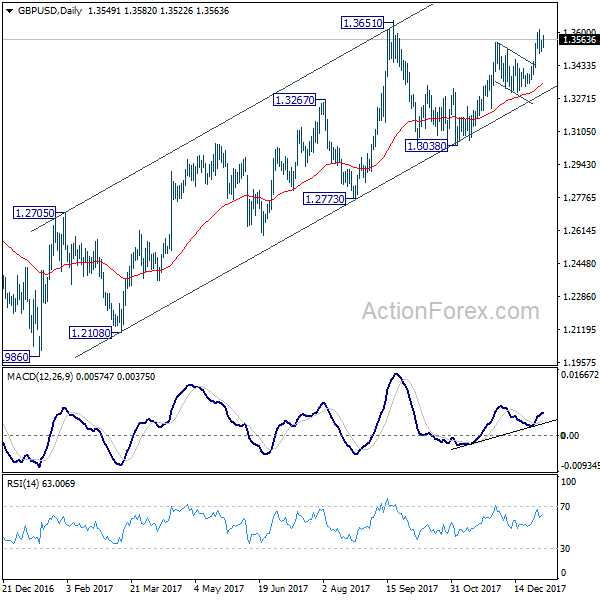
GBP/USD Mid-Day Outlook
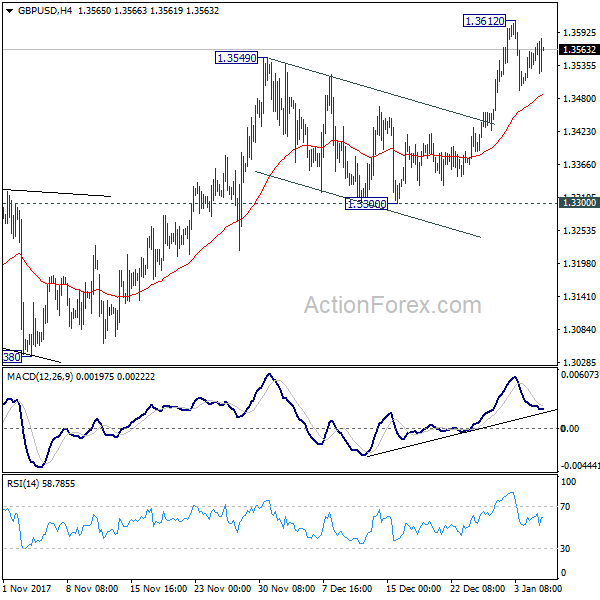
Daily Pivots: (S1) 1.3518; (P) 1.3538; (R1) 1.3572; More.....
Intraday bias in GBP/USD remains neutral for consolidation below 1.3612 temporary top. As long as 4 hour 55 EMA (now at 1.3488) holds, further rally is expected. Above 1.3612 will target 1.3651 key resistance first. Break will resume medium term rise from 1.1946 and target key resistance level at 1.3835. However, sustained break of 4 hour 55 EMA will turn focus back to 1.3300 support.
In the bigger picture, while the medium term rebound from 1.1946 low was strong, it's limited below 1.3835 key support turned resistance. As long as 1.3835 holds, we'd view such rebound as a correction. That is, we'd expect another leg in the long term down trend through 1.1946 low. However, sustained break of 1.3835 should at least send GBP/USD to 38.2% retracement of 2.1161 (2007 high) to 1.1946 (2016 low) at 1.5466.
USD/CHF Mid-Day Outlook
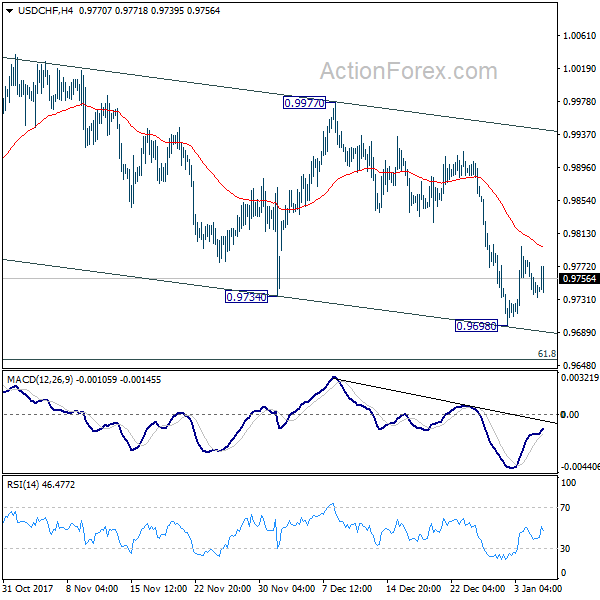
Daily Pivots: (S1) 0.9729; (P) 0.9755; (R1) 0.9772; More....
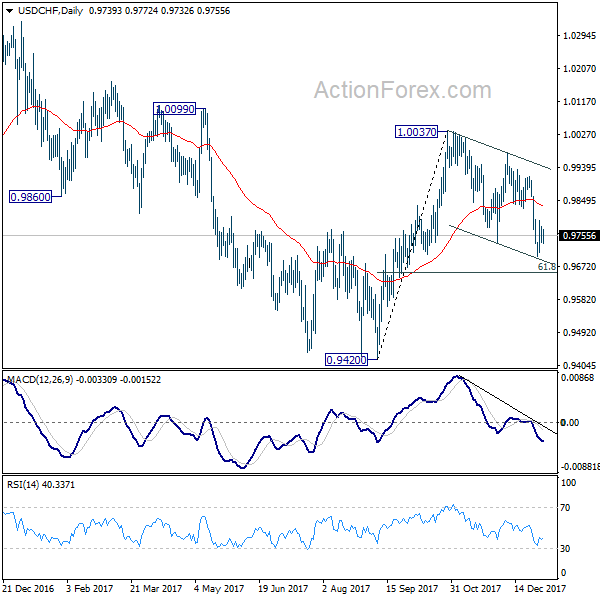
USD/CHF is staying in corrective trading above 0.9698 temporary low and intraday bias remains neutral. As long as 4 hour 55 EMA (now at 0.9795) holds, deeper fall is mildly in favor. But we'd expect 61.8% retracement of 0.9420 to 0.1.0037 at 0.9656 to contain downside and bring rebound. Sustained break of 4 hour 55 EMA will argue that the correction from 1.0037 has completed and turn focus to 0.9977 resistance for confirmation.
In the bigger picture, range trading continues between 0.9420/1.0342. At this point, 0.9420 appears to be a strong support level. Therefore, in case of decline attempt, we don't expect a firm break of this level. Nonetheless, strong break of 1.0342 is also needed to confirm upside momentum. Otherwise, medium term outlook will stay neutral.
USD/JPY Mid-Day Outlook
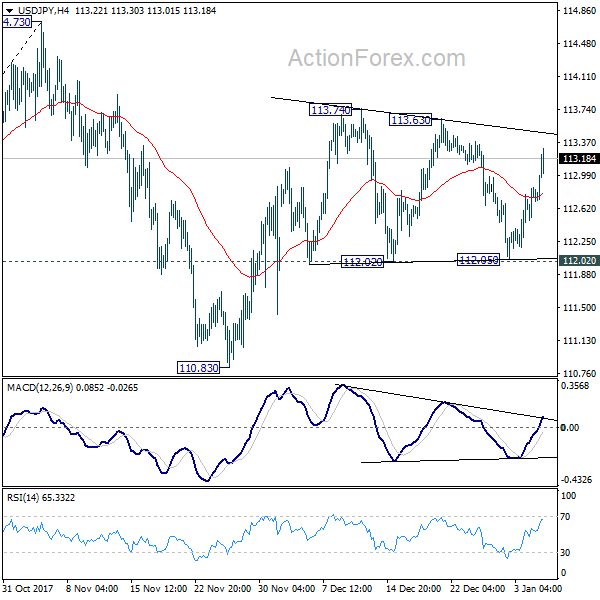
Daily Pivots: (S1) 112.51; (P) 112.68; (R1) 112.92; More...
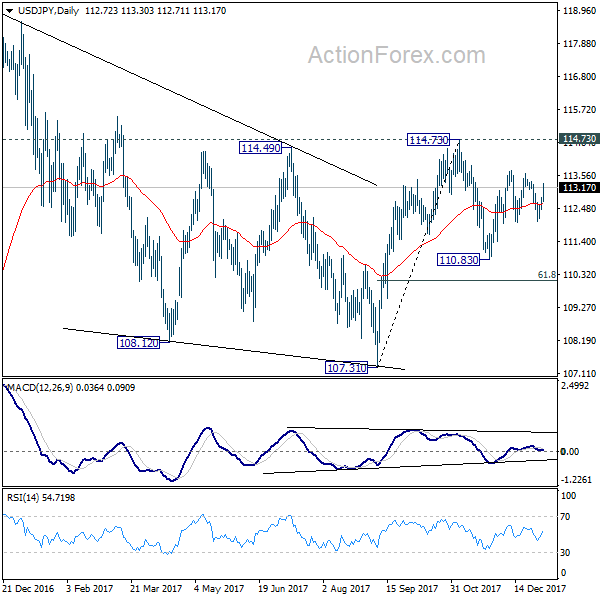
Despite the strong rebound from 112.05, USD/JPY is staying in range of 112.02/113.74 and intraday bias remains neutral first. Near term outlook stays bullish as long as 112.02 support holds and further rise is expected. Break of 113.74 will resume the rebound from 110.83 and target 114.73 key resistance. Decisive break there will carry larger bullish implications. However, break of 112.02 will likely extend the corrective pattern from 114.73 with another leg through 110.83 support.
In the bigger picture, we're holding on to the view that correction from 118.65 is completed at 107.31. And medium term rise from 98.97 (2016 low) is going to resume soon. Sustained break of 114.73 should affirm our view and send USD/JPY through 118.65. However, break of 107.31 will dampen this view and extend the medium term fall back to 98.97 low.
USD/CAD Mid-Day Outlook
Daily Pivots: (S1) 1.2462; (P) 1.2508; (R1) 1.2534; More....
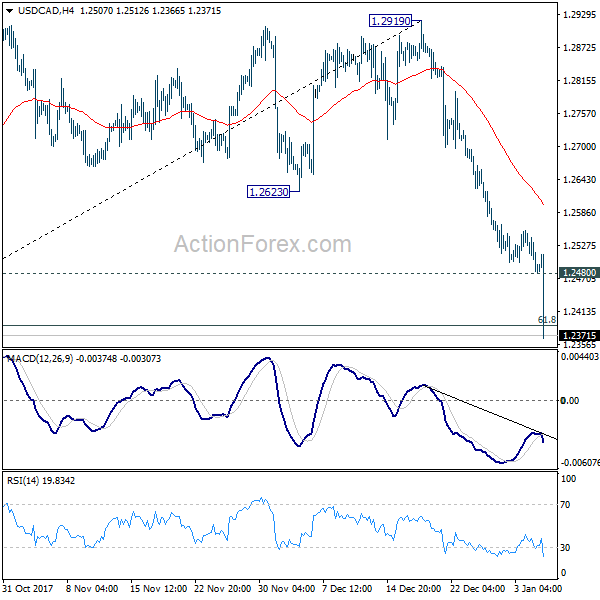
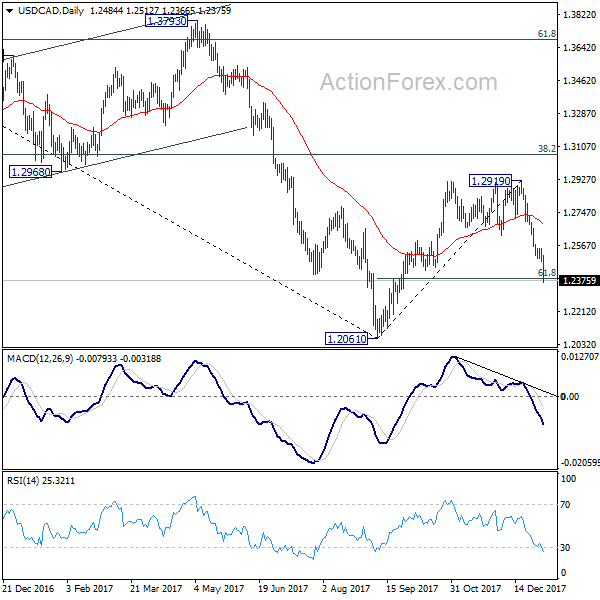
Dollar's fall accelerates to as low as 1.2366 so far and breaks 61.8% retracement of 1.2061 to 1.2919 at 1.2389. Based on current momentum, it's getting more likely that fall from 1.2919 is resuming larger down trend. Intraday bias stays on the downside as long as 1.2480 minor resistance holds. Sustained trading below 1.2389 will pave the way to 1.2061 low. On the upside, above 1.2480 will turn intraday bias neutral first.
In the bigger picture, current near term downside acceleration argues that USD/CAD was rejected by 55 week EMA (now at 1.2850. And the rebound from 1.2061 is possibly completed at 1.2919. More importantly, larger fall from 1.4689 (2016 high) could be resuming. Decisive break of 1.2061 low will target 61.8% retracement of 0.9406 to 1.4689 at 1.1424. Nonetheless, break of 1.2623 will revive the original case of bullish reversal and would resume the rebound from 1.2061 to 38.2% retracement of 1.4689 to 1.2061 at 1.3065.
Canadian Dollar Surges on Another Stellar Job Report, Dollar Struggles after Mixed NFP
Canadian dollar soars in early US session after another month of stellar job data. The employment market grew and impressive 78.6k in December, just slightly smaller than prior month's 79.5k. It's also well above expectation of 0k growth. Unemployment ate, dropped to 5.7%, down from 5.9% and was way below expectation of 6.0%. That's also the lowest level in more than four decades, since the series began in 1976. The strength in job market is sealing the deal for BoC to hike again in Q1. And there could be more speculations for a January hike ahead. USD/CAD dives through 1.2380 handle, comparing to 1.2500 just an hour ago. Also from Canada, trade deficit came in larger than expected at CAD -2.5b in November.
Dollar, on the other hand, is trading a touch softer after mixed job data. Non-farm payrolls report showed 148k job growth in December, well below expectation of 189k. But prior month's figure was revised up from 228k to 252k. Unemployment rate was unchanged at 4.1% as expected. The positive part is that average hourly earnings grew 0.3% mom, meeting expectation. While the set of NFP data still indicates very healthy job market in the US, it's not doing much to solidify three Fed hikes this year. Also from US, trade deficit widened to USD -50.5b in November.
Technically, EUR/USD is still holding below 1.2091 resistance. USD/CHF is kept well above 0.9698 temporary low. USD/JPY is in range of 112.02/112.05. With the exception of USD/CAD, there is no clear sign of post-data direction in other Dollar pairs.
Released earlier today, Eurozone CPI slowed to 1.4% yoy in December, in line with consensus. But core CPI was unchanged at 0.9% yoy, missing expectation of 1.0% yoy. PPI jumped to 2.8% yoy in November, though. Eurozone retail PMI rose to 53 in December. German retail sales was strong and grew 2.3% mom in November. From Australia, trade balance unexpectedly turn into AUD -0.63b deficit in November, much worse than expectation of AUD 0.55b surplus. Japan monetary base rose 11.2% yoy in December. UK BRC shop price index dropped -0.6% yoy in December.
USD/CAD Mid-Day Outlook
Daily Pivots: (S1) 1.2462; (P) 1.2508; (R1) 1.2534; More....
Dollar's fall accelerates to as low as 1.2366 so far and breaks 61.8% retracement of 1.2061 to 1.2919 at 1.2389. Based on current momentum, it's getting more likely that fall from 1.2919 is resuming larger down trend. Intraday bias stays on the downside as long as 1.2480 minor resistance holds. Sustained trading below 1.2389 will pave the way to 1.2061 low. On the upside, above 1.2480 will turn intraday bias neutral first.
In the bigger picture, current near term downside acceleration argues that USD/CAD was rejected by 55 week EMA (now at 1.2850. And the rebound from 1.2061 is possibly completed at 1.2919. More importantly, larger fall from 1.4689 (2016 high) could be resuming. Decisive break of 1.2061 low will target 61.8% retracement of 0.9406 to 1.4689 at 1.1424. Nonetheless, break of 1.2623 will revive the original case of bullish reversal and would resume the rebound from 1.2061 to 38.2% retracement of 1.4689 to 1.2061 at 1.3065.
Economic Indicators Update
| GMT | Ccy | Events | Actual | Forecast | Previous | Revised |
|---|---|---|---|---|---|---|
| 23:50 | JPY | Monetary Base Y/Y Dec | 11.20% | 13.20% | ||
| 00:01 | GBP | BRC Shop Price Index Y/Y Dec | -0.60% | -0.10% | ||
| 00:30 | AUD | Trade Balance (AUD) Nov | -0.63B | 0.55B | 0.11B | -0.30B |
| 07:00 | EUR | German Retail Sales M/M Nov | 2.30% | 1.00% | -1.20% | |
| 09:10 | EUR | Eurozone Retail PMI Dec | 53 | 52.4 | ||
| 10:00 | EUR | Eurozone PPI M/M Nov | 0.60% | 0.30% | 0.40% | |
| 10:00 | EUR | Eurozone PPI Y/Y Nov | 2.80% | 2.50% | 2.50% | |
| 10:00 | EUR | Eurozone CPI Core Y/Y Dec A | 0.90% | 1.00% | 0.90% | |
| 10:00 | EUR | Eurozone CPI Estimate Y/Y Dec | 1.40% | 1.40% | 1.50% | |
| 13:30 | CAD | International Merchandise Trade (CAD) Nov | -2.5B | -1.3B | -1.5B | -1.6B |
| 13:30 | CAD | Net Change in Employment Dec | 78.6K | 0.0K | 79.5K | |
| 13:30 | CAD | Unemployment Rate Dec | 5.70% | 6.00% | 5.90% | |
| 13:30 | USD | Change in Non-farm Payrolls Dec | 148K | 189K | 228K | 252K |
| 13:30 | USD | Unemployment Rate Dec | 4.10% | 4.10% | 4.10% | |
| 13:30 | USD | Average Hourly Earnings M/M Dec | 0.30% | 0.30% | 0.20% | |
| 13:30 | USD | Trade Balance Nov | -50.5B | -48.1B | -48.7B | -48.9B |
| 15:00 | CAD | Ivey PMI Dec | 62.2 | 63 | ||
| 15:00 | USD | ISM Non-Manufacturing/Services Composite Dec | 57.6 | 57.4 | ||
| 15:00 | USD | Factory Orders Nov | 1.40% | -0.10% |
Global Equity Bulls Unstoppable, NFP in Focus
Another day, another record high for world stocks, as a growing sense of optimism over the global economy boosts risk sentiment.
Asian shares ventured higher during early trading on Friday, while European markets opened on a positive note amid the risk-on environment. With the Dow Jones Industrial Average surpassing 25,000 for the first time ever on Thursday, U.S equity bulls are clearly back in town and as such, we could see further gains on Wall Street this afternoon.
Dollar steady ahead of NFP
It is interesting how the Dollar remained stuck near a four-month low during early trading on Friday, despite the stronger than expected data in the US boosting expectations of a Fed rate hike in March.
The U.S ADP employment report smashed market expectations, as U.S private employers added 250,000 jobs in December, an encouraging sign from the U.S labour markets. The fact that the Dollar still depreciated following the economic release suggests that investors may be diverting their attention elsewhere, namely the upcoming U.S tax reforms. One of the biggest risks the Dollar could face this year, is the impact of Trump's sweeping tax overhaul falling below market expectations.
Today's main event risk for the Dollar will be the non-farm payroll report, which should offer fresh insight into the health of the U.S. job market. With the ADP results steamrolling over market expectations, investors will be paying attention to see if NFP headline figures produce a similarly positive pattern. Although Dollar bulls have entered the year simply missing in action, today's NFP report could provide a welcome boost. A solid headline NFP figure, coupled with signs of rising wage growth, may offer an opportunity for Dollar bulls to make a late Friday appearance. Alternatively, a disappointing U.S jobs report would likely result in further downside.
Taking a look at the technical picture, the Dollar Index remains bearish on the daily charts, with sustained weakness below 91.80 opening a path towards 91.55. For bulls to have any chance of charging back into the game, prices needed to break above 92.33 and 92.65, respectively.
Commodity spotlight - Gold
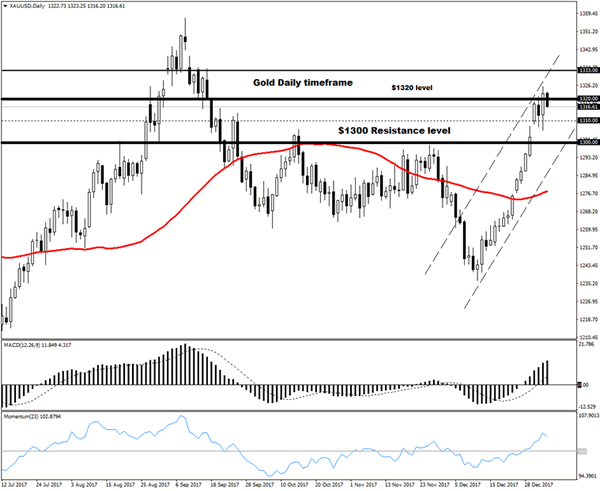
Gold edged lower trading on Friday, ahead of the anticipated U.S non-farm payroll data release, but remained on track for a fourth consecutive week of gains.
This has been a positive trading week for Gold, with a vulnerable U.S Dollar and geopolitical tensions in Iran likely factors behind the metal's appreciation. Gold bulls could be instilled with fresh inspiration to elevate prices higher, if the NFP report disappoints this afternoon. On the other hand, a solid report could spell further declines in the short term, with $1310 acting as a level of interest. Taking a look at the technical picture, Gold remains bullish on the daily charts above $1300. Bulls need to conquer $1320 for the metal to witness further upside towards $1333.
Dollar Stronger ahead of NFP Report; European Stocks Drift Higher
Here are the latest developments in global markets:
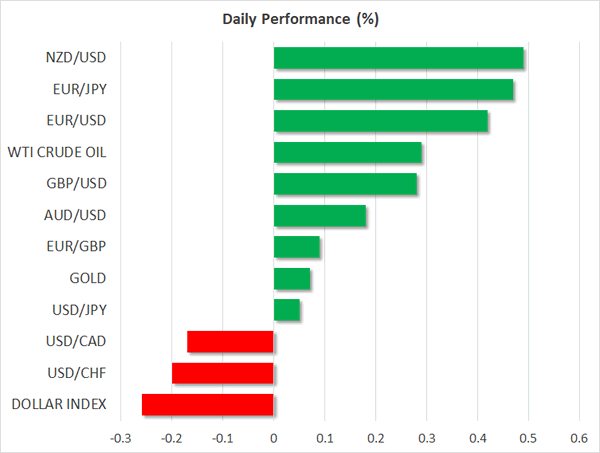
FOREX: December's preliminary inflation figures out of the Eurozone offered little to the euro as the price measures came in line with expectations on a yearly basis and slightly weaker relative to the month before. However, the region's producer prices surprised to the upside, providing some support to the common currency, which consolidated near four-week highs versus the greenback. Euro/dollar parked at 1.2048 (-0.16%), while euro/yen climbed to a two-year high of 136.51 (+0.30%). Pound/dollar reversed gains from earlier in the day, retreating to 1.3540, with investors looking forward to fresh Brexit news before taking positions. The dollar index broke above the 92 key-level (+0.20%) ahead of the all-important NFP report, while against the yen it stretched towards 113.25 (+0.44%) amid risk-on sentiment. Dollar/loonie inched up to 1.2510.
STOCKS: European stocks climbed higher on Friday, with eurozone shares being on track to post the best weekly performance since May as recent economic data strengthened investors optimism on the region's economic outlook. The pan-European STOXX 600 and the blue-chip Euro STOXX 50 were up by 0.56% and 0.61% on the day respectively at 1015 GMT with healthcare and consumer cyclicals leading the gains. The Swiss SMI jumped to an all-time high (+0.41%), while the British FTSE 100 posted another record high (+0.28%). The German DAX 30 extended its uptrend for the third day, surging by 1.0% on the back of rising auto and healthcare stocks. Futures on the main US indices were pointing to a positive open.
COMMODITIES: Oil prices slipped even further during the European session as traders doubted whether the market will retain its bullish run given the threat from higher US production. WTI crude was trading 0.90% lower at $61.46 per barrel and Brent declined by 0.80% to $67.52. In other energy news, Saudi Arabia converted its giant oil company Aramco into a joint-stock company as of January 1, a key step to go through an initial public offering in 2018 in the domestic stock exchange. However, an international listing is also considered. Gold was down by 0.40% at $1,317.50 per ounce.
Day ahead: US & Canada report employment numbers
Looking ahead to the remainder of the day, the US will publish another patch of economic data that have the potential to shake the dollar.
Among the releases, the US government's monthly nonfarm payrolls report, which tracks labor stats for both the private and public sectors, will be in focus. According to analysts, the report due at 1330 GMT is expected to show a job gain of 190,000 in December compared to 228,000 seen in the previous month, whilst the unemployment rate is forecasted to remain unchanged at a 17-year low of 4.1%. However, these numbers might come second in priority as the markets are eagerly awaiting for wage growth to pick up instead and therefore push up the slow-moving inflation towards the Fed's 2.0% target. In November, average hourly earnings grew by 0.2% m/m and are anticipated to continue rising in December at the slightly faster pace of 0.3%. However, on a yearly basis wage growth is projected to stand flat at 2.5%.
Meanwhile, the Bureau of Economic analysis will give an update on trade balance figures, with the monthly trade deficit estimated to widen in November. At 1500 GMT factory orders and durable goods will come into view.
Traders will keep a close eye on the loonie as well, as Canadian labor data will be available along with the US employment report. Unlike the unemployment rate in the US, the Canadian one is anticipated to inch up by 0.1 percentage points to 6.0% in December. Regarding the number of job positions, those are anticipated to increase by 1,000, far below the previous mark of 79,500. Data on the trade balance and Ivey PMI readings will also gather some attention out of Canada.
In terms of policymakers' appearances, Philadelphia Fed President Patrick Harker will be speaking on the US economic outlook at 1515 GMT and Cleveland Fed President Loretta Mester will be participating in a panel discussion titled "Coordinating Conventional and Unconventional Monetary Policies for Macroeconomic Stability" at 1730 GMT. Bank of England chief economist Andy Haldane will be chairing panel discussions at the Allied Social Sciences Association Annual Meeting; the relevant event begins at 1930 GMT.
In oil markets, the US Baker Hughes oil rig count due at 1800 GMT will be in focus.