Sample Category Title
Summary 1/2 – 1/5
Tuesday, Jan 2, 2018
[php_everywhere] [/php_everywhere]
Wednesday, Jan 3, 2018
[php_everywhere] [/php_everywhere]
Thursday, Jan 4, 2018
[php_everywhere] [/php_everywhere]
Friday, Jan 5, 2018
[php_everywhere] [/php_everywhere].
Week Ahead – Beleaguered Dollar Eyes First US Jobs Report of 2018; December PMIs in Focus
Markets will begin to get back to normal in the first week of 2018 following the Christmas and New Year breaks. PMI surveys will dominate the economic calendar, but traders will likely be most looking forward to the US nonfarm payrolls report to inject much needed life into the lacklustre US dollar.
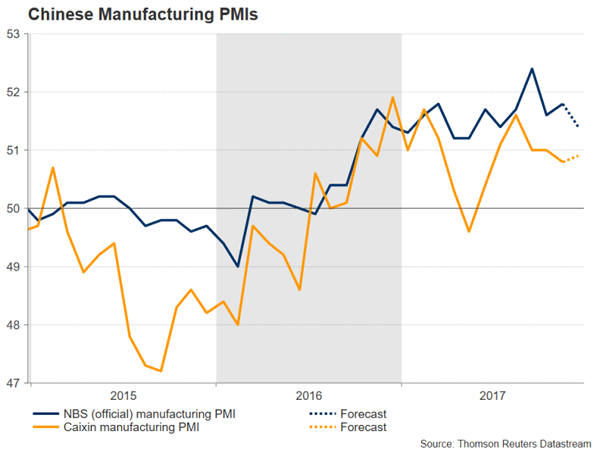
The coming week will start a little early, on Sunday, as China releases the official manufacturing and non-manufacturing PMIs. The manufacturing PMI is forecast to ease slightly to 51.4 in December. They will be followed by the private Caixin equivalents on Tuesday (manufacturing) and Thursday (services). The Caixin manufacturing PMI is expected to improve marginally by 0.1 to 50.9 in December. The indicators have been fairly steady in recent months so are unlikely to see much reaction in forex markets, although a big surprise in the figures would still have the potential to cause some volatility as volumes are expected to remain low in the first few days of the year.
The Eurozone is set to have another light calendar week, though the flash inflation release on Friday is sure to attract some attention. Annual inflation in the euro area is forecast to ease to 1.3% in December from 1.5% in November. Core inflation is also expected to moderate, from 1.1% to 1.0%. The data may provide traders with an excuse to sell the euro, which has had an incredible run in 2017 and is on track for a second consecutive week of gains after a poor start to December. However, any selloff would likely be limited as Tuesday's (manufacturing) and Thursday's (services and composite) final PMI readings for December are expected to confirm Eurozone business activity was at a near 7-year high in December.
The UK will also see the release of PMI data, which will be more important as flash readings are not published for the UK. The Markit/CIPS manufacturing PMI is due on Tuesday, followed by the construction PMI on Wednesday and the services PMI on Thursday. The manufacturing and construction PMIs are forecast to dip slightly in December, but the services PMI is expected to hold steady at 53.8. The pound regained its footing this week on the back of a weaker greenback, after sliding for much of December. Next week's data could provide cable with another leg up if they surprise on the upside.
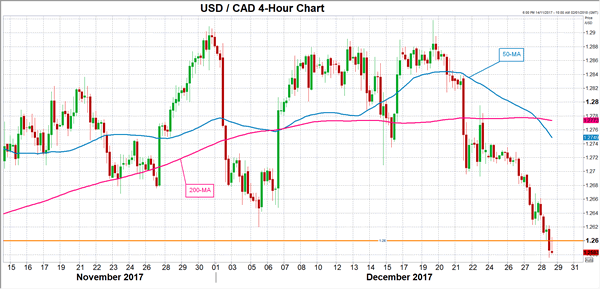
The Canadian dollar has surged to a 10-week high this week, with dollar/loonie breaching the key support area of 1.26. The loonie was boosted last week by stronger-than-expected inflation and retail sales figures. Next Friday's employment report out of Canada has the capacity to push the currency further higher as investors speculate whether the Bank of Canada could raise rates again as early as the January meeting. Employment is forecast to rise by 10k in December, below the impressive 79.5k figure of November but closer to its long-run average. Also to watch out of Canada are producer prices on Thursday and the Ivey PMI on Friday.
The US currency turned bearish in the short term during December, with many investors putting this down to "buy the rumour, sell the fact" in response to the passage of Trump's tax plan. Data due out of the United States next week may help shift sentiment to a more positive one. The first major release is Wednesday's ISM manufacturing PMI. The closely watched index is forecast to fall slightly from 58.2 to 58.1 in December. The non-manufacturing composite out on Friday is expected to be more positive as it is forecast to edge up from 57.4 to 57.6. November trade data and factory orders are also out on Friday but the focus will be the nonfarm payrolls report.
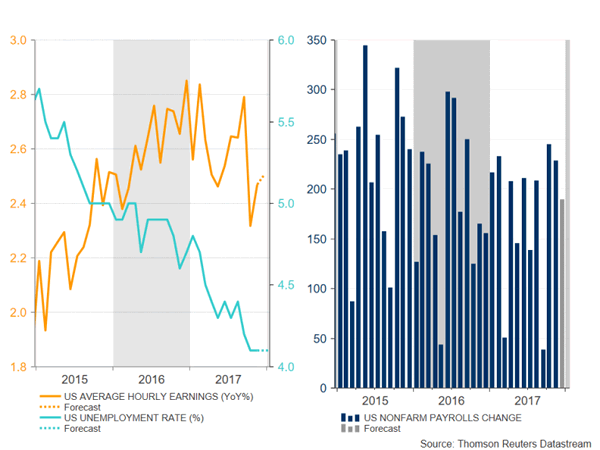
The US economy is expected to add 189k jobs in December versus 228k in the prior month. The jobless rate is forecast to remain unchanged at 4.1%, while average earnings are also likely to hold steady, at 2.5% year-on-year in December.
Dollar traders should also watch out for the FOMC minutes of the December policy meeting on Wednesday. The greenback pulled back after the December meeting as the Fed stuck its projections of three rate hikes in 2018. But any indication of a more hawkish tilt in the minutes than revealed in the statement could spur the dollar higher.
2017 – A Year Defined by Bubbles, Brawls, Brexit and Brent
This has certainly been another eventful trading year for financial markets, as investors juggled with numerous themes throughout 2017.
Market players marched into the trading year adopting a risk-on attitude, amid growing optimism over Donald Trump pushing ahead with a large fiscal spending package. The "trump effect" not only elevated global stocks to 19-month highs in January, but also sent the Dollar to its highest level in 14 years. In February, the series of pending elections in Europe, ongoing Brexit developments and heightened Trump uncertainties, made political risk a recurrent theme during the first quarter of 2017. Although during the same month Trump made promises of a "phenomenal" tax plan, the growing threat of him moving forward with the protectionist policies while overlooking the proposed fiscal stimulus, weighed heavily on investor sentiment.
It was all about Brexit fuelled anxiety and Trump jitters in March, which ultimately supported safe-haven assets such as Gold while investors fled to safety. The Federal Reserve moved forward with a "dovish hike" in the same month which punished the Dollar further. The unsavoury combination of geopolitical tensions and political risk circling the French presidential elections in Europe, weighed heavily on risk sentiment in April. Financial markets eventually received a boost near the end of the month, after Centrist Emmanuel Macron secured a position in the second round of the French presidential elections.
OPEC was in focus in May after the cartel thoroughly underwhelmed participants by renewing an agreement to cap output by 1.8 million barrels a day until March 2018. With the rapid resurgence of U.S. Shale complicating the cartel's efforts to rebalance markets, most investors were hoping for deeper production cuts to quell oversupply woes. The disappointment exposed oil prices to downside risks, with the commodity eventually tumbling into a bear market in June. The Fed was also in focus in June as it defied a string of weak inflation figures by raising U.S. interest rates for the second time in 2017.
A cautious Federal Reserve in July sent the Dollar to fresh 13 month lows against a basket of major currencies. Although the central bank signalled that it would begin shrinking its massive holding of bonds "relatively soon", the heightened concerns over inflation remaining "somewhat below 2%" in the near term, weighed on investor sentiment. In August, the vulnerable Dollar was battered further by the political drama in Washington, while global stocks were punished by geopolitical tensions across the globe.
North Korea stole the spotlight in September after testing its most powerful nuclear bomb yet. Demand for safe-haven assets received a boost amid the geopolitical risk during the trading month- with gold jumping to a yearly high at $1357.
Much focus was directed towards the Catalonia developments in October which fanned concerns about the future of the European Union. The mighty Euro came under selling pressure in October after preliminary results from the Catalonia referendum showed 90% of Catalans were in favour of independence. What really exposed the currency to heavy losses, occurred near the end of the month, after Catalonia officially declared independence from Spain. What I found interesting was how the European Central Bank moved forward with a "dovish taper" during the same month, by announcing that from January, it would taper its bond-buying to €30 billion from €60 billion per month. Bitcoin was also the talk of the town across financial markets in October, after the cryptocurrency conquered the $5000 barrier.
After over a decade, the Bank of England finally lifted interest rates by 25 basis points to 0.5%, from the 0.25% record low in November; despite this, Sterling still depreciated. With the central bank cautioning that future rate increases would be "at a gradual pace" and to "a limited extent", the markets interpreted this as a dovish hike. The mounting political uncertainty at home and Brexit risk added salt to the Pound's injuries. The cryptocurrency craze reached new heights in November, as Bitcoin concluded the month near $10000.
In December, the Federal Reserve raised U.S. interest rates for the third time this year but this was already heavily priced in. The same could be said for the muted market reaction, despite the U.S. Congress passing President Donald Trump's $1.5 trillion tax overhaul. I believe December was dedicated to market chatter around cryptocurrency, with Bitcoin aggressively appreciating to all-time highs of $19783 before sharply tumbling lower. With Bitcoin and other cryptocurrencies appreciating considerably this year, most are asking if similar gains will be exhibited in 2018. As 2017 slowly comes to an end, investors may start pondering how Trump's $1.5 trillion tax overhaul will influence the Dollar next year.
Greenback Sell-Off Sees GBPUSD Eyeing 18-Month Highs
The pound has been drifting lower against the dollar for most of December and during that time, despite finding firm support around 1.33, further losses appeared to be on the horizon.
The descending triangle that formed over the course of this month is typically a bearish signal, with a break below 1.33 being confirmation of this. On this occasion, that break never came, with the dollar sell-off over the last couple of days triggering a move above the triangle instead.
GBPUSD Daily
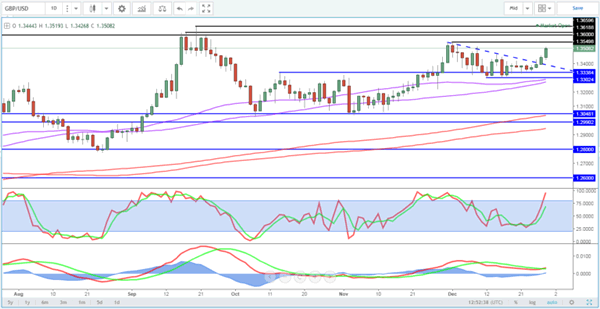
With the pound not performing particularly well against other currencies, it's clear that this is primarily a dollar-driven move.
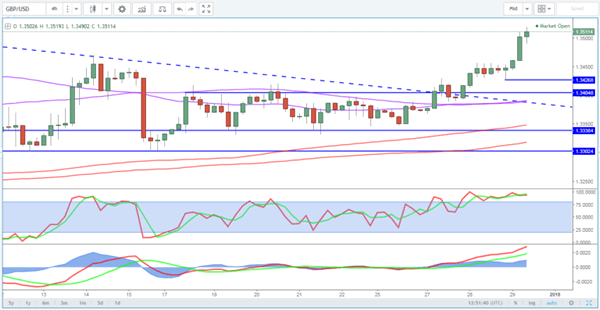
There are a number of technical levels to watch out for, with 1.3550 offering initial resistance to the upside, with it having been the most recent peak at the start of the month.
Above here, there are a number of resistance levels between 1.36 and around 1.3650, a break above which would see the pair trading at its highest level since the immediate aftermath of the Brexit vote in June 2016.
Below, support can still be found around 1.33, although if we see a correction of the recent rally it's worth keeping an eye on key Fib levels (38.2%, 50% and 61.8%) as well as the area around 1.34-1.3425, with it being the most recent area of support and resistance.
GBPUSD 4-Hour
USDJPY Technically Bearish Below 112.40 Level
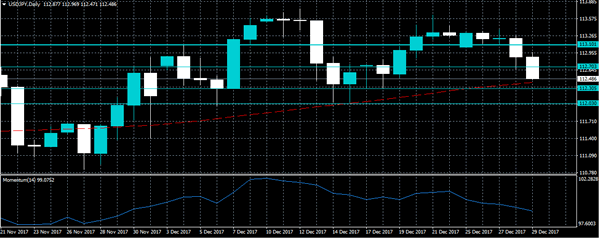
The greenback continues to retreat against the Japanese yen currency, as the U.S dollar index crashes to its lowest trading level in over three-months. The USDJPY currently trades around the 112.50 mark, and risks turning technically bearish below the pairs 100-day moving average, located at the 112.40 level. Heading into the last trading session of 2017, the U.S dollar is set for its worst yearly loss since 2003, despite the Federal Reserve raising U.S interest rates and the overall U.S economy improving.
The USDJPY pair is likely to encounter further losses below the 112.40 level, sellers will likely now target towards the 112.30 and 112.03 levels.
Should the USDJPY pair find intraday buying interest above the 112.40 leve, upside resistance is found at the 112.70 and 113.10 levels.
EURUSD Strongly Bullish Above 1.1959
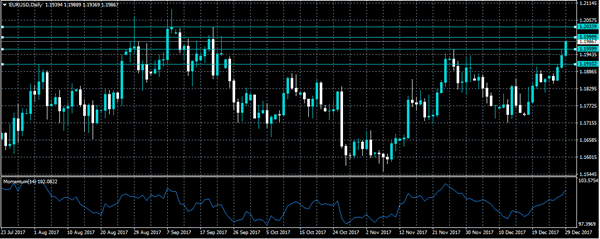
The euro has moved to its highest trading level against the U.S dollar since September, hitting 1.1990 during the European trading session. The greenback has come under intense year-end selling pressure, with the EURUSD pair now approaching the psychological 1.2000 level, with well-defined technical resistance above at the key 1.2030 region. Traders have continued to sell the U.S dollar index on Friday, after it broke below its 20-period moving average on an historical 10-year basis.
The EURUSD is strongly bullish while trading above the November price-high, found at the 1.1959 level. Buyers may now target towards the key 1.2000 and 1.2033 resistance levels.
Should the EURUSD pair move below the 1.1959 support level, further selling towards the 1.1910 technical support region remains possible.