

Sample Category Title
SNB Left Interest Rate On Hold At -0.75%, Lifted Its Inflation Forecast
.
For the 24 hours to 23:00 GMT, the USD rose 0.34% against the CHF and closed at 0.9896.
Yesterday, the Swiss National Bank (SNB) retained the benchmark interest rate at -0.75% and projected that inflation in Switzerland would exceed its target in three years. However, the central bank reiterated its commitment to “intervene in the foreign exchange market as necessary”. The central bank upgraded its inflation forecast to 0.5% for 2017, up from 0.4% predicted earlier and to 0.7% for next year, from 0.4%. The central bank also predicted the Swiss economy to expand around 2.0% in 2018, after advancing by 1.0% in 2017.
In the Asian session, at GMT0400, the pair is trading at 0.9885, with the USD trading 0.11% lower against the CHF from yesterday’s close.
The pair is expected to find support at 0.9848, and a fall through could take it to the next support level of 0.9812. The pair is expected to find its first resistance at 0.9913, and a rise through could take it to the next resistance level of 0.9942.
Moving ahead, market participants would eye Switzerland’s trade balance and the KOF leading indicator, both due to release next week.
The currency pair is showing convergence with its 20 Hr and 50 Hr moving averages.

Canada’s New Housing Price Index Climbed In October
For the 24 hours to 23:00 GMT, the USD declined 0.14% against the CAD and closed at 1.2803.
On the data front, Canada's new housing price index advanced 0.1% MoM in October, compared to a rise of 0.2% in the prior month, while markets had anticipated for a gain of 0.2%.
In the Asian session, at GMT0400, the pair is trading at 1.2780, with the USD trading 0.18% lower against the CAD from yesterday's close.
The pair is expected to find support at 1.2707, and a fall through could take it to the next support level of 1.2635. The pair is expected to find its first resistance at 1.2859, and a rise through could take it to the next resistance level of 1.2939.
Ahead in the day, Canada's existing home sales data for November, will be on investor's radar.
The currency pair is trading below its 20 Hr and 50 Hr moving averages.

ECB: Confident About Economy, But Cautious About Policy
- Draghi more upbeat on growth, but policy outlook unchanged
- Markets unmoved by expected commitment to continuing easy policy
- ECB makes substantial upward revisions to growth outlook…
- …But inflation to remain subdued
- Clear message that easy policy will continue but can it last throughout 2018?
There was little or no excitement expected by markets from the ECB's governing council meeting and the ECB lived down to these expectations. ECB president Mario Draghi's press conference and new ECB economic projections both spelled out the same two related messages. The ECB is pleasantly surprised by the strength of the recovery in activity in the Euro area and it is determined to avoid any unpleasant surprises in financial markets that might threaten that recovery any time soon.
As a result, the strong signal from the ECB was that any adjustment in its monetary policy is still a long way away even if Mr Draghi seemed to create a very small element of wriggle room in this regard. Indeed, on several occasions during the press conference Mr Draghi sought to underline policy continuity by indicating that there had been no discussion of future policy options. A slight easing in the exchange rate of the Euro and unchanged market interest rates in the immediate aftermath of the ECB's pronouncements suggested that the message of no change now or any time soon was received and understood by markets.
While acknowledging the current momentum in the Euro area economy, Mr Draghi avoided any worrisome implications for ECB policy by emphasising the lack of any notable follow through from stronger growth to higher inflation. The new ECB projections which show growth remaining well above potential but inflation remaining below target out to 2020 provide further re-assurance of a decoupling of growth and inflation that could allow 'An ample degree of monetary stimulus ' remain in place for some considerable time.
New ECB projections entail material upward revisions to the outlook for economic growth for each year from 2017 to 2019 (2.4% v2.2%, 2.3% v 1.8% and 1.9% v 1.7%). Although growth moderates to 1.7% in the ECB's initial projection for 2020, this remains well above most estimates of the Euro area's potential growth rate.
As the graph illustrates, the new ECB staff projections envisage the four year period between 2017 and 2020 delivering the strongest sustained period of growth in activity and employment since the mid 2000's. However, unlike that period which saw inflation persistently above 2%, the new ECB projections see only a modest pick-up in consumer prices that means inflation remains below the ECB's target rate out to 2020 (when questioned, Mr Draghi carefully avoided repeating last December's assertion that an inflation outturn of 1.7% is 'not really' in line with the ECB's target).
Indeed, ECB projections imply that, although increases in GDP are set to remain well above the Euro area's potential growth rate and the output gap is now moving into positive territory, current policy settings can deliver a notable break from history by helping growth and inflation to remain on smooth glide paths towards desired outcomes.
It may be that global economic slack and reforms in some parts of the Euro area will mean that, as in the US, inflation falls substantially short of the trend in activity but this would mark a dramatic change in the performance of the Euro area economy.
We would note one small pointer that hints albeit slightly towards an inflation trend that might warrant a somewhat less accommodative future monetary policy stance. The initial headline inflation forecast of 1.7% for 2020 is restrained marginally by oil prices and underlying inflation at 1.8% is probably broadly in line with the stated ECB target of a rate 'below, but close to, 2%'.
We would also highlight that Mr Draghi was careful to avoid suggesting that reaching any particular inflation rate would trigger consideration of policy tightening. Instead, he repeatedly said that what matters in terms of policy is evidence of a pick-up in inflation that is 'sustainable and self- sustaining'. He also said that it remains 'quite early' both in terms of the measures the ECB announced in October and, more generally, in terms of current activity and inflation developments to even begin to contemplate future policy measures.
While we think that a clear pick-up in inflation accompanied by signs of faster increases in wages may prompt notably different messaging from the ECB, that is not an issue for today. A more relevant near term policy signal is the continuing reference today to 'domestic price pressures (that) remain muted overall and have yet to show convincing signs of a sustained upward trend. An ample degree of monetary stimulus therefore remains necessary for underlying inflation pressures to continue to build up and support headline inflation developments over the medium term.'
Mr Draghi did note that the Governing council is now more confident than it was six weeks ago that in time improving economic conditions will translate into higher inflation.
But again he sought to distance the point between stronger growth and any inflation outcome that might require tighter policy. For now, he suggested healthier growth meant that the risk of deflation had disappeared and the possibility of very low inflation had become much more remote. The clear message is that growth and inflation have some way to go before they trigger any significant policy discussion. To further emphasise this point, he noted that a strong majority on the Governing council favour keeping the Asset Purchase Programme open-ended rather than preannouncing a specific end date.
Our sense is that while there is a strong consensus around the ECB's governing council table on the outlook for Euro area activity, views on the likely consequences for inflation may be more diverse and judgements as to the implications for policy may be becoming more fractured. There is little doubt that dovish thinking remains dominant at least for now. However, the persistence of above trend growth and even tentative signs of emerging price pressures could tilt the balance notably as 2018 progresses.
For now, the ECB's current message and the near term policy outlook are crystal clear. The key question is whether markets are pricing in at least the possibility of a more forceful change in ECB policy even if that possibility remains a year or more away.
USD/JPY Signaling Bearish Continuation Below 112.30
Key Highlights
- The US Dollar faced bearish pressure after the fed rate decision and declined below 113.00 against the Japanese Yen.
- USD/JPY also broke a crucial support area near 112.30 and a bullish trend line on the 4-hours chart.
- Japan's Tankan Large Manufacturing Index in Q4 2017 posted an increase from 22 to 25.
- Today's Industrial production report in the US could be important since the production is forecasted to increase by 0.3% (MoM).
USDJPY Technical Analysis
After a steady rise, the US Dollar faced offers near 113.75 against the Japanese Yen. The USD/JPY pair declined and moved below the 113.00 support area to break 112.50.
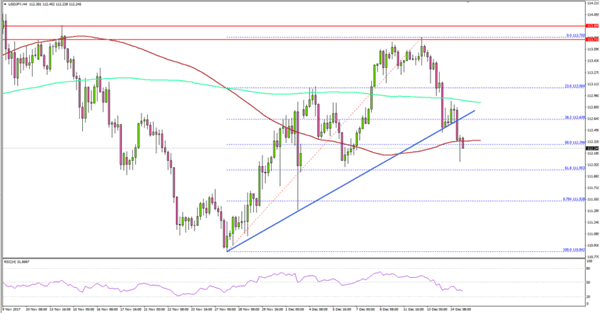
The fed interest rate decision and yesterday's CPI release were the main drivers of the recent downside move from 113.75. At the outset, the 4-hours chart of USD/JPY suggests that the recent break below the 112.30-40 support area holds a lot of importance.
There was a bullish trend line positioned at 112.50 on the same chart. More importantly, the 100 simple moving average (red, 4-hour) was at 112.30. Sellers also succeeded in pushing the pair below the 50% fib retracement level of the last wave from the 110.84 low to 113.75 high.
Therefore, a close below the 112.30 support means there could be more declines in USD/JPY toward 112.00 and 111.60. An intermediate support on the downside is around the 61.8% fib retracement level of the last wave from the 110.84 low to 113.75 high.
On the upside, the broken support at 112.30 and 112.50 are likely to act as a resistance. However, the most important resistance on the upside is around the 200 simple moving average (green, 4-hou) at 112.85.
Looking at the 4-hour RSI for USD/JPY, there is a declining pattern below the neutral level. Therefore, buyers will most likely struggle to retain bullish traction in the near term.
The current market sentiment is mixed for the US dollar since EUR/USD failed to remain above the 1.1820 level. On the other hand, GBP/USD was able to settle above the 1.3400 support. Therefore, it would be interesting to see how this week ends for the greenback and especially USD/JPY.
ECB Upbeat On Economic Outlook, While Maintaining ‘Dovish Tapering’ Tone
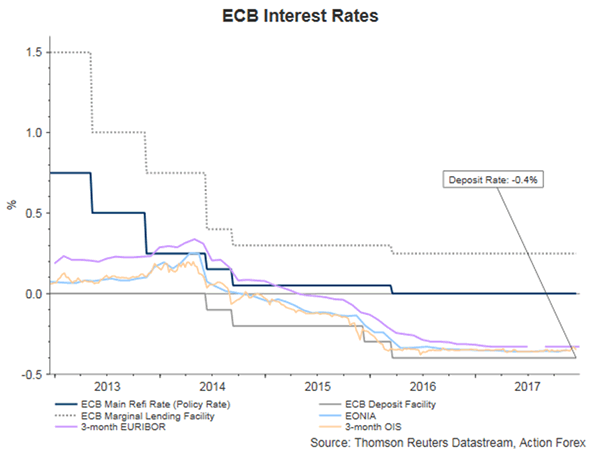
As widely anticipated, ECB left the policy rates unchanged, with the main refinancing rate, the marginal lending rate and the deposit rate staying at 0%, 0.25% and -0.40% respectively. The focus of the meeting was on the updated economic projections and the press conference. For the former, accompanying the upbeat statement were upgrades of GDP growth and inflation forecasts. The staff has also unveiled the 2020 outlook for the first time. For the latter, little news revealed with President Mario Draghi refraining from discussing the internal division over the future of the QE program. He, however, reiterated that the monetary policy should remain accommodative as inflation has yet to be self-sustainable.
The members turned more optimistic over the economic developments. As mentioned in the accompanying statement, the updated economic forecasts indicate 'a strong pace of economic expansion and a significant improvement in the growth outlook'. However, they remained cautious over the inflation outlook, suggesting that it has 'yet to show convincing signs of a sustained upward trend'. As such, 'an ample degree of monetary stimulus therefore remains necessary for underlying inflation pressures to continue to build up'. We believe this is consistent with the 'dovish tapering' stance it adopted in October, when it announced to shrink the asset purchase program. The tone is reminiscent of the Fed when it announced tapering of the QE program back then, although Draghi in the last meeting emphasized that the ECB is not Fed!
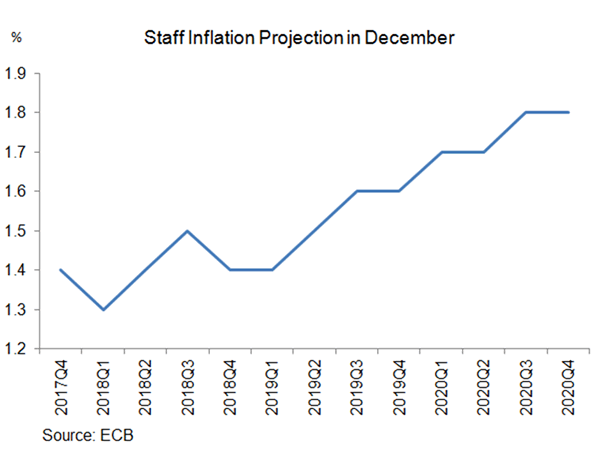
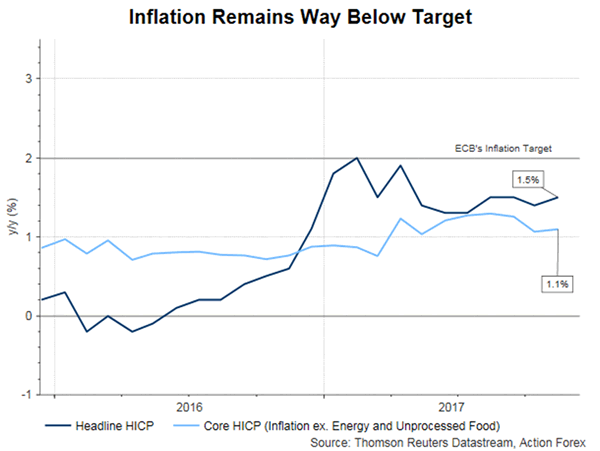
The staff upgraded the GDP growth estimates, forecast growth to reach +2.3% in 2018 and +1.9% in 2019, up from previous projections of +1.8% and +1.7%, respectively. The projection also includes a forecast for 2020 for the first time. The central bank projects growth to be +1.7% in 2020. Thanks to energy prices, inflation forecast as revised higher, by +0.2 percentage point, to +1.4% in 2018. However, core inflation is revised -0.2 percentage point lower to +1.1% next year. Inflation forecast stayed unchanged for 2019, with both headline and core HICP readings at +1.5%. For 2020, headline and core inflation are projected to be +1.7% and +1.8% respectively.
There was little news on the asset purchase program, of which the central bank announced the reduction in the pace from 60B euro to 30B euro per month, effective January 2018. Draghi also refrained from discussing more about the monetary policy outlook. He was in the same tone as what was suggested in forward guidance: interest rates would stay at current low levels until 'well past' the end of the asset purchase program. He noted that an abrupt end of the program was never discussed.
Elliott Wave View: Dow Future
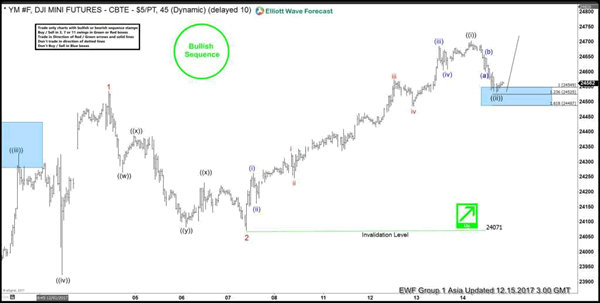
Dow Future Short Term Elliott Wave view suggests that rally to 24536 ended Minor wave 1 and Minor wave 2 ended at 24071 as a triple three Elliott Wave structure. The Index has since broken above Minor wave 1 at 24536 which suggests the next leg higher has started. Up from 24071, the rally is progressing as 5 waves impulse Elliott Wave Structure and Minute wave ((i)) ended at 24073.
Minute wave ((ii)) pullback is proposed complete at 24532 after a 3 swing pullback, but the Index still needs to break above 24073 to confirm this view. Until then, a double correction in Minute wave ((ii)) can’t be ruled out. A break below 24532 low from here suggests Minute wave ((ii)) is still in progress in 3, 7, or 11 swing to correct the rally from Minor wave 2 (24071) low. However, as far as the dips stay above 20471 low, expect the Index to extend higher. We don’t like selling the Index.
YM_F Dow Future 1 Hour Elliott Wave Chart
EUR/USD Daily Outlook
Daily Pivots: (S1) 1.1743; (P) 1.1803 (R1) 1.1835; More....
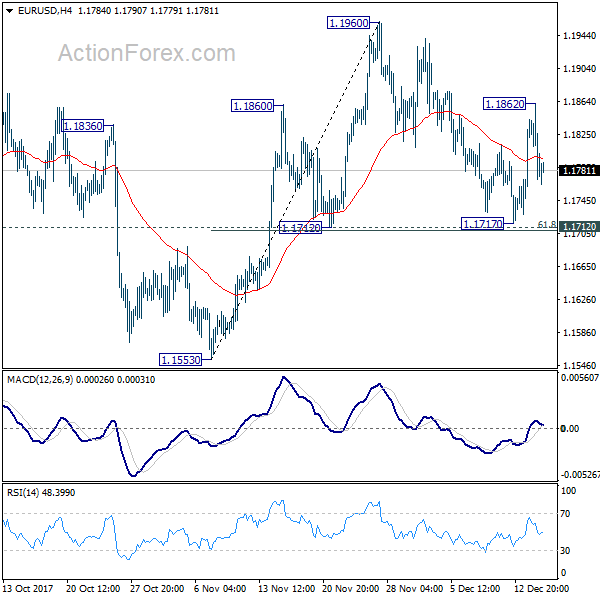
EUR/USD's rebound from 1.1717 was limited at 1.1862 and retreated deeply. Intraday bias is turned neutral first. Overall, near term outlook remains bullish with 1.1712 cluster support (61.8% retracement of 1.1553 to 1.1960 at 1.1708) intact. Further rally is expected and above 1.1862 will target 1.1900 first. Break will target 1.2029 high next. However, decisive break there will indicate that rebound from 1.1553 has completed at 1.1960. In that case, deeper fall would be seen to 1.1553 and possibly below to extend the decline from 1.2091.
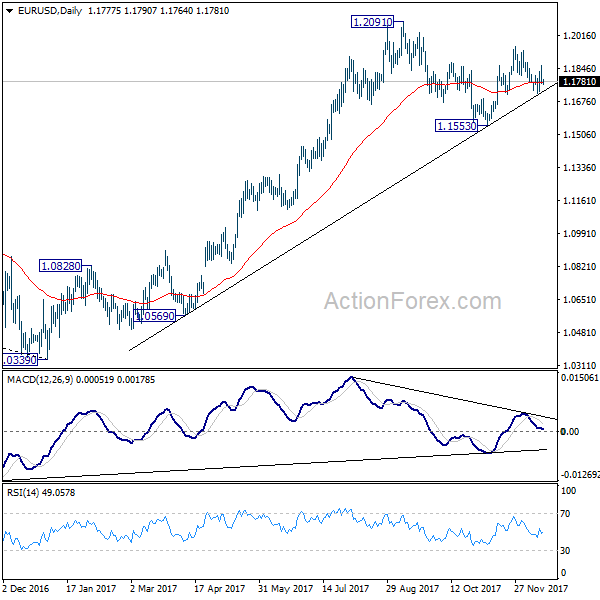
In the bigger picture, rise from 1.0339 medium term bottom is seen as a corrective move for the moment. Therefore, in case of another rally, we'd be expect 38.2% retracement of 1.6039 (2008 high) to 1.0339 (2017 low) at 1.2516 to limit upside and bring reversal. Meanwhile, sustained trading below 55 week EMA (now at 1.1423) will suggest that such medium term rebound is completed and could then bring retest of 1.0339 low.
GBP/USD Daily Outlook
Daily Pivots: (S1) 1.3387; (P) 1.3425; (R1) 1.3467; More....
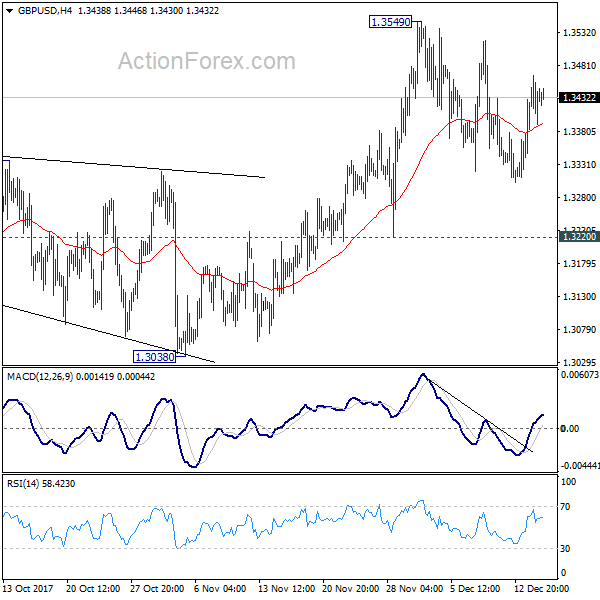
The corrective pattern from 1.3549 is still unfolding and intraday bias remains neutral. Another fall cannot be ruled out yet. But after all, as long as 1.3220 support holds, we'd continue to favor another rise. On the upside, break of 1.3549 will target 1.3651 high next. However, firm break of 1.3220 will turn near term outlook bearish for 1.3038 key support level.
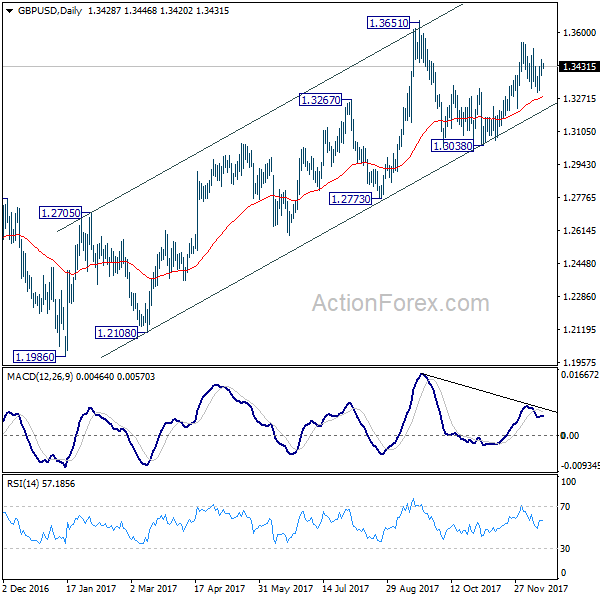
In the bigger picture, while the medium term rebound from 1.1946 low was strong, it's limited below 1.3835 key support turned resistance. As long as 1.3835 holds, we'd view such rebound as a correction. That is, we'd expect another leg in the long term down trend through 1.1946 low. However, sustained break of 1.3835 should at least send GBP/USD to 38.2% retracement of 2.1161 (2007 high) to 1.1946 (2016 low) at 1.5466.
USD/CHF Daily Outlook
Daily Pivots: (S1) 0.9850; (P) 0.9877; (R1) 0.9915; More....
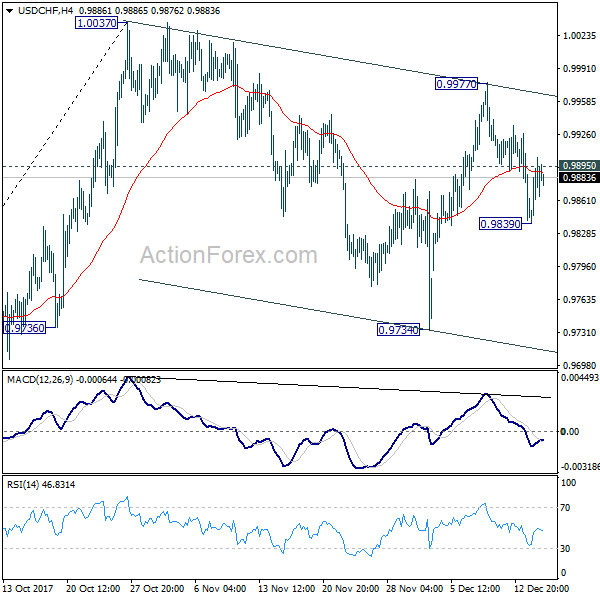
Breach of 0.9895 minor resistance argues that pull back from 0.9977 might be completed at 0.9839. But upside momentum is weak so far. Intraday bias is turned neutral first. On the downside, break of 0.9839 will extend the fall from 0.9977. Such decline is seen as part of the correction pattern from 1.0037. It could target 0.9734 support and below. But we'd expect strong support from 61.8% retracement of 0.9420 to 0.1.0037 at 0.9656 to contain downside and bring rebound. On the upside, break of 0.9977 will revive near term bullishness and target 1.0037 and above.
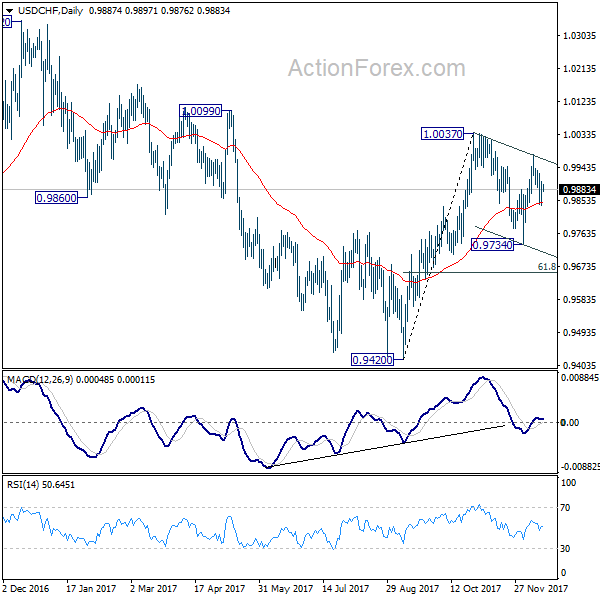
In the bigger picture, range trading continues between 0.9420/1.0342. At this point, 0.9420 appears to be a strong support level. Therefore, in case of decline attempt, we don't expect a firm break of this level. Nonetheless, strong break of 1.0342 is also needed to confirm upside momentum. Otherwise, medium term outlook will stay neutral.
Market Morning Briefing: Dollar-Index Reached A Low Of 93.28
STOCKS
Dow (24508.66, -0.31%) has weekly resistance near 24700 and if that holds, the index could enter into a sideways consolidation mode within 24700-24000 before again moving up towards 25000 in the longer term.
Dax (13068.08, -0.44%) came off sharply and could try to re-test lower levels of 12900 again before moving back towards 13100 or higher. For now, near term trade is likely to be stuck in the 13150-12900 region.
Nikkei (22494.76, -0.88%) has been pulled down by the US-Japan 10YR yield spread and Dollar Yen. While these look bearish for the near term, Nikkei could be headed towards 22250.
Shanghai (3275.53, -0.51%) is unable to move up$ sharply above 3270. Shanghai could either remain range-bound just now or try to move down towards 3250 again before it is pushed upwards. Near term likely to be sideways.
Nifty (10252.10, +0.58%) is fluctuating in the 10150-10300 region. It could well be ranged within the said region for some more time before it decides on further direction.
Sensex (33246.70, +0.59%) may bounce from levels near 32750. Overall sideways range-trade possible within 33500-32750 region.
COMMODITIES
Gold (1254.90) has paused a bit after making an intra-day high of 1260 as expected. While 1260 holds, the price may fall back towards 1240; else a break above 1260 if sustains could trigger a rally towards 1280 and higher.
Brent (63.33) and WTI (57.19) are both trading higher today. While support on Brent holds at 62, the price could eventually test 68 in the medium term while WTI is likely to re-test crucial levels of 59-60 resistance zone.
Copper (3.0755) has moved up a bit and could test important resistance near 3.10 which may push prices back towards 3.00-2.95 levels in the near to medium term.
FOREX
Dollar-Index (93.56) reached a low of 93.28 yesterday post the Fed rate hike but has been trading higher around 93.5-93.6 post the ECB announcement that they will be continuing their asset purchase programme till Sept next year, thereby indicating possible weakness in the Euro relative to the Dollar. However, the impact of this might be temporary in nature and we still expect to see the Index move towards support at 93 in a week or two.
Euro (1.1786) after seeing a high of 1.1863 yesterday has now dropped and is currently trading in the 1.177-1.179 range. The ECB’s plans to continue injecting liquidity in the medium term and its concerns about global factors (which could possibly affect European exports) point towards a possible interest in not letting Euro rise and harm exports. Although Euro is trading lower currently, we expect it to resume its upmove towards 1.19 by the end of this month and thereby test resistance on the weekly line charts.
Dollar-Yen (112.25) has dropped further as expected and might touch 112 by next week. A further decline towards 110 near support on weekly candles could happen by Jan if the US-Japan yield spread (2.313) finally drops towards 2.28 after having hovered near resistance (2.35-2.36) for couple of months.
Pound (1.3433) has been trading at similar levels as yesterday (near 1.342-1.345) and as mentioned yesterday, we might have to wait for a couple of sessions for more directional clarity (ie whether it will move back down on its downtrend towards support at 1.32-1.3225 on the daily, 3 day and weekly charts, or whether it will test resistance near 1.355-1.3575 on the weekly candles before dipping again.)
We were expecting Rupee (64.345) to drop to 64.15-64.20 in case Euro gained strength after the ECB meet. Inspite of Euro weakness after the meet, Rupee opened lower at 64.165. However, we could see markets factor in the Euro behavior and Dollar Rupee to rise back towards 64.30-64.40 today.
INTEREST RATES
The US yields have come down to test support levels and is likely to bounce back in the next few sessions. View is bullish for the early trades next week.
The US-Japan 10Yr (2.31%) is falling as expected. A further fall towards 2.28% or lower could bring down Dollar Yen also to lower levels.
The German-US 10YR (-2.04%) is stable at levels seen yesterday. The yield spread could test immediate resistance and could come off towards -2.08% or lower in the near term, indicating a fall in Euro too.