Sample Category Title
Trade Idea Wrap-up: EUR/USD – Target met and stand aside
EUR/USD - 1.1880
Most recent candlesticks pattern : N/A
Trend : Up
Tenkan-Sen level : 1.1915
Kijun-Sen level : 1.1908
Ichimoku cloud top : 1.1945
Ichimoku cloud bottom : 1.1876
Original strategy :
Sold at 1.1975, met target at 1.1875
Position : - Short at 1.1975
Target : - 1.1875
Stop : -
New strategy :
Stand aside
Position : -
Target : -
Stop : -
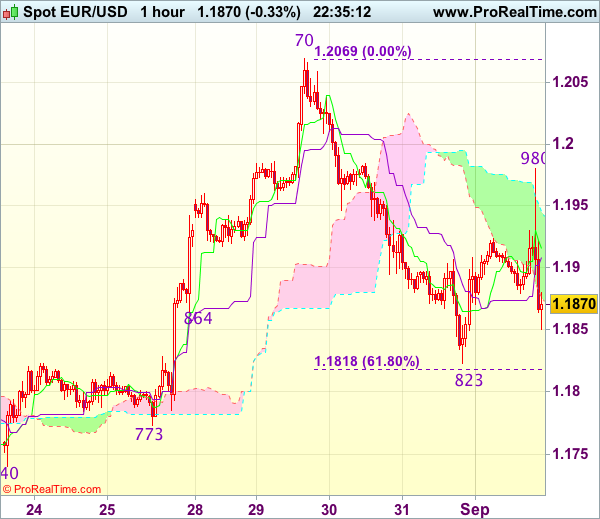
Although the single currency staged a brief bounce to 1.1980 in NY morning after NFP, as renewed selling interest emerged there and euro has dropped again, retaining our bearishness for weakness to 1.1850, however, break of yesterday’s low at 1.1823 is needed to signal the fall from 1.2070 top has resumed and extend decline to 1.1815-18 (61.8% Fibonacci retracement of 1.1662-1.2070) but downside should be limited to 1.1790-00 and support at 1.1773 should remain intact.
As we have taken profit on our short position entered at 1.1975, would not chase this fall here and would be prudent to stand aside for now. Above 1.1940-45 would suggest an intra-day low is formed instead, bring another test of said resistance at 1.1980 but only break there would signal the fall from 1.2070 has ended at 1.1823 yesterday, bring further gain to 1.2000 and possibly towards 1.2025-30.
Dollar Ignores Weak US Payrolls
- European stock markets gained slightly ground with the German Dax (+0.8%) and Cac40 (+0.8%) outperforming. US stock markets opened with small gains as well (+0.2%) despite a rather weak payrolls report.
- US August payrolls disappointed on all fronts. Net job creation printed at 156k (vs 180k forecast) and the previous two month's suffered a combined 41k downward revision. The unemployment rate unexpectedly ticked up to 4.4% and average hourly earnings rose slower than anticipated (0.1% M/M & 2.5% Y/Y).
- US factories ramped up in August to the fastest pace of expansion in six years, driven by employment gains. The US manufacturing ISM rose from 56.3 to 58.8, while markets expected a much smaller increase to 52.8.
- "Since the introduction of the euro, there were significant movements of the euro-dollar rate. We're now roughly where we were when the euro was introduced. We've been below parity and we've been at $1.50-$1.60. Therefore, I wouldn't over-interpret or dramatize," ECB Governing Council member Nowotny said.
- Lifting euro zone inflation may be more difficult than earlier expected, ECB Vice President Constancio said, days before the bank begins a much anticipated discussion on the future of its stimulus policy.
- ECB policy makers may not be ready to finalize their decision on next year's bond-purchase program until December, according to euro-area officials familiar with the matter (rumours).
- The August UK manufacturing PMI beat expectations, rising from 55.3 to 56.9 (vs 55.0 forecast). Companies reported the strongest intake of new orders since May, bolstered by the weaker pound. The currency's depreciation also contributed to purchase-price gains accelerating for the first time in seven months.
- UK trade secretary Fox has accused the EU of "blackmail" over Brexit divorce payments, capping off a testy week of negotiations. The comments come after Michel Barnier, chief Brexit negotiator for the EU, repeatedly bemoaned the UK's approach to the process, noting yesterday that "no decisive process" had been made in the third round of talks.
- Kenya's supreme court has nullified the result of last month's presidential election, in an unprecedented ruling that deals a severe political blow to incumbent president Uhuru Kenyatta. It means a new vote has to be held within 60 days.
Rates
Second failed test of 2.1% despite weak payrolls
German Bunds underperformed US Treasuries today. Core bond trading was neventful until around European noon. ECB Nowotny said that he wouldn't over-interpret or dramatize the recent euro strength. His comments triggered a setback in German Bunds with next week's ECB meeting in mind. Will Draghi and co already provide a blueprint for next year's APP programme (tapering)? Rumours suggested a delay until December, but the market didn't react that way. Intraday losses in Bunds were temporarily erased by a disappointing US payrolls report. US Treasuries benefited as well with a test of key support in the US 10-yr yield (2.1%). However, the move barely lasted 10 minutes with immediate return action toward pre-payrolls levels. The US Note future's performance was especially disappointing taking into account the upcoming long weekend in the US. Markets are closed on Monday for Labour Day which traditionally favours safe havens in the run-up.
A similar reaction to the payrolls was visible in the dollar. Both market reactions suggest that the downtrend in both USD and US yields seems to be exhausted. A period of consolidation is now more likely unless of course the ECB decides otherwise. An APP-announcement next week should for example send yields back higher.
The German yield curve bear steepens at the time of writing with yield changes ranging between +0.5 bps (2-yr) and +4 bps (30-yr). The US yield curve steepens as well, but to a lesser extent. US yields increase by up to 1.8 bps (30-yr). On intra-EMU bond markets, 10-yr yield spread changes versus Germany are nearly unchanged with Portugal (-3 bps) outperforming and Spain (+2 bps) underperforming.
Currencies
Dollar ignores weak US payrolls
The US payrolls disappointed in all aspects. The dollar instantaneously lost ground, but the gains were rapidly erased. EUR/USD spiked from about 1.1920 to 1.1980, but retraced the gains and now trades below the 1.19 handle. Similarly, USD/JPY dived from 110.10 to 109.56 only to return back to the 110 level. There were and are doubts about the August payrolls, as a statistical quirk might be responsible for the weak results. That could explain the bizarre price action. Alternatively, the market reaction may be evidence that the downward dollar trend is exhausted for now.
The dollar initially gradually strengthened versus euro and yen during the European morning session. There was little news behind the movement. EUR/USD bottomed at about 1.1880 and was already somewhat higher when ECB Nowotny said that the complaints about a too-strong euro were overdone. German yields rose up to 4 basis points (US/German yield spread narrowed a few basis points) and EUR/USD spiked to 1.1930 before retracing part of the gains. The market reasons that the ECB may already announce its plans about the APP programme next week if they aren't too concerned about euro strength. The positive euro bias remained in place going towards the payrolls, while USD/JPY held on to its modest gains. The Nowotny comments were euro specific and these kinds of remarks should keep the euro market itchy in the run up to next week's ECB meeting.
The US August payrolls report was weak in its most important components. Payrolls rose 156 000 instead of the expected 180 000, July and June payrolls were downwardly revised by a combined 41k, the unemployment rate ticked up to 4.4% from 4.3% and the average hourly earnings rose a lower-than-expected 0.1% M/M and 2.5% Y/Y. It's not excluded that a statistical quirk was responsible for the weakness as is often the case in August. The dollar was sold, pushing EUR/USD in a first reaction to 1.1980 and USD/JPY lower to 109.56. However, the tide turned completely and the dollar losses were erased. The dollar tries to gain additional ground as we conclude our report..
Bloomberg reported: "ECB policy makers may not be ready to finalize their decision on next year's bond-purchase plan until just a couple of weeks before the current program expires, according to euro-area officials familiar with the matter". The message was released 10 minutes after the payrolls release. It is intrinsically euro negative, but given the moves in other dollar crosses and in other markets, we don't think it influenced trading.
Sterling strengthens against EUR after payrolls?!?
Sterling traded sideways in the morning session, ignoring an unexpectedly strong Manufacturing PMI. The headline PMI rose to 56.9 in August from 55.3 in July, a four month high. The improvement was broad-based (all main components) including strong export orders, suggesting that the weak pound is starting to help the economy. EUR/GBP kept close to the 0.9211 going towards the US payrolls release. Strange enough, cable didn't return gains after the weaker payrolls unlike EUR, JPY, …. This resulted in a significant decline of EUR/GBP, which fell in the afternoon from 0.9210 to 0.9150.
Trade Idea: EUR/GBP – Buy at 0.9115
EUR/GBP - 0.9270
Original strategy :
Buy at 0.9145, Target: 0.9295, Stop: 0.9105
Position : -
Target : -
Stop : -
New strategy :
Buy at 0.9115, Target: 0.9235, Stop: 0.9175
Position : -
Target : -
Stop : -
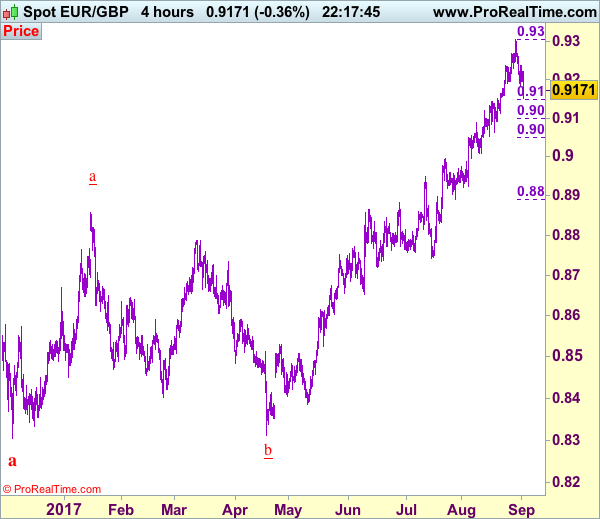
Although the single currency has slipped again today and near term downside risk remains for the corrective fall from 0.9307 top to extend weakness to 0.9145-49 (38.2% Fibonacci retracement of 0.8892-0.9307), reckon 0.9110-15 would limit downside and bring rebound later, above 0.9220-25 would bring test of resistance at 0.9238 but a firm break above latter level is needed to signal the correction from 0.9307 has ended, bring retest of this level, break there would extend the major rise from 0.8304 to 0.9335-40 and 0.9365-70.
In view of this, we are inclined to buy euro on next corrective fall and would be prudent to exit on such rebound. Below 0.9095-00 (50% Fibonacci retracement of 0.8892-0.9307) would abort and signal top has been formed at 0.9307, bring correction of recent upmove to 0.9050-51 (61.8% Fibonacci retracement and previous support) later.
Our preferred count is that, after forming a major top at 0.9805 (wave V), (A)-(B)-(C) correction is unfolding with (A) leg ended at 0.8400 (A: 0.8637, B: 0.9491 and 5-waver C ended at 0.8400. Wave (B) has ended at 0.9413 and impulsive wave (C) has either ended at 0.8067 or may extend one more fall to 0.8000 before prospect of another rally. Current breach of indicated resistance at 0.9043 confirms our view that the (C) leg has ended and bring stronger rebound towards 0.9150/54, then towards 0.9240/50.
Jobs: Continued Gains in Growth and Fed Moves Ahead
August job gains of 156,000 and a steady rise in wages indicate continued economic growth and consumer spending. Hurricane Harvey hits next month's data. Past the cycle, structural unemployment issues remain.
August Jobs Up 156,000: Consistent with Economic Growth
Nonfarm payrolls rose 156,000 in August, with the three month average at 185,000 jobs. Job gains are consistent with 2.5 percent economic growth in the third quarter, steady consumer spending and Fed policy as currently projected for a December rate hike.
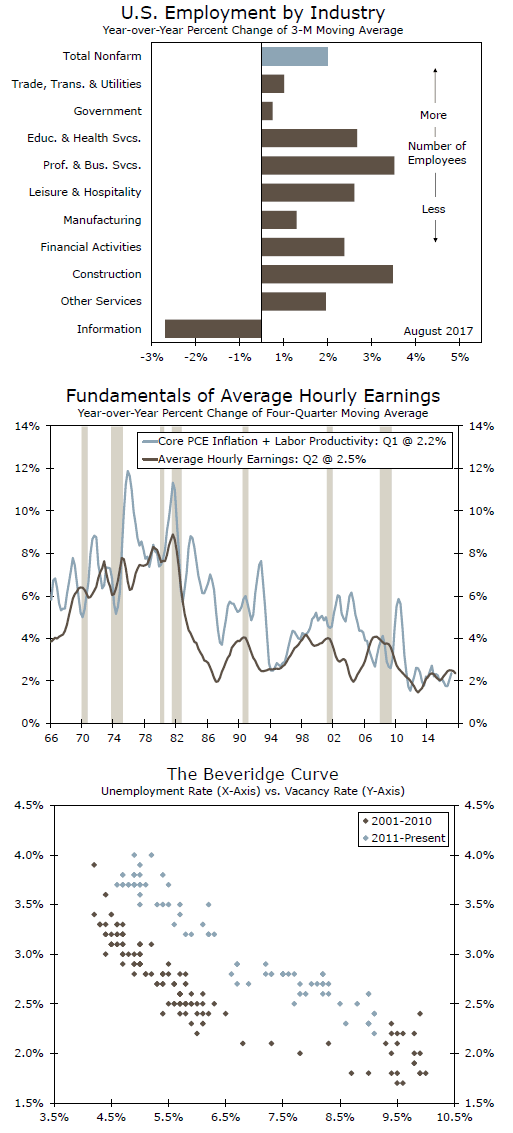
Hiring in the services sector remained solid, with gains in business services, education & health, finance and leisure & hospitality (top graph). Government jobs have declined on average 6,000 jobs over the past three months.
In the goods sector, manufacturing employment posted a strong gain (28,000) over the past three months, while hiring in construction was up a still solid 13,000 jobs on average over the past three months.
Wage Growth: Real Wage Gains Over the Past Two Years?
Despite the focus on nominal wage gains, the real story for the American household is that real wages continue to rise and thereby boost household real incomes and consumer spending.
Nominal average hourly earnings rose 0.1 percent in August and are up 2.5 percent over the year. While job growth remains strong, earnings continue to hang in this mid-two percent pace. The softer inflation readings and weak productivity numbers have limited the gains in nominal wage growth.
Over the longer run, wages reflect the economic fundamentals of the labor market, and those fundamentals include productivity and inflation (middle chart). Lackluster productivity growth in the current cycle has weighed on wage growth and will likely continue to hamper wage appreciation. Moreover, inflation has been persistently below the FOMC's target of two percent and has struggled to sustain upward momentum. With both productivity growth and inflation continuing to prove sluggish, it is not altogether surprising that wage growth has disappointed given the performance of the fundamentals.
Structural Problems Persist: Drag on Growth
For any given unemployment rate (labor supply) the vacancy rate (job openings) remains wider than in the prior ten year period (bottom graph). This Beveridge Curve signals a structural weakness in the labor market which is confirmed by several labor market survey indicators. Compared to a year ago, the unemployment rate for those without a high school education and with a high school diploma remains higher than the unemployment rate for those with some college.
The mean duration of unemployment rate remains at 24.4 weeks which is higher than any level since 1982. Finally, the prime age labor force participation rate has risen over the last year but remains far below the level of participation since 1990.
GBPJPY Maintains Neutral Trend in the Short-term
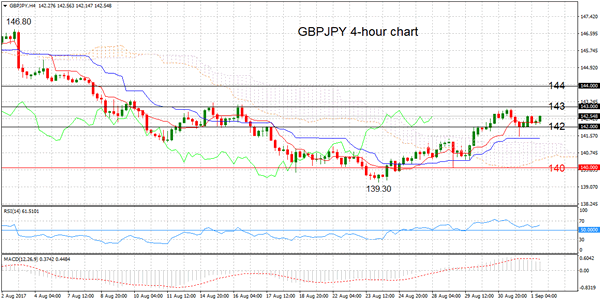
GBPJPY has a neutral intra-day bias and has been trapped between the key round level of 142 and 143 today. Short-term momentum oscillators (on the 4-hour chart) are moving sideways, indicating the start of a consolidation phase in the market.
Looking at the bigger picture, GBPJPY declined from the August 3 high of 146.80 to reach a low of 139.30 on August 24. An attempt to rebound from the multi-month low found resistance at 143 as RSI reached overbought levels at 70 and upside momentum faded. The 143-level has acted as resistance in mid-August and so it's seen as a strong barrier to upside moves.
If support at 142 fails then GBPJPY would come under increased pressure with scope to reach the key 140-level and possibly re-test the low at 139.30. A deeper decline would suggest a top is in place at 143 and GBPJPY would resume the downtrend that started from the July 11 high of 147.77.
Alternatively, a sustained move above the top of the range at 143-resistance would indicate that the intra-day neutral bias has ended and prices would target 144. This could shift the short-term bias to bullish. Since the market is above the Ichimoku cloud and both RSI and MACD are in bullish territory, another push higher cannot be ruled out.
The underlying medium-term trend is neutral-to-bearish since July but it is unclear yet whether the bounce from 139.30 is a mere correction of the July-August downtrend.
Trade Idea: USD/CAD – Stand aside
USD/CAD - 1.2411
New strategy :
Stand aside
Position: -
Target: -
Stop:-
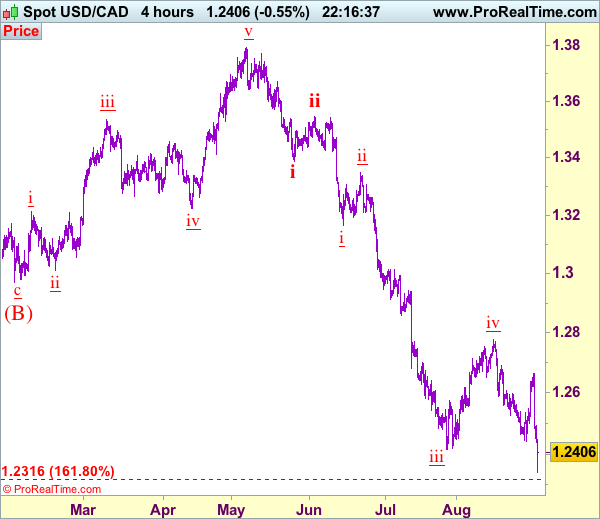
Although current break of 1.2414 support confirms our bearish view that recent decline has resumed and may extend weakness to 1.2340, then 1.2310-15, oversold condition should limit downside and reckon current wave v would be limited to 1.2250-60 and price should stay above 1.2200-10, risk from there has increased for a rebound to take place next week. We are keeping our count that wave v as well as wave (C) ended at 1.3794 and impulsive wave (i ii, i ii) is now unfolding with minor wave iii ended at 1.2414, followed by wave iv correction possibly ended at 1.2778, wave v should extend towards 1.2300.
In view o this, would not chase this fall here and would be prudent to stand aside in the meantime. Above 1.2445-50 would bring rebound to 1.2490-00 but break of latter level is needed to signal a temporary low is possibly formed, bring further gain to 1.2530-35 and then 1.2570-75 but upside should be limited to 1.2600 and price should falter well below resistance at 1.2663.
To recap, wave B from 1.3066 is unfolding as an a-b-c and is sub-divided as a: 1.2192, b: 1.2716 and wave c is a 5-waver with i: 1.1983, ii: 1.2506, extended wave iii with minor iii at 1.0206, wave iv ended at 1.0781 and wave v as well as wave iii has ended at 0.9931, hence the subsequent choppy trading is the wave iv which is unfolding as (a)-(b)-(c) with (a) leg of iv ended at 1.0854, followed by (b) leg at 1.0108 and (c) leg as well as the wave iv ended at 1.0674. The wave v is sub-divided by minor wave (i): 0.9980, (ii): 1.0374, (iii): 0.9446, (iv): 0.9913 and (v) as well as v has possibly ended at 0.9407, therefore, consolidation with upside bias is seen for major correction, indicated target at 1.3700 and 1.4000 had been met and further gain to 1.4700 would be seen later.
USD/CAD Seems Unstoppable
USD/CAD plunged much below several support levels after the release of the first United States data. The figures have come in worse than expected and have invalidated a potential upside movement. The greenback is demolished once again by the United States economy. Unfortunately, the poor numbers will most likely force the Federal Reserve to keep the Federal Funds Rate on hold till next year.
The USD sellers have taken the lead again and seems motivated to drag the currency to new lows in the upcoming period. Right now I don't see how the USD could turn to the upside, maybe only a severe oversold will bring the bulls in the market again.
The US Unemployment Rate increased unexpectedly, from 4.3% to 4.4% in August, even if the traders have expected to see a 4.3% growth, while the NFP registered the lowest level of the last three months, was reported at 156K, much below the 180K estimate and versus the 209K in the former reading period. Moreover, the Average Hourly Earnings rose only by 0.1%, less versus the 0.2% estimate.
The US is to release more data in the upcoming hours, but I don't see them capable to save it from the downside.
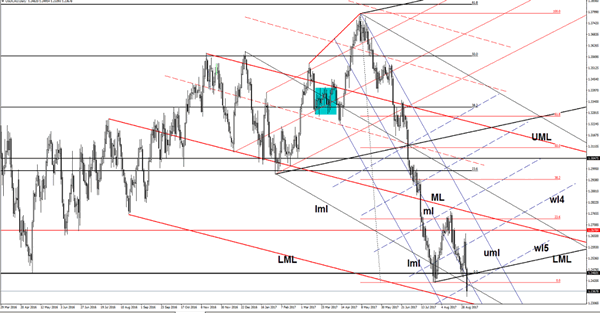
You can see that the rate has dropped much below the 1.2460 static support, lower median line (LML) of the black ascending pitchfork, median line (ml) of the minor descending pitchfork, the warning line (wl5) and the lower median line (lml) of the black descending pitchfork.
It was almost to reach the lower median line (LML) of the major descending pitchfork, could still react this level if the US data will continue to disappoint later. Only a failure to reach the LML will signal a major oversold and a potential rebound.
EUR/GBP Additional Drops Expected
Price is trading in the red and seems poised to extend the sell-off. A breakdown through seems imminent after the retest of the upper median line (UML) and the 0.9226 horizontal resistance. A major drop will appear if the rate will close under the median line (ml) and if will come to retest it.
Price is trading in the red and seems poised to extend the sell-off. A breakdown through seems imminent after the retest of the upper median line (UML) and the 0.9226 horizontal resistance. A major drop will appear if the rate will close under the median line (ml) and if will come to retest it.
AUD/USD Erased The Morning Losses
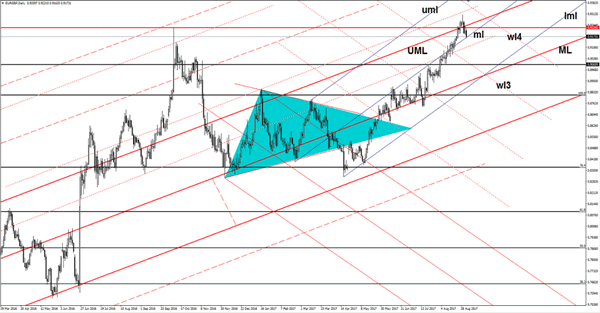
AUD/USD rallied after the US data were sent to the public and reached new highs. Has found temporary resistance right above the 0.7989 level. Should climb much higher and could approach the 0.8065 swing high in the upcoming period, but only if will stay within the minor ascending pitchfork's body.

Elliott Wave Analysis: USDJPY and EURUSD
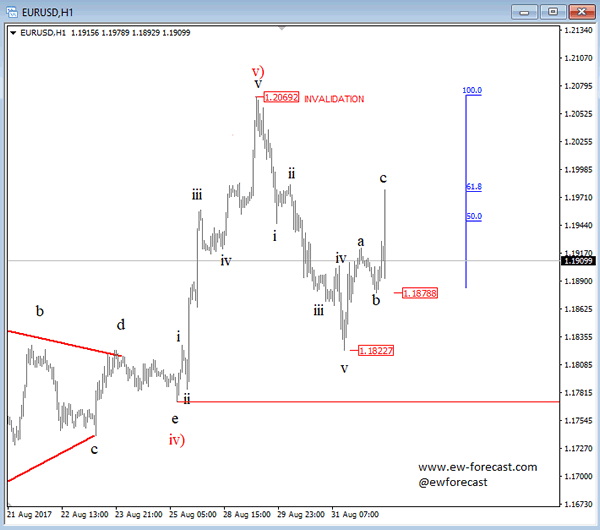
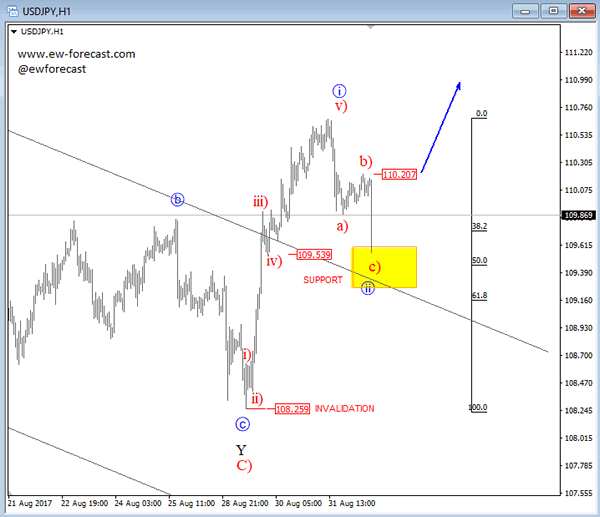
NFP came out below expectations (156k vs 180k), but USD saw a new leg down only temporary, now is turning up again. We have seen a nice move down on USDJPY to 109.50 supports from where we expect more upside now. Same thing with EURUSD which appears to be bearish away from 1.1980.
USDJPY, 1H
EURUSD, 1H