Sample Category Title
US Futures Gap Up on US-Iran Peace Deal Hopes With US Dollar in Retreat
Key takeaways
- Global risk sentiment improved sharply after senior US officials signalled that a US-Iran peace agreement may be nearing completion, triggering strong gains in US equity futures and sending the US dollar lower.
- The US economy is showing increasing stagflationary pressures as consumer sentiment collapsed to a record low while inflation expectations continued to rise, placing new Federal Reserve Chair Kevin Warsh under immediate policy pressure.
- Asia Pacific markets rallied on easing geopolitical fears, led by Japan’s Nikkei 225 hitting a fresh all-time high, while Southeast Asia’s accelerating shift toward biofuels is beginning to create broader food supply and inflation risks across the region.
- Chart of the day: WTI crude bearish break below 50-day moving average with key short-term resistance at $100.80/bbl. Potential near-term weakness may expose intermediate supports at $90.50 and $87.60.
Top macro headlines
- US officials signalled an imminent US-Iran peace deal: In contrast to US President Donald Trump, who stated earlier on Sunday that he told his representatives “not to rush” into any deal with Iran, senior US officials highlighted that the US and Iran are closing in on a deal to reopen the Strait of Hormuz. The development triggered an intraday rally in S&P 500 (+0.8%) and Nasdaq 100 (+1.3%) E-mini futures during Monday’s Asia opening session.
- US consumer sentiment plunges to an all-time record low: The University of Michigan consumer sentiment index dropped to 44.8 in May, the lowest level on record, falling below the pandemic and 2008 financial crisis troughs. The collapse is directly tied to soaring gasoline prices approaching $5 a gallon nationwide due to the ongoing Middle East conflict.
- Kevin Warsh sworn in as Fed Chair amid stagflation: Kevin Warsh officially took the helm of the Federal Reserve on Friday. He assumes leadership of a central bank navigating a difficult environment where surging fuel costs are driving up inflation while rapidly eroding consumer demand.
- Gold surges as dollar weakens: Spot gold prices rose 1.2% to $4,564/oz on Monday, supported by a weaker US dollar and lower oil prices due to renewed optimism over an imminent US-Iran peace deal.
- Southeast Asia pivots to biofuels, threatening food supply: Cut off from Middle Eastern energy by the Strait of Hormuz closure, Southeast Asian nations are shifting palm oil and local crops into diesel and gasoline blends. This rapid transition is squeezing regional supplies for cooking oil, animal feed and agricultural exports.
Key macro themes
- Geopolitical whiplash and energy uncertainty: Conflicting messaging between US officials over the US-Iran peace process continues to create volatility. While oil prices initially hit two-week lows on optimism surrounding negotiations, the lack of a finalized agreement means the Strait of Hormuz remains closed, perpetuating the global supply shock.
- Stagflationary pressures worsen: With consumer sentiment at record lows and one-year inflation expectations rising to 4.8%, according to the final May University of Michigan survey, the US economy is flashing classic stagflation warning signs. Rising gasoline prices are disproportionately impacting lower-income consumers and severely complicating the Fed’s policy options.
- Food versus fuel crisis in emerging markets: The prolonged energy shock is forcing structural shifts across emerging markets. Southeast Asia’s increasing use of crops for fuel production highlights how the geopolitical oil crisis is spilling over into global agricultural and food supply chains, compounding inflation risks.
Global market impact (last 48 hours)
Equities: The S&P 500’s eight-week rally is showing signs of potential buyer exhaustion according to several technical indicators. Even if a US-Iran peace deal is finalized, markets may still face a “sell the news” reaction as June approaches, a month historically associated with softer equity performance.
Fixed Income: Incoming Fed Chair Kevin Warsh faces a difficult bond market backdrop. With US long-term five-year inflation expectations surging to 3.9%, the highest level since October 2025 according to May’s University of Michigan survey data, Treasury yields remain highly sensitive to any further energy-driven inflation shocks.
FX: The US dollar weakened over the weekend, offering a modest reprieve to emerging market currencies while making dollar-priced commodities such as gold and silver more affordable for international buyers.
Commodities: Oil prices initially hit two-week lows on optimism surrounding peace negotiations, but markets remain highly reactive to Trump’s subsequent “do not rush” remarks. Spot gold rose 1.2% to $4,564/oz, while spot silver surged 3.1% to $77.85/oz.
Asia Pacific impact
- Stock markets and regional security: Major Asia Pacific equity markets started the week on a bullish footing, tracking gains in US futures. The Nikkei 225 surged 3.1% to a fresh intraday all-time high of 65,330, while China A50 (+0.7%), ASX 200 (+0.6%) and STI (+0.6%) also advanced. Regional security developments will remain in focus this week with the Quad foreign ministers meeting in New Delhi on Tuesday, followed by the Shangri-La Dialogue in Singapore on Friday.
- Commodities and food security: Indonesia and Malaysia’s rapid shift toward higher biodiesel blends to offset lost Middle Eastern oil supply is tightening cooking oil availability. The diversion is expected to push food inflation higher and disrupt regional export balances.
- Diplomatic realignment: Philippine President Ferdinand Marcos Jr. is set to visit Japan to strengthen bilateral ties, reflecting broader regional efforts to secure energy cooperation and maritime security amid ongoing global instability.
Top 2 events to watch today
- US-Iran peace deal news flows – Impact: All asset classes
- Singapore Core Inflation (Apr) – 1:00 SGT (consensus: 1.7% y/y, Mar: 1.7%)
Impact: USD/SGD, SGD crosses, STI
Chart of the day – WTI crude bearish break below 50-day moving average
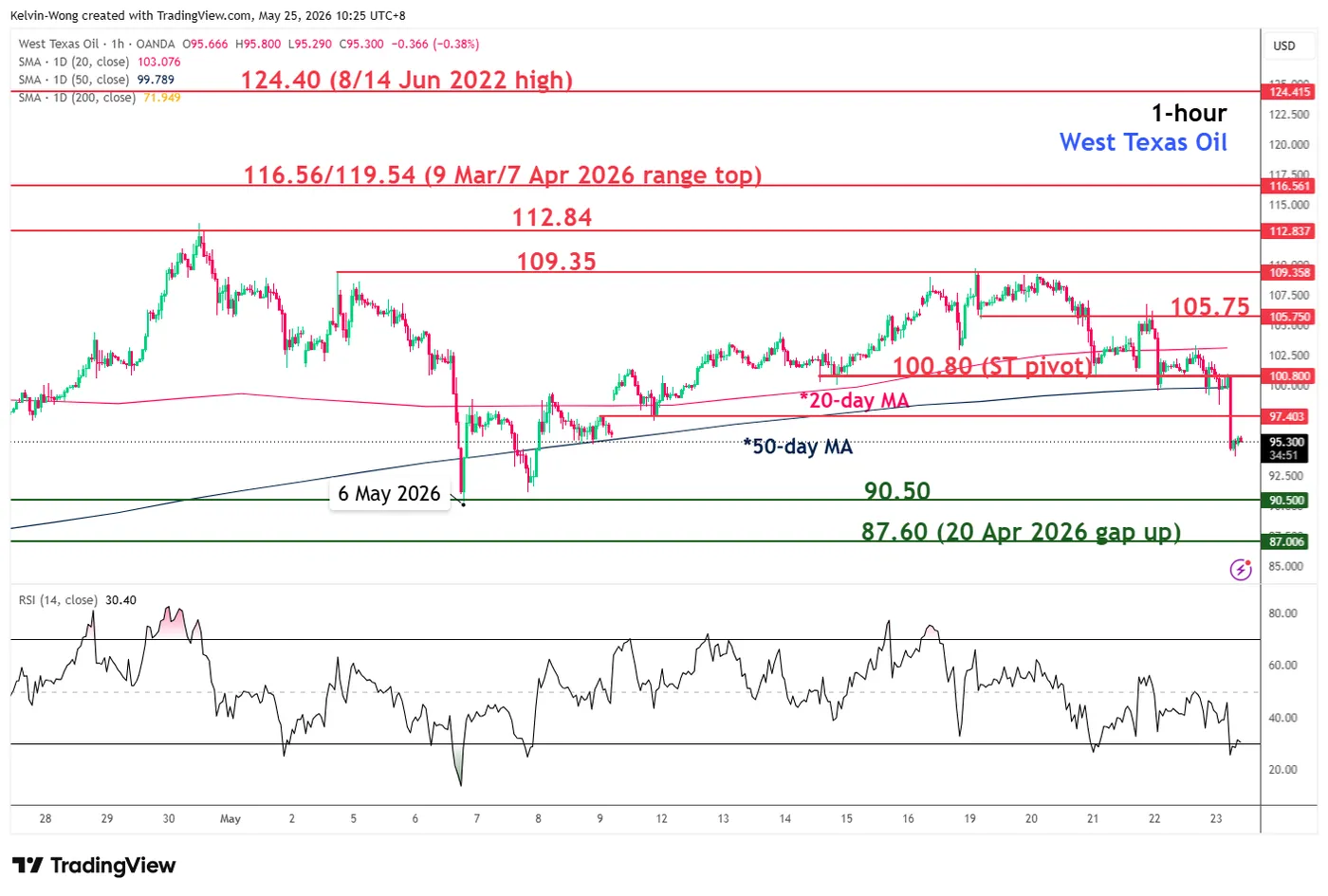
Fig. 1: West Texas oil CFD minor trend as of 25 May 2026 (Source: TradingView).
The price action of the West Texas oil CFD, a proxy for WTI crude oil futures, staged an intraday bearish breakdown below its 50-day moving average during Monday’s Asian opening session. This marks the first confirmed breakdown after price action previously tested the 50-day moving average on 6 May and 17 April 2026.
Hourly RSI momentum remains in bearish territory, with oversold conditions visible but no bullish divergence signal emerging yet.
Watch the $100.80 short-term pivotal resistance, which is also close to the 50-day moving average. Failure below this level could expose the next intermediate supports at $90.50 and $87.60.
On the other hand, a clearance with an hourly close above $100.80 would negate the bearish scenario and open the door for a squeeze higher toward the next intermediate resistances at $105.75 and $109.35.
EUR/USD Recovery Builds Slowly As Traders Eye Breakout Potential
Key Highlights
- EUR/USD dipped further before the bulls appeared near 1.1575.
- It traded above a bearish trend line with resistance at 1.1610 on the 4-hour chart.
- GBP/USD climbed higher above the 1.3450 resistance zone.
- Gold started a consolidation phase above the $4,450 support.
EUR/USD Technical Analysis
The Euro remained in a bearish zone below 1.1720 against the US Dollar. EUR/USD even dipped below 1.1620 before the bulls appeared.
Looking at the 4-hour chart, the pair traded as low as 1.1576 and recently started a recovery wave. The pair climbed above the 23.6% Fib retracement level of the downward move from the 1.1787 swing high to the 1.1576 low.
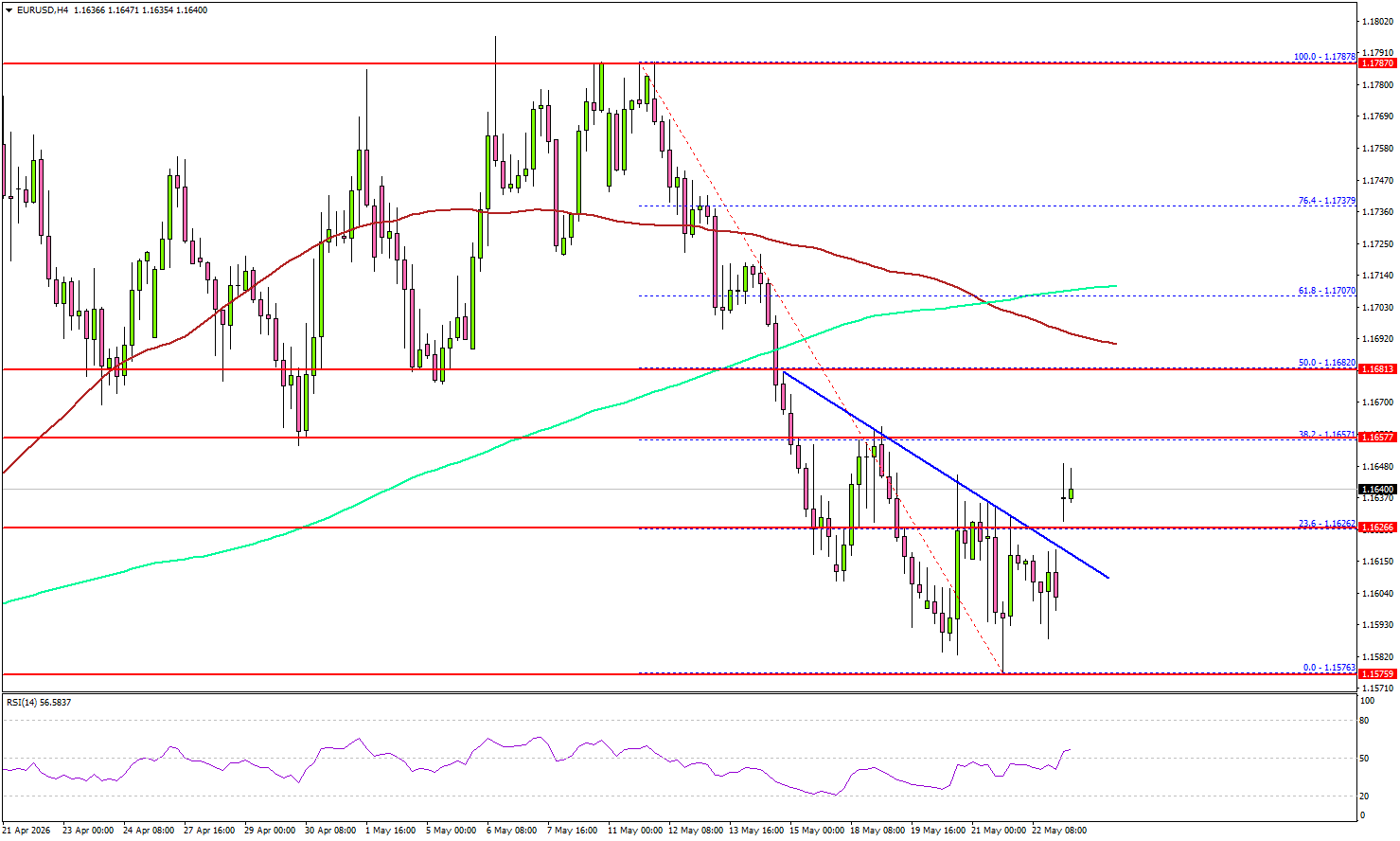
Besides, the pair traded above a bearish trend line with resistance at 1.1610. On the upside, the pair faces resistance at 1.1655. The first major resistance could be 1.1685, the 100 simple moving average (red, 4-hour), the 200 simple moving average (green, 4-hour), and the 61.8% Fib retracement level of the downward move from the 1.1787 swing high to the 1.1576 low.
A close above 1.1700 could open doors for gains above 1.1720. In the stated case, the bulls could aim for a move to 1.1800. If there is another decline, the pair could find bids near 1.1600.
The first major support sits near the 1.1575 level. The next support could be 1.1550. A close below 1.1550 might initiate a drop to 1.1500. Any more losses might open the doors for a drop toward the 1.1465 zone.
Looking at GBP/USD, the pair started a decent increase and was able to clear the 1.3450 resistance zone.
Upcoming Key Economic Events:
- ECB's Sleijpen speech.
Hawkish RBNZ, Fragile Aussie: Why AUD/NZD Could Break Hard This Week
Outside developments surrounding the US-Iran negotiations, this week’s largest FX event risks may come from Oceania, where traders face a potentially divergence between the policy outlooks of the Reserve Bank of New Zealand and Reserve Bank of Australia. While the RBNZ is widely expected to leave the Official Cash Rate unchanged at 2.25% on Tuesday, markets increasingly see risks that the central bank delivers a more hawkish message than currently priced. By contrast, Wednesday’s Australian CPI report could expose downside risks for the Aussie if inflation fails to justify further RBA tightening expectations. The risks are asymmetric.
For New Zealand, the danger for markets is not that the RBNZ hikes this week. Almost nobody expects that. The real danger is that the central bank sounds far more worried about inflation than traders currently assume. Elevated oil prices and imported inflation risks are beginning to unsettle economists, policymakers, and markets alike. The latest NZIER Shadow Board already exposed those cracks, with three members openly calling for an immediate hike because “the real interest rate has remained low for a prolonged period.”
If Governor Anna Breman or the new economic projections deliver a higher OCR track, signals rates could rise toward 3.00%-3.25% by early 2027, or reveals a meaningful internal split pushing for hikes, NZD could reprice aggressively.
That possibility matters because markets are nowhere near consensus on where New Zealand rates are ultimately heading. Some banks still expect only one additional hike over the next year, while others see a full 100bps tightening cycle. Westpac is even more aggressive. That leaves NZD exposed to a violent adjustment if the RBNZ confirms that inflation fears tied to the energy shock are becoming more persistent rather than temporary.
Australia, meanwhile, looks far less comfortable. The Aussie spent weeks building a sizeable hawkish premium as traders embraced the idea that the Reserve Bank of Australia might eventually push rates toward 4.70% by late 2026. But April jobs data changed the mood. Cracks are beginning to appear in the labor market, and suddenly the RBA no longer looks eager to keep on tightening unless inflation genuinely explodes higher again.
Wednesday’s CPI report therefore carries a very different risk profile for AUD. Headline inflation is expected to rise from 4.6% to 4.8%, while trimmed mean CPI is seen edging from 3.3% to 3.4%. But the market’s problem is that expectations are already elevated. The RBA now faces a much higher hurdle for another hike because policymakers do not want to tighten into a slowing economy unless they absolutely must. If core inflation undershoots even modestly, the hawkish premium supporting AUD could evaporate very quickly.
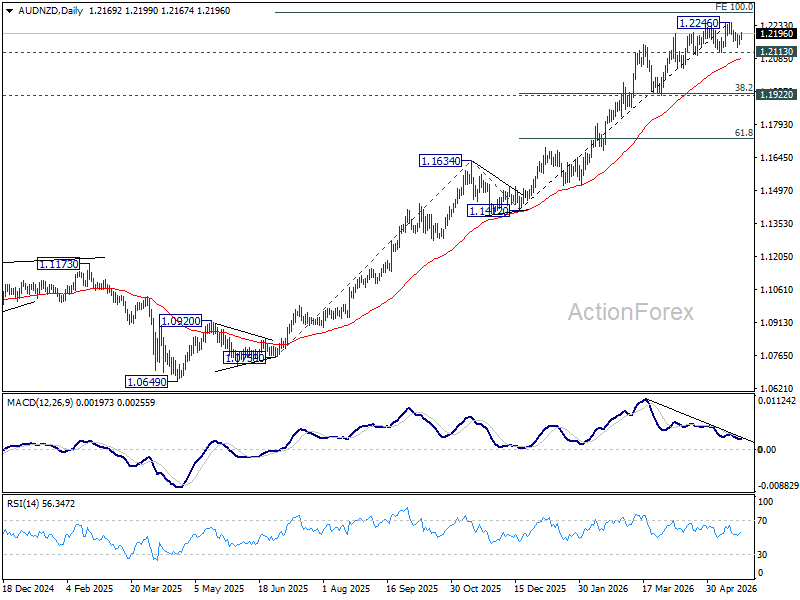
That is why AUD/NZD suddenly looks dangerous. Near 1.2200, the cross has already started flashing technical warning signs, with bearish divergence developing on D MACD as upside momentum fades.
Resistance near 100% projection of 1.0759 to 1.1634 from 1.1412 at 1.2287 could become a major ceiling if the RBNZ surprises hawkishly while Australian inflation disappoints.
Decisive break below 1.2113 support would strongly suggest that a medium-term top is already in place, opening a much deeper slide toward 1.1922 cluster support (38.2% retracement of 1.1412 to 1.2246 at 1.1927).
RBNZ Shadow Board Backs Hold at 2.25%, Three Call for Immediate Hike
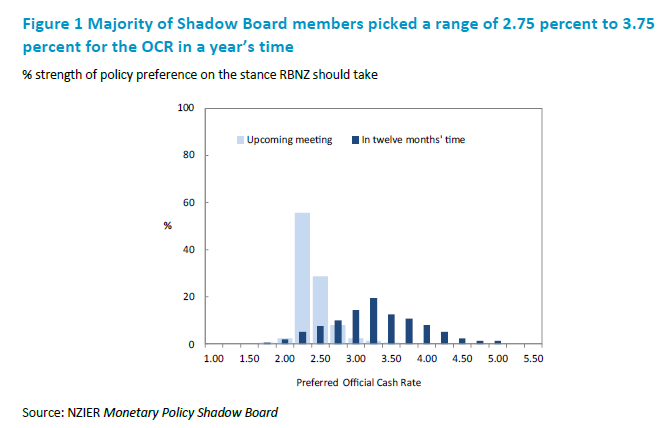
A split emerged within the NZIER Monetary Shadow Board ahead of this week’s Reserve Bank of New Zealand policy decision. While the majority recommended keeping the Official Cash Rate unchanged at 2.25%, several members argued that tightening should begin immediately as inflation pressures build.
The majority view centered on weak domestic conditions and geopolitical uncertainty. Members pointed to “subdued growth and spare capacity” in the New Zealand economy, alongside uncertainty surrounding the US-Israel-Iran conflict, as reasons to leave policy unchanged for now. However, three members favored a rate increase, warning that “the real interest rate has remained low for a prolonged period,” which they believe is “adding to inflation pressures.”
Despite the near-term split, the board broadly agreed that rates will need to move higher over the coming year, with most expecting the OCR to rise into a 2.75% to 3.75% range. The debate mirrors broader global central bank tensions, where policymakers are weighing whether to look through the latest fuel shock because growth is soft, or tighten sooner to prevent inflation expectations from becoming entrenched.
ECB’s Lagarde Signals Higher Inflation Forecasts, June Hike Bets Firm
ECB President Christine Lagarde opened the door wider to a June rate hike after signaling that the central bank’s inflation forecasts are likely to move higher again. Lagarde said the ECB’s March projection of 2.6% inflation for 2026 “will probably be revised,” noting that “the situation has evolved” since those estimates were published.
Although Lagarde avoided directly committing to tighter policy, she stressed that policymakers must “look at all the data available” and evaluate “whether action is needed.” She also reiterated that the ECB’s objective is “2% medium term,” reinforcing that inflation credibility remains central to policy discussions.
The comments are likely to strengthen market conviction that the ECB will raise rates by 25bps next month. Several policymakers have already hinted that prolonged energy-driven inflation risks could force the Governing Council to act sooner rather than later.
Iran Talks Drive Market Focus as USD/JPY Tests Higher
The week remained focused on the Iran situation, as negotiations reached an important stage. Some progress was reported, but major issues remained, especially around Iran’s uranium enrichment program and how quickly sanctions could be eased.
USD/JPY pushed higher as the Bank of Japan stayed on the sidelines and markets continued to focus on the gap between US and Japanese interest rates. US economic data was weaker than expected, with the University of Michigan consumer sentiment report falling to 44.8 from 48.2. Fed Governor Christopher Waller also pushed back against hopes for early rate cuts, supporting the view that US rates may stay high for longer.
WTI oil fell back toward $100 as hopes for a settlement reduced some of the immediate supply fears. Even with geopolitical risks, US stock markets finished the week higher. The Dow reached a new record high, and the S&P 500 rose for the eighth straight week, helped by continued interest in AI stocks.
Markets This Week
US Stocks
The Dow reached new record highs as worries about inflation and higher interest rates were outweighed by optimism about future company earnings. The uptrend remains strong, and with the potential for progress toward ending the conflict with Iran in the coming week, focusing on buying opportunities looks to be the best strategy.
Resistance levels are at 51,000, 51,500 and 52,000. Support is seen at 50,000, 49,500, 49,000, 48,500 and 48,000.
Japanese Stocks
The Nikkei 225 returned to record highs as lower oil prices and a strong outlook for AI-related companies supported positive market sentiment. The recovery is encouraging, but the short-term trend is still moving sideways, so looking for range-trading opportunities may be the preferred strategy this week.
Resistance is seen at 64,000, 65,000, 66,000, 67,000 and 68,000, while support is at 61,000, 60,000, 59,000, 58,500 and 57,000.
USD/JPY
USD/JPY continued to test higher as short-term traders who expected more yen-buying action from the Bank of Japan were caught holding short positions. Comments from the new Fed Chair also supported USD/JPY, as he suggested that interest rate cuts may take longer than expected due to high inflation.
For medium-term traders, selling opportunities ahead of 160 may be the preferred strategy, as intervention risk remains high near that level. For short-term traders, focusing on the current small range or waiting for higher volatility may be the better approach.
Resistance is at 160.00, 160.50, 162.00 and 165.00, while support is seen at 158.00, 157.00, 156.00, 155.50 and 155.00.
Gold
Gold continued to test lower last week as a stronger US dollar and expectations for higher long-term interest rates reduced demand for the metal. The market remains relatively quiet overall, and it was surprising that there was not more selling pressure after prices moved below last month’s lows.
A quick end to the conflict with Iran could bring some buying interest back into gold, but for now, looking for further downside seems most likely to be the best strategy.
Resistance is at $4,550, $4,600, $4,665, $4,750 and $4,900, while support is at $4,500, $4,450 and $4,350.
Crude Oil
WTI crude oil tested higher at the start of the week, but later fell back toward $100 after Trump indicated that talks with Iran were productive and close to a possible conclusion.
The negotiations remain difficult to forecast, but Trump has a strong motivation to end the conflict quickly to help support the US economy. At the moment, headlines about Iran are driving oil prices, and there appears to be more risk to the downside if progress toward a settlement continues.
Resistance is at $105, $110 and $120, while support is at $95, $90, $80, $75, $70 and $67.50.
Bitcoin
Bitcoin fell last week as selling in ETFs and rising long-term interest rates around the world reduced demand for risk assets. Higher yields are becoming more attractive for some investors, which put pressure on Bitcoin.
However, support at $75,000 held, so range-trading opportunities may remain the best strategy as long as this level continues to hold.
Resistance is at $80,000, $85,000 and $90,000, while support is at $75,000, $65,000, $60,000 and $55,000.
This Week’s Focus
- Monday: UK and US holiday
- Tuesday: Japan BoJ Core CPI, US CB Consumer Confidence
- Wednesday: Australia CPI
- Thursday: US Building Permits, Core PCE Price Index, GDP, Durable Goods Orders and New Home Sales
- Friday: Japan Tokyo Core CPI and Industrial Production, EU German Unemployment Rate, US Chicago PMI
USD/JPY will still be important this week, as traders remain cautious about possible Bank of Japan intervention if yen weakness continues. The week may start quietly because of holidays in the UK and US, with no major economic announcements until Thursday.
Markets are likely to focus mainly on headlines from the Iran-US negotiations.
GBPJPY Wave Analysis
GBPJPY: ⬆️ Buy
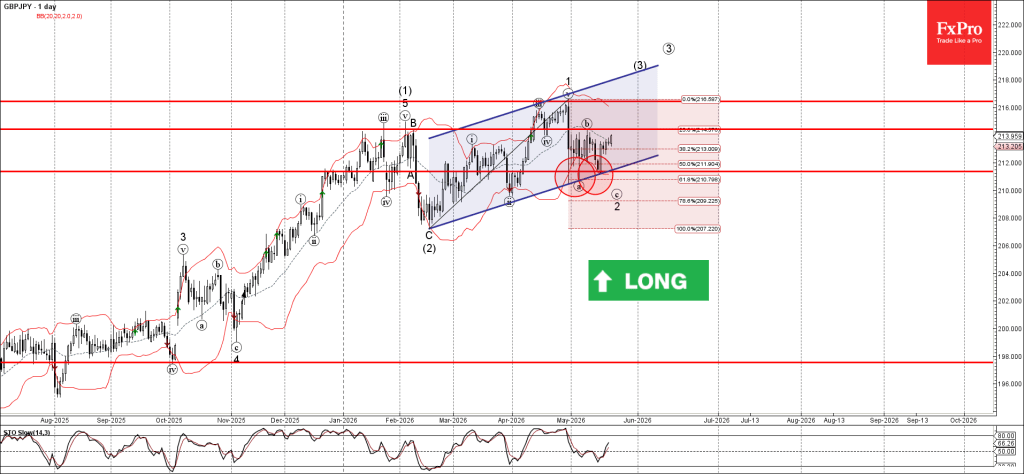
- GBPJPY reversed from support zone
- Likely to rise to resistance level 214.40
GBPJPY currency pair recently reversed up from the support zone between the support level 211.00 (which has been reversing the price from the start of May), lower daily Bollinger Band and the support trendline of the daily up channel from February.
The upward reversal from this support zone stopped the previous minor ABC correction 2 from the end of April.
Given the strong daily uptrend and the continuation of the bearish yen sentiment seen across the FX markets today, GBPJPY currency pair can be expected to rise to the next resistance level 214.4 (top of the pervious wave b).
Dow Jones Wave Analysis
Dow Jones: ⬆️ Buy
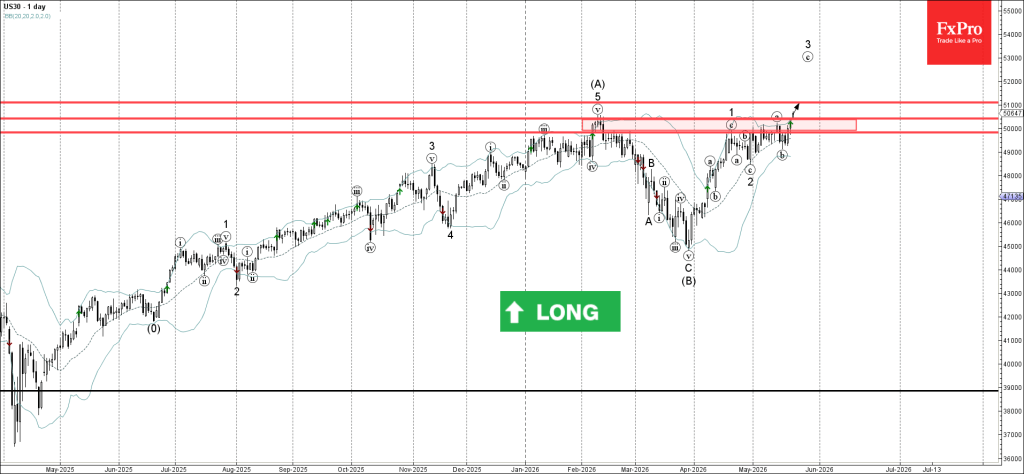
- Dow Jones broke resistance zone
- Likely to rise to resistance level 51000.00
Dow Jones index continues to rise after the earlier breakout of the resistance zone between the resistance levels 50000.00 and 50400.00 (which stopped wave A at the stat of April).
The breakout of this resistance zone should accelerate the active impulse wave 3 – which belongs to the intermediate impulse wave (C) from March.
Given the overriding daily uptrend, Dow Jones index can be expected to rise to the next resistance level 51000.00.
Eco Data 5/25/26
| GMT | Ccy | Events | Act | Cons | Prev | Rev |
|---|---|---|---|---|---|---|
| 12:30 | CAD | Corporate Profits Q/Q Q1 | -2.00% | -1.60% |
| 12:30 | CAD |
| Corporate Profits Q/Q Q1 | |
| Actual | -2.00% |
| Consensus | |
| Previous | -1.60% |
Trump Announces Iran Breakthrough — But Will Oil and Yields Believe It?
Global markets are entering the new week facing an important question: did US President Donald Trump just announce the beginning of real peace in the Middle East, or merely a ceasefire extension in a still-dangerous conflict?
Trump said on Saturday that a major agreement with Iran had been “largely negotiated” and that a formal Memorandum of Understanding would soon be announced. Iranian officials also confirmed that discussions are moving toward a first-stage framework. Optimism centered on the possibility of easing tensions around the Strait of Hormuz, the vital artery for global energy trade that has remained at the center of market anxiety for months.
Yet the deeper details suggest investors may remain cautious about fully embracing the breakthrough narrative. Both Washington and Tehran have indicated that the proposed framework would mainly function as a 30-to-60-day ceasefire extension designed to keep negotiations alive rather than permanently settle the conflict.
More importantly, some of the most explosive disputes remain unresolved. Iran-linked media insist Tehran will retain effective control over transit rules and security management in the Strait of Hormuz, while there still appears to be no meaningful agreement on Iran’s highly enriched uranium stockpile or the broader nuclear issue.
That is why oil prices, Treasury yields, and Dollar may become the real lie detectors for the market this week. If traders truly believe the agreement represents lasting normalization and free reopening of global energy flows, Brent crude should break sharply lower while inflation fears and global yields retreat. But if oil remains elevated and yields continue holding firm, markets would effectively be signaling that they still see the agreement as just another temporary truce rather than a durable peace settlement.
Ceasefire Extension Buys Time, but Permanent Peace Still Far Away
The framework currently under discussion between Washington and Tehran appears designed first and foremost to stop the conflict from reigniting immediately rather than permanently resolve the crisis. While Trump described the agreement as “largely negotiated,” officials on both sides have clarified that the proposed Memorandum of Understanding would effectively function as a 30-to-60-day ceasefire extension intended to create diplomatic space for broader negotiations later this summer.
That distinction is critical for markets. The war that erupted following the February 28 US-Israeli strikes has fundamentally reshaped global energy pricing, inflation expectations, and central bank outlooks. A temporary pause in hostilities may help reduce immediate fears of re-escalation, but it does not automatically remove the structural geopolitical premium embedded in oil prices unless investors believe a durable settlement is genuinely emerging.
In reality, the current framework appears closer to a diplomatic bridge agreement than a comprehensive peace accord. The proposed arrangement would reportedly include limited sanctions relief, partial unfreezing of Iranian overseas assets, and some form of gradual easing of tensions around the Strait of Hormuz. In exchange, Tehran may offer limited concessions, potentially including provisional cooperation on shipping access and a commitment to enter broader nuclear discussions during the next phase of talks.
But the hardest negotiations have effectively been postponed rather than completed. Iranian officials continue signaling that meaningful discussions over the nuclear program and highly enriched uranium stockpile will only begin after hostilities are formally suspended and confidence-building measures are implemented. That means the next 30 to 60 days may prove even more important than the current announcement itself.
For markets, this creates a very different dynamic from a clean peace settlement. Traders are not yet being asked to price a fully normalized Middle East. Instead, they are being asked to price a fragile diplomatic holding pattern where the probability of renewed confrontation has decreased, but where the fundamental drivers of the conflict remain unresolved beneath the surface.
The Real Question Is Not Just Whether Hormuz Reopens — But Who Controls It
Financial markets may ultimately judge Trump’s Iran breakthrough based on one issue above all others: the future of the Strait of Hormuz.
While headlines initially focused on the possibility of reopening the critical energy corridor, the deeper dispute quickly became clear over the weekend. Iranian-linked media strongly pushed back against suggestions that Tehran would surrender operational control over the Strait as part of the proposed agreement. Instead, officials tied to the IRGC emphasized that management of shipping routes, transit procedures, and passage permits would remain entirely under Iranian authority.
That creates a major problem for markets attempting to price a genuine return to normal global energy flows. Washington’s position has consistently centered around restoring unrestricted international access through Hormuz, while Tehran increasingly appears determined to preserve the leverage it gained during the conflict. Iran’s proposed transit system — including vetting mechanisms, controlled routing, and “security fees” for shipping — effectively turns Hormuz into a managed geopolitical pressure point rather than a fully normalized commercial corridor.
For oil traders, this distinction is enormous. As long as Tehran retains the ability to control shipping conditions inside Hormuz, a meaningful geopolitical premium is likely to remain embedded in oil prices. The implications extend far beyond energy markets. Persistently elevated oil prices would continue feeding inflation concerns globally, complicating the outlook for major central banks already struggling with the economic fallout from the conflict.
Iran’s Uranium Stockpile Remains the Unresolved Core of the Conflict
One of the most striking aspects of Trump’s Iran announcement was not what it included — but what it left out.
Despite months of US rhetoric emphasizing Iran’s nuclear program as a central threat, the proposed framework appears to contain little immediate progress on Tehran’s highly enriched uranium stockpile or the broader nuclear dispute. Instead, Iranian officials and hardline media suggest those negotiations are effectively being deferred into the next stage of diplomacy, potentially weeks or months away.
That sequencing matters enormously. Tehran is reportedly insisting that sanctions relief, asset unfreezing, and stabilization measures must come first before it considers substantive concessions on enrichment or international oversight. In effect, Iran appears to be treating the current framework as a mechanism to reduce immediate economic and military pressure while postponing the most politically sensitive elements of the negotiations.
For markets, this reinforces the idea that the current agreement may function more as a diplomatic bridge than a final settlement. The ceasefire framework may reduce the immediate risk of renewed strikes or energy disruptions, but it does not yet resolve the deeper strategic confrontation surrounding Iran’s nuclear capabilities. As long as the uranium issue remains unresolved, traders are unlikely to fully embrace the narrative of lasting geopolitical normalization in the Middle East.
Oil Will Be the First and Most Important Market Verdict
If markets are going to deliver a real-time verdict on Trump’s Iran breakthrough, Brent crude will almost certainly be the most important gauge to watch this week. Oil has been the central transmission channel through which the entire conflict has affected global markets — driving inflation fears, bond yields, central bank expectations, and broad risk sentiment. That means the credibility of the agreement will ultimately be tested first through energy pricing.
Brent crude already retreated sharply from last week’s spike high at 112.72 to close near 104.24 after diplomacy headlines emerged. But importantly, oil has not collapsed. Instead, price action remains trapped firmly inside the large converging triangle pattern that has dominated the market since the March peak at 119.50.
In many ways, that technical structure reflects the evolution of the crisis itself: the initial phase was pure geopolitical panic, while the current phase has transitioned into a slower-moving inventory depletion and supply-risk cycle.
As long as Brent remains elevated above key technical support levels, markets are effectively signaling that geopolitical risk premiums remain intact. Traders may believe the probability of immediate military escalation has decreased, but they are not yet convinced that physical oil flows through the Strait of Hormuz are genuinely returning to normal conditions.
Technically, Brent oil might gyrate lower to 96.03 support and possibly below in the next few days. But the most critical level sits at 100% projection of 115.30 to 96.03 from 112.71 at 93.45. Until Brent decisively breaks below that level on a daily closing basis, current fall is just one of the legs inside the mentioned triangle pattern. That is, the market is likely treating Trump’s announcement as a temporary de-escalation rather than a structural peace settlement.
However, if Brent breaks firmly below 93.45, the market narrative could shift rapidly. That would likely signal growing confidence that physical supply normalization is genuinely underway and that the geopolitical premium embedded since March is finally beginning to unwind. In that scenario, downside acceleration toward 86.09 and even 161.8% projection at 81.54 could become realistic targets.

Bond Markets Still Need Convincing Before Inflation Fears Truly Fade
While oil prices will likely deliver the first verdict on Trump’s Iran breakthrough, Treasury yields may ultimately determine whether markets genuinely believe the inflation shock tied to the conflict is starting to reverse. The global bond selloff accelerated sharply over the past two months as investors increasingly priced the risk that elevated energy prices would feed into broader inflation pressures and force central banks back toward tightening.
That concern remains very much alive. US 10-year Treasury yield surged as high as 4.69% last week before pulling back modestly to close near 4.56. Importantly, yields remain comfortably above the critical 4.48 resistance-turned-support zone. As long as that level holds, markets are effectively signaling that inflation fears tied to oil, shipping disruptions, and second-round price effects have not meaningfully disappeared.
The timing issue is becoming increasingly important for central banks. Institutions such as ECB have largely spent recent weeks in wait-and-see mode, hoping that tensions surrounding the Strait of Hormuz would ease quickly enough to prevent a broader inflation spiral. But with oil prices still elevated and uncertainty surrounding Hormuz unresolved, policymakers are running out of time to simply “look through” the shock. Markets are now increasingly leaning toward another ECB hike in June, while fed fund futures are pricing roughly a 68% chance of a Fed hike by December back to 3.75–4.00%.

That shift also complicates the transition inside the Federal Reserve itself. Kevin Warsh may now be formally installed as Trump’s successor as Fed Chair, but elevated oil prices and sticky inflation risks could sharply limit his room to steer policy toward easier conditions. In fact, Jerome Powell’s decision to remain on the Board of Governors after leaving the Chair role may prove one of the most important underappreciated developments for markets.
Powell staying on the Board is highly unusual historically and creates a powerful hawkish counterweight inside the Fed. As Chair, Powell had to constantly balance internal factions and maintain consensus. But as a regular Governor, he no longer carries the burden of diplomacy. Instead, he becomes a single but extremely influential voting member capable of openly resisting premature easing if inflation risks remain elevated.
Technically, 10-year yields remain one of the clearest market confirmation gauges. A decisive break below 4.48 would suggest investors are beginning to genuinely price disinflation and fading energy risks again, opening room for 38.2% retracement of 3.96 to 4.69 at 4.41 and providing relief for equities.
But if yields remain firmly above that zone, the bond market may effectively be signaling that Trump’s Iran deal has not yet solved the underlying inflation problem at all.

Dollar the Final Confidence Gauge for Global Markets
In many ways, Dollar may become the final and most comprehensive test of whether markets truly trust Trump’s Iran breakthrough.
The greenback has benefited throughout the conflict from a powerful combination of safe-haven demand, elevated Treasury yields, and rising expectations that Fed may need to stay tighter for longer due to oil-driven inflation pressures. For Dollar to reverse meaningfully now, markets would need confidence not only that geopolitical tensions are easing, but also that energy prices and inflation risks are genuinely starting to normalize.
That has not happened yet. Dollar Index’s extended rebound from 97.62 and subsequent break above 99.31 last week indicate that the pullback from 100.64 may already have completed. More importantly, the recovery came after firm defense of 61.8% retracement of 95.55 to 100.64 at 97.49 — a technical development suggesting underlying bullish momentum in Dollar remains intact for now.

If oil prices stay elevated and Treasury yields remain firm, Dollar is unlikely to weaken meaningfully even if diplomatic headlines continue improving. Markets would effectively continue treating the geopolitical shock as unresolved, maintaining demand for Dollar through both safe-haven flows and rising US yield support.
Under that scenario, Dollar Index could extend higher toward 100.64 again and potentially even 38.2% retracement of 110.17 to 95.5 at 101.13. Nevertheless, barring an actual escalation (e.g., direct kinetic actions), Dollar Index will likely struggle to breach 101.13 purely on headline momentum.
However, the opposite scenario is equally important to monitor. If Brent crude breaks decisively lower and US 10-year yields fall through key support levels, Dollar could quickly lose momentum as markets aggressively unwind geopolitical and inflation positioning.
Sustained break below 55 D EMA (now at 98.72) would strongly suggest the fall from 100.64 is resuming through 97.62 towards 95.55 low. That would likely signal investors are finally becoming convinced the Iran agreement represents more than just another temporary ceasefire extension.
EUR/USD Weekly Outlook
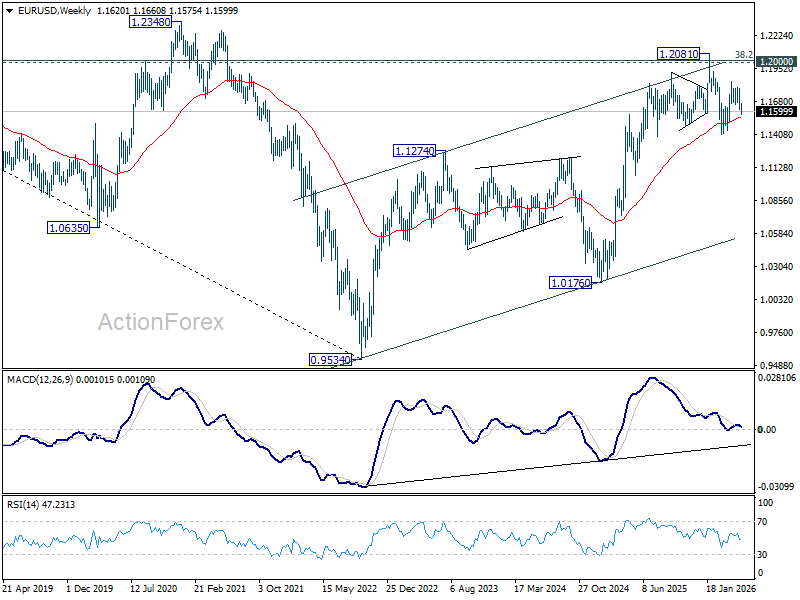
EUR/USD's extended decline suggests that corrective rebound from 1.1408 has completed at 1.1848. But as a temporary low was formed at 1.1575, initial bias remains neutral this week first. On the downside, below 1.1575 will bring deeper fall back to retest 1.1408 low. However, firm break of 1.1660 resistance will dampen this bearish view, and bring stronger rise back to 1.1795 resistance first.
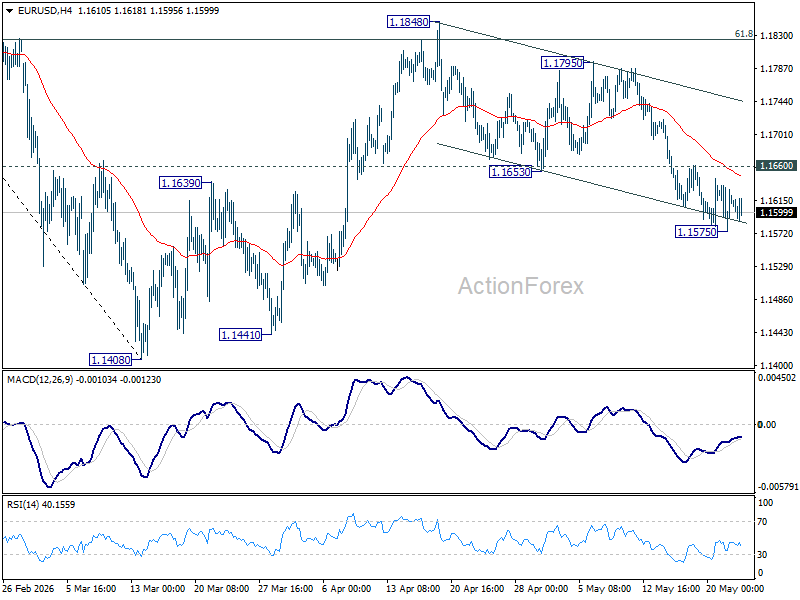
In the bigger picture, the strong support from 38.2% retracement of 1.0176 to 1.2081 at 1.1353 suggests that the pullback from 1.2081 is more likely a corrective move. Strong support was also found in 55 W EMA (now at 1.1542). Focus is back on 1.2 key cluster resistance level. Decisive break there will carry long term bullish implications. Nevertheless, break of 1.1408 support will revive the case of medium term bearish trend reversal.
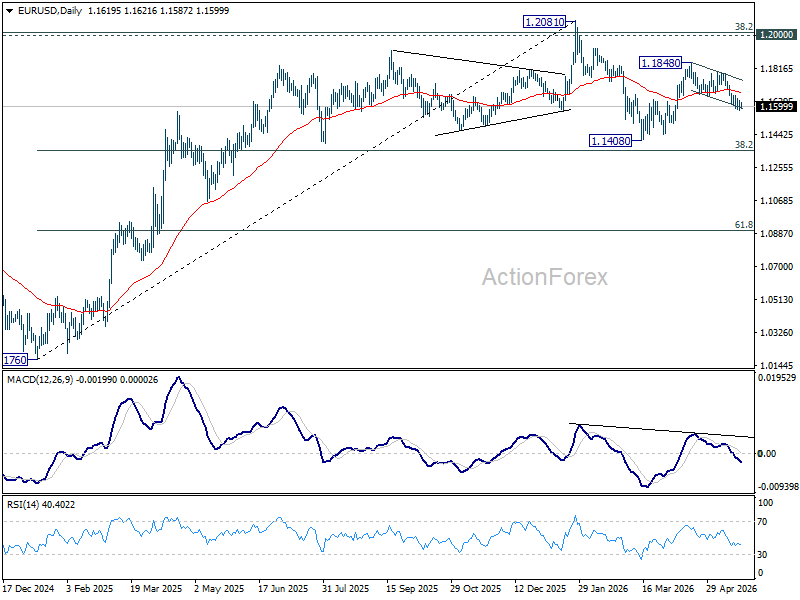
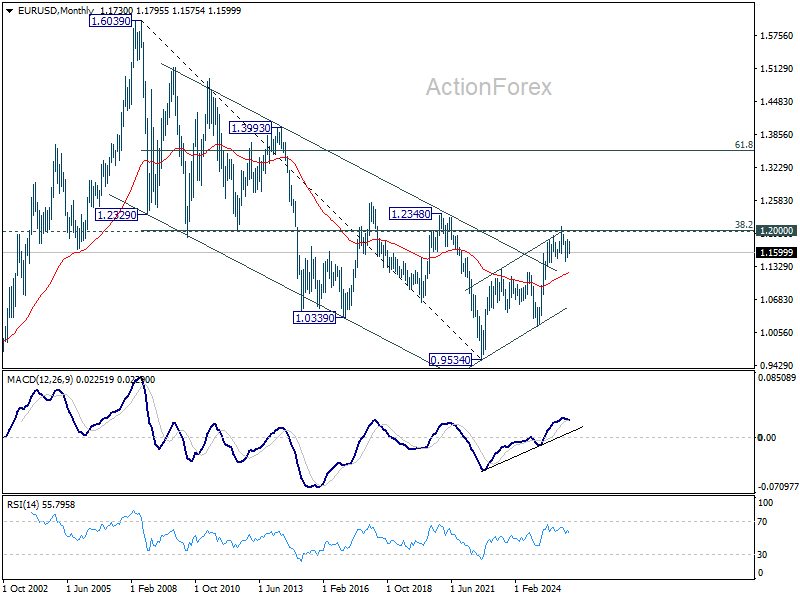
In the long term picture, 38.2% retracement of 1.6039 to 0.9534 at 1.2019, which is close to 1.2000 psychological level is the key for the outlook. Rejection by this level will keep the multi decade down trend from 1.6039 (2008 high) intact, and keep outlook neutral at best. However, decisive break of 1.2000/19, will suggest long term bullish trend reversal, and target 61.8% retracement at 1.3554.