Sample Category Title

EUR/AUD Weekly Outlook

ActionForex

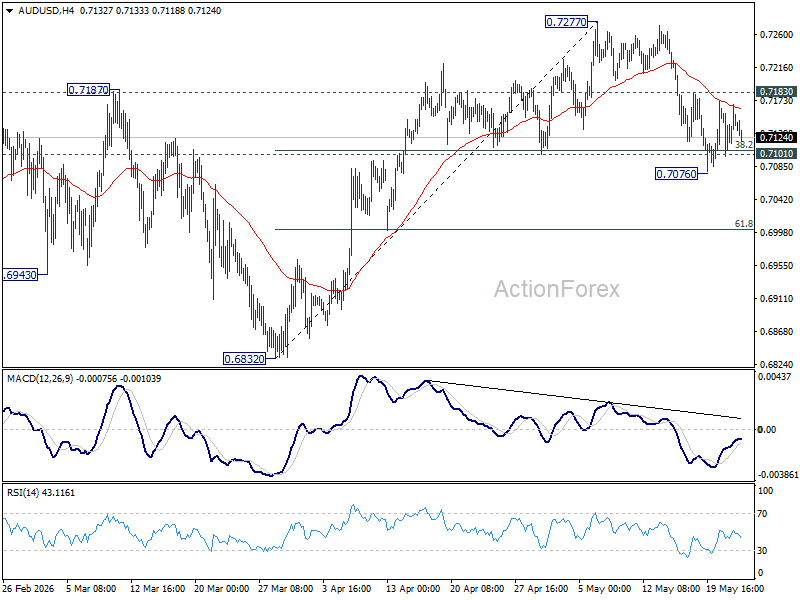
EUR/AUD's extended pullback last week suggests that rebound from 1.6125 has completed at 1.6842, after rejection by 55 D EMA (now at 1.6720). But as a temporary low as formed at 1.6497, initial bias is turned neutral this week first. On the downside, break of 1.6497 will target a retest on 1.6125 low. Nevertheless, firm break of 1.6708 will should resume the rebound from 1.6125 through 1.6842 to 38.2% retracement of 1.8554 to 1.6125 at 1.7053.

In the bigger picture, fall from 1.8554 (2025 high) is in progress and deeper decline should be seen to 61.8% retracement of 1.4281 to 1.8554 at 1.5913, which is slightly below 1.5963 structural support. Decisive break there will pave the way back to 1.4281 (2022 low). For now, risk will stay on the downside as long as 55 W EMA (now at 1.7184) holds, even in case of strong rebound.

In the longer term picture, fall from 1.8554 is seen as the third leg of the pattern from 1.9799 (2020 high), which is part of the pattern from 2.1127 (2008 high). Sustained trading below 55 M EMA (now at 1.6592) will confirm this bearish case, and pave the way back towards 1.4281.

EUR/CHF Weekly Outlook

EUR/CHF stayed in sideway trading below 0.9264 last week and outlook is unchanged. Initial bias remains neutral first, and further rise is expected with 0.9155 support intact. Firm break of 0.9264 will resume the rebound from 0.8979 to 0.9394 resistance next. However, break of 0.9155 will turn bias back to the downside for deeper pullback.

In the bigger picture, considering bullish convergence condition in W MACD, a medium term bottom should be in place at 0.8979. Sustained trading above 55 W EMA (now at 0.9283) will add more credence to this case. Further break of 0.9394 resistance will pave the way to 0.9660 resistance next. However rejection by the 55 W EMA will set up another fall through 0.8979 low at a later stage.

In the long term picture, outlook will stay bearish as long as 0.9407 support turned resistance (2022 low) holds. However, firm break of 0.9407 will argue that the down trend from 1.2004 (2018 high) has completed with five waves down to 0.8979. Stronger rebound should then be seen to 38.2% retracement of 1.2004 to 0.8979 at 1.0135 in the medium term.

Markets Weekly Outlook – Markets Brace for US-Iran Talks Amid Post-Ceasefire Surge

  • The announcement of a tentative US-Iran ceasefire led to the "unwinding of the fear trade".
  • The S&P 500 and Nasdaq Composite both enjoyed a strong recovery, finishing green for seven consecutive trading sessions. History suggests this momentum is set to continue.
  • The week ahead is dominated by central bank activity, specifically commentary from the RBNZ, employment data impacting the RBA's decision, and the ECB's balancing act on rate hikes.

The trading week was nothing short of a roller coaster, dominated by a dramatic shift in geopolitical sentiment that sent volatility through the energy and metals complexes. For much of the week, the primary narrative was the "unwinding of the fear trade" following the announcement of a tentative US-Iran ceasefire.

Oil was the biggest casualty of this cooling rhetoric. Brent crude, which had been knocking on the door of triple digits amid threats to the Strait of Hormuz, tumbled as much as 15% mid-week.

Gold, too, felt the pinch. After stalling at the $4,900 resistance level, the yellow metal saw its war premium erode, though it remains supported by a softer US Dollar. Speaking of the Greenback, the DXY is currently hovering near a critical "Golden Cross" support at 98.50.
OAU Share CFDs on MT5

US equities enjoyed a strong recovery after the ceasefire news.The S&P 500 has finished green for 7 consecutive trading sessions, the longest streak since October 2025. The index has rallied +7.6% over this period, recovering nearly the entire war decline.

A similar 7-day stretch has also been recorded by the Nasdaq Composite, the longest since August 2025.

Source: TradingView

Since the 1950s, the market has seen a similar streak with at least a +7.0% gain only 9 other times, per Carson Investment Research.

Following this, the S&P 500 has been higher in 8 of those instances over the next month, with an average return of +4.4%.

Over the following 3 months, the market has been up in 7 instances and has gained +10.2% on average.

History suggests market momentum is set to continue.

This was despite US inflation data rising 0.9% MoM with headline inflation rising to its highest in 2 years. Inflation data had been the key data release this week and came in largely in line with estimates which left markets to focus on the geopolitical narrative as the week came to a close.

Heading into the weekend, markets are rather optimistic as the US-Iran prepare for talks in Pakistan scheduled to start on Saturday. The talks will likely have a massive impact on whether markets kick the new week off on a risk off or risk on tone.

The Week Ahead: Central Banks in the Crosshairs

Here is the summary of what I will be watching for next week in Asia, the US, Eurozone (EU), and UK with a quiet week expected from an economic data perspective.

China & Japan: Asian Resilience?

In China, market participants will be monitoring trade data and liquidity injections from the PBoC. With global growth concerns lingering, any sign of domestic stimulus will be welcomed by equity bulls. In Japan, the Nikkei 225 remains on a knife-edge. We are watching the 50-day Moving Average closely; a sustained break below this level could confirm bearish breakdown conditions, especially if JPY strength persists as a safe-haven play.

Australia & New Zealand: RBA and RBNZ in Focus

The NZD/USD is currently testing major support at 0.5700. The upcoming RBNZ commentary will be pivotal; a dovish tilt here could see the Kiwi break lower. Across the Tasman, Australia’s employment data will provide the RBA with the ammunition needed to decide if they can afford to pause or if the inflationary spillover from energy costs requires one more hike.

Europe & UK: The ECB’s Balancing Act

Despite the ceasefire, European equities have remained cautious. The ECB is still pricing in two rate hikes, fueled by the lag effect of energy prices on core inflation. We’ll be watching the Euro (EUR/USD) to see if it can capitalize on a potentially stalling Dollar or if the Eurozone’s sluggish growth outlook keeps a lid on any rallies.

The US: Geopolitics in focus as data remains light

A very quiet week in the US with the Fed’s Beige Book the highlight of the week. Markets are likely to be more engrossed by developments around the weekend talks with Iran and how that might shape markets and the US dollar in the week ahead.

For all market-moving economic releases and events, see the MarketPulse Economic Calendar. (click to enlarge)

Chart of the Week - Nasdaq 100

From a technical standpoint, The Nasdaq 100 (US100) is currently exhibiting a strong bullish reversal after finding significant support near the 22,800 handle in late March.

The index has staged an impressive breakout above the descending trendline that has constrained price action since the February peaks, signaling a shift in momentum.

This trendline (channel) breakout sets the index up for a potential move of 2000-odd points to the upside, around the 26500 handle.

Currently, price is wrestling with the 100-day Simple Moving Average (red line) at 25,013, which coincides with a structural resistance level. A daily close above this zone would clear the path for a retest of the 25,320 horizontal barrier.

The RSI (14) is trending upward at 60.9, suggesting there is still room for further gains before reaching overbought territory.

However, traders should watch for potential pullbacks toward the 200-day SMA (yellow line) at 24,568, which now serves as a key dynamic support. A failure to hold above this level would negate the recent breakout.

NASDAQ 100 Daily Chart, April 10, 2025

Source:TradingView.Com (click to enlarge)

Metals Lost in Translation; Risk-Assets or Safe-Haven? – Silver (XAG/USD), Gold (XAU/USD) & Copper (XCU/USD) Outlook

  • Silver, Gold and the entire metals Market have been trading in confusion around US-Iran conflict and ceasefire news.
  • Struggling to find stable ground, Participants wonder if they are still true safe-havens.
  • Daily timeframe analysis for XAG/USD, XAU/USD and XCU/USD (Copper).

Metals have been an essential store of value and currency since the dawn of humanity.

Traditionally seen as safe havens, however, their price action has been nothing but confusing, even before the onset of the conflict.

Following the appointment of Kevin Warsh as head of the Federal Reserve, a massive wave of profit-taking triggered an unavoidable crash. They managed to retain a large part of their 2025 appreciation but haven't found stable ground despite the evident appeal of safe havens.

Having stalled their corrections as geopolitical sentiment was starting to heat up (Greenland Crisis, Iran revolts leading to the War), the precious metals still could not muster the appeal to return to their January highs.

Metals performance in 2026 – Source: TradingView, April 10, 2026.

As you can see on the 2026 performance chart, metals reacted almost the opposite of what most Participants would have expected, particularly at the beginning of the War.

This dynamic continued with them only rebounding as rumors of a ceasefire and negotiations began, pointing to a new realization: Around current levels, Metals are now behaving like risk assets.

This reminds us that all asset classes and correlations move a certain way in "normal" Markets, but such historic trends can change brutally when:

  • Prices get extreme and/or
  • When volatility gets extreme (and Markets break).

Turning back to today, what will happen if the war actually ends? Will they continue going higher?

Why look for quite expensive safe havens if there are no more fundamental reasons to do so?

If they are really risk assets, they should keep bouncing, but buying discounted Stocks and Cryptos makes more sense for a risk-on trade.

Once again, these are million-dollar questions.

Let's dive right into a Daily timeframe analysis of Gold (XAU/USD), Silver (XAG/USD), and Copper (XCU/USD) to see if technicals can tip the scales in favor of one side of the asset equation.

Gold (XAU/USD) Daily Chart and levels

Gold (XAU/USD) Daily Chart, April 10, 2026 – Source: TradingView

Gold recovered strongly since reaching a catastrophic bottom two weeks ago, wicking at its 200-Day Moving Average (which remains a long-term barometer for bull-bear price action).

On the bigger picture however, the trend remains much weaker for the yellow metals, and while not as bearish anymore, struggling to breach $4,900 puts the action into a sideways consolidation until further news.

This gets confirmed with the neutral daily RSI.

Look for a range between $4,400 and $4,800 until breakout or breakdown follows. Nearing resistance, some short-term downside could be expected soon.

Higher Timeframe Levels to watch for Gold (XAU/USD):

Resistance Levels:

  • $4,850 to $4,900 Key Resistance
  • $5,100 Pivotal Resistance
  • $5,400 Wartime Resistance
  • Current All-time Highs – $5,500 to $5,600

Support Levels:

  • Intraday Momentum Pivot $4,675 (Short-term bearish below)
  • December Record $4,548
  • Pivotal Support $4,400 – Long-term Bearish below
  • $4,175 200-Day MA
  • Main Support $3,880 to $4,050
  • $3,200 to $3,500 Major Support

Silver (XAG/USD) Daily Chart and levels

Silver (XAG/USD) Daily Chart, April 10, 2026 – Source: TradingView

Silver, more prone to risk, has been tracking better than its yellow peer.

Still, the precious metal is evolving within its Daily Pivot zone ($75 to $79) and will soon face a very essential test ahead: Its 50-Day Moving Average ($79)

  • Breaking it to the upside should see continuation back towards $84 at least
    • $90 may quickly follow if momentum gathers pace
  • Rejecting it however would point it back towards $64
    • More rangebound conditions could emerge for the long-run if it finds support there.

Higher Timeframe Levels to watch for Silver (XAG/USD):

Resistance Levels:

  • 50-Day Moving Average ($79)
  • Key Momentum Pivot $75 to $79
  • Major Resistance $84.50
  • Key psychological resistance $100 to $104
  • Current Record $121.67

Support Levels:

  • Weak support at trendline ($73.20)
  • Minor 2026 Support $70 to $72
  • December FOMC Minor Support $64 to $66
  • $50 to $55 October Resistance now Major Support

Copper (XCU/USD) Daily Chart and levels

Copper (XCU/USD) Daily Chart, April 10, 2026 – Source: TradingView

Copper is the only metal that has managed to form a significant bounce after retesting its 200-Day MA just last week.

Bulls are still in control but will need to breach the key $5.90 level (top of daily pivot zone).

Failing to break it to the upside could see a retest of the $5.50 Support, into a more rangebound price action ahead.

Higher Timeframe Levels to watch for Copper (XCU/USD):

Resistance Levels:

  • $5.90 Major Momentum Pivot
  • $6.00 to $6.10 Early Jan 2026 Record
  • Current ATH Resistance $6.40 to $6.50
  • $6.52 Current Record
  • Potential Resistance $6.90 to $7.00

Support Levels:

  • Minor Support at March 2025 Highs $5.40 to $5.50
  • War lows $5.18
  • 200-Day MA $5.24
  • Major Monthly Support between $4.90 to $5.00

Keep closely track of the latest war headlines, but don't fall in narrative traps as metals have now been moving on pure price action (and confusion).

Safe Trades!

The Weekly Bottom Line: Oil Prices – To the Moon and… (May Be) Back

Canadian Highlights

  • The ongoing U.S.-Iran conflict continues to dominate the headlines, pushing oil prices closer to recent highs.
  • Monthly GDP and trade data shows Canada’s economy started the year on a steadier footing.
  • The Bank of Canada maintained its dovish tone in its Summary of Deliberations, but acknowledged the two-sided risks on growth and inflation stemming from the war.

U.S. Highlights

  • President Trump’s speech on Wednesday dashed hopes of a swift resolution to the conflict in Iran, sending crude oil prices higher.
  • Retail sales rebounded in February after two months of stagnation. Meanwhile, JOLTS data indicated that the labor market remained in a low-hire, low-fire mode during February.
  • Unless March payroll figures surprise meaningfully on the downside tomorrow, this week’s data supports the Federal Reserve’s current cautious, wait-and-see stance.

Canada – Barreling Ahead

WTI prices surged another 20% this week to over $110/bbl amid fading hopes for a quick resolution to the U.S.-Iran war. In his speech last night, President Trump’s hawkish remarks did little to ease markets, providing no timeline for a conflict resolution and warning of a possible escalation in coming weeks. Iran also doubled down on comments that it denies seeking a ceasefire, while insisting the Strait of Hormuz will remain closed and under its control. Despite the increase in oil prices, the Canadian dollar weakened by 0.7% to 71.9 cents U.S., as safe-haven flows and strong domestic data south of the border put a bid under the U.S. Dollar. Elsewhere, Canadian yields eased slightly this week as hawkish bets for Bank of Canada rate hikes later this year were pared back slightly.

Canadian data this week gave a clearer picture of economic momentum prior to oil price shock. Industry-level GDP for the month of January showed Canada’s economy started the year on a firmer footing than many feared amid lacklustre Q4-2025 results. The reading was still on the softer side, growing by a modest 0.1% month-on-month (m/m), but it outpaced both Statistics Canada and market expectations for no growth. What’s more, early signs are pointing to an acceleration of 0.2% m/m real GDP growth in February, putting quarterly growth on track achieve trend-like results (Chart 1). Though positive on the margin, these readings may hold slightly less weight coming before the oil price shock impacted the economy.

February’s international merchandise trade data also gave us another look at Q1 growth conditions. It was a sturdy month, as both exports and imports sharply reversed course from last month’s sagging activity (Chart 2). Gains on both sides of the ledger were broad-based as most subsectors booked a gain, though a bounce-back in auto-sector activity did a lot of the heavy lifting. The recent meteoric rise in oil prices will start to show up in the March data, boosting nominal trade momentum into the second quarter, which should help narrow Canada’s trade deficit. Elsewhere in trade, Canadian representatives are slowly re-engaging U.S. counterparts after a quiet few months, with hopes of smooth negotiations ahead of the July 1st CUSMA review.

The ongoing energy price shock and trade risks are still clouding the near-term outlook. In their Summary of Deliberations released this week, Bank of Canada Governing Council members recognized these challenges, but agreed to “look through” the spike in oil-driven inflation spike, opting instead of a more data-driven approach to policy setting. For now, the Bank maintains its dovish stance from the March policy meeting, given Canada’s economy remains sub par, with recent softness in core inflation and growth risks that tilt toward the downside. We expect the BoC to remain on the sidelines at their April 29th meeting, but will plan to monitor this shock carefully – weighing downside risks to growth against the upside inflationary impacts – and is prepared to act if circumstances change.

U.S. – Oil Prices: To the Moon and… (May Be) Back

Financial markets were volatile this week amid uncertainty on the duration of the Middle East conflict. The S&P 500 traded lower initially but rebounded mid-week on signs of de-escalation in the U.S.–Iran conflict. Treasury yields and crude prices also eased on the news, though the reprieve was brief. Like Artemis II, Trump’s speech on Wednesday night sent oil prices to the moon again on Thursday morning. While Trump reaffirmed a 2–3 week timeline for ending U.S. military involvement, he dashed hopes for a peace deal, promising to hit Iran “extremely hard”, and said that re-opening the Strait of Hormuz was not a U.S. goal.

Even if the U.S. reduces its military attacks soon, oil prices could stay high: ramping up production and repairing infrastructure takes time, and supply risks persist if the Strait of Hormuz remains closed or below capacity. Inflationary risks are tilted upward even as our latest report notes the latest oil shock is unlike the one in 2022 in some ways. This shock is more concentrated in oil, with natural gas and agricultural commodity prices contained.

The economic backdrop is also different. Supply chains weren’t strained before the latest price shock, the labor market has cooled, and the economy isn’t firing on all cylinders. Still, with gas prices rising to $4/gallon this week, and signs that the conflict is adding pressure to other commodities, higher inflation is in the cards (Chart 1). This week’s data showed households’ inflation expectations jumped in March.

This is the fourth price shock to hit households in five years, arriving amid a slowing labor market. JOLTS data showed hiring declined in February, while job openings and layoffs were steady but low, suggesting the labor market remains in a low-hire, low-fire mode. Markets expect payrolls to rise by 65k in March, similar to the ADP print, and a partial rebound after an unexpected loss of 92k jobs in February. While not yet signaling a sharp deterioration, a cooling labor market leaves households more exposed to negative shocks.

Consumer spending has stayed relatively resilient, but households are inflation-weary and showed caution even before the latest surge at the pump. Retail sales rose 0.6% m/m in February after two months of stagnation (Chart 2). Adjusted for inflation, sales volumes are up only 1% from a year ago. Larger tax refunds may help mitigate higher gas prices, but slower hiring and equities selloff could still weigh on consumption.

With stagflation fears surfacing, the Fed faces a tough balancing act. So far, it seems content to stay on hold. Earlier this week, Fed Chair Powell said oil shocks are typically short-lived and the Fed can remain patient; however, he noted the Fed would act if inflation expectations shift. NY Fed President Williams said, “the current stance of monetary policy is well positioned to balance risks to our maximum employment and price stability goals.” However, if you chase two rabbits, you likely won’t catch either. Let’s hope the Fed doesn’t find itself in that spot.

Economics Week Ahead

United States:

  • Existing Homes Sales (Monday), Tax Day (Wednesday), Fed Speak (Thursday & Friday)

G10 Economies:

  • Australia Employment (Thursday), U.K. Monthly GDP (Thursday)

Emerging Markets:

  • China GDP (Thursday)

U.S. Week Ahead

Existing Home Sales • Monday

Next week kicks off with the latest read on residential activity. The recent spurt in mortgage rates ahead of the critical spring selling season has placed housing in the spotlight. We note that existing sales measure contract closings, which typically take a month or two to complete. And so, March's existing sales report will largely reflect conditions that predate the Iran conflict and the resulting ~40 bps increase in mortgage rates.

But even before geopolitical tensions intensified, buyer demand appeared soft on account of ongoing affordability challenges. Mortgage purchase applications declined 13% in February and rose just 6% in March. Pending home sales, which are signed contracts, did gain modestly in February. Nevertheless, the recent unexpected spike in rates are likely to lead to cancellations and mortgage qualification failures, likely resulting in a slower pace of final sales than what the pending sales number suggests. With that in mind, we expect March resales to have declined to a 3.97 million unit pace, below the current consensus of 4.06 million.

Source: NAR, MBA and Wells Fargo Economics

Tax Day • Thursday

Next Wednesday marks the official end to the 2025 tax season. To date, non-withheld income tax receipts (the amount of money flowing into the Treasury from households) haven't shown any major surprises and are tracking along pretty smoothly compared to previous years (chart).

Individual income tax refunds have tracked a little lighter than we had expected at the start of tax season—around 11% higher than last year, compared to our expectation for 18% growth. Smaller than expected refunds likely means many households had lower annual tax payments, which may result in smaller April-nonwithheld tax receipts to the Treasury. We therefore expect low- to mid-teens growth for April compared to last year. Remember, smaller tax payment flow to the Treasury = smaller rise in the Treasury General Account = more benign funding market conditions for repo, etc.

Fed Speak • Thursday & Friday

There are a number of Fed speakers on the docket next week. Williams (Thurs.) and Waller (Fri.) strike us as the most noteworthy. We consider Williams as a good proxy for the more academically-minded members of the Fed. He doesn't usually shock markets, but his comments will be closely scrutinized for signals on a higher‑for‑longer stance versus the timing of any potential cuts. He has recently stressed that policy is “well positioned,” so any subtle shift in language in the wake of the Iran conflict could be meaningful. Waller, on the other hand, isn’t shy about changing his mind publicly. While he voted with the Committee at the most recent meeting, he dissented in favor of a cut at the one prior. More recently, he has emphasized data dependence and a willingness to hold rates if the data firm, while remaining opposed to hikes.

G10 Week Ahead

Australia Employment • Thursday

Next week’s Australian employment report for March should offer an early read on economic conditions in early 2026, as it is the first labor market release to partially overlap with the onset of the Middle East conflict. That said, it remains too soon for the data to materially affect the RBA’s Cash Rate outlook, given any momentum would largely predate the conflict. In February, the unemployment rate edged up to 4.3% from 4.1%, even as employment rose by 48.9K, driven entirely by gains in part-time jobs that more than offset declines in full-time employment. For March, consensus expects the unemployment rate to hold steady, with job gains slowing to 17.8K.

Absent a significant upside surprise, the RBA’s focus is likely to remain squarely on inflation and the anchoring of inflation expectations. Domestic price pressures are already facing additional upside risks from higher energy costs, which have begun to show up in domestic fuel prices. After reversing course on easing and delivering back-to-back rate hikes that have lifted the Cash Rate to 4.10%, we see the growth and labor market outlook as arguing for greater restraint. While markets have priced in three additional hikes this year, we expect policy to remain on hold, though risks remain skewed toward further tightening should inflation expectations continue to rise.

Source: Bloomberg Finance L.P. and Wells Fargo Economics

U.K. Monthly GDP • Thursday

We expect UK's February GDP to rise 0.1% month-over-month, following a flat print in January. Despite the modest improvement, the outlook for Q1-2026 remains subdued after a weaker-than-expected January and a pullback in retail sales volumes in February. Growth is likely to be mixed across sectors, with some gains in industrial production and services largely offset by weakness in construction. February PMIs were broadly unchanged to slightly weaker compared with January, with the notable exception of construction, where activity declined more sharply. And even if growth were to surprise to the upside, the data predate the escalation of the conflict, which is likely to limit the weight policymakers place on the release.

With growth subdued, inflation starting from a lower trend, weak labor market and contained wage pressures, this backdrop strengthens the case for the Bank of England (BoE) to proceed cautiously and keep the Bank Rate on hold at 3.75%. This is especially true given that the policy rate is already near the top of the BoE’s estimated 2.75%–3.75% neutral range.

Source: Bloomberg Finance L.P. and Wells Fargo Economics

EM Week Ahead

China GDP • Thursday

A slew of data will be released next week to gauge the health and direction of China's economy. Q1 GDP as well as end of quarter activity data will all be closely monitored to see how Middle East tensions are impacting one of the largest oil-importing nations in the world. We forecast GDP growth that is slightly below consensus for Q1; however, March data may be parsed more closely as oil prices rose most sharply over the course of last month of the quarter.

But even if growth and activity surprise to the upside, repeating the 5% growth that was achieved last year will be challenging for China. As we have noted in the past, China has limited policy tools and less willingness to use policy support to spark activity due to negative tradeoffs. A real estate correction is still underway, which should be apparent when home price data are released, and tariffs and trade tensions with the U.S. also complicate China's ambitions as world supplier. For now, we forecast China's economy to grow 4.5% this year, and risks are tilted to the downside given the rise in energy prices. Perhaps Q1 gets off to a better start than we expect, but the later quarters may exhibit the bigger drag on overall growth.

Canada’s Auto Sector to Show Rebound Amid Mixed Home Resales

It’s a relatively quiet week for Canadian data releases with attention focused on February’s manufacturing and wholesale trade reports on Wednesday.

Advance estimates from Statistics Canada pointed to rebounds in both wholesale sales (excluding petroleum and agricultural products) up 2.3%, while manufacturing sales jumped 3.8% in February, supported by higher sales in the transportation subsector and manufactured food products.

Both releases are consistent with earlier reports that disruptions to auto production late last year and early 2026 were temporary. Earlier disruptions were tied to semiconductor shortages at some plants, and the latest disruptions in January due to longer-than-usual winter retooling to produce new models at some plants.

The anticipated rebound in manufacturing and wholesales points to firmer goods sector momentum heading into February, following a softer start to the year. Together with earlier data, these releases reinforce the view that underlying economic activity is gradually improving after a modest gain in January.

Housing’s slow start to the spring

On the services side of the economy, home resales remains under pressure with mixed early market reports for March following four straight declines in resales nationally since October 2025.

Early reports showed higher sales in some markets (including Toronto), but declines continued in Vancouver. Home prices also continued to edge lower in British Columbia, Alberta, and Ontario, but rose in Quebec, parts of the Prairies, and Atlantic Canada.

Overall, real gross domestic product edged up by 0.1% in January with early estimates pointing to continued expansion in February, supporting a pickup in growth through Q1.

On balance, current data are tracking broadly in line with our base case forecast for moderate Q1 growth with momentum building, despite ongoing sector-specific volatility.

Summary 4/13 – 4/17

Monday, Apr 13, 2026

GMT Ccy Events Cons Prev
22:30 NZD Business NZ PSI Mar 48
23:50 JPY Money Supply M2+CD Y/Y Mar 1.60% 1.70%
12:30 CAD Building Permits M/M Feb -0.40% 4.80%
14:00 USD Existing Home Sales Mar 4.01M 4.09M
22:30 NZD
Business NZ PSI Mar
Consensus
Previous 48
23:50 JPY
Money Supply M2+CD Y/Y Mar
Consensus 1.60%
Previous 1.70%
12:30 CAD
Building Permits M/M Feb
Consensus -0.40%
Previous 4.80%
14:00 USD
Existing Home Sales Mar
Consensus 4.01M
Previous 4.09M

Tuesday, Apr 14, 2026

GMT Ccy Events Cons Prev
23:01 GBP BRC Like-For-Like Retail Sales Y/Y Mar 0.70%
00:30 AUD Westpac Consumer Confidence Apr 1.20%
01:30 AUD NAB Business Conditions Mar 7
01:30 AUD NAB Business Confidence Mar -1
03:00 CNY Trade Balance (USD) Mar 107.5B 213.6B
04:30 JPY Industrial Production M/M Feb F -2.10% -2.10%
10:00 USD NFIB Business Optimism Index Mar 98.6 98.8
12:30 USD PPI M/M Mar 1.20% 0.70%
12:30 USD PPI Y/Y Mar 4.60% 3.40%
12:30 USD PPI Core M/M Mar 0.50% 0.50%
12:30 USD PPI Core Y/Y Mar 4.20% 3.90%
23:01 GBP
BRC Like-For-Like Retail Sales Y/Y Mar
Consensus
Previous 0.70%
00:30 AUD
Westpac Consumer Confidence Apr
Consensus
Previous 1.20%
01:30 AUD
NAB Business Conditions Mar
Consensus
Previous 7
01:30 AUD
NAB Business Confidence Mar
Consensus
Previous -1
03:00 CNY
Trade Balance (USD) Mar
Consensus 107.5B
Previous 213.6B
04:30 JPY
Industrial Production M/M Feb F
Consensus -2.10%
Previous -2.10%
10:00 USD
NFIB Business Optimism Index Mar
Consensus 98.6
Previous 98.8
12:30 USD
PPI M/M Mar
Consensus 1.20%
Previous 0.70%
12:30 USD
PPI Y/Y Mar
Consensus 4.60%
Previous 3.40%
12:30 USD
PPI Core M/M Mar
Consensus 0.50%
Previous 0.50%
12:30 USD
PPI Core Y/Y Mar
Consensus 4.20%
Previous 3.90%

Wednesday, Apr 15, 2026

GMT Ccy Events Cons Prev
23:50 JPY Machinery Orders M/M Feb -1.10% -5.50%
09:00 EUR Eurozone Industrial Production M/M Feb 0.20% -1.50%
12:30 CAD Manufacturing Sales M/M Feb 3.80% -3.00%
12:30 CAD Wholesale Sales M/M Feb 0.20% -1.00%
12:30 USD Empire State Manufacturing Apr 0.5 -0.2
12:30 USD Import Price Index M/M Mar 0.80% 1.30%
14:00 USD NAHB Housing Market Index Apr 37 38
14:30 USD Crude Oil Inventories (Apr 10) 2.1M 3.1M
18:00 USD Fed's Beige Book
23:50 JPY
Machinery Orders M/M Feb
Consensus -1.10%
Previous -5.50%
09:00 EUR
Eurozone Industrial Production M/M Feb
Consensus 0.20%
Previous -1.50%
12:30 CAD
Manufacturing Sales M/M Feb
Consensus 3.80%
Previous -3.00%
12:30 CAD
Wholesale Sales M/M Feb
Consensus 0.20%
Previous -1.00%
12:30 USD
Empire State Manufacturing Apr
Consensus 0.5
Previous -0.2
12:30 USD
Import Price Index M/M Mar
Consensus 0.80%
Previous 1.30%
14:00 USD
NAHB Housing Market Index Apr
Consensus 37
Previous 38
14:30 USD
Crude Oil Inventories (Apr 10)
Consensus 2.1M
Previous 3.1M
18:00 USD
Fed's Beige Book
Consensus
Previous

Thursday, Apr 16, 2026

GMT Ccy Events Cons Prev
01:00 AUD Consumer Inflation Expectations Apr 5.20%
01:30 AUD Employment Change Mar 17.9K 48.9K
01:30 AUD Unemployment Rate Mar 4.30% 4.30%
02:00 CNY GDP Y/Y Q1 4.80% 4.50%
02:00 CNY Industrial Production Y/Y Mar 5.40% 6.30%
02:00 CNY Retail Sales Y/Y Mar 2.40% 2.80%
02:00 CNY Fixed Asset Investment (YTD) Y/Y Mar 1.90% 1.80%
06:00 GBP GDP M/M Feb 0.10% 0.00%
06:00 GBP Goods Trade Balance (GBP) Feb -20.3B -14.4B
06:30 CHF Producer and Import Prices M/M Mar 0.20% -0.30%
06:30 CHF Producer and Import Prices Y/Y Mar -2.70%
09:00 EUR Eurozone CPI Y/Y Mar F 2.50% 2.50%
09:00 EUR Eurozone Core CPI Y/Y Mar F 2.30% 2.30%
11:30 EUR ECB Meeting Accounts
12:30 USD Initial Jobless Claims (Apr 10) 215K 219K
12:30 USD Philadelphia Fed Manufacturing Apr 10.5 18.1
13:15 USD Industrial Production M/M Mar 0.10% 0.20%
13:15 USD Capacity Utilization Mar 76.40% 76.30%
14:30 USD Natural Gas Storage (Apr 10) 55B 50B
01:00 AUD
Consumer Inflation Expectations Apr
Consensus
Previous 5.20%
01:30 AUD
Employment Change Mar
Consensus 17.9K
Previous 48.9K
01:30 AUD
Unemployment Rate Mar
Consensus 4.30%
Previous 4.30%
02:00 CNY
GDP Y/Y Q1
Consensus 4.80%
Previous 4.50%
02:00 CNY
Industrial Production Y/Y Mar
Consensus 5.40%
Previous 6.30%
02:00 CNY
Retail Sales Y/Y Mar
Consensus 2.40%
Previous 2.80%
02:00 CNY
Fixed Asset Investment (YTD) Y/Y Mar
Consensus 1.90%
Previous 1.80%
06:00 GBP
GDP M/M Feb
Consensus 0.10%
Previous 0.00%
06:00 GBP
Goods Trade Balance (GBP) Feb
Consensus -20.3B
Previous -14.4B
06:30 CHF
Producer and Import Prices M/M Mar
Consensus 0.20%
Previous -0.30%
06:30 CHF
Producer and Import Prices Y/Y Mar
Consensus
Previous -2.70%
09:00 EUR
Eurozone CPI Y/Y Mar F
Consensus 2.50%
Previous 2.50%
09:00 EUR
Eurozone Core CPI Y/Y Mar F
Consensus 2.30%
Previous 2.30%
11:30 EUR
ECB Meeting Accounts
Consensus
Previous
12:30 USD
Initial Jobless Claims (Apr 10)
Consensus 215K
Previous 219K
12:30 USD
Philadelphia Fed Manufacturing Apr
Consensus 10.5
Previous 18.1
13:15 USD
Industrial Production M/M Mar
Consensus 0.10%
Previous 0.20%
13:15 USD
Capacity Utilization Mar
Consensus 76.40%
Previous 76.30%
14:30 USD
Natural Gas Storage (Apr 10)
Consensus 55B
Previous 50B

Friday, Apr 17, 2026

GMT Ccy Events Cons Prev
08:00 EUR Eurozone Current Account (EUR) Feb 29.8B 37.9B
09:00 EUR Eurozone Trade Balance (EUR) Feb 11.1B 12.1B
12:15 CAD Housing Starts Mar 253K 251K
08:00 EUR
Eurozone Current Account (EUR) Feb
Consensus 29.8B
Previous 37.9B
09:00 EUR
Eurozone Trade Balance (EUR) Feb
Consensus 11.1B
Previous 12.1B
12:15 CAD
Housing Starts Mar
Consensus 253K
Previous 251K

Eco Data 4/14/26

GMT Ccy Events Act Cons Prev Rev
23:01 GBP BRC Like-For-Like Retail Sales Y/Y Mar 3.10% 0.70%
00:30 AUD Westpac Consumer Confidence Apr -12.50% 1.20%
01:30 AUD NAB Business Conditions Mar 6 7 6
01:30 AUD NAB Business Confidence Mar -29 -1 0
03:00 CNY Trade Balance (USD) Mar 51.1B 107.5B 213.6B
04:30 JPY Industrial Production M/M Feb F -2.00% -2.10% -2.10%
10:00 USD NFIB Business Optimism Index Mar 95.8 98.6 98.8
12:30 USD PPI M/M Mar 0.50% 1.20% 0.70% 0.50%
12:30 USD PPI Y/Y Mar 4.00% 4.60% 3.40%
12:30 USD PPI Core M/M Mar 0.10% 0.50% 0.50% 0.30%
12:30 USD PPI Core Y/Y Mar 3.80% 4.20% 3.90% 3.80%
23:01 GBP
BRC Like-For-Like Retail Sales Y/Y Mar
Actual 3.10%
Consensus
Previous 0.70%
00:30 AUD
Westpac Consumer Confidence Apr
Actual -12.50%
Consensus
Previous 1.20%
01:30 AUD
NAB Business Conditions Mar
Actual 6
Consensus
Previous 7
Revised 6
01:30 AUD
NAB Business Confidence Mar
Actual -29
Consensus
Previous -1
Revised 0
03:00 CNY
Trade Balance (USD) Mar
Actual 51.1B
Consensus 107.5B
Previous 213.6B
04:30 JPY
Industrial Production M/M Feb F
Actual -2.00%
Consensus -2.10%
Previous -2.10%
10:00 USD
NFIB Business Optimism Index Mar
Actual 95.8
Consensus 98.6
Previous 98.8
12:30 USD
PPI M/M Mar
Actual 0.50%
Consensus 1.20%
Previous 0.70%
Revised 0.50%
12:30 USD
PPI Y/Y Mar
Actual 4.00%
Consensus 4.60%
Previous 3.40%
12:30 USD
PPI Core M/M Mar
Actual 0.10%
Consensus 0.50%
Previous 0.50%
Revised 0.30%
12:30 USD
PPI Core Y/Y Mar
Actual 3.80%
Consensus 4.20%
Previous 3.90%
Revised 3.80%

Weekly Focus – Markets Remain on Edge with Fragile Ceasefire in Force

Risk markets recovered and markets repriced central bank action this week, after President Trump announced a two-week ceasefire in the Middle East. Attacks initially continued after the announcement but paused in the early hours of Thursday, except for Lebanon, where Israel continues its forceful military incursion. Despite the temporary and fragile ceasefire, the Strait of Hormuz (SOH) remains effectively closed, and the warring parties disagree publicly on some key ceasefire conditions, particularly those related to Lebanon and the control of the Strait of Hormuz.

Talks to agree on a more permanent ceasefire will begin today in Pakistan, with US Vice President JD Vance leading the US delegation, and Iran represented by high-level political figures, parliament speaker Mohammad Ghalibaf and foreign minister Abbas Araghchi. We still think it is going to be difficult to find common ground on the most controversial issues. Iran still insists on its right to enrich uranium, which the US says they cannot accept. A new major point of disagreement is Iran's demand to maintain control of and charge tolls on the Strait of Hormuz. As we write in our Geopolitical Radar - Pause, Not Peace, 10 April, a ceasefire deal that leaves the Islamic regime in charge of the strait is nothing but prelude to a new war in the future.

Oil prices fell significantly this week with Brent initially trading around USD 90 per barrel after the ceasefire announcement. Since, the price has moved in the USD 90-100 range, as Israeli operations in Lebanon have continued despite Iran and mediator Pakistan, saying the ceasefire was agreed to also apply to Lebanon. Regardless of whether a more permanent ceasefire can be agreed upon, energy prices will remain elevated for longer. The IEA estimates more than 40 crucial energy assets in the region have been damaged. Repairs and ramping up production will be costly and take time. In addition, if Iran is left in control of the strait, a significant geopolitical risk premium will remain.

As energy prices fell, markets also repriced central bank action. For the ECB, markets now price in the first rate hike by June, followed by another one later this year. For the Fed, markets now see a slightly higher chance of a rate cut next year. We have not made any changes to our ECB or Fed calls, but we have revised our Bank of England call and now expect them to keep the Bank Rate unchanged at 3.75% for the coming 12 months. As energy and rate markets adjusted, euro reversed most of its war-time losses vs. the dollar and is currently trading close to the 1.17 level.

Next week will be rather light in terms of data. On Tuesday, China will release trade data for March, which will likely again show robust export growth. One caveat, though, is that the data is very volatile from month to month, so we are likely to see some correction from the extraordinarily high figures in February. The data will also not cover the full impact of the Iran war. On Thursday, China will release both Q1 GDP as well as the monthly batch of data for retail sales, housing, industrial production and investments. Especially housing and consumer data is in focus as these have been the weak spots of the economy. GDP growth is expected at 4.8% y/y, up from 4.5% y/y in Q4, driven by strong export growth. On Thursday, we also get the February GDP print from the UK. Euro area March final HICP print and ECB minutes are also due on Thursday.

Full report in PDF.