Sample Category Title
Market Analysis: EUR/USD Tumbles, USD/JPY Eyes More Gains
EUR/USD declined from the 1.0450 resistance and traded below 1.0300. USD/JPY is rising and might gain pace above the 158.00 resistance.
Important Takeaways for EUR/USD and USD/JPY Analysis Today
- The Euro started a fresh decline below the 1.0350 support zone.
- There is a key bearish trend line forming with resistance at 1.0320 on the hourly chart of EUR/USD at FXOpen.
- USD/JPY climbed higher above the 156.50 and 157.30 levels.
- There is a major bearish trend line forming with resistance at 157.75 on the hourly chart at FXOpen.
EUR/USD Technical Analysis
On the hourly chart of EUR/USD at FXOpen, the pair struggled to clear the 1.0450 resistance zone. The Euro started a fresh decline and traded below the 1.0350 support zone against the US Dollar.
The pair declined below 1.0300 and tested the 1.0225 zone. A low was formed near 1.0224 and the pair recently attempted a recovery wave. There was a minor recovery wave above the 1.0280 level. The pair climbed above the 23.6% Fib retracement level of the downward move from the 1.0458 swing high to the 1.0224 low.
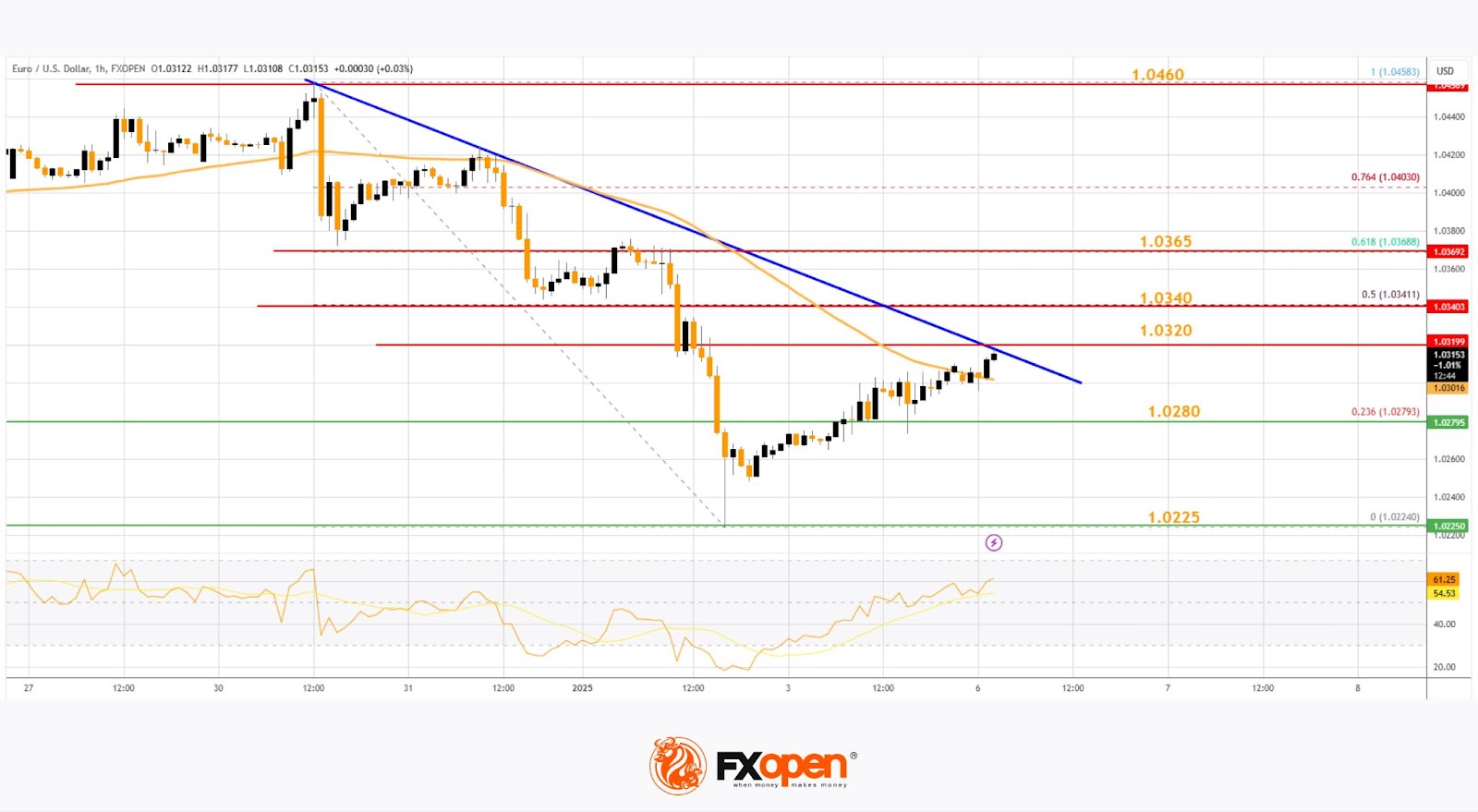
The pair is now trading above 1.0285 and the 50-hour simple moving average. On the upside, the pair is now facing resistance near the 1.0320 level. There is also a key bearish trend line forming with resistance at 1.0320.
The next key resistance is at 1.0340. The main resistance is near the 1.0365 level or the 61.8% Fib retracement level of the downward move from the 1.0458 swing high to the 1.0224 low.
A clear move above the 1.0365 level could send the pair toward the 1.0460 resistance. An upside break above 1.0460 could set the pace for another increase. In the stated case, the pair might rise toward 1.0500.
If not, the pair might resume its decline. The first major support on the EUR/USD chart is near 1.0280. The next key support is at 1.0225. If there is a downside break below 1.0225, the pair could drop toward 1.0200. The next support is near 1.0150, below which the pair could start a major decline.
USD/JPY Technical Analysis
On the hourly chart of USD/JPY at FXOpen, the pair started a fresh upward move from the 156.00 zone. The US Dollar gained bullish momentum above 156.85 against the Japanese Yen.
It even cleared the 50-hour simple moving average and 157.30. The pair climbed above 157.50 and traded as high as 157.77. It is now consolidating gains above the 23.6% Fib retracement level of the upward move from the 156.87 swing low to the 157.77 high.
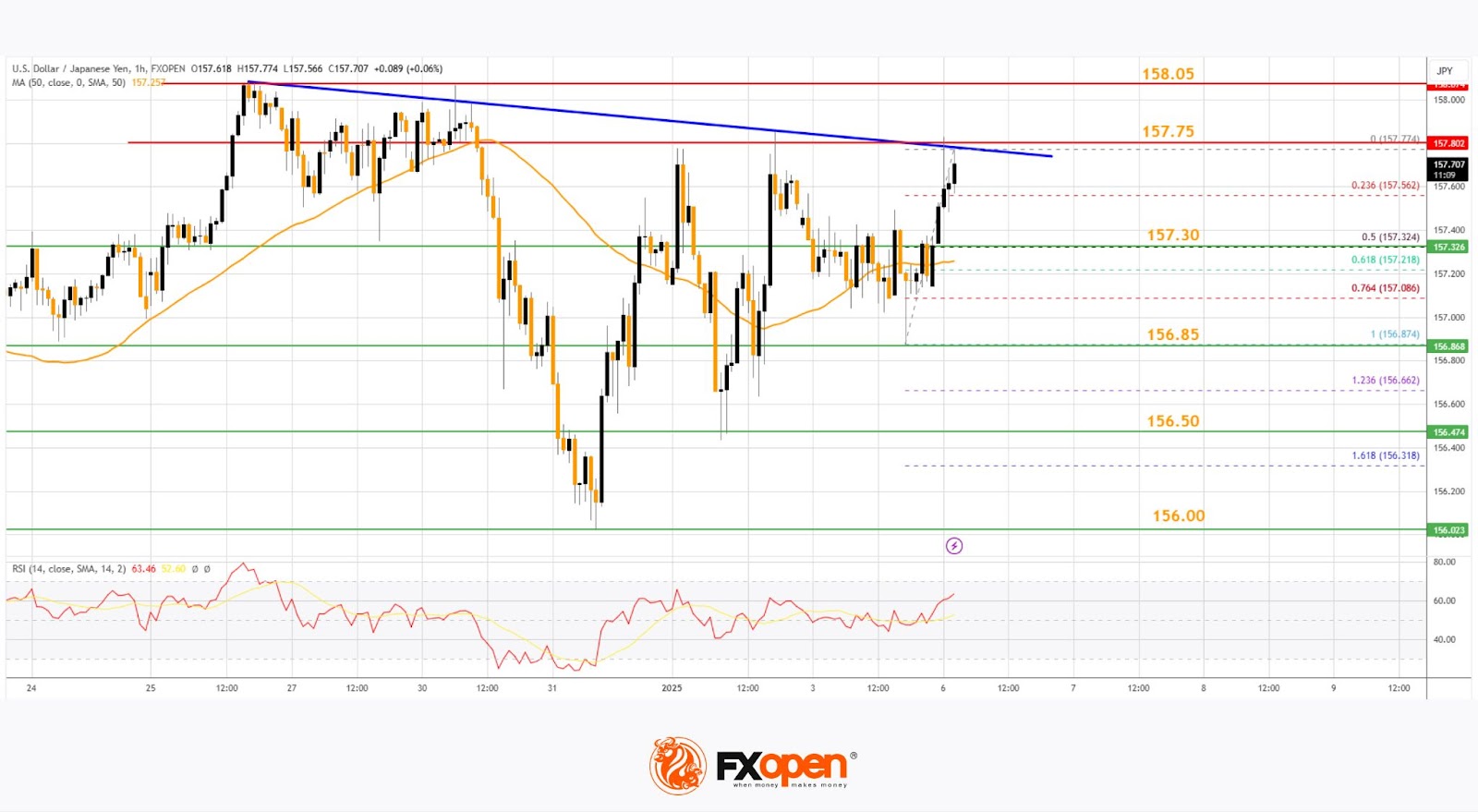
The current price action above the 157.30 level is positive. Immediate resistance on the USD/JPY chart is near 157.75. There is also a major bearish trend line forming with resistance at 157.75.
The first major resistance is near 158.05. If there is a close above the 158.05 level and the RSI moves above 70, the pair could rise toward 158.80.
The next major resistance is near 159.20, above which the pair could test 160.00 in the coming days. On the downside, the first major support is 157.30 or the 50% Fib retracement level of the upward move from the 156.87 swing low to the 157.77 high, below which the bears could gain strength.
The next major support is visible near the 156.85 level. If there is a close below 156.85, the pair could decline steadily. In the stated case, the pair might drop toward the 156.00 support zone. The next stop for the bears may perhaps be near the 155.45 region.
Trade over 50 forex markets 24 hours a day with FXOpen. Take advantage of low commissions, deep liquidity, and spreads from 0.0 pips. Open your FXOpen account now or learn more about trading forex with FXOpen.
This article represents the opinion of the Companies operating under the FXOpen brand only. It is not to be construed as an offer, solicitation, or recommendation with respect to products and services provided by the Companies operating under the FXOpen brand, nor is it to be considered financial advice.
Focus on German Inflation Today
In focus today
In the euro area, focus is on German inflation data for December, which will provide an important hint of where we can expect euro area data to be tomorrow. Spanish inflation showed higher-than-expected inflation in December, which importantly was also due to core inflation rising more than expected. We expect euro area HICP inflation tomorrow to rise to 2.4% year-on-year in December from 2.2% in November. The increase is mainly due to base effects on energy and food inflation, while we expect core inflation to decline from 2.7% y/y in November to 2.6% y/y. Most importantly, we expect the monthly price increase in core inflation to once again be compatible with the 2% target when annualised. The data is thus expected to support the case for continued rate cuts by the ECB.
In the euro area, we also receive the final service and composite PMI for December. The flash release came very early in December, so the final release could deviate more than usual, warranting close monitoring of the release today. The final manufacturing PMI came in at 45.1, which was revised marginally down from 45.2 in the preliminary release.
We likewise receive service PMIs from the US and the UK.
As described earlier, we receive inflation data from the entire euro area tomorrow. Also, tomorrow we get Swiss inflation and services ISM from the US. On Wednesday, minutes from the Fed's December meeting and Swedish CPI data are released. On Thursday, the ECB releases its Economic Bulletin. On Friday, the US jobs report for December is due for release. We also get inflation data from Denmark and Norway.
Economic and market news
What happened overnight
In China, the Caixin service PMI came in at 52.2 in December, up from 51.5 the month before, and in line with the official NBS survey from last week. The figure signals the highest growth in the Chinese service sector since May.
In Japan, service PMI came in at 50.9 in December compared to 50.5 in November, however lower than the flash print of 51.4. It was the second straight month that service activity expanded in Japan.
What happened over the weekend
In the US, The ISM manufacturing report showed strength, with improvements in new orders, production, and prices, although employment figures were weaker. This presents somewhat conflicting signals compared to the PMIs, where even the revised index indicated that output and new orders remained close to November levels. In the broader context, both ISM and PMI continue to signal stagnant growth, consistent with recent hard data on industrial production and capacity utilisation.
Fed officials Kugler and Daly, voting members, discussed monetary policy, stating that the Fed's task of controlling inflation is not yet complete. However, they also emphasised that they do not want the Fed to risk harming the labour market in the process. They did not specify what these comments imply for their judgement on future rate decisions. On Friday, Fed's Barkin, a non-voting member, expressed a preference for maintaining a restrictive monetary policy, citing more upside than downside risks for inflation. We anticipate the next rate cut at the March meeting, followed by quarterly rate cuts of 25 basis points until March 2026, bringing the interest rate target to a range of 3.00-3.25%.
Equities: Global equities ended higher on the second trading day this year. Looking at the performance in terms of both direction and sector rotation between the US and Europe, one can hardly believe it was the same trading day. In Europe, equities were lower with defensives outperforming, while in the US, we saw sizeable gains with significant cyclical outperformance, with some of the post-election trades once again standing out. It is still early in the year with two weeks until Trump's inauguration, but the exuberant narrative that dominated the latter part of 2024 seems to be continuing into the beginning of 2025. In the US on Friday, Dow +0.8%, S&P 500 +1.3%, Nasdaq +1.8%, Russell 2000 +1.7%. This morning, we have a very mixed performance in Asia, with China and Japan lower, while both Taiwan and South Korea are higher by more than 2%. Futures in the US are mixed as well, while futures in core Europe are higher.
FI: The push for lower rates is still not that clear-cut as the fight against inflation in the US is not over according to comments from two Federal Reserve officials during the weekend and the Federal Reserve needs to be mindful of the labour market ahead of the release of nonfarm payrolls on Friday. We will get inflation data from the eurozone that is expected to rise modestly. Combined with the all the bond issuance and no reinvestments from ECB as the reinvestments from the PEPP ended last week there is pressure on the long end of the European and US yield curves although 10Y yields/rates have risen some 40bp since early December.
FX: Friday' session in FX markets was generally characterised by a reversal of Thursday's moves with not least the EUR and the CEEs gaining ground on European natural gas prices stabilising. This contributed to returning EUR/USD back to the 1.03 level but also EUR/Scandies rose modestly. USD/JPY continues to trade in the high 150s while EUR/GBP remains close to the 0.83 level.
EUR/USD Drops: Is the Bearish Trend Set to Continue?
Key Highlights
- EUR/USD started a fresh decline below the 1.0350 level.
- A key bearish trend line is forming with resistance at 1.0400 on the 4-hour chart.
- GBP/USD is consolidating losses near the 1.2420 level.
- Bitcoin is slowly moving higher above the $98,000 resistance level.
EUR/USD Technical Analysis
The Euro failed to settle above the 1.0420 level against the US Dollar. EUR/USD extended losses below the 1.0380 and 1.0350 levels.
Looking at the 4-hour chart, the pair settled below the 1.0350 level, the 100 simple moving average (red, 4-hour), and the 200 simple moving average (green, 4-hour). The pair even declined below the 1.0300 support zone.
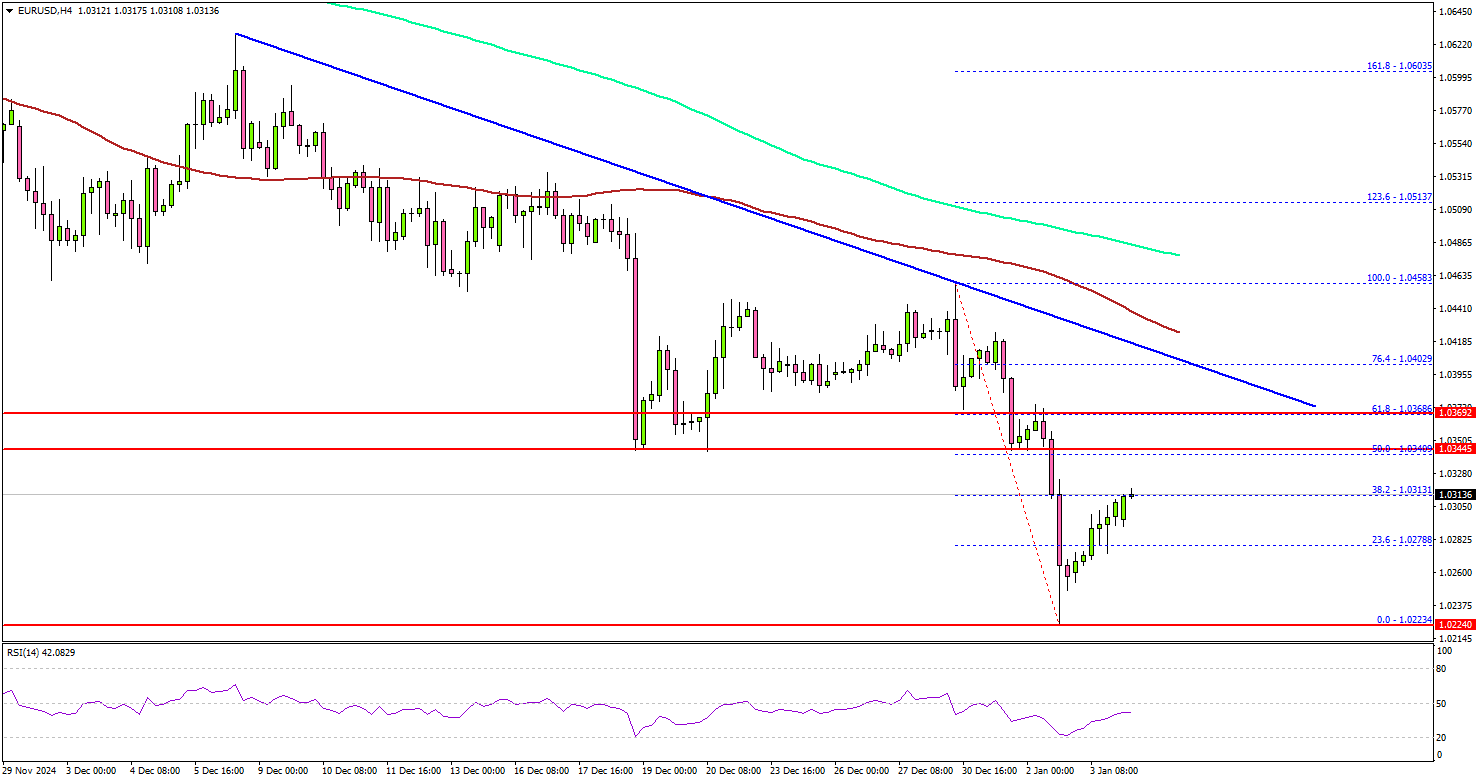
A low was formed at 1.0223 and the pair is now attempting a recovery wave. There was a minor increase above the 1.0275 level. The pair climbed above the 23.6% Fib retracement level of the downward move from the 1.0458 swing high to the 1.0223 low.
On the upside, the pair is facing hurdles near the 1.0350 level. The first major resistance is near the 1.0380 level. There is also a key bearish trend line forming with resistance at 1.0400 on the same chart.
The next major resistance is near the 1.0420 level. A close above the 1.0420 level could set the tone for another increase. In the stated case, the pair could rise toward the 1.0500 resistance.
On the downside, immediate support sits near the 1.0275 level. The next key support sits near the 1.0250 level. Any more losses could send the pair toward the 1.0220 level.
Looking at GBP/USD, the pair is now correcting some losses but it might face resistance near the 1.2450 level.
Upcoming Economic Events:
- Euro Zone Services PMI for Dec 2024 – Forecast 51.4, versus 51.4 previous.
- UK Services PMI for Dec 2024 – Forecast 51.4, versus 51.4 previous.
- US Services PMI for Dec 2024 – Forecast 58.5, versus 58.5 previous.
Dollar Starts Strong vs Europe, Sets Sights on Yen and Commodity Currencies Next
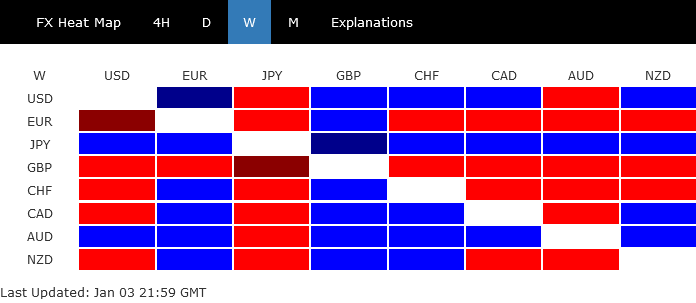
Dollar Index started the new year with a pronounced surge. Sterling, Euro, and Swiss Franc bore the brunt of this strength, reflecting the sluggish economic outlook in Europe and ongoing concerns about the impact of new US tariffs. Despite these gains, Dollar's performance against other currencies, including Yen and commodity-linked peers, was more muted. Consolidations in US Treasury yields and resilient risk sentiment somewhat limited the greenback's upside momentum.
Behind Dollar’s firmness is an evolving interest rate narrative in the US. Recent economic data has reinforced the idea that Fed will pursue fewer rate cuts this year, providing a steady backdrop of support. Meanwhile, Europe faces a bleaker economic outlook, with political uncertainties amplifying downside risks. This stark divergence in fundamentals would widen the rate gap between Fed and other European central banks, intensifying headwinds for European majors in general in the coming months.
In a somewhat surprising twist, Yen emerged as the week’s best performer, with its outperformance largely stemmed from heavy selling in other majors. Nevertheless Yen’s medium-term vulnerability remains intact given BoJ’s cautious stance on rate hikes. Against Dollar, Yen may face renewed pressure again soon as US yields resume their climb.
Commodity currencies— Aussie, Kiwi, and Loonie—also saw some respite, though much of their strength was a correction from steep losses in December rather than a shift in fundamentals. Notably, Australian and New Zealand Dollars may face renewed pressure if weakness in Chinese markets deepens, especially since China’s bumpy start to the year has already dented investor confidence.
Dollar Kicks Off 2025 with a Boost from Hawkish Fed Expectations
Dollar Index began 2025 on a firm footing, posting notable gains as investors price in a gentler path of Federal Reserve easing this year. Recent data highlighting US economic resilience and persistent, though moderated, inflation risks have reinforced the view that Fed may opt for fewer rate cuts than previously anticipated.
Compounding this sentiment are heightened expectations around the incoming Trump administration’s pro-growth measures—ranging from deregulation and tax reforms to stricter immigration policies and tariffs—which could further lift economic activity and stoke inflationary pressures.
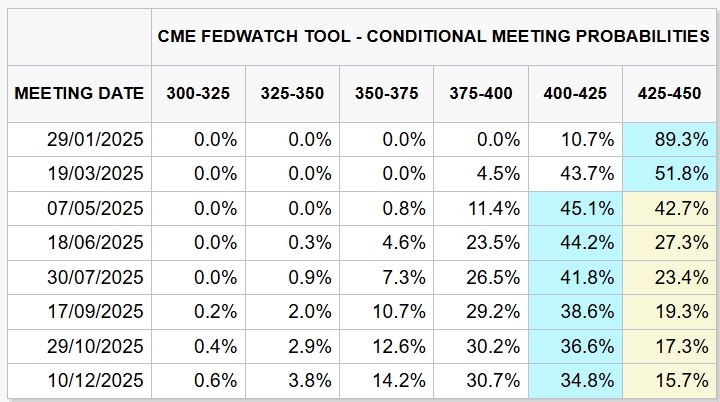
Current fed fund futures indicate almost 90% chance that Fed will keep rates at 4.25–4.50% later this month. More importantly, there is 85% probability of just one additional cut to 4.00–4.25% for the entire year. By contrast, ECB is widely forecast to slash rates by as much as 100 basis points over the same period. This stark divergence in central bank policy has underpinned the Dollar’s appeal among traders.
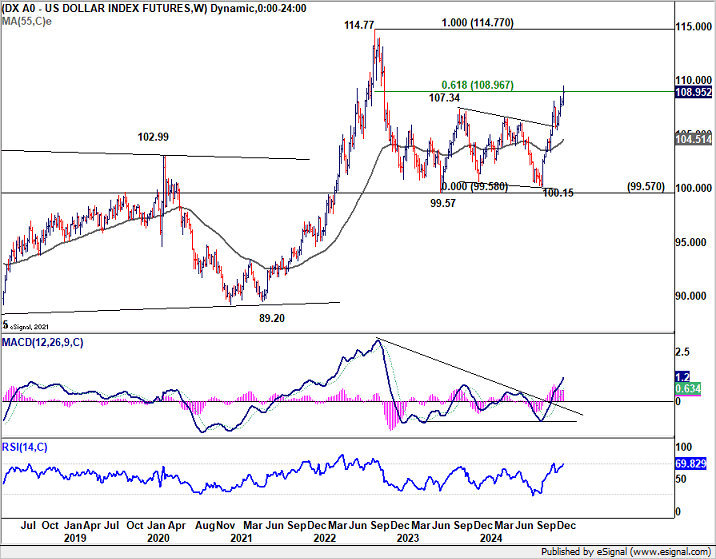
Technically, Dollar Index's rally from 100.15 reaccelerated, as seen in D MACD, and hit as high as 109.53. Near term outlook will now remain bullish as long as 107.73 support holds. Next target is 61.8% projection of 100.15 to 108.07 from 105.42 at 110.31.
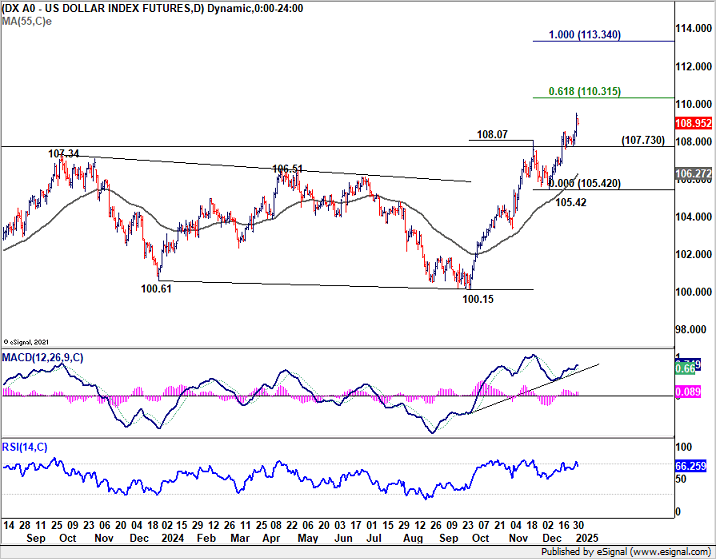
In the bigger picture, there are various interpretations on the price actions from 114.77 (2022 high). It's unsure if the corrective pattern from there has completed totally, or there would be one more down leg. But in either case, sustained trading above 61.8% retracement of 114.77 to 99.57 at 108.96 would pave the way to retest 114.77 high later in the year.
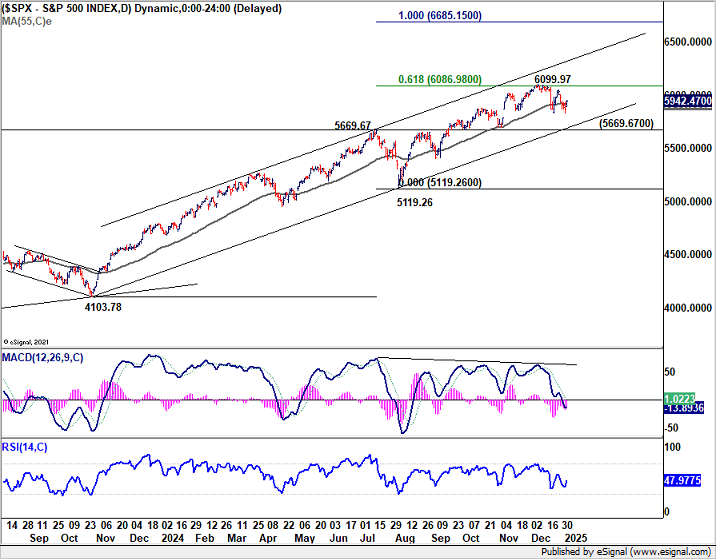
Meanwhile, US equities have thus far welcomed the recalibration of Fed expectations. S&P 500 is seen as in consolidations only, and larger up trend remains in force with 5669.67 resistance turned support intact. Another rally through 6099.97 is expected at a later stage after the consolidations complete.
However, should the stock market’s risk-on sentiment comes back, it may limit Dollar Index’s upside momentum, particularly above the immediate 110.31 target noted.
Yen Resilient But Vulnerability Persists
While Yen remained resilient against last week, it clearly lacked momentum for a sustainable rebound. The currency remains at risk of further depreciation, and much will depend on how BoJ proceeds with interest rate hikes and whether US Treasury yields continue their rally.
Although BoJ is expected to persist with gradual rate increases, Governor Kazuo Ueda has consistently expressed caution, highlighting the global economic uncertainties—particularly regarding US policy under the incoming administration. These concerns could lead the central bank to adopt a cautious, wait-and-see approach, making a January rate hike increasingly uncertain.
Moreover, market consensus suggests that the BoJ could raise rates only two to three times this year, potentially reaching 1.00%—a milestone not seen in decades. However, such adjustments may do little to strengthen Yen meaningfully, as they would largely reflect policy normalization rather than outright tightening.
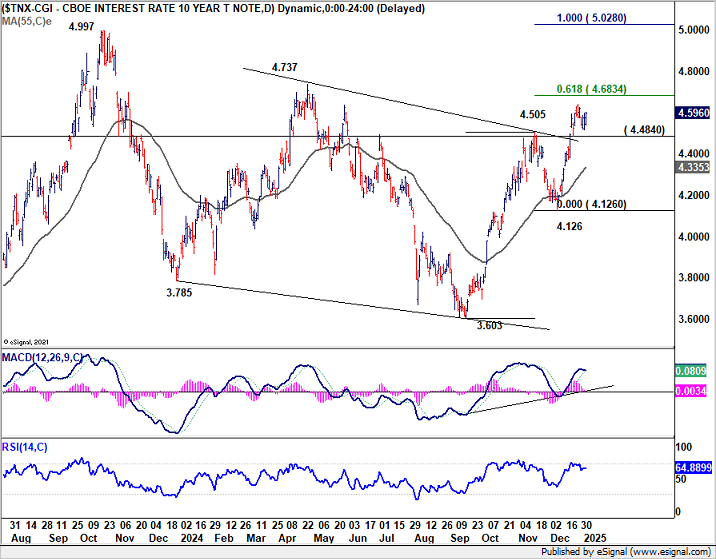
Technically, US 10-year yield's rally from 3.603 stalled just ahead of 61.8% projection of 3.603 to 4.505 from 4.126 at 4.683. Further rally is expected as long as 4.484 support holds,. Decisive break of 4.683 could prompt upside acceleration to 100% projection 5.028. Nevertheless, break of 4.484 will bring deeper correction to 55 D EMA (now at 4.335), and possibly below before the next rise.
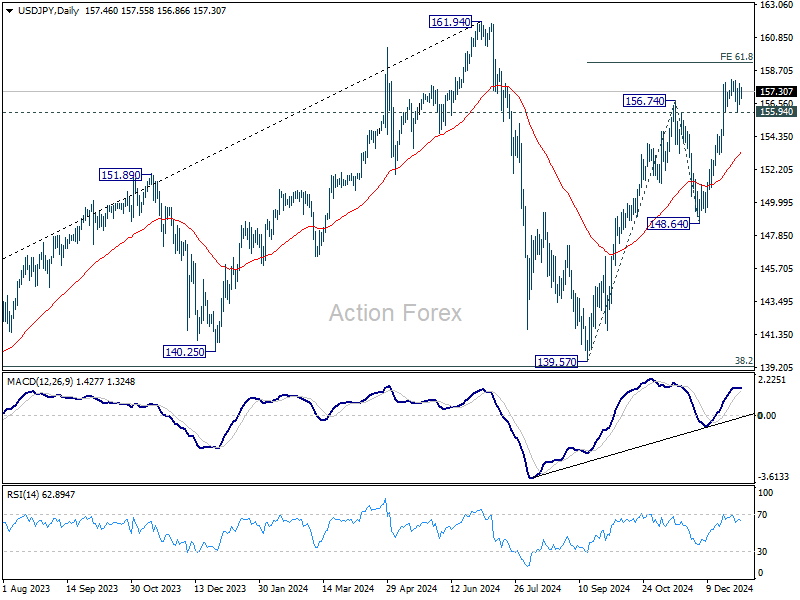
USD/JPY's outlook is a little bit more complicated. On the one hand, the next move should be tightly correlated with US 10-year yield. Rise from 139.57 should extend to 61.8% projection of 139.57 to 156.74 from 148.64 at 159.25, in particular when 10-year yield resumes the rally towards 4.683. However, Japan's stance on intervention would then be the determining factor on whether USD/JPY could power up further through 161.94 high.
Commodity Currencies Fragile as Chinese Markets Falter, Yuan Pressured
Commodity currencies have shown resilience last week, largely shielded by heavy selling in European majors. However, their vulnerability remains high as 2025 unfolds, especially for Australian and New Zealand Dollars.
The crux of the concern lies in China’s weak market performance at the start of the year. Chinese equities kicked off 2025 with their worst annual opening in nearly a decade, reflecting fragile investor sentiment despite the first full-year stock market gain since 2020.
This cautious mood seems contradictory in light of Beijing’s December policy meetings, which signaled clearer stimulus intentions. Yet many market participants worry about the speed and efficacy of any measures, particularly as meaningful policy action may not materialize until the “Two Sessions” legislative gathering in March.
In addition, domestic deflationary pressures persist, and the threat of renewed US tariffs looms, adding to the downside risks for China’s economy and the commodity currencies that depend on its growth.
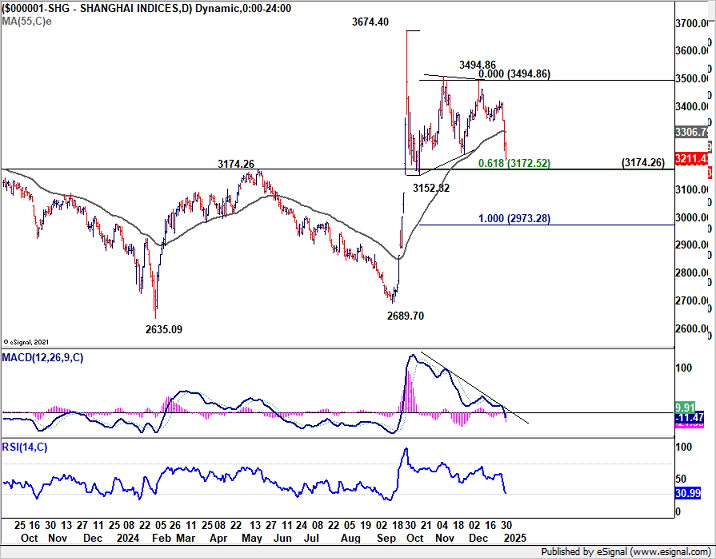
Technically, the "free fall" in the Shanghai SSE composite looks rather concerning. Risk will now stay heavily on the downside as long as 55 D EMA (now at 3306.79) holds. Focus is on key support level between 3152.82 and 3174.26. Decisive break there could prompt downside acceleration to 100% projection of 3674.40 to 3152.82 from 3494.86 at 2973.28.
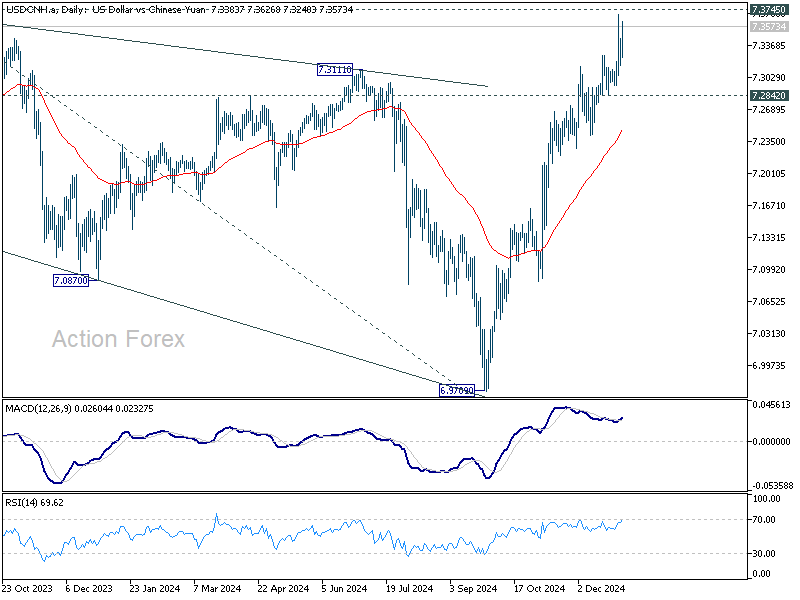
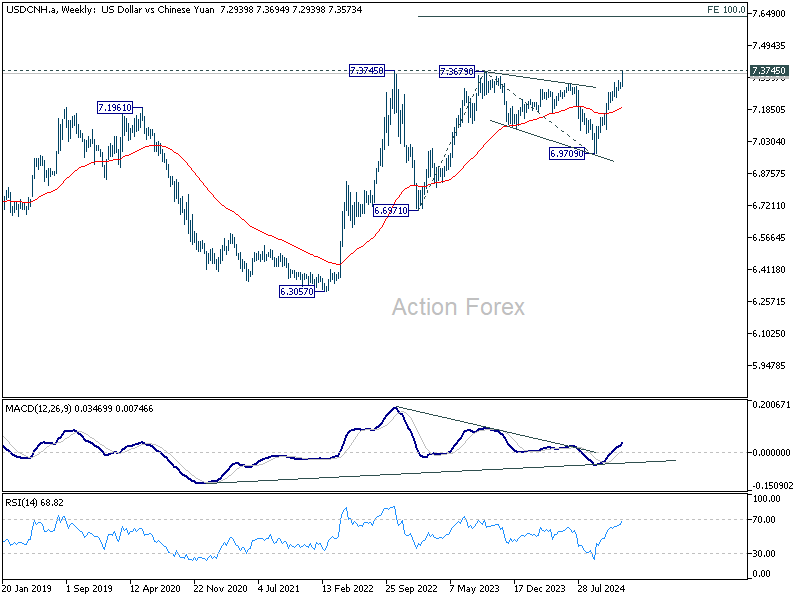
Adding to the concerns, the Chinese Yuan (offshore) is on the verge of breaking through record high with the strong decline in Yuan at the start of the year. While the depreciation of Yuan might be endorsed by the government as counter measures to trade war 2.0 with the US, investor reactions would be uncertain.
Technically, further rally is expected in USD/CNH as long as 7.2842 support holds. Decisive break of 7.3745 will resume the up trend from 6.3057. Next medium term target will be 100% projection of 6.6971 to 7.3679 from 6.9709 at 7.6411.
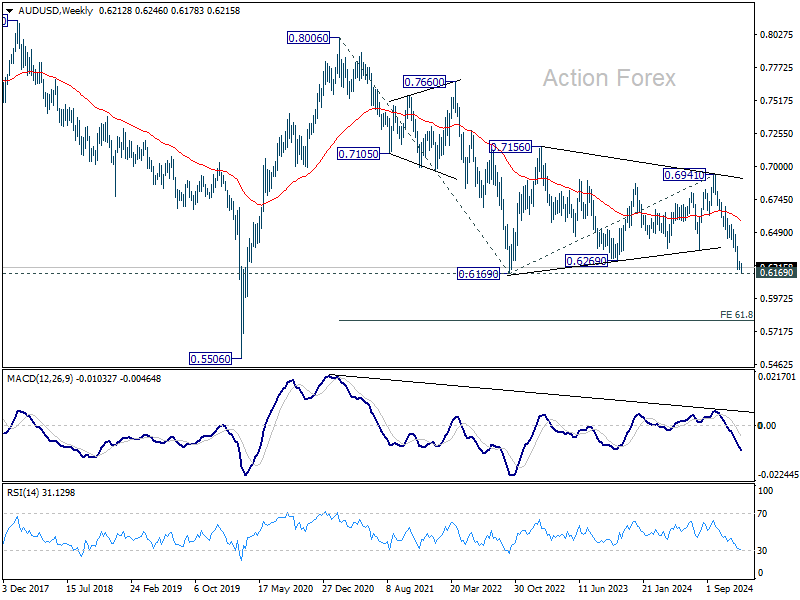
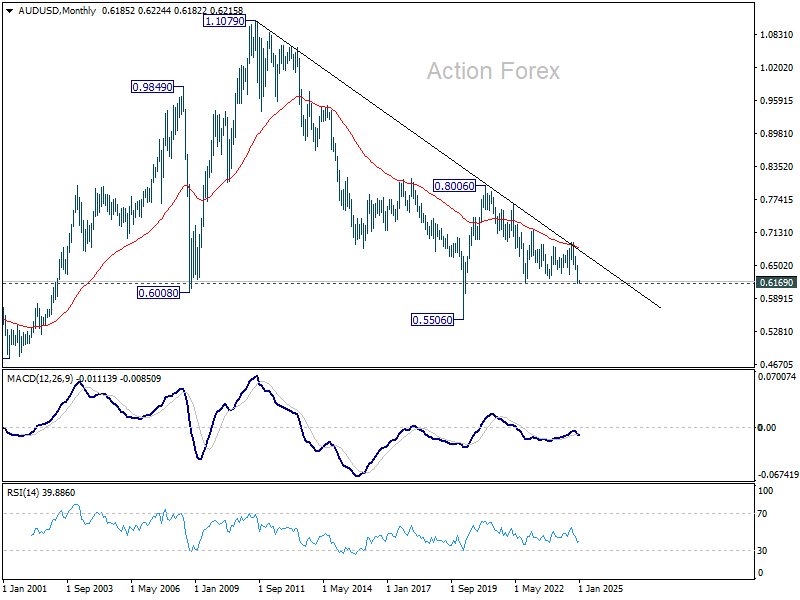
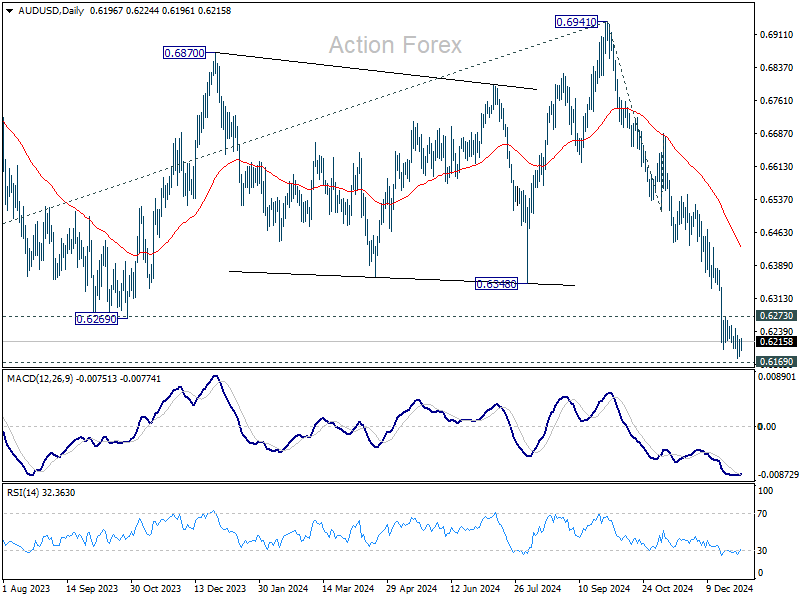
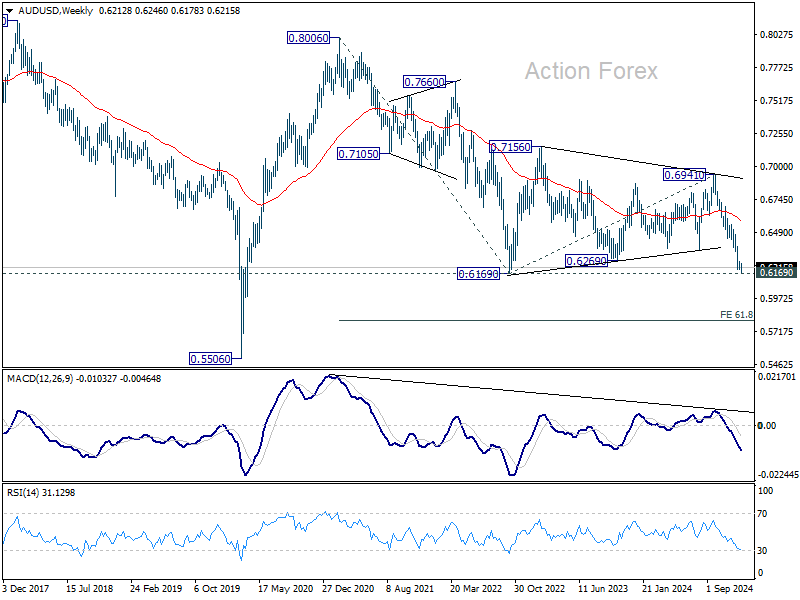
AUD/USD's decline slowed ahead of 0.6169 key support (2022 low). But near term risk will stay on the downside 0.6273 resistance holds. Decisive break of 0.6169 will confirm resumption of whole down trend from 0.8006 (2021 high). Next medium term target would be 61.8% projection of 0.8006 to 0.6169 from 0.6941 at 0.5806. Break of 0.6273 will bring near term corrective rebound first.
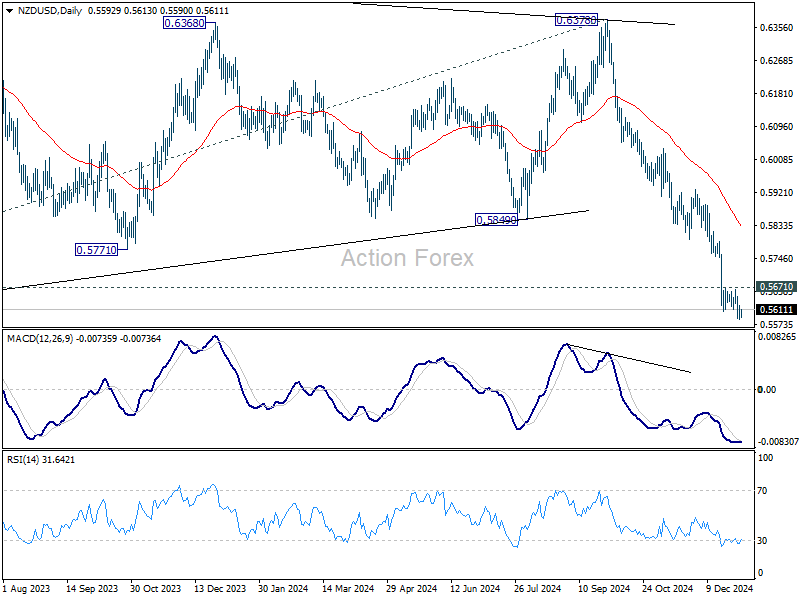
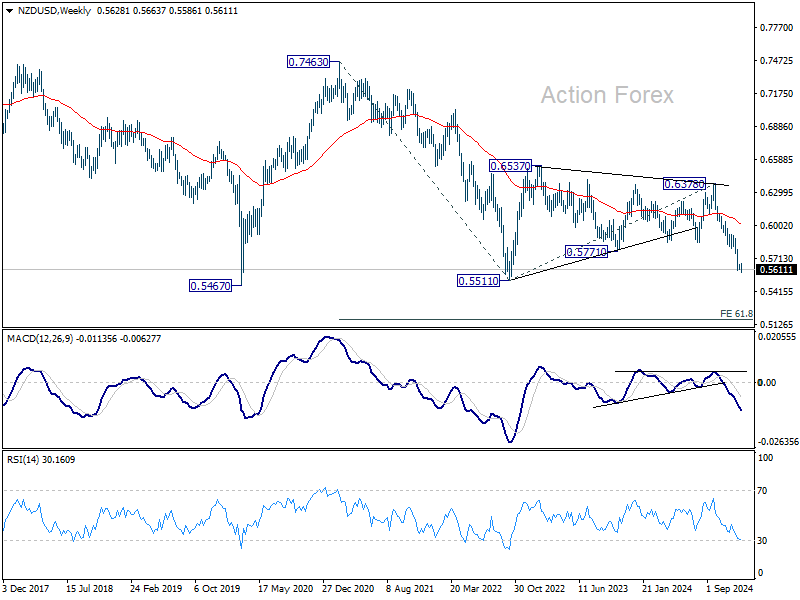
As for NZD/USD, near term risks will stay on the downside as long as 0.5671 resistance holds. Firm break of 0.5511 (2022 low) would pave the way to 61.8% projection of 0.7463 to 0.5511 from 0.6378 at 0.5172. Meanwhile, break of 0.5671 will bring near term corrective rebound first.
EUR/USD Weekly Outlook
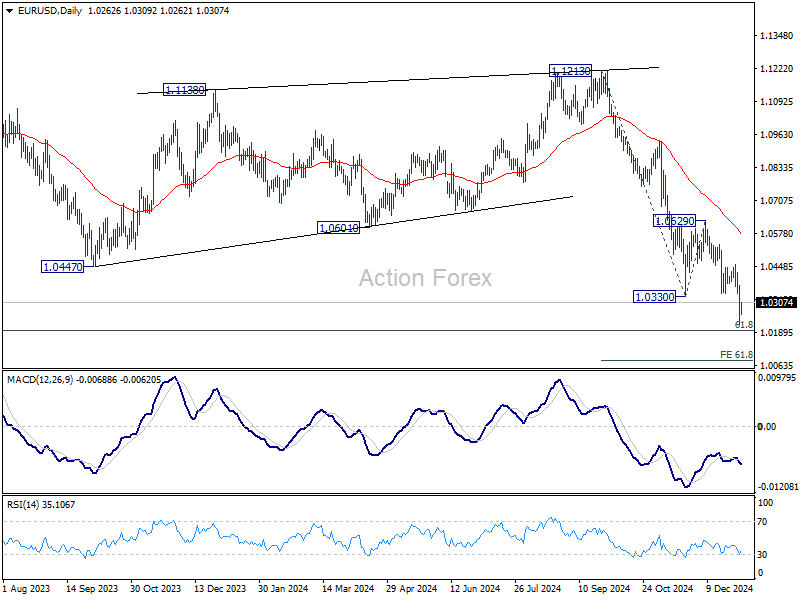
EUR/USD's decline from 1.1213 resumed by breaking through 1.0330 support last week. A temporary low might be formed at 1.0223 and initial bias is turned neutral this week first. But further decline is expected as long as 1.0457 resistance holds. On the downside, break of 1.0223 will target 61.8% projection of 1.1213 to 1.0330 from 1.0629 at 1.0083.
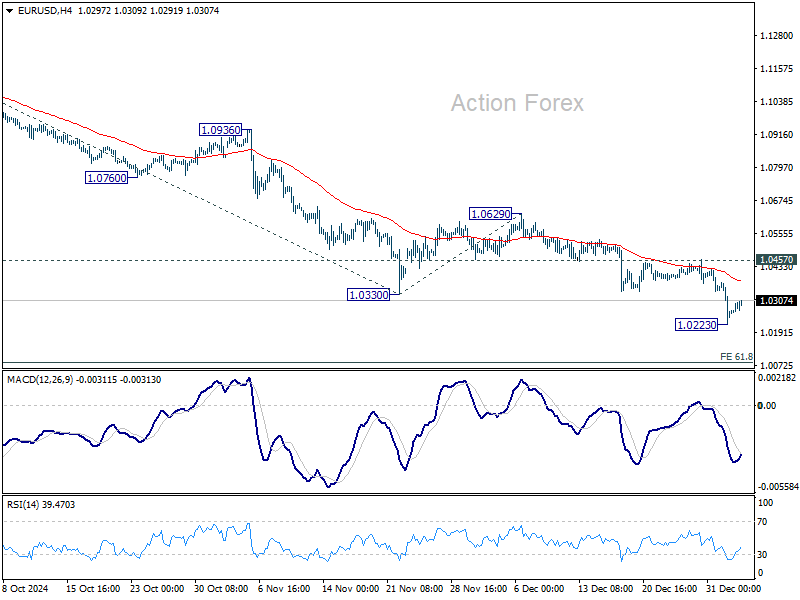
In the bigger picture, fall from 1.1274 (2023 high) should either be the second leg of the corrective pattern from 0.9534 (2022 low), or another down leg of the long term down trend. In both cases, sustained break of 61.8 retracement of 0.9534 to 1.1274 at 1.0199 will pave the way back to 0.9534. For now, outlook will stay bearish as long as 1.0629 resistance holds, even in case of strong rebound.
In the long term picture, down trend from 1.6039 remains in force with EUR/USD staying well inside falling channel, and upside of rebound capped by 55 M EMA (now at 1.0973). Consolidation from 0.9534 could extend further and another rising leg might be seem. But as long as 1.1274 resistance holds, downside breakout would be mildly in favor.
EUR/USD Weekly Outlook
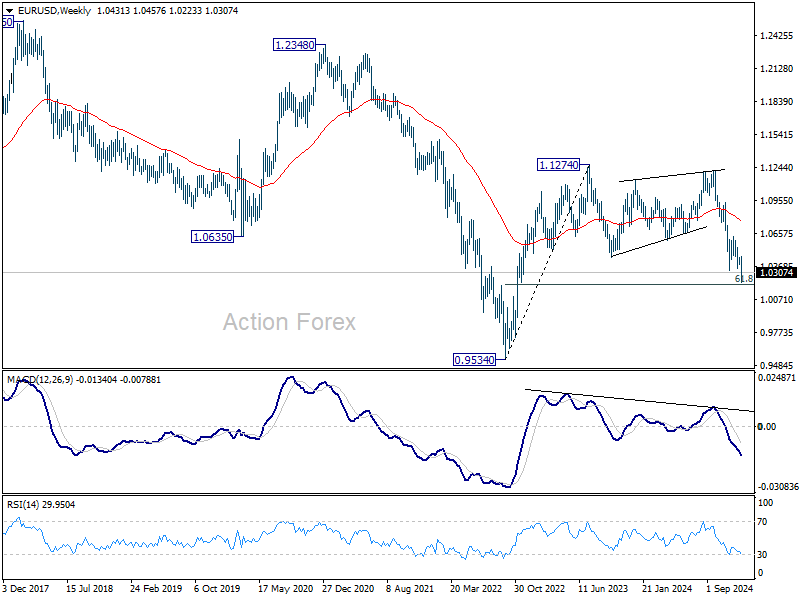
EUR/USD's decline from 1.1213 resumed by breaking through 1.0330 support last week. A temporary low might be formed at 1.0223 and initial bias is turned neutral this week first. But further decline is expected as long as 1.0457 resistance holds. On the downside, break of 1.0223 will target 61.8% projection of 1.1213 to 1.0330 from 1.0629 at 1.0083.
In the bigger picture, fall from 1.1274 (2023 high) should either be the second leg of the corrective pattern from 0.9534 (2022 low), or another down leg of the long term down trend. In both cases, sustained break of 61.8 retracement of 0.9534 to 1.1274 at 1.0199 will pave the way back to 0.9534. For now, outlook will stay bearish as long as 1.0629 resistance holds, even in case of strong rebound.
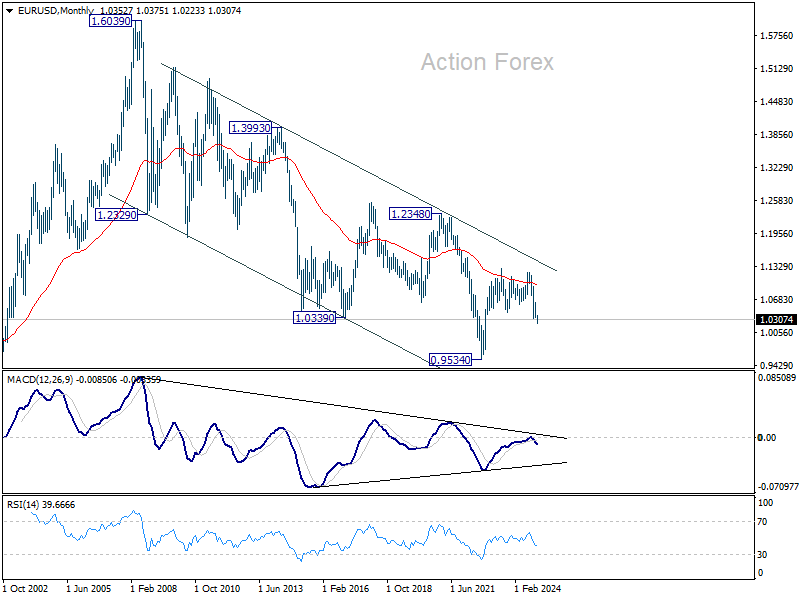
In the long term picture, down trend from 1.6039 remains in force with EUR/USD staying well inside falling channel, and upside of rebound capped by 55 M EMA (now at 1.0973). Consolidation from 0.9534 could extend further and another rising leg might be seem. But as long as 1.1274 resistance holds, downside breakout would be mildly in favor.
USD/JPY Weekly Outlook
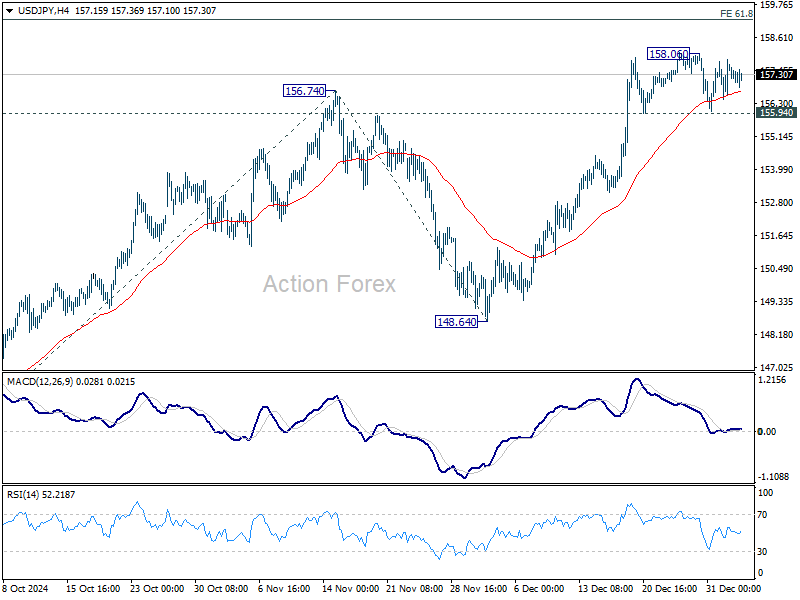
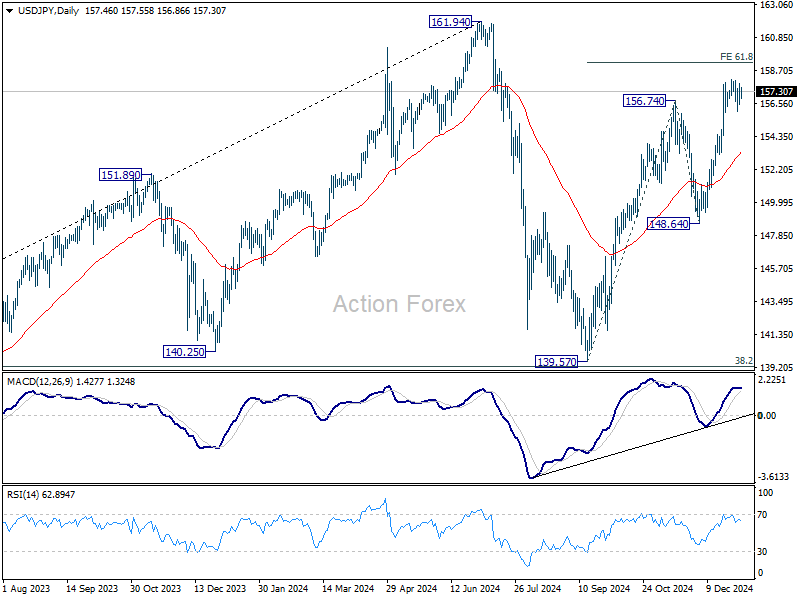
USD/JPY stayed in sideway consolidations last week. Initial bias remains neutral this week first. Break of 158.06 will resume the rally from 139.57 to 61.8% projection of 139.57 to 156.74 from 148.64 at 159.25. Firm break there will target 161.94 high. However, break of 155.94 will turn bias to the downside, for deeper pull back to 55 D EMA (now at 153.34).
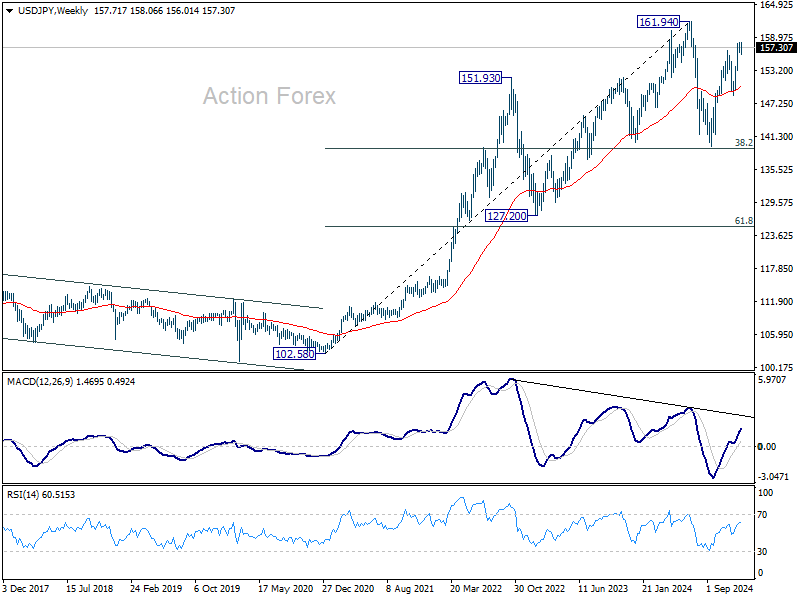
In the bigger picture, price actions from 161.94 are seen as a corrective pattern to rise from 102.58 (2021 low). The range of medium term consolidation should be set between 38.2% retracement of 102.58 to 161.94 at 139.26 and 161.94. Nevertheless, sustained break of 139.26 would open up deeper medium term decline to 61.8% retracement at 125.25.
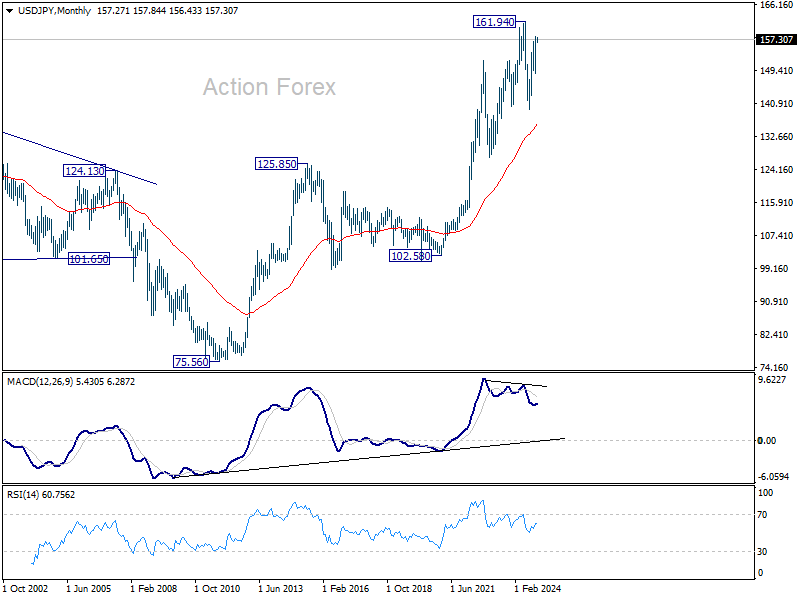
In the long term picture, it's still early to conclude that up trend from 75.56 (2011 low) has completed. A medium term corrective phase should have commenced, with risk of deep correction towards 55 M EMA (now at 136.02).
GBP/USD Weekly Outlook
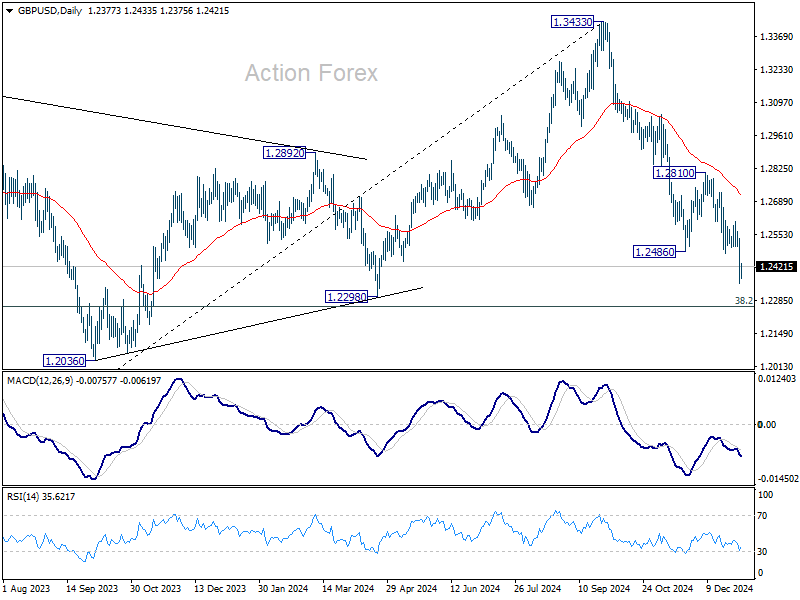
GBP/USD's fall from 1.3433 resumed by breaking through 1.2486 support last week. Initial bias stays on the downside this week for 1.2256/98 cluster support zone. Strong support is expected there to contain downside to bring rebound, at least on first attempt. On the upside, break of 1.2474 support turned resistance will turn intraday bias neutral first. However, decisive break of 1.2256/98 will carry larger bearish implications.
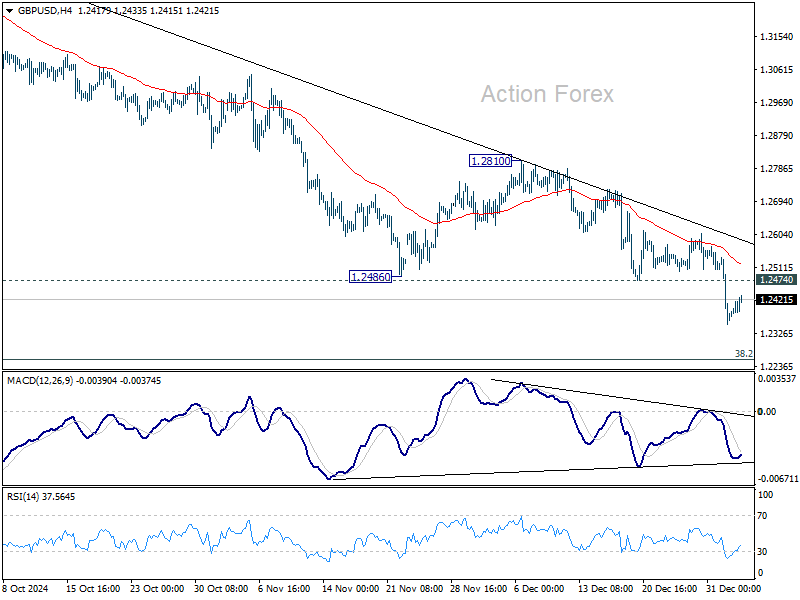
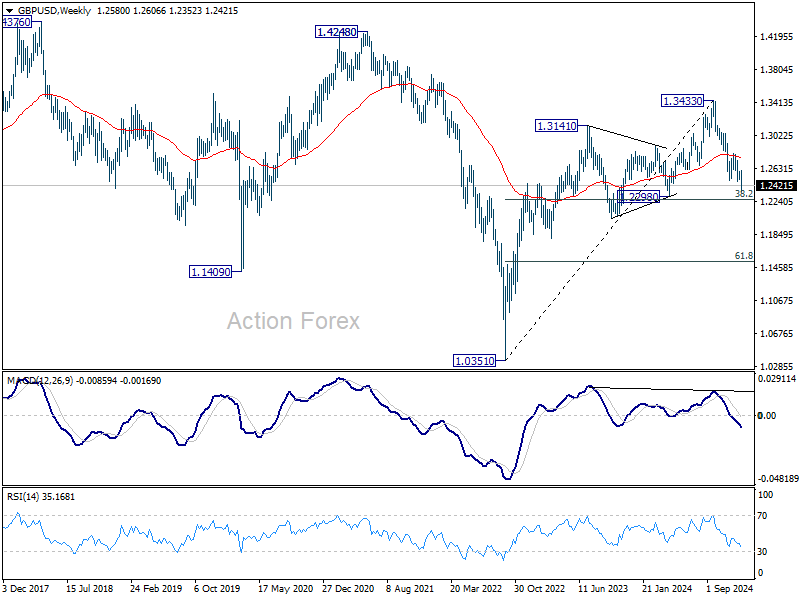
In the bigger picture, price actions from 1.3433 medium term are seen as correcting whole up trend from 1.0351 (2022 low). Deeper decline could be seen to 38.2% retracement of 1.0351 to 1.3433 at 1.2256, which is close to 1.2298 structural support. But strong support is expected there to bring rebound to extend the corrective pattern. However, firm break of 1.2256 will argue that the trend has reversed and target 61.8% retracement at 1.1528.
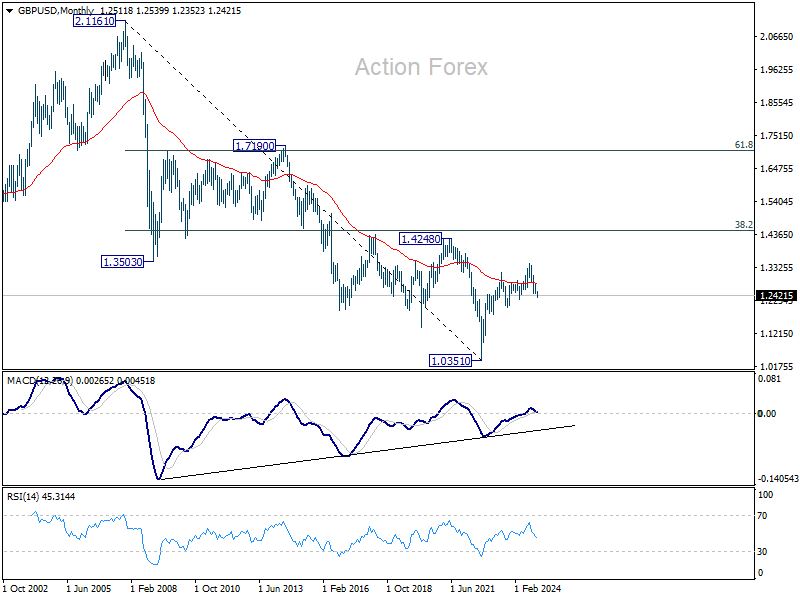
In the long term picture, price actions from 1.0351 (2022 low) are seen as a corrective pattern to the long term down trend from 2.1161 (2007 high) only. Outlook will be neutral at best as long as 1.4248 structural resistance holds, even in case of strong rebound.
USD/CHF Weekly Outlook
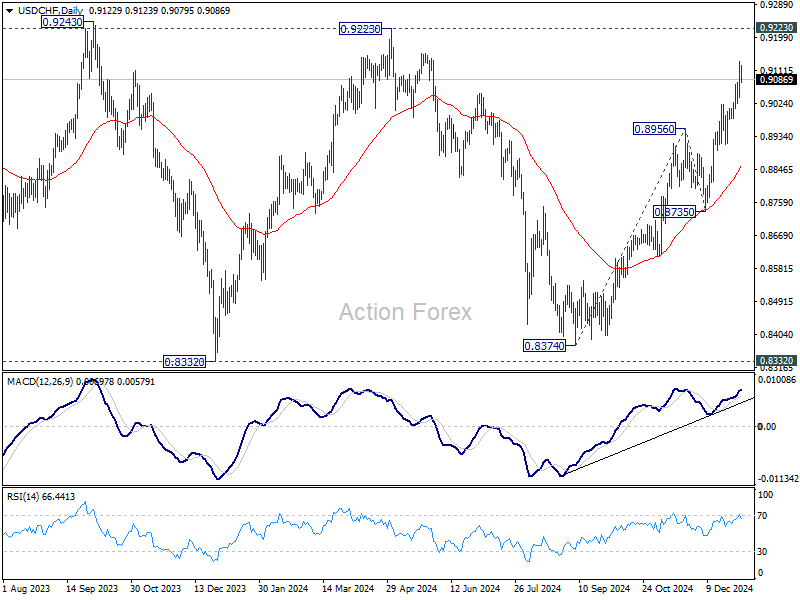
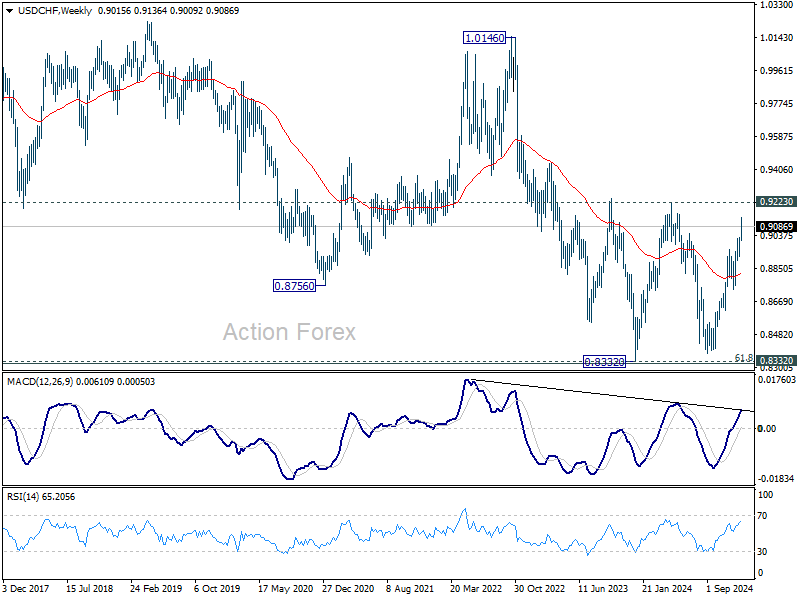
USD/CHF's rally from 0.8374 continued last week, but retreated after forming a temporary top at 0.9136. Initial bias is turned neutral this week for some consolidations first. Further rise is expected as long as 0.8956 resistance turned support holds. Above 0.9136 will target 0.9223 key resistance next.
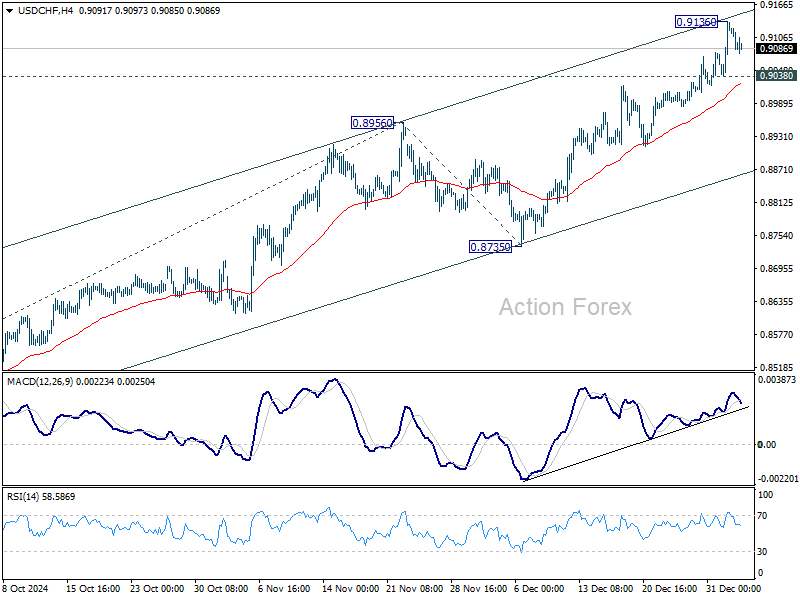
In the bigger picture, price actions from 0.8332 (2023 low) are currently seen as a medium term corrective pattern, with rise from 0.8374 as the third leg. Overall outlook will continue to stay bearish as long as 0.9223 resistance holds. Break of 0.8332 low is in favor at a later stage when the consolidation completes. However, decisive break of 0.9223 will be an important sign of bullish trend reversal.
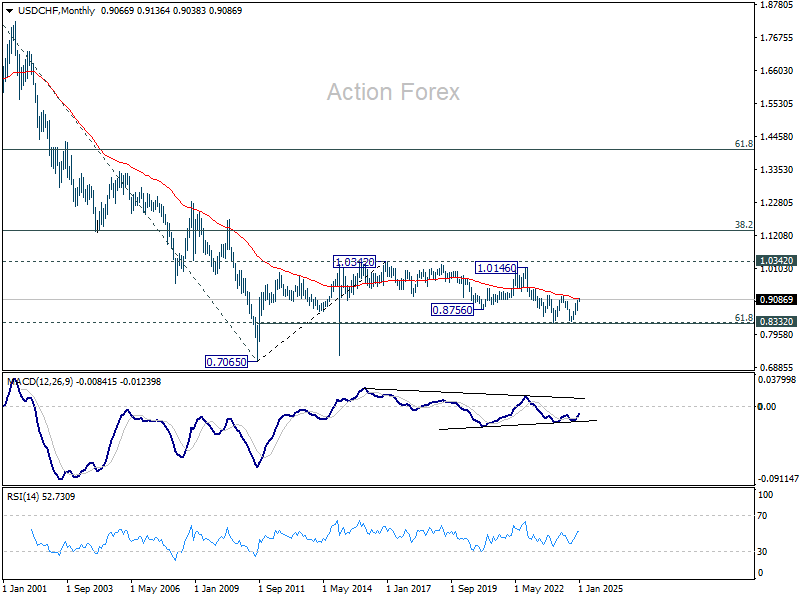
In the long term picture, price action from 0.7065 (2011 low ) are seen as a corrective pattern to the multi-decade down trend from 1.8305 (2000 high). Fall from 1.0342 (2016 high) is seen as the second leg. Sustained break of 55 M EMA (now at 0.9131) will indicate that the third leg has already started. However, rejection by 55 M EMA again, followed by break of 61.8% retracement of 0.7065 to 1.0342 at 0.8317, will pave the way back to 0.7065.
AUD/USD Weekly Report
AUD/USD edged lower last week but lost momentum just ahead of 0.6169 key support. Further decline remains in favor as long as 0.6273 resistance holds. Decisive break of 0.6169 will target 138.2% projection of 0.6941 to 0.6511 from 0.6687 at 0.6074. However, considering bullish convergence condition in 4H MACD, break of 0.6273 resistance will indicate short term bottoming, and turn bias back to the upside for stronger rebound.
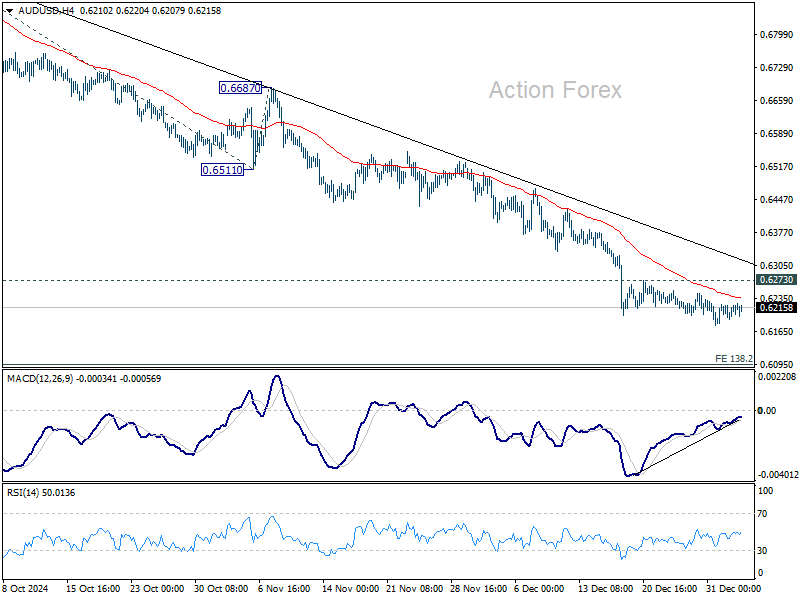
In the bigger picture, price actions from 0.6169 (2022 low) are seen as a medium term consolidation to the down trend from 0.8006, and could have completed at 0.6941 already. Firm break of 0.6169 support will confirm down trend resumption for 61.8% projection of 0.8006 to 0.6169 from 0.6941 at 0.5806 next. In any case, outlook will stay bearish as long as 55 W EMA (now at 0.6587) holds.
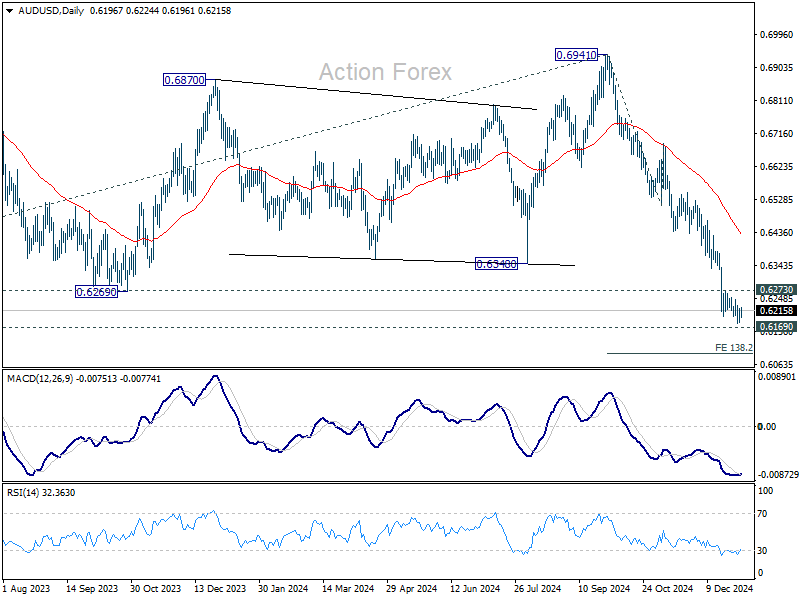
In the long term picture, the down trend from 1.1079 (2011 high) should have completed at 0.5506 (2020 low) already. It's unsure yet whether price actions from 0.5506 are developing into a corrective pattern, or trend reversal. But in either case, fall from 0.8006 is seen as the second leg of the pattern. Hence, even in case of deeper fall, strong support should emerge above 0.5506 to contain downside to bring reversal.