

Sample Category Title
Dollar Rebounds After Exceptionally Strong US Consumer Confidence
Sunrise Market Commentary
- Rates: Did German/EMU inflation already peak in January?
End-of-quarter conditions and rumours about an anxious ECB lifted core bonds yesterday, with Bunds outperforming. Today, German inflation data might draw attention. Did German/EMU CPI already peak in January? It could reduce speculation that the ECB will start normalizing its policy sooner than expected and support the Bund in an intraday perspective. - Currencies: EUR/USD corrects south as ECB speculation eases
Yesterday, EUR/USD declined further off the recent highs. Euro longs were squeezed by market rumours that the ECB was ‘unhappy' with the hawkish market reaction after the March policy meeting. If German inflation returns back below 2.0% today, it might reinforce the euro correction
The Sunrise Headlines
- US stock markets ended mixed yesterday with the S&P 500 and Nasdaq, unlike the Dow Jones, overcoming early weakness to close slightly positive. Overnight, most Asian stock markets lose ground with China underperforming (-1%)
- The Fed may raise rates three more times in 2017 said Boston Fed Rosengren and SF Fed Williams. "An increase at every other FOMC meeting over the course of this year could and should be" the default starting in June, Rosengren said. Stock market valuations "may be a little frothy" in terms of anticipated stimulus, Williams added.
- The White House has not abandoned hope that Congress could make another effort to pass healthcare legislation that Trump administration officials believe would ease resistance to enacting tax reform.
- US crude inventories climbed less than analysts predicted last week, while gasoline stocks narrowed sharply, lifting oil prices above $52.5/barrel for Brent crude.
- South Africa's ruling ANC party is split at the top over whether FM Gordhan should be sacked, sources said. The rift at the top comes amid party divisions over the finance ministers plans to rein in spending as the economy stagnates,
- Margin debt climbed to a record high in February, a fresh sign of bullishness for flummoxed investors trying to navigate the political and economic crosscurrents driving markets.
- Today's eco calendar contains EMU confidence data, German CPI, US weekly jobless claims and the final US Q4 GDP reading. Several Fed and ECB members are scheduled to speak and Italy sells bonds. The CNB has a policy meeting
Currencies: Dollar Rebounds After Exceptionally Strong US Consumer Confidence
EUR/USD topside rejected as ECB speculation eases
EUR/USD declined further below 1.08 yesterday. The move was inspired by rumours that the ECB has become reluctant to change the language of its policy statement after the hawkish reaction to the March communication. Declining EMU yields rather than outright USD strength drove EUR/USD trading. USD/JPY traded sideways to slightly lower even as US equities traded with a positive bias as Fed speakers talked rather hawkish. EUR/USD finished the session at 1.0766 (from 1.0814 on Tuesday). USD/JPY closed the day at 111.04 (from 111.15).
Overnight, Asian equities mostly show modest to moderate losses even as US indices held near record high levels. USD/JPY struggles to extend its rebound off the recent lows which weighs on Japanese equities. End of quarter/fiscal year caution of Japanese investors is probably a factor for behind the recent mediocre performance of USD/JPY. The pair tried to regain further ground early in the session, but for now the move has no strong legs. The dollar remains well bid against a weak euro. EUR/USD trades in the 1.0750 area, holding near yesterday's correction low.
Today's eco calendar is better filled. The economic confidence data from the EC will probably be solid given the recent evidence from other regional data. The first estimate of the German March CPI is interesting. Headline HICP is expected to rise 0.5% M/M, but might result in a decline of the Y/Y reading from 2.2% to 1.9%. The move is due to base effects. However, markets realizing that German/EMU CPI probably won't sustain north of 2.0% in the near future, might cause a softer position on the interest rate markets. It could also put some further pressure on the euro short-term. US jobless claims ticked somewhat higher of late but are expected to return to 247.000 from 261 000. If so, the report can be considered as confirming a healthy US labour market. There are again several Fed members scheduled to speak, but we expect them to confirm the scenario of at least two additional rate hikes.
The dollar changed course on Tuesday. The US reflation trade regained momentum after a very strong US consumer confidence. Yesterday, the euro faced headwinds as market rumours questioned the scenario of early ECB policy normalization.
The debate will probably resurface, but for now, it looks that the relative policy divergence between the Fed and the ECB turned again in favour of the dollar, at least short-term. The topside of EUR/USD looks again better protected. A cautious EUR/USD sell-on-upticks approach can be reconsidered. At the same time, the picture of USD/JPY is not really convincing. Will this change when Japanese investors enter a new fiscal year next week?
From a technical point of view, the picture of USD/JPY remains fragile as it dropped below 111.60/36 support. Next support kicks in at 108.84 (50% retracement of the MT up-move). EUR/USD extensively tested 1.0829/1.0874 resistance, but the test was rejected. 1.0906 now looks a solid resistance. EUR/USD might return lower in the previous 1.0875/1.05 trading range.
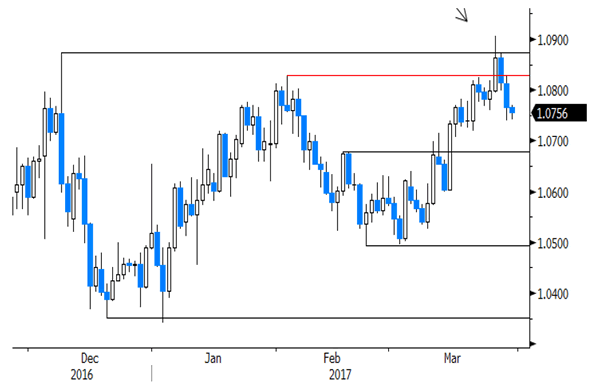
EUR/USD: test of 1.0874 resistance rejected, at least for now
EUR/GBP
Sterling ignores May triggering article 50
The UK finally triggered article 50 of the Lisbon treaty, starting the official procedure to leave the EU in two years' time. Sterling was quite aggressively sold in (thin) Asian markets, but rebounded going into the official Brexitannouncement. The statement of Theresa May and the first answer of EU's Tusk were quite conciliatory. EUR/GBP filled bids in the 0.8625 area after the Brexitstatements, but regained some ground afterward. We are reluctant to make a direct link between the Brexit-communication and the performance of sterling. Euro weakness also played a role. EUR/GBP closed the session at 0.8658 (from 0.8685). The swings in cable were more modest. Sterling traded soft against the dollar (1.2434 close).
Toda, there are no important eco data in the UK. Yesterday's exchange of official notes between the UK and the EMU was rather reconciliatory, but it didn't contain real clues for sterling trading. There might be some Brexit radio silence short-term. We don't see a clear trend for sterling trading until the next concrete steps in the Brexit-process are taken.
Two weeks ago, sterling found a better bid after the early March decline. Some time ago, EUR/GBP cleared 0.8592 resistance, improving the MT technical picture. However, (substantially) higher than expected UK inflation probably put a decent floor for sterling short-term. We changed our short-term bias on EUR/GBP from positive to neutral. Further consolidation in the 0.85/0.88 area might be on the cards. Longer term, Brexit-complications remain a potential negative for sterling. We are not convinced that the BoE will raise rates anytime soon, even not after this months' higher inflation data
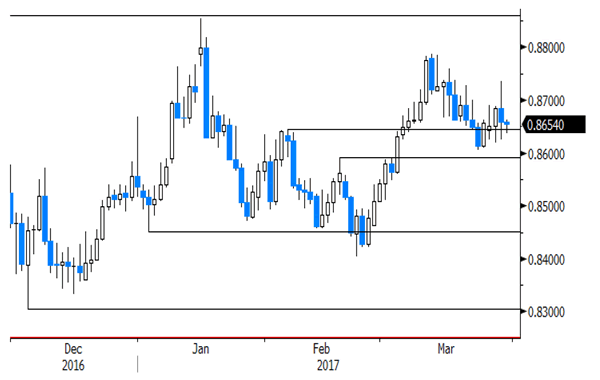
EUR/GBP: no negative impact from the Brexit announcement on sterling (yet).
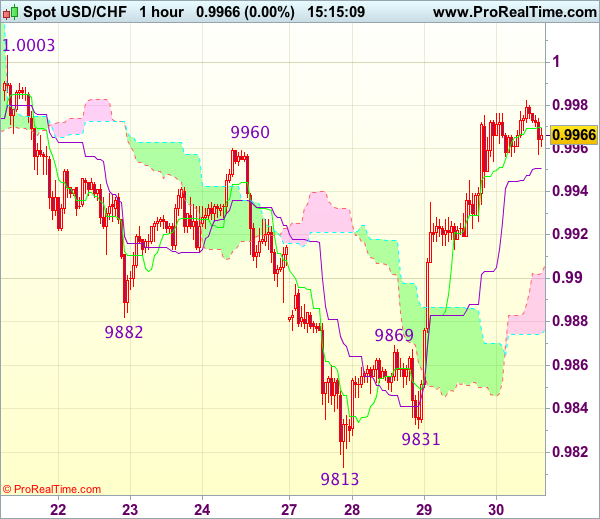
Trade Idea : USD/CHF – Buy at 0.9920
USD/CHF - 0.9972
Most recent candlesticks pattern : N/A
Trend : Near term up
Tenkan-Sen level : 0.9970
Kijun-Sen level : 0.9951
Ichimoku cloud top : 0.9902
Ichimoku cloud bottom : 0.9874
New strategy :
Buy at 0.9920, Target: 1.0020, Stop: 0.9885
Position : -
Target : -
Stop : -
The greenback has continued trading with a firm undertone after this week’s rally from 0.9813, adding credence to our view that recent decline has ended at 0.9813, hence upside bias remains for this rise from 0.9813 to bring retracement of recent decline and further gain to resistance at 1.0003 would be seen but break there is needed to provide confirmation and retain bullishness for further rise to 1.0030 but previous support at 1.0060 should remain intact.
In view of this, would not chase this rise here and would be prudent to buy dollar on pullback as 0.9920-25 should limit downside. Below the upper Kumo (now at 0.9902) would suggest top is formed instead, bring weakness to the lower Kumo (now at 0.9874) but break of said support at 0.9831 is needed to revive bearishness for retest of 0.9813 first.
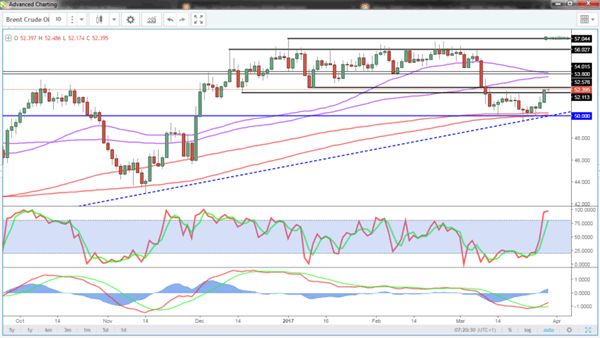
Can Oil Build On Yesterday’s Gains?
European equity markets are expected to open a little higher on Thursday, a day after the UK formally notified its partners of 44 years of its intentions to leave the EU.
The market reaction to the event was relatively muted in the end, something that wasn't guaranteed given the sensitivity to Brexit related news over the last nine months, particularly in the UK. The pound, which has at times been very vulnerable to Brexit, saw some weakness in the lead up to the announcement – some of which was likely due to the Scottish parliament voting for another referendum – but only ended the session slightly lower.
FTSE seen higher as oil extends gains while GBP remains soft
This helped to spur on the FTSE yesterday, along with the rally in oil which rallied almost 2% on the day and has started today on a positive note as well. A smaller than expected rise in crude inventories last week was enough to trigger yesterday's move, despite only falling a little short of forecasts and Tuesday's API number.
Oil rally on smaller inventory build could be bullish signal
Brent crude prices fell quite sharply at the start of the month before consolidating around $50 a barrel, which proved itself to be a strong level of support. There were signs last week that it may take something significant to break this level when a near five million build in inventories triggered a strong sell-off into the $50 level before immediately reversing course and wiping out the losses. Given how little it's taken to trigger a 2% swing higher, I wonder whether we've establish a temporary bottom in Brent. The next test comes around $52-52.50, with a break above this potentially triggering a move back towards $54-55.
USD rebounds after hawkish Fed remarks, more speeches to come today
The US dollar has experienced a slight rebound in recent days, aided by some more hawkish commentary from Federal Reserve officials. Yesterday John Williams and Eric Rosengren – neither of which are voters this year – alluded to the possibility of three more rate hikes this year while Charles Evans – who is a voter – was a touch more on the dovish side but still open to two further hikes and three if fundamentals improve. With two more officials due to speak today, it will be interesting to see whether we're seeing another coordinated response from the Fed to lift rate expectations, with markets having recently pared them back a fair bit.
It's looking a little light on the high impact data front again but there are still some notable releases scattered throughout the day. We'll get some inflation data from Germany and Spain this morning, as well as some sentiment data from the eurozone. This will be followed later by final fourth quarter GDP data and jobless claims from the US.
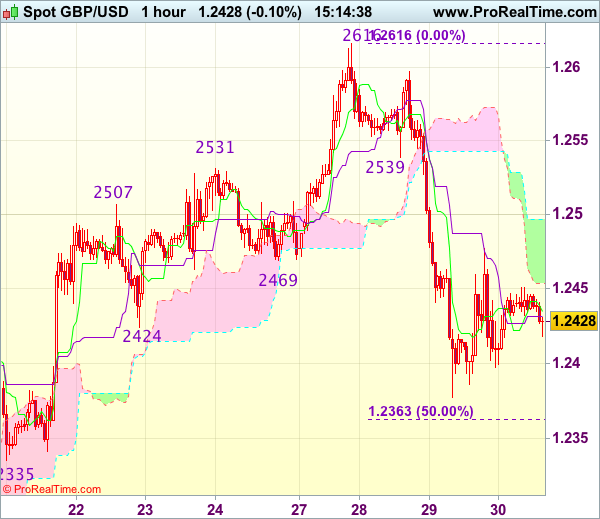
Trade Idea : GBP/USD – Sell at 1.2500
GBP/USD - 1.2422
Most recent candlesticks pattern : N/A
Trend : Near term up
Tenkan-Sen level : 1.2435
Kijun-Sen level : 1.2432
Ichimoku cloud top : 1.2497
Ichimoku cloud bottom : 1.2454
Original strategy :
Sell at 1.2500, Target: 1.2365, Stop: 1.2535
Position : -
Target : -
Stop : -
New strategy :
Sell at 1.2500, Target: 1.2365, Stop: 1.2535
Position : -
Target : -
Stop : -
Cable’s recovery after falling to 1.2377 yesterday suggests consolidation above this level would be seen and another bounce to 1.2475-80 is likely, however, still reckon upside would be limited to 1.2500-10 and bring another decline later, below said support at 1.2377 would extend the fall from 1.2616 top to 1.2360-65 (50% Fibonacci retracement of 1.2109-1.2616), however, loss of near term downward momentum should prevent sharp fall below 1.2335 support and reckon 1.2300-05 (61.8% Fibonacci retracement) would hold from here, bring rebound later.
In view of this, we are looking to sell cable on subsequent recovery as 1.2500 should limit upside and bring another decline. Above 1.2500-10 would defer but only break of previous support at 1.2539 would abort and signal the fall from 1.2616 has ended instead, bring rebound to 1.2560-65 first.
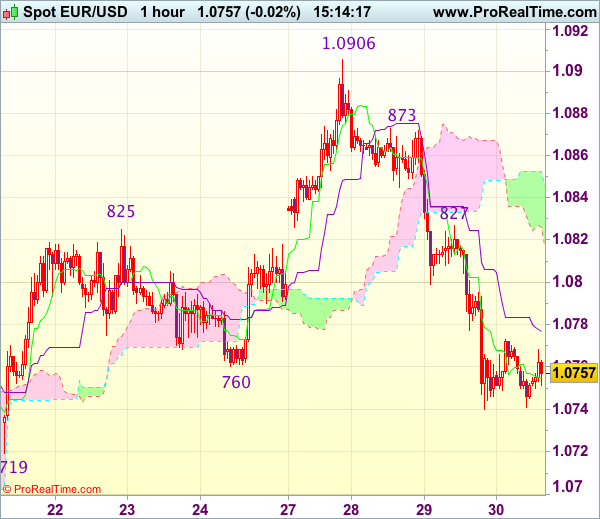
Trade Idea : EUR/USD – Sell at 1.0820
EUR/USD - 1.0754
Most recent candlesticks pattern : N/A
Trend : Near term up
Tenkan-Sen level : 1.0755
Kijun-Sen level : 1.0777
Ichimoku cloud top : 1.0853
Ichimoku cloud bottom : 1.0826
New strategy :
Sell at 1.0820, Target: 1.0720, Stop: 1.0855
Position : -
Target : -
Stop : -
As the single currency has remained under pressure after this week’s selloff from 1.0906 top, suggesting bearishness remains for further decline towards previous support at 1.0719, however, break there is needed to retain downside bias and signal recent rise has ended at 1.0960, then further weakness to 1.0695-00 and possibly 1.0670 would be seen but oversold condition would limit downside and reckon 1.0650 would hold from here, risk from there is seen for a rebound to take place later.
In view of this, would not chase this fall here and would be prudent to sell dollar on recovery as 1.0827 resistance should limit upside and bring another decline. Above 1.0845-50 would abort and signal the fall from 1.0906 has ended instead, bring test of 1.0873 resistance first.
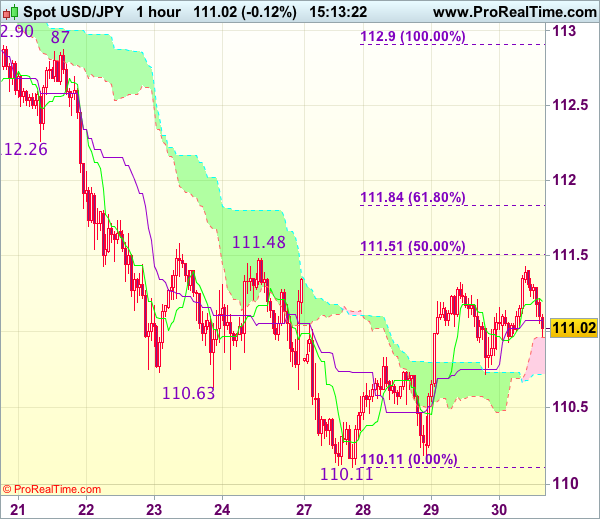
Trade Idea : USD/JPY – Stand aside
USD/JPY - 110.96
Most recent candlesticks pattern : N/A
Trend : Down
Tenkan-Sen level : 111.19
Kijun-Sen level : 111.08
Ichimoku cloud top : 110.96
Ichimoku cloud bottom : 110.72
Original strategy :
Exit short entered at 111.20,
Position : - Short at 111.20
Target : -
Stop : -
New strategy :
Stand aside
Position : -
Target : -
Stop : -
Although the greenback has retreated after intra-day initial brief rise to 111.43, below 110.72 (previous support as well as current level of the lower Kumo) is needed to suggest an intra-day top is formed, bring further fall to 110.45-50, then towards this week’s low at 110.11, otherwise, further choppy trading is in store. Below 110.11 would revive bearishness and extend recent decline to 109.95-00, then towards 109.70-75.
On the upside, above 111.48-51 (previous resistance and 50% Fibonacci retracement of 112.90-110.11) would signal low has been formed at 110.11, bring retracement of recent decline to 111.80-85 (61.8% Fibonacci retracement) but price should falter below previous support at 112.26, bring retreat later. As near term outlook is mixed, would be prudent to stand aside for now.
The Post-Brexit Pound, Bears Vs Bulls
Wednesday marked the official countdown of UK's divorce from the EU, ending a 44-year relationship with its neighbors. The end of this relationship is of course painful, but many agree that this marriage was not a case of love at first sight after all. Investors decided not to take any significant action on Wednesday, the GBPUSD traded within 70 pips trading range, and all major European equity markets closed higher.
Predicting currency movements was never an easy task, and inthe pound's case it's even a more complicated situation given that we never experienced such a divorce in the past. Economic conditions in the U.K. are in a much better shape than what was anticipated nine months ago, with most economic indicators surprising to the upside. Meanwhile, the BoE is likely to turn more hawkish as the depreciation of sterling continues to feed through to increased prices. These factors helped the pound to find a floor in the past 6-months, but the forward outlook will much depend on how negotiations progress in the next couple of months.
Sterling bears hope that the EU will take a tough stance on the U.K., making it a lesson for the rest of EU countries. This would lead to British completely losing access to the European single market, companies freezing CAPEX, and many multinational companies moving their hubs to different countries. If this was the case, then we're likely to see renewed selling pressure on the pound, potentially dropping below 1.20.
The sector which matters most is unquestionably the financial sector, and I believe many CEO's won't wait too long before moving operations elsewhere. Without passporting rights, UK financial services firms must have a state level agreement to perform activities in other European Union countries, and we've already seen a couple of announcements for major investment banks planning to move some jobs to another EU jurisdiction. If such actions accelerate, it will be an indication that negotiations are not moving on the right path and will support the views that sterling will head lower.
The EU will also suffer on the short to medium-run if they play tough, after all the U.K. is the second largest economy within the union. However, the EU will not sacrifice the achievements of a 76-year project based on short-term losses.
The bulls on the other side of the equation assume that some sort of agreement will materialize. For instance, U.K. pays the divorce bill, allows free movement of people and in return they maintain some sort of access to the EU single market. I think this scenario will have a more upside risk than the bearish scenario with a potential of 10% appreciation on GBPUSD.
GBP/USD Reverts Into Triangle Pattern After Brexit
Currency pair GBP/USD
The United Kingdom (UK) has officially and formally triggered Article 50 on Wednesday 29 March 2017, which starts the British exit (Brexit) out of the European Union. The process and negotiations will last 2 years and the UK is set to leave the EU by 29 March 2019.
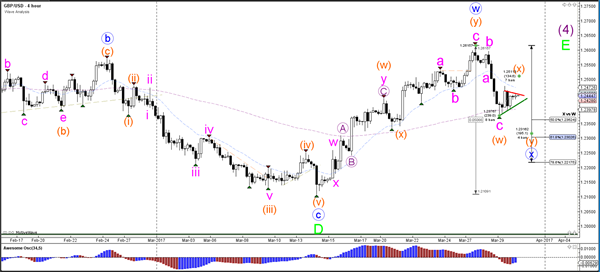
The GBP/USD is building a small triangle (red/green lines) pattern. The wave WXY (orange) could be part of a wave X (blue) which is part of a larger WXY (blue) to complete a wave E (green) triangle.
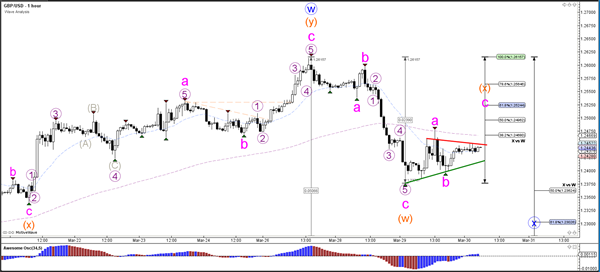
The GBP/USD is building a potential ABC (pink) zigzag within wave X (orange). A break above resistance (red) could see price move towards the targets.
Currency pair EUR/USD
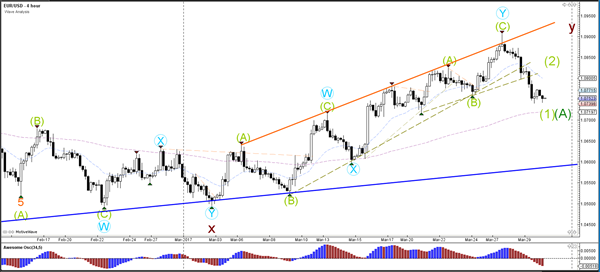
The EUR/USD broke below two support trend lines (dotted green) and is showing a strong bearish impulse. This could either be a wave 1 (light green) or wave A (dark green).
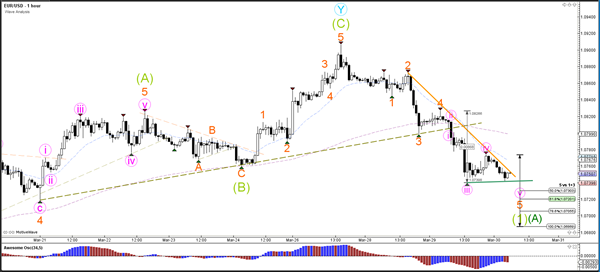
The EUR/USD could be in a final wave 5 (pink/orange) of the bearish impulse. A break below support (green) could see price move towards the Fibonacci targets whereas a break above resistance (orange) could see a correction of the wave 1/A (greens).
Currency pair USD/JPY
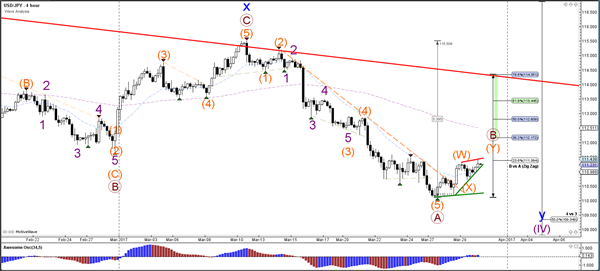
The USD/JPY continued with the bullish bounce and breakout above the resistance trend line (dotted orange). Price could be retracing the swing high and swing low of wave A (brown) which is why the Fibonacci levels of wave B vs A could become resistance levels. A bearish bounce could see price fall towards the 50% Fibonacci level of wave 4 vs 3 which in turn could be a bullish bouncing spot.
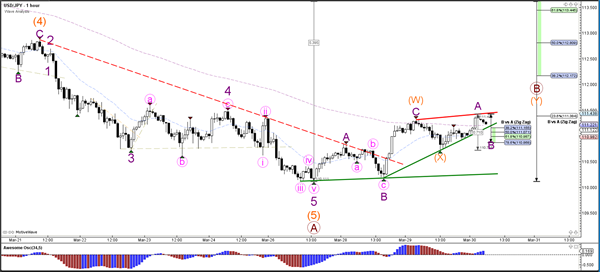
The USD/JPY offer support (green) and resistance (red) trend lines which could be breakout levels. However, price could bounce at the wave B vs A Fibonacci levels for an ABC zigzag (purple).
AUD/USD: Double Delight For Australia As New Home Sales Rebound In February And Job Vacancies Register An Increase For...
For the 24 hours to 23:00 GMT, the AUD strengthened 0.42% against the USD to close at 0.7665.
LME Copper prices rose 1.26% or $72.5/MT to $5847.0/MT. Aluminium prices rose 0.65% or $12.5/MT to $1931.0/MT.
In the Asian session, at GMT0300, the pair is trading at 0.7658, with the AUD trading 0.09% lower against the USD from yesterday's close.
Early morning data showed that Australian job vacancies advanced 1.8% in February, after climbing by a revised 2.5% in the previous month. This led the total number of job vacancies to rise to the highest level since May 2011 in the December-February quarter. Additionally, sales of new homes in Australia rebounded by 0.2% on a monthly basis in February, following a 2.2% decline in the previous month.
The pair is expected to find support at 0.7633, and a fall through could take it to the next support level of 0.7607. The pair is expected to find its first resistance at 0.7680, and a rise through could take it to the next resistance level of 0.7701.
Moving ahead, investors look forward to Australia's private sector credit data for February, due in the early hours tomorrow.
The currency pair is showing convergence with its 20 Hr moving average and is trading above its 50 Hr moving average.

EUR/USD: German Flash CPI For March Awaited
For the 24 hours to 23:00 GMT, the EUR declined 0.46% against the USD and closed at 1.0764.
In economic news, German import price index advanced above expectations by 0.7% on a monthly basis in February and after registering a rise of 0.9% in the previous month.
In the US, pending home sales registered a rise of 5.5% on a monthly basis in February, compared to a drop of 2.8% in the prior month. Markets were expecting pending home sales to climb 2.5%. In contrast, MBA mortgage applications in the US registered a drop of 0.8% in the week ended 24 March 2017. Mortgage applications had fallen 2.7% in the previous week.
Separately, the Boston Federal Reserve President, Eric Rosengren stated that four rate hikes are appropriate for this year.
In the Asian session, at GMT0300, the pair is trading at 1.0745, with the EUR trading 0.18% lower against the USD from yesterday's close.
The pair is expected to find support at 1.0713, and a fall through could take it to the next support level of 1.0682. The pair is expected to find its first resistance at 1.0801, and a rise through could take it to the next resistance level of 1.0858.
Moving ahead, investors look forward to the Euro-zone's consumer confidence and German consumer price index (CPI) data, due in a few hours. Additionally, the US Q4 annualised GDP and weekly jobless claims data will also attract a significant amount of market attention.
The currency pair is trading below its 20 Hr and 50 Hr moving averages.
