Fri, Apr 10, 2026 12:21 GMT
More

    Sample Category Title

    USD/CHF Weekly Outlook

    ActionForex

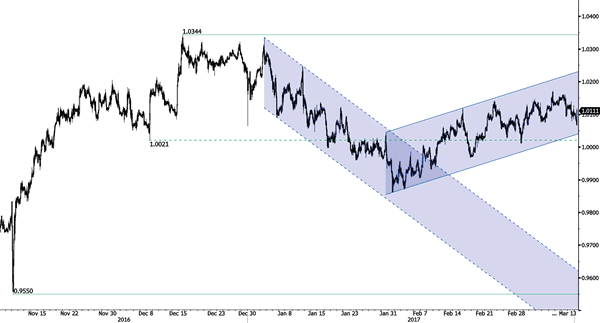
    USD/CHF dived further to as low as 0.9860 last week but recovered since then. Initial bias remains neutral this week for some consolidation first. Upside of recovery should be limited by 1.0043 resistance and bring another decline. Current fall from 1.0342 is seen as the third leg of the pattern from 1.0327. Below 0.9860 will target 61.8% retracement of 0.9443 to 1.0342 at 0.9786 and below. On the upside, break of 1.0043 will indicate short term bottoming and turn bias back to the upside.

    In the bigger picture, rejection from 1.0327 resistance suggests that consolidation pattern from there is still in progress. Fall from 1.0342 is seen as the third leg and retest of 0.9443/9548 support zone could be seen. But we'd expect strong support from there to contain downside. At this point, we're still expecting the larger rally to resume later to 38.2% retracement of 1.8305 to 0.7065 at 1.1359, after the consolidation completes.

    USD/CHF Weekly Chart

    USD/CHF Monthly Chart

    USD/CHF Weekly Chart

    USD/CHF Monthly Chart

    Subscribe to our daily and mid-day newsletter to get this report delivered to your mail box

    AUD/USD Weekly Outlook

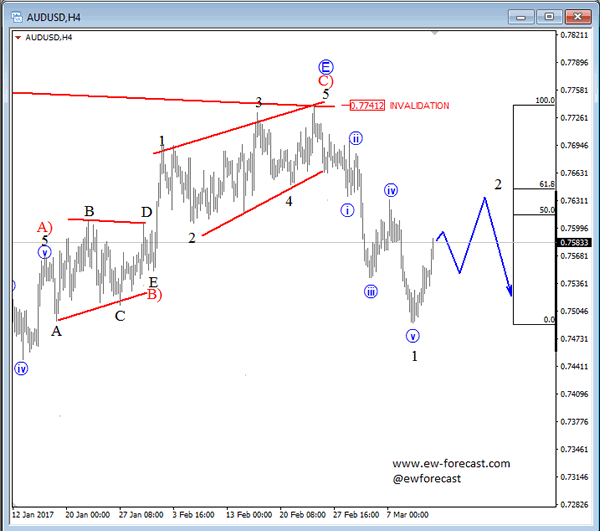
    AUD/USD surged to as high as 0.7965 last week and maintained near term bullishness. Initial bias stays on the upside this week for 0.7777/7833 resistance zone. A this point, we'd still expect strong resistance from there to limit upside and bring near term reversal. Break of 0.7510 minor support will indicate that rise from 0.7158 has completed already and turn bias back to the downside for this key near term support level.

    In the bigger picture, we're still treading price actions from 0.6826 low as a correction. And, as long as 38.2% retracement of 0.9504 to 0.6826 at 0.7849 holds, long term down trend from 1.1079 is expected to resume sooner or later. Break of 0.6826 low will target 0.6008 key support level. However, firm break of 0.7849 will indicate that rise from 0.6826 is developing into a medium term rebound, rather than a sideway pattern. In such case, stronger rise should be seek to 55 month EMA (now at 0.8205) and above.

    In the longer term picture, while the down trend from 1.1079 might extend lower, we're not anticipating a break of 0.6008 (2008 low) yet. We'll look for bottoming above there to reverse the medium term trend.

    AUD/USD 4 Hours Chart

    AUD/USD Daily Chart

    AUD/USD Weekly Chart

    AUD/USD Monthly Chart

    Subscribe to our daily and mid-day newsletter to get this report delivered to your mail box

    USD/CAD Weekly Outlook

    USD/CAD dropped further to as low as 1.2968 last week before turning sideway. Initial bias is neutral this week first. Current development affirmed the case that corrective rise from 1.2460 has completed at 1.3598 already, after hitting 50% retracement of 1.4689 to 1.3838. Deeper fall is expected as long as 1.3168 minor resistance holds. Break of 1.2968 should pave the way to retest 1.2460 low. However, on the upside, break of 1.3168 will mix up the near term outlook and turn focus back to 1.3387 resistance first.

    In the bigger picture, price actions from 1.4689 medium term top are seen as a correction pattern. The first leg has completed at 1.2460. The second leg could be completed at 1.3598 and fall from there is tentatively seen as the third leg. Break of 1.2460 will target 50% retracement of 0.9460 to 1.4689 at 1.2075 before completing the correction. In case of another rise, we'd look for reversal signal above 61.8% retracement of 1.4689 to 1.2460 at 1.3838.

    In the longer term picture, rise from 0.9056 (2007 low) is viewed as a long term up trend. It's taking a breath after hitting 1.4689. But such rise expected to resume later to test 1.6196 down the road.

    USD/CAD 4 Hours Chart

    USD/CAD Daily Chart

    USD/CAD Weekly Chart

    USD/CAD Monthly Chart

    Subscribe to our daily and mid-day newsletter to get this report delivered to your mail box

    GBP/JPY Weekly Outlook

    GBP/JPY stayed in established range of 140.43/77 last week and outlook is unchanged. Initial bias remains neutral this week first. Overall, price actions from 148.42 are seen as a corrective pattern with first leg completed at 136.44. Break of 140.43 will argue that the second leg is finished too. In such case, intraday bias will be turned back to the downside for 136.44 and below. Meanwhile, break of 144.77 will target a test on 148.42 high next.

    In the bigger picture, price actions from 122.36 medium term bottom are still seen as a corrective pattern. Main focus is on 38.2% retracement of 195.86 to 122.36 at 150.42. Rejection from there will turn the cross into medium term sideway pattern with a test on 122.36 low next. Though, sustained break of 150.42 will extend the rebound towards 61.8% retracement at 167.78.

    In the longer term picture, while price actions from 122.36 would develop into a medium term correction, fall from 195.86 is still seen as resuming the down trend from 251.09 (2007 high). Hence, after the correction from 122.36 completes we'd expect another fall through 116.83 low.

    GBP/JPY 4 Hours Chart

    GBP/JPY Daily Chart

    GBP/JPY Weekly Chart

    GBP/JPY Monthly Chart

    Subscribe to our daily and mid-day newsletter to get this report delivered to your mail box

    EUR/JPY Weekly Outlook

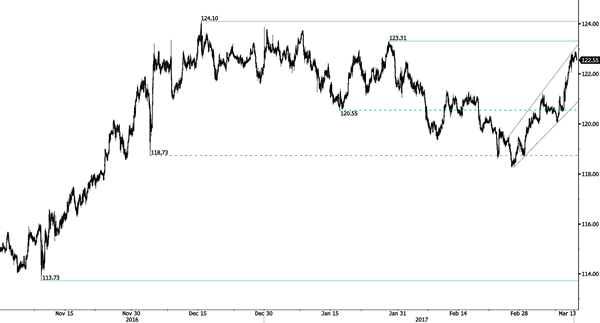
    EUR/JPY continued to stay in the consolidation pattern from 124.08 last week and outlook is unchanged. Initial bias remains neutral this week first. Deeper fall cannot be ruled out yet. On the downside, below 120.54 will target 118.45 cluster support (38.2% retracement of 109.20 to 124.08 at 118.39). In that case, we'd expect strong support from there to bring rebound. On the upside, break of 124.08 will extend the larger rally from 109.20 to 126.09 key resistance next.

    In the bigger picture, price actions from 109.20 medium term bottom are seen as part of a medium term corrective pattern from 149.76. There is prospect of another rise towards 126.09 key resistance level before completion. But even in that case, we'd expect strong resistance between 126.09 and 141.04 to limit upside, at least on first attempt. Nonetheless, decisive break of 118.45 cluster support (38.2% retracement of 109.20 to 124.08 at 118.39) will argue that rise from 109.20 is completed and turn outlook bearish for 61.8% retracement at 114.88 and below.

    In the long term picture, current medium term decline from 149.76 is seen as part of a long term sideway pattern from 88.96. Decisive break of 126.09 will indicate that such decline is completed and EUR/JPY has started another medium term rally already.

    EUR/JPY 4 Hours Chart

    EUR/JPY Daily Chart

    EUR/JPY Weekly Chart

    EUR/JPY Monthly Chart

    Subscribe to our daily and mid-day newsletter to get this report delivered to your mail box

    EUR/GBP Weekly Outlook

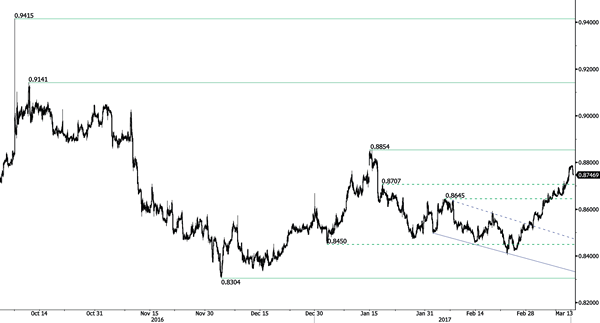
    EUR/GBP stayed in consolidation pattern from 0.8469 last week and outlook is unchanged. Initial bias stays neutral first. At this point, we're tentatively viewing fall from 0.8851 as the third leg of the corrective pattern from 0.9304. Hence, we'd expect upside of the recovery from 0.8469 to be limited by 50.% retracement of 0.8851 to 0.8469 at 0.8660 to bring fall resumption. Below 0.8469 will turn bias to the downside for 0.8303 low. However, firm break of 0.8660 will indicate that rise from 0.8303 is still in progress and would turn bias to the upside for 0.8851 resistance and above.

    In the bigger picture, price actions from 0.9304 are viewed as a medium term corrective pattern. Deeper fall cannot be ruled out yet. But we'd expect strong support from 0.8116 cluster support (50% retracement of 0.6935 to 0.9304 at 0.8120) to contain downside. Overall, the corrective pattern would take some time to complete before long term up trend resumes at a later stage. Break of 0.9304 will pave the way to 0.9799 (2008 high).

    In the long term picture, firstly, price action from 0.9799 is seen as a long term corrective pattern and should have completed at 0.6935. Secondly, rise from 0.6935 is likely resuming up trend from 0.5680 (2000 low). Thirdly, this is supported by the impulsive structure of the rise from 0.6935 to 0.9304. Hence, after the consolidation from 0.9304 completes, we'd expect another medium term up trend to target 0.9799 high and above.

    EUR/GBP 4 Hours Chart

    EUR/GBP Daily Chart

    EUR/GBP Weekly Chart

    EUR/GBP Monthly Chart

    Subscribe to our daily and mid-day newsletter to get this report delivered to your mail box

    EUR/AUD Weekly Outlook

    EUR/AUD dropped to as low as 1.3997 last week and the break of 1.4025 support indicates down trend resumption. Initial bias stays on the downside this week for 1.3671 key support level next. As the larger decline from 1.6587 is seen as a corrective move, we'd expect downside to be contained by 1.3671 to bring reversal. On the downside, break of 1.4289 resistance will confirm short term bottoming and turn bias back to the upside for 1.4721 resistance.

    In the bigger picture, price actions from 1.6587 medium term top are viewed as a consolidative pattern. 50% retracement of 1.1602 to 1.6587 at 1.4095 was already met. While further fall cannot be ruled out, we'd expect strong support above 1.3671 to contain downside and bring rebound. Up trend from 1.1602 should not be finished and will resume later. Break of 1.4721 resistance will indicate completion of such correction and outlook bullish for retesting 1.6587 high.

    In the longer term picture, the rise from 1.1602 long term bottom isn't over yet. We'll keep monitoring the development but there is prospect of extending the rise to 61.8% retracement of 2.1127 to 1.1602 at 1.7488 and above. However, break of 1.3671 should confirm trend reversal and target 1.1602 long term bottom again.

    Subscribe to our daily and mid-day newsletter to get this report delivered to your mail box

    EUR/CHF Weekly Outlook

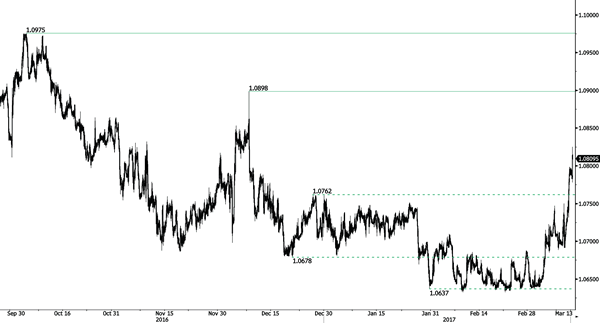
    EUR/CHF dipped to as low as 1.0635 last week but recovered ahead of 1.0620 support. Initial bias stays neutral this week for consolidations. Near term outlook will remain bearish as long as 1.0749 resistance holds and deeper decline is expected. Decisive break of 1.0620 key support level will confirm resumption of whole fall from 1.1198. In that case, next downside target will be 1.0485 fibonacci level. Break of 1.0749 will raise the chance of medium term reversal and turn focus back to 1.0897 key resistance.

    In the bigger picture, the decline from 1.1198 is seen as a corrective move. Such correction is still in progress. Sustained trading below 38.2% retracement of 0.9771 to 1.1198 at 1.0653 will target 50% retracement at 1.0485. On the upside, break of 1.0897 resistance is needed to confirm completion of such fall. Otherwise, outlook will stay bearish.

    EUR/CHF 4 Hours Chart

    EUR/CHF Daily Chart

    EUR/CHF Weekly Chart

    EUR/CHF Monthly Chart

    Subscribe to our daily and mid-day newsletter to get this report delivered to your mail box

    Weekly Economic and Financial Commentary


    U.S. Review

    Data Supports Cautiously Optimistic Fed View

    • The Federal Reserve held rates steady this week, as widely expected. It reiterated the strengthening U.S. domestic outlook would warrant gradual policy tightening over the medium term. No clues were given on the timing of the next move, likely because uncertainty surrounds the unfolding of the new administration's policy, and the Fed can afford to wait for clarity because inflation remains tame.
    • The economic calendar was packed with more positive reads on the U.S. economy, capped off with the 227,000 jobs added in January - a fairly solid start to what is shaping up to be an interesting year.

    No Urgency in Data, Fed Has Space to See Policy Unfold

    FOMC members see a strengthening U.S. economy that warrants a gradual return to normal monetary policy. The trick now is timing interest rate moves without derailing said strength. After checking the box on the full employment objective, guiding inflation to 2 percent requires a bit more finesse. Tight labor markets fuel inflation and monetary policy tools operate on a lag; therefore, the data-dependent Fed follows data-heavy weeks, like this one, closely for hints that inflation is moving ahead of target. Major indicators out this week - January jobs data, ISM surveys, consumer confidence and income & spending, to name a few - gave an upbeat assessment of the current economy and expected conditions going forward. Inflation indicators showed mild price pressure - enough to assure the Fed that inflation is firming but not flaring. Lack of urgency in the economic data thus far affords the FOMC some time to wait for clarity on the new administration's policy actions and their economic implications.

    Personal income and spending in December was solid, up 0.3 percent and 0.5 percent, respectively. Following two months of soft readings, personal consumption expenditures ended the year on better footing. Real personal spending was up a more muted 0.3 percent in December, as inflation cut into purchasing power. Still, Americans spent a larger share of income, lowering the savings rate to 5.4 percent from 5.6 percent in November - providing some hard data to corroborate optimism in the various consumer sentiment surveys since the election. Conference Board Consumer Confidence's measure of expectations surged postelection but retraced in January, though consumers' assessment of the present economic situation improved. Like the FOMC, consumers' confidence in sustaining a strong economic outlook hinges on how the new administration's policy unfolds.

    Sentiment among manufacturers continues to improve, according to the ISM survey. The closely-watched indicator rose for the fifth consecutive month, to 56.0 in January, as broad-based gains across indices pointed to steady optimism among respondents. The employment component stood out most in the upbeat report, rising 3.3 points to 56.1. Pressure from soft global growth and the energy-related investment downturn has largely faded, though manufacturers still have to face headwinds from the stronger greenback weighing on exports. Inflationary pressures were also apparent in the report, with the prices paid component rising in 15 manufacturing industries, while none reported paying lower prices for inputs. This also assures the Fed inflation is on course to meet its target, as core goods deflation has weighed on overall inflation in recent years.

    January's jobs report surprised to the upside as employers added 227,000 jobs on the month, much stronger than the consensus estimate. The job market also pulled more Americans in from the sidelines; as the labor force participation rate rose 0.2 percentage points to 62.9 percent, giving the slight uptick in unemployment to 4.8 percent some positive light. Average hourly wage growth was softer than expected, particularly if the labor market is at full employment; this bears watching for the next few months. We still expect inflation to move to the two percent target this year, prompting two rate hikes, with the first move in June.

    U.S. Outlook

    Trade Balance • Tuesday

    The international trade balance for the final month of 2016 likely remained more or less steady relative to the November trade deficit. Net exports exerted a sizable 1.7 percentage point drag on real GDP growth in Q4 as a whole, largely as a result of some payback due to the quirky surge in soybean exports that boosted growth in Q3. Despite quarterly volatility, net exports subtracted just 0.1 percentage points from real GDP growth in full-year 2016. Smoothing through the volatility, export growth has begun to stabilize after weakening early in 2016.

    Should the data come in as expected, the full-year 2016 U.S. trade deficit would be approximately $500 billion. Despite the recent pickup in export growth, we expect the real trade deficit to widen a bit in 2017 as the dollar appreciates further, global growth remains tepid and healthy domestic demand continues to pull in imports.

    Previous: -$45.2B Wells Fargo: -$44.6B Consensus: -$45.0B

    Import Price Index • Friday

    Import prices increased 0.4 percent in December, boosted by a 7.9 percent surge in imported petroleum prices following OPEC's agreement early in the month. However, dollar strength has continued to keep non-energy import prices under pressure; exfuels, import prices have fallen in three consecutive months and have not increased since last July.

    We expect import prices to rise another 0.4 percent in January. If realized, this would bring the year-ago change to 3.5 percent, nearly double December's multiyear high and the fastest pace of total import inflation since March 2012. Base effects from the steep decline in oil prices are providing a boost to import price inflation. Despite the dollar recently giving back some of its post-election gains, renewed dollar strength as the Fed moves forward with normalization will likely counteract some of the inflationary effects of higher energy prices in this space.

    Previous: 0.4% Wells Fargo: 0.4% Consensus: 0.4% (Month-over-Month)

    Monthly Budget Statement • Friday

    The fiscal stimulus debates sparked by the election have brought federal revenue and spending trends to the forefront for markets. The Monthly Treasury Statement offers a snapshot of these trends. For most of the recovery, revenue growth outpaced spending growth as the result of an improving economy and policy changes. More recent, however, spending growth has returned to a steady pace, while revenues have decelerated dramatically.

    Multiple factors have led to the anemic pace of tax collections, including weak corporate profits, slowing employment growth and smaller capital gains realizations. On balance, our expectation for faster economic growth in 2017 should fuel higher tax collections, but a robust turnaround seems unlikely at this point in the cycle. As policymakers weigh changes to the tax code, the recent federal revenue slowdown will do them few favors as they strive to maintain deficit-neutrality.

    Previous: -$27.5B Consensus: $33.0B

    Global Review

    Global Economy Getting on Firmer Footing

    • Real GDP in the Eurozone grew at an annualized rate of 2.0 percent in Q4, stronger than most analysts had expected. In the United Kingdom, the Bank of England revised up its forecasted growth rate to 2.0 percent from 1.4 percent for 2017, but does not seem to be in a great hurry to tighten rates.
    • Real GDP in Canada rose more than expected in November, although it is difficult to make a convincing case that the Canadian economy is "booming" at present. Real GDP in Mexico rose 2.2 percent on a year-ago basis in Q4. We remain concerned about the outlook for the Mexican economy going forward.

    Global Economy Getting on Firmer Footing

    Real GDP data released this week showed that economic growth in some of America's major trading partners was reasonably solid in Q4-2016. If, as we expect, economic growth in the rest of the world firms further in coming quarters, then the outlook for U.S. exports should brighten somewhat, everything else equal.

    Real GDP in the Eurozone grew at an annualized rate of 2.0 percent in the fourth quarter, a tad stronger than the 1.8 percent growth rate that was registered in Q3 (see chart on front page). A breakdown of the GDP data into its underlying demand components will not be available for another month, but it appears that growth in Q4 was driven primarily by domestic demand. If so, then the expansion in the Eurozone is becoming more and more self-sustaining. Although the ECB is probably not quite ready to dial back its QE program, it could begin to do so later this year. (See Is ECB Policy Tightening Coming Into View, which is posted on our website.)

    We reported in this space last week that real GDP in the United Kingdom grew at an annualized rate of 2.4 percent in Q4 (top chart), which was stronger than the rate that most analysts had expected. This week, the Bank of England released its quarterly Inflation Report in which it revised its own GDP forecast for 2017 up to 2.0 percent from 1.4 percent. Interestingly though, the Monetary Policy Committee (MPC) does not seem to be in a huge hurry to raise rates. Not only did all nine MPC members vote at the Feb. 2 meeting to keep policy on hold, but the MPC indicated in the statement after the meeting that it could tolerate a temporary overshoot of CPI inflation above its 2 percent target. (See U.K. Q4 GDP Growth: BoE Policy Implication for our most recent thoughts on British interest rates going forward.)

    Moving on to North America, real GDP in Canada rose 0.4 percent in November relative to the previous month (middle chart). Not only was the outturn stronger than most analysts had expected, but it more than reversed the 0.2 percent decline in output that occurred in October. It appears that the Canadian economy has accelerated again following the marked slowdown that accompanied the collapse in energy prices that commenced in 2014. That said, it is difficult to make a convincing case that the Canadian economy is "booming" at present with a year-over-year growth rate of only 1.7 percent. Consequently, we look for the Bank of Canada to remain on hold throughout most of 2017.

    South of the border, real GDP in Mexico rose 2.2 percent on a year-ago basis in Q4, a slight uptick from the 2.0 percent rate that was registered in Q3 (bottom chart). As we wrote earlier this week, however, growth in the Mexican manufacturing sector remains lackluster. (See Mexican Economic Growth Slows a Bit in Q4-2016.) Moreover, we remain concerned about the outlook for the Mexican economy going forward. As we noted last week, the central bank has hiked rates by 275 bps since December 2015 in an effort to counter some of the sharp downward pressure on the currency. Indeed, we forecast that the combination of rising interest rates and uncertainty related to NAFTA will lead to a mild recession in the Mexican economy this year.

    Global Outlook

    U.K. Industrial Production • Friday

    British industrial production (IP) grew by a stronger-than-expected 2.1 percent on the month in November. Oil and gas production surged as the Buzzard oil fields came back on line after an extended shutdown - one of the U.K.'s largest oil fields. Year over year, overall IP was up 2.0 percent, compared to the 0.9 percent decline in October. In addition, manufacturing production saw a 1.3 percent increase on the month helped by a large upswing in the pharmaceutical sector. On a year-ago basis, the manufacturing sector grew by 1.2 percent. For December, the consensus expects slower growth for industrial and manufacturing production as warmer weather more than likely hampered output in the energy sector.

    Meanwhile, next week we will also get data on the U.K.'s December's trade balance, which widened in November as the increase in exports was not enough to offset the jump in imports.

    Previous: 2.0% Consensus: 2.9% (Year-over-Year)

    Mexico Industrial Production • Friday

    Mexican industrial production (IP) was unchanged in November from a month prior as a slump in mining nearly offset strong gains in manufacturing production. However, the year-over-year results showed an improvement of 1.3 percent, compared to the 1.2 percent decline in October. Preliminary fourth-quarter economic data showed that the industrial sector posted a flat rate, underscoring the difficult times the sector is facing, even as the Trump administration has not started the process of attempting to renegotiate NAFTA. The manufacturing sector, which grew 4.3 percent in November 2016 compared to the previous year, could be negatively impacted depending on the outcome of the negotiations.

    Other data slated for release next week include consumer price inflation and vehicle production.

    Previous: 1.3%

    Canada Jobs Report • Friday

    Canada's jobs report is quite volatile month to month as shown in the graph on the right. In December, Canada employment bested expectations of a slight loss of jobs, adding 53,700 jobs, and ended the year up 214,000 jobs - the largest increase since 2012. December's report came on the tails of a 10,700 increase in November and marked five months of consecutive growth. That said, the economy actually added 81,000 full-time positions in December, offset by a loss of 27,000 part-time positions. By sector, jobs were added in both the service-producing (+52,000) and goods-producing sector (+1,700), which includes manufacturing. Meanwhile, Canada's unemployment rate ticked up to 6.9 percent, as more people entered into the workforce. Markets do not expect for this momentum to have carried into the new year and looks for the economy to have shed 10,000 jobs in January.

    Previous: 53,700 Consensus: -10,000

    Point of View

    Interest Rate Watch

    Anticipating Fed Expectations

    "Inflation increased in recent quarters but is still below the Committee's 2 percent longer-run objective." – FOMC statement from the February meeting.

    But not for long - our forecast for the PCE deflator calls for 1.9 percent in the current quarter and then 2.0 percent by Q3. This would signal a continued negative real fed funds rate (top graph). The rise in inflation is consistent with stabilizing oil prices that should no longer prevent inflation from hitting the 2 percent target by mid-2017. Meanwhile, on the labor market side of the mandate, the unemployment rate has fallen from 6.2 percent in 2014 to 4.8 percent currently. We expect two moves in 2017 - the first in June and a second dependent on the market and FOMC's perception of the impact of the administration's economic initiatives.

    Market Moving Ahead of FOMC

    In contrast to the FOMC's characterization of inflation expectations, the Fed's five-year five year forward measure of inflation expectations has shifted upward noticeably post-election. This is reflected in the market's reaction as illustrated in the middle figure. However, if the FOMC's neutral fed funds rate is indeed 3.0 percent, as they estimate, this would suggest the two-year Treasury yield has a long way to go - upward.

    Global Economic Improvement and the Fed's Balance Sheet

    Our outlook is for an improvement in global growth in 2017 relative to 2016 with increased reflation in several U.S. trading partners. Global and U.S. reflation will put pressure on the FOMC to begin a rebalancing of its balance sheet (bottom graph) which we believe would be possible by mid-2018. Fed guidance is imprecise as phasing-out reinvestment is timed to occur "once normalization of the fed funds rate is well under way." Of course, this imprecision is to be expected, given the uncertainties of economic and political developments over the next two years. Normalization would likely feed into the fiscal policy debate as the interest rate burden of the federal debt would increase with a balance sheet reduction.

    Credit Market Insights

    The Return of Homeowner Equity

    U.S. home prices have rebounded meaningfully since the Great Recession. According to data from S&P CoreLogic Case-Shiller, national home prices have risen nearly 40 percent from their 2012 trough. While the persistent increase in home prices has created affordability challenges in many markets around the country, homeowners have largely benefitted from rising home values.

    Fueled by home price appreciation and the pay down of principal, homeowner equity - the difference between the value of one's home and the amount of mortgage debt on the home - has climbed higher. After hitting a trough in Q2 2011, home equity wealth has risen by more than 50 percent, increasing from $6.1 trillion to $13.0 trillion in Q3 2016. Negative homeowner equity - those that owe more on their home than it is worth - has also shown cyclical improvement. Just 6.3 percent of homeowners with a mortgage have negative equity, which is down from 26 percent in 2010, according to CoreLogic estimates.

    The rise in home equity wealth corresponds with other barometers of consumer finances, including delinquency rates and income growth, which point to strengthening household balance sheets. Moreover, the rebuilding of this component of household wealth has been supportive for consumer spending. We expect national home prices to rise another 4 percent in 2017, supporting additional gains in equity.

    Topic of the Week

    NAFTA Rules of Origin: What Is at Stake?

    At a time when supply chains extend across country boundaries all over the world, NAFTA's rules of origin become even more important to determine the source of exported and imported goods. The rules of origin are used to determine if products produced in a member country of NAFTA, using imported inputs, are considered to have been produced in that country for taxing purposes. That is, it determines if the product has enough NAFTA country content to not pay duties or taxes imposed on imports. For example, an automobile produced in North America is considered exempt of duties if 62.5 percent of the automobile originates in North America. The Trump administration could negotiate an increase of that percentage to encourage greater production of automobiles in the United States versus automobiles produced in Europe or Asia.

    This is important, because, in the past, companies have tried to bypass free trade agreement rules by originating production in member countries of NAFTA by locating a single part of the production process in the United States, Canada or Mexico. However, this part of the production process is so minimal it is clear that the firms organized such production to benefit from the lower taxes. An example that comes to mind is a producer of orange concentrate from outside the NAFTA region that opens a plant in one of the NAFTA member countries just to add water to the concentrate and sell it as orange juice produced in NAFTA, thus avoiding taxes on trade.

    Rules of origin exist for all production taking place in the United States, Canada and Mexico and determine if a product is indeed produced by one of the members of the trade agreement for purposes of taxes/duties. Changing the rules of origin could benefit U.S. producers and generate more jobs in certain industries, like the automobile industry, something that could address the issues brought about by the Trump administration.

    The Weekly Bottom Line

    HIGHLIGHTS OF THE WEEK

    United States

    • Political events and communiqués from the new administration, continued to dominate the headlines - taking some of the attention away from what was a week of upbeat economic data.
    • The FOMC held rates steady this week, but remained upbeat about the economy - pointing to continued improvement in the labor market. This narrative was corroborated by this morning's employment report, which blew expectations of 180K out of the water as payrolls rose by 227K.
    • In the near term, we expect the Fed to remain on the sidelines in order to observe how the economy behaves under heightened policy uncertainty. If the economic expansion continues at the current moderate but above trend pace of growth, we expect the Fed to hike around the mid-year mark. By that point some of the missing pieces from the policy puzzle should have fallen into place.

    Canada

    • According to Canada's leading rodent forecaster, we are in for an early spring. And while Canada's economy is not out of the shadows yet, data out this past week showed that it did spring back into action in November.
    • Real GDP rose 0.4% in November, led by a rebound in the goods sector. Canada's economy picked up momentum in the second half of the year, as the good sector has improved against a back drop of consistent growth in services.
    • In a speech, Bank of Canada Governor Poloz expressed concerns about both the move up in Canadian bond yields and the level of the loonie. This underscored the dovish stance of the Bank, given the risks to growth are primarily to the downside. A significant shock, or series of smaller shocks could see the Bank cut again.

    UNITED STATES - UPBEAT ECONOMIC DATA CORROBORATES FED NARRTIVE

    Political events and communiqués from the new administration, whether formal or informal, continued to dominate the headlines this week - taking some of the attention away from the upbeat economic data. Equity markets eased off slightly from last week's all-time high, while long-term treasury yields are expected to end the week roughly unchanged. The euphoric post-election momentum appears to have finally plateaued as both equity and fixed income markets remain range-bound near recent highs.

    The lack of policy detail in key areas such as tax reform, infrastructure spending and trade is likely to have featured in the FOMC's decision to hold the federal funds rate steady this week - a decision that surprised no one. The committee remained upbeat on the outlook, noting that the economy "continued to expand at a moderate pace", while making reference to solid job gains and an unemployment rate that remains "near its recent low".

    This narrative was corroborated by January's employment report, which blew expectations of 180K out of the water as payrolls rose by 227K (Chart 1). Gains were fairly widespread in the private services sector, while on the goods-producing side they were concentrated in construction (+36K) - a highly seasonal sector and thus one where we could see some reversal in the months ahead. The unemployment rate ticked up slightly to 4.8%, but for a good reason, as the continued improvement in labor market conditions is drawing in more workers from the sidelines - evidenced by the 0.2 ppts move up in the participation rate on the month to 62.9%. While this development is welcome and largely anticipated, taken together with the deceleration in wage growth to 2.5% y/y from 2.8% in the month prior, it is likely to hearten Fed doves to argue for continued patience.

    Earlier in the week, personal income and spending data for December was also positive, providing a solid handoff for consumer spending growth heading into 2017. Incomes rose 0.3% m/m and spending rose 0.5% m/m. Consumer spending drove growth in the fourth quarter and we expect this momentum to carry into the first quarter of 2017. Manufacturing activity remained solid, as the ISM index rose to the quickest pace of expansion in over two years in January. Comments by survey respondents were generally positive with little evidence that recent domestic and global events had taken a toll on demand. On the other hand, services sector activity held steady on the month with the index still at its highest level since September 2016 (Chart 2).

    Overall, the US economy continues to exhibit signs of improvement. In the near term, we expect the Fed to remain on the sidelines in order to observe how the economy behaves under heightened policy uncertainty. If the economic expansion continues at the current moderate but above trend pace of growth, we expect the Fed to hike around the midyear mark. By that point some of the missing pieces from the policy puzzle should have fallen into place, such as infrastructure spending plans. Yet, it looks like the highlyanticipated tax reform bill will not be written until summer. That, coupled with the slow nature of the political process in general, has the potential to lead to some pullback in consumer, business, and market sentiment. In the meantime, markets will continue to hang on every word from the new administration.

    CANADA - A GROUNDHOG AND A CENTRAL BANKER WALK INTO A BAR

    We heard from two high-profile forecasters this week. A central banker reminded us that economic forecasts are only approximations, and that "models are not crystal balls". A couple of days later, a rodent suggested that we're in for an early-spring. While we will address Governor Poloz's remarks in a bit, the groundhog may be onto something with data released this week indicating that Canada's economy already had a spring in its step as far back as November.

    Monthly real GDP rose by a healthy 0.4% in November, recovering from a 0.2% drop in October. After making little progress through 2015 and the first half of 2016, Canada's economy has picked up some momentum in the latter half of 2016 (see chart). The main factor behind the swing from September to November was related to improved fortunes in the goods-producing sector. The sector is growing just below 1% on a yearly basis, after spending much of the last two years in contraction.

    In contrast, the services sector continues to chug along at a pace just shy of 2%. Beneath the surface, one industry that has been a key driver of services sector growth is showing distinct signs of cooling. Real estate rental and leasing expanded at a 2.2% year/year pace in November, a marked deceleration from the roughly 3.5% y/y clip at the beginning of 2016. This suggests that the multiple housing regulations that have been put into place alongside rising interest rates are slowing real estate activity.

    The healthy GDP figures add to the evidence that the Canadian economy is shaking off some of the setbacks earlier in the year and growth in the fourth quarter of 2016 is likely to come in ahead of the Bank's expectations of 1.5%. Still, these facts are not likely to move the needle very much for the Bank of Canada, given the still significant amount of economic slack that remains. As such, the Bank of Canada will probably be happy to leave its policy interest rate at 0.50% well into the future, helping to support the ongoing absorption of the remaining slack.

    In fact, in his remarks this week, the Bank of Canada Governor Poloz seemed to reinforce the risk of further monetary easing in Canada. He indicated the Bank's discomfort with both the run up in Canadian bond yields and the elevated level of the loonie. A rate cut would help on both of these fronts, but at this point we do not expect further easing will come to pass, given an outlook for continued absorption of the remaining economic slack. As Governor Poloz pointed out, however, the risks to the growth outlook remain tilted towards the downside with the threshold for action potentially breached either by a significant shock, or a series of small shocks.

    Indeed, the Canadian dollar is the second best performing major currency since the U.S. election (see chart), seemingly at odds with the rising downside risk to Canada's economy stemming from a more protectionist stance by the Trump administration. The loonie has had a helping hand from firmer oil prices, but markets may be somewhat complacent about the potential impact from any thickening of the U.S. border.