Sample Category Title

USD/CHF Mid-Day Outlook

ActionForex

Daily Pivots: (S1) 0.7962; (P) 0.7987; (R1) 0.8002; More….

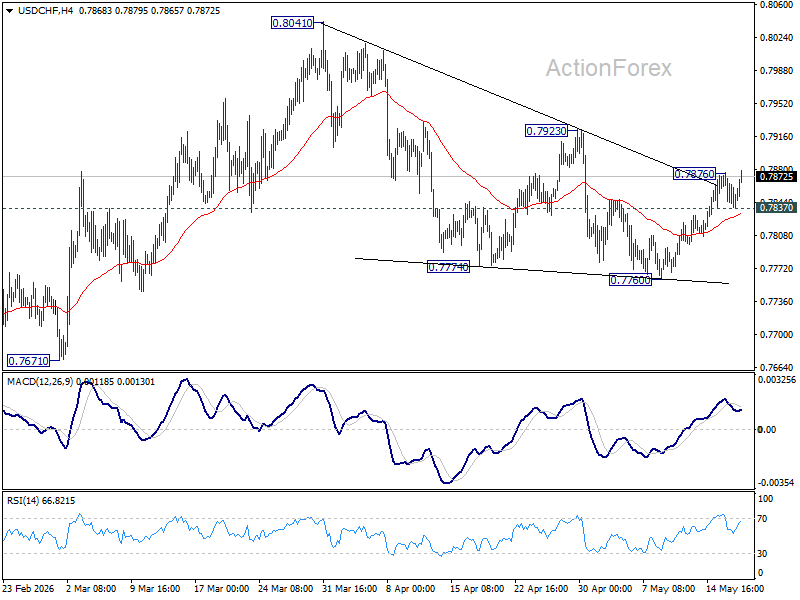
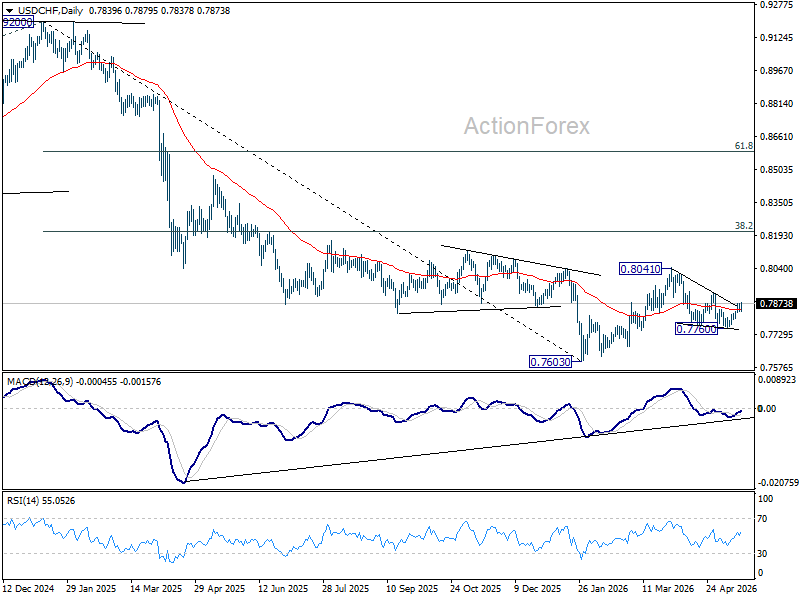
Focus remains on 0.7877 cluster support (38.2% retracement of 0.7603 to 0.8041 at 0.7874) in USD/CHF. Decisive break there will argue that whole rise from 0.7603 as completed, and bring deeper fall to 61.8% retracement at 0.77706 and below. Nevertheless, strong bounce from 0.7874/7 will retain near term bullishness for another rise through 0.8041 at a later stage.

In the bigger picture, rebound from 0.7603 medium term bottom is seen as correcting the fall from 0.9200 only. rejection by 55 W EMA (now at 0.8081) will affirm this case, and setup down trend resumption to 100% projection of 1.0146 (2022 high) to 0.8332 from 0.9200 at 0.7382 at a later stage. Though, sustained break of 55 W EMA will suggest that it's probably correcting the larger scale down trend from 1.0146 (2022 high).

EUR/USD Mid-Day Outlook

Daily Pivots: (S1) 1.1546; (P) 1.1575; (R1) 1.1627; More….

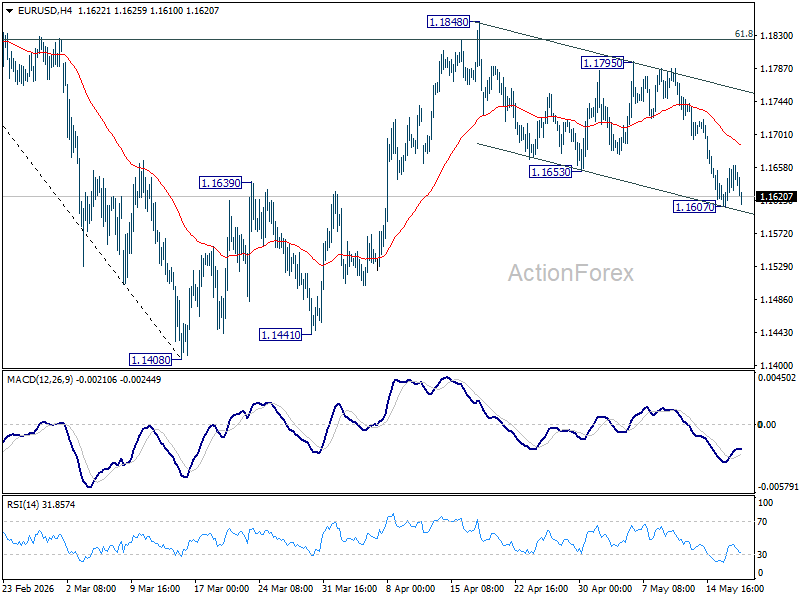
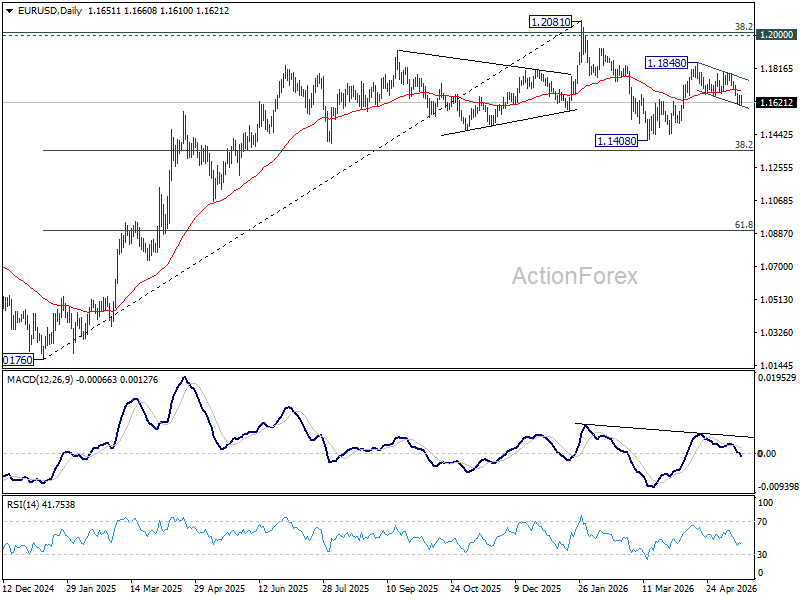
Intraday bias in EUR/USD remains on the upside for the moment. Fall from 1.2081 could have completed as a correction at 1.1408. Further rise should be seen to 61.8% retracement of 1.2081 to 1.1408 at 1.1824. Firm break there will pave the way to retest 1.2081 high. On the downside, below 1.1626 minor support will turn intraday bias neutral and bring consolidations first.

In the bigger picture, the strong support from 38.2% retracement of 1.0176 to 1.2081 at 1.1353 suggests that the pullback from 1.2081 is more likely a corrective move. Strong support was also found in 55 W EMA (now at 1.1505). Focus is back on 1.2 key cluster resistance level. Decisive break there will carry long term bullish implications. Nevertheless, break of 1.1408 support will revive the case of medium term bearish trend reversal.
GBP/USD Mid-Day Outlook

Daily Pivots: (S1) 1.3236; (P) 1.3268; (R1) 1.3327; More...

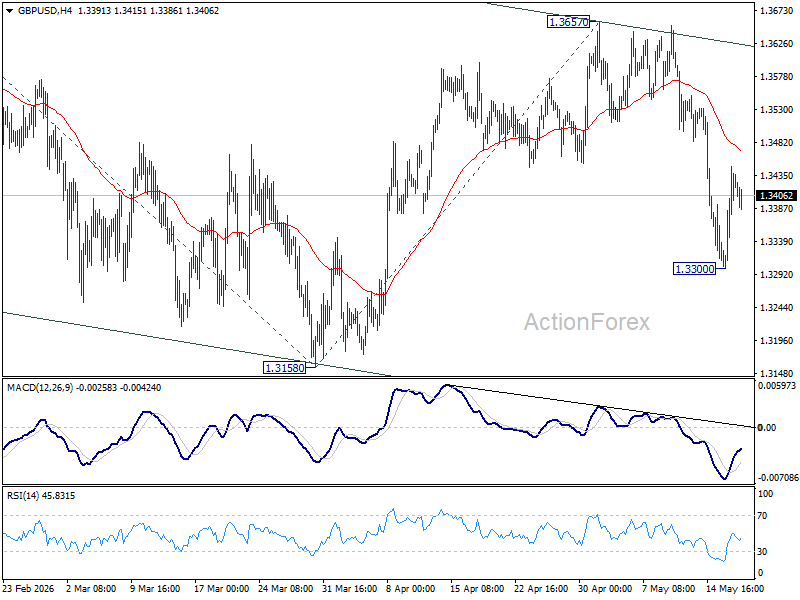
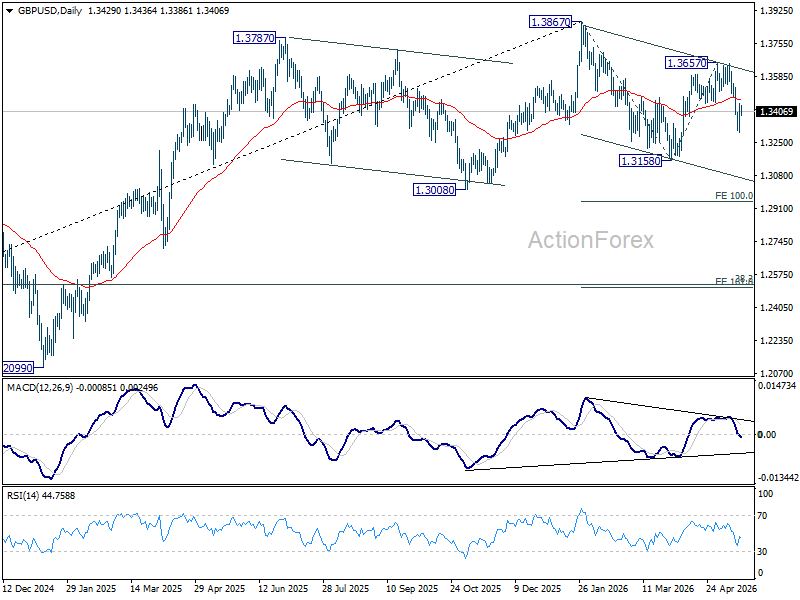
GBP/USD's break of 1.3479 resistance argues that fall from 1.3867 has completed as a correction at 1.3158. Intraday bias is back on the upside. Further rally should be seen to retest 1.3867 high. On the downside, below 1.3385 will turn intraday bias neutral and bring consolidations first. But retreat should be contained well above 1.3158 low to bring another rally.

In the bigger picture, current development suggests that price actions from 1.3867 are merely a corrective pattern within the broader up trend from 1.0351 (2022 low). With 1.3008 support intact, medium term bullishness is maintained and break of 1.3867 is back in favor for a later stage, towards 1.4248 key resistance (2021 high).

Ceasefire Resets Fed Outlook, Markets Set to Look Through FOMC Minutes and Hot CPI

The ceasefire between the US and Iran has reset the Fed outlook, shifting market focus away from near-term inflation data toward the broader policy path. With oil prices falling and supply risks easing, the markets could be willing to look through both FOMC minutes today and a likely elevated March CPI reading on Friday.

The repricing has been swift. Odds of the Fed holding at 3.50–3.75% through year-end have dropped from around 80% to near 58%, with roughly 42% now pricing in at least one rate cut. More importantly, the possibility of a rate hike has been effectively erased. This marks a clear transition from a higher-for-longer mindset toward a more balanced outlook. Just days ago, markets were positioning for a prolonged inflation shock driven by surging energy prices. That narrative has now been disrupted.

As a result, this week’s key events are losing relevance. The March FOMC minutes, due today, will likely reflect a Fed grappling with a potential wartime shock, with oil prices approaching $120. Even if the tone appears hawkish, markets are expected to largely ignore it. The reason is straightforward. The primary driver behind that hawkish stance—the risk of sustained energy disruption—has been partially resolved. The ceasefire has effectively reset the clock, rendering the minutes outdated upon release.

The same logic applies to CPI. March inflation is almost certain to print high, capturing the peak of the energy shock. But with Brent already down sharply, markets are set to treat the data as rear-view mirror inflation, focusing instead on forward-looking indicators.

However, the disinflation path is not immediate. The reopening of the Strait of Hormuz is gradual, with shipping networks expected to take six to eight weeks to normalize. During this period, oil prices are likely to remain elevated, sustaining some inflation pressure in the near term.

This creates a transitional phase where inflation remains firm, even as the underlying drivers begin to fade. But importantly, many Fed officials are likely to view this as transitory. As long as inflation expectations remain anchored, policymakers can afford to look through short-term volatility. This supports a patient stance in the near term while keeping the door open for easing once the temporary effects dissipate.

By early second half, the data should begin to reflect a clearer disinflation trend if traffic through the Strait of Hormuz is fully normalized. As base effects from the energy shock roll off and supply conditions improve, the case for Fed's monetary policy normalization will strengthen. That makes a year-end rate cut a logical baseline scenario.

However, this repricing remains highly conditional. Vice President JD Vance described the ceasefire as a “fragile truce”, underscoring the risk that the current optimism may prove premature. Execution risk is particularly high around the Strait of Hormuz. Iranian Foreign Minister Abbas Araghchi noted that passage is currently managed “via coordination with Iran’s Armed Forces.” Any disruption or miscalculation could quickly reintroduce war premium.

For now, markets are effectively priced for perfection. Dollar has come under broad pressure, reflecting the shift in expectations, while risk currencies are benefiting from improved sentiment. Ultimately, the Fed itself has not changed—but the environment around it has. The path toward rate cuts is now visible, but it depends on sustained, tangible progress in the US-Iran negotiations. Until then, markets will continue to price easing cautiously, with one eye firmly on geopolitics.

In currency markets, Dollar is the clear underperformer today, with broad-based selling pressure. Loonie follows as the second weakest, weighed down by falling oil prices, while Yen also lags. On the other side, Kiwi leads gains, supported by RBNZ’s hawkish hold, followed by Sterling and Swiss Franc. Euro and Aussie are trading in the middle of the pack.

In Europe, at the time of writing, FTSE Is up 2.96%. DAX is up 5.14%. CAC is up 4.75%. UK 10-year yield is down -0.215 at 4.623. Germany 10-year yield is down -0.177 at 2.909. Earlier in Asia, Nikkei rose 5.29%. Hong Kong HSI rose 3.16%. China Shanghai SSE rose 2.03%. Singapore Strait Times rose 0.81%. Japan 10-year JGB yield fell -0.046 to 2.364.

Silver to Rally Toward 84 on Ceasefire Euphoria—Is “Day 10” a Trap?

Silver has broken out on ceasefire-driven Dollar weakness, with 84 now in focus. But the rally may be time-limited, as “Day 10” of the ceasefire window could bring back risk and trigger a reversal. Read More.

RBNZ Holds, Warns of “Decisive” Hikes if Inflation Expectations De-Anchor

RBNZ kept rates unchanged—but signaled it won’t hesitate to act. A warning of “decisive” hikes has put inflation expectations at the center of the policy outlook. Read More.

Eurozone Producer Inflation Falls -0.7% mom in February on Energy Drop

Eurozone PPI fell in February as energy prices dropped, signaling easing pipeline pressures. However, core components remained firm, suggesting underlying inflation is not fully fading. Read More.

GBP/USD Mid-Day Outlook

Daily Pivots: (S1) 1.3236; (P) 1.3268; (R1) 1.3327; More...

GBP/USD's break of 1.3479 resistance argues that fall from 1.3867 has completed as a correction at 1.3158. Intraday bias is back on the upside. Further rally should be seen to retest 1.3867 high. On the downside, below 1.3385 will turn intraday bias neutral and bring consolidations first. But retreat should be contained well above 1.3158 low to bring another rally.

In the bigger picture, current development suggests that price actions from 1.3867 are merely a corrective pattern within the broader up trend from 1.0351 (2022 low). With 1.3008 support intact, medium term bullishness is maintained and break of 1.3867 is back in favor for a later stage, towards 1.4248 key resistance (2021 high).


Economic Indicators Update

GMT CCY EVENTS Act Cons Prev Rev
23:30 JPY Labor Cash Earnings Y/Y Feb 3.30% 2.70% 3.00% 2.50%
02:00 NZD RBNZ Interest Rate Decision 2.25% 2.25% 2.25%
05:00 JPY Eco Watchers Survey: Current Mar 42.2 47.9 48.9
06:00 EUR Germany Factory Orders M/M Feb 0.90% 3.20% -11.10%
07:00 CHF Unemployment Rate M/M Mar 3.00% 3.00% 3.00%
08:30 GBP Construction PMI Mar 45.6 43.6 44.5
09:00 EUR Eurozone PPI M/M Feb -0.70% -0.70% 0.70% 0.80%
09:00 EUR Eurozone PPI Y/Y Feb -3.00% -3.00% -2.10% -2.00%
09:00 EUR Eurozone Retail Sales M/M Feb -0.20% -0.20% -0.10%
14:30 USD Crude Oil Inventories (Apr 3) -1.0M 5.5M
18:00 USD FOMC Minutes


Euro Seized the Opportunity to Rise

  • The US-Iran ceasefire sent EURUSD to 1.17.
  • The dollar will be sensitive to developments in the Washington-Tehran talks.

The US dollar was hit by a wave of selling following reports of a two-week truce between Washington and Tehran. And although Middle Eastern countries continue to report attacks by Iran, and Israel has no intention of halting its strikes on Lebanon, EURUSD recorded its best rally since late January. Investors, driven by FOMO (fear of missing out), briefly pushed the euro above 1.17.

Markets shoot first and ask questions later. The war had led to a rise in oil prices and the US dollar, whilst the EURUSD and US stock indices were steadily falling. The ceasefire turned yesterday’s winners into losers and the underdogs into favourites. The greenback is losing ground as tensions ease. At the same time, the futures market has raised the odds of a Fed rate cut in 2026 from 12% to 44%.

It is unclear whether Donald Trump has resolved the conflict in the Middle East. The differences between the opposing sides have not gone away. Iran claims victory in the conflict, whilst the US says it has achieved and even exceeded its objectives. For now, the markets are trying to work out whose claims are more misleading and are awaiting signals from the direct talks on 10 April.

It is widely known how Donald Trump conducts negotiations. The tactic of threats has not gone away, which could be perceived as an escalation of the geopolitical conflict and could prompt the EURUSD to pull back. Nevertheless, Iran and the US have already taken the first step, and, coupled with falling oil prices, this offers hope that the euro will continue to rise.

The fall in the dollar and US Treasury yields has allowed gold to recover. The precious metal has broken above $4,800 per ounce thanks to renewed hopes of a cut in the federal funds rate and the return of funds previously withdrawn to meet margin requirements on securities.

EUR/USD Soars on Middle East Pause

EUR/USD rose sharply midweek to 1.1675, reaching a four-week high. Pressure on the US dollar came after President Donald Trump postponed the threat of strikes on Iranian civilian infrastructure for two weeks. The politician described this as a "bilateral ceasefire" conditional upon the reopening of the Strait of Hormuz.

According to Trump, the US has received a 10-point proposal from Iran, which is being viewed as a working basis for negotiations. The two-week window could be used to reach a resolution. Iran has reportedly agreed to temporarily open the strait, provided that attacks cease. Israel has also supported the ceasefire.

At the same time, macroeconomic data point to rising inflation expectations in the US. In March, these increased, with transport costs in logistics rising markedly.

Investor attention is now focused on the release of March inflation data (CPI), which could clarify the degree of price pressure amid the ongoing conflict.

Technical Analysis

On the H4 chart of EUR/USD, the market is forming a consolidation range around the 1.1700 level. A downward wave to 1.1566 is expected as a local target. Subsequently, a move higher to 1.1717 is anticipated. Technically, this scenario is confirmed by the MACD indicator, with its signal line above zero and pointing firmly upwards, indicating continued bullish momentum and the potential for the uptrend to continue.

On the H1 chart, the market is forming the structure of the next downward wave to the 1.1566 level. After reaching this level, an increase to 1.1717 is expected, with the potential for the move higher to extend to 1.1730. Technically, this scenario is confirmed by the Stochastic oscillator, with its signal line below 80 and pointing firmly downwards towards 20.

Conclusion

EUR/USD has surged on news of a potential breakthrough in Middle East tensions, with Trump postponing strikes on Iranian infrastructure and a two-week "bilateral ceasefire" taking effect, conditional on the reopening of the Strait of Hormuz. Iran's reported 10-point proposal and agreement to temporarily open the strait have provided a significant boost to risk appetite, weighing on the safe-haven dollar. However, rising US inflation expectations and the upcoming CPI release remind markets that domestic price pressures remain a concern. While technical indicators suggest some near-term consolidation or pullback, the pair's direction will ultimately depend on whether diplomatic efforts hold and whether the ceasefire translates into a more lasting de-escalation.

Eurozone Producer Inflation Falls -0.7% mom in February on Energy Drop

Eurozone PPI fell -0.7% mom and -3.0% yoy in February, in line with expectations, with the decline largely driven by a sharp drop in energy inflation before the Iran War.

The breakdown highlights a mixed picture beneath the headline. Energy prices dropped -2.4% mom, offsetting gains in intermediate goods and capital goods, both up 0.3%, as well as a 0.2% rise in durable consumer goods. Non-durable consumer goods edged lower by -0.2%.

Across the EU, producer prices fell -0.5% mom and -2.7% yoy, with notable declines in (-3.1%), Ireland (-2.6%) and Portugal (-1.8%). The highest increases were observed in Croatia (+3.8%), Finland (+2.7%) and Lithuania (+1.8%).

Full Eurozone PPI release here.

AUD/USD And NZD/USD Turn Bullish, Is Rally Set to Extend?

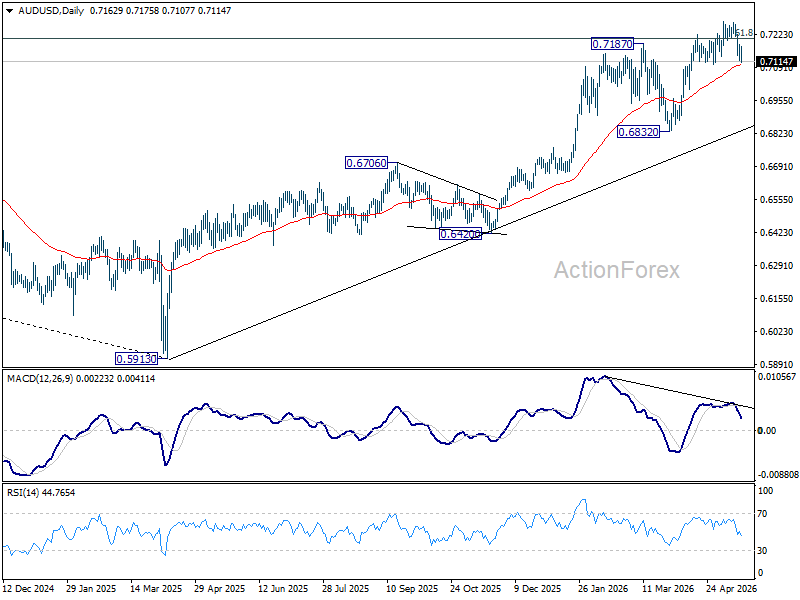
AUD/USD started a fresh increase above 0.6970 and 0.7000. NZD/USD is also rising and might aim for more gains above 0.5850.

Important Takeaways for AUD USD and NZD USD Analysis Today

  • The Aussie Dollar started a steady increase above 0.7000 against the US Dollar.
  • There was a break above a rising channel with resistance at 0.6960 on the hourly chart of AUD/USD at FXOpen.
  • NZD/USD is consolidating gains above the 0.5755 pivot zone.
  •  There was a break above a key contracting triangle with resistance at 0.5710 on the hourly chart of NZD/USD at FXOpen.

AUD/USD Technical Analysis

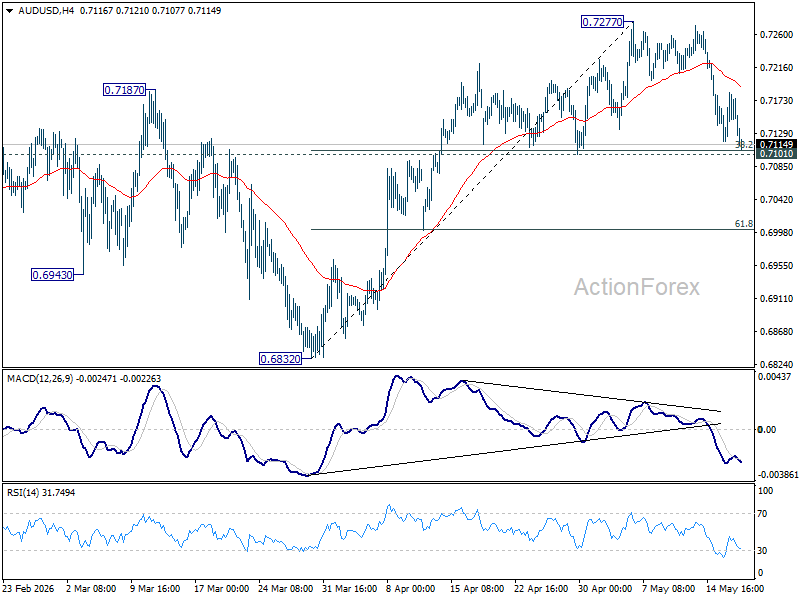
On the hourly chart of AUD/USD at FXOpen, the pair started a fresh increase from 0.6860. The Aussie Dollar was able to clear 0.6900 to move into a positive zone against the US Dollar.

There was a break above a rising channel with resistance at 0.6960. There was a close above 0.7000 and the 50-hour simple moving average. Finally, the pair tested 0.7080. A high was formed near 0.7084 and the pair recently started a consolidation phase. There was a minor decline below 0.7075.

On the downside, initial support is near the 23.6% Fib retracement level of the upward move from the 0.6859 swing low to the 0.7084 high. The next area of interest could be near 0.6970 and the 50% Fib retracement.

If there is a downside break below 0.6970, the pair could extend its decline toward the 0.6945 zone and the 50-hour simple moving average. Any more losses might signal a move toward 0.6895.

On the upside, the AUD/USD chart indicates that the pair is now facing resistance near 0.7085. The first major hurdle for the bulls might be 0.7120. An upside break above 0.7120 might send the pair further higher. The next stop is near 0.7200. Any more gains could clear the path for a move toward 0.7320.

NZD/USD Technical Analysis

On the hourly chart of NZD/USD on FXOpen, the pair started a fresh increase from 0.5675. The New Zealand Dollar broke the 0.5720 barrier to start the recent rally against the US Dollar.

More importantly, there was a break above a key contracting triangle with resistance at 0.5710. The pair settled above 0.5755 and the 50-hour simple moving average.

It tested 0.5835 and is currently consolidating gains. There was a minor pullback below 0.5820. The NZD/USD chart suggests that the RSI is now just above 70. On the upside, the pair might struggle near 0.5835. The next major hurdle is near the 0.5880 pivot level.

A clear move above 0.5880 might even push the pair toward 0.6950. Any more gains might clear the path for a move toward the 0.7000 zone in the coming days.

On the downside, immediate support is near the 0.5795 level and the 23.6% Fib retracement level of the upward move from the 0.5678 swing low to the 0.5834 high.

The first key zone for the bulls sits at 0.5755 and the 50% Fib retracement. The next important level is 0.5720 and the 50-hour simple moving average. If there is a downside break below 0.5720, the pair might slide toward 0.5690. Any more losses could lead NZD/USD into a bearish zone to 0.5650.

Trade over 50 forex markets 24 hours a day with FXOpen. Take advantage of low commissions, deep liquidity, and spreads from 0.0 pips (additional fees may apply). Open your FXOpen account now or learn more about trading forex with FXOpen.

This article represents the opinion of the Companies operating under the FXOpen brand only. It is not to be construed as an offer, solicitation, or recommendation with respect to products and services provided by the Companies operating under the FXOpen brand, nor is it to be considered financial advice.

Crypto Market Gained 4% With a Sigh of Relief

Market Overview

The crypto market capitalisation surged by 4% over the past 24 hours to $2.45 trillion, making a promising move above the 50-day moving average. Leading the gains were ZEC (+22%), ICP (+13%) and Avalanche (+9.5%); underperforming the market were TRX (-0.2%), BNB (+2.5%) and Monero (+2.8%). News of a two-week ceasefire brought a sigh of relief, sharply boosting demand for risky assets.

The sentiment index stood at 17 at the start of the day on Wednesday. However, significantly higher levels are to be expected unless the situation changes dramatically by the end of the day, as much of the market’s positivity emerged after today’s figures were released.

Bitcoin slipped above $72.7K on positive news from the Middle East, retreating slightly at the time of writing to $71.8K, up 4.8% over the past 24 hours. This consolidation above the 50-day MA and a move above the late-March highs are setting an optimistic tone. The immediate focus remains on the $75K area, near which lies the 61.8% resistance level of the latest downward impulse and two March pivot points

News Background

According to CoinShares, global investments in crypto funds rose by $224 million last week following an outflow the week before. Investments in Bitcoin increased by $107 million, in XRP by $120 million, and in Solana by $35 million. Investments in Ethereum fell by $53 million.

The inflow into XRP was the most significant among all assets and the largest since mid-December 2025.

According to BitInfoChart, the number of daily active addresses on the Bitcoin network has fallen to its lowest level since autumn 2013. The decline in network activity has negatively impacted transaction fees and mining profitability.

Bitcoin’s hash rate, smoothed by a 30-day SMA, fell during the first quarter from 1,066 EH/s to 1,004 EH/s, according to Hashrate Index. The 5.8% drop was due to the decommissioning of outdated equipment.

Bitcoin is vulnerable to risks posed by quantum computers, but the main risk lies not in the technology itself but in the community’s inability to reach consensus, according to Grayscale. Deciding on a course of action carries the risk of protracted disagreements and could take years.

Silver to Rally Toward 84 on Ceasefire Euphoria—Is “Day 10” a Trap?

Silver’s breakout above 76.29 resistance today marks a decisive extension of the rebound from 60.97 short term bottom, driven by broad Dollar weakness following the US-Iran ceasefire. The move reflects a classic war premium unwind, with precious metals benefiting as the greenback slides and risk sentiment improves.

The strength of the rally suggests more than just a technical bounce. Last week’s sharp selloff appears to have flushed out weak hands, allowing institutional buyers to take control of price action. The result is a cleaner structure, where upside momentum is no longer constrained by overleveraged positioning.

With Dollar weakness likely to persist in the near term, Silver now has a clear path toward the next key level at 84.21, 38.2% retracement of 121.83 to 60.97. This level represents not just a technical target, but a decision point for the broader trend.

However, the rally will likely unfold within a narrow time window. The current surge is closely tied to the ceasefire euphoria, and momentum is likely to be concentrated within the first 7–10 days of the agreement. As markets approach the final phase of the two-week window, attention will shift back to geopolitical risks.

That raises the risk of a “Day 10” inflection point. If negotiations fail to show tangible progress, traders may begin to price back in war premium ahead of the ceasefire’s expiry. This could trigger a pre-emptive selloff, particularly if Silver has not yet reached its upside targets.

The behavior around 84.21 will be critical. A sustained break would suggest that institutional accumulation is complete and that buyers are willing to hold positions beyond the current macro catalyst. In contrast, rejection near that level could signal distribution, with stronger hands using the rally to offload positions to late entrants. That would drag Silver back to 60-70 structural floor.

In that sense, Silver’s rally is not just about direction—but timing. The market is advancing on improving sentiment, but without concrete geopolitical progress, the same forces driving the move could reverse quickly. For now, the trend is higher, but the clock is already ticking.