Sample Category Title

(RBNZ) OCR on hold at 2.25%

Reserve Bank of New Zealand

The Monetary Policy Committee today agreed to hold the OCR at 2.25 percent. Since the February Monetary Policy Statement, events in the Middle East have materially altered the outlook and the balance of risks for inflation and economic growth in New Zealand. In the near term, inflation is expected to increase and the economic recovery to weaken. The Committee is vigilant to any generalised inflationary pressure and stands ready to act to return inflation to its medium-term target.

The Middle East conflict has disrupted global supply chains, leading to significantly higher prices for oil and refined petroleum products. As a result, near-term inflation is increasing and economic growth is weakening in many countries. Global financial markets have been volatile and market interest rates have increased.

In New Zealand, the extent of the near-term increase in headline inflation will depend on how the conflict in the Middle East evolves and the magnitude and duration of the disruption to global supply chains and energy markets.

Medium-term inflationary pressure will depend on the extent to which higher costs influence price- and wage-setting behaviour by firms and workers in the economy. If medium-term inflation expectations increase, then inflation is likely to become more persistent. However, weak demand and spare productive capacity in the economy should constrain the degree to which higher costs can be passed on.

The current economic situation is different to 2022 when COVID-19 and Russia’s invasion of Ukraine disrupted global supply chains and increased energy prices. Back then, demand was growing strongly, adding to inflation pressure.

The Committee’s decision to hold the OCR balances the potential benefits of responding pre-emptively to the risk of higher medium-term inflation against the cost of unnecessarily stifling the economic recovery.

The Monetary Policy Committee is focused on ensuring that inflation returns to the 2-percent target midpoint over the medium term. This requires core inflation and wage growth to remain contained and medium- and long-term inflation expectations to remain around 2 percent. If these conditions are not met, decisive and timely increases in the OCR would be required.


Summary record of meeting – April 2026

Since the February Monetary Policy Statement, events in the Middle East have materially altered the outlook and the balance of risks for inflation and economic growth. Inflation is now expected to remain at the top of the Monetary Policy Committee’s (MPC) 1 to 3 percent target band in the March 2026 quarter and increase considerably in the near term. Near-term economic activity is also expected to be weaker, dampening the medium-term inflationary effects of the Middle East conflict. There is a risk that inflation could be significantly higher and output markedly lower than currently expected.

The Committee’s focus is on the medium-term outlook for inflation.

Conflict in the Middle East is leading to significant supply side disruptions

Conflict in the Middle East has significantly reduced the supply of oil, gas and other petrochemicals, including fertilisers, flowing from the Middle East through the Strait of Hormuz. The price of oil has increased substantially in the last month, while prices for many refined petroleum products have increased by even more. Oil and gas products are a key input into broader supply chains and are critical inputs for many sectors in New Zealand, such as transport, agriculture, and packaging.

The outlook for petrochemical prices depends on how the conflict in the Middle East evolves, the extent to which critical infrastructure is damaged, and how quickly supply chains adjust. Oil futures markets are volatile and currently suggest a relatively quick resolution to supply disruptions, with declines in oil prices expected over the coming months. The Committee believes the balance of risks to future oil prices is to the upside.

Global financial market volatility has increased in the wake of the shock. Equity prices have fallen in most jurisdictions, and the US dollar has appreciated against most currencies, reflecting expectations of weaker global growth. Financial markets have priced in expectations of higher central bank policy interest rates this year. However, at this stage, most advanced economy central banks have left interest rates unchanged at recent decisions.

Global inflation is expected to increase and growth to weaken

Prior to the onset of conflict in the Middle East, global economic growth had been resilient. Global inflation was also generally declining towards respective countries’ inflation targets. Disruptions to global supply chains and higher oil prices are likely to lead to higher inflation and weaker growth in the near term, particularly in countries heavily dependent on Middle East oil and gas. This includes many of New Zealand’s trading partners in Asia.

There is significant cross-country variation in the starting point for inflation, the fiscal and regulatory response to higher oil prices, and economic resilience to the shock. The monetary policy reactions across countries will likely differ.

Supply chain disruptions will lead to higher near-term inflation in New Zealand

Annual consumers price inflation increased to 3.1 percent in the December 2025 quarter, slightly above the Committee’s 1 to 3 percent target band. Higher oil prices will result in higher headline inflation in the near term. The extent of this increase will depend on how the conflict in the Middle East evolves and the magnitude and duration of the disruption to supply chains.

The Committee has updated its forecast for consumers price inflation for the first and second quarters of 2026. This forecast is based on observed higher fuel prices and current futures pricing, which assumes that Dubai crude oil prices drop below USD100 per barrel by the end of June. The Committee also assumes some near-term pass through into other consumers price inflation components, particularly transportation, airfares and food prices. These assumptions result in an inflation forecast of 3.0 percent in the March quarter and 4.2 percent in the June quarter. The Committee see significant uncertainties around this forecast and will update it at coming monetary policy meetings.

Economic growth is expected to be weaker in the near term

Prior to the conflict, New Zealand’s economic recovery was at an early stage. GDP growth of 0.2 percent in the December 2025 quarter was lower than expected, largely due to relatively weak household consumption and business investment. However, higher frequency indicators over January and February suggested that the recovery was gaining strength.

The Middle East conflict will result in weaker economic activity in the near term. Higher fuel prices are increasing costs, lowering profit margins for many businesses, and reducing household purchasing power. Increased global uncertainty is also expected to weigh on investment. Data received in recent weeks suggest a weakening in business activity and consumer confidence since the onset of the conflict. Recent discussions with businesses are consistent with a slowing in economic activity over March. Many firms reported that higher fuel prices are already being passed through to a range of other prices. Some firms are applying temporary fuel surcharges while others report difficulty in passing on cost increases.

The inflation outlook will depend on price setting behaviour and domestic demand

The Committee’s mandate is to focus on ensuring that inflation returns to the target mid-point over the medium term. The outlook for medium-term inflation pressures depends on the size and persistence of the inflationary impulse stemming from higher oil prices and the extent to which it is offset by weaker demand in the economy.

In the near term, the Committee expects higher fuel prices to spill over into increased transport and food prices, reflecting the high energy intensity of these products. Short-term inflation expectations are increasing.

Returning inflation to the 2 percent target mid-point over the medium term requires core inflation and wage growth being contained, and medium- and long-term inflation expectations remaining around 2 percent. The extent to which these criteria are met will influence the scope for the Committee to look through current near-term inflation or whether tighter monetary policy is required. The Committee will be looking to timely indicators to help make this assessment, such as surveys of households and businesses, intelligence from business visits and high frequency price and activity information.

The Committee expects second round effects of the oil shock on price- and wage-setting behaviour and inflation expectations to be constrained to some extent by weak demand and excess productive capacity in the economy. At the time of the February Monetary Policy Statement, the Committee judged that the economy was operating well below its productive capacity. While energy supply constraints could reduce potential output in the near term, it is still likely that spare capacity persists for longer as higher fuel costs and rising uncertainty weaken economic activity. This is a different starting point compared to when COVID-19 and Russia’s invasion of Ukraine in 2022 disrupted supply chains and increased energy prices. Back then, demand was growing strongly, adding to inflation pressure.

Domestic financial conditions have tightened since February

New Zealand wholesale interest rates have increased since the onset of the conflict. While this partly reflects expectations of OCR increases, some illiquidity in swap markets has accentuated these moves. Fixed-term mortgage rates have increased, with two-year rates up by around 20 basis points. This reduces the further stimulus that was expected in February from mortgage borrowers refixing at lower interest rates. Term deposit interest rates, particularly at the most popular six-month term, have not increased to the same degree.

The New Zealand dollar has depreciated somewhat in trade-weighted terms, consistent with broader moves in currency markets, posing some upside risk to inflation while benefitting exporters.

The Committee discussed risks to the medium-term outlook

The Committee noted that the balance of risks has shifted, and there are likely to be differences between the near term and medium term.

The Committee discussed the risk that the conflict has more persistent impacts on inflationary pressures. The Committee noted that current futures prices for oil imply a relatively quick resumption in oil supply and discussed the risk that supply chains could be disrupted for longer even if the conflict ends relatively soon.

The Committee discussed the risk of a larger change in price setting behaviour as firms seek to pass on higher fuel costs. This risk is accentuated by current tight business margins given weak activity and substantial cost pressures, which could limit the degree to which some firms are able to absorb further cost increases. This would result in inflation spreading beyond energy-intensive products into services, with core inflation and medium-term inflation expectations increasing and pushing up wage expectations.

The Committee also discussed the risk of a more pronounced decline in economic activity. Households have been cautious in the face of weak real income growth, high unemployment and house price weakness. Investment activity is also expected to remain weak. There is a risk that household and business caution becomes more pronounced, resulting in higher unemployment and weaker growth.

Business activity could also be constrained if it becomes difficult to secure productive inputs such as fuel, fertiliser or other products requiring petrochemicals such as plastic for packaging. This could accentuate disruptions in regional economies due to domestic energy constraints. At the same time, businesses and households are likely to adapt to adverse circumstances.

The Committee agreed to hold the OCR at 2.25 percent

The Committee noted that the net effect of the conflict in the Middle East on medium-term inflation pressures in New Zealand will depend on how the countervailing factors play out. It also noted that financial conditions had already tightened since the onset of conflict.

The Committee discussed the size and speed of any monetary policy response to the risks of higher medium-term inflation.

If the increase in near-term inflation is largely temporary, the Committee envisages gradually moving the OCR to more neutral levels as activity recovers and near-term inflationary pressures dissipate. However, any signs of significant second-round inflationary effects or increases in medium-term inflation expectations would require decisive and timely increases in the OCR to re-anchor inflation expectations. The Committee is vigilant to these risks.

On the timing of any increase in the OCR, members discussed that a pre-emptive response to medium-term inflation pressures could guard against the risk of inflation expectations becoming unanchored and reduce the extent of second round price increases. In turn, this could mean that monetary policy may need to tighten by less and result in output contracting by less than otherwise.

Conversely, the Committee noted the risk of reacting to higher near-term inflation and accentuating weakness in the real economy and labour market. Members noted that this could cause unnecessary volatility in output and employment if the conflict was resolved in the near term or if the economic outlook weakens by more than currently expected.

Some members placed more emphasis on the arguments in favour of an early monetary policy response, noting that further data and analysis would provide greater clarity about medium-term inflation pressures. Other members emphasised downside risks to growth and argued for more opportunity to judge the extent to which weaker growth balances the second-round effects of higher fuel prices.

On balance, the Committee decided to leave the OCR unchanged at this meeting. It will continue to assess the countervailing forces on the inflation outlook and stands ready to act decisively to ensure that inflation reaches the 2 percent mid-point of the target band in the medium term.

On Wednesday 8 April the Committee reached consensus to hold the OCR at 2.25 percent.

Attendees:
MPC members: Anna Breman (Chair), Carl Hansen, Hayley Gourley, Karen Silk, Paul Conway, Prasanna Gai
Treasury Observer: Struan Little
MPC Secretary: Chris Bloor

Oil Drops Below $100 on US-Iran Ceasefire, But $80 Seen as Floor Without Peace Deal

Oil’s immediate slide from around $115 to below $100 shows markets are embracing the US-Iran ceasefire and unwinding war premium. But with no peace deal in place, prices are likely to hold above $80 as residual risk remains. The sharp move reflects a rapid shift from pricing disruption to pricing partial normalization following the announcement of a two-week “double-sided ceasefire.”

The de-risking move was triggered by US President Donald Trump’s decision to suspend planned attacks on Iranian infrastructure, conditional on the “COMPLETE, IMMEDIATE, and SAFE OPENING of the Strait of Hormuz.” Trump declared, “This will be a double sided CEASEFIRE!”, signaling a temporary pause in escalation.

On the Iranian side, Foreign Minister Abbas Araghchi confirmed that vessels would be allowed to transit the Strait during the ceasefire period “via coordination with Iran’s Armed Forces.” This effectively enables a safe reopening of Hormuz, removing the most acute supply bottleneck.

A critical development underpinning this ceasefire is the emergence of Pakistan as a credible intermediary. Prime Minister Shehbaz Sharif and Field Marshal Asim Munir were directly credited by Trump, highlighting a significant shift in diplomatic backchannels. This marks the establishment of a viable mediation channel between Washington and Tehran, something markets had not been able to price previously.

The immediate market impact comes through supply normalization. With tankers resuming transit, the collapse in war-risk insurance premiums is allowing crude flows from Saudi Arabia, Iraq, and Kuwait to restart. This insurance premium collapse is a key channel through which oil prices have adjusted lower.

Crucially, this remains a pause, not peace. The agreement lasts only two weeks, and without tangible progress toward a broader settlement, a portion of the war premium is likely to remain embedded. This explains why the market is repricing lower—but not collapsing.

From a price framework perspective, Brent is now likely to test $90 and potentially extend toward $80. However, a sustained break below 80 would require clear progress toward a lasting peace deal. Without that, residual geopolitical risk should continue to anchor prices above this level.

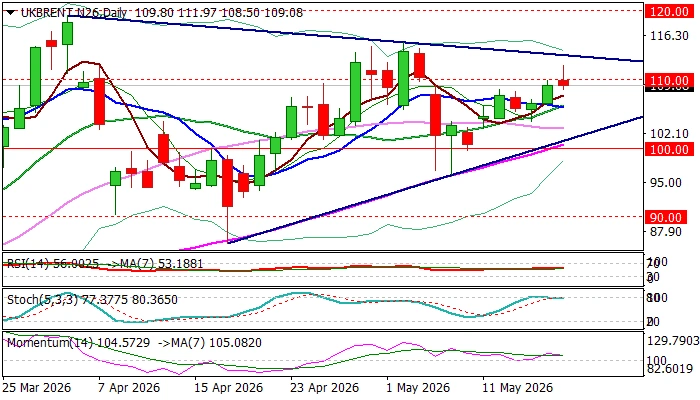
Technically, Brent crude's fall from 119.24 resumed by breaking 96.26. This decline is seen as the third leg of the pattern from 119.97 high. Immediate focus is now on 100% projection of 119.24 to 96.26 from 114.81 at 91.83. Firm break there will pave the way to 138.2% projection at 83.05, where it will meet 81.41 key support level.

This aligns with the broader view: oil is normalizing—but not yet transitioning back into a full peace regime.

NZD/USD Tests Major 0.57 Support Ahead of RBNZ Meeting – FX Technical Levels

NZD/USD has been thrashed since the start of the US-Iran war, amid heavy concerns about energy supply in the Land of the Kiwi.

At the beginning of 2026, the New Zealand Dollar was on a powerful run. Traders priced higher odds for rate hikes, while most other Central Banks were priced for pauses and cuts. Since then, pricing has dramatically shifted.

Numerous policymakers now hint at incoming rate hikes to diminish the inflationary impact of 60% rises in Oil prices.

Having lost some relative strength, the new Governor Anna Breman failed to forecast a significant hawkish turn that had been anticipated by Market participants earlier in the year – You can access her recent Speech right here.

Having missed its Q4 GDP data, released in mid-March, traders quickly began pricing out any signs of heating in the NZ economy.

Combine these factors with a gigantic rise in the Petrodollar since March, and traders got exactly what they needed to not only take profits on previous bullish views but also reverse them into a bearish trend – the major pair is down 4.75% since.

The upcoming meeting is strongly priced for a pause (about 90% odds).

However, traders have priced in 60 basis points of hikes for the rest of the year.

Given the turn in fundamentals and upcoming event, the drops in NZD/USD might just be over.

Traders will focus on New Zealand macro data and especially the Royal Bank's inflation outlook for the next meeting (May 27, 2026).

Combine high odds of more hawkish communications with daily bullish divergences (see below), and the NZD/USD could be poised for a decent upside reversal – The rest will be to see if it leads to a proper uptrend.

To prepare for the upcoming key RBNZ meeting this evening, it is appropriate to conduct a multi-timeframe analysis of NZD/USD and assess potential scenarios.

NZD/USD Multi-Timeframe Technical Analysis

Daily Chart

NZD/USD Daily Chart – Source: TradingView. April 7, 2026

The Kiwi Dollar has entered a significant downtrend since beginning March, easing from 0.60 right below 0.57.

Subject to heavy profit taking from its mid-January gigantic rise, the selloff accelerated as concerns for antipodean crude delivery kept looming on the NZD buying power.

The conflict is nearing an important turning point; A de-escalation deadline is about to expire, so if the situation worsens, the outlook can be quite cloudy – To help yourself to spot a direction, it can be quite essential to look at the Dollar Index (DXY), remaining close to 100.00. Rejecting its highs will help NZD/USD to rebound.

If de-escalation occurs, NZD/USD is poised for a consequent reversal, particularly as the RBNZ is expected to tighten the screws for a potential future hike – Combine this with prices reaching the bottom of its main downward channel, and technicals are also corroborating this view.

Be careful as Monetary Policy meetings can be quite unpredictable, hence the largest traders will await for the decision to move their pawns.

Let's take a closer look to spot levels of interest for the ongoing correction.

4H Chart and Technical Levels

NZD/USD 4H Chart – Source: TradingView. April 7, 2026

The immediate action is still indecisive, as seen with the RSI hanging around the neutral zone.

To tilt the scales however, the recent dip below 0.57 could not hold, hence bulls could be getting the upper hand in coming times. This will need to be confirmed after the RBNZ meeting (tonight) and particularly after a break of the 4H 50-period MA (0.57275).

Trading Levels for NZD/USD:

Resistance Levels

  • 4H 50-period MA (0.57275)
  • 0.5770 to 0.5790 Major Momentum Pivot (channel highs)
  • 0.5850 December High Pivotal Resistance
  • 0.5885 to 0.59 Minor resistance
  • September 2025 Pivot area 0.60 to 0.60150

Support Levels

  • Main Support 0.57 (+/- 150 pips) – testing
  • War lows 0.56825
  • Minor Support 0.5650
  • January 2025 Support 0.56

1H Chart

NZD/USD 1H Chart – Source: TradingView. April 7, 2026

Looking even closer to the 1H timeframe, the Major FX pair marks heavy indecision as traders await the key fundamental events to make their moves.

  • Above 0.57275, bulls take the upper hand which would point to 0.58850 (Channel highs)
  • Below 0.5690, bears retake control and point to further selling acceleration.

Safe Trades and good luck for the upcoming meeting!

AUDCAD Wave Analysis

AUDCAD: ⬆️ Buy

  • AUDCAD reversed from support level 0.9510
  • Likely to rise to resistance level 0.9760

AUDCAD currency pair recently reversed up from the support level 0.9510 (which has been reversing the price from February).

The support level 0.9510 was strengthened by the lower daily Bollinger Band, upper trendline of the weekly up channel from June and the 38.2% Fibonacci correction of the upward impulse from December.

Given the long-term uptrend, AUDCAD can be expected rise to the next resistance level 0.9760 (which stopped earlier waves b and (3)).

Eco Data 4/8/26

GMT Ccy Events Act Cons Prev Rev
23:30 JPY Labor Cash Earnings Y/Y Feb 3.30% 2.70% 3.00% 2.50%
02:00 NZD RBNZ Interest Rate Decision 2.25% 2.25% 2.25%
05:00 JPY Eco Watchers Survey: Current Mar 42.2 47.9 48.9
06:00 EUR Germany Factory Orders M/M Feb 0.90% 3.20% -11.10%
07:00 CHF Unemployment Rate M/M Mar 3.00% 3.00% 3.00%
08:30 GBP Construction PMI Mar 45.6 43.6 44.5
09:00 EUR Eurozone PPI M/M Feb -0.70% -0.70% 0.70% 0.80%
09:00 EUR Eurozone PPI Y/Y Feb -3.00% -3.00% -2.10% -2.00%
09:00 EUR Eurozone Retail Sales M/M Feb -0.20% -0.20% -0.10%
14:30 USD Crude Oil Inventories (Apr 3) 3.1M -1.0M 5.5M
18:00 USD FOMC Minutes
23:30 JPY
Labor Cash Earnings Y/Y Feb
Actual 3.30%
Consensus 2.70%
Previous 3.00%
Revised 2.50%
02:00 NZD
RBNZ Interest Rate Decision
Actual 2.25%
Consensus 2.25%
Previous 2.25%
05:00 JPY
Eco Watchers Survey: Current Mar
Actual 42.2
Consensus 47.9
Previous 48.9
06:00 EUR
Germany Factory Orders M/M Feb
Actual 0.90%
Consensus 3.20%
Previous -11.10%
07:00 CHF
Unemployment Rate M/M Mar
Actual 3.00%
Consensus 3.00%
Previous 3.00%
08:30 GBP
Construction PMI Mar
Actual 45.6
Consensus 43.6
Previous 44.5
09:00 EUR
Eurozone PPI M/M Feb
Actual -0.70%
Consensus -0.70%
Previous 0.70%
Revised 0.80%
09:00 EUR
Eurozone PPI Y/Y Feb
Actual -3.00%
Consensus -3.00%
Previous -2.10%
Revised -2.00%
09:00 EUR
Eurozone Retail Sales M/M Feb
Actual -0.20%
Consensus -0.20%
Previous -0.10%
14:30 USD
Crude Oil Inventories (Apr 3)
Actual 3.1M
Consensus -1.0M
Previous 5.5M
18:00 USD
FOMC Minutes
Actual
Consensus
Previous

RBNZ Preview: Hawkish Hold May Spark NZD/USD Bounce, Not Trend Reversal

The Reserve Bank of New Zealand is widely expected to leave the Official Cash Rate unchanged at 2.25% in the upcoming Asian session, with consensus firmly aligned around a hold. NZD/USD may see a relief bounce if the RBNZ delivers a hawkish hold, but the broader downtrend is unlikely to reverse as weak domestic demand and global risks continue to cap upside.

With the decision largely priced in, attention will turn to statement and the post meeting press conference, where tone—not action—will drive market reaction. The key issue is how the RBNZ interprets the current oil-driven inflation spike against a backdrop of softening domestic demand.

This puts the central bank in a familiar dilemma: oil-driven inflation versus fragile growth. Headline inflation is hovering above the top of the 1–3% target band at 3.1%, but policymakers may choose to “look through” the shock if it is deemed temporary. However, any concern about second-round effects, particularly on wages and expectations, would tilt the stance more hawkish.

At the same time, signs of economic fragility are building. GDP momentum has softened and unemployment is trending higher toward 5.4%. This leaves policymakers cautious about tightening prematurely, even as inflation pressures remain elevated.

The outcome is likely to hinge on forward guidance. A hawkish hold, emphasizing sticky core inflation and leaving the door open for future hikes, could trigger a relief bounce in NZD/USD. A dovish hold, focused on spare capacity and weak demand, would likely reinforce downside pressure.

Technically, NZD/USD, trading at around 0.5700, is still locked inside a year long consolidation pattern that started at 0.5484 (April 2025). It's plausible that the consolidation pattern has completed with three waves to 0.6092 (January 2026). But the momentum of the subsequent fall doesn't warrant range breakout yet.

For the near term, risk will stay on the downside as long as 55 D EMA (now at 0.5843) holds in case of recovery. Any downside acceleration ahead, and break of 0.5580 support will argue that the long term down trend is ready to resume through 0.5484.

On the other hand, firm break of 55 D EMA will suggest that the consolidation pattern is indeed a five-wave triangle, and another bounce would be seen towards 0.6092 resistance before the consolidation finally completes.


Sunset Market Commentary

Markets

US President Trump this time seems to stand with his 8pm ET deadline to deliver a fatal blow against Iran (hitting energy facilities & infrastructure) unless the country cedes to his demands. On Truth Social he posted that “a whole civilization will die tonight, never to be brought back again. I don’t want that to happen, but it probably will”. Almost simultaneously, vice-president JD Vance at a press conference In Budapest suggested that “very shortly, this war will come to an end”. He hinted at two pathways to the end game, one of which is some sort of last-minute deal, the other being forceful military action. In the meantime, both the US and Israel stepped up pressure by striking more than 50 targets on Kharg Island, Iran’s oil export hub. Iran also rejected the temporary ceasefire offer put forward by intermediaries with threats to close the straight of Bab-El-Manbab (Red Sea) via proxies as well. Brent crude holds near the (June) contract high of $110/b. Several European and UK markets return from the long Easter break with interest rate markets doing so in bear flattening fashion. German yields add 2.5 bps (30-yr) to 7 bps (2-yr) with UK yields currently 5 bps higher at the front end of the curve. Central bank comments include ECB Wunsch in an interview with the WSJ. He doesn’t want to exclude an April rate hike: “We need to move at some point to control the indirect effects. So the focus will be on what’s our view over the medium term and it’s still an uncertain view.” He admitted that the ECB responded too slowly to the previous energy supply shock (2022) which is something to draw lessons from. That basically boils it down to April or June. He plotted two scenarios for the ECB. “Either this crisis ends quite soon and you know if we hike then we can probably undo that after a while. Or, this crisis is going to last and then the first hike will only be the first hike of probably a series.” Interestingly, he said that we need some demand destruction, although he linked that in first instance to avoiding fiscal stimulus to dampen the blow from rising energy prices. ECB Radev said that the likelihood of the more adverse scenario has increased, but doesn’t know if the ECB will have enough data by April to potentially pull the trigger on interest rates. During the Easter weekend, ECB Villeroy suggested that we’re closer to the adverse than to the baseline scenario. At the March ECB’s watcher conference, ECB President Lagarde hinted at some measured adjustment of policy if the energy shock gives rose to a large though not-too-persistent of overshoot of the inflation target. Agility is key so inaction isn’t interpreted as not willing to act. US Treasuries outperform today, but they ceded more ground especially just ahead of the Easter break (after strong payrolls). Today’s weekly ADP employment data continue to point at a strengthening labour market while (outdated) February core durable goods orders surprised positively (though after a January downward revision). The dollar (EUR/USD 1.1565) and stock markets (-0.5%) trade more stoic going into tonight’s deadline.

News & Views

Czech CPI inflation printed at 0.6%% M/M and 1.9% Y/Y in March (from -0.1% M/M and 1.4% in February). Energy prices rose 5.3% M/M reducing the decline compared to the previous year from -7.8% in February to -1.7% Y/Y. Services inflation rose 0.3% M/M and 4.7% Y/Y. Goods inflation accelerated to 0.8% M/M raising the yearly figure to 0.1% Y/Y from -0.7% previously. Headline inflation still holding below the CNB’s 2% target probably leaves the central bank time to assess how much the (energy) price shock from the conflict in the Middle East will filter though toward the rest of the economy. In the Minutes of the March meeting, the CNB analyzed that it was necessary to keep policy tight, not underestimate the cost of the current energy shock and that it remains prepared to respond in case of risks to a further rise in core inflation. At the same time, there was a consensus that the external shock occurred in a context of low inflation and relatively high interest rates. This provides a buffer for absorbing the shock and makes it premature to already consider raising rates. Despite the wait-and-see mode, markets currently still discount gradual rate hikes by the CNB (approximately 50 bps to near 4%) towards the turn of the year.

A survey of the German IFO institute showed that business climate in the German Automotive industry deteriorated somewhat in March. The indicator fell to minus 18.7 down from minus 15.7 points in February as companies assessed their current business situation as considerably worse. However, at the same time companies raised their expectations as they saw an improvement both for the backlog of orders and export orders. Companies also expect job cuts to slow down in coming months. IFO even assessed that “the decline in new jobs, which could be observed since 2022, seems to have come to a halt”.

Fed’s Williams Sees No Policy Shift Despite Oil-Driven Inflation Risks

New York Fed President John Williams signaled that the Fed could remain in a wait-and-see stance, even as higher energy prices from the Iran conflict are expected to push headline inflation higher. Speaking to Bloomberg TV, Williams said “the story hasn’t changed very much,” emphasizing that underlying inflation dynamics remain broadly stable despite the oil-driven headline surge.

Williams acknowledged that rising energy costs will lift headline inflation, but stressed the distinction between headline vs underlying inflation, suggesting policymakers are not yet concerned about second-round effects. He also downgraded his 2026 growth outlook modestly to 2.0–2.5% from 2.5–2.75%, while maintaining confidence in a stable labor market. “We’ve seen the labor market much more stable now,” he said, adding it is “definitely not… weakening.”

On policy, Williams made clear there is no urgency to adjust rates, stating that “monetary policy is exactly where it needs to be.” The Fed, in his view, is well positioned to monitor how the oil shock feeds through to the economy before responding.

Central Banks Risk Making a Mistake

  • Raising interest rates during an oil crisis is a clear mistake.
  • Stagflation is knocking at the door of the US economy.

The US dollar has been fluctuating within a 0.5% range since the end of last week amid conflicting signals regarding the situation in the Middle East. On the one hand, Iran has rejected mediators’ proposal for a 45-day ceasefire with the US, which marked a clear escalation and triggered a rise in Brent prices and a strengthening of the greenback. On the other hand, traffic through the Strait of Hormuz is at its highest since early March, as Tehran concludes more and more bilateral agreements on passage through the world’s main oil artery.

The gradual restoration of pre-war traffic through the Strait of Hormuz is key to stabilisation. Brent prices already factor in a risk premium for potential US strikes on Iran’s energy infrastructure. Another postponement of the ultimatum would cause Brent and the US dollar to retreat.

The conditions proposed by one side remain a red line for the other. So far, there has been no clear progress, and the parties are not genuinely moving closer to an agreement.

The problem is that geopolitical risks will not disappear even in the event of a truce, sustaining heightened demand for the US dollar as a safe-haven asset. This is all the more so given that the Fed’s rival central banks are poised to make a mistake by raising interest rates. The oil and gas shortage is a blow to spending, and a tightening of monetary policy will double the economic pain.

The fall in EUR/USD could have been more severe were it not for Donald Trump’s eccentricity, which is undermining investor confidence in the US dollar and bonds. At the same time, the market is realising that the US economy will also suffer. It is heading towards stagflation, as evidenced by the dynamics of leading indicators.

In March, the ISM Services PMI fell, with the employment component dropping to its lowest level since 2023. Meanwhile, the input prices component reached its highest level since October 2022, recording its largest monthly increase in the last 14 years. Stagflation is evident, which is weighing on the US dollar.

EUR/USD Mid-Day Outlook

Daily Pivots: (S1) 1.1508; (P) 1.1540; (R1) 1.1575; More….

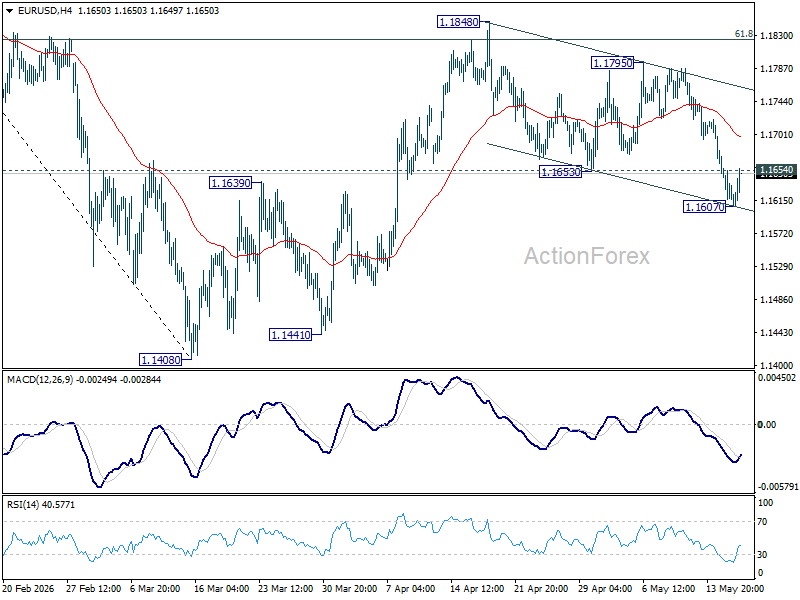
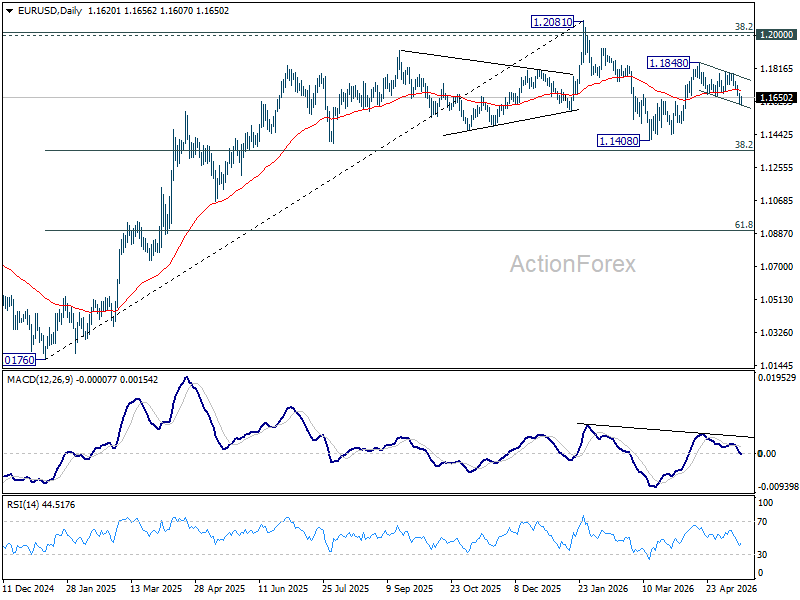
Intraday bias in EUR/USD remains neutral as consolidations from 1.1408 is still extending. With 1.1666 cluster resistance (38.2% retracement of 1.2081 to 1.1408 at 1.1665) intact, further decline is expected. On the downside, firm break of 1.1408 will resume the fall from 1.2081 to 38.2% retracement of 1.0176 to 1.2081 at 1.1353. However, decisive break of 1.1666 will argue that the fall from 1.2081 has completed, and turn bias back to the upside for 61.8% retracement of 1.2081 to 1.1408 at 1.1824.

In the bigger picture, prior break of 55 W EMA (now at 1.5011) should confirm rejection by 1.2 key cluster resistance level. The whole up trend from 0.9534 (2022 low) might have completed as a three wave corrective rise too. Deeper fall is expected to long term channel support (now at 1.0535). Meanwhile, risk will stay on the downside as long as 1.2081 holds, even in case of strong rebound.