Sample Category Title
NZDUSD Wave Analysis
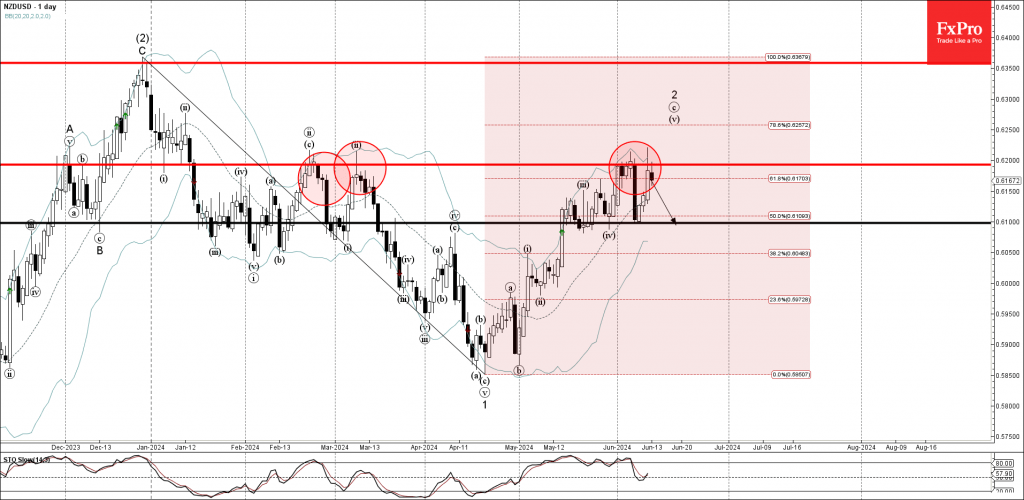
- NZDUSD reversed from key resistance level 0.6200
- Likely to fall to support level 0.6100
NZDUSD currency pair recently reversed down from the key resistance level 0.6200 (which has been reversing the price from February).
The resistance level 0.6200 was strengthened by the upper daily Bollinger Band and by the 61.8% Fibonacci correction of the previous downward impulse 1 from December.
Given the strength of the resistance level 0.6200, NZDUSD currency pair can be expected to fall further to the next support level 0.6100, low of the previous minor correction iv.
Elliott Wave Intraday Analysis on DAX Looking for Support Soon
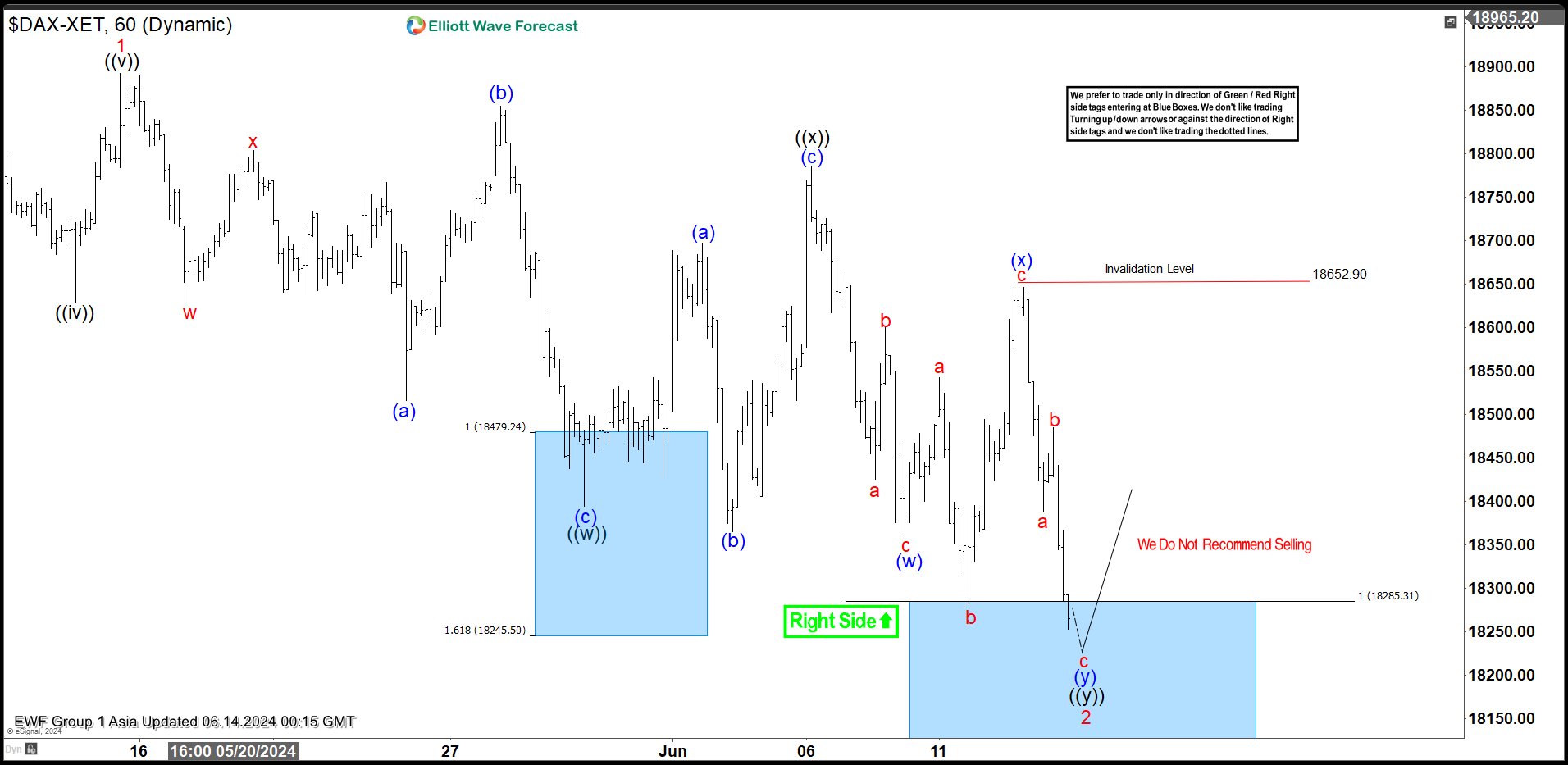
Short Term Elliott Wave in DAX suggests the Index is correcting cycle from 4.19.2024 low. The rally from 4.19.2024 low ended wave 1 at 18892.92. Wave 2 pullback is currently in progress as a double three Elliott Wave structure. Down from wave 1, wave (a) ended at 18515.84 and wave (b) ended at 18855.05. Wave (c) lower ended at 18394.43 which completed wave ((w)) in higher degree. Wave ((x)) unfolded as an expanded flat Elliott Wave structure. Up from wave ((w)), wave (a) ended at 18697.09 and wave (b) ended at 18365.53. Wave (c) higher ended at 18784.65 which completed wave ((x)) in higher degree.
The Index has resumed lower in wave ((y)). Down from wave ((x)), wave (w) ended at 18359.42 and wave (x) rally ended at 18652.90. Wave (y) lower is now in progress to complete wave ((y)) of 2 in higher degree. The Index has reached the extreme area from wave 1 peak. This area of support is at 100% – 161.8% Fibonacci extension of wave ((w)), which comes at 17981 – 18287.2. From this area, the Index should turn and resume higher or at minimum rally in 3 waves.
DAX 60 Minutes Elliott Wave Chart
DAX Elliott Wave Video
https://www.youtube.com/watch?v=IF9XAi9KmWk
Bank of Japan (BoJ) Preview: Potential Cut in Bond Buying to Aid Ailing Yen?
- Hawkish FOMC adds further pressure on the BoJ as USD/JPY advances.
- Speculation builds that the BoJ will announce a more comprehensive cut to its bond buying programme.
Fundamental Overview: FOMC Recap and BoJ Outlook
The Japanese continued its slide this morning as USD/JPY edged higher toward the 160.00 psychological level. A brief respite yesterday for USD/JPY which was somewhat of a surprise given the outcome of the Federal Reserve (FOMC) meeting. The Fed left its benchmark lending rate steady in the range of 5.25%-5.50% while delivering a somewhat hawkish update to the summary of economic projections (dot plot).
The Fed adjusted its rate cut expectation for 2024 down to one 25bps cut from the previous three, while at the same time increasing their expectations for rate cuts in 2025 from three to four. A comment that surprised many was Fed Chair Powell stating that the Fed does not have a high degree of confidence in their forecasts, something which may have cast a shadow on the updated dot plot and inflation projections moving forward. Given the higher-for-longer narrative, market participants may be eyeing further gains for the US Dollar against the Japanese Yen, which adds an extra layer of intrigue around the BoJ policy meeting
FOMC Dot Plot Updated, Showing 1 Rate Cut in 2024
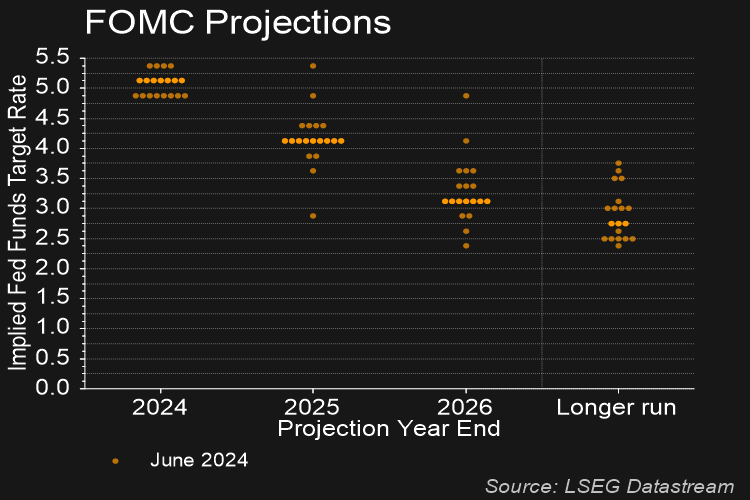
Source: LSEG Datastream, June 12, 2024
The BoJ meeting tomorrow will now take center stage as market participants look for further cues from the Central Bank. Governor Ueda has been on the right path in terms of policy normalization but has constantly reiterated the need for caution as the BoJ continues to keep a close watch on wage growth.
In March, the BoJ ended 8 years of short-term negative interest rates and the yield curve control (YCC) policy on the 10-year Japanese Government Bond (JGB). Despite the removal of the YCC policy the Central Bank pledged to keep buying roughly $38 billion worth of government bonds each month to maintain its balance sheet. A surprise cut in bond buying on May 13 has led to increased speculation that the BoJ may be ready to move to a more comprehensive reduction in its bond purchases.
The Nikkei Newspaper reported as much earlier today as well, which begs the question, will such a move provide support to the ailing Japanese Yen? In theory, this would be correct as a reduction in bond buying leads to a decrease in the money supply which tends to strengthen a country’s domestic currency. It is also seen as a prelude to rate hikes and a sign that the Central Bank has confidence in the economy thereby increasing foreign investment and demand for the Japanese Yen.
The Japanese Yen could really use a ‘pick me up’ narrative, following months of struggles against its G7 counterparts. Given that FX intervention has only led to a short-term appreciation for the Yen, it may be time for Governor Ueda to get the ball rolling and offer bolder guidance in the context of policy normalisation.
Risk Events: US PPI Data and Initial Jobless Claims
Looking ahead to the rest of the day, two key US data releases are due later in the day which could stoke volatility in USD/JPY heading into the BoJ meeting. A positive beat of consensus for the US PPI data and initial jobless claims releases could provide further impetus to the US Dollar Index and push USD/JPY closer to the 160.00 handle. A miss to the downside may add some weakness to the US dollar which in my view may not be sustainable.
Technical Outlook for USD/JPY
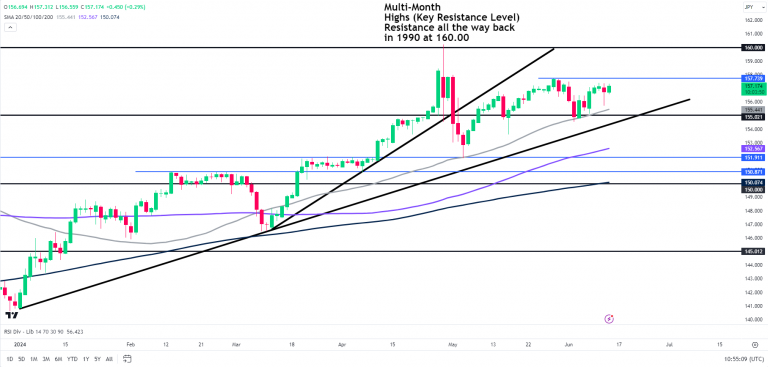
Looking at USDJPY from a technical perspective, the pair has been stuck in a range for the past four weeks, trading between the 155.00 support level and the most recent high around 157.73. Price action has been choppy on USDJPY as the lack of clarity from the BoJ weighs on the mind of market participants.
As you can see on the chart below, USDJPY is supported by the 50-day MA which rests just above the psychological 155.00 handle with a long-term ascending trendline just below it. A break of the 50-day MA could see USDJPY retest the trendline in a break or bounce scenario.
Looking at the upside and immediate resistance is provided by the May 29 high around the 157.73 handle. A break of this level clears a path for a run up all the way to the 160.00 handle. Beyond the 160.00 handle it becomes increasingly challenging to look at the technical outlook given the lack of recent price action data at these levels.
USD/JPY Daily Chart – June 13, 2024
XAU/USD: $2,500 Target Remains in Focus But Consolidation Likely to Precede Fresh Rally
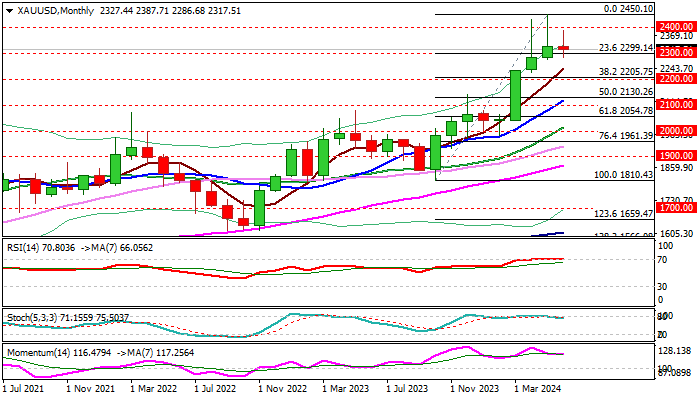
Gold is likely to retest the latest record high and attack psychological $2500 level in coming months, as all key factors that drive the metal’s price remain supportive.
Persisting geopolitical tensions and threats of escalation continue to underpin demand, along with growing signals of stronger monetary easing and one of the most significant – gold purchases by central banks – led by China.
However, overbought conditions on monthly chart and long upper shadows of April/May monthly candlesticks, as well as June’s candlestick so far being in the shape of long-legged Doji, signal rising offers and indecision, indicating that bulls might be running out of steam.
This suggests that metal’s price may hold in extend consolidation, which so far finds ground at $2300 zone, with dips not to exceed solid supports at $2200 (psychological / Fibo 38.2% of $1810/$2450) to keep larger bulls intact for fresh push higher.
Sunset Market Commentary
Markets
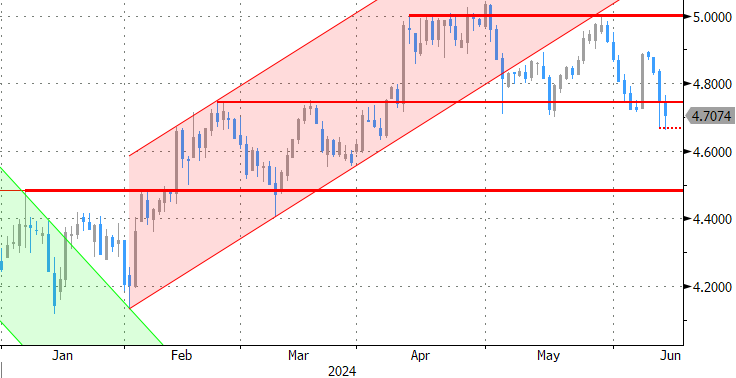
Yesterday’s ‘hawkish’ Fed dots raising governors’ 2024/25 inflation projections, a higher reference for the neutral rate (2.75% ) and indicating only one rate cut this year as the FOMC’s preferred interest rate scenario only limited the big decline in US yields post a softer than expected US may CPI release. US 2-y and 10-y yields were saved by the bell not to drop below key support zones respectively at 4.70% (mid-May low) and 4.26% (50% retracement rise December/April & recent correction low). Still, markets clearly saw a more than 50% chance of the Fed again backtracking on its guidance and deploy two rate cuts starting in September rather December. Given Fed guidance yesterday, it would be reasonable to expect money markets to continue switching between a first Fed rate cut in September rather than December or vice-versa and above mentioned yields’ levels to provide solid support. Today’s US jobless claims and PPI data for sure are second tier compared to yesterday’s CPI. Even so, as they pointed in the same direction yesterday’s lows/key supports are again at risk. US jobless claims jumped from 229k to 242k, the highest level in nine months. US (headline) PPI even declined 0.2% M/M to slow the Y/Y-measure to 2.2% from 2.3%. Core PPI didn’t rise in May (0.0%). US yields currently decline between 3 bps (30-y) and 5 bps (5-y). Markets further embrace a September Fed rate cut (75%). Going into this evening’s sale of $ 22bln of 30-y US notes, yesterday’s and today’s moves again made treasuries far more expensive compared to Tuesday’s successful 10-y sale. Interesting the see investors’ interest at current pricing. German Bunds again substantially underperform Treasuries showing changes of less than 1 bp across the curve. ECB’s Vasle and Muller joined comments from colleagues recently that it’s too early communicate on the timing of further steps, among others as wage growth remains and upside risk to inflation. For EMU yields, especially for longer maturities, the upward tendency still holds even after recent correction. Higher EMU yields/underperformance also suggests a gradual tentative rise in EMU risk premia. In this respect, intra-EMU spreads (VS Germany) continued this week’s uptrend (France, Italy, Greece +4 bps, Spain, Portugal, Belgium, Ireland + 3 bps). Lower yields gains again don’t help (European) equities. The Eurostoxx50 again cedes 1.1%. US indices are holding near recent record levels (S&P 500 + 0.25% , Nasdaq + 0.70%).
On FX markets, the dollar, despite a diminishing interest rate differential, still marginally outperforms the likes of the euro or the yen. DXY gains modestly (104.8 from 104.7). EUR/USD struggles to hold to 1.08 big figure. USD/JPY, admittedly in low volatility trading, surpasses the 157 barrier as market await tomorrow’s BOJ decision. Markets see a chance of the BOJ reducing its bond buying. A further rate cut is expected later this summer.
News & Views
Germany’s finance ministry is considering a supplementary budget for this year, Bloomberg reported after Bild newspaper aired the news earlier today. The revision to the 2024 finance plan, which is still being discussed, would allow the government to borrow an additional €11bn on top of the net new €40bn expected before (down from €70bn). Germany’s constitutional debt brake limits deficit spending to just 0.35% of GDP. This structural component is complemented with a cyclical element, however, to smoothen out business cycles. As the economy grew more modestly than expected during the previous budget preparations, some leeway opened up for the government.
MSCI late yesterday denied debt sold by the European Union entrance to its government bond indices. The news came unexpected and is a setback for investors, who anticipated that MSCI inclusion would drastically improve liquidity and overall demand for the bonds. The current supranational status means that triple A rated EU bonds still trade with a discount compared to equally- (and in some cases even lower-)rated peers. A survey of investors conducted by the EU last year revealed that inclusion in such indices was “the single-most important remaining step in order for EU-bonds to trade and price similarly to European government bonds.” MSCI said it will re-evaluate the eligibility criteria in 2025Q2.
Graphs
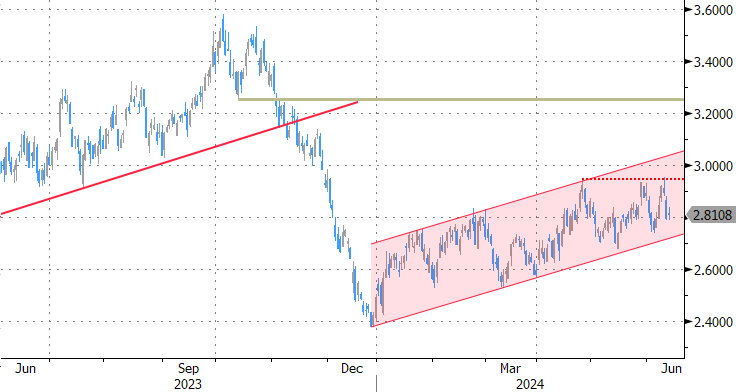
EMU 10-y swap stays in gradual uptrend even as ECB started cutting rates. EMU risk premium in play?
US 2-y yield revisits yesterday’s lows as high jobless claims and soft US PPI challenge yesterday’s Fed guidance.
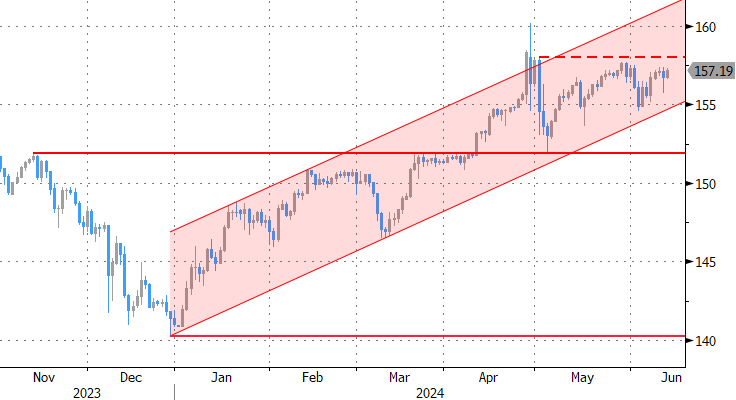
USD/JPY: dollar holding up well despite loss of interest rate support. Yen awaits BOJ decision.
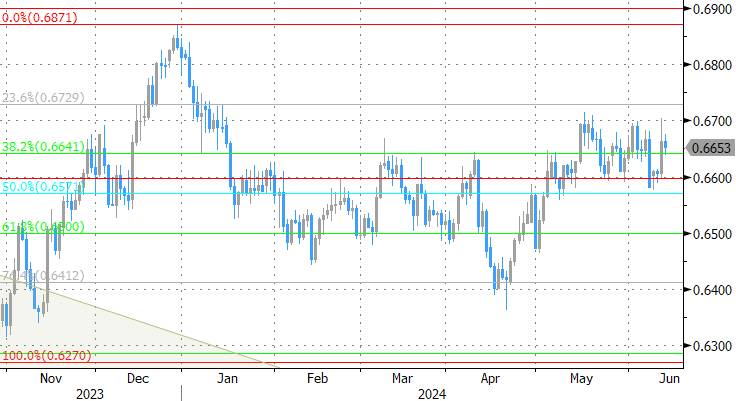
AUD/USD tries upside test. Strong labour market data suggest RBA to stick to higher for longer narrative.
EUR/USD Mid-Day Outlook
Daily Pivots: (S1) 1.0745; (P) 1.0799; (R1) 1.0862; More....
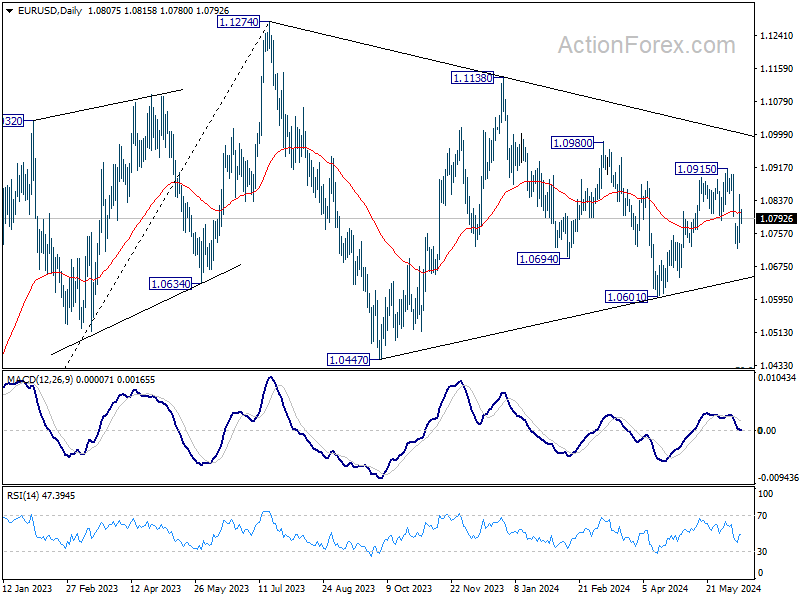
Intraday bias in EUR/USD remains neutral at this point. On the upside, firm break of 1.0915 will resume whole rise from 1.0601. On the downside, break of 1.0718 will resume the fall from 1.0915 instead.
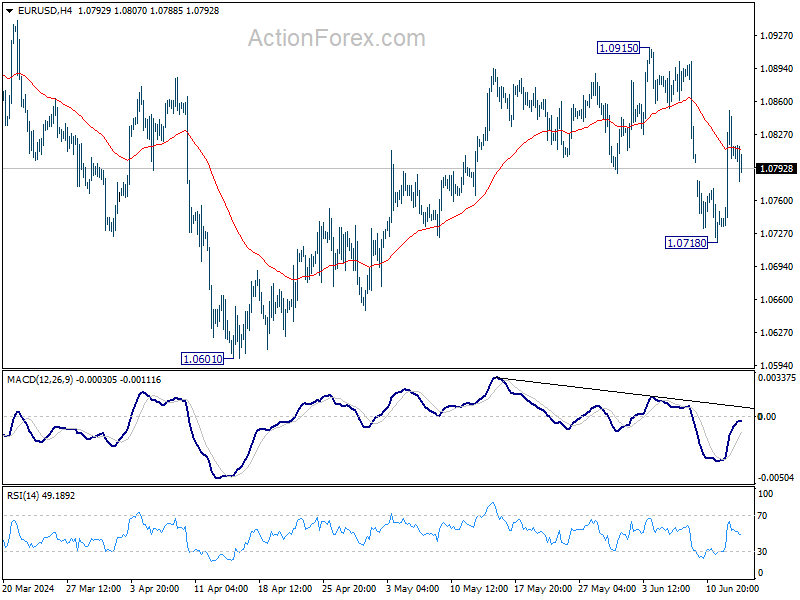
In the bigger picture, price actions from 1.1274 are viewed as a corrective pattern, which might still be in progress. Break of 1.0601 will target 1.0447 support and possibly below. Nevertheless, on the upside, firm break of 1.1138 will argue that larger up trend from 0.9534 (2022 low) is ready to resume through 1.1274 high.
GBP/USD Mid-Day Outlook
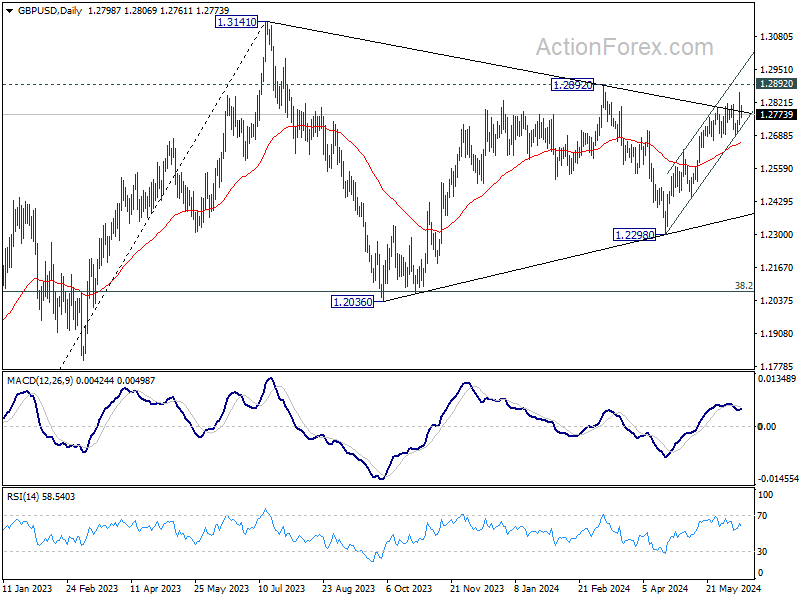
Daily Pivots: (S1) 1.2733; (P) 1.2796; (R1) 1.2862; More...
Intraday bias in GBP/USD is turned neutral first but further rally is expected as long as 1.2687 support holds. Above 1.2869 will target 1.2892 resistance. Decisive break there will strengthen the case that correction from 1.3141 has completed, and bring further rally to retest this high.
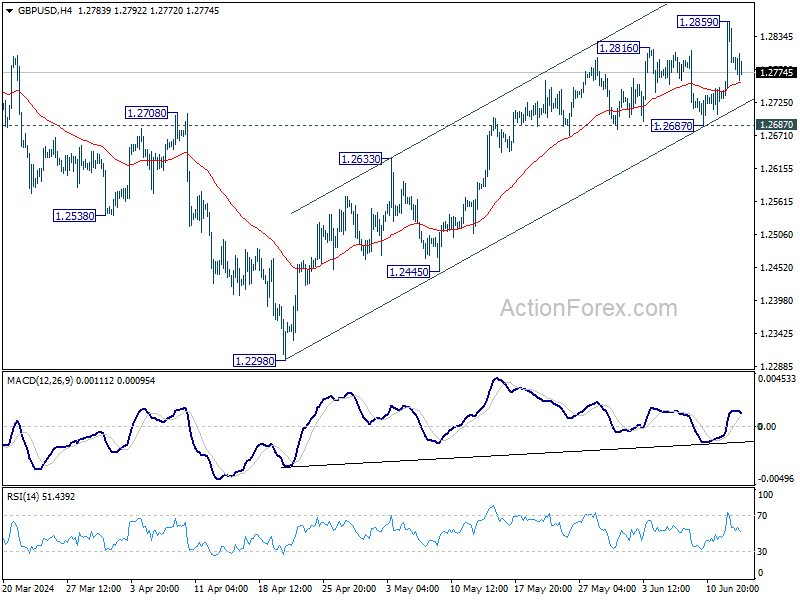
In the bigger picture, price actions from 1.3141 medium term top are seen as a corrective pattern. Fall from 1.2892 is seen as the third leg which might have completed already. Break of 1.2892 resistance will argue that larger up trend from 1.0351(2022 low) is ready to resume through 1.3141. Meanwhile, break of 1.2445 support will extend the corrective pattern with another decline instead.
USD/JPY Mid-Day Outlook
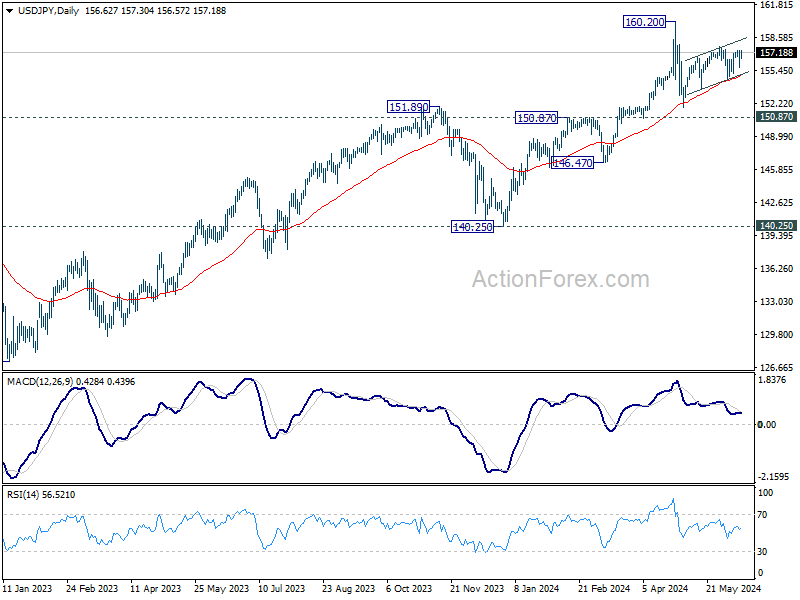
Daily Pivots: (S1) 155.84; (P) 156.61; (R1) 157.49; More...
No change in USD/JPY's outlook as range trading continues. Intraday bias remains neutral. On the downside, break of 154.53 will turn bias to the downside for 151.86 support and possibly below, as the third leg of the corrective pattern from 160.20. On the upside, break of 157.70 will resume the whole rise from 151.86 and target 160.20 high.
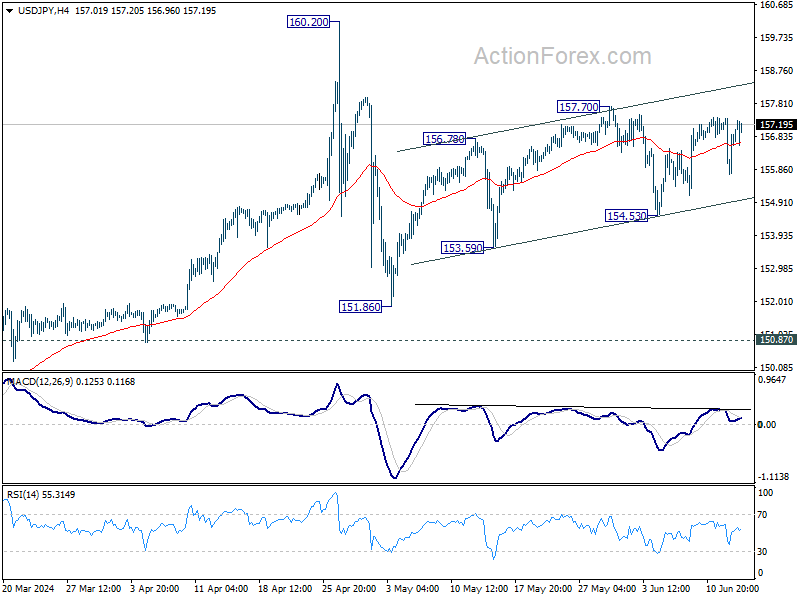
In the bigger picture, a medium term top should be formed at 160.20. As long as 55 W EMA (now at 147.77) holds, fall from 160.20 is seen as correcting the rise from 140.25 only. However, sustained break of 55 W EMA will argue that larger correction is possibly underway, and target 146.47 support next.
Aussie Shrugs After Strong Employment Data
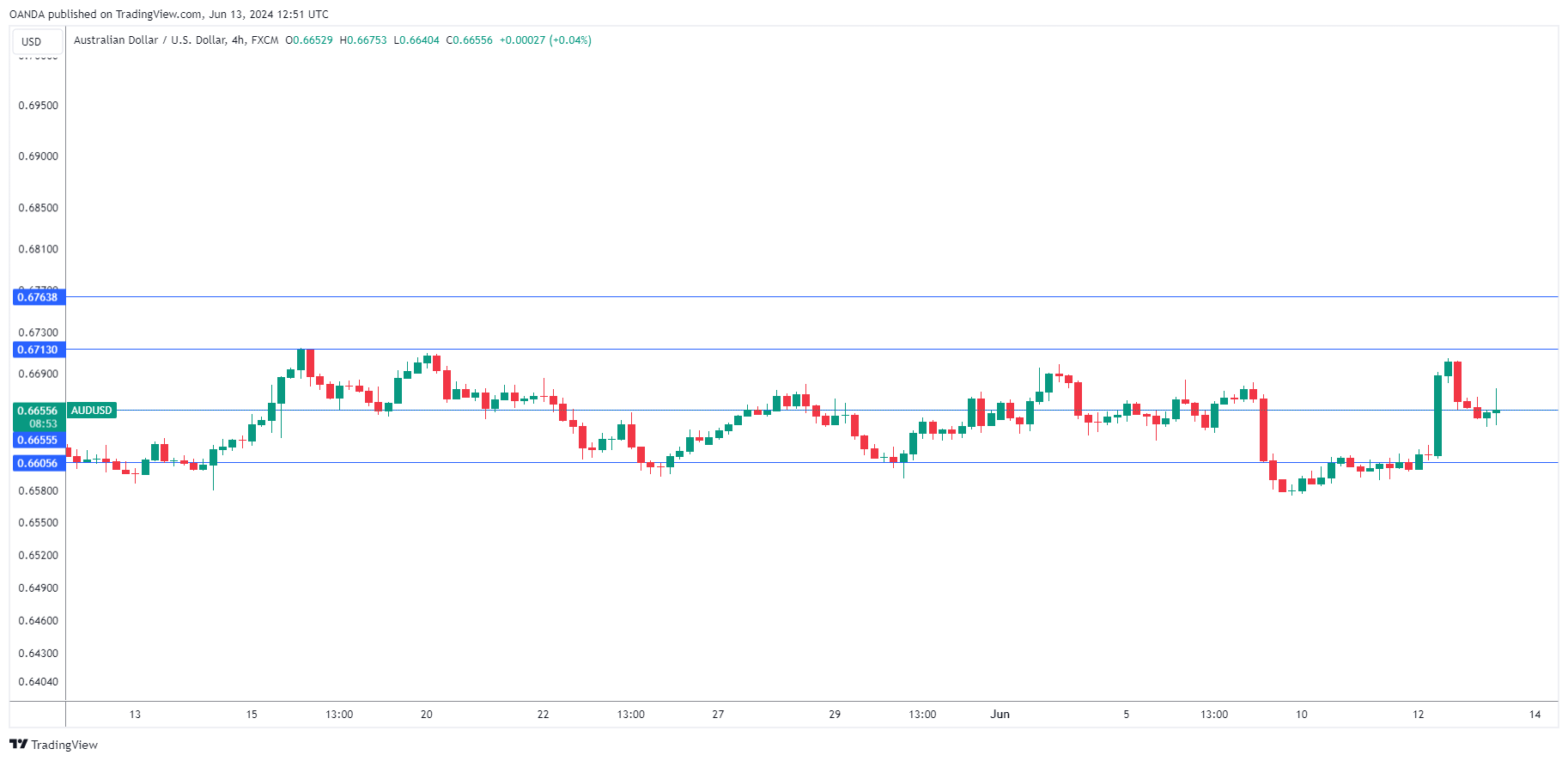
The Australian dollar has edged lower on Thursday. AUD/USD is trading at 0.6674 in the North American session, up 0.14% on the day. The Aussie didn’t show much reaction to today’s solid Australian employment report.
Australian employment beats forecasts
Australia’s economy has been slowing but the May employment report indicated that the labor market remains robust despite the uncertain economic landscape. The economy added 39.7 thousand jobs, above the revised gain of 37.4 thousand in April and the market estimate of 30 thousand. Full-time employment surged with a gain of 41.7 thousand, after two soft months. The unemployment rate dipped to 4.0%, down from 4.1%.
Today’s employment report is the final tier-1 event before the Reserve Bank of Australia meets on June 14th. The RBA has kept rates unchanged at 4.35% for six straight times and is expected to hold rates again next week. The central bank remains concerned about inflation, which has proven to stubborn and rose unexpectedly in April to 3.6%, up from 3.5%.
The Reserve Bank remains hawkish and has warned that it could raise rates if inflation continued to rise. A rate hike is an unlikely scenario but the message from the RBA is that inflation is too high and rate cuts will be delayed, perhaps until early 2025.
US inflation lower than expected
US inflation decelerated in May, raising hopes that inflationary pressures will continue to decline. The headline figure fell from 3.4% to 3.3% and core CPI dropped to 3.4%, down from 3.6%. The inflation release did not have a significant impact on rate cut expectations, with the markets currently pricing in quarter-point cut in September at 57%, according to the CME’s FedWatch.
AUD/USD Technical
- AUD/USD tested support at 0.6655 earlier. Below, there is support at 0.6605
- 0.6713 and 0.6763 are the next resistance lines