

Sample Category Title
USD/CAD Daily Outlook
Daily Pivots: (S1) 1.3545; (P) 1.3592; (R1) 1.3623; More....
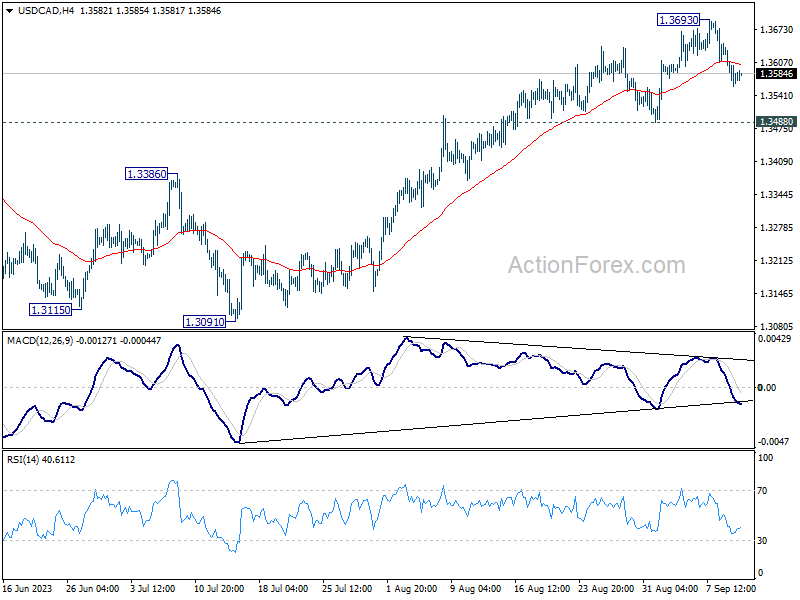
Outlook in USD/CAD remains unchanged and intraday bias stays neutral. Consolidation from 1.3693 would extend and deeper pull back might be seen. But further rally is expected as long as 1.3488 support holds. Above 1.3693 will resume the rally from 1.3091 to 1.3860 resistance, and then 1.3976 high.
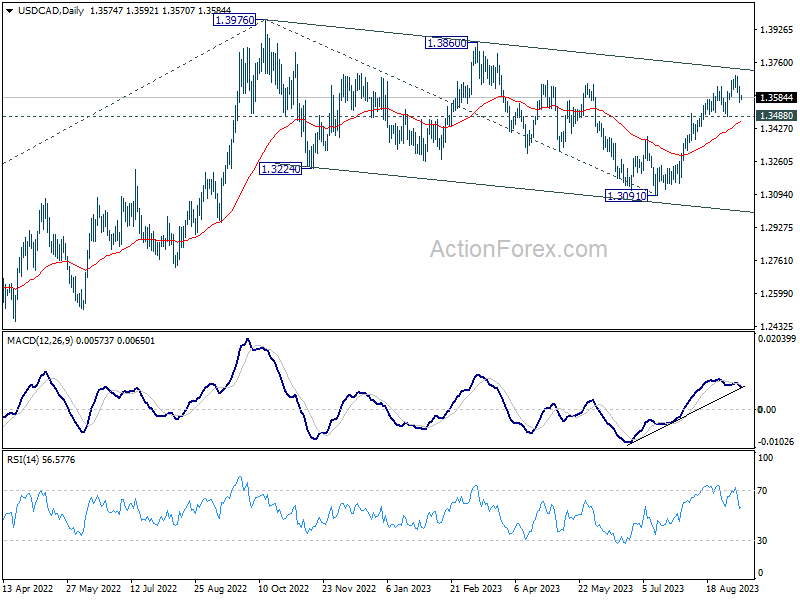
In the bigger picture, price actions from 1.3976 are viewed as a corrective pattern only. Upon completion, rise from 1.2005 (2021 low) would resume through 1.3976. Next target is 61.8% projection of 1.2005 to 1.3976 from 1.3091 at 1.4309. For now, this will remain the favored case as long as 55 D EMA (now at 1.3456) holds.
Sterling and Euro in Focus: Markets Await UK Employment and Germany ZEW
In Asian trading session today, the forex markets remained steady with no significant movements outside of yesterday's range among major pairs and crosses. Sterling stood slightly firmer, holding much anticipation for the forthcoming UK employment data, notably the insights on wage growth which can potentially delineate its next significant move.
In contrast, Euro presented a softer tone as markets awaited Germany ZEW Economic Sentiment indicator, an important data set which may reflect further degradation given the mounting worries of recession. EUR/GBP's reactions to the releases could be noteworthy.
As we look beyond, Yen has reverted back to its previous week's range vis-à-vis other major rivals, as yesterday's sharp rise was fleeting. However, it maintains its position as the second strongest currency at present. Australian Dollar emerges as the frontrunner, a situation catalyzed by rejuvenated Chinese Yuan.
Dollar, on the other hand, has been exhibiting mild weakness this week, closely followed by Swiss Franc. Euro and Canadian dollar are maneuvering with mixed performance. But the picture could be shaken up drastically with the unveiling of US CPI data on Wednesday and the much-awaited ECB rate decision alongside the economic projections slated for release on Thursday.
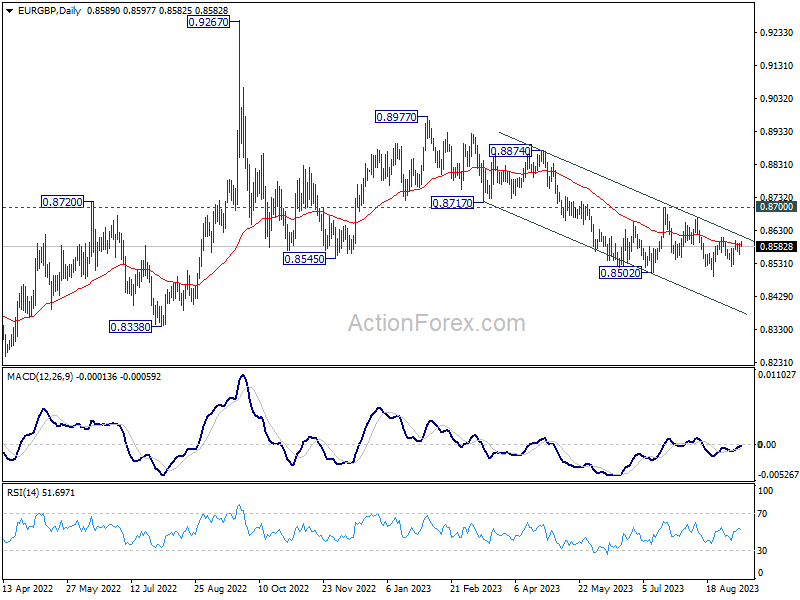
Technically, being capped by falling 55 D EMA, immediate risks for EUR/GBP is staying on the downside. That is, down trend from 0.8977 is in favor to resume sooner rather than later through last week's low of 0.8491. Sustained break of the 55 D EMA would provide some near term relieve for the cross. Yet, until 0.8700 resistance is decisively broken, bullish reversal remains unconfirmed, keeping the door wide open for sellers to regain control post a recovery.
In Asia, at the time of writing, Nikkei is up 0.81%. Hong Kong HSI is up 0.01%. China Shanghai SSE is up 0.04%. Singapore Strait Times is down -0.20%. Japan 10-year JGB yield is up further by 0.0054 at 0.711. Overnight, DOW rose 0.25%. S&P 500 rose 0.67%. NASDAQ rose 1.14%. 10-year yield rose 0.030 to 4.288.
Japan's FM Suzuki expects BoJ to liaise with government closely
In the wake of the spike in Yen, prompted by BoJ Governor Kazuo Ueda's remarks, Finance Minister Shunichi Suzuki made clarifying comments today. Yen's climb was chiefly attributed to Ueda's interview with Yomiuri Shimbun, where he hinted at the possibility of exiting negative rates policy in the coming year.
At a regular press conference, Suzuki underlined the autonomy of BOJ, stating that the "specific monetary policy conduct is up to the BOJ to decide."
However, the minister did not hold back from expressing the government's expectations . Suzuki conveyed his aspirations for BOJ, emphasizing its collaboration with the government. He said, "I expect the BOJ to continue to liaise with the government closely and conduct monetary policy appropriately."
The guiding principle for this collaboration, as Suzuki suggests, should be a comprehensive evaluation of the economy, considering factors like pricing and prevailing financial conditions. The ultimate aim is to "achieve its price stability target in a stable and sustainable way."
The remarks by the Finance Minister, while emphasizing BoJ's autonomy, also subtly convey the weight of responsibility the central bank carries in managing the nation's economic health, especially in unpredictable financial climates.
Australia consumer sentiment fell to 79.7, languishes at deeply pessimistic levels
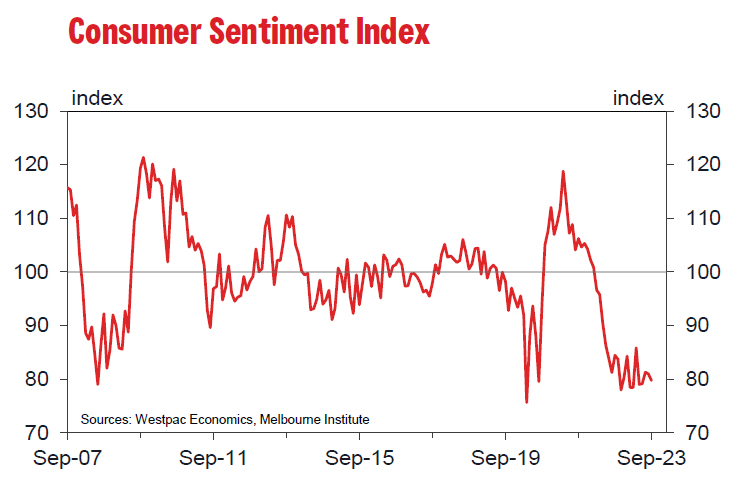
Australia's consumer sentiment, as depicted by Westpac Consumer Sentiment Index, witnessed a dip of -1.5% mom, settling at 79.7 in September. The sentiment has been gloomily "languished at deeply pessimistic levels".
Westpac draws attention to the historical context, pointing out that since the initiation of the survey back in 1974, such enduring periods of pessimism have been rare. The most notable instance was during early 1990s' recession when sentiments dipped even lower and remained so for a duration exceeding two years.
On the brighter side, households showcased reduced apprehension about potential rate hikes, with noticeable surge in confidence, up 7.8%, particularly among mortgagors. However, looming worries about cost of living and inflation continue to weigh down on consumer spirits. Although job confidence has steadied itself, it has drastically plummeted, down -33% from its peak levels. One silver lining is the buoyed expectations around house prices.
Westpac expects RBA to maintain their status quo until August 2024. By this timeframe, Westpac envisions inflation receding to 3.4%, a jump in unemployment rate to 4.5%, and a noticeable slowdown in the annual growth rate of consumer spending, tapering to a mere 0.8%.
Also released, NAB Business Conditions rose from 11 to 13 in August. Business Confidence rose from 1 to 2.
Looking ahead
UK employment data and Germany ZEW Economic Sentiment are the only notably economic data release today.
USD/CAD Daily Outlook
Daily Pivots: (S1) 1.3545; (P) 1.3592; (R1) 1.3623; More....
Outlook in USD/CAD remains unchanged and intraday bias stays neutral. Consolidation from 1.3693 would extend and deeper pull back might be seen. But further rally is expected as long as 1.3488 support holds. Above 1.3693 will resume the rally from 1.3091 to 1.3860 resistance, and then 1.3976 high.
In the bigger picture, price actions from 1.3976 are viewed as a corrective pattern only. Upon completion, rise from 1.2005 (2021 low) would resume through 1.3976. Next target is 61.8% projection of 1.2005 to 1.3976 from 1.3091 at 1.4309. For now, this will remain the favored case as long as 55 D EMA (now at 1.3456) holds.
Economic Indicators Update
| GMT | Ccy | Events | Actual | Forecast | Previous | Revised |
|---|---|---|---|---|---|---|
| 00:30 | AUD | Westpac Consumer Confidence Sep | -1.50% | -0.40% | ||
| 01:30 | AUD | NAB Business Conditions Aug | 13 | 10 | 11 | |
| 01:30 | AUD | NAB Business Confidence Aug | 2 | 2 | 1 | |
| 06:00 | GBP | Claimant Count Change Aug | 29K | |||
| 06:00 | GBP | ILO Unemployment Rate (3M) Jul | 4.30% | 4.20% | ||
| 06:00 | GBP | Average Earnings Excluding Bonus 3M/Y Jul | 7.60% | 7.80% | ||
| 06:00 | GBP | Average Earnings Including Bonus 3M/Y Jul | 8.20% | 8.20% | ||
| 09:00 | EUR | Germany ZEW Economic Sentiment Sep | -15 | -12.3 | ||
| 09:00 | EUR | Germany ZEW Current Situation Sep | -75 | -71.3 | ||
| 09:00 | EUR | Eurozone ZEW Economic Sentiment Sep | -6.2 | -5.5 | ||
| 10:00 | USD | NFIB Business Optimism Index Aug | 91.6 | 91.9 |
Japan’s FM Suzuki expects BoJ to liaise with government closely
In the wake of the spike in Yen, prompted by BoJ Governor Kazuo Ueda's remarks, Finance Minister Shunichi Suzuki made clarifying comments today. Yen's climb was chiefly attributed to Ueda's interview with Yomiuri Shimbun, where he hinted at the possibility of exiting negative rates policy in the coming year.
At a regular press conference, Suzuki underlined the autonomy of BOJ, stating that the "specific monetary policy conduct is up to the BOJ to decide."
However, the minister did not hold back from expressing the government's expectations . Suzuki conveyed his aspirations for BOJ, emphasizing its collaboration with the government. He said, "I expect the BOJ to continue to liaise with the government closely and conduct monetary policy appropriately."
The guiding principle for this collaboration, as Suzuki suggests, should be a comprehensive evaluation of the economy, considering factors like pricing and prevailing financial conditions. The ultimate aim is to "achieve its price stability target in a stable and sustainable way."
The remarks by the Finance Minister, while emphasizing BOJ's autonomy, also subtly convey the weight of responsibility the central bank carries in managing the nation's economic health, especially in unpredictable financial climates.
Australia consumer sentiment fell to 79.7, languishes at deeply pessimistic levels
Australia's consumer sentiment, as depicted by Westpac Consumer Sentiment Index, witnessed a dip of -1.5% mom, settling at 79.7 in September. The sentiment has been gloomily "languished at deeply pessimistic levels".
Westpac draws attention to the historical context, pointing out that since the initiation of the survey back in 1974, such enduring periods of pessimism have been rare. The most notable instance was during early 1990s' recession when sentiments dipped even lower and remained so for a duration exceeding two years.
On the brighter side, households showcased reduced apprehension about potential rate hikes, with noticeable surge in confidence, up 7.8%, particularly among mortgagors. However, looming worries about cost of living and inflation continue to weigh down on consumer spirits. Although job confidence has steadied itself, it has drastically plummeted, down -33% from its peak levels. One silver lining is the buoyed expectations around house prices.
Westpac expects RBA to maintain their status quo until August 2024. By this timeframe, Westpac envisions inflation receding to 3.4%, a jump in unemployment rate to 4.5%, and a noticeable slowdown in the annual growth rate of consumer spending, tapering to a mere 0.8%.
GBP/USD Recovery Could Soon Fade, UK Jobs Report Next
Key Highlights
- GBP/USD is attempting a recovery wave from the 1.2445 zone.
- A key bearish trend line is forming with resistance near 1.2600 on the 4-hour chart.
- EUR/USD is consolidating losses below the 1.0800 pivot level.
- USD/JPY failed to surpass 147.80 and corrected gains.
GBP/USD Technical Analysis
The British Pound found support near the 1.2445 zone against the US Dollar. GBP/USD formed a short-term base and recently started an upside correction above 1.2480.
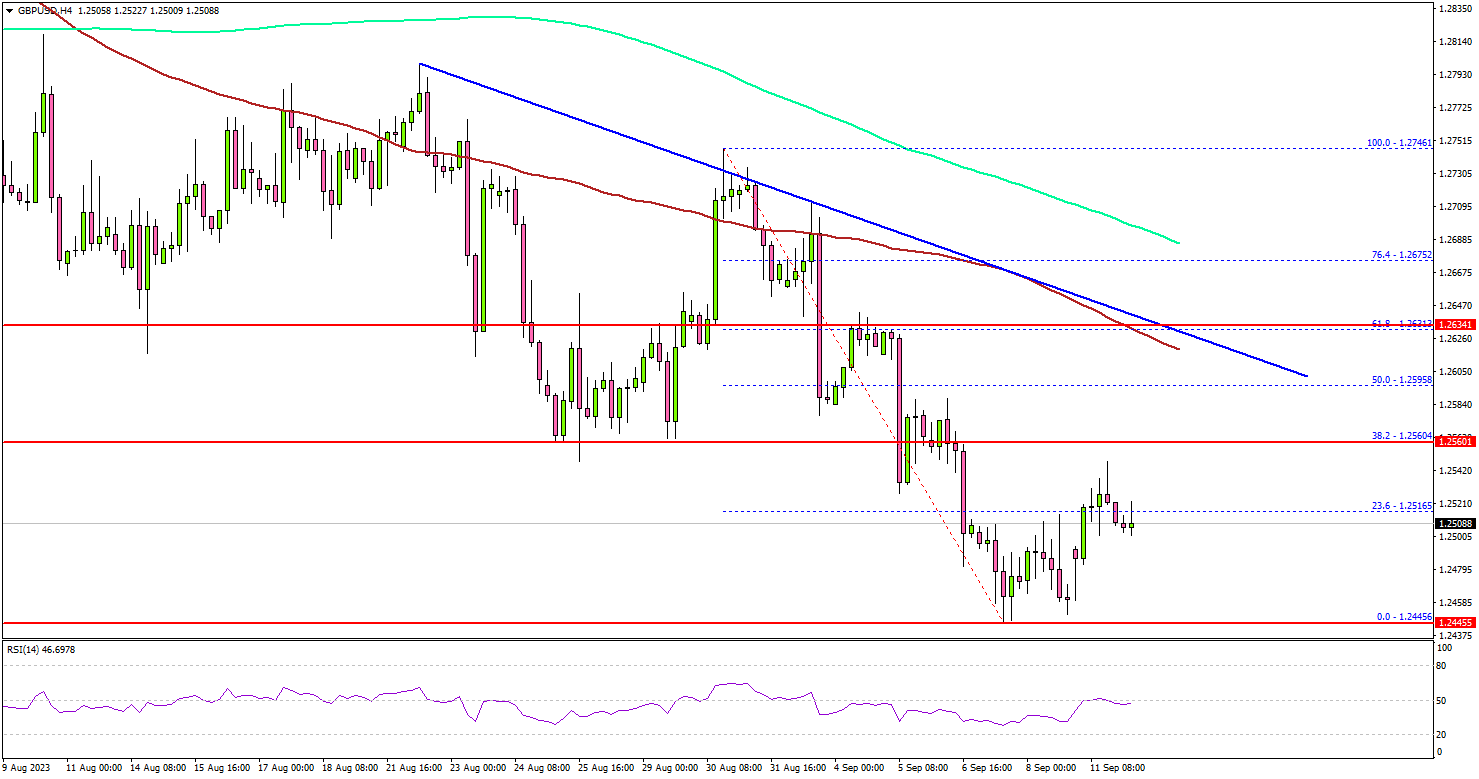
Looking at the 4-hour chart, the pair was able to clear the 1.2500 level but is still well below the 100 simple moving average (red, 4 hours) and the 200 simple moving average (green, 4 hours).
It broke the 23.6% Fib retracement level of the downward move from the 1.2746 swing high to the 1.2445 low. On the upside, an initial resistance is near the 1.2560 level.
The first major resistance is near the 1.2600 handle. There is also a key bearish trend line forming with resistance near 1.2600 on the same chart. The trend line is close to the 50% Fib retracement level of the downward move from the 1.2746 swing high to the 1.2445 low.
The next major resistance is near the 1.2635 level. A close above 1.2635 could start another decent increase. In the stated case, the pair could rise toward the 1.2700 level.
On the downside, immediate support is near 1.2480. The next key support is seen near the 1.2445 level. The first major support is near 1.2420. If there is a move below 1.2420, the pair could dive toward 1.2340. Any more losses might send the pair toward the 1.2250 level.
Looking at EUR/USD, the pair is attempting a short-term upside correction but upsides might be limited above 1.0800.
Economic Releases
- German ZEW Business Economic Sentiment Index for Sep 2023 – Forecast -15.0, versus -12.3 previous.
- UK Claimant Count Change for Aug 2023 – Forecast 12.0K, versus 29.0K previous.
- UK ILO Unemployment Rate for July 2023 (3M) – Forecast 4.3%, versus 4.2% previous.
AUD/JPY: Make or Break Time as China’s Economy Appears to be Stabilizing
- China’s new yuan loans skyrocketed to 1.36 trillion yuan in August, much higher than the prior month’s 345 billion yuan.
- Optimism grows for China’s outlook as stimulus appears to filtering throughout the economy
- Dollar has biggest drop in two months as yen and yuan gain
The big risk aversion trade over the summer has seen AUD/JPY consolidate around the 94.00 level. A downbeat outlook for China kept the Australian dollar heavy, while US economic resilience has kept yen softer on a widening interest rate differential. The AUD/JPY daily highlights a global growth picture that is either looking for a China rebound, which should help Australia’s growth momentum or a Japan recovery that is not on solid footing.
The AUD/JPY daily displays a symmetrical triangle that shows price has converged towards the 94.00 region. The bullish trend that started in the spring ended mid-June ahead of the 97.70 level. Price is poised to either resume the longer-term bullish trend that started after the pandemic low was made in March 2020 or potentially show the start of a significant bearish reversal.
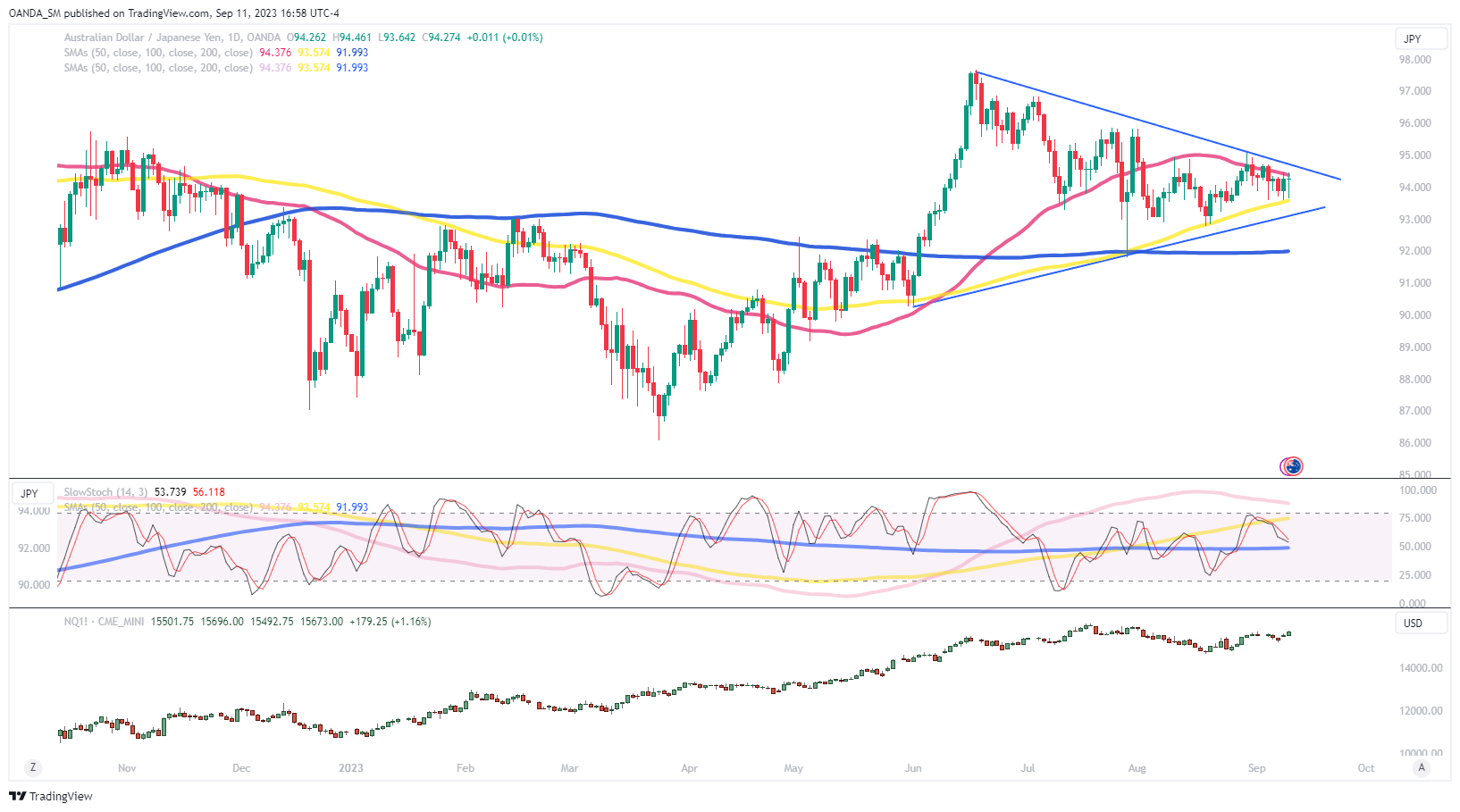
The Australian dollar and Japanese yen seems likely to remain a key risk barometer, which means it could react strongly with what happens with this week’s US inflation data and with China’s decision on rates and their activity data. If bullishness emerges, price could initially targets the 95.50 region, while downside support would come from the 200-day SMA level, which currently resides at the 92.00 level.
This week the Australian economic calendar is filled with economic data that might take a backseat to everything that happens from the US and China. The main Australian data release of the week is Australia jobs, which could show job growth rebounded, but will unlikely bring back rate hike expectations for the RBA.
AUDUSD Wave Analysis
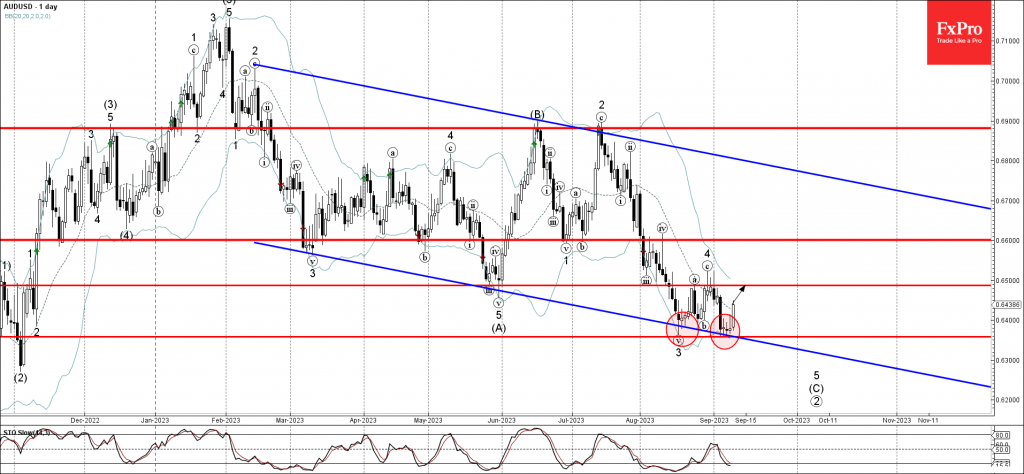
- AUDUSD reversed from support level 0.6360
- Likely to rise to resistance level 0.6500
AUDUSD today reversed up strongly from the strong support level 0.6360 (pervious monthly low from August), intersecting with the lower daily Bollinger Band and the support trendline of the wide down channel from February.
The upward reversal from the support level 0.6360 stopped the active short-term impulse wave 5, which belongs to wave (C) from the end of August.
Given the strength of the support level 0.6360, AUDUSD can be expected to rise further toward the next resistance level 0.6500 (top of the pervious waves a and 4 from the end of August).
EURUSD Wave Analysis
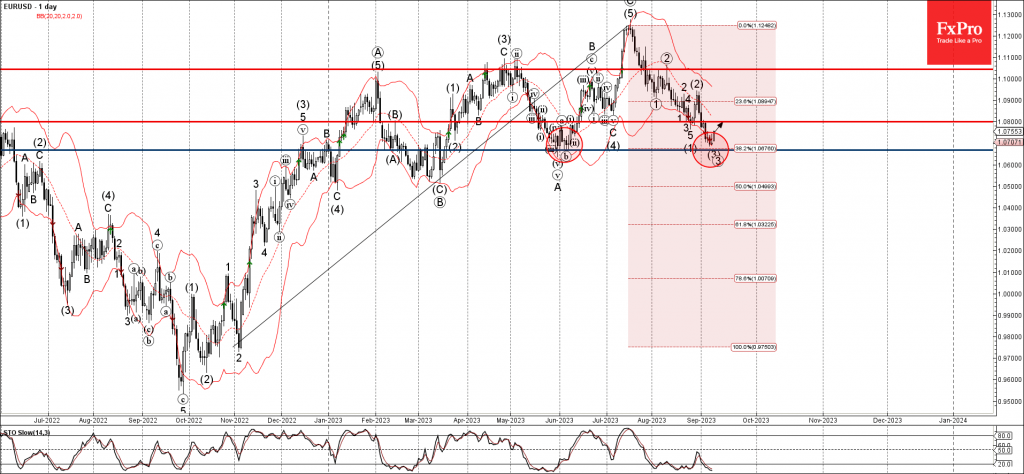
- EURUSD reversed from key support level 1.0665
- Likely to rise to resistance level 1.0800
EURUSD currency pair recently reversed up from the key support level 1.0665 (former strong support from April and May), intersecting with the lower daily Bollinger Band and the 38.2% Fibonacci correction of the upward impulse from November of 2022.
The upward reversal from the support level 1.0665 stopped the previous short-term impulse wave 3.
Given the oversold daily Stochastic and the strong USD sales seen across the FX markets today, EURUSD can be expected to rise further toward the next resistance level 1.0800 (former low of wave 3 from the end of last month).
New York Fed Survey: Consumer inflation expectations rise slightly
The August 2023 New York Fed Survey of Consumer Expectations has revealed a moderate increase in the median one- and five-year-ahead inflation expectations, both witnessing a rise of 0.1% to sit at 3.6% and 3.0%, respectively. However, expectations for three-year-ahead inflation demonstrated a dip, dropping by -0.1% to 2.8%.
On the unemployment front, there was a noticeable increase in mean unemployment expectations, with the mean probability of a higher unemployment rate one year from now spiking by 1.8%, settling at 38.5%. Despite this increase, the figure remains beneath its 12-month trailing average which stands at 40.2%.
Median expectation for growth in household income experienced a decrement, falling by -0.3% to arrive at 2.9% in August, marking the lowest figure since July 2021.