Sample Category Title
New York Fed Survey: Consumer inflation expectations rise slightly
The August 2023 New York Fed Survey of Consumer Expectations has revealed a moderate increase in the median one- and five-year-ahead inflation expectations, both witnessing a rise of 0.1% to sit at 3.6% and 3.0%, respectively. However, expectations for three-year-ahead inflation demonstrated a dip, dropping by -0.1% to 2.8%.
On the unemployment front, there was a noticeable increase in mean unemployment expectations, with the mean probability of a higher unemployment rate one year from now spiking by 1.8%, settling at 38.5%. Despite this increase, the figure remains beneath its 12-month trailing average which stands at 40.2%.
Median expectation for growth in household income experienced a decrement, falling by -0.3% to arrive at 2.9% in August, marking the lowest figure since July 2021.
Australian Dollar Jumps as Chinese Deflation Eases
- Australian dollar jumps 1%
- Australia releases consumer and business confidence on Tuesday
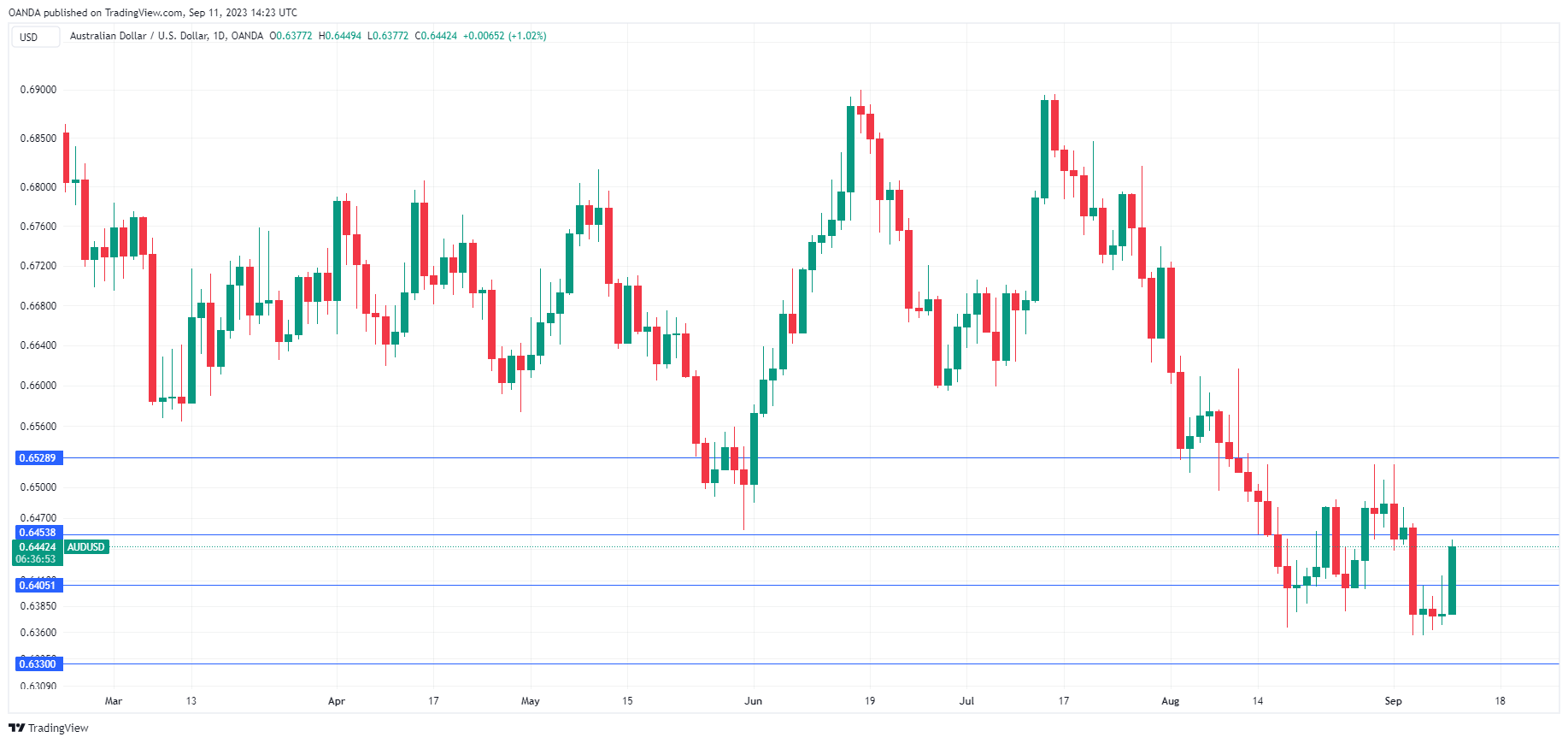
The Australian dollar is sparkling on Monday, with massive gains of 1% against the US dollar. In the North American session, AUD/USD is trading at 0.6441.
China inflation numbers boost Aussie
The Australian dollar received a major boost after China’s inflation release over the weekend. CPI for August rose 0.1% y/y, following a -0.3% reading in July, which marked the first monthly decline in over two years. On a monthly basis, August CPI rose 0.3%, higher than the July gain of 0.2% and matching the consensus. As well, producer prices fell 3%, down from -4.4% in August. The inflation data didn’t knock anyone off their seats, but the fact that deflation showed signs of easing raised risk appetite and boosted the Australian dollar.
China’s economy has deteriorated more sharply than expected, raising alarm bells about the strength of the world’s second-largest economy. The government has responded by injecting stimulus including interest rate cuts and tax breaks but will need to do more to boost economic activity. Manufacturing continues to decline and growth in the services sector has been weakening. China is Australia’s largest trading partner and the Australian dollar is sensitive to economic developments, as we saw earlier today with the Aussie’s sharp gains.
Australian consumers and businesses have been squeezed by high inflation and interest rates, which has taken a toll on confidence. We’ll get a look at consumer and business confidence on Tuesday. Westpac Consumer Confidence Change slipped 0.4% in August but is expected to rebound to 0.6% in September. The NAB Business Confidence index is projected to dip to 1 in August, up from 2 in July. A reading above zero points to improving conditions and below zero to worsening conditions..
AUD/USD Technical
- AUD/USD pushed above resistance at 0.6405 and 0.6453. Above, there is resistance at 0.6528
- There is support at 0.6330 and 0.6282
BoE Mann: Risk of tightening too little more salient
BoE MPC member Catherine Mann expressed a potent concern regarding the UK's current economic landscape, emphasizing the "salient" risk of "tightening too little" in her speech today.
Mann cited alarming data where inflation in core and services has consistently remained above 6% for over a year now. Drawing from econometric analyses which break down inflation dynamics into components of "expectations and inertia", she highlighted an unsettling trend — a steady increase in these components, encouraging continuation of inflation persistence. "Worrying to me," Mann noted, "is that a statistically-derived time-varying trend of inflation has drifted above 2%."
Mann elucidated the channels through which monetary policy transmits its effects on financial markets, influencing price settings and impacting the real economy prominently through an "expectations channel".
She emphasized that "duration above target matters for policy risk assessment", pointing out that the longer the inflation rates hover markedly above target levels, the more challenging and costly it becomes to rein it back to the desired target.
In her assessment, "to pause or to hold the policy rate lower for longer" poses a substantial risk, potentially embedding inflation more deeply and necessitating a more intensive future tightening to alter inflationary expectations and to eliminate the ingrained inflation resulting from a prolonged above-target duration.
To mitigate such adverse outcomes, she championed an approach inclined towards over-tightening, arguing that this strategy would act as a preventive measure against the deeper entrenchment of inflation.
However, Mann remained adaptive to changing economic narratives. She conveyed a readiness to "not hesitate to cut rates" if she observes faster deceleration in inflation paired with notable dip in economic activities.
Sunset Market Commentary
Markets
The dollar taking a breather against the likes of the yen and the yuan this morning helped to smoothen global sentiment even as the move was mainly inspired by potential action of the respective central banks (BOJ, PBOC) to prevent a further decline of their currencies, rather than a ‘natural risk-on’ correction of the dollar. Admittedly, optimists also saw better Chinese lending data as a tentative sign that the economy might be nearing a bottom. Whatever the driver, the EurosStoxx 50 at some point gained about 1.0%, but there was too little news to support follow-through gains (currently +0.5%). The S&P 500 opened 0.5 % higher. In its summer forecast update, the European Commission as expected downwardly revised its 2023 (0.8% from 1.1%) and to 2024 (1.3% from 1.6%) growth forecasts as consumption is still held back by the ongoing increase in prices for most goods and services even as the labour market stays strong. The EC slightly reduced the EMU 2023 inflation forecast from 6.7% in the spring update to currently 6.5%. However, a sustained return of inflation to the 2.0% ECB target isn’t in the cards yet with the 2024 outlook put slightly higher at 3.2% (from 3.1% ). The trends of the EC forecast didn’t come as a big surprise and had limited impact on markets. In a tentatively steepening move, German yields add between 1.0 bp (2-y) and 4.5 bps (30-y). The US curve show a similar move with the 2-y little changed but the 30-y gaining 4.7 bps. For now, the downside in oil looks well protected. Any attempt of Brent to return below $90 p/b is still met by a solid bid.
As indicated, a CB-driven decline in USD/JPY (currently 146.50) and USD/CNY (currently 7.294 compared to 7.344 on Friday) also weighed on the dollar overall. DXY dropped back below the 105 handle (104.67). EUR/USD tries to hold north of 1.07(3). However, from a technical point of view, the USD uptrend remains intact. A mild risk-on today favours sterling against the euro with EUR/GBP drifting back to then 0.8560 area. UK labour data to be published tomorrow morning are the next point of reference for the BoE (and for markets).
News & Views
Norwegian inflation unexpectedly decelerated in August. Prices fell -0.8 m/m, bringing the headline y/y figure from 5.4% to 4.8% and defying expectations for a status quo. A core gauge adjusted for tax changes and excluding energy products dropped 0.6% m/m. The yearly figure eased from 6.4% to 6.3% while consensus anticipated a further rise to 6.6%. Furnishings, household equipment & routine maintenance (-3.2%) as well as housing, water and other utilities (-1.3%) registered the biggest monthly declines. The Norwegian krone briefly dipped following the release before paring losses back to EUR/NOK 11.42. That’s about the same low (NOK) level when the Norges Bank lifted rates in August to 4%. The central bank then said it “The future policy rate path will depend on economic developments. If the economy evolves as currently anticipated, the policy rate will be raised further in September”. Inflation has undershot June expectations but hangs in the balance with the ongoing weak Norwegian krone. A final September hike to 4.25% is therefore still likely.
August Inflation in the Czech Republic came in close to expectations with prices pressures easing to 8.5% (from 8.8%) on a 0.2% monthly pace. Housing, water, energy & fuel (0.3%), transport (1.7%) and especially domestic fuels (7.7%) were among the strongest drivers on a monthly basis. The Czech National Bank said today’s numbers were in line with the summer forecast made in August. Core inflation even came in slightly below expectations, at 6% vs a 6.2% estimate. The ongoing decline in the latter reflects “a fading of growth in prices of foreign inputs and a cooling of domestic demand.” The CNB expects yearly inflation to ease further in September before temporarily halting this trend in October due to statistical base effects. Inflation should be close to the 2% target early next year, it concluded. The Czech crown reacted stoic on the publication at first before extending a losing streak. The CNB’s statement added to the losses, with the CZK probably eying the core inflation miss. EUR/CZK rallies from 24.37 at the open to 24.53 currently. The CZK came in markets’ crosshair after the NBP shocked with a 75 bps rate cut last week, sending shockwaves through regional markets outside Poland too. The numbers today add fuel to the fire, even as governors (eg. deputy governor Zamrazilova) already said the CNB won’t be hasty in cutting rates. Czech swap rates tumble by double digits at the front end of the curve. More than 50 bps of cuts are priced in by year’s end.
EUR/USD Mid-Day Outlook
Daily Pivots: (S1) 1.0681; (P) 1.0713; (R1) 1.0731; More...
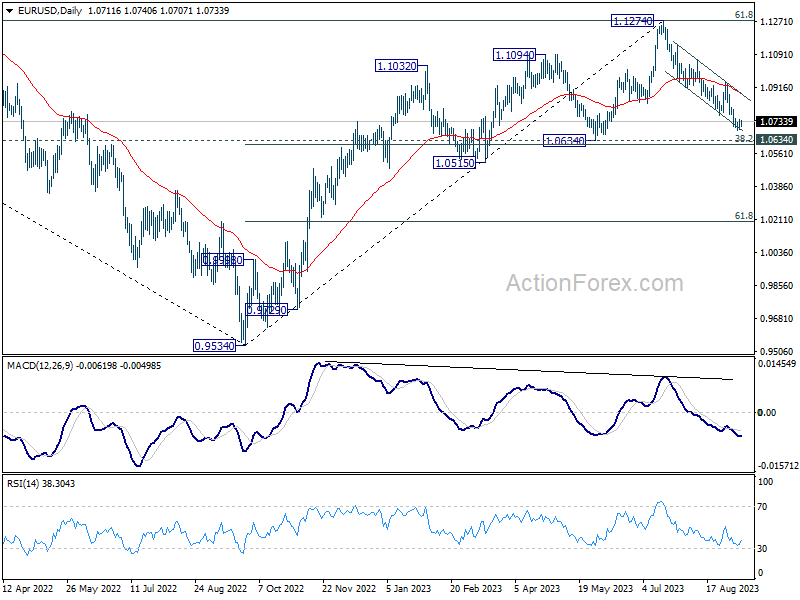
EUR/USD is extending the consolidation from 1.0685 and intraday bias stays neutral. Outlook will stay bearish as long as 1.0944 resistance holds. On the downside, below 1.0685 will resume the fall from 1.1274 to 1.0609/34 cluster support zone next.
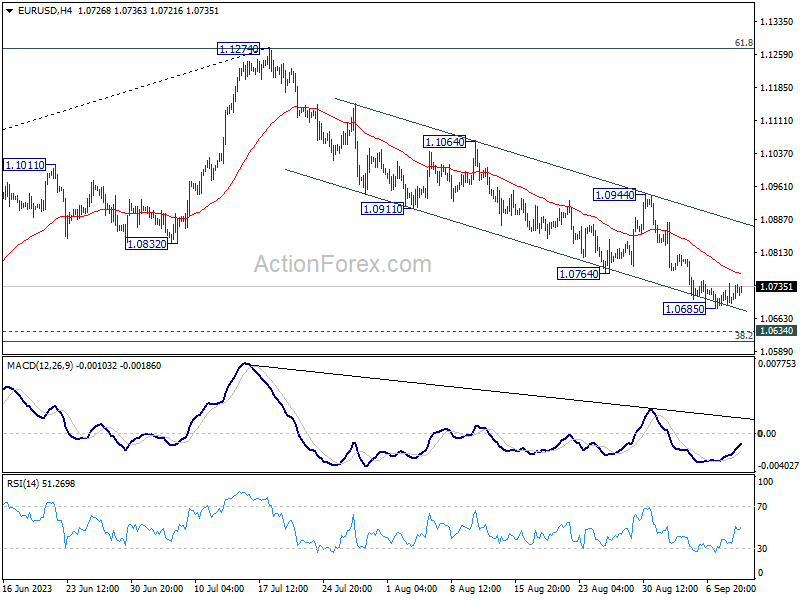
In the bigger picture, fall from 1.1274 medium term top is seen as a correction to up trend from 0.9534 (2022 low). Strong support could be seen from 1.0634 cluster support (38.2% retracement of 0.9534 to 1.1274 at 1.0609) to bring rebound, at least on first attempt. Break of 1.0944 will indicate the start of the second leg, and target retest of 1.1274. However, sustained break of 1.0609/0634 will raise the chance of bearish trend reversal, and target 61.8% retracement at 1.0199.
GBP/USD Mid-Day Outlook
Daily Pivots: (S1) 1.2441; (P) 1.2478; (R1) 1.2504; More...
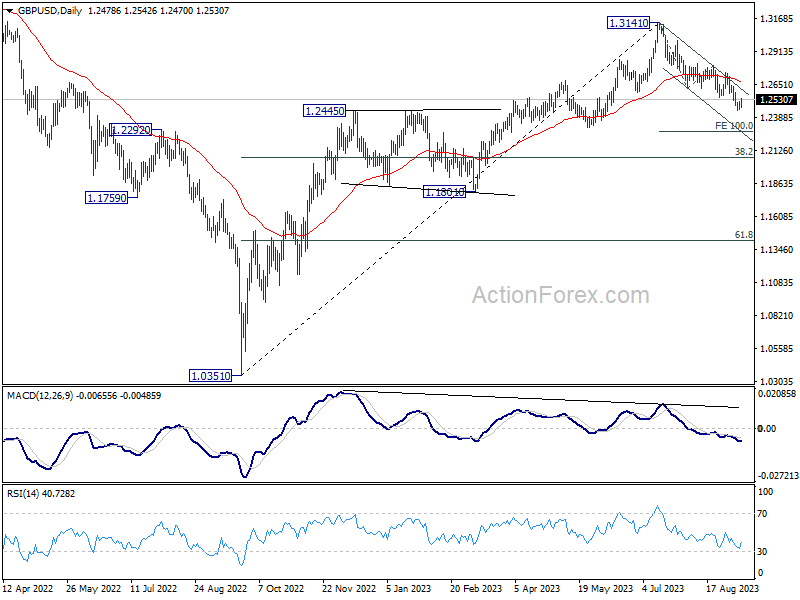
GBP/USD is extending the consolidation from 1.2443 and intraday bias remains neutral. Upside of recovery should be limited by 1.2618 support turned resistance to bring another fall. Break of 1.2443 will resume the decline from 1.3141 and target 100% projection of 1.3141 to 1.2618 from 1.2799 at 1.2276.
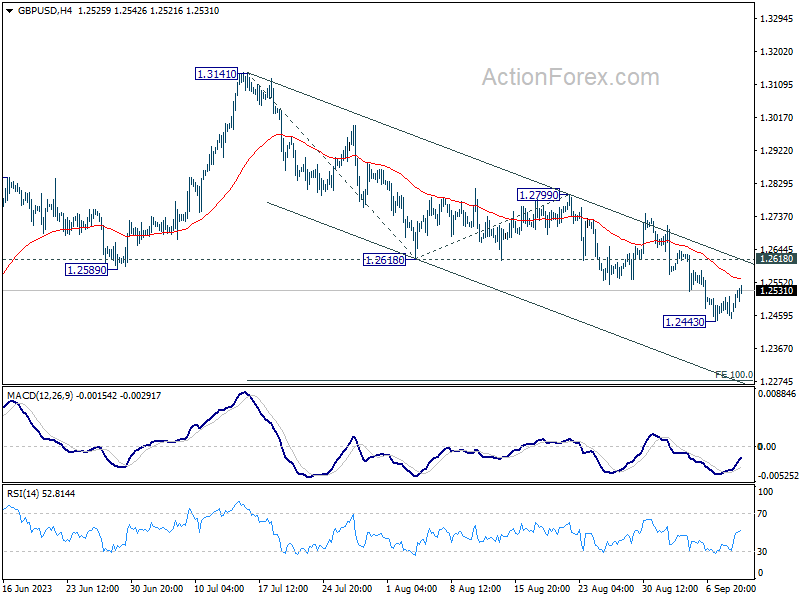
In the bigger picture, fall from 1.3141 medium term top is seen as a correction to up trend from 1.0351 (2022 low). Deeper decline would be seen to 38.2% retracement of 1.0351 to 1.3141 at 1.2075. Strong support would be seen there to bring rebound on first attempt. But outlook will be neutral at best as long as 1.3141 resistance holds, and consolidation from there is set to extend, until further development.
USD/CHF Mid-Day Outlook
Daily Pivots: (S1) 0.8904; (P) 0.8921; (R1) 0.8946; More....
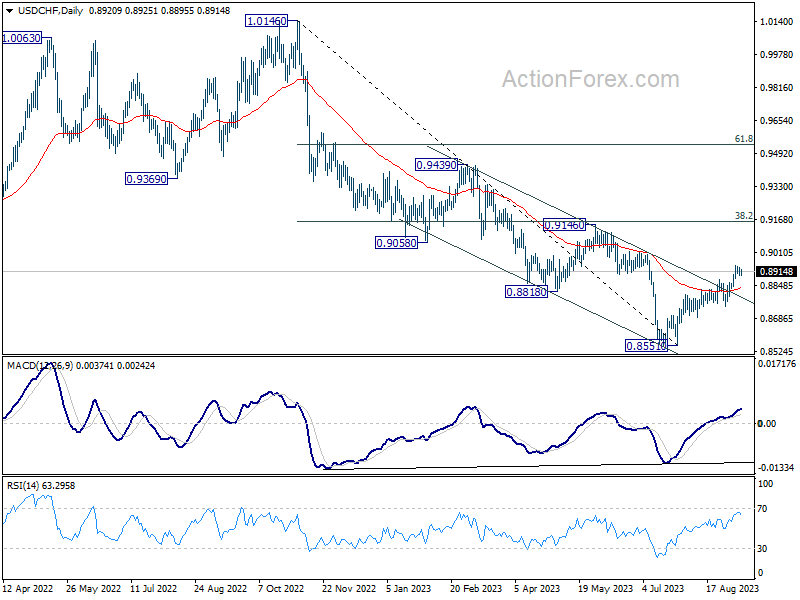
USD/CHF is staying in consolidation from 0.8943 and intraday bias remains neutral. While deeper pull back cannot be ruled out, downside should be contained above 0.8743 support to bring another rally. Break of 0.8943 will extend the rise from 0.8551 to 0.9146 cluster resistance.
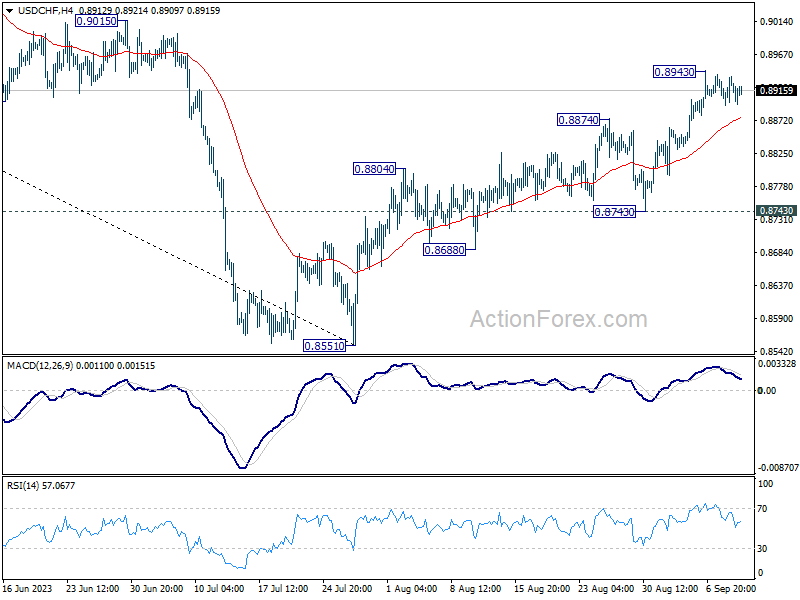
In the bigger picture, rebound from 0.8551 medium term bottom is currently seen as a correction to the downtrend from 1.0146 (2022 high). Further rally would be seen to 0.9146 cluster resistance (38.2% retracement of 1.0146 to 0.8551 at 0.9160). Strong resistance could be seen there to limit upside, at least on first attempt.
USD/JPY Mid-Day Outlook
Daily Pivots: (S1) 146.93; (P) 147.40; (R1) 147.76; More...
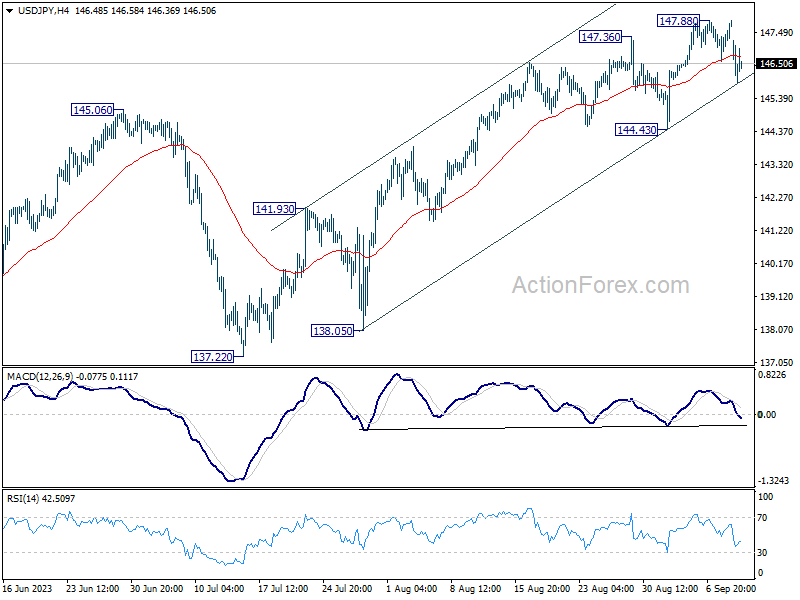
USD/JPY recovered after dipping to 145.88 today, drawing support from near term rising channel. Intraday bias remains neutral for the moment as consolidation form 147.88 could extend. But outlook remains bullish with 144.43 support intact. On the upside, above 147.88 will resume larger rise from 127.20, to retest 151.93 high.
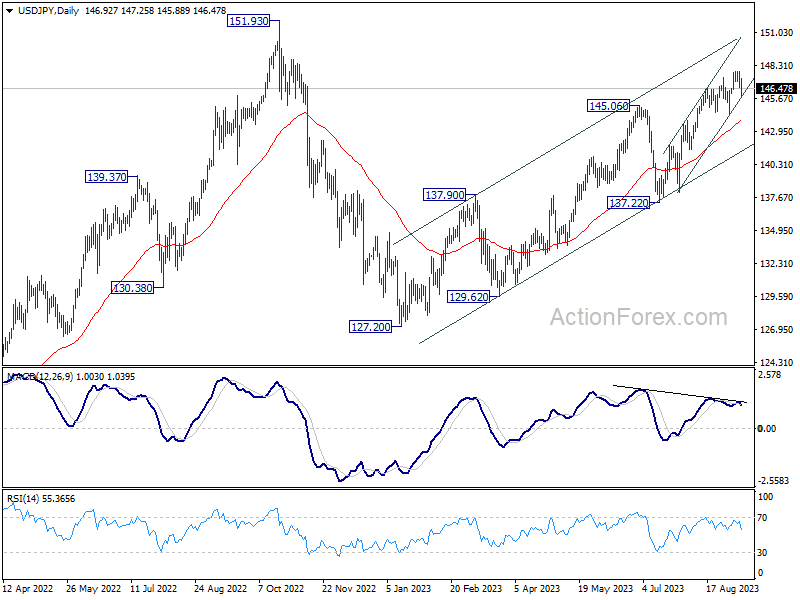
In the bigger picture, while rise from 127.20 is strong, it could still be seen as the second leg of the corrective pattern from 151.93 (2022 high). Rejection by 151.93, followed by break of 137.22 support will indicate that the third leg of the pattern has started. However, sustained break of 151.93 will confirm resumption of long term up trend.
Euro Softens Slightly on Growth Downgrade, Yen Rally Short-Lived
Trading in the European session has been relatively muted, with the primary contributor to the quietness being a notably thin economic calendar. Euro experienced a mild dip following European Commission's downgrade of growth projections for Eurozone for the current year and next. While Euro displayed pronounced weakness against commodity-linked currencies, its descent was restricted against other major peers. As market participants await ECB's interest rate announcement set for this Thursday, it seems that Euro traders are preserving their substantial positions for the time being.
Early trading saw Yen surged, primarily fueled by remarks from BoJ Governor Kazuo Ueda, stirring market chatter about a potential departure from negative interest rates by early next year. However, Yen's ascent was short-lived, with the currency giving up most of its gains by the onset of US session. Presently, the Yen ranks as the day's second-best performer, sitting behind Australian Dollar and just ahead of New Zealand Dollar.
In contrast, US Dollar has been the day's laggard, giving up some ground following its gains from the past week. Swiss Franc and Euro trail close behind in underperformance. Meanwhile, Sterling and Canadian Dollar are showing mixed performance.
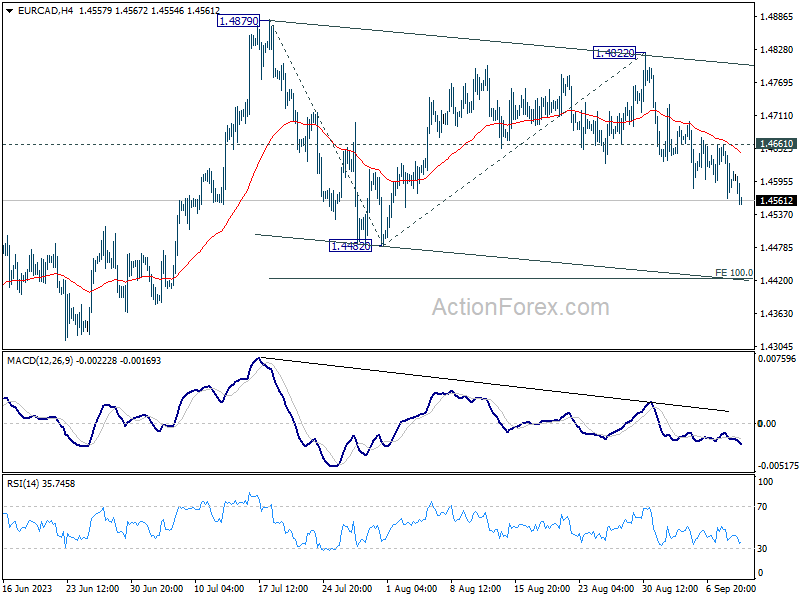
From technical perspective, EUR/CAD's bearish run from 1.4822 continues, marking a decline to 1.4554 today so far. As long as 1.4661 resistance remains intact, further downside is anticipated. The ongoing fall from 1.4822 is perceived as the third leg of the corrective pattern from 1.4879. The forthcoming targets are set at 1.4482 support, and then 100% projection of 1.4879 to 1.4482 from 1.4822 at 1.4425.
In Europe, at the time of writing, FTSE is up 0.06%. DAX is up 0.48%. CAC is up 0.59%. Germany 10-year yield is up 0.0316 at 2.644. Earlier in Asia, Nikkei dropped -0.43%. Hong Kong HSI dropped -0.58%. China Shanghai SSE rose 0.84%. Singapore Strait Times rose 0.33%. Japan 10-year JGB yield is up 0.0546 at 0.705.
EU downgrades Eurozone growth forecasts, Germany in contraction this year
European Commission, in its Summer 2023 interim forecast, revised down its growth projections for Eurozone. For 2023, growth outlook was cut from 1.1% to 0.8%, while 2024 projection was trimmed from 1.6% to 1.3%. On the inflation front, expectations for 2023 was adjusted downward from 5.8% to 5.6%, yet 2024 forecast saw a minor uptick from 2.8% to 2.9%.
Delving into individual nations, Germany's economic forecast has been dampened significantly. Growth projection for 2023 is now set at a contraction of -0.4%, a stark difference from prior 0.2% growth prediction. 2024 projection has been revised down from 1.4% to 1.1%.
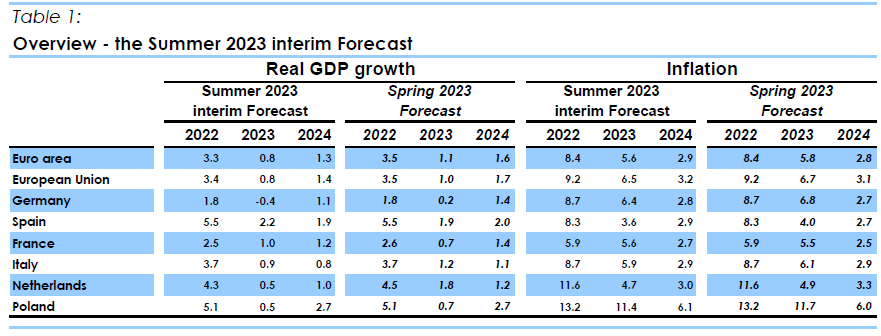
On the contrary, France has seen a boost in its 2023 growth projection, raised from 0.7% to 1.0%. However, its 2024 growth forecast was trimmed slightly, from 1.4% to 1.2%.
Valdis Dombrovskis, Executive Vice-President for an Economy that Works for People,said: "The persistently high inflation rate has exacted a heavy cost, although signs of its abating are visible. Following a spell of economic slack, we anticipate a modest rebound in growth in the coming year. This optimism is driven by a resilient labor market, historical lows in unemployment, and diminishing price pressures. Nonetheless, the economic trajectory remains uncertain, necessitating vigilant risk monitoring."
Echoing these sentiments, Paolo Gentiloni, Commissioner for Economy, stated, "Our economies have been battling numerous challenges this year, culminating in softer growth than our spring projections had indicated. While inflationary pressures are waning, the rate varies across the EU. Furthermore, Russia's aggressive actions against Ukraine persist, leading not just to human distress but also significant economic upheaval."
10-year JGB yield hits 9-year high on BoJ Ueda, Yen rebounds
Yen saw a notable uptick in Asian session, buoyed by hawkish sentiments by BoJ Governor Kazuo Ueda. Concurrently, 10-year JGB yield scaled its highest level in nine years, breaking 0.7% mark.
In an interview with Yomiuri newspaper published over the weekend, Ueda hinted at the possibility that BoJ might have sufficient data by the close of the year to contemplate ending its negative interest rate policy. Such remarks from Ueda have spurred speculation among market analysts, with some interpreting them as early signals for the markets, suggesting a potential end to negative interest rates by Q1 2024. Before this step, there also are anticipations of yield curve control being phased out later this year.
On the flip side, certain analysts, referencing recent data which highlights decelerating wage growth, argue that the transition from negative rates might not be imminent. They believe Ueda's remarks might be more of a countermeasure to Yen's recent depreciation.
Ueda, during the interview, emphasized the need for Japan to witness a consistent rise in inflation, complemented by wage growth, before implementing changes. "If we judge that Japan can achieve its inflation target even after ending negative rates, we'll do so," Ueda asserted. However, he also reiterated the central bank's stance on maintaining its ultra-loose policy for now, until there's firm confidence that inflation will consistently hover around the 2% mark, bolstered by robust demand and wage growth.
He cautioned, "While Japan is showing budding positive signs, achievement of our target isn't in sight yet." Looking ahead, Ueda underscored the importance of wage trajectories in the coming year, indicating that conclusive decisions would be data-driven. "We can't rule out the possibility we'll get enough information and data by year-end," Ueda added.
USD/JPY Mid-Day Outlook
Daily Pivots: (S1) 146.93; (P) 147.40; (R1) 147.76; More...
USD/JPY recovered after dipping to 145.88 today, drawing support from near term rising channel. Intraday bias remains neutral for the moment as consolidation form 147.88 could extend. But outlook remains bullish with 144.43 support intact. On the upside, above 147.88 will resume larger rise from 127.20, to retest 151.93 high.
In the bigger picture, while rise from 127.20 is strong, it could still be seen as the second leg of the corrective pattern from 151.93 (2022 high). Rejection by 151.93, followed by break of 137.22 support will indicate that the third leg of the pattern has started. However, sustained break of 151.93 will confirm resumption of long term up trend.
Economic Indicators Update
| GMT | Ccy | Events | Actual | Forecast | Previous | Revised |
|---|---|---|---|---|---|---|
| 23:50 | JPY | Money Supply M2+CD Y/Y Jul | 2.50% | 2.50% | 2.40% | 2.50% |
| 06:00 | JPY | Machine Tool Orders Y/Y Aug P | -17.60% | -19.80% | -19.70% | |
| 08:00 | EUR | Italy Industrial Output M/M Jul | -0.70% | -0.30% | 0.50% |
US 500 Index Challenges 50-day SMA
- US 500 index rebounds from its September low
- Bulls attack the 50-day SMA
- Momentum indicators point to short-term gains
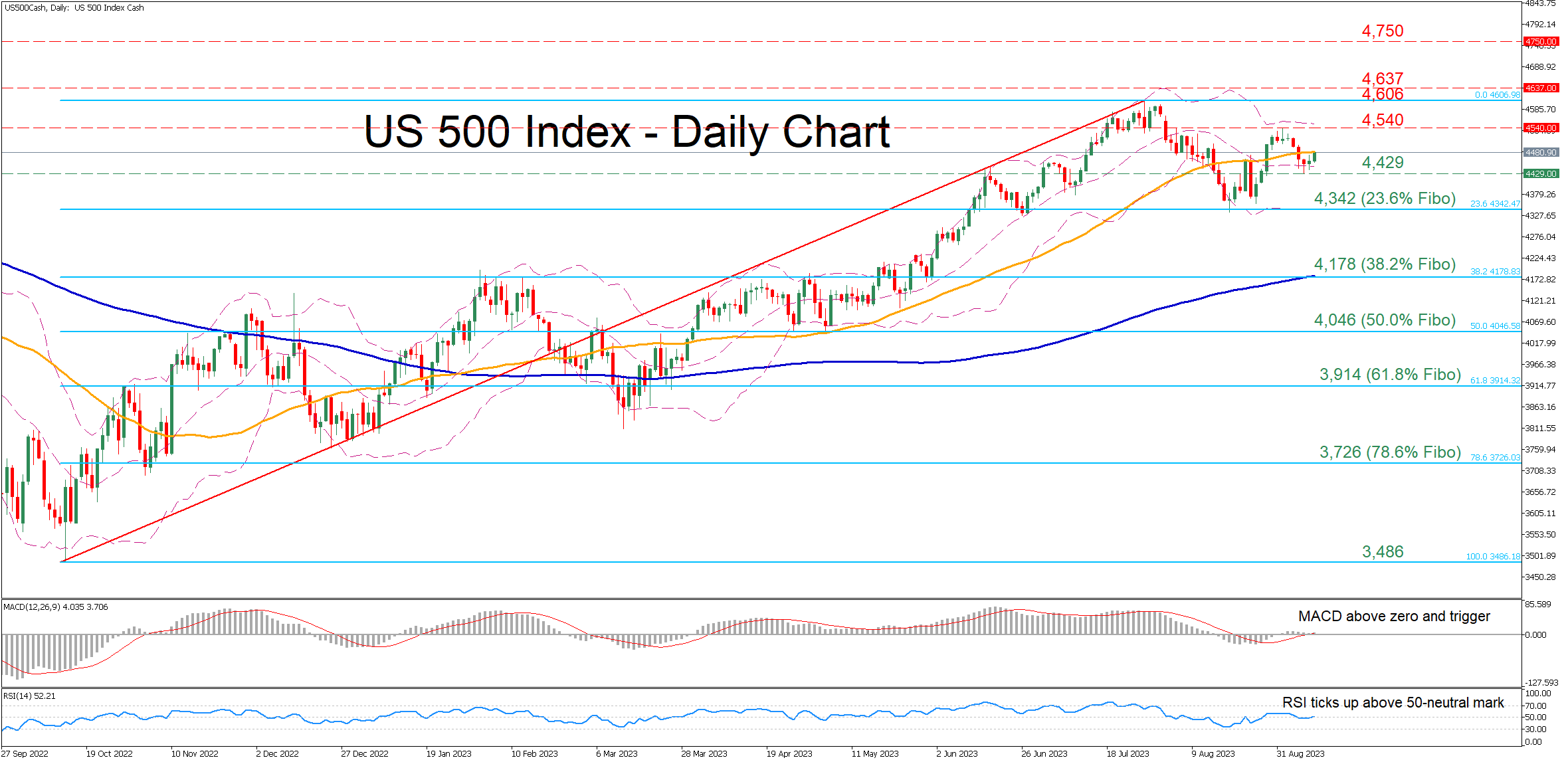
The US 500 stock index (cash) is currently testing the 50-day simple moving average (SMA), with short-term oscillators endorsing this latest advance. The MACD jumped above its red signal line in the positive zone, while the RSI is hovering above the 50-neutral threshold.
If buyers propel the price above the 50-day SMA, initial resistance could be found at the recent rejection region of 4,540. Surpassing that zone, the index might ascend towards the 16-month peak of 4,606. A break above that territory could open the door for the March 2022 high of 4,637.
Alternatively, should the bears regain the upper hand, the recent support of 4,429 may act as the first line of defence. Sliding beneath that floor, the price could challenge 4,342, which is the 23.6% Fibonacci retracement of the 3,486-4,606 upleg. If that barricade fails, attention might shift to the 38.2% Fibo of 4,178, which coincides with the 200-day SMA.
Overall, the US 500 index has regained traction, but bulls should not get excited before they conquer the 50-day SMA.