

Sample Category Title
Weekly Economic & Financial Commentary: Cracks Starting to Emerge?
Summary
United States: Cracks Starting to Emerge?
- After a strong run last week, this week’s barrage of economic data brought expectations back down to Earth. Durable goods orders seem to be stagnating as high mortgage rates keep the housing market under pressure. Meanwhile, preliminary benchmark revisions from BLS reveal that the labor market is not as scorching as previously thought.
- Next week: Personal Income & Spending (Thu.), Employment (Fri.), ISM Manufacturing (Fri.)
International: European Economic Prospects Getting Dimmer
- This week's PMI surveys from Europe pointed to the growth challenges facing Europe's key economies and highlighted the risk of a renewed stumble across the Eurozone. Of particular note, the August service sector PMIs returned to contractionary territory as the Eurozone services PMI fell to 48.3, and the U.K. services PMI fell to 48.7.
- Next week: China PMIs (Thu.), Eurozone CPI (Thu.), Canada GDP (Fri.)
Topic of the Week: What Would a "Hard Landing" in China Portend for Other Major Economies?
- Some observers worry that the debt build-up in China's property sector may lead to an economic "hard landing" in the world's second-largest economy. We analyze what effects a significant economic slowdown/downturn in China may have on the U.S., Eurozone and Japanese economies.
The Weekly Bottom Line: Fed Chair Powell Sticks to Tough Talk
U.S. Highlights
- Speaking at the Jackson Hole Economic Symposium on Friday, Chair Powell noted that some progress had been made on the inflation front, but that inflation was still “too high”. He noted that the Fed would proceed carefully in either tightening the policy rate further or holding it constant as it watches the data.
- Existing home sales were one piece of data reacting strongly to higher rates, falling further in July. Inventories remained lean, at 42% below pre-pandemic levels.
- Lack of supply in the existing market continues to push buyers to the new market, with sales there up strongly in July.
Canadian Highlights
- Consumer activity was soft in June, with retail sales posting a very mild gain. Actual Q2 consumer spending is released with GDP data next week, and the retail data is pointing to a subdued 1% annualized gain in overall spending.
- July’s flash estimate flagged stronger retail spending growth last month, in line with our internal debit and credit card data. However, temporary government income supports were likely behind these healthy prints, and spending growth is set to fade.
- In a bid to help housing affordability, the federal government may be looking at capping international students. This restricting of population inflows would weigh on consumption.
U.S. – Fed Chair Powell Sticks to Tough Talk
In a relatively quiet economic data week, markets took their cue from Chair Powell’s Jackson Hole Economic Symposium speech. The annual speech is always a highly anticipated event, but this year’s was particularly important with the Fed being at a monetary policy pivot point. The speech struck a balance between acknowledging that some progress had been made on inflation, but that it remained “too high” with substantial ground to cover to get back to price stability. Equity and bond markets didn’t like this reminder and were down on Friday (at time of writing).
The Chair noted the FOMC was prepared to “raise rates further if appropriate”, and that it intended to hold policy at a restrictive level until confident that inflation was moving sustainably down toward its objective. However, given that they are navigating in a cloudy environment, they would proceed “carefully”. What appeared to be off the table was any indication of potentially lowering rates, thus giving the speech a more hawkish tilt in our view. We believe that the continuation of this tough talk is necessary to prevent an undesirable give back in bond yields and, ultimately, to help keep inflationary expectations in check as it continues to monitor the data closely.
Powell provided a little more detail into the factors that will go into policymaking by breaking down inflation into three key categories. This included core goods inflation, along with housing and non-housing services. He noted progress on all three. On non-housing services – a category also known as “supercore”, which accounts for over half of the core PCE index – annual inflation has moved mostly sideways, but encouragingly it has started to decline on a three and six-month basis. Meanwhile, housing services inflation is expected to continue to ease given well-known lags, but they will be watching market rent data closely.
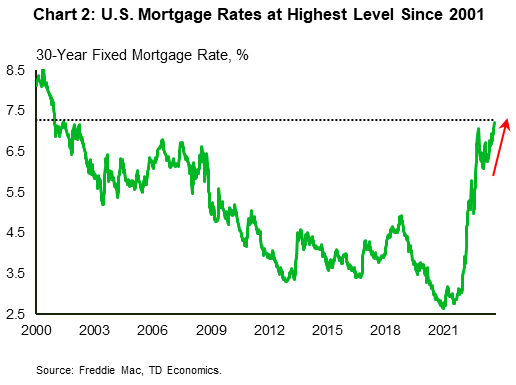
Speaking of housing, existing home sales continued to head lower in July. With mortgage rates some 40 basis points higher than in the two months prior it is no wonder that activity pulled back. The elevated rate environment also poses a hurdle on the supply side, as existing homeowners with much lower mortgage rates are reluctant to move and take on a higher rate. This theme is evident in inventories, which were 42% lower than pre-pandemic July levels (July 2019).
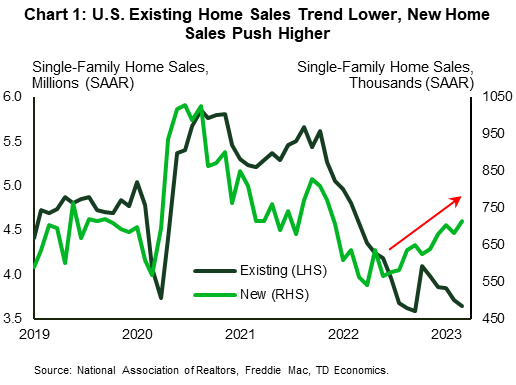
The tightness in resale market has kept a floor on home prices, while also pushing more would-be buyers to the “new” home market. New single-family home sales continue to buck the broader negative trend, making additional gains in July (Chart 1). This has been much to the delight of homebuilders, who have looked to boost supply in the single-family sector. While this trend may have some more room to run, mortgage rates have pushed even higher recently and are now hovering in the 7.2-7.5% range (Chart 2). This could test the strength of the positive single-family homebuilding trend sooner than anticipated, as evidenced by the recent pullback in homebuilder confidence and some flattening in single-family housing permits. Ultimately, it all ties back to interest rates, which, given the Fed’s continued tough talk, appear set to remain higher for longer.
Canada – Cooler Spending On Tap
It was a choppy week for bonds, with Canadian yields diving lower on Wednesday amid weak global PMI data before recovering some lost ground to end the week. As of writing, the benchmark Canadian 10-year yield was on track to end the week modestly lower than where it began. Oil prices are seemingly headed for their second weekly decline on Chinese growth concerns, reports of healthy supply coming out of Iran and the possibility that U.S. sanctions might be lifted on the Venezuelan oil sector.
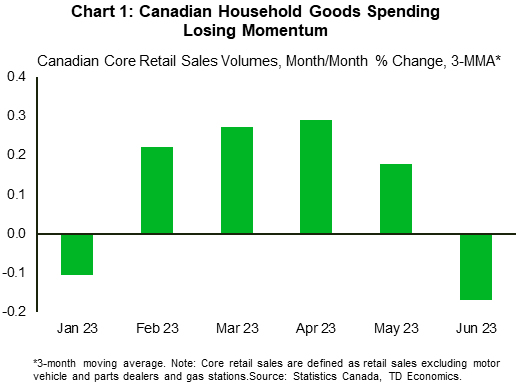
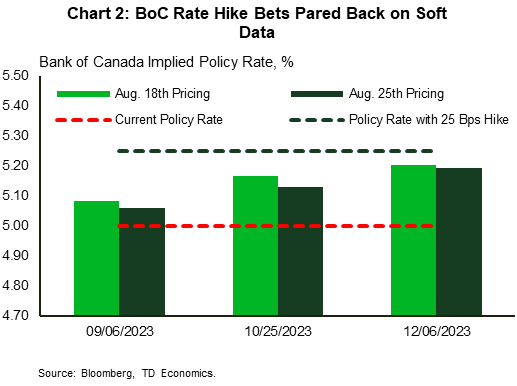
This soft tone extended to the June retail sales data, which inched only marginally higher by 0.1% month-on-month (m/m). On the one hand, it slightly beat Statistics Canada's advance estimate. On the other, core sales (which strip out autos and gas stations), plunged nearly 1% m/m (Chart 1), and volumes were slightly lower. This cooler consumer momentum contributed to traders paring back their expectations for BoC hikes (Chart 2).
One silver lining from the retail report was that nominal spending may have increased 0.4% m/m in July according to Statcan's preliminary estimate. Taken together with healthy flash estimates for manufacturing and wholesale activity in July and growth in hours worked reported in the Labour Force Survey, it appears that overall economic growth was positive last month.
The retail report also squares with our internal data showing a solid monthly gain in debit and credit card spending in July. But there are good reasons to fade this positive news. Recall that last month, the federal government paid out the $2.5 billion Grocery Rebate and one payment of the enhanced Canada Workers Benefit. Assuming no additional step-up in government supports, this temporary boost to household incomes will dissipate and with it, momentum in consumer spending. Accordingly, after a hefty third quarter, we expect a slowdown in household spending thereafter.
The federal government may soon be doing their part to soften consumer spending by limiting population flows. Cabinet ministers met this week to discuss Canada's housing affordability crisis and one of the solutions floated was a cap on international students. Capping international student inflows is likely an easier lever to pull to address rental affordability than ramping up new home construction quickly. However, the idea was met with some resistance. At least one province – Quebec – has been unreceptive, vowing to reject the federal government's idea. Provinces would likely be on the hook for some of the tuition shortfall for post-secondary schools.
Summary 8/28 – 9/1
Monday, Aug 28, 2023
| GMT | Ccy | Events | Consensus | Previous |
|---|---|---|---|---|
| 01:30 | AUD | Retail Sales M/M Jul | 0.30% | -0.80% |
| 08:00 | EUR | Eurozone M3 Money Supply Y/Y Jul | 0.00% | 0.60% |
| 23:30 | JPY | Unemployment Rate Jul | 2.50% | 2.50% |
| GMT | Ccy | Events | |
|---|---|---|---|
| 01:30 | AUD | Retail Sales M/M Jul | |
| Forecast: 0.30% | Previous: -0.80% | ||
| 08:00 | EUR | Eurozone M3 Money Supply Y/Y Jul | |
| Forecast: 0.00% | Previous: 0.60% | ||
| 23:30 | JPY | Unemployment Rate Jul | |
| Forecast: 2.50% | Previous: 2.50% | ||
Tuesday, Aug 29, 2023
| GMT | Ccy | Events | Consensus | Previous |
|---|---|---|---|---|
| 06:00 | EUR | Germany Gfk Consumer Sentiment Sep | -24.3 | -24.4 |
| 13:00 | USD | S&P/Case-Shiller Home Price Indices Y/Y Jun | -1.50% | -1.70% |
| 13:00 | USD | Housing Price Index M/M Jun | 0.20% | 0.70% |
| 14:00 | USD | Consumer Confidence Aug | 116.5 | 117 |
| 22:45 | NZD | Building Permits M/M Jul | 3.50% |
| GMT | Ccy | Events | |
|---|---|---|---|
| 06:00 | EUR | Germany Gfk Consumer Sentiment Sep | |
| Forecast: -24.3 | Previous: -24.4 | ||
| 13:00 | USD | S&P/Case-Shiller Home Price Indices Y/Y Jun | |
| Forecast: -1.50% | Previous: -1.70% | ||
| 13:00 | USD | Housing Price Index M/M Jun | |
| Forecast: 0.20% | Previous: 0.70% | ||
| 14:00 | USD | Consumer Confidence Aug | |
| Forecast: 116.5 | Previous: 117 | ||
| 22:45 | NZD | Building Permits M/M Jul | |
| Forecast: | Previous: 3.50% | ||
Wednesday, Aug 30, 2023
| GMT | Ccy | Events | Consensus | Previous |
|---|---|---|---|---|
| 01:30 | AUD | Monthly CPI Y/Y Jul | 5.20% | 5.40% |
| 01:30 | AUD | Building Permits M/M Jul | -0.50% | -7.70% |
| 05:00 | JPY | Consumer Confidence Index Aug | 37.5 | 37.1 |
| 06:00 | EUR | Germany Import Price Index M/M Jul | -0.20% | -1.60% |
| 07:00 | CHF | KOF Economic Barometer Aug | 91.3 | 92.2 |
| 08:00 | CHF | Credit Suisse Economic Expectations Aug | -32.6 | |
| 08:30 | GBP | Mortgage Approvals Jul | 52K | 55K |
| 08:30 | GBP | M4 Money Supply M/M Jul | 0.10% | -0.10% |
| 09:00 | EUR | Eurozone Economic Sentiment Indicator Aug | 93.9 | 94.5 |
| 09:00 | EUR | Eurozone Services Sentiment Aug | 4.2 | 5.7 |
| 09:00 | EUR | Eurozone Industrial Confidence Aug | -9.8 | -9.4 |
| 09:00 | EUR | Eurozone Consumer Confidence Aug F | -16 | -16 |
| 12:00 | EUR | Germany CPI M/M Aug P | 0.30% | 0.30% |
| 12:00 | EUR | Germany CPI Y/Y Aug P | 6.00% | 6.20% |
| 12:15 | USD | ADP Employment Change Aug | 205K | 324K |
| 12:30 | USD | GDP Annualized Q2 P | 2.40% | 2.40% |
| 12:30 | USD | GDP Price Index Q2 P | 2.20% | 2.20% |
| 12:30 | USD | Goods Trade Balance (USD) Jul P | -90.0B | -87.8B |
| 12:30 | USD | Wholesale Inventories Jul P | 0.20% | -0.50% |
| 14:00 | USD | Pending Home Sales M/M Jul | -0.40% | 0.30% |
| 14:30 | USD | Crude Oil Inventories | -6.1M | |
| 23:50 | JPY | Industrial Production M/M Jul P | -1.40% | 2.40% |
| 23:50 | JPY | Retail Trade Y/Y Jul | 5.40% | 5.90% |
| GMT | Ccy | Events | |
|---|---|---|---|
| 01:30 | AUD | Monthly CPI Y/Y Jul | |
| Forecast: 5.20% | Previous: 5.40% | ||
| 01:30 | AUD | Building Permits M/M Jul | |
| Forecast: -0.50% | Previous: -7.70% | ||
| 05:00 | JPY | Consumer Confidence Index Aug | |
| Forecast: 37.5 | Previous: 37.1 | ||
| 06:00 | EUR | Germany Import Price Index M/M Jul | |
| Forecast: -0.20% | Previous: -1.60% | ||
| 07:00 | CHF | KOF Economic Barometer Aug | |
| Forecast: 91.3 | Previous: 92.2 | ||
| 08:00 | CHF | Credit Suisse Economic Expectations Aug | |
| Forecast: | Previous: -32.6 | ||
| 08:30 | GBP | Mortgage Approvals Jul | |
| Forecast: 52K | Previous: 55K | ||
| 08:30 | GBP | M4 Money Supply M/M Jul | |
| Forecast: 0.10% | Previous: -0.10% | ||
| 09:00 | EUR | Eurozone Economic Sentiment Indicator Aug | |
| Forecast: 93.9 | Previous: 94.5 | ||
| 09:00 | EUR | Eurozone Services Sentiment Aug | |
| Forecast: 4.2 | Previous: 5.7 | ||
| 09:00 | EUR | Eurozone Industrial Confidence Aug | |
| Forecast: -9.8 | Previous: -9.4 | ||
| 09:00 | EUR | Eurozone Consumer Confidence Aug F | |
| Forecast: -16 | Previous: -16 | ||
| 12:00 | EUR | Germany CPI M/M Aug P | |
| Forecast: 0.30% | Previous: 0.30% | ||
| 12:00 | EUR | Germany CPI Y/Y Aug P | |
| Forecast: 6.00% | Previous: 6.20% | ||
| 12:15 | USD | ADP Employment Change Aug | |
| Forecast: 205K | Previous: 324K | ||
| 12:30 | USD | GDP Annualized Q2 P | |
| Forecast: 2.40% | Previous: 2.40% | ||
| 12:30 | USD | GDP Price Index Q2 P | |
| Forecast: 2.20% | Previous: 2.20% | ||
| 12:30 | USD | Goods Trade Balance (USD) Jul P | |
| Forecast: -90.0B | Previous: -87.8B | ||
| 12:30 | USD | Wholesale Inventories Jul P | |
| Forecast: 0.20% | Previous: -0.50% | ||
| 14:00 | USD | Pending Home Sales M/M Jul | |
| Forecast: -0.40% | Previous: 0.30% | ||
| 14:30 | USD | Crude Oil Inventories | |
| Forecast: | Previous: -6.1M | ||
| 23:50 | JPY | Industrial Production M/M Jul P | |
| Forecast: -1.40% | Previous: 2.40% | ||
| 23:50 | JPY | Retail Trade Y/Y Jul | |
| Forecast: 5.40% | Previous: 5.90% | ||
Thursday, Aug 31, 2023
| GMT | Ccy | Events | Consensus | Previous |
|---|---|---|---|---|
| 01:00 | CNY | NBS Manufacturing PMI Aug | 49.5 | 49.3 |
| 01:00 | CNY | Non-Manufacturing PMI Aug | 51.1 | 51.5 |
| 01:00 | NZD | ANZ Business Confidence Aug | -13.1 | |
| 01:30 | AUD | Private Capital Expenditure Q2 | 1.10% | 2.40% |
| 05:00 | JPY | Housing Starts Y/Y Jul | -0.80% | -4.80% |
| 05:00 | JPY | Construction Orders Y/Y Jul | -1.30% | 8.60% |
| 06:00 | EUR | Germany Retail Sales M/M Jul | 0.30% | -0.80% |
| 06:45 | EUR | France Consumer Spending M/M Jul | 0.30% | 0.90% |
| 06:45 | EUR | France GDP Q/Q Q2 | 0.50% | 0.50% |
| 07:55 | EUR | Germany Unemployment Change Jul | 10K | -4K |
| 07:55 | EUR | Germany Unemployment Rate Jul | 5.60% | 5.60% |
| 08:00 | EUR | Italy Unemployment Jul | 7.40% | 7.40% |
| 09:00 | EUR | Eurozone Unemployment Rate Jul | 6.40% | 6.40% |
| 09:00 | EUR | Eurozone CPI Y/Y Aug P | 5.10% | 5.30% |
| 09:00 | EUR | Eurozone CPI Core Y/Y Aug P | 5.30% | 5.50% |
| 11:30 | EUR | ECB Monetary Policy Meeting Accounts | ||
| 12:30 | CAD | Current Account (CAD) Q2 | -6.2B | |
| 12:30 | USD | Initial Jobless Claims (Aug 25) | 227K | 230K |
| 12:30 | USD | Personal Income M/M Jul | 0.30% | 0.30% |
| 12:30 | USD | Personal Spending Jul | 0.70% | 0.50% |
| 12:30 | USD | PCE Price Index M/M Jul | 0.20% | 0.20% |
| 12:30 | USD | PCE Price Index Y/Y Jul | 3.30% | 3.00% |
| 12:30 | USD | Core PCE Price Index M/M Jul | 0.20% | 0.20% |
| 12:30 | USD | Core PCE Price Index Y/Y Jul | 4.20% | 4.10% |
| 13:45 | USD | Chicago PMI Aug | 44.1 | 42.8 |
| 14:30 | USD | Natural Gas Storage | 18B | |
| 23:50 | JPY | Capital Spending Q2 | 7.90% | 11.00% |
| GMT | Ccy | Events | |
|---|---|---|---|
| 01:00 | CNY | NBS Manufacturing PMI Aug | |
| Forecast: 49.5 | Previous: 49.3 | ||
| 01:00 | CNY | Non-Manufacturing PMI Aug | |
| Forecast: 51.1 | Previous: 51.5 | ||
| 01:00 | NZD | ANZ Business Confidence Aug | |
| Forecast: | Previous: -13.1 | ||
| 01:30 | AUD | Private Capital Expenditure Q2 | |
| Forecast: 1.10% | Previous: 2.40% | ||
| 05:00 | JPY | Housing Starts Y/Y Jul | |
| Forecast: -0.80% | Previous: -4.80% | ||
| 05:00 | JPY | Construction Orders Y/Y Jul | |
| Forecast: -1.30% | Previous: 8.60% | ||
| 06:00 | EUR | Germany Retail Sales M/M Jul | |
| Forecast: 0.30% | Previous: -0.80% | ||
| 06:45 | EUR | France Consumer Spending M/M Jul | |
| Forecast: 0.30% | Previous: 0.90% | ||
| 06:45 | EUR | France GDP Q/Q Q2 | |
| Forecast: 0.50% | Previous: 0.50% | ||
| 07:55 | EUR | Germany Unemployment Change Jul | |
| Forecast: 10K | Previous: -4K | ||
| 07:55 | EUR | Germany Unemployment Rate Jul | |
| Forecast: 5.60% | Previous: 5.60% | ||
| 08:00 | EUR | Italy Unemployment Jul | |
| Forecast: 7.40% | Previous: 7.40% | ||
| 09:00 | EUR | Eurozone Unemployment Rate Jul | |
| Forecast: 6.40% | Previous: 6.40% | ||
| 09:00 | EUR | Eurozone CPI Y/Y Aug P | |
| Forecast: 5.10% | Previous: 5.30% | ||
| 09:00 | EUR | Eurozone CPI Core Y/Y Aug P | |
| Forecast: 5.30% | Previous: 5.50% | ||
| 11:30 | EUR | ECB Monetary Policy Meeting Accounts | |
| Forecast: | Previous: | ||
| 12:30 | CAD | Current Account (CAD) Q2 | |
| Forecast: | Previous: -6.2B | ||
| 12:30 | USD | Initial Jobless Claims (Aug 25) | |
| Forecast: 227K | Previous: 230K | ||
| 12:30 | USD | Personal Income M/M Jul | |
| Forecast: 0.30% | Previous: 0.30% | ||
| 12:30 | USD | Personal Spending Jul | |
| Forecast: 0.70% | Previous: 0.50% | ||
| 12:30 | USD | PCE Price Index M/M Jul | |
| Forecast: 0.20% | Previous: 0.20% | ||
| 12:30 | USD | PCE Price Index Y/Y Jul | |
| Forecast: 3.30% | Previous: 3.00% | ||
| 12:30 | USD | Core PCE Price Index M/M Jul | |
| Forecast: 0.20% | Previous: 0.20% | ||
| 12:30 | USD | Core PCE Price Index Y/Y Jul | |
| Forecast: 4.20% | Previous: 4.10% | ||
| 13:45 | USD | Chicago PMI Aug | |
| Forecast: 44.1 | Previous: 42.8 | ||
| 14:30 | USD | Natural Gas Storage | |
| Forecast: | Previous: 18B | ||
| 23:50 | JPY | Capital Spending Q2 | |
| Forecast: 7.90% | Previous: 11.00% | ||
Friday, Sep 1, 2023
| GMT | Ccy | Events | Consensus | Previous |
|---|---|---|---|---|
| 00:30 | JPY | Manufacturing PMI Aug F | 49.7 | 49.7 |
| 01:45 | CNY | Caixin Manufacturing PMI Aug | 49.4 | 49.2 |
| 06:30 | CHF | CPI M/M Aug | -0.10% | |
| 06:30 | CHF | CPI Y/Y Aug | 1.60% | |
| 07:30 | CHF | PMI Manufacturing Aug | 41.5 | 38.5 |
| 07:45 | EUR | Italy Manufacturing PMI Aug | 45.9 | 44.5 |
| 07:50 | EUR | France Manufacturing PMI Aug F | 46.4 | 46.4 |
| 07:55 | EUR | Germany Manufacturing PMI Aug F | 39.1 | 39.1 |
| 08:00 | EUR | Eurozone Manufacturing PMI Aug F | 43.7 | 43.7 |
| 08:30 | GBP | Manufacturing PMI Aug F | 42.5 | 42.5 |
| 12:30 | CAD | GDP M/M Jun | 0.20% | 0.30% |
| 12:30 | USD | Nonfarm Payrolls Aug | 170K | 187K |
| 12:30 | USD | Unemployment Rate Aug | 3.50% | 3.50% |
| 12:30 | USD | Average Hourly Earnings M/M Aug | 0.30% | 0.40% |
| 13:30 | CAD | Manufacturing PMI Aug | 49.6 | |
| 13:45 | USD | Manufacturing PMI Aug F | 47.00 | 47.00 |
| 14:00 | USD | ISM Manufacturing PMI Aug | 46.6 | 46.4 |
| 14:00 | USD | ISM Manufacturing Prices Paid Aug | 42.9 | 42.6 |
| 14:00 | USD | ISM Manufacturing Employment Index Aug | 44.4 | |
| 14:00 | USD | Construction Spending M/M Jul | 0.50% | 0.50% |
| GMT | Ccy | Events | |
|---|---|---|---|
| 00:30 | JPY | Manufacturing PMI Aug F | |
| Forecast: 49.7 | Previous: 49.7 | ||
| 01:45 | CNY | Caixin Manufacturing PMI Aug | |
| Forecast: 49.4 | Previous: 49.2 | ||
| 06:30 | CHF | CPI M/M Aug | |
| Forecast: | Previous: -0.10% | ||
| 06:30 | CHF | CPI Y/Y Aug | |
| Forecast: | Previous: 1.60% | ||
| 07:30 | CHF | PMI Manufacturing Aug | |
| Forecast: 41.5 | Previous: 38.5 | ||
| 07:45 | EUR | Italy Manufacturing PMI Aug | |
| Forecast: 45.9 | Previous: 44.5 | ||
| 07:50 | EUR | France Manufacturing PMI Aug F | |
| Forecast: 46.4 | Previous: 46.4 | ||
| 07:55 | EUR | Germany Manufacturing PMI Aug F | |
| Forecast: 39.1 | Previous: 39.1 | ||
| 08:00 | EUR | Eurozone Manufacturing PMI Aug F | |
| Forecast: 43.7 | Previous: 43.7 | ||
| 08:30 | GBP | Manufacturing PMI Aug F | |
| Forecast: 42.5 | Previous: 42.5 | ||
| 12:30 | CAD | GDP M/M Jun | |
| Forecast: 0.20% | Previous: 0.30% | ||
| 12:30 | USD | Nonfarm Payrolls Aug | |
| Forecast: 170K | Previous: 187K | ||
| 12:30 | USD | Unemployment Rate Aug | |
| Forecast: 3.50% | Previous: 3.50% | ||
| 12:30 | USD | Average Hourly Earnings M/M Aug | |
| Forecast: 0.30% | Previous: 0.40% | ||
| 13:30 | CAD | Manufacturing PMI Aug | |
| Forecast: | Previous: 49.6 | ||
| 13:45 | USD | Manufacturing PMI Aug F | |
| Forecast: 47.00 | Previous: 47.00 | ||
| 14:00 | USD | ISM Manufacturing PMI Aug | |
| Forecast: 46.6 | Previous: 46.4 | ||
| 14:00 | USD | ISM Manufacturing Prices Paid Aug | |
| Forecast: 42.9 | Previous: 42.6 | ||
| 14:00 | USD | ISM Manufacturing Employment Index Aug | |
| Forecast: | Previous: 44.4 | ||
| 14:00 | USD | Construction Spending M/M Jul | |
| Forecast: 0.50% | Previous: 0.50% | ||
Week Ahead – Focus Shifts Back to Data after Jackson Hole, NFP the Highlight
US
Now that we heard from Fed Chair Powell at the Kansas City Fed’s Jackson Hole Symposium, the focus shifts back to the data. This week is filled with data that will outline how quickly the economy is weakening. Consumer data will show personal income growth is not keeping up with spending, while confidence holds steady. The Fed’s favorite inflation reading is also expected to show subdued growth is holding steady on a monthly basis. Friday’s NFP report will show private sector hiring is cooling.
Over the weekend, the spotlight will be on US-China relations. US Commerce Secretary Gina Raimondo will meet with Chinese officials, striving to lower tensions between the world’s two largest economies.
The week will also be filled with Fed speak. On Monday and Tuesday, Barr speaks about banking services. On Thursday, we hear from both Bostic and Collins, while Friday contains appearances by Bostic, a couple of hours before the NFP report, and Mester on inflation later in the morning.
Eurozone
Next week is data-heavy but there are a few releases that stand out. The most notable is the HICP flash estimate for the eurozone on Thursday which is expected to drop slightly at the headline and core levels. There will be individual country releases in the days running up to this which may signal whether Thursday’s data will likely beat or fall short of expectations. ECB accounts are also released on Thursday which will be of interest considering markets now view the rate decision at the next meeting as a coin toss between 25 basis points and no change.
UK
The week starts with a bank holiday and it doesn’t get much more exciting from there. There are a few tier-three data releases and Huw Pill from the Bank of England will make appearances on Thursday and Friday.
Russia
A selection of economic data is on offer next week including unemployment on Wednesday, GDP on Thursday, and the manufacturing PMI on Friday.
South Africa
No major events next week with PPI on Thursday the only notable release. It follows CPI data this past week which fell to 4.8%, well within the SARB 3-6% target range, following a much lower 0.9% monthly reading in July.
Turkey
The CBRT surprised markets last week by hiking rates far more aggressively than expected, taking the repo rate to 25%, up from 17.5%. The move may cost people at the central bank their jobs if history is anything to go by, with President Erdogan openly no fan of higher rates. That said, he did employ these people shortly after his election victory so perhaps with that behind him, he may be more open to it while remaining vocally against. This week offers very little, with GDP on Thursday the only release of note.
Switzerland
Inflation data on Friday is expected to show prices rising 1.5% on an annual basis, slightly lower than in July and well below the SNB 2% target. The central bank hasn’t appeared satisfied though and markets are fully pricing in a hike in September, with 32% chance of it being 50 basis points. The manufacturing PMI will also be released on Friday, with retail sales on Thursday, and the KoF economic barometer and economic expectations on Wednesday.
China
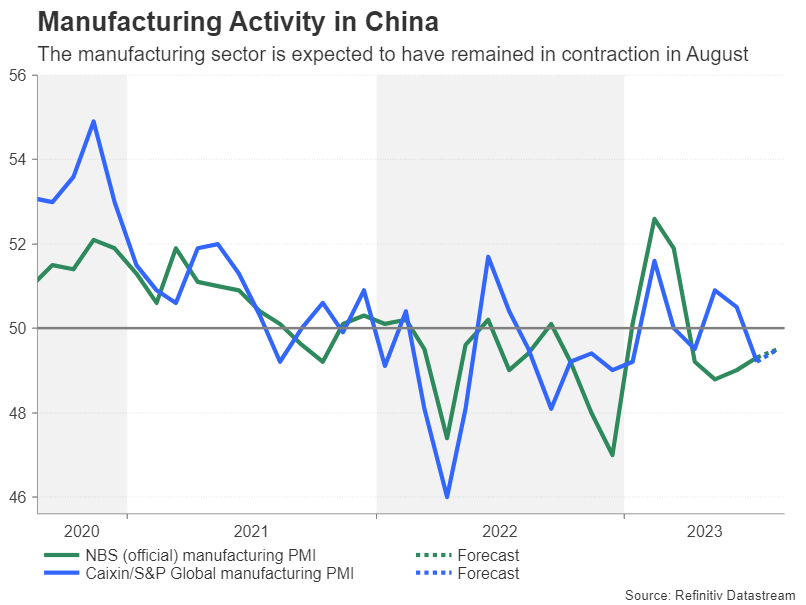
Only three key economic releases to monitor for the coming week. First up, the NBS manufacturing and services PMIs for August will be out on Thursday. Another contractionary print of 49.5 is expected for the manufacturing sector, almost unchanged from July’s reading of 49.5. If it turns out as expected, it will be the fifth consecutive month of negative growth for manufacturing activities as China grapples with a weak external environment and domestic financial contagion risk that has been triggered by debt-laden property developers.
Secondly, the NBS services PMI for August is forecasted to remain surprisingly resilient at 51, almost unchanged from 51.5 in July. The services sector is still in an expansionary mode albeit at a slower pace that is likely being supported by domestic tourism.
Thirdly, the private sector-focused Caixin manufacturing PMI for August which consists of small and medium enterprises will be released on Friday, 1 September. Consensus is still expecting a contractionary reading of 49.5, almost unchanged from July’s print of 49.2. If it turns out as expected, it will be the second consecutive month of negative growth.
A slew of key earnings releases to take note of starting this Saturday, 26 August will be China Merchants Bank, and Bank of Communications followed by; BYD (Monday, 28 August), Ping An Insurance, NIO, Country Garden (Tuesday, 29 August), Agricultural Bank of China (Wednesday, 30 August), ICBC, Bank of China, China Minsheng Bank (Thursday, 31 August).
Also, market participants will be on the lookout for fiscal stimulus measures to defuse the $23 trillion debt bomb owed by local governments, financial affiliates, and property developers. On Friday, 25 August, China policymakers unveiled a further easing of its home mortgage policies that scrap a rule that disqualifies first-time homebuyers who had a mortgage that is fully repaid from being considered a first-time buyer in major cities in an attempt to boost up residential property transactions.
India
Two key data to focus on. Q2 GDP on Thursday where the consensus is expecting a further economic growth expansion to 7% y/y in Q2, a further acceleration from 6.1% y/y recorded in Q1.
Lastly, the manufacturing PMI for August will be released on Friday where it is being forecasted to come in at 57, almost unchanged from the July reading of 57.7 which will indicate a 26th straight month of growth expansion for manufacturing activities.
Australia
Retail sales for July will be out on Monday, with a recovery to 0.3% m/m from -0.8% m/m in June.
On Wednesday, the important monthly CPI indicator for July will be out and the consensus forecast is another month of cooling to 5.2% from 5.4% in June. If it turns out as expected, RBA may have more reasons to justify its current pause at 4.1% for two consecutive meetings. Its next monetary policy meeting will be on 5 September, and as of 24 August, the ASX 30-day interbank cash rate futures have priced in a 12% chance of a rate cut to 3.85% (25 bps cut).
New Zealand
A quiet week with the only focus on the ANZ business confidence indicator for August on Thursday followed by ANZ consumer confidence for August on Friday.
Japan
The action comes mid-week. Consumer confidence for August is released on Wednesday and is expected to be almost the same at 37.2 versus July’s 37.1.
On Thursday, we will have retail sales and industrial production for July. Growth in retail sales is expected to slip slightly to 5.4% y/y from 5.9% in June. Meanwhile, industrial production is expected to contract to -1.4% m/m from 2.4% m/m in June, and -0.7% y/y is forecasted from 0% y/y recorded in June.
Singapore
The sole key data to monitor will be the producer prices index for July out on Tuesday with another month of negative growth forecasted at -9% y/y, a slower pace of contraction from -14.3% recorded in June. It would be the 7th consecutive month of decline.
Economic Calendar
Saturday, Aug. 26
- Kansas City Fed’s annual symposium concludes with speeches from BOE’s Broadbent
Sunday, Aug. 27
Economic Data/Events
- China industrial profits
- US Commerce Secretary Raimondo meets with Chinese officials
Monday, Aug. 28
Economic Data/Events
- Australia retail sales
- Mexico trade
- ECB’s Nagel, de Cos, and Holzmann, as well as Danish central bank governor Signe Krogstrup, speak at the Alpbach forum in the Austrian Tyrol
- UK financial markets closed for the Summer Bank Holiday.
Tuesday, Aug. 29
Economic Data/Events
- US Conference Board consumer confidence
- Czech Republic GDP
- Japan unemployment
- Mexico international reserves, GDP
- Sweden GDP
- UK Foreign Secretary Cleverly to visit China and discuss war in Ukraine
- Bank of Finland news conference on monetary policy
- US bank regulators expected to propose requirements for smaller banks
- Informal meeting of EU defense ministers in Spain
Wednesday, Aug. 30
Economic Data/Events
- US Q2 GDP(Prelim), wholesale inventories, pending home sales
- Australia CPI, building approvals
- Eurozone economic confidence, new car registrations, consumer confidence
- Germany CPI
- New Zealand building permits
- Russia unemployment
- Spain CPI
- Bank of China earnings
Thursday, Aug. 31
Economic Data/Events
- US personal spending and income, initial jobless claims
- China manufacturing PMI, non-manufacturing PMI
- Eurozone CPI, unemployment
- Finland GDP
- France CPI, GDP
- Germany unemployment
- Hong Kong retail sales
- India GDP
- Italy unemployment, CPI
- Japan industrial production, retail sales
- Mexico unemployment
- Poland CPI
- South Africa trade balance
- Thailand trade
- Turkey GDP
- ECB releases account of July monetary policy meeting
- EU foreign affairs ministers meet in Toldeo, Spain
- ECB’s Schnabel speaks at inflation conference organized by ECB and the Cleveland Fed
- ECB Executive Board member Luis de Guindos speaks at seminar organized by Universidad Internacional Menéndez Pelayo in Santander, Spain
- BOE chief economist Huw Pill and Fed’s Bostic speak at South African Reserve Bank biennial conference
Friday, Sept. 1
Economic Data/Events
- US unemployment, nonfarm payrolls, light vehicle sales, ISM manufacturing, construction spending.
- Canada GDP
- China Caixin manufacturing PMI
- European Final manufacturing PMI readings: Eurozone, Germany, France, and the UK
- Hungary GDP
- India manufacturing PMI
- Italy GDP
- Japan capital spending
- Singapore to hold presidential vote
- South African Reserve Bank governor Kganyago, Fed’s Bostic, and the BOE’s Huw Pill speak at the South African Reserve Bank conference
- Fed’s Collins speaks on the role of community colleges at a virtual event
- Ambrosetti Forum in Italy
Sovereign Rating Updates:
- Belgium (Fitch)
- Hungary (Moody’s)
Week Ahead – Volatility to Continue as US Jobs and Inflation Data on the Way
Markets have been taunted by shifting Fed expectations over the past week and there’s likely to be more anguish for investors in the next few days as crucial payrolls and inflation numbers are coming up. The August jobs report and PCE inflation readings will be closely watched amid signs the US economy is starting to lose steam fast. The Eurozone economy is going through an even rougher patch, putting the spotlight on flash CPI figures. China has been another source of concern and its PMI prints for August will be important too.
NFP report and PCE inflation to raise the stakes
It's payrolls week in the United States and the August numbers will be eagerly awaited on Friday as, apart from some signs already that jobs growth is slowing, the latest S&P Global PMI survey raised a few alarm bells about hiring conditions. Nonfarm payrolls are projected to have increased by 170k in August, moderating from the 187k jobs added in July.
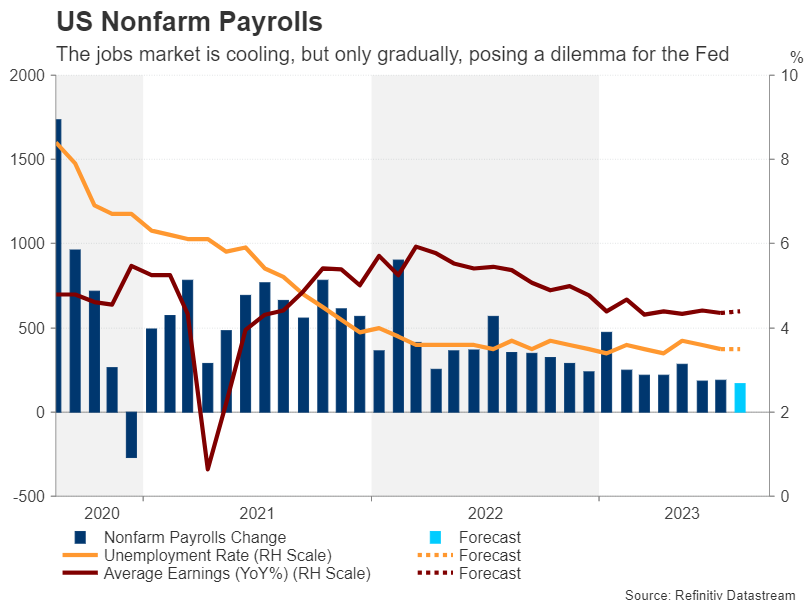
The unemployment rate is expected to hold steady at 3.5%, while average hourly earnings growth is also forecast to remain unchanged at 4.4% y/y in August.
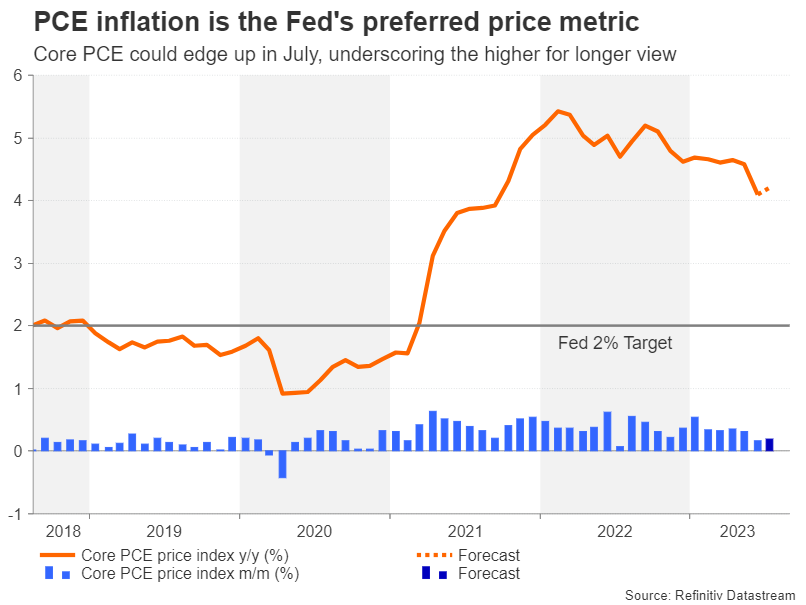
Also attracting a lot of attention is Thursday’s personal income and outlays report, which contains the all-important core PCE price index. With both personal income and personal consumption holding up surprisingly well against the backdrop of rising borrowing costs, another solid reading for August would ease worries about a slowing economy. What has been more of concern, however, is the stickiness of the Fed’s favourite inflation gauge.
Although core PCE did finally take a dive in July to fall to 4.1% y/y, that’s still double the Fed’s target of 2%. Furthermore, core PCE could edge up to 4.2% in July, so those investors hoping for further declines in this particular metric are likely to be disappointed.
Yet, with the economic risks tilted somewhat more towards a recession than a soft landing after the PMI releases, if the above indicators are broadly better than expected, it’s unlikely that rate hike odds would rise very significantly. On the other hand, an overall soft or even poor set of data could lead investors to further up their rate cut bets for next year, punishing the US dollar but probably boosting Wall Street.
Ahead of those big reports, the Conference Board’s consumer confidence index will be watched on Tuesday along with the JOLTS job openings for July. On Wednesday, the second estimate for Q2 GDP growth and ADP employment report will keep the top-tier data flowing. Pending home sales are due on Wednesday too and the Chicago PMI will follow on Thursday.
Wrapping up the US agenda on Friday will be the ISM manufacturing PMI, which will get to have the final say on how markets close for the week. It’s expected to come in at 46.6 for August, a very modest improvement over the prior month.
Will Eurozone inflation keep falling?
Across the pond, recession fears are heightened even more so, as there appears to be no relief for European businesses lately. Manufacturing activity did improve slightly in August, but services output slumped deeper into contraction territory. With interest rates at a record high since the euro’s inception, energy prices rising again and demand weakening in key export markets such as the US and China, one of the few things Europeans can celebrate about is that inflation is on the way down.
The flash estimates for August are due on Thursday and should show further declines. The headline rate of CPI is expected to dip from 5.3% to 5.1% y/y, while core CPI that strips out food, energy, alcohol and tobacco prices is forecast to ease from 5.5% to 5.3% y/y.
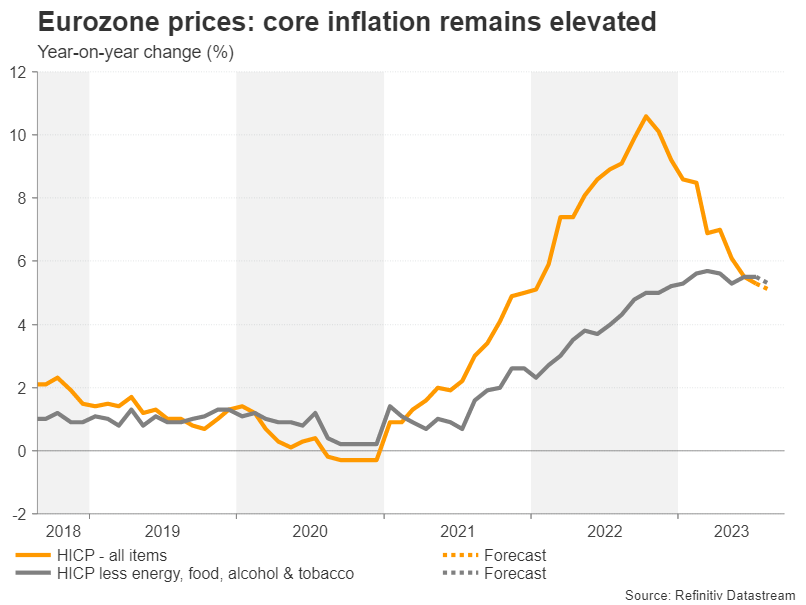
The European Central Bank has repeatedly stressed that getting core CPI down to 2% is its main priority and will likely relay that message in the minutes of the July meeting that will be published on Thursday. However, a less hawkish-than-anticipated tone is possible as the recent deceleration in growth is raising doubts about the need for further rate increases.
The euro could halt its slide and firm somewhat should rate hike bets for September, which at the moment is a coin toss, be ratcheted up from any upside surprises. But even then, the gains would be limited as the risk of a more severe downturn would also rise.
Battered aussie eyes Chinese PMIs and local CPIs
Amid frustration about China’s drip-feed stimulus, announcements on new support measures have become almost a daily occurrence. Yet, for the markets, a one-off bazooka is seen as having a bigger impact. In the absence of one, all investors can do is to look for signs that the incremental policy tweaks are starting to generate some momentum in the economy.
There could be some clues of this on Thursday when China reports its manufacturing and non-manufacturing PMIs for August. The Caixin manufacturing PMI will follow on Friday.
The Australian dollar, which is viewed as a liquid proxy for China-related risks, has taken quite a beating lately following a series of downbeat Chinese data. China’s slowdown is already being felt across the Australian economy as pointed by the recent dismal PMIs.
Next week, the focus will be on domestic barometers, comprising July retail sales (Monday), monthly CPI prints (Wednesday) and Q2 capital expenditure (Thursday).
In recent meetings, the Reserve Bank of Australia had become more concerned about growth than inflation. If the annual CPI rate maintains a downward course in July, the RBA would have little incentive to hike rates again, and unless there is a turnaround in risk sentiment, the aussie looks poised to remain under pressure.
In other data, second quarter GDP growth figures are due out of Canada on Friday, while in Japan, there’s a slew of releases, including preliminary industrial output for July on Thursday and the Ministry of Finance’s estimate of Q2 capital expenditure on Friday. The latter will provide an indication on whether or not the preliminary GDP reading of 6.0% annualized growth is likely to be revised up or down.
As ECB Hike Dilemma Sharpens, Traders Seek Clarity in Inflation Numbers
With Lagarde taking off her ultra-hawk armor at the latest ECB gathering and last week’s business surveys pointing to deepening wounds for the Euro area economy, investors have become skeptical as to whether the ECB should press the hike button again in September. Will the Eurozone preliminary inflation numbers, due out on Thursday at 09:00 GMT, clear the fog? And could traders become willing to buy the euro again?
To hike or not to hike?
At the July ECB gathering, policymakers decided to raise interest rates by 25bps to a historic high as it was widely anticipated, but they abstained from committing to further moves. At the press conference following the decision, President Lagarde appeared way less hawkish than she did at previous gatherings, acknowledging that the economic outlook has deteriorated and replying with a “decisive maybe” when asked whether they are planning to hike again in September.
Since then, the CPI data for July revealed that headline inflation dropped to 5.3% year-on-year from 5.5%, but the core metric that excludes energy, food, alcohol and tobacco, held steady at 5.5% yoy. Combined with a rise in services inflation to a new record of 5.6% yoy, this is far from suggesting that the ECB’s job is done.
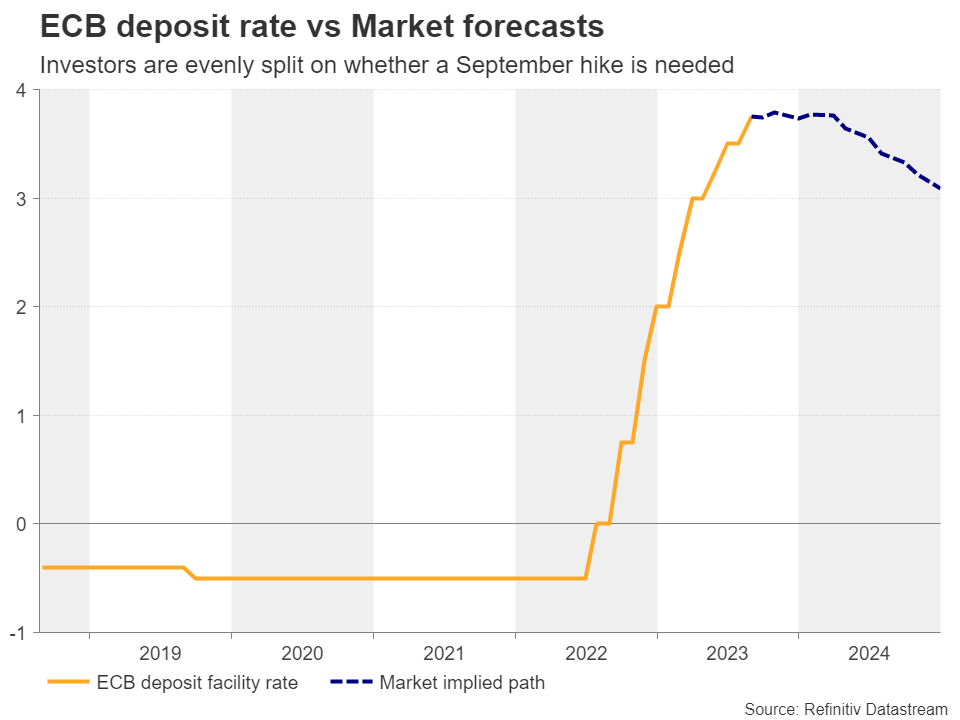
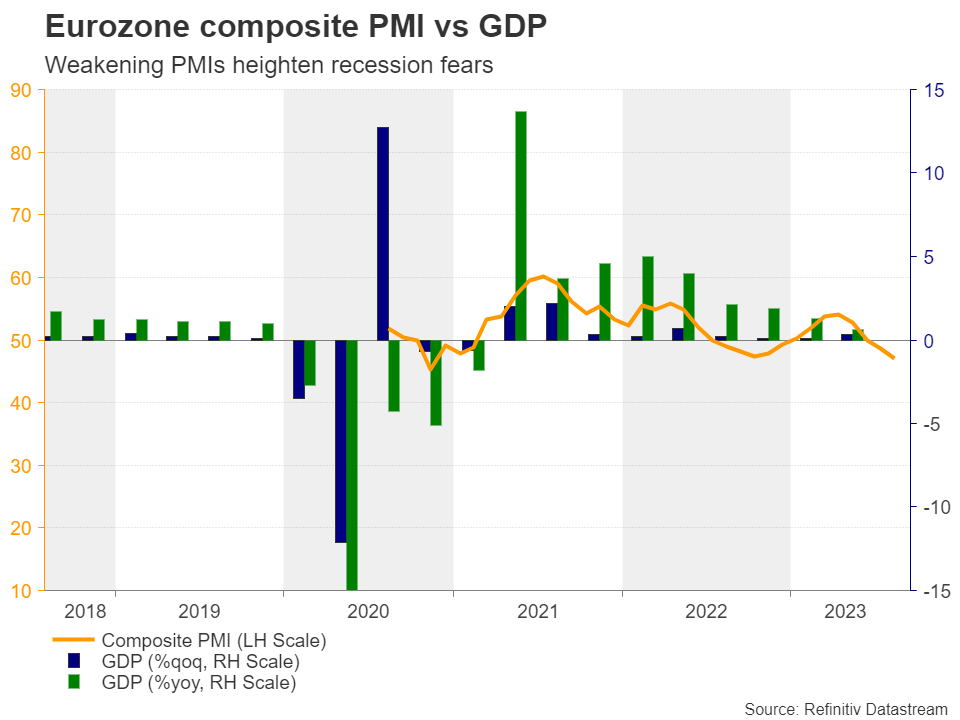
Nevertheless, the ECB’s soft rhetoric and a streak of data pointing to continued economic weakness in the region have made investors skeptical as to whether officials should raise rates again at the September 14 gathering, and the decision now boils down to a coin toss according to money markets. Preliminary business surveys for August have rung the recession bells, with the service-sector PMI falling into contractionary territory for the first time since December, joining the manufacturing index and dragging the composite down to 47.0 from 48.6. Will the ECB take the sidelines in order to protect the overall economy, or will they stay committed to bringing inflation to heel at any cost?
Further inflation cooling to bolster the pause case
With the ECB trapped between a rock and a hard place, Thursday’s flash CPI numbers could attract special attention as they could tilt the scale either towards a September hike or a pause. The headline CPI rate is expected to have declined further to 5.1% from 5.3%, and the ultra-core that excludes energy, food, alcohol and tobacco, is forecast to have slipped to 5.3% yoy from 5.5%.
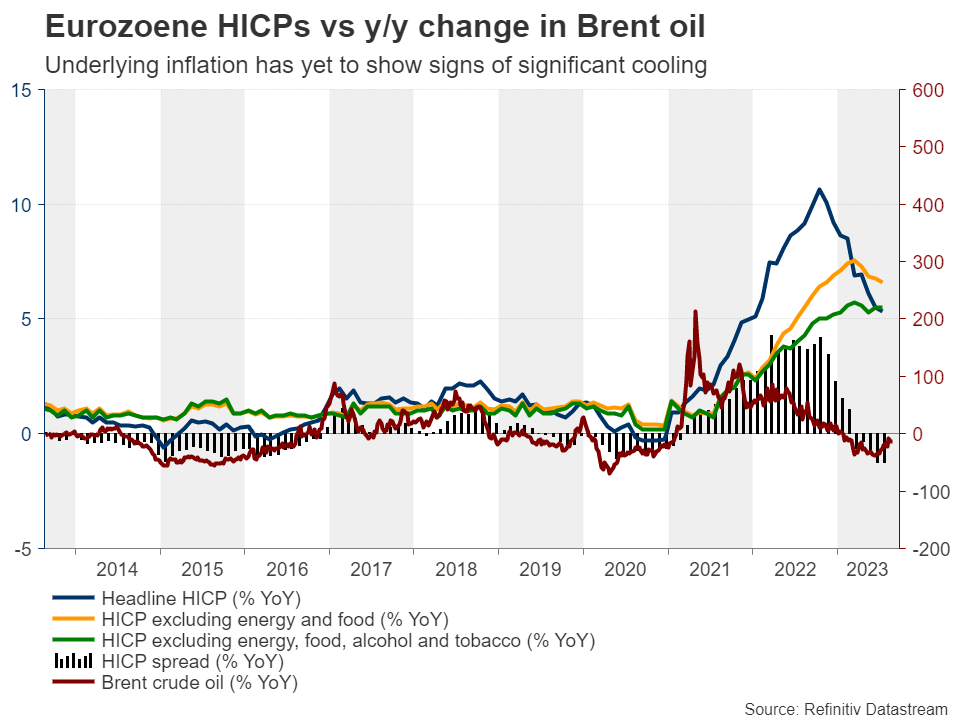
Further slowdown in inflation amid a bleeding economy could convince market participants that Lagarde and her colleagues could wait for a while before deciding whether and when further hikes are appropriate. In other words, a pause in September could turn out to be the base case scenario in the eyes of investors.
Euro/dollar may continue drifting south
Something like that could result in further selling in the euro, especially against its US counterpart which has been enjoying inflows, not only because traders are re-examining the case of interest rates in the US staying higher for longer than previously thought, but also as a safe haven. Concerns surrounding the performance of the Chinese economy have intensified as the latest stimulus measures by Chinese authorities and the People’s Bank of China (PBOC) failed to revive market sentiment.
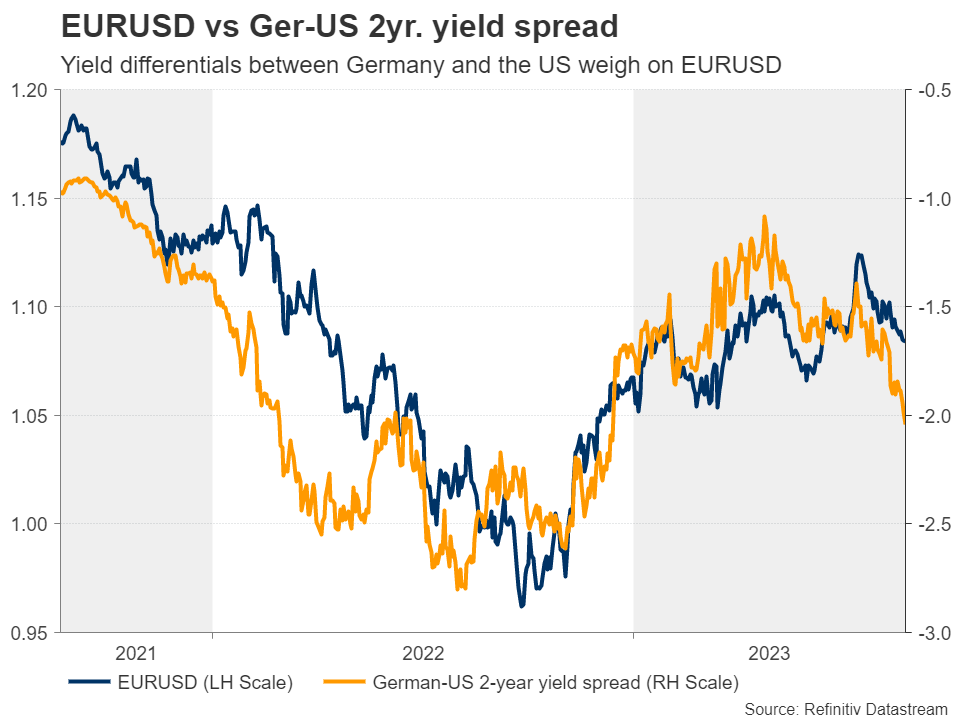
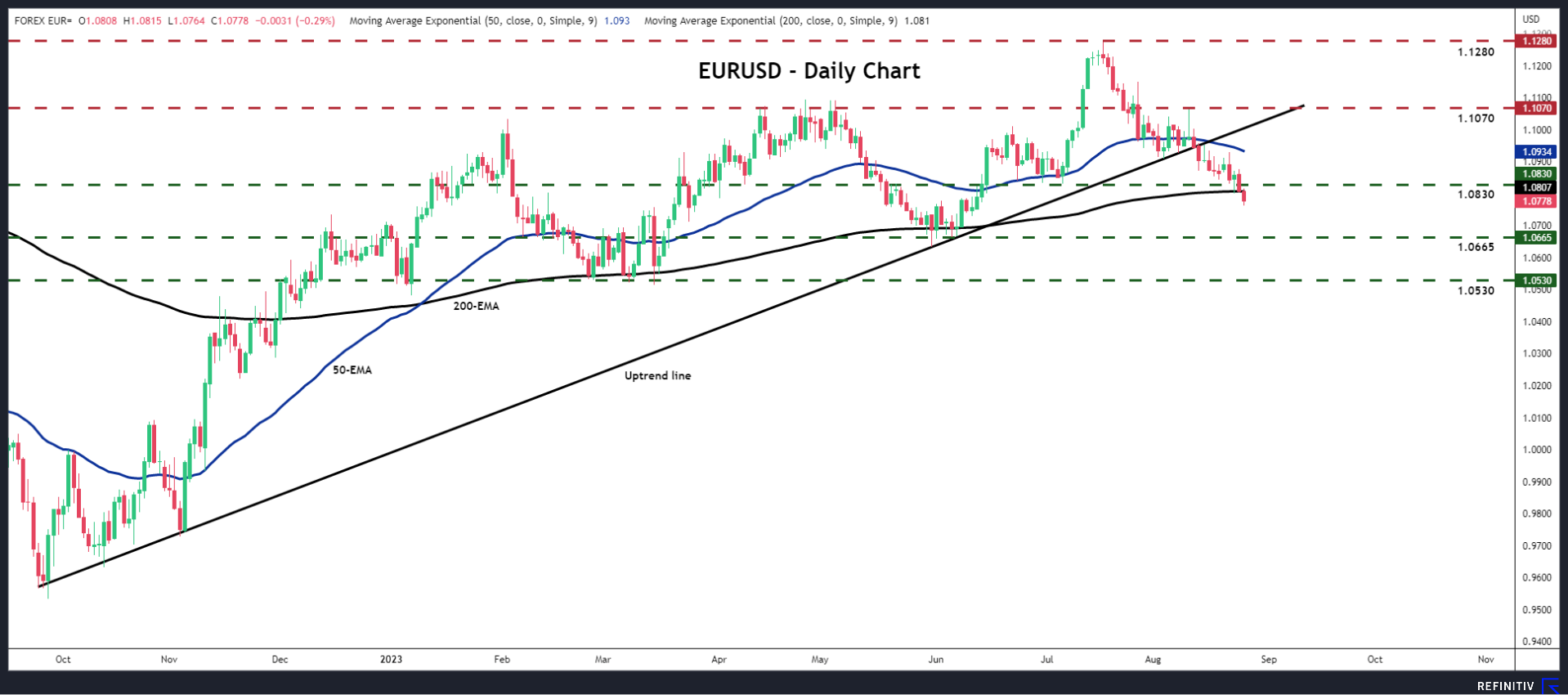
Euro/dollar fell below the support (now turned into resistance) zone of 1.0830 on Thursday and broke below the 200-day exponential moving average (EMA) on Friday. Combined with the fact that the pair is trading well below the prior uptrend line drawn from the low of September 26, these technical signs increase the likelihood for further declines, at least until the critical area of 1.0665, the break of which may be the confirmation signal for a full-scale bearish reversal.
But let’s not ignore some upside risks
Having said all that though, besides painting an ugly economic picture, the PMIs revealed that inflationary pressures have picked up in August, both in terms of average selling prices and input costs, although both measures are still pointing to far weaker inflation rates than the ones seen during the two years prior to this summer.
This means that there may be some upside risks surrounding Thursday’s CPI figures. Ergo, in the case that inflation reaccelerates somewhat instead of slowing further, the euro may rebound on renewed speculation about a September ECB hike. Nonetheless, a lot more is needed for euro/dollar to re-enter an uptrend orbit. Eurozone data may have to start showing signs of stabilization and from a technical perspective, the pair may need to rebound and return above the key resistance of 1.1070.
Weekly Focus – Slowing Down
Financial stress in China and weak US and euro PMIs set the scene for global markets this week. It started out with continued focus on China where the housing crisis and financial risks from shadow banking has resurfaced. Chinese financial stress eased somewhat during the week, though, as there was no new bad news to fuel a further sell-off. It does not mean the problems are no longer there, however. We see increasing downside risks to Chinese growth and have revised down the annual growth estimate to 4.8% from 5.2%, see Resarch China: downside risks on the rise - scenarios for Chinese growth, 21 August. We expect Chinese policy makers to step up stimulus to stave off a crisis but there is a risk they continue to be two steps behind and growth slows even more.
PMIs out of the US and the euro area added to the picture of a slowing global economy. In the US Composite PMI dropped to 50.4 in August from 52.0 in July with declines in both manufacturing and services. The European PMI figures also came out much weaker than expected with services showing renewed signs of slowing. The German Services PMI numbers stood out with a massive 5 index points decline, which has only happened three times before with the latest being in March 2020 during the Covid-19 lockdown. The service sector has been the engine that kept activity running at a decent level while the manufacturing sector has been in recession for a while. However, it now seems the service sector is finally losing some steam as well. It will be interesting to see if this finally translates into more weakness in labour markets, which have stayed surprisingly resilient over the past year despite weaker growth.
The BRICS countries this week expanded the cooperation with six new members being Argentina, Ethiopia, Egypt, Saudi Arabia, United Arab Emirates and Iran. BRICS' stated goal is to be a champion for the Global South working for a multipolar world and with the increase in members they now represent 37% of global GDP (PPP terms) and 46% of global population. We could very well see a further expansion of the group in the years to come.
Bond yields started the week higher but the soft PMI data led markets to rethink the need for further central banks hikes and yields turned lower again. That was until markets started to fret about Jackson Hole and coming speeches by Governors of both the Fed and ECB, Jerome Powell and Christine Lagarde. Then yields came back up. Equities rallied on the softer central bank outlook despite the economic weakness but fell back again when jitters rose going into Jackson Hole.
Looking ahead, it's time for US labour market data again, with main focus naturally on the August non-farm payrolls, where the gradual cooling in employment growth has likely continued. We're looking for +160k. The Fed pays close attention to the development in average hourly earnings and another print at 0.4% m/m or above would likely be a hawkish signal for the markets. JOLTS data for July is also up for release on Tuesday where job openings have been a good leading indicator for wage growth as well. US ISM Manufacturing and July PCE data is also due for release. In China, PMI for August will be in focus while Flash CPI inflation in the euro area will be a key input for the coming ECB meeting in September.
Is the Price of Natural Gas Forming a New Trend?
The US Energy Information Administration said on Thursday that natural gas inventories in US storage rose by 18 billion cubic feet in the week ended Aug. 18. That was below the 29 billion cubic feet increase forecast by analysts polled by S&P Global Commodity Insights.
It is possible that market participants thought that insufficient filling of storage facilities will lead to a rise in gas prices in the coming winter. According to the forecast of the International Energy Agency (IEA), the price of gas will peak at USD 3.44/MMBtu in December 2023 (approximately +36% from current levels).
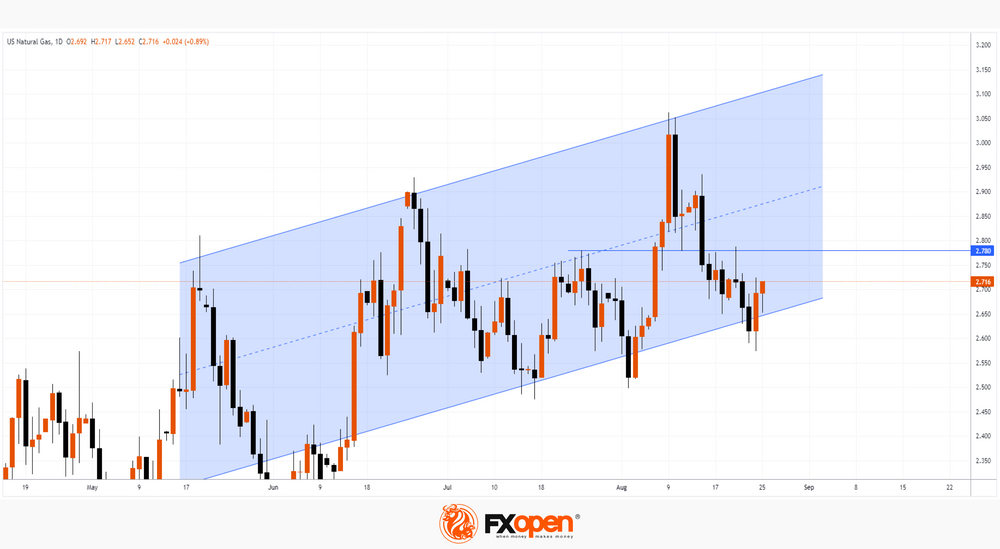
The natural gas price chart shows that:
→ in July-August, a series of rising supports was formed;
→ the peak of August is higher than the peak of June, which in turn is higher than the peak of May.
A sequence of higher extremes could indicate that the market is in an uptrend that could bring the price closer to the IEA's price targets. The nearest resistance on this way is the level of 2.78, which in July-August repeatedly influenced the price dynamics.
This article represents the opinion of the Companies operating under the FXOpen brand only. It is not to be construed as an offer, solicitation, or recommendation with respect to products and services provided by the Companies operating under the FXOpen brand, nor is it to be considered financial advice.
Sunset Market Commentary
Markets:
“We will keep at it until the job is done”. Fed chair Powell’s long-awaited speech at the Jackson Hole Symposium by the Kansas City Fed finally arrived. His message is the same as last year when he scared markets in an eight-minute address that the Fed will stick to a restrictive monetary policy. This time around markets were more prepared for the communication though. “Although inflation has moved down from its peak—a welcome development—it remains too high. We are prepared to raise rates further if appropriate, and intend to hold policy at a restrictive level until we are confident that inflation is moving sustainably down toward our objective.” “The lower monthly readings for core inflation in June and July were welcome, but two months of good data are only the beginning of what it will take to build confidence that inflation is moving down sustainably toward our goal. We can’t yet know the extent to which these lower readings will continue or where underlying inflation will settle over coming quarters. Twelve-month core inflation is still elevated, and there is substantial further ground to cover to get back to price stability.” Overall, Fed Chair’s Powell didn’t really alter his message from previous press conferences. He continues to err on the hawkish side of expectations. US Treasuries spiked lower in a first reaction as Powell kept the possibility of a (September) rate hike firmly alive. Money markets only discount a one in five probability for that to happen. US yield changes currently range between flat (2-yr) and -2.8 bps (30-yr). The move didn’t last though. The dollar couldn’t build on recent gains, currently losing some ticks. EUR/USD changes hands around 1.0830. US stock markets rise between 0.5% and 1%. Interestingly, topics like the possibility of higher neutral rate or raising the inflation target weren’t touched upon during his speech.
News & Views:
The monthly business survey published by the National Bank of Belgium, which started to fall in April, levelled off in August (-14.9 from -14.8 in July). However, stabilization compared to the previous month masks disparate developments at sector level. Business climate improved in trade as respondents expect higher demand and increased their orders with suppliers. Still employment expectations in the sector were more muted. In the building industry (-7.2 from -5.8) confidence is suffering from much gloomier demand expectations and a less favourable assessment of order books. Confidence in manufacturing stabilized (-16.1 from -16.0), influenced by a fall in all underlying components, with the exception of demand expectations, which rose strongly. After two months of sharp decline, general market demand expectations also recovered in the business-related services, due to an improved assessment of current activity. Still, business leaders expressed a much more reserved opinion when it came to expectations of their own activity. All in all, services confidence remained fairly stable (-8.8 from -9.0).
Statistics Sweden today reported several data series including lending data and data on real estate prices. The Real Estate Price index (for one to two-dwelling buildings) in the second quarter declined another 1% compared to the previous quarter and was 12% lower compared to the same quarter last year. Other data series showed that the annual growth rate of lending to households slowed to just 0.9% Y/Y (from 1.1% Y/Y in June). Mortgages accounted for 83% of total lending to households. The amount of mortgages rose 1.3% Y/Y in July. The annual growth rate of loans for consumption eased to 0.6% Y/Y (accounting for 6% of household lending). Lending to non-financial corporates still was 7% Y/Y in July. Labour market data showed an unexpected decline in the unemployment rate (SA) from 7.9% to 7%. The number of people in the labour force and the number of employed people were about 120k higher compared to last year. Both the labour force participation rate (75.7%) and employment rate rose (73.1% up 1.3% Y/Y).At EUR/SEK 11.89 the Swedish krone continues to trade within reach of the all-time low level against the euro (EUR/SEK 11.96) touched earlier this week. The Riksbank raised its policy rate to 3.75% at the end of June meeting and is expected to hike the policy rate at least one more time, starting with a step to 4% at the September 21 meeting. July CPIF inflation was unchanged at 6.4% Y/Y. Core inflation stays high at.8% Y/Y.
Powell signals Fed’s readiness to tighten further amid inflation concerns
Fed Jerome Powell made clear the Central Bank's stance on the current inflation environment in his opening remarks at the Jackson Hole Symposium. Noting a decline from peak inflation rates, Powell emphasized, "Although inflation has moved down from its peak—a welcome development—it remains too high."
Demonstrating Fed's commitment to fight inflation, he added, "We are prepared to raise rates further if appropriate, and intend to hold policy at a restrictive level until we are confident that inflation is moving sustainably down toward our objective."
Acknowledging the recent decline in core inflation during June and July, Powell cautioned against reading too much into short-term data. "The lower monthly readings for core inflation in June and July were welcome, but two months of good data are only the beginning of what it will take to build confidence that inflation is moving down sustainably toward our goal," he remarked.
Drawing a metaphor to describe the present economic landscape, Powell stated, "As is often the case, we are navigating by the stars under cloudy skies." Under such conditions, he emphasized the importance of a strategic and risk-aware approach.
Elaborating on the Fed's forward plan, Powell said, "At upcoming meetings, we will assess our progress based on the totality of the data and the evolving outlook and risks. Based on this assessment, we will proceed carefully as we decide whether to tighten further or, instead, to hold the policy rate constant and await further data."
This clear yet cautious messaging from Powell reiterates the Fed's commitment to ensuring price stability and managing the inflationary pressures faced by the economy, while also emphasizing a data-driven and measured approach to monetary policy adjustments.