

Sample Category Title
Dollar Stands Tall, Euro and Sterling Down on Recession Worries
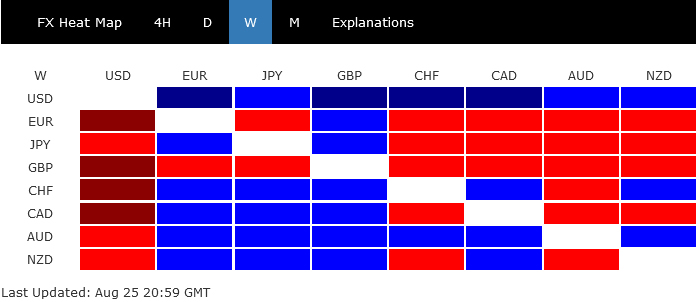
Dollar clinched the title of the week's best performing currency, even though there was just muted impact from Fed Chair Jerome Powell's remarks at Jackson Hole. While Powell's renewed commitment to combating inflation prompted traders to elevate their expectations for another rate hike within the year, broader market reactions, notably in equities and bonds, were rather subdued. Clearly, investors are taking a long view beyond the anticipated pause in September.
On the other side of the pond, Sterling and Euro languished, standing out as the week's most notable underperformers. The disappointing set of services PMI data confirmed the slowing pace of economic activity in both UK and Eurozone. This data, coupled with the looming threat of a recession, poses a quandary for the BoE and ECB. Both institutions find themselves navigating the challenging task of reining in stubbornly high inflation without inadvertently triggering an economic downturn.
Interestingly, amidst the broader European gloom, Swiss Franc emerged as a beacon of strength, clinching the position of the week's second strongest currency. Nevertheless, this strength was largely attributable to buying activity against both Euro and Sterling.
Down under, Australia spearheaded the advance among the commodity currencies, though their gains were largely muted, with much of the global attention being fixated on developments in US and Europe. The shadow of uncertainty continues to loom large over China, with concerns about its economic recovery and vulnerabilities in its property and financial sectors potentially setting the stage for future turbulence, which would drag down the commodity currencies again.
Lastly, Japanese Yen offered a mixed performance. While it appeared largely range-bound, there were subtle indications of growing bearish momentum when pitted against the resilient greenback.
Odds of another Fed hike rose after Powell, but not in Sep
Fed Chair Jerome Powell's highly anticipated speech at the annual Jackson Hole symposium provided the financial markets with some insightful takeaways. While the overall tone was marginally more hawkish than anticipated, it wasn't as alarming as some had feared. The equity and bond markets responded with steadiness, signaling no drastic shifts in sentiments.
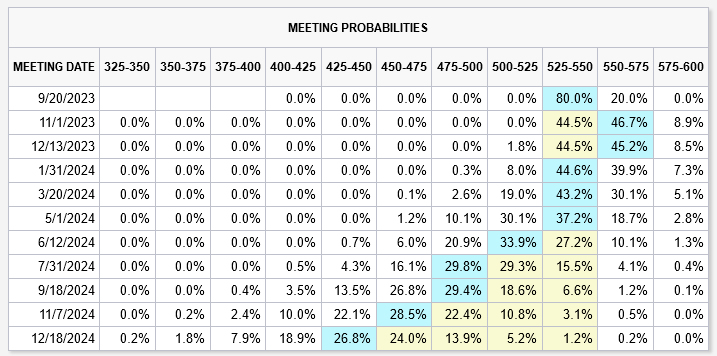
The current market pricing is still firm on a pause at the September FOMC meeting. However, the likelihood of another rate increase within the year has now gained traction. Nevertheless, future actions from Fed will hinge significantly on forthcoming data, particularly the upcoming Non-Farm Payroll and inflation metrics.
Interestingly, Powell's narrative mirrored the one from his previous Jackson Hole address a year ago, emphasizing the combat against inflation. Although there's been a recent easing in core inflation, Powell took a conservative stance by emphasizing that "two months of good data are only the beginning of what it will take to build confidence."
Highlighting Fed's commitment, Powell maintained that they "are prepared to raise rates further if appropriate" and reiterated the pledge to "hold policy at a restrictive level until we are confident that inflation is moving sustainably down toward our objective."
Fed fund futures are currently still pointing to a hold in September, with 80% chance. Yet, in the wake of Powell's address, the odds favoring a 25bps rate hike either in November or December rose above the 50% mark.
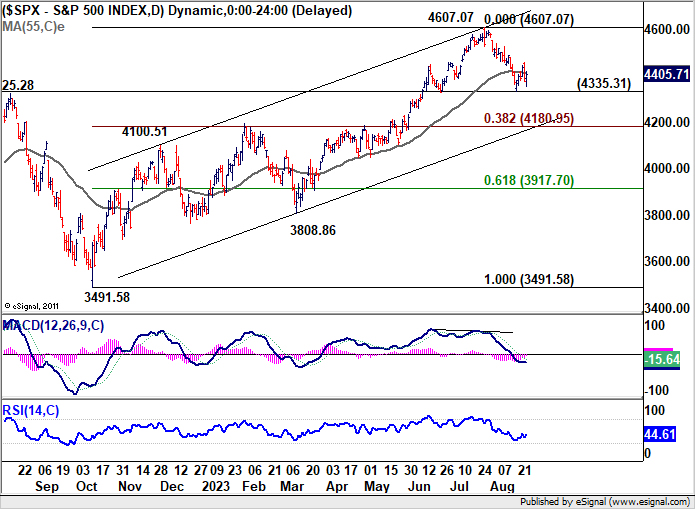
S&P 500 has indeed closed slightly higher on Friday after initial sell-off. But risk is mildly on the downside for the near term, after Thursday's single day reversal. That is, corrective fall from 4607.07 is in favor to continue. Break of 4335.31 will extend the decline to 38.2% retracement of 3491.58 to 4607.07 at 4180.85, which is close to medium term channel support.
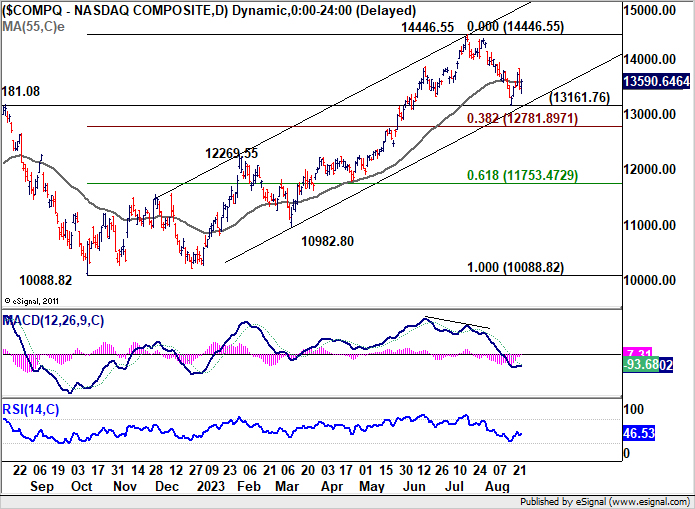
Outlook is similar for NASDAQ. The post Nvidia bounce on Thursday was rather disappointing as the index ended in a single day reversal too. Risk is mildly on the downside for the near term. Break of 13161.76 will extend the correction from 14446.55 to 38.2% retracement of 10088.82 to 14446.55 at 12781.89.
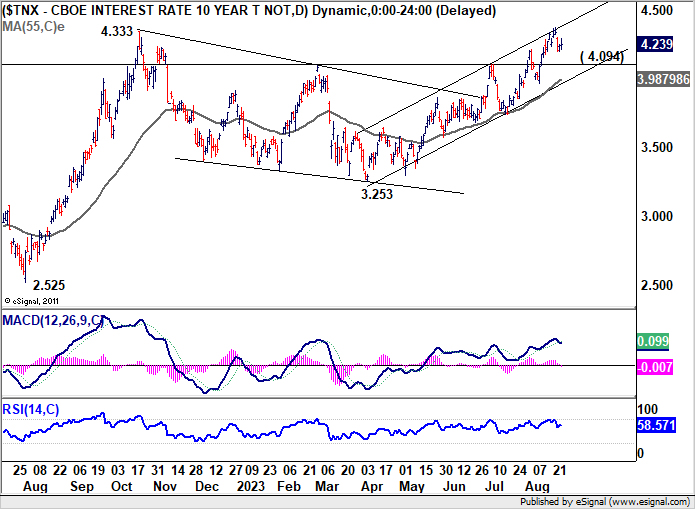
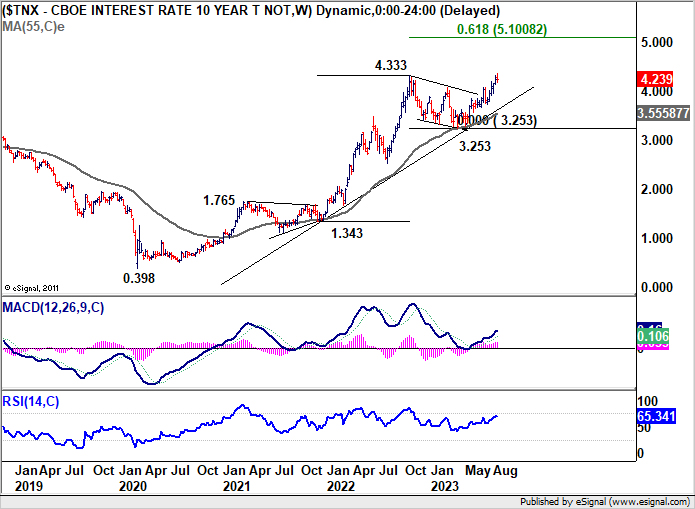
10-year yield breached 4.333 resistance last week but failed to sustain above there, and closed lower at 4.239. For the near term, outlook will stay bullish as long as 4.094 resistance turned support holds. There question is on whether there in enough selloff in the US bond markets to push 10-year yield firmly above 4.333, to target 61.8% projection of 1.343 to 4.333 from 3.253 at 5.100.
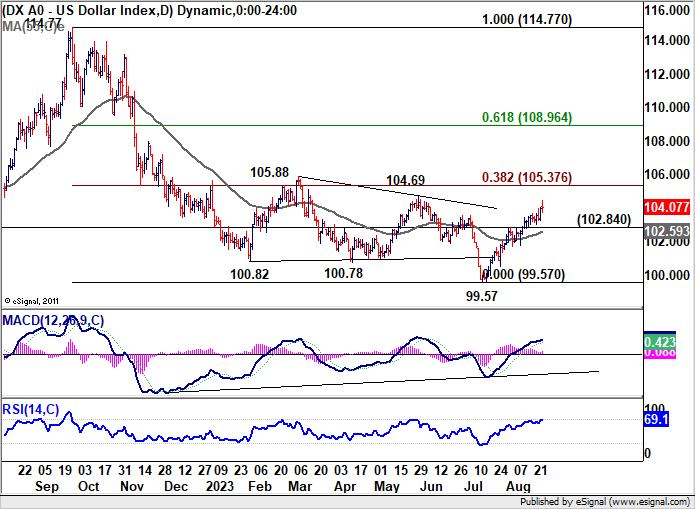
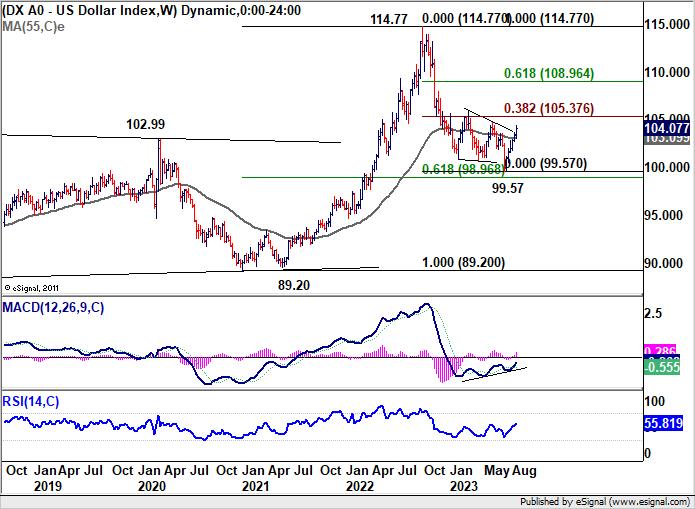
Dollar index ended the rebound from 99.57 last week and hit as high as 104.44. Further rise is expected as long as 102.84 resistance turned support holds, to 38.2% retracement of 114.77 to 99.57 at 105.37. For now, this rebound is more seen as a corrective move. Thus, strong resistance could be seen from 105.37 to limit upside to complete the rebound. Yet, sustained break of 105.37, coupled with intensified risk aversion in the broader markets, would argue that DXY is already reversing the whole down trend form 114.77 (2022 high).
ECB Lagarde's measured messaged overshadowed by recession risks
ECB President Christine Lagarde stayed out of the debate over whether the ECB should lift interest rates again in September. She reiterated that "It's critically important that inflation expectations remain anchored at 2 per cent." Lagarde reinforced that the ECB is "deliberately, decisively data-dependent" and committed to taking decisions one meeting at a time.
But overall, hawks seemed to have a louder voice out of Jackson hole, with Bundesbank President Joachim Nagel saying it's premature to consider a pause. Latvia's Martins Kazaks said he would err on the side of raising rates despite risks on both sides. Austrian Robert Holzmann said "a little more should be added."
But in the background, Euro has been weighed down by dismal economic data over the week. In particular, PMI data indicated that the services sector in Eurozone is losing the steam to offset the manufacturing recession, while Germany has become the "sick man" of the region. Recession risk is generally on the rise.
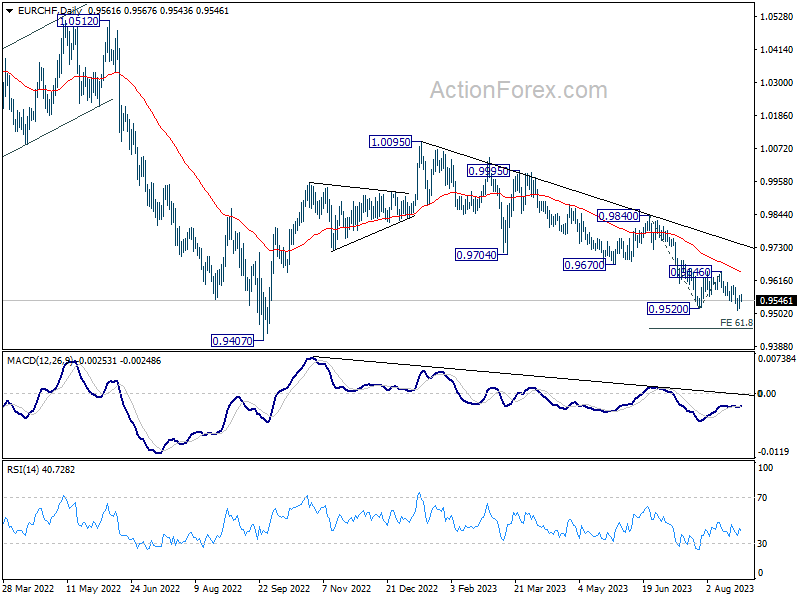
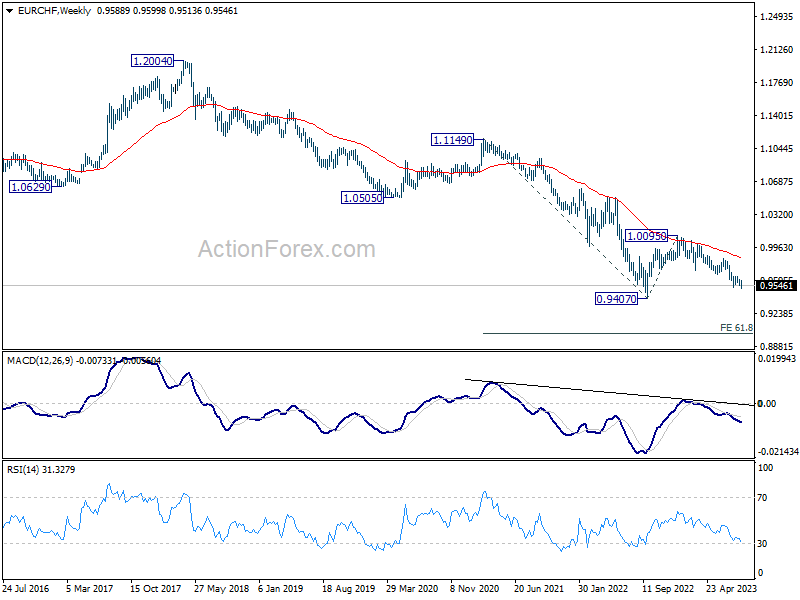
EUR/CHF attempted down trend resumption last week but quickly recovered after breaching 0.9520 to 0.9513. Nevertheless, overall outlook is clearly bearish with the cross capped well below falling 55 D EMA. Break of 0.9513 will pave the way to 61.8% projection of 0.9840 to 0.9520 from 0.9646 at 0.9448. Whether EUR/CHF can dive beyond 2022 low of 0.9407 hinges significantly on how the looming recession unfolds.
Sterling weak as UK's outlook not better than Eurozone's
Amid global concerns about economic downturn, UK is not exempt from the rising tide of recession risks. Recent PMI data has put UK on par with Eurozone in terms of gloomy outlook. The speed of decline in services sector has particularly taken analysts by surprise. Even though BoE is largely anticipated to further tighten its monetary stance by raising rates to 5.50% next month, the futures market has grown more skeptical. Presently, there's just a one-in-three probability being priced in for rates to touch the 6% mark in the foreseeable future.
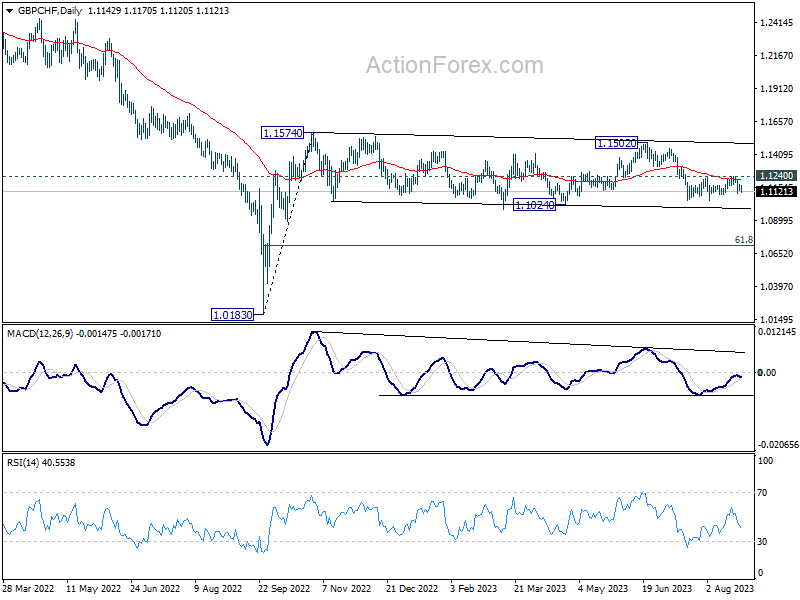
GBP/CHF has turned into sideway trading since mid-July, and it's still holding above 1.1024 support. However, risks for an intensified selloff is growing after rejection by 55 D EMA . For now, further fall is in favor as long as 1.1240 resistance holds. Sustained break of 1.1024 will confirm breakout from the medium term range from 1.1574, and pave the way to 61.8% retracement of 1.0183 to 1.1574 at 1.0174.
USD/CAD Weekly Outlook
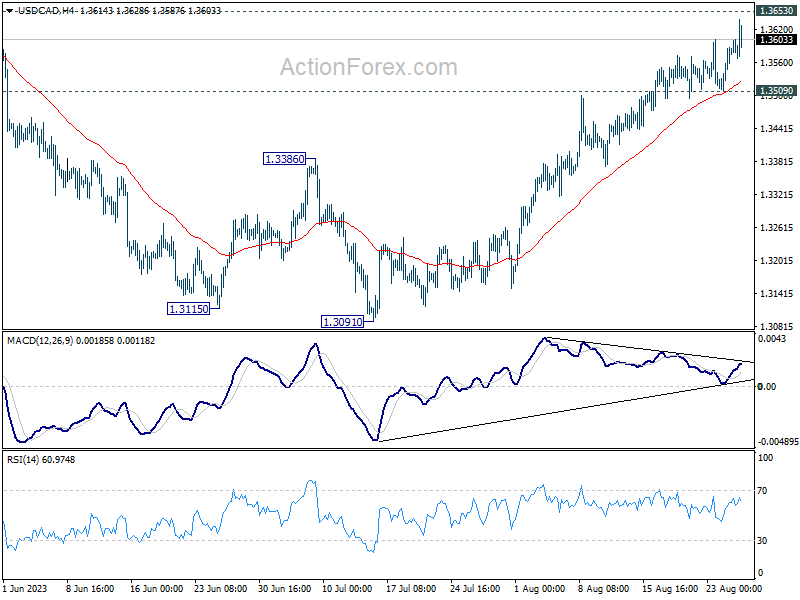
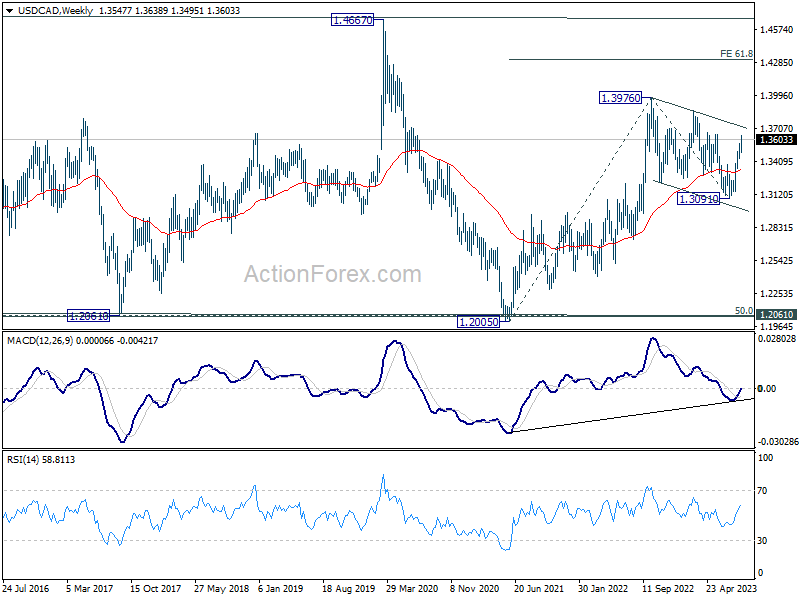
USD/CAD's rally from 1.3091 continued last week despite some interim retreat. Initial bias is now on the upside this week for 1.3653 resistance. Decisive break there will confirm that correction from 1.3976 has completed, a target a test on this high. On the downside, however, break of 1.3509 support will indicate short term topping, and turn bias to the downside for some correction first.
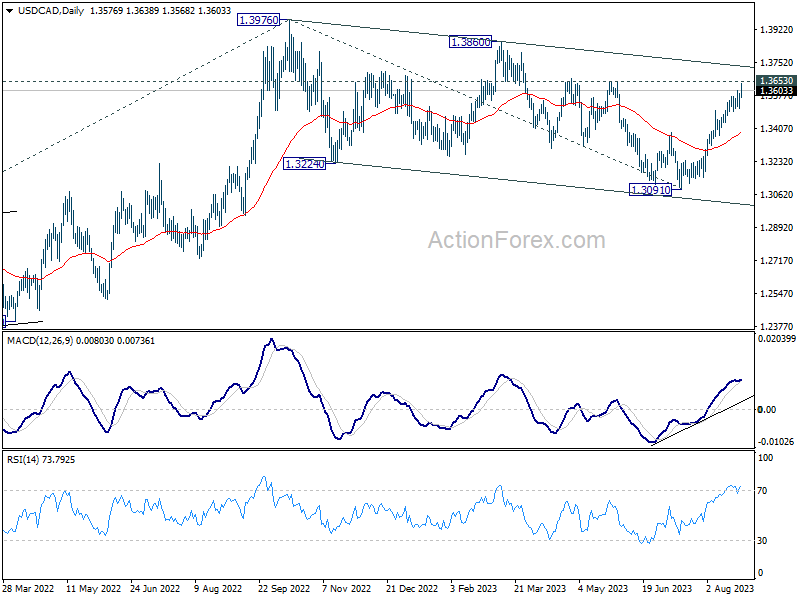
In the bigger picture, price actions from 1.3976 are viewed as a corrective pattern only. Upon completion, rise from 1.2005 (2021 low) would resume through 1.3976. Next target is 61.8% projection of 1.2005 to 1.3976 from 1.3091 at 1.4309. For now, this will remain the favored case as long as 55 D EMA (now at 1.3387) holds.
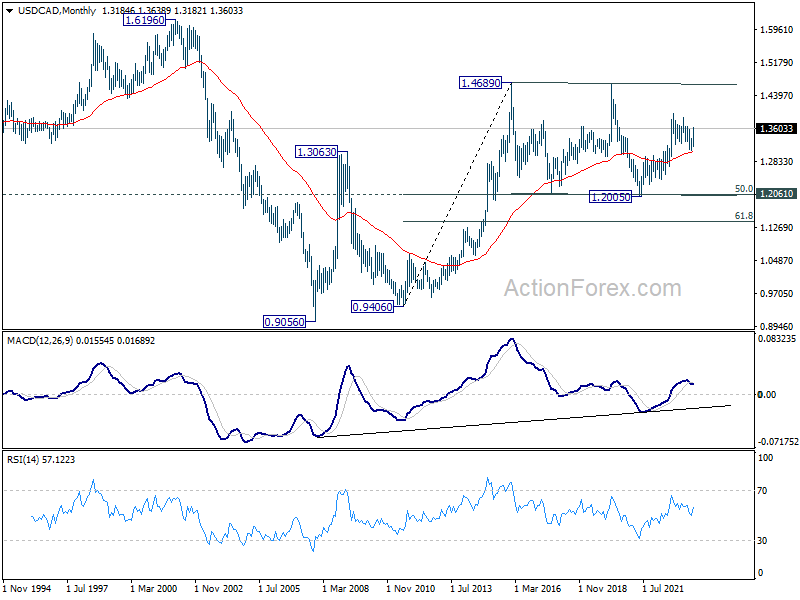
In the longer term picture, price actions from 1.4689 (2016 high) are seen as a consolidation pattern only, which might have completed at 1.2005. That is, up trend from 0.9506 (2007 low) is expected to resume at a later stage. This will remain the favored case as 55 M EMA (now at 1.3044) holds.
AUD/USD Weekly Report
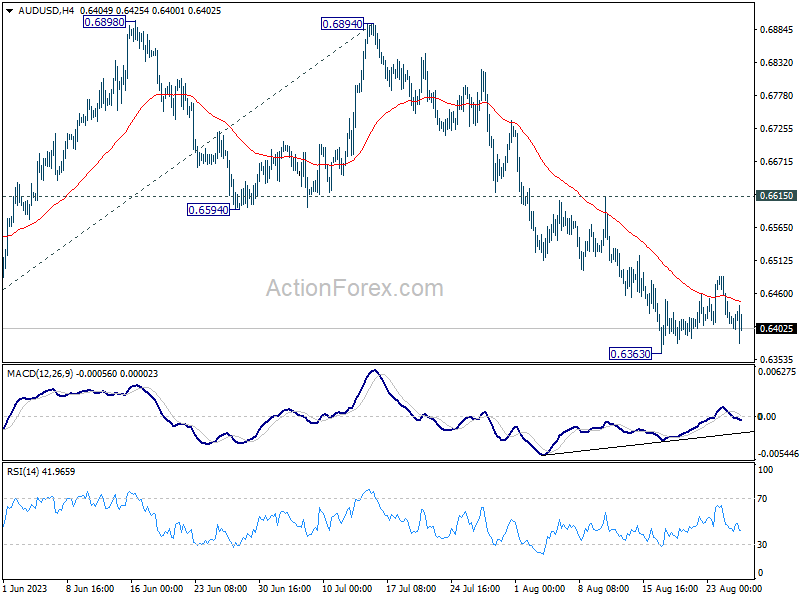
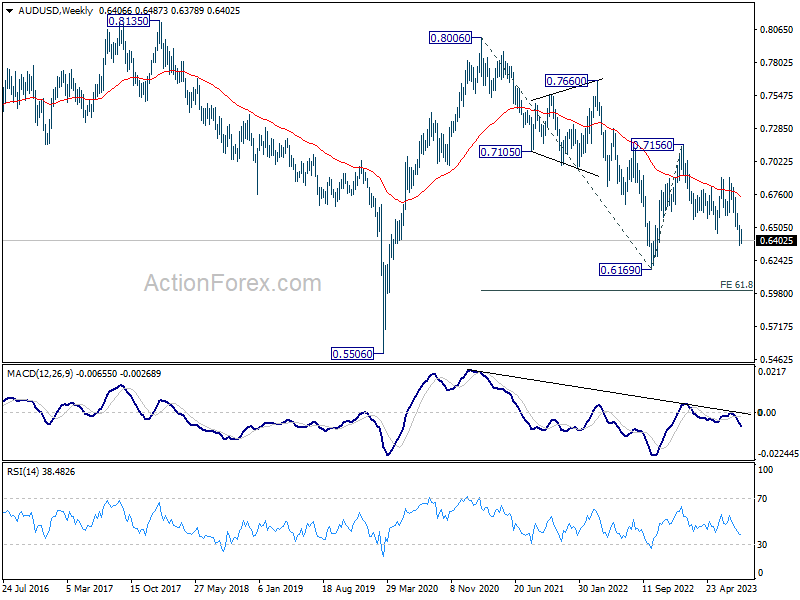
AUD/USD extended the consolidation pattern from 0.6363 last week and outlook is unchanged. Initial bias remains neutral this week first. While stronger recovery cannot be ruled out, upside should be limited by 0.6615 resistance. Break of 0.6363 will resume larger fall from 0.7156 to 100% projection of 0.7156 to 0.6457 from 0.6894 at 0.6195.
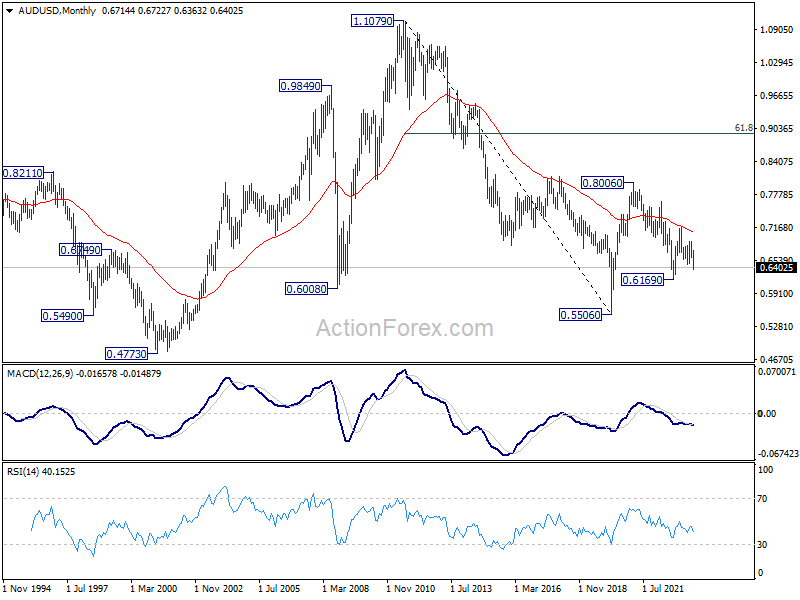
In the bigger picture, current development argues that the down trend from 0.8006 (2021 high) is still in progress. Decisive break of 0.6169 will target 61.8% projection of 0.8006 to 0.6169 to 0.7156 at 0.6021. This will now remain the favored case as long as 0.6894, in case of strong rebound.
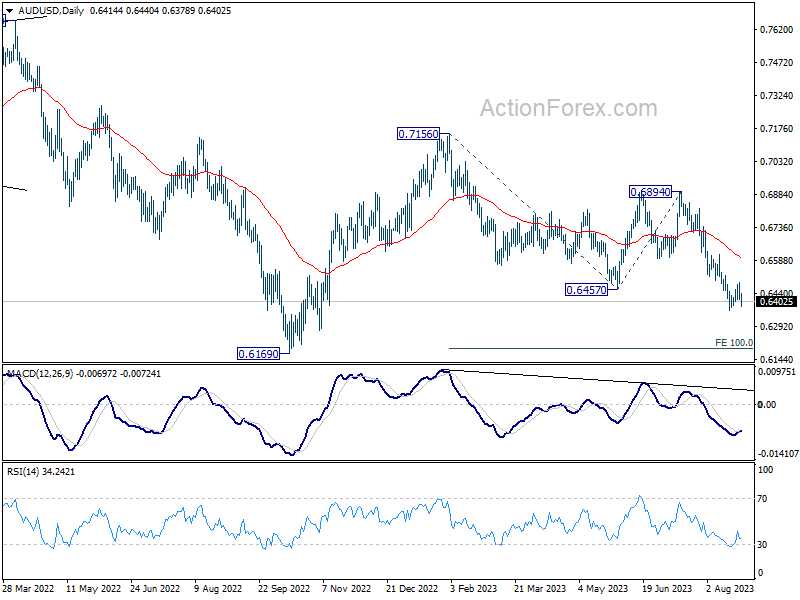
In the long term picture, while fall from 0.8006 might extend lower, the structure argues that it's merely a correction to rise from 0.5506 (2020 low). In case of downside extension, strong support should emerge above 0.5506 to bring reversal. But still, momentum of the next move will be monitored to adjust the assessment.
USD/CAD Weekly Outlook
USD/CAD's rally from 1.3091 continued last week despite some interim retreat. Initial bias is now on the upside this week for 1.3653 resistance. Decisive break there will confirm that correction from 1.3976 has completed, a target a test on this high. On the downside, however, break of 1.3509 support will indicate short term topping, and turn bias to the downside for some correction first.
In the bigger picture, price actions from 1.3976 are viewed as a corrective pattern only. Upon completion, rise from 1.2005 (2021 low) would resume through 1.3976. Next target is 61.8% projection of 1.2005 to 1.3976 from 1.3091 at 1.4309. For now, this will remain the favored case as long as 55 D EMA (now at 1.3387) holds.
In the longer term picture, price actions from 1.4689 (2016 high) are seen as a consolidation pattern only, which might have completed at 1.2005. That is, up trend from 0.9506 (2007 low) is expected to resume at a later stage. This will remain the favored case as 55 M EMA (now at 1.3044) holds.
GBP/JPY Weekly Outlook
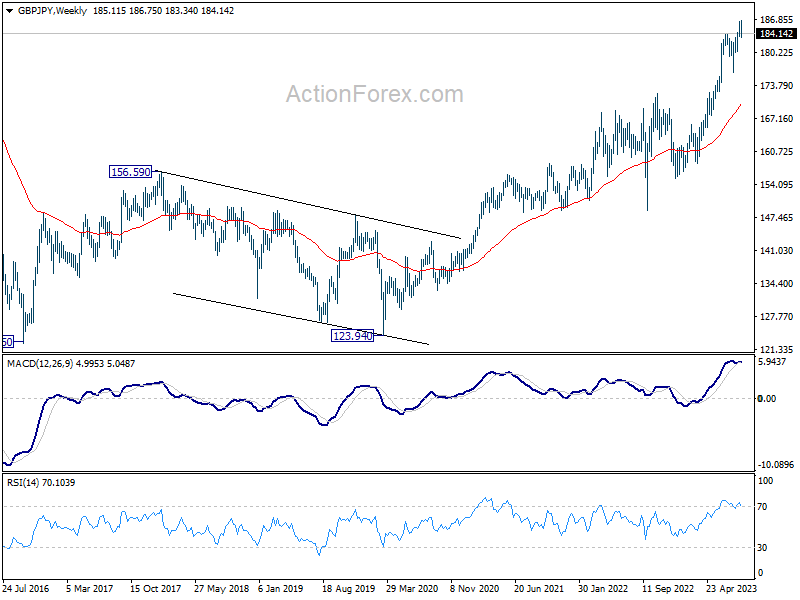
GBP/JPY edged higher again to 186.75 last week but the retreated to 183.35. With subsequent recovery, initial bias is neutral this week first. But risk will stays on the downside as long as 186.75 resistance holds. Break of 183.35 will resume the correction from 186.75 short term top to 55 D EMA (now at 181.17) and possibly below.
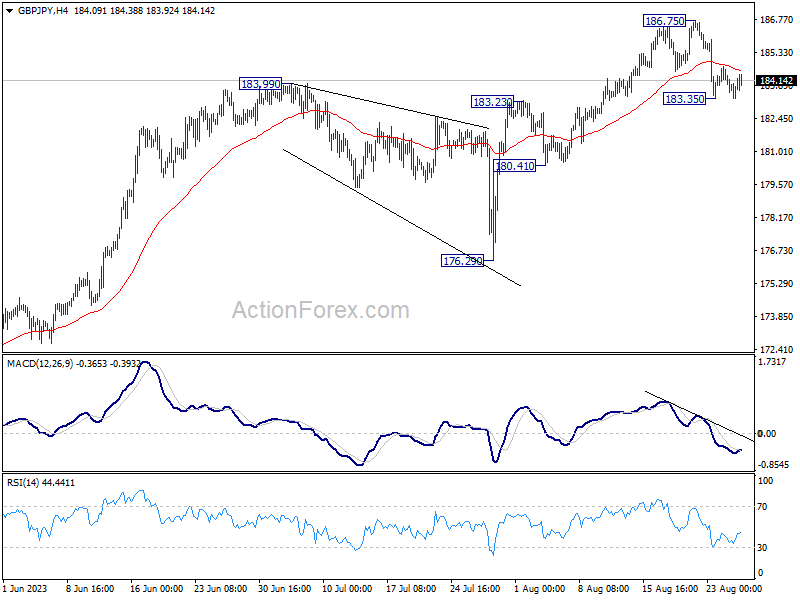
In the bigger picture, up trend from 123.94 (2020 low) is in progress. Next target is 195.86 (2015 high). This will remain the favored case as long as 176.29 support holds, even in case of deeper pull back.
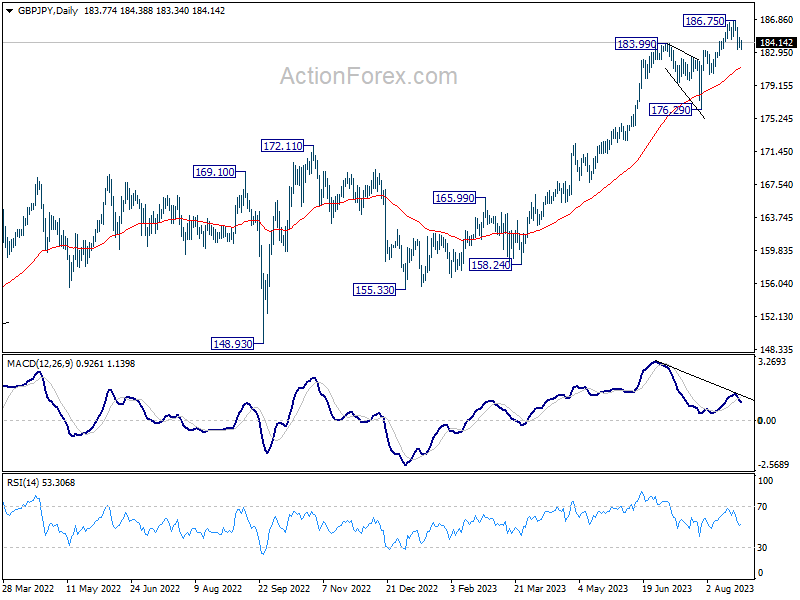
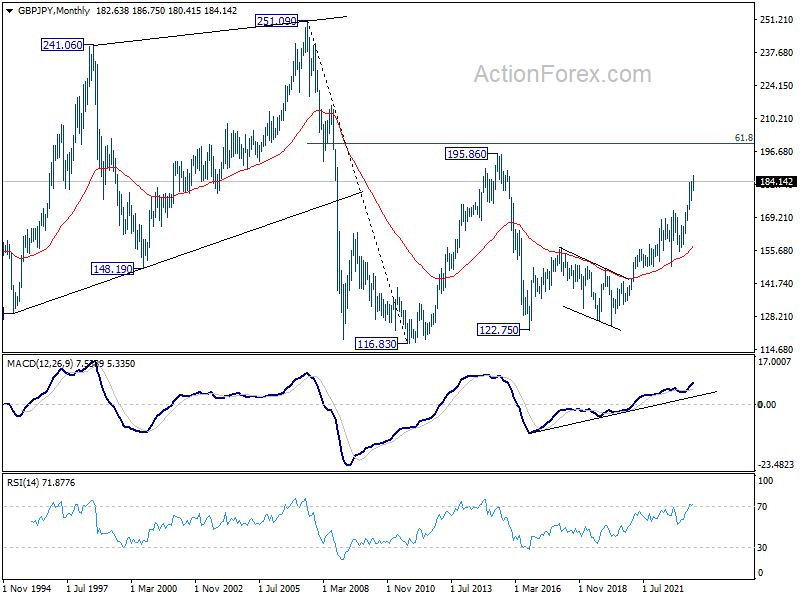
In the longer term picture, rise from 122.75 (2016 low) in still in progress to retest 195.86 (2015 high). Based on current momentum, break of 195.86 is in favor. But strong resistance could still be seen from 61.8% retracement of 251.09 (2007 high) to 116.83 (2011 low) at 199.80 to limit upside on first attempt.
EUR/JPY Weekly Outlook
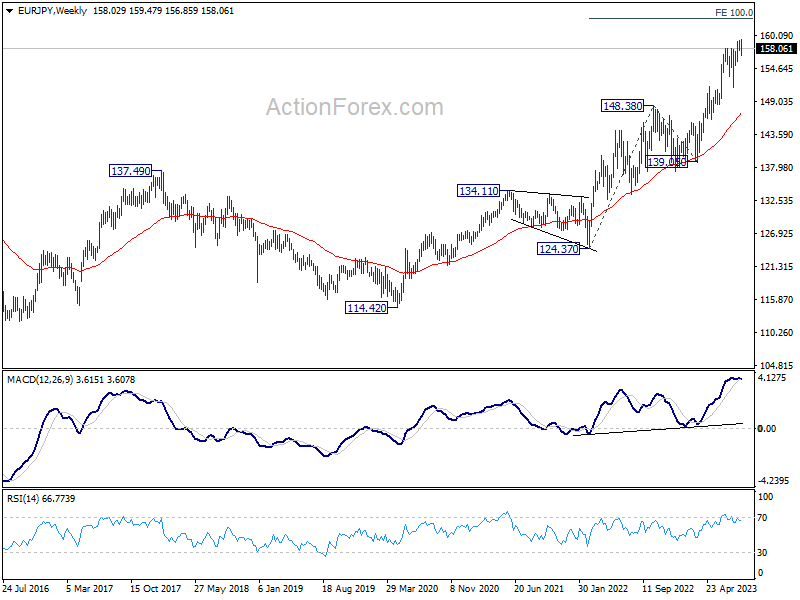
EUR/JPY edged higher again last week to 159.47 but retreated to 156.85. With subsequent recovery, initial bias is neutral this week first. Risk will stay mildly on the downside as long as 159.47 short term top holds. Break of 156.85 will resume the corrective fall to 55 D EMA (now at 155.72) and possibly below.
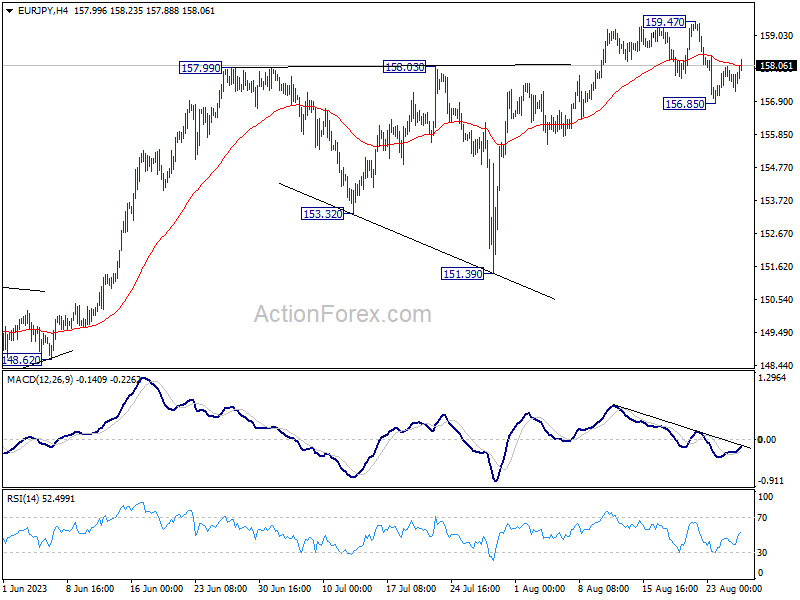
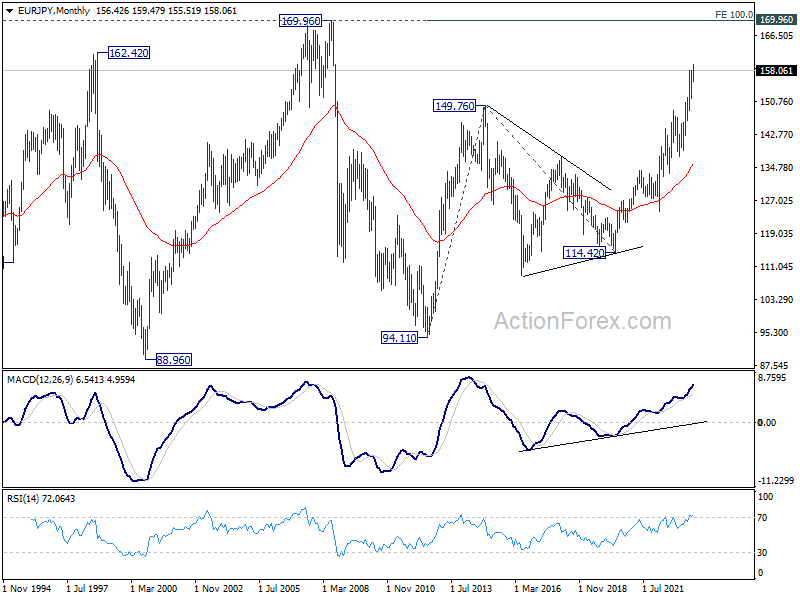
In the bigger picture, rise from 114.42 (2020 low) is in progress. Next target is 100% projection of 124.37 to 148.38 from 139.05 at 163.06. Sustained break there will pave the way to retest long term resistance at 169.96. This will remain the favored case as long as 151.39 support holds, even in case of deep pull back.
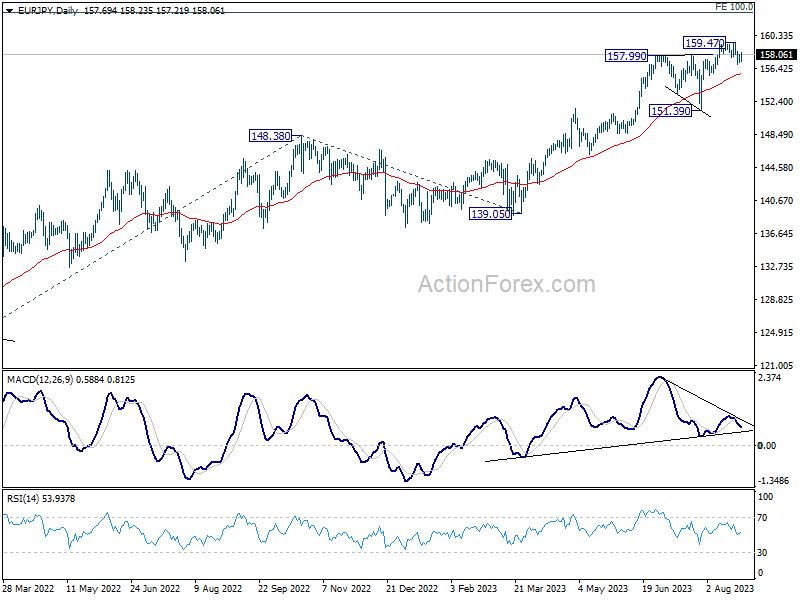
In the long term picture, rise from 109.03 (2016 low) is seen as the third leg of the whole up trend from 94.11 (2012 low). Next target is 100% projection of 94.11 to 149.76 from 114.42 at 170.07 which is close to 169.96 (2008 high).
EUR/GBP Weekly Outlook
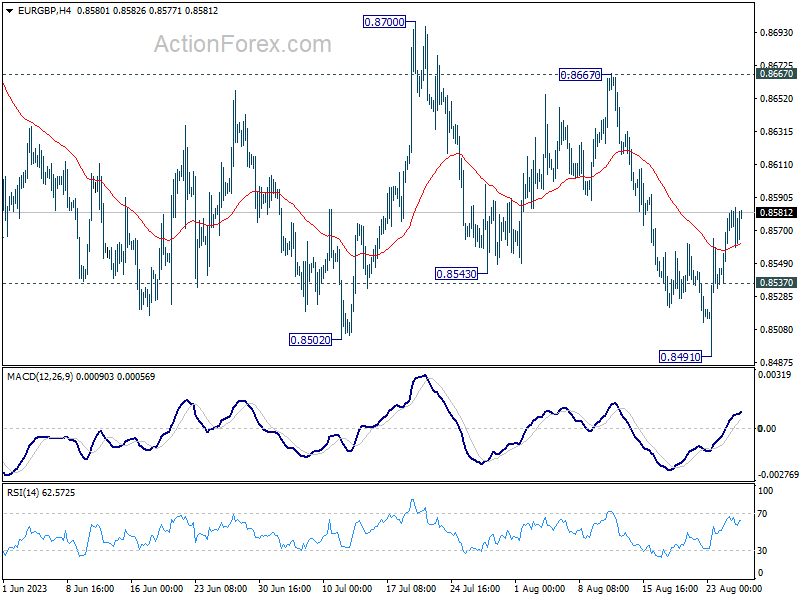
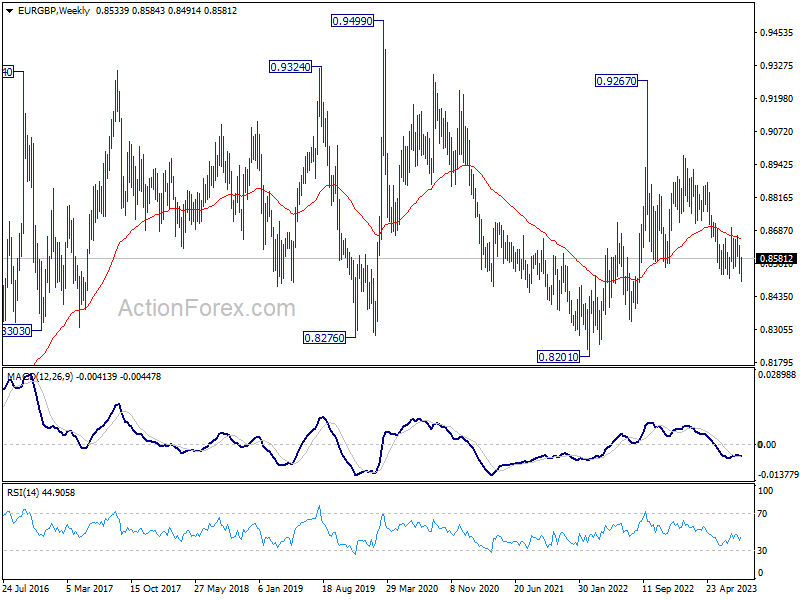
EUR/GBP dipped to 0.8491 last week but rebounded strongly since then. Initial bias is mildly on the upside for stronger rebound. But overall outlook will stay bearish as long as 0.8667 resistance holds. That is, larger down trend from 0.8977 is in favor to continue. Below 0.8537 minor support will bring retest of 0.8491 low first.
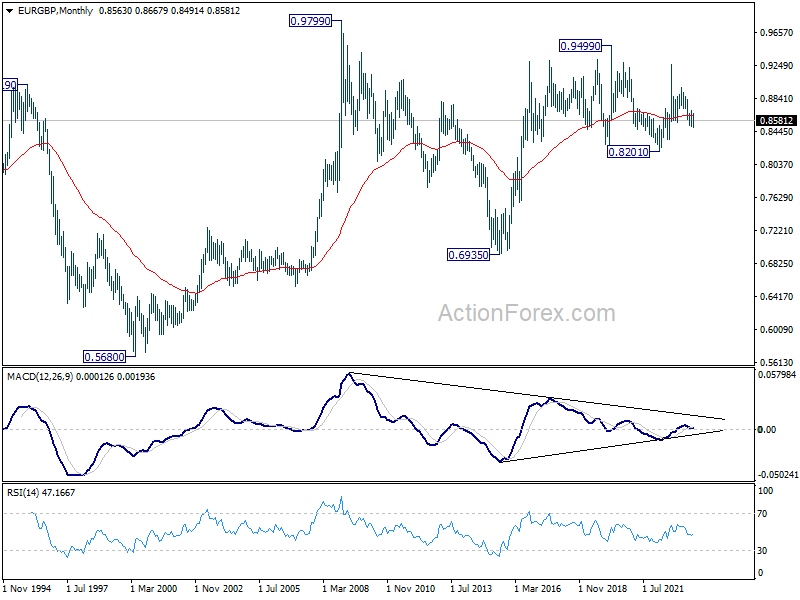
In the bigger picture, the down trend from 0.9267 (2022 high) is seen as part of the long term range pattern from 0.9499 (2020 high). Further decline is in favor as long as 0.8667 resistance holds. Break of 0.8502 will resume the fall towards 0.8201 (2022 low).
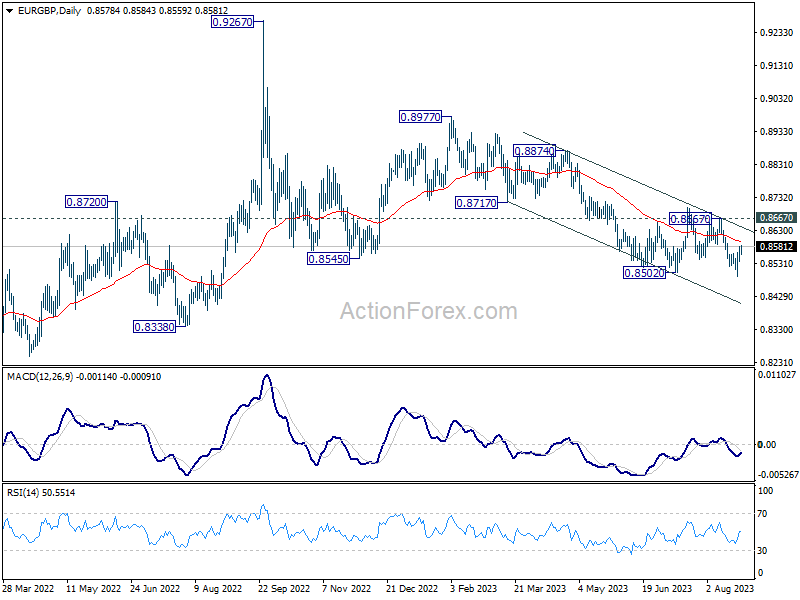
In the long term picture, long term range pattern is extending. But rise from 0.6935 (2015 low) is expected to resume at a later stage, to 0.9799 (2009 high).
EUR/AUD Weekly Outlook
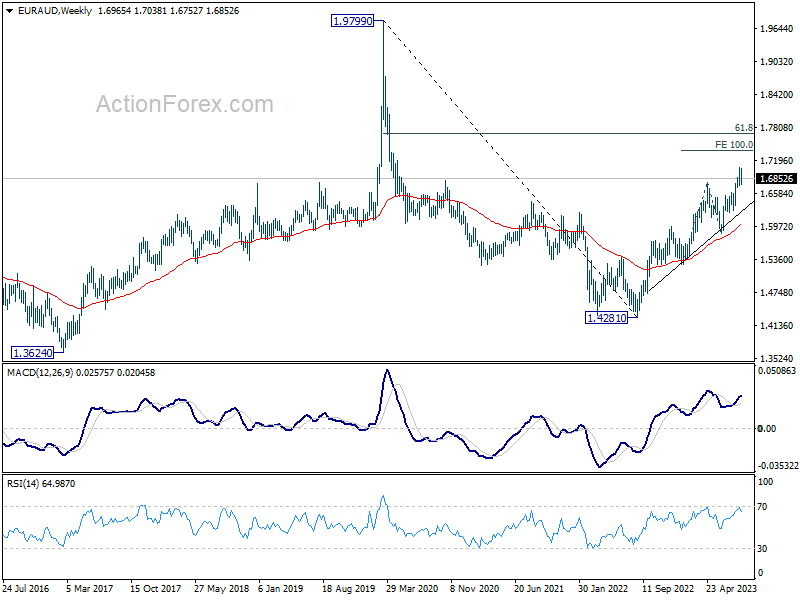
EUR/AUD's pull back from 1.7062 extended lower last week, but stayed above 1.6737 support. Initial bias stays neutral this week first and further rally is in favor. On the upside, firm break of 1.7062 resistance will resume larger up trend to 1.7377 projection level next. However, firm break of 1.6737 will bring deeper pull back to 1.6601 resistance turned support instead.
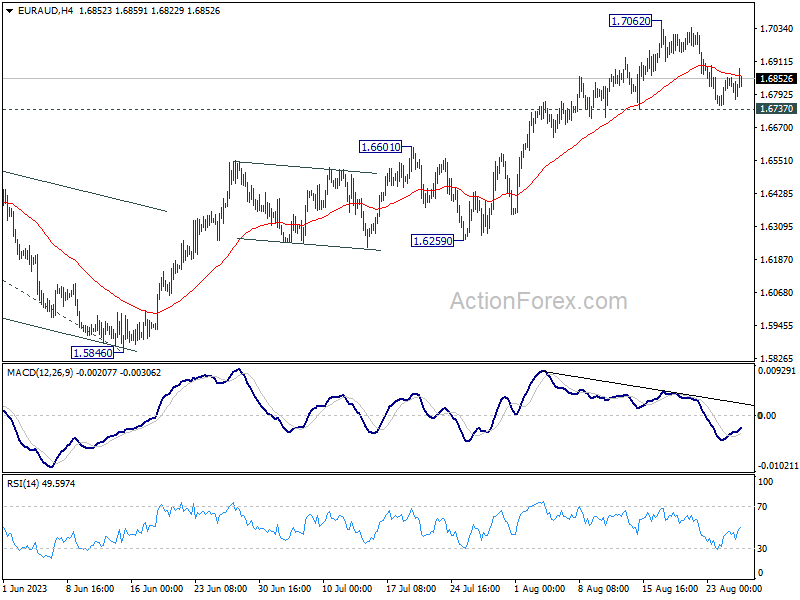
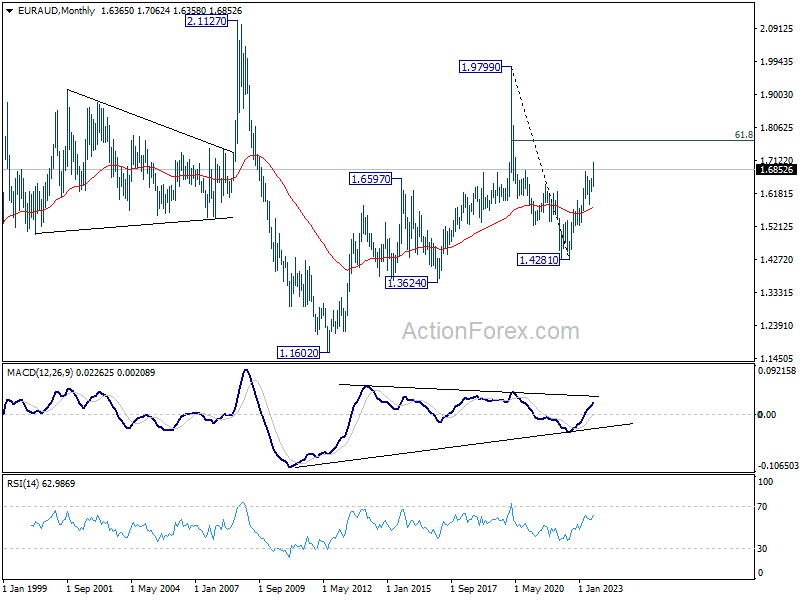
In the bigger picture, the rise from 1.4281 (2022 low) is in progress. Next target is 100% projection of 1.5254 to 1.6785 from 1.5846 at 1.7377. For now, outlook will stay bullish as long as 1.5846 support holds, even in case of another pull back.
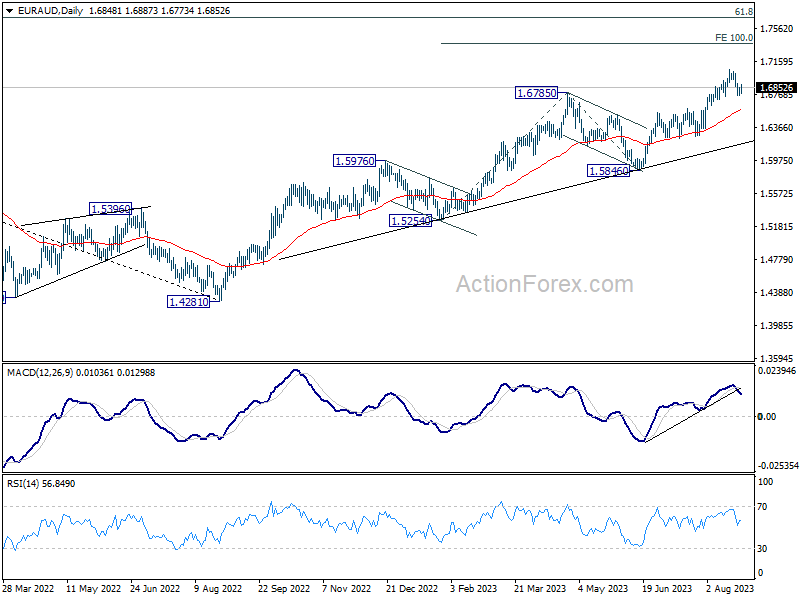
In the longer term picture, it's still early to decide if rise from 1.4281 is resuming whole up trend from 1.1602 (2012 low). But in either case, further rally is in favor as long as 1.5846 support holds. Next target is 61.8% retracement of 1.9799 to 1.4281 at 1.7691.
EUR/CHF Weekly Outlook
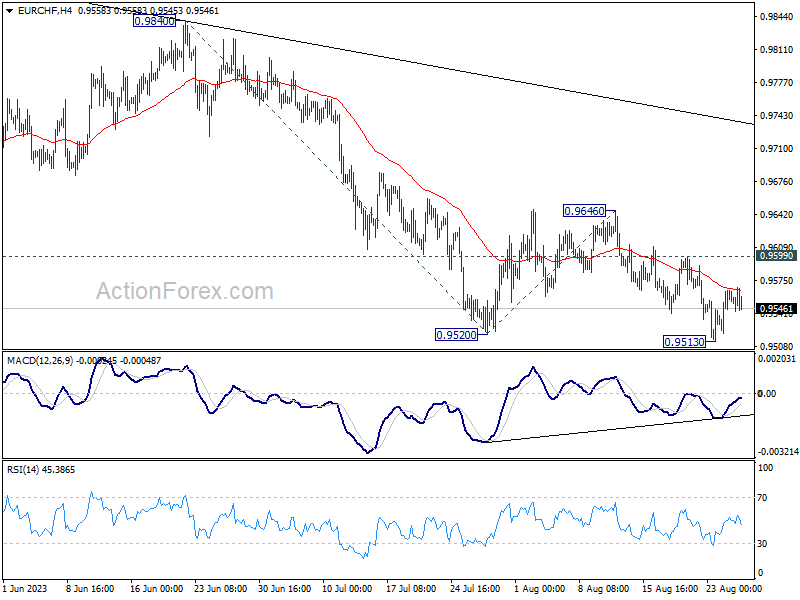
EUR/CHF's breach of 0.9520 support argues that fall from 1.0095 is resuming. But as it recovered after hitting 0.9513, initial bias is neutral this week first. Further decline is expected as long as 0.9599 resistance holds. Break of 0.9513 will target 61.8% projection of 0.9840 to 0.9520 from 0.9646 at 0.9448.
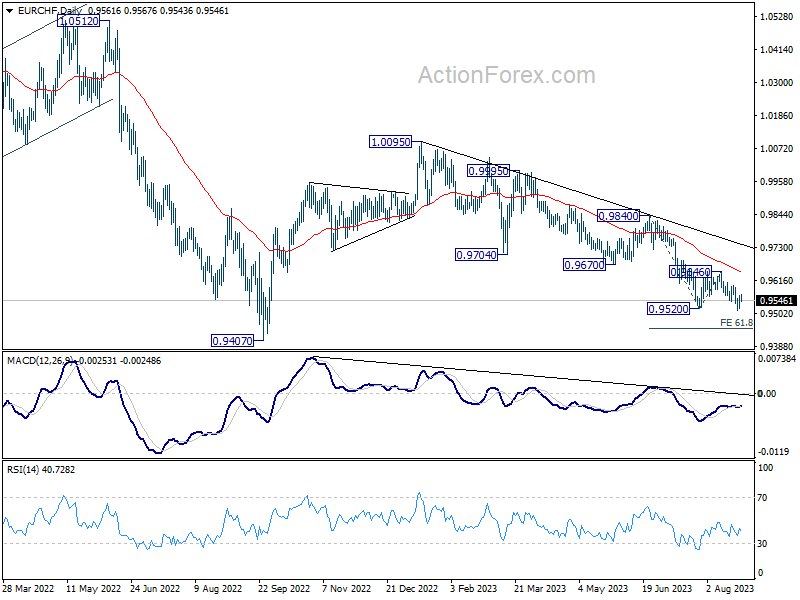
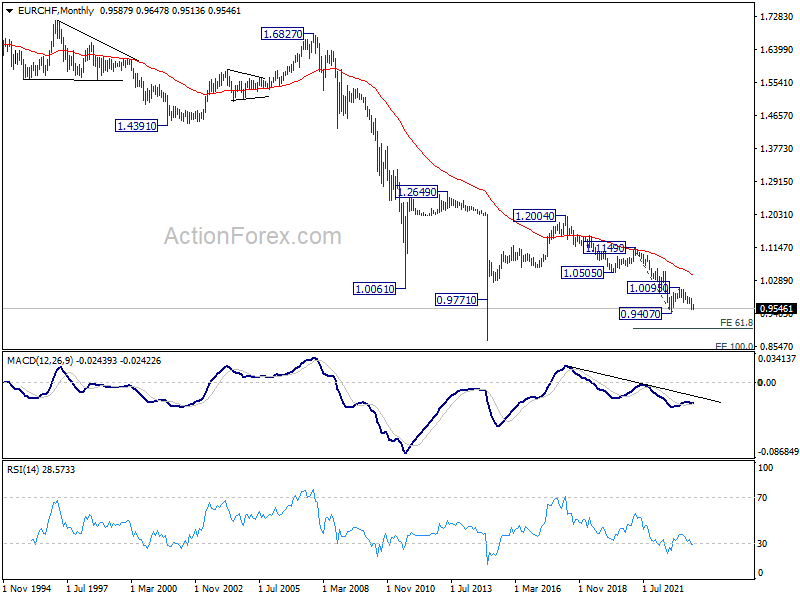
In the bigger picture, medium term outlook is staying bearish as the pair is capped well below falling 55 W EMA (now at 0.9839). Down trend from 1.2004 (2018 high) is in favor to continue. Sustained break of 0.9407 will target 61.8% projection of 1.1149 to 0.9407 from 1.0095 at 0.9018. For now, this will remain the favored case as long as 0.9670 support turned resistance holds, in case of strong rebound.
In the long term picture, outlook remains bearish as it's staying well below 55 M EMA (now at 1.0421). Break of 1.00095 resistance is needed to be the first sign of bottoming, or the multi-decade down trend is expected to continue.
Powell at Jackson Hole: Fed Committed to 2% Inflation But Agility Required
Summary
- Fed Chair Jerome Powell reiterated the FOMC's commitment to bring inflation down to 2% during his speech in Jackson Hole, WY today. He stated that "two percent is and will remain our inflation target."
- In order to bring inflation back to target, Powell said that a period of below-trend economic growth will be required. Consequently, the stance of monetary policy will need to remain restrictive for the foreseeable future. The Fed Chair also indicated that the FOMC "is prepared to raise rates further if appropriate."
- But the FOMC is facing a number of uncertainties at this juncture. Consequently, Fed policymakers will need to be "agile." In other words, the FOMC is in data dependency mode for the foreseeable future.
- We believe there is a high bar for the FOMC to raise rates at its September 20 meeting. We forecast the Committee will remain on hold at subsequent meetings, but we acknowledge the risk of further tightening if economic growth does not slow to a below-trend rate and/or inflation remains unacceptably high.
Fed Committed to 2% Inflation Target
As has become customary for the Chair of the Federal Reserve, Jerome Powell kicked off the Kansas City Fed's annual Jackson Hole Economic Policy Symposium today with a speech entitled "Inflation: Progress and the Path Ahead." The speech that Powell delivered last year at Jackson Hole, which we discussed in our Weekly Economic and Financial Commentary on August 26, 2022, was short and to the point. In the five-page speech that he delivered last year, Powell essentially said that the FOMC would do everything needed to ensure that inflation would return to the Committee's 2% target. The FOMC had already raised rates by 225 bps when Powell delivered his speech last year. It would go on to hike by another 300 bps in the subsequent 12 months.
The mission at Jackson Hole last year was simple. Powell needed to convince market participants that the FOMC was committed to bringing down inflation, and his concise and direct remarks largely succeeded in that regard. Because inflation remains above target today, the Fed Chair apparently wanted to send a message that the FOMC remains committed to bringing inflation down. He reiterated last year's mantra at the very beginning of his remarks today by saying "it is the Fed's job to bring inflation down to our two percent goal, and we will do so." In case the point was missed, he closed by saying "restoring price stability is essential," and "we will keep at it until the job is done." Powell also threw cold water on any expectations that the FOMC might tweak its inflation target higher by stating "two percent is and will remain our inflation target."
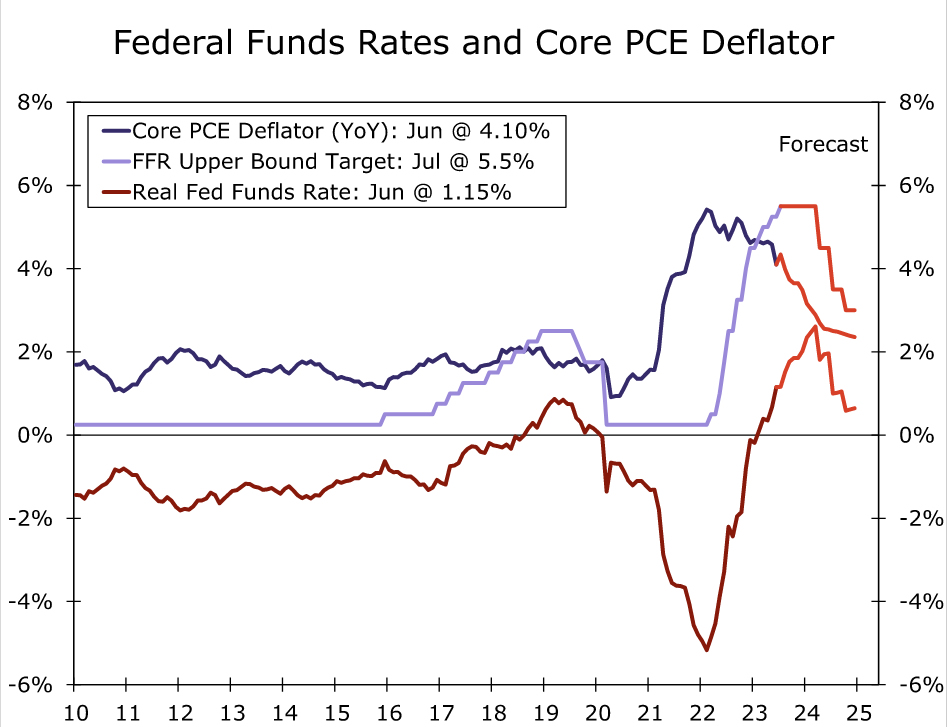
Although Powell welcomed the decline in the rate of inflation that has occurred since last year's speech—the year-over-year rate of core PCE inflation has receded gradually from its peak of 5.4% in February 2022 to 4.1% currently—he indicated that "it remains too high." In order to bring inflation back to the Committee's 2% target, the Fed Chair said that the labor market must become less tight. Powell went on to state that "a period of below-trend economic growth" will be needed to bring inflation sustainably back to target. Consequently, the stance of monetary policy, which Powell characterized as "restrictive" at present, will need to remain so for the foreseeable future. In short, the Fed likely will not be cutting rates anytime soon. Indeed, Powell indicated that the FOMC "is prepared to raise rates further if appropriate."
Uncertainties Cloud the Outlook for Monetary Policy
But Powell also highlighted in this year's speech the uncertainties the FOMC faces in achieving its goal. He noted that "it is challenging to know in real time" when a sufficiently restrictive stance of policy has been achieved, and he said "that assessment is further complicated by uncertainty about the duration of the lags with which monetary tightening affects economic activity and especially inflation." Because there is a risk of doing too much (i.e., tanking the economy) as well as a risk of doing too little (i.e., allowing high inflation to become entrenched), Powell said that policymaking will need to be "agile" going forward. In short, the FOMC is in data dependency mode at present. Incoming economic data will determine whether the Committee tightens policy further or whether it decides to remain on hold. But given the current state of play—the real economy appears to be holding up rather well and inflation remains well above target—don't expect monetary easing anytime soon.
Our assessment is that there is a high bar for the FOMC to raise rates at its next policy meeting on September 20. Patrick Harker, the president of the Federal Reserve Bank of Philadelphia and a voting member of the FOMC this year, said yesterday that the Committee has "probably done enough" in terms of monetary tightening. It appears that there are a number of other Committee members who also think that further tightening is not warranted. If the macro U.S. economy evolves largely in line with our forecast in coming months, then we think the FOMC will remain on hold at its November 1 meeting as well. That said, we acknowledge the risk that the Committee could tighten further at future meetings if economic growth does not slow to a below-trend rate and/or inflation remains unacceptably high.
Even if the FOMC remains on hold, the stance of monetary policy is likely to tighten passively in coming months. Real interest rates matter more for real economic growth than nominal interest rates. If, as we forecast, the FOMC remains on hold as inflation recedes gradually further in coming months, then the real fed funds rate will creep higher (Figure 1). Although the probability of a "soft landing" has increased, the economy is by no means "out of the woods" in terms of a potential recession. Indeed, we continue to forecast that real GDP will contract modestly in the first half of 2024 and that the unemployment rate will rise by roughly one percentage point or so from its current level of 3.5%. For details, see our most recent U.S. Economic Outlook.
Fed Chair Powell on “Navigating by the Stars Under Cloudy Skies”
At the Federal Reserve Bank of Kansas City's Jackson Hole Symposium, Federal Reserve Chair Jay Powell gave a much-anticipated speech titled, Inflation: Progress and the Path Ahead.
Chair Powell kicked off his remarks re-iterating the Fed's 2% target, and its commitment to attaining that goal. Powell outlined the decline in inflation so far, and acknowledged the welcome cooler inflation readings in past two months. However, he then emphasized that there is "substantial further ground to cover to get back to price stability."
On the inflation outlook, he discussed the three key parts of inflation in more detail, but stuck to his past messaging that "getting inflation sustainably back down to 2 percent is expected to require a period of below-trend economic growth as well as some softening in labor market conditions." In terms of inflation details:
- He noted that sustained progress on core goods prices is needed.
- On the services side, that housing services inflation has recently begun to fall, and the process is expected to continue given the well known lags (see report), but they will be watching market rent data closely.
- Finally, inflation in non-housing services , aka "supercore", has finally started to decline on a three and six-month basis, and "further progress will be essential to restoring price stability". But that "over time restrictive monetary policy… reducing inflationary pressures in this key sector."
On the economic outlook, he pointed out that there is evidence that higher real long-term yields (up about 150 basis points since last year), and tighter financial conditions are contributing to slower growth in the economy. But that more recently, growth has remained above trend, and consumer spending has been picking up. Powell also noted that the labor market is rebalancing but the process remains incomplete. On both scores the speech emphasized that if progress is no longer being made, it would also call for a "monetary policy response" – aka further rate hike(s).
Before concluding he acknowledged that the uniqueness of the current cycle causes additional uncertainty for policymakers. For example, job openings have declined substantially without a rise in the unemployment rate. Therefore, the fed will need to remain "agile" in setting policy.
As to where that policy is headed, given that they are "navigating by the stars under cloudy skies" he kept his options open. The Fed will "proceed carefully" on whether to tighten further or hold steady.
Key Implications
The Chair's speech at Jackson Hole is always a marquee economic event, but with the Fed at a pivot point in its tightening cycle, this year's speech was particularly important. Markets are trying to gauge whether the fed is in wait-and-see mode, and feels it can be patient and wait for past rate hikes to cool the economy and bring down inflation, or whether more rate hikes are required. Looking at the market's reaction immediately following the speech, the odds on future fed hikes didn't shift a great deal. The slim odds of a hike in September got slimmer, and the roughly 50% odds of a hike in November are every so slightly higher. Market odds on the first rate cut next year remain unchanged at June.
In recent weeks market pricing had likely moved in a direction the Fed liked, so Powell likely didn't want to rock the boat too much. The Fed is in wait and see mode, but has its finger hovering over the hike button if progress on cooler growth stalls. As discussed in our recent Q&A, the FOMC will likely to continue to talk tough, to prevent an undesirable give back in bond yields, as it watches the incoming data closely.