Sample Category Title
Powell signals Fed’s readiness to tighten further amid inflation concerns
Fed Jerome Powell made clear the Central Bank's stance on the current inflation environment in his opening remarks at the Jackson Hole Symposium. Noting a decline from peak inflation rates, Powell emphasized, "Although inflation has moved down from its peak—a welcome development—it remains too high."
Demonstrating Fed's commitment to fight inflation, he added, "We are prepared to raise rates further if appropriate, and intend to hold policy at a restrictive level until we are confident that inflation is moving sustainably down toward our objective."
Acknowledging the recent decline in core inflation during June and July, Powell cautioned against reading too much into short-term data. "The lower monthly readings for core inflation in June and July were welcome, but two months of good data are only the beginning of what it will take to build confidence that inflation is moving down sustainably toward our goal," he remarked.
Drawing a metaphor to describe the present economic landscape, Powell stated, "As is often the case, we are navigating by the stars under cloudy skies." Under such conditions, he emphasized the importance of a strategic and risk-aware approach.
Elaborating on the Fed's forward plan, Powell said, "At upcoming meetings, we will assess our progress based on the totality of the data and the evolving outlook and risks. Based on this assessment, we will proceed carefully as we decide whether to tighten further or, instead, to hold the policy rate constant and await further data."
This clear yet cautious messaging from Powell reiterates the Fed's commitment to ensuring price stability and managing the inflationary pressures faced by the economy, while also emphasizing a data-driven and measured approach to monetary policy adjustments.
Market Treads Cautiously Ahead of Powell and Lagarde’s Speeches
As the financial world gears up for the much-anticipated remarks from Fed Chair Jerome Powell and ECB President Christine Lagarde, market participants are treading with caution. Dollar has started to retreat, shedding some of its recent impressive gains. Simultaneously, Euro grapples to find solid ground elsewhere amidst a mixed backdrop.
Both leading central bank figures hold the potential to introduce unexpected elements in their addresses, and market stakeholders are all too aware of the volatility this could trigger. The spotlight on Powell will shine particularly on his interpretation of the juxtaposed trends of softening headline inflation and the persistence of service sector prices. Additionally, the consequences of robust consumer spending will be keenly observed.
In the European context, the grapevine is abuzz with speculation. Following the recently revealed PMI data, which fell well short of market expectations, rumors are rife that Lagarde might hint at a monetary policy pause in September. Such a move, if communicated or even hinted at, could instigate significant market shifts as the week concludes.
Technically, to indicate a near term bearish reversal in Dollar, 1.0929 resistance in EUR/USD, 1.2799 resistance in GBP/USD, 0.8758 support in USD/CHF will need to be taken out decisively Meanwhile, for Dollar to confirm underlying bullish momentum, UUSD/JPY and USD/CD should break through 146.55 and 1.3602 resistance respectively with ease. The market awaits these developments with bated breath.
In Europe, at the time of writing, FTSE is up 0.66%. DAX is up 0.65%. CAC is up 0.88%. Germany 10-year yield is up 0.0368 at 2.553. Earlier in Asia, Nikkei dropped -2.05%. Hong Kong HSI dropped -1.40%. China Shanghai SSE dropped -0.56%. Singapore Strait Times rose 0.29%. Japan 10-year JGB yield rose 0.0110 to 0.660.
German Ifo business climate sinks for fourth month, economy faces uphill battle
Germany's economic outlook has dimmed yet again, as indicated by the Ifo Business Climate Index which registered its fourth consecutive monthly drop. In August, the index tumbled from 87.4 to 85.7. The downward trajectory was visible across both Current Situation Index, which slid from 91.4 to 89.0, and Expectations Index, which descended from 83.6 to 82.6.
A sectoral breakdown of the data highlighted broad-based concerns. Manufacturing saw a decline from -13.9 to -16.6. Meanwhile, Services sector took a more significant hit, plummeting from a modest 1.0 to a concerning -4.2. Trade and Construction sectors also continued their downward spiral, recording readings of -25.5 and -29.3 respectively, from their previous standings of -23.7 and -24.6.
Ifo's commentary on the data was stark. They noted, "Assessments of the current situation fell to their lowest level since August 2020." The institution also flagged a growing pessimism among companies regarding the forthcoming months, adding, "The German economy is not out of the woods yet."
Chinese stocks falter despite efforts to boost confidence
In a bid to shake off the lethargy that has seen Chinese stocks on a decline for three consecutive weeks, authorities have taken notable measures. Yet, the efforts seem to have fallen short. Reports suggest that the Chinese government is contemplating a reduction in stamp duty on stock trading by up to 50%. This is seen as a move to rejuvenate waning investor confidence.
The China Securities and Regulatory Commission also made an endeavor to put concerns at bay. The regulatory body convened a virtual meeting with multiple global financial institutions, emphasizing the resilience and potential of China's economic landscape. But these overtures seem to have done little in swaying investor sentiment, at least for now.
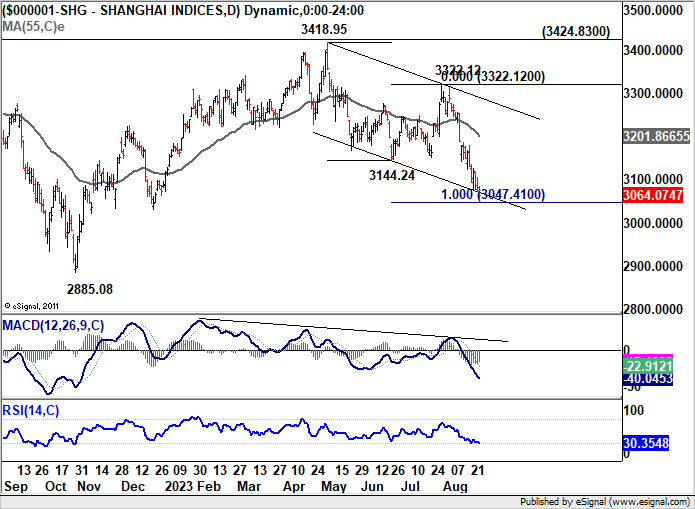
The Shanghai SSE extended the whole down trend from 3418.95 to close at 3064.07. It's now in proximity to 100% projection 3418.95 to 3144.24 from 3322.12. Strong rebound from current level, followed by firm break of 3144.24 support turned resistance, will argue that the decline has completed already. The three wave structure would also affirm that it's merely a corrective move.
However, sustained break of 3047.41 could prompt further downside acceleration towards 2885.08 (2022 low), and open up more medium term bearish bias. The situation could probably unfolded next week and that would be an important risk factor in Asia, in addition to the aftermath of Jackson Hole in the US.
USD/JPY Daily Outlook
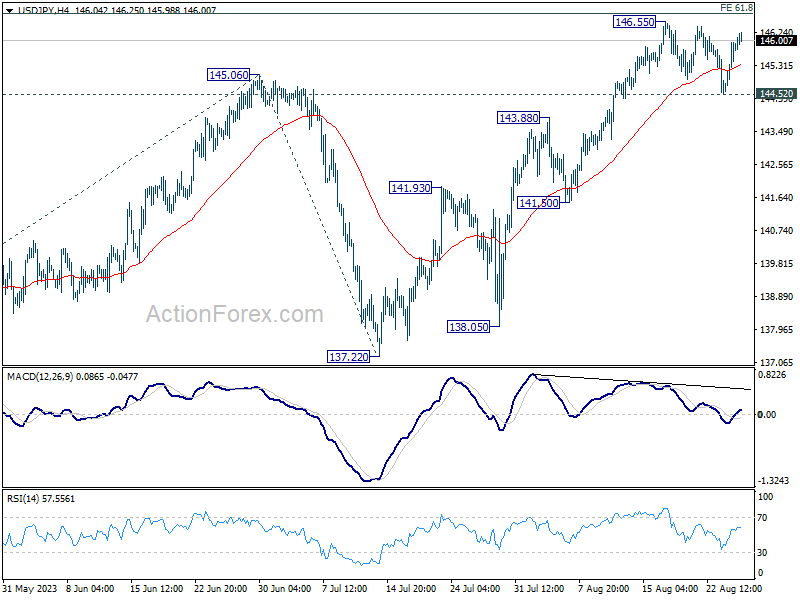
Daily Pivots: (S1) 144.98; (P) 145.47; (R1) 146.34; More...
Intraday bias in USD/JPY stays neutral as it's still bounded in range. On the upside, sustained break of 61.8% projection of 129.62 to 145.06 from 137.22 at 146.76 will pave the way to retest 151.93 high. However, considering bearish divergence condition in 4H MACD, firm break of 144.52 support will be a sign of reversal, and turn bias back to the downside for 55 D EMA (now at 142.45).
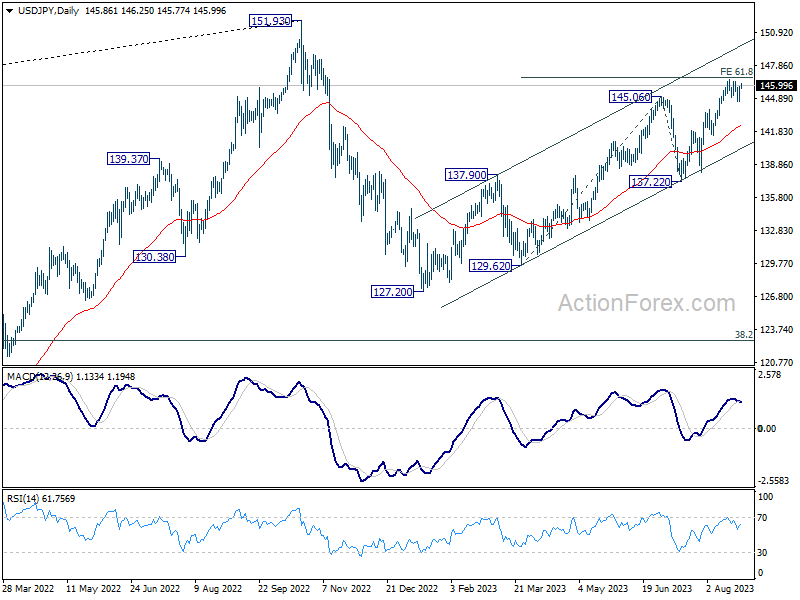
In the bigger picture, overall price actions from 151.93 (2022 high) are views as a corrective pattern. Rise from 127.20 is seen as the second leg of the pattern and could still be in progress. But even in case of extended rise, strong resistance should be seen from 151.93 to limit upside. Meanwhile, break of 137.22 support should confirm the start of the third leg to 127.20 (2023 low) and below.
Economic Indicators Update
| GMT | Ccy | Events | Actual | Forecast | Previous | Revised |
|---|---|---|---|---|---|---|
| 23:30 | JPY | Tokyo CPI Y/Y Aug | 2.90% | 3.00% | 3.20% | |
| 23:30 | JPY | Tokyo CPI ex Fresh Food Y/Y Aug | 2.80% | 2.90% | 3.00% | |
| 23:30 | JPY | Tokyo CPI ex Food Energy Y/Y Aug | 4.00% | 4.00% | ||
| 23:50 | JPY | Corporate Service Price Index Y/Y Jul | 1.70% | 1.20% | 1.20% | 1.40% |
| 06:00 | EUR | Germany GDP Q/Q Q2 F | 0.00% | 0.00% | 0.00% | |
| 08:00 | EUR | Germany IFO Business Climate Aug | 85.7 | 86.6 | 87.3 | 87.4 |
| 08:00 | EUR | Germany IFO Current Assessment Aug | 89.0 | 89.8 | 91.3 | 91.4 |
| 08:00 | EUR | Germany IFO Expectations Aug | 82.6 | 83.8 | 83.5 | 83.6 |
| 14:00 | USD | Michigan Consumer Sentiment Index Aug F | 71.2 | 71.2 |
Chinese stocks falter despite efforts to boost confidence
In a bid to shake off the lethargy that has seen Chinese stocks on a decline for three consecutive weeks, authorities have taken notable measures. Yet, the efforts seem to have fallen short. Reports suggest that the Chinese government is contemplating a reduction in stamp duty on stock trading by up to 50%. This is seen as a move to rejuvenate waning investor confidence.
The China Securities and Regulatory Commission also made an endeavor to put concerns at bay. The regulatory body convened a virtual meeting with multiple global financial institutions, emphasizing the resilience and potential of China's economic landscape. But these overtures seem to have done little in swaying investor sentiment, at least for now.
The Shanghai SSE extended the whole down trend from 3418.95 to close at 3064.07. It's now in proximity to 100% projection 3418.95 to 3144.24 from 3322.12. Strong rebound from current level, followed by firm break of 3144.24 support turned resistance, will argue that the decline has completed already. The three wave structure would also affirm that it's merely a corrective move. However, sustained break of 3047.41 could prompt further downside acceleration towards 2885.08 (2022 low), and open up more medium term bearish bias.
Investors will likely be keeping an eagle eye on developments next week. The unfolding situation in China's stock market stands as a significant risk factor in Asia, especially when juxtaposed with the aftermath of the Jackson Hole symposium in the US.
Crypto Market Tamed on the Lower Ladder
Market picture
Thursday’s sell-off in the US stock market forced cryptocurrencies to bounce back from the previous day. As a result, the crypto market capitalisation is back at $1.05 trillion (-1.8% in 24 hours). Solana (-5.2%) and XRP (-3.3%) led the decline among the top altcoins, while Ethereum held up relatively well, losing 1.3%.
The Cryptocurrency Fear and Greed Index is in “Fear” territory for the latest week, with a current reading of 39. By this measure, the market is far from oversold and not yet attractive to bargain hunters.
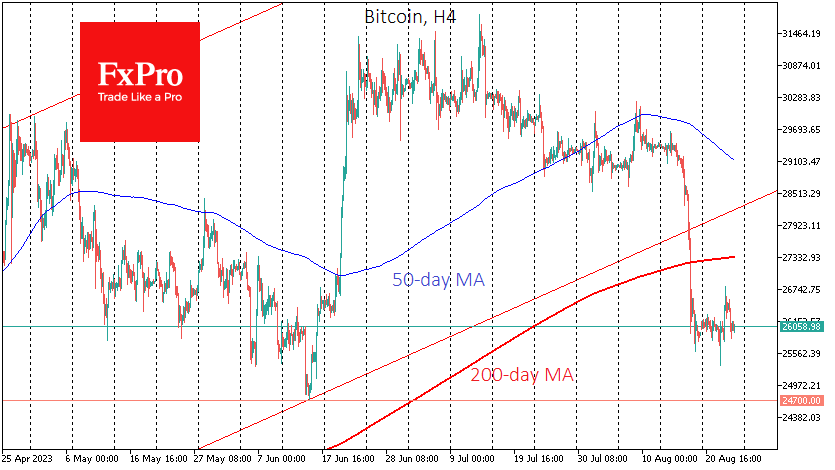
Bitcoin has entered another long horizontal consolidation and is going down another ladder. The previous two ladders were from late June to mid-July (around $30.5K) and from late July to mid-August (around $29.3K).
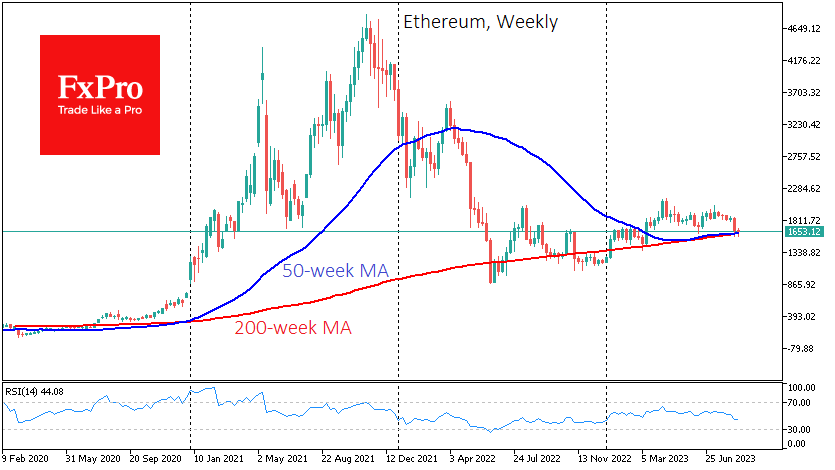
Ethereum is consolidating around $1650, a significant pivot level of the last 12 months. A failure below this level could start a capitulation that could take the price to $1200 within a week or two. The ability to hold here would indicate buyer support, potentially kick-starting a rally.
However, we still see a higher probability of a continued downturn in the crypto market in the coming months.
News background
Social media-famous crypto analyst Justin Bennett warned that Bitcoin could fall as low as $14,000. According to him, BTC has fallen out of the bullish channel it has been in for about a decade. A likely global economic recession and falling stock markets compound the risks.
Bitcoin will halve to $35,000 by April next year and rise to a new record high of $148,000 by July 2025, Pantera Capital predicts, based on historical data from past growth cycles.
Donald Trump’s NFTs surged in value following his interview with US TV host Tucker Carlson. The trading volume of the politician’s NFT collection increased by nearly 1,000% overnight.
Binance stopped supporting cryptocurrency cards in Latin America and the Middle East. Binance launched the first bank cards with cryptocurrency support in 2020.
The decentralised payment protocol Solana Pay has integrated its plugin with the e-commerce platform Shopify. In the first phase, only USDC stablecoin is available for payment.
USD/JPY Breaks Above 146, Tokyo Core CPI Dips to 2.8%
- Tokyo Core CPI gains 2.8%, less than expected
- Powell and Ueda to speak at Jackson Hole symposium
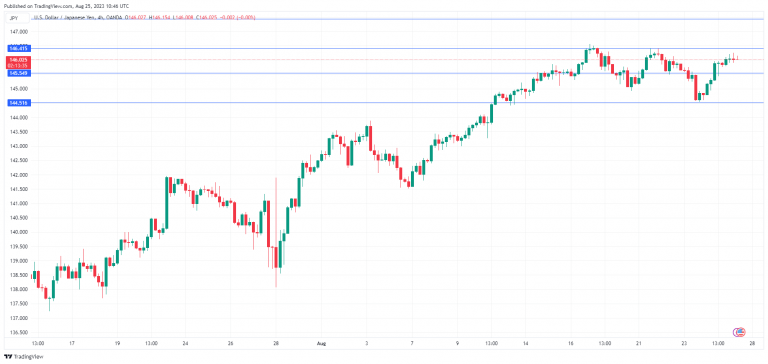
USD/JPY has posted small gains on Friday, enough to push above the symbolic 146 line. On the data calendar, Tokyo Core CPI dipped lower and Fed Chair Powell addresses the Jackson Hole Symposium later today.
Tokyo Core CPI eases to 2.8%
Japan released the Tokyo Core CPI earlier today. This is the first inflation release of the month, making it a key event. In August, Tokyo Core CPI rose 2.8% y/y, down from 3.0% in July and just under the consensus estimate of 2.9%. Despite the drop in inflation, the indicator has remained above the Bank of Japan’s 2% target for some fifteen months. Earlier in the month, the so-called “core-core index”, which excludes fresh food and energy, remained at 4.0%. This points to broad inflationary pressure and raises questions about the BoJ’s insistence that inflation is transient.
The BoJ has said it will not exit its ultra-loose monetary policy until wage growth rises enough to keep inflation sustainable around 2%. Still, the markets have been burned before by the BoJ making unexpected moves and are on guard for the BoJ tightening policy, especially with the yen at very low levels.
The markets are keeping a close eye on the Jackson Hole symposium, with Fed Chair Powell and BoJ Governor Ueda both attending. Powell delivers a key speech on Friday and Ueda will participate in a panel discussion on Saturday. If either one provides insights into future rate policy, it could mean some volatility from USD/JPY on Monday.
What does the Fed have planned? That depends on which Fed member is addressing the media. Philadelphia Fed President Patrick Harker said on Thursday that he didn’t see a need to raise rates further, absent any unexpectedly poor data, but added that the Fed wouldn’t be lowering rates anytime soon. However, Boston Fed President Susan Collins said that rate increases might still be necessary. The Fed is likely to pause at the September meeting, but what happens after that is unclear..
USD/JPY Technical
- USD/JPY is facing resistance at 146.41, followed by 147.44
- There is support at 145.54 and 144.51
AUD/USD: Remains Under Pressure But Key Support Still Holds
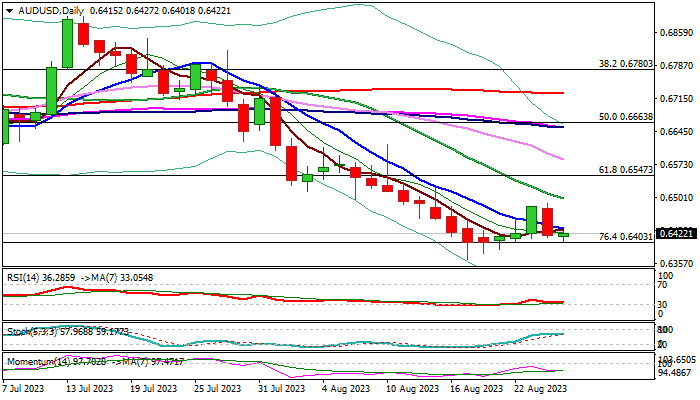
AUDUSD is holding within a narrow range on Friday, as price action reduces speed ahead of today’s key event -speech of Fed Chair Powell at Jackson Hole symposium, which is expected to give more hints about the central bank’s steps in the near future on interest rates.
Near-term structure remains weak following Wednesday’s strong rally (up 0.93% for the day) and subsequent drop on Thursday (down 0.91%) which fully reversed recovery, but still holding above 0.6400 support (psychological / Fibo 76.4% of 0.6170/0.7157 rally) which recently contained several attacks and acts as solid support.
Technical studies on daily chart are in bearish mode and add to overall negative picture, however firm break of 0.6400 zone is required to generate bearish signal and open way for fresh acceleration lower.
The Aussie dollar would come under increased pressure on hawkish comments from Powell, but may receive fresh support if comments sound to markets as less hawkish than expected or dovish.
Res: 0.6488; 0.6500; 0.6567;0.6592.
Sup: 0.6400; 0.6364; 0.6272; 0.6170.
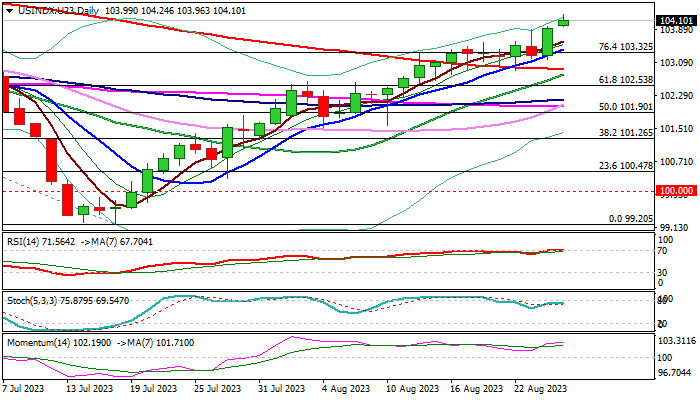
Dollar Index: Bulls Hold Grip ahead of Powell’s Speech in Jackson Hole
The dollar index keeps firm tone and hit the highest since early July in early Friday’s trading, in extension of Thursday’s 0.63% advance (the biggest one day gains since July 27).
The greenback resisted some softer tones from Fed policymakers on Thursday and kept its strong bullish stance against the major world counterparts, on expectations that Fed Chair Powell will reiterate the central bank’s view on keeping high interest rates for extended period.
Recent solid US economic data signal that the economy is relatively resilient and labor sector remains tight that leaves space for keeping high borrowing cost for some time to push still elevated inflation towards the central bank’s target at 2%, without serious negative impact to the economy.
However, traders remain cautious as any softer tones from Powell, which should not be dovish but less hawkish than expected, may sour the sentiment and increase pressure on dollar.
Bulls eye key short-term barrier at 104.59 (May 31 peak) violation of which would unmask next pivotal level at 105.13 (Fibo 38.2% of 114.72/99.20 fall).
Initial support lays at 103.60 (rising 5DMA) followed by 10DMA (103.40), which should ideally keep the downside protected and guard lower pivot at 102.93 (200DMA), loss of which will be bearish.
Res: 104.24; 104.59; 105.13; 105.40.
Sup: 103.60; 103.40; 103.18; 102.93.
EUR/USD: Euro Falls to New Multi-Week Low Following Break of Key Supports
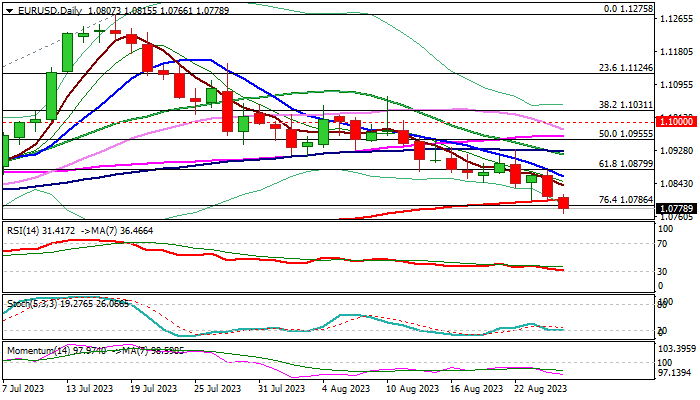
The Euro dips further on Friday and on track for the sixth consecutive weekly loss.
Weak risk sentiment and growing expectations that the Fed and ECB would raise their interest rates again in November, add pressure on the single currency, as markets await today’s speeches of Fed Chair Powell and ECB President Lagarde at the Jackson Hole, to get more clues about the future steps of major central banks.
Additional pressure on Euro came from German GDP data which showed that the economy stagnated in the second quarter after a winter recession and contribute to gloomy outlook, with weaker than expected country’s business morale (Ifo report) in August, further souring the sentiment.
Bears broke below 200DMA (1.0802) and Fibo support at 1.0786 (76.4% of 1.0635/1.1275) with close below these levels to confirm fresh bearish signal and increase risk of test of 1.0700 (psychological) and 1.0635 (May 31 low) in extension.
Daily studies remain bearish and support the action, with upticks to be capped by falling 10DMA (1.0862) to keep larger bears in play.
Res: 1.0802; 1.0839; 1.0862; 1.0879.
Sup: 1.0733; 1.0700; 1.0667; 1.0635.
German Ifo business climate sinks for fourth month, economy faces uphill battle
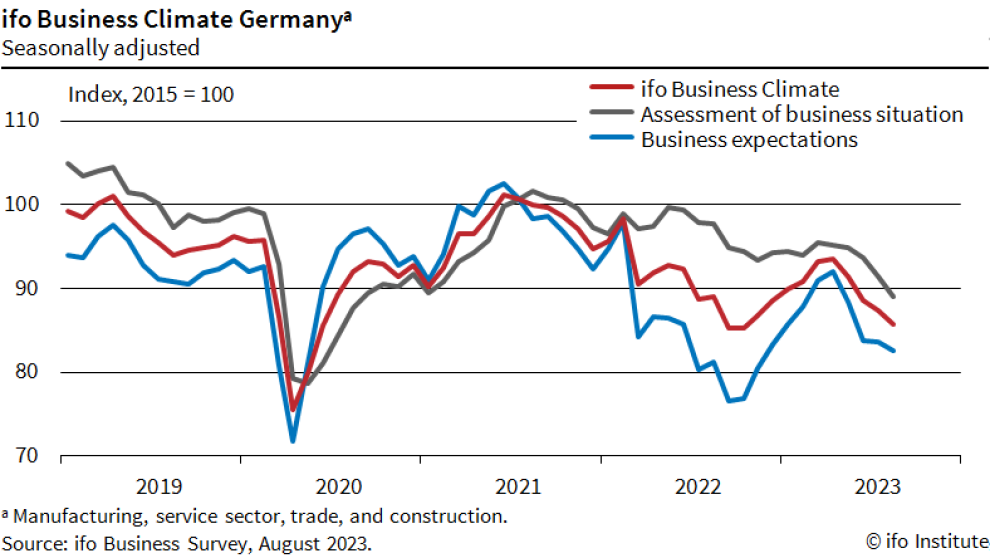
Germany's economic outlook has dimmed yet again, as indicated by the Ifo Business Climate Index which registered its fourth consecutive monthly drop. In August, the index tumbled from 87.4 to 85.7. The downward trajectory was visible across both Current Situation Index, which slid from 91.4 to 89.0, and Expectations Index, which descended from 83.6 to 82.6.
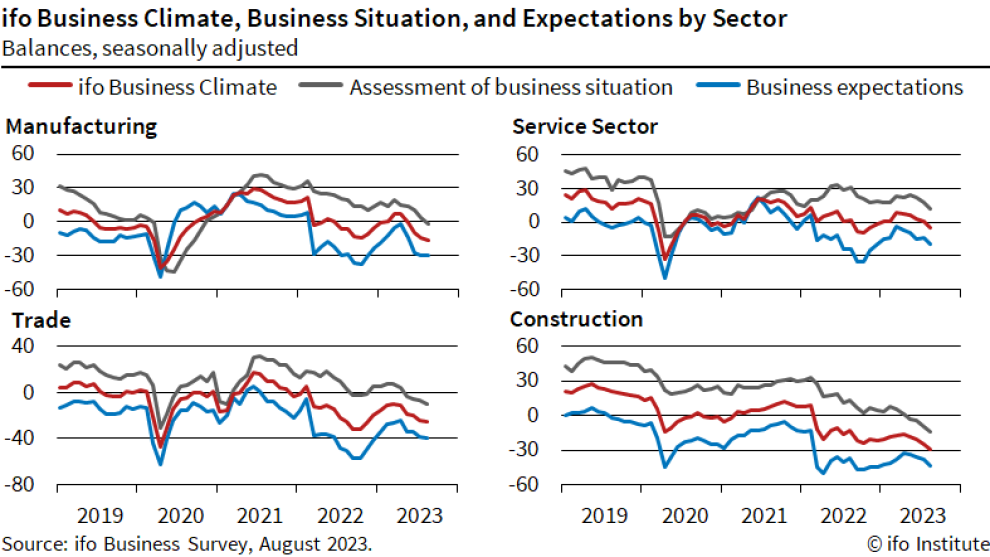
A sectoral breakdown of the data highlighted broad-based concerns. Manufacturing saw a decline from -13.9 to -16.6. Meanwhile, Services sector took a more significant hit, plummeting from a modest 1.0 to a concerning -4.2. Trade and Construction sectors also continued their downward spiral, recording readings of -25.5 and -29.3 respectively, from their previous standings of -23.7 and -24.6.
Ifo's commentary on the data was stark. They noted, "Assessments of the current situation fell to their lowest level since August 2020." The institution also flagged a growing pessimism among companies regarding the forthcoming months, adding, "The German economy is not out of the woods yet."
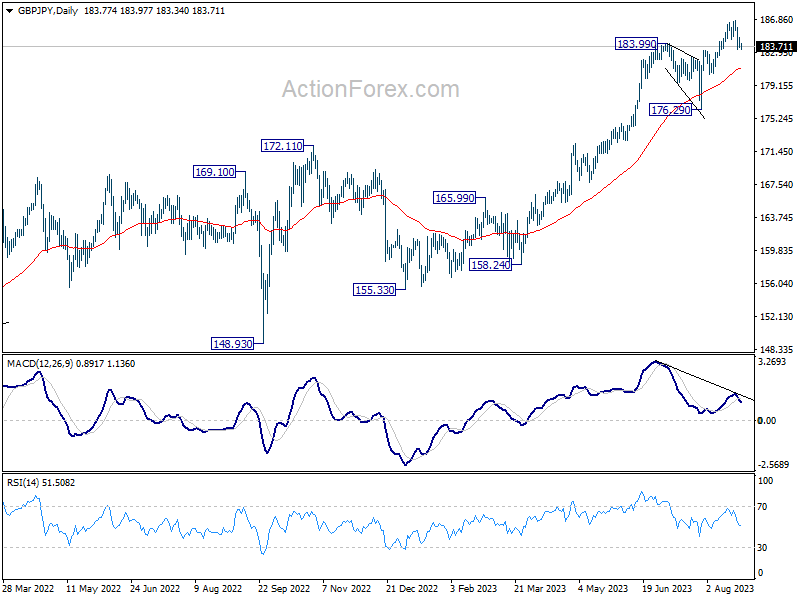
GBP/JPY Daily Outlook
Daily Pivots: (S1) 183.31; (P) 184.04; (R1) 184.46; More...
Intraday bias in GBP/JPY stays mildly on the downside for the moment. Fall from 186.75 short term top is in progress for 55 D EMA (now at 181.16). For now, risk will remain on the downside as long as 186.75 resistance holds, in case of recovery.
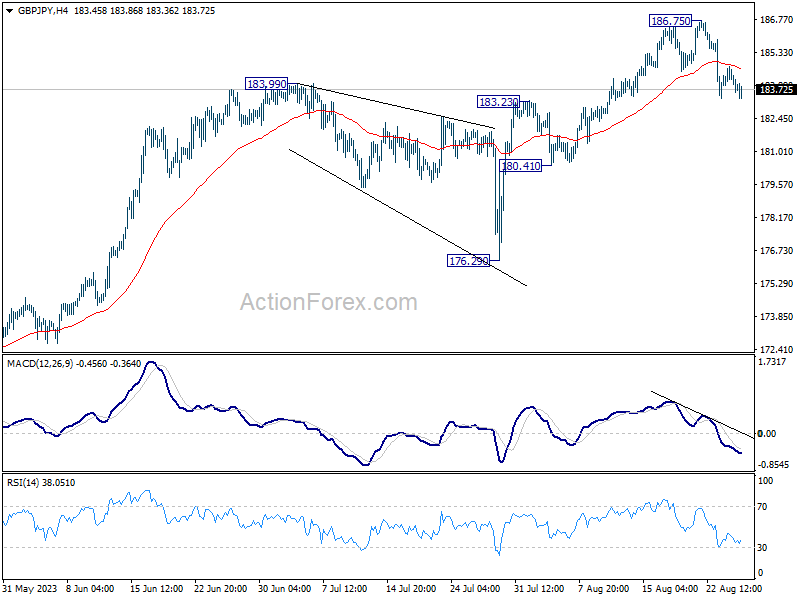
In the bigger picture, up trend from 123.94 (2020 low) is in progress. Next target is 195.86 (2015 high). This will now remain the favored case as long as 176.29 support holds, even in case of deeper pull back.