

Sample Category Title
ECB’s Vujcic: Whether we are in a restrictive-enough territory remains to be seen
ECB Governing Council member Boris Vujcic acknowledged the restrictive nature of the ECB's present stance. However, he tempered this by highlighting the uncertainty that remains, suggesting that the real test of the bank's approach lies ahead.
"Whether we are in a restrictive-enough territory remains to be seen. And this is something that you will only see from the inflation data that will come in the next prints," he emphasized.
Despite indications of a cooling economic activity, Vujcic pointed out that this deceleration is not as evident in the current inflation rates. The upcoming months, according to him, will be crucial in discerning the direction of services inflation and in understanding "whether we will feel the consequences of the slowdown in the labor market."
While ECB expects to reach its 2% inflation target in 2025, Vujcic said that "by spring next year, we will have a clearer picture of whether we are firmly on the path toward achieving that or we will have to do more."
ECB’s Nagel: Too early to think about a pause
ECB Governing Council member Joachim Nagel, in remarks made yesterday, reinforced his stance on the ongoing monetary tightening efforts of the central bank. Addressing speculations around a potential pause, he firmly stated, "It's for me much too early to think about a pause," emphasizing the significant gap between the current inflation rate and ECB's target.
Nagel pointed out the glaring disparity between the present inflation situation and ECB's benchmark, saying, "We shouldn't forget inflation is still around 5%. So this is much too high. Our target is 2%. So there's some way to go."
Despite the overarching concern regarding a slowdown in economic activity in Eurozone, Nagel highlighted the persistence of core inflation and characterized the labor market as being "really pretty good."
Dismissing prevalent narratives surrounding Germany's economic health, he countered, "I hear a lot of talk about Germany, the sick man of Europe. This is definitely not the case." Concluding on an optimistic note, Nagel added, "I'm still pretty optimistic that we will have a soft landing."
ECB’s Centeno: Downside risks have materialized
ECB Governing Council member Mario Centeno, indicated yesterday that the transmission of ECB's policy is "up and running" and pointed out the rapidity with which inflation has decelerated, noting its descent has outpaced its ascent.
However, he urged prudence, stating, "We have to be cautious this time around because downside risks that we identified in June in our forecast have materialized." This marks a shift from the pattern observed throughout the pandemic recovery, where, as Centeno highlighted, "usually we have been surprised on the upside."
Centeno also hinted at the uncertainty ahead, observing, "There's plenty of data still to be made available until the September decision." He further emphasized the significance of the upcoming forecast, mentioning, "We have a new forecast. That forecast will tell us precisely how we see this transmission of our decisions into inflation and the economy."
Cliff Notes: Eagerly Awaiting Chair Powell at Jackson Hole
Key insights from the week that was.
Following last week’s update on aggregate wage inflation, Westpac revised its profile for wages growth over 2023 and 2024. In essence, the update speaks to a broad-based moderation in the pace of wage inflation. This is certainly highlighted by the softer-than-expected outcome for the headline figure in June, up 0.8% (3.6%yr), but is also witnessed to by the detail. The moderation is evident across most components of the data, not only in the breakdowns by sector and by bargaining arrangement, but also if bonuses are included or only those who received a pay increase are considered. The next update for September quarter 2023 will capture an above-average increase in the minimum wage (5.9% in 2023 vs. 4.7% in 2022) in addition to the 15% pay raise for aged care workers. Still, factoring in that strength – a forecast 1.3% gain – is still not enough to offset the broader moderation at play, leading us to revise down our year-end forecast for wages growth from 4.1%yr to 3.8%yr.
The August edition of Westpac’s Housing Pulse provided an in-depth update on the current drivers and outlook for Australia’s housing market. The upturn has gradually gained traction over recent months, but with turnover rising slowly, the recovery remains characterised as ‘price-led’. The nature of the recovery to date highlights the importance of affordability constraints, a factor which we believe will play a key role in guiding house price outcomes over the next few years. This is most aptly highlighted by the sub-indexes in the Westpac-MI Consumer Sentiment survey. At 72.1, the ‘time to buy a dwelling’ index remains near extreme cyclical lows; at 151.2, the House Price Expectations Index is meanwhile at a new cycle high, in strongly optimistic territory. Westpac expects house prices to rise by 7% in 2023; then, as affordability acts as a drag on buyer sentiment and demand, house price growth is expected to slow to 4% in both 2024 and 2025.
Before moving offshore, a quick note on Australia’s goods exports. This sector has become an increasingly important driver of growth over the last three years, with its share of the national economy up from 19% in 2019 to 27% in 2022. However, this strength was inherently built upon a fragile base, effectively being the consequence of a surge in global commodity prices, up 52.8% since 2019. Meanwhile, goods export volumes have declined by 2.1% over the last three years, the weakest result on record dating back to 1960. This largely speaks to the emerging weakness in resource exports, namely the “Big 3” of metal ores, coal and other fuels which together account for nearly two-thirds of Australia’s goods export volumes. The “Big 3” have suffered from a sustained period of underinvestment in capacity and repeat instances of disruptions to production, an environment that is clearly unable to foster quality growth in real export volumes. While the near-to-medium term outlook should benefit from fewer disruptions and some semblance of an investment response, the longer-term outlook for resource exports appears more uncertain. The transition to net-zero necessitates a restructuring of energy production globally, weakening global appetite for Australia’s fossil fuel exports. However, it also requires rapid investment in infrastructure and the replacement of transport fleets globally. The transition is therefore a constraint for some producers, but a great opportunity for others.
Offshore, the August flash PMIs for Europe, UK, US and Japan were instructive, pointing to a further deterioration in manufacturing and emerging weakness in services.
In the US, the manufacturing PMI ticked down to 47.0 from 49.0 led by declines in output and new orders. Services also ticked down from 52.3 to 51.0, likely attributable to softening consumer spending. The employment sub-index for both showed an incremental increase in employment, the slowest through this cycle, with declining new orders and rising wage costs arguably prompting some firms to consider cutting staff. Input price inflation was positive again after a brief trip below 50. This was supported by larger wage bills and an increase in raw material prices. However, output prices are now under pressure as firms discount their goods and services given constrained consumer spending power.
In the UK, the services PMI fell into contraction for the first time since January, 48.7. Both new orders and output declined while jobs rose marginally. A moderation in input costs came from lower energy and material prices, but wages continue to worry many firms. Output prices eased for the fourth month in a row, though this is yet to show up in the CPI. Manufacturing meanwhile fell deeper into contraction to 42.5, the thirteenth sub-50 reading in a row. New order and production both decelerated, signalling a bleak outlook.
Europe's services PMI saw a sizeable decline to 48.3, a 30-month low, while manufacturing improved to a still deeply contractionary 43.7. Employment in manufacturing was weak while services employment softened but remained expansionary. Manufacturers' costs declined, likely thanks to easing energy prices, as strong wage growth supported services input costs. Manufacturer output prices fell, continuing along their trend, while services prices rose slowly.
Japan's manufacturing PMI was little changed at 49, and services held up at 54.3. Optimism in services is likely driven by strong tourism spending versus domestic demand. Employment continued to show promise, a constructive development for next year's spring wage negotiations which the BoJ will keenly assess. Input prices also increased in Japan, though the detail suggests passthrough to services is more probable than manufacturing.
While there was no new data of significance for China this week, market participants remained focused on possible outcomes there in coming months. A quiet data week allowed us to take a deep dive into the recent detail for trade, investment and consumption, with a view to assess both the strengths and weaknesses of China’s economy and consequently the most probable evolution of growth with/ without further support from authorities. In our view, clear, active support from authorities can sustain growth around the current 5% target for a few more years. However, inaction is likely to entrench current pessimism amongst consumers and small business, weakening growth prospects to the extent that authorities medium-term development ambitions are unlikely to come to pass. Which path China takes will be determined in the next few months.
USD/JPY Remains In Strong Uptrend As Dollar Gains Strength
Key Highlights
- USD/JPY climbed above the 146.00 level before it corrected lower.
- A key bearish trend line is forming with resistance near 146.15 on the 4-hour chart.
- EUR/USD could extend losses below the 1.0800 level.
- GBP/USD could dive and trade toward 1.2550.
USD/JPY Technical Analysis
The US Dollar started a strong increase above the 143.20 level against the Japanese Yen. USD/JPY even before the 144.50 resistance and climbed above 145.50.
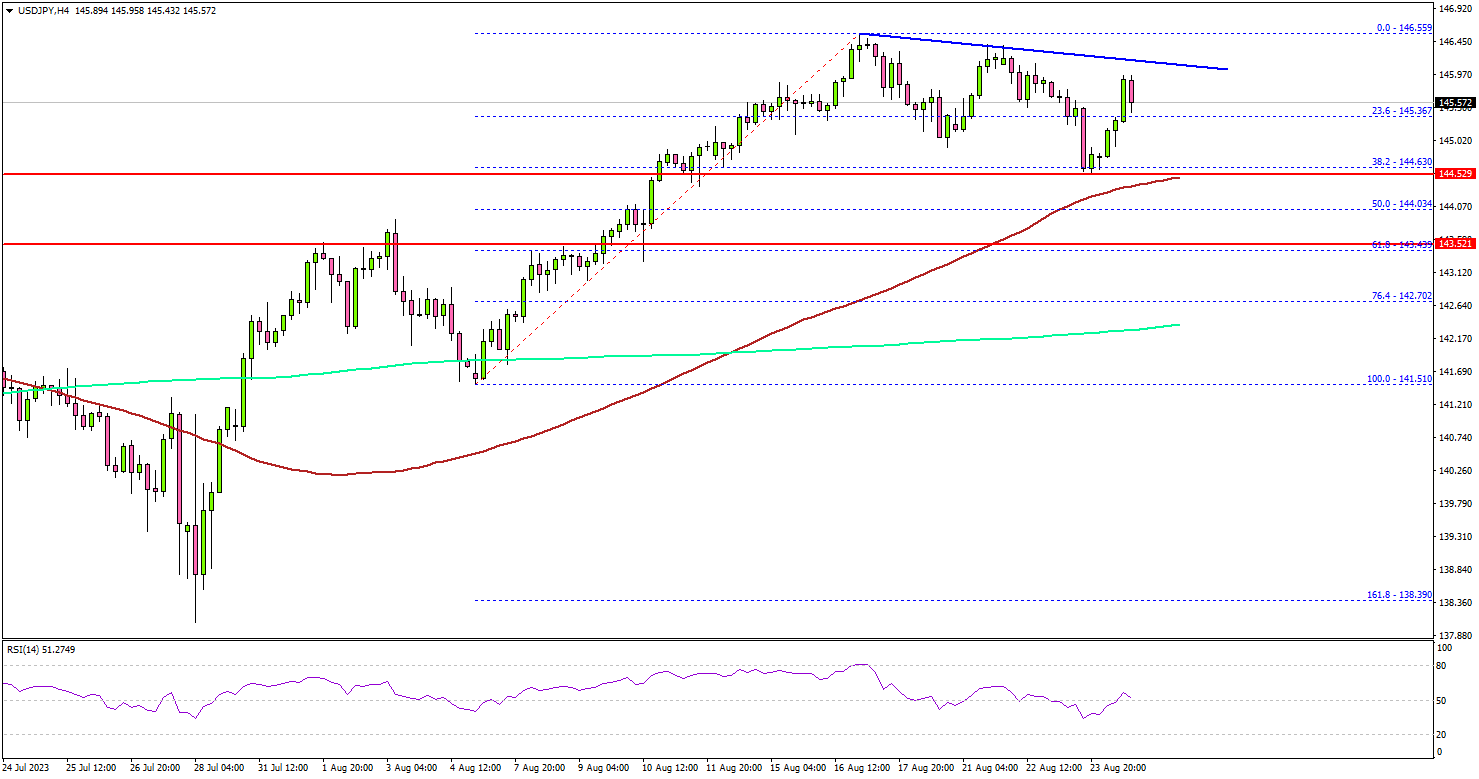
Looking at the 4-hour chart, the pair traded toward the 146.50 level and settled above the 100 simple moving average (red, 4 hours) and the 200 simple moving average (green, 4 hours).
A high was formed near 146.55 before there was a minor downside correction. The pair traded below the 145.50 level and tested the 38.2% Fib retracement level of the upward move from the 141.51 swing low to the 146.55 high.
The pair stayed above 144.60 and the 100 simple moving average (red, 4 hours). It is now attempting a fresh increase above 145.20. On the upside, an initial resistance is near the 146.20 level. There is also a key bearish trend line forming with resistance near 146.15 on the same chart.
A close above 146.20 could start a decent increase. In the stated case, the pair could rise toward the 146.55 level. Any more gains could start a fresh increase toward the 148.00 level.
If not, the pair might react to the downside toward the 144.60 support. The next key support is seen near the 144.00 level or the 50% Fib retracement level of the upward move from the 141.51 swing low to the 146.55 high.
If there is a move below 144.00, the pair could dive toward 142.50. Any more gains might open the doors for a test of 141.50.
Looking at EUR/USD, the pair is still trading in a bearish zone and there is a risk of more downsides below the 1.0800 level.
Economic Releases
- German IFO Business Climate Index for August 2023 – Forecast 86.7, versus 87.3 previous.
- Jackson Hole Symposium.
- Federal Reserve Chair Jerome Powell’s Speech.
EURGBP Wave Analysis
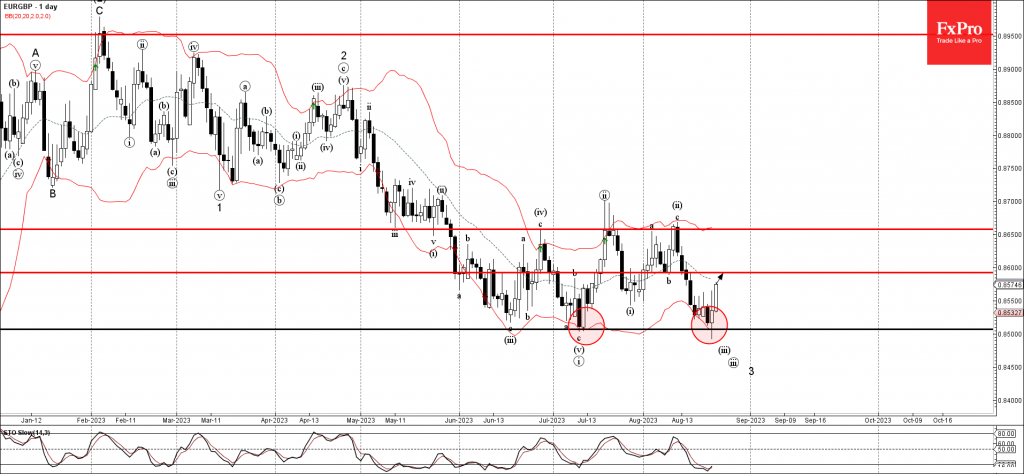
- EURGBP reversed from support level 0.8500
- Likely to rise to resistance level 0.8600
EURGBP currency pair recently reversed up from the key support level 0.8500 (previous monthly low from July) and the lower daily Bollinger Band.
The upward reversal from the support level 0.8500 stopped the earlier short-term impulse waves iii and 3 of the impulse wave (3) from February.
Given the strength of the support level 0.8500 and the oversold daily Stochastic, EURGBP can be expected to rise further toward the next support level 0.8600.
GBPCAD Wave Analysis
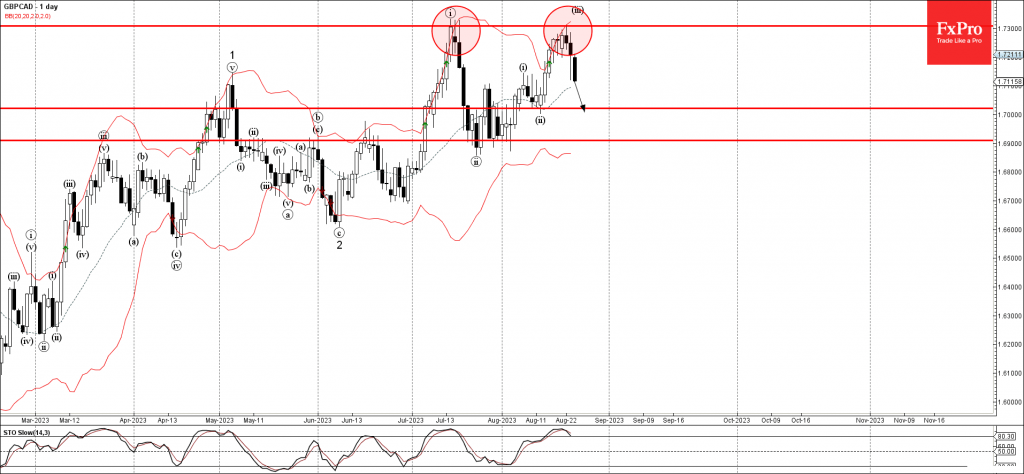
- GBPCAD reversed from resistance level 1.7300
- Likely to fall to support level 1.7020
GBPCAD currency pair recently reversed down from the pivotal resistance level 1.7300 (previous monthly high from July) intersecting with the upper daily Bollinger Band.
The downward reversal from the resistance level 1.7300 started the active short-term correction ii.
Given the still overbought daily Stochastic and strong sterling sales, GBPCAD can be expected to fall further toward the next support level 1.7020 (low of the previous correction ii).
Fed Collins: Be patient and not get ahead of data
Boston Fed President, Susan Collins, offered a cautionary stance on the current monetary policy trajectory in her latest remarks. Addressing the possibility of further rate hikes, Collins noted, "We may be near, we could even be at a place where we would hold" and not lift rates further.
While not ruling out the possibility of future hikes, Collins emphasized a measured approach, stating, "But certainly additional increments are possible, and we need to look holistically and be really patient right now and not try to get ahead of what the data will tell us as it unfolds."
On the topic of inflation, Collins expressed her confidence in the Federal Reserve's capabilities, saying she is "hopeful Fed can bring inflation back to 2% in a reasonable amount of time."
However, she cautioned against making premature judgments about potential rate cuts, remarking it's "premature to send a clear signal about the timing of rate cuts."
How Much Trouble China’s Economy In and Is There Risk for Global Contagion?
China has long been the world’s growth engine, but that status is under threat as its economic recovery has hit a major stumbling block and the high-growth era seems to be well and truly over. Exports are falling, consumers aren’t spending much, bank lending is slowing and the crisis in the property sector only seems to be deepening. Can the Chinese government navigate its way out of this mess, which is partly its own doing, or is there more pain to come?
The post-financial crisis credit boom
It could be said that China’s current troubles have been a long time coming. Whilst the slowdown became more pronounced after the pandemic, the root of the problem in fact goes back to the 2008 financial crisis. Just as other governments around the world resorted to extreme measures to boost their economies amid a global recession, Beijing came up with its own unorthodox policies to expand credit.
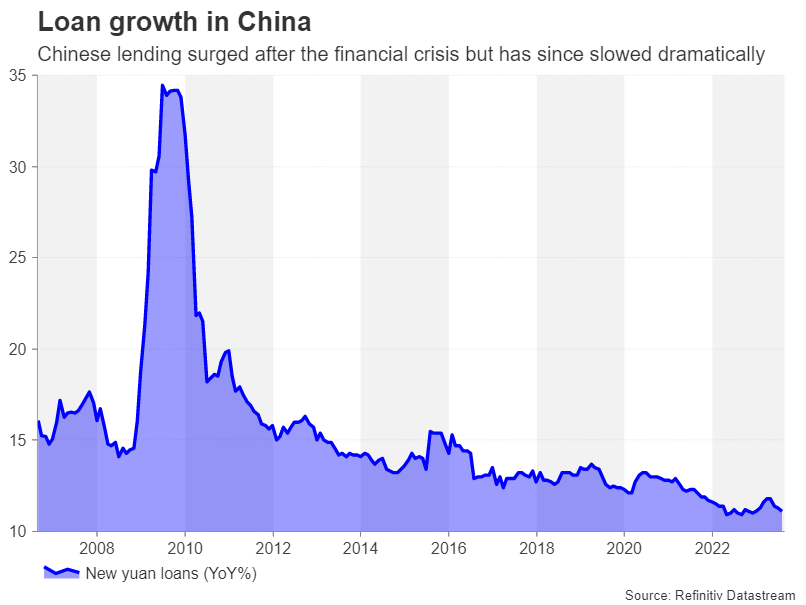
This inadvertently gave rise to the country’s infamous shadow banking sector, through which lending surged and set the stage for an unsustainable property bubble. To be fair to the government, it has made various efforts over the years to deleverage the highly indebted economy. But each attempt has brought about an unduly slowdown in growth accompanied by some form of market panic, forcing authorities to either backtrack some of their reforms or to find alternative backdoor channels for new stimulus.
Alarm bells are ringing in the property sector
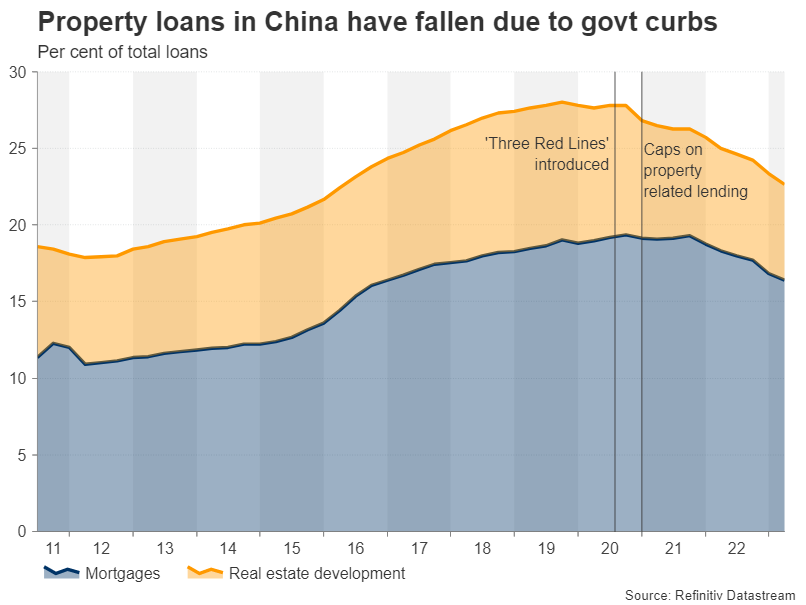
In many ways, the current crisis is no different, yet there are three distinctions that can be made this time round that ought to be raising alarm bells in Beijing. First, the property sector is facing collapse amid some high-profile defaults and many other big developers also drowning in debt.
The government recently eased borrowing restrictions for home buyers and announced more support for ailing developers. But the scandal of unfinished projects is so widespread that buyers have no confidence in the market and half-measures by authorities won’t be enough to prevent existing new homeowners from stopping their mortgage payments nor for potential homeowners to part with their cash. This makes it almost inevitable that more real estate developers will default in the coming months.
A worsening debt problem
But what can the government do about it? Calls for a massive stimulus package keep getting louder but this would only risk fuelling more debt. Doing nothing is also not an option as shadow banks, many of which are state backed, are highly exposed to the property market. Should the real estate crisis spill over to the shadow banking sector, it could spark a broader liquidity crunch in the economy. There are already signs that some trust companies are struggling to meet the payments on their investment products due to liquidity problems.
And this takes us to the second distinction about why China’s latest economic woes are more severe than previous ones. China has one of the highest debt-to-GDP ratios in the world, running close to 300% when both public and private credit is combined. What this effectively means is that Beijing has limited scope to boost the economy through more lending, putting policymakers in a bind.
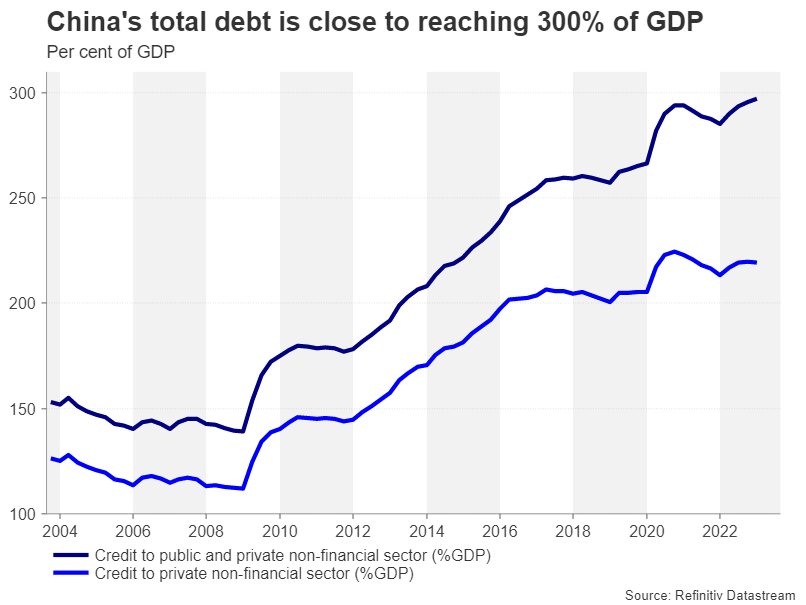
The fact that the government has been reluctant to bring out the big guns demonstrates its unease about adding to the soaring debt mountain. Policymakers’ dilemma has been made worse by speculative attacks on the yuan. The Chinese currency has depreciated by around 5.5% in the year-to-date on the back of the weakening economic outlook. This has tied the hands of the People’s Bank of China when it comes to how much it can cut interest rates at a time when slashing borrowing costs would be the appropriate policy response. The incremental cuts in interest rates have so far had a negligible effect in lifting sentiment, underscoring the need for bolder action.
Exports no longer a growth engine
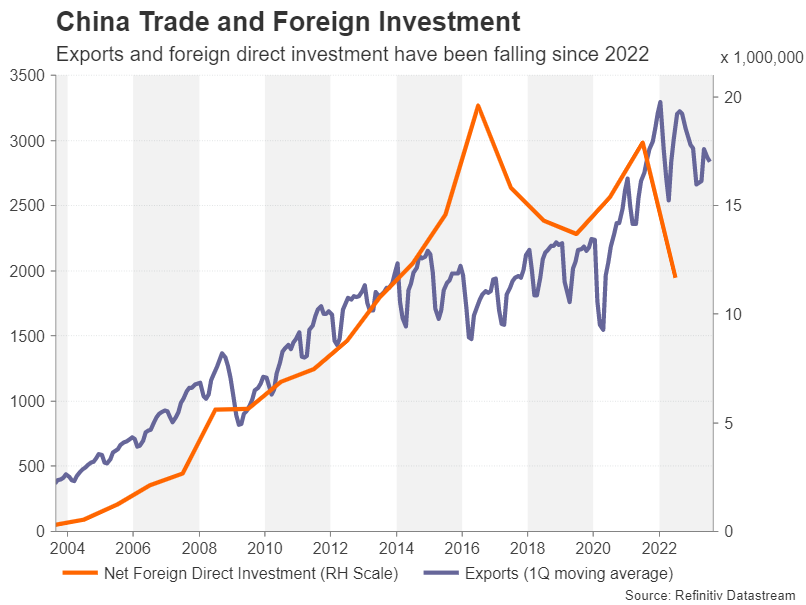
In a further blow for policymakers, exports - the backbone of the economy – have been quite sluggish over the past year and can no longer be relied upon to shore up growth in the hour of need. This brings us to the final point about why the risk of contagion, not just across the entire Chinese economy, but globally as well, is so high.
Although it’s true that rising interest rates in China’s main trading partners are dampening demand for Chinese manufactured goods, it’s not the only cause for the country’s deteriorating external balance. Exports have been on a downward trend since the beginning of 2022 and foreign direct investment last year was the lowest since 2013.
Trump’s trade war lives on
Trade restrictions imposed by the United States finally appear to be taking a toll on Chinese exports. But this isn’t the only setback. Other Western nations are also becoming increasingly wary about doing business with China, while Washington is additionally targeting investment in the country, specifically by US tech firms.
This can partly be explained as a legacy of Trump era policies, which the Biden administration has not only embraced, but also taken to the next level. But Beijing’s more aggressive foreign and domestic policies under Xi Jinping are also a factor as to why China has lost some of its business allure internationally.
The impact on China’s current account balance has been limited, as imports have also been falling during this period. Nonetheless, without substantial new inflow of foreign investment to generate more jobs and demand for exports dwindling, China is running out of options to kick-start growth.
The dreaded devaluation option
With the property mess and rising unemployment weighing on consumer sentiment, and businesses having the added headache of regulatory crackdowns, China is having a major confidence crisis right now and it could only be a matter of time before authorities realize that there may be just one way out of it.
China has yet to contemplate currency devaluation. Its attempts at stemming the yuan’s depreciation suggests this is not a preferred option. However, this has more to do with maintaining stability in financial markets and not being dictated by market forces than not wanting to use the exchange rate to stimulate growth.
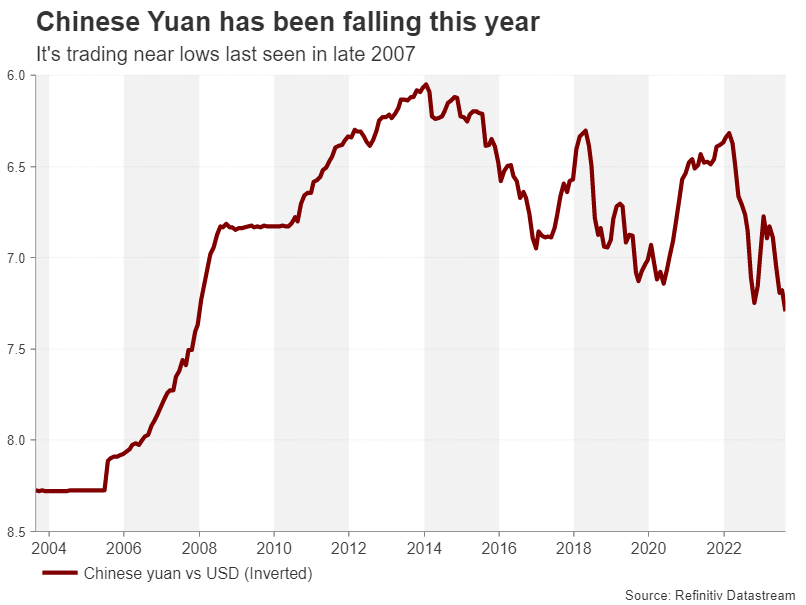
The biggest obstacle to devaluating the yuan is the threat of drawing the ire of Washington. Still, if in a few months or even a year from now, the existing policy measures do little in lifting growth and external demand remains subdued, the government might feel justified to turn to its last resort.
A weaker yuan would immediately boost exports as well as free the central bank to pursue looser monetary policy. It wouldn’t solve the property crisis, but it could alleviate the problem by generating more jobs and lowering the debt burden on the economy.
Beijing unlikely to turn West
There is an alternative way of course of achieving all this and that is to mend ties with the West, particularly the US, and to open the domestic market to foreign companies. But such a shift is unlikely to happen anytime soon, if ever.
With the government determined to prevent a large-scale market fallout and at the same time wanting to avoid going down the road of bailouts and handouts, this approach of drip-feed stimulus may well end up being the worst-case scenario as it could lead China towards a Japan-style stagnation.
Could a Lehman-style collapse be a good thing?
However, if a major property developer or even a shadow bank were to collapse, whilst this would undoubtedly have huge ripple effects domestically and globally, it would at least necessitate the government to respond more forcefully, bringing about an economic turnaround sooner rather than later.
As things stand, there is little concern in US and European markets about a spillover from the turmoil in China’s real estate sector. The main worry is the prolonged drag on the global growth outlook.
Aussie and Asian stocks feel the pain
However, for countries that are highly exposed to the Chinese economy such as Australia and New Zealand, their currencies have already been underperforming this year due to the ongoing uncertainties. The slowdown in China was likely a significant factor in the Reserve Bank of Australia’s earlier-than-anticipated pause in its tightening campaign.
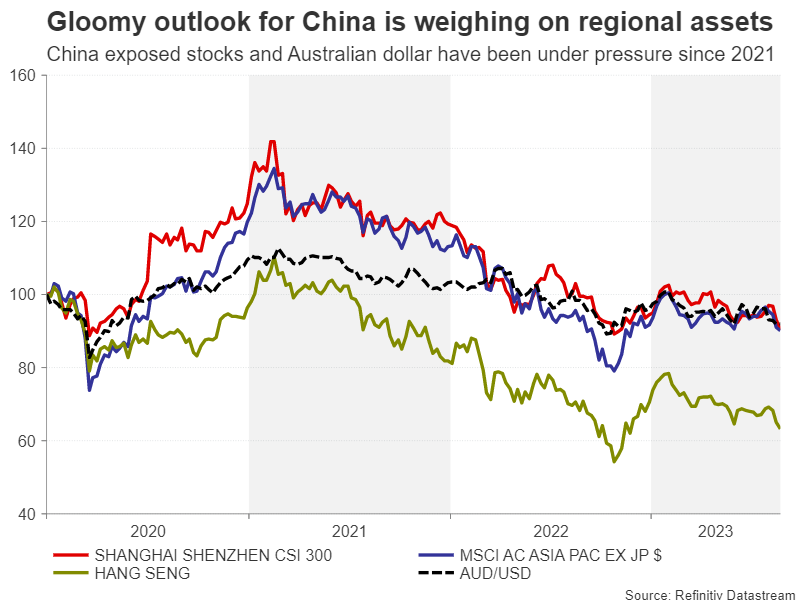
The biggest impact, though, has been on regional stock markets. The MSCI AC Asia index (ex. Japan) has declined by over 30% since the 2021 peak when the reopening rally came to a halt. This is in line with falls of around 37% for China’s benchmark CSI 300 index. Worst hit has been Hong Kong’s Hang Seng index, which has plummeted by more than 40%.