Sample Category Title
WTI Oil Technical: Potential Bullish Reversal to Resume Medium-Term Uptrend
- The recent decline of -6.8% from its 10 August 2023 high has not damaged the medium-term uptrend phase of WTI oil.
- Today’s price actions have indicated a revival of a short-term uptrend phase.
- Watch the key short-term support at US$80.90.
The price actions of West Texas Oil (a proxy of WTI crude oil futures) have indeed shaped the expected minor short-term pull-back and broke below US$79.80 per barrel minor support as it printed an intraday low of US$79.11 last Thursday, 17 August.
All in all, it has recorded an accumulated decline of -6.8% from its 10 August 2023 high of US$84.92 but from a technical analysis perspective, the medium-term uptrend phase in place since 28 June 2023 low of US$66.95 remains intact.
Medium-term momentum has turned positive
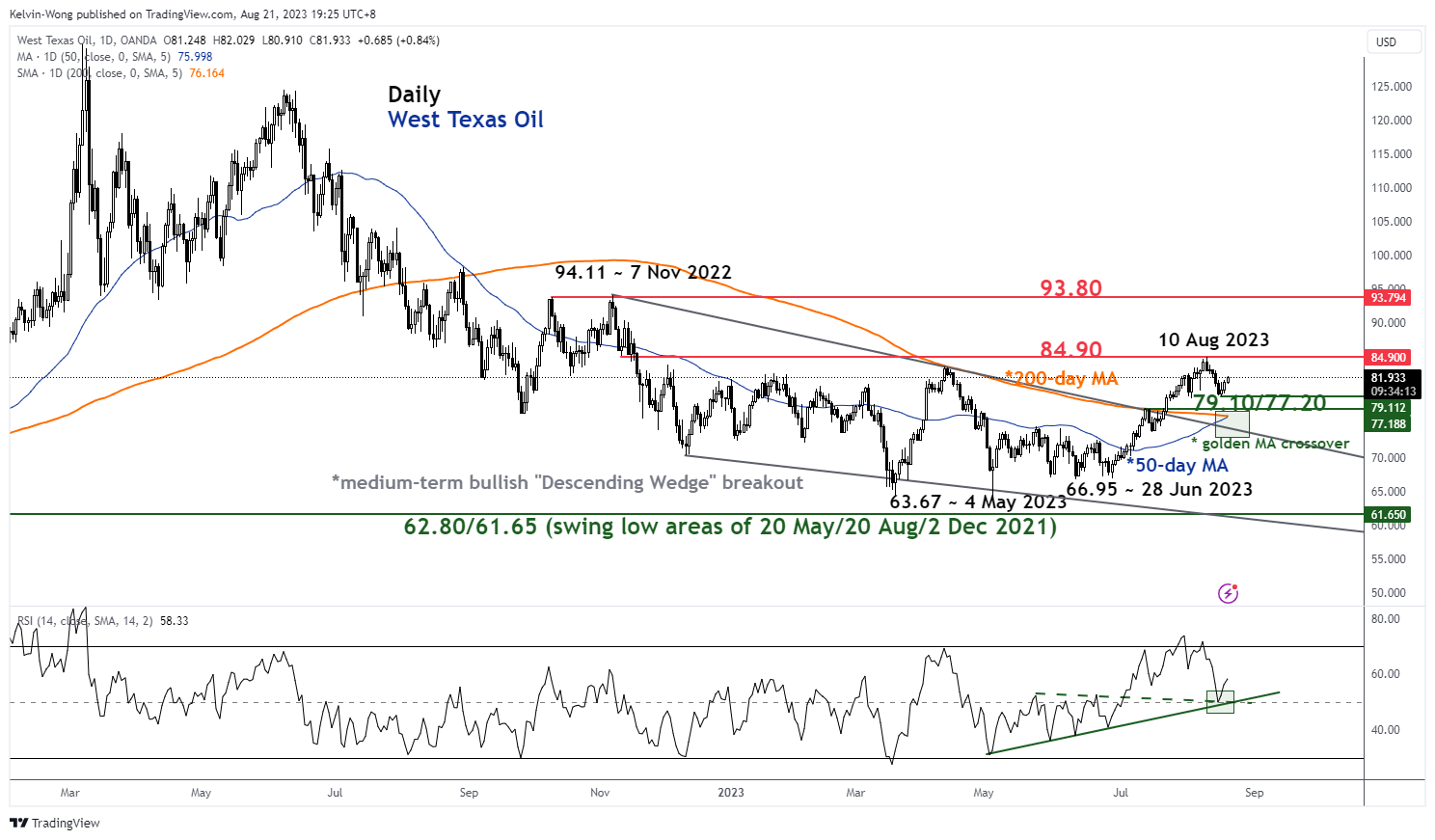
Fig 1: West Texas Oil medium-term trend as of 21 Aug 2023 (Source: TradingView, click to enlarge chart)
Recent price actions of West Texas Oil have led to the emergence of an imminent “golden crossover” bullish condition seen in the 50-day and 200-day moving averages.
In addition, the daily RSI oscillator has also just staged a rebound right at a key parallel support at the 50 level. These observations suggest that medium-term bullish momentum may have resurfaced which in turn increases the odds of the continuation of a potential impulsive up move sequence within its medium-term uptrend phase in place since the 28 June 2023 low.
Evolving into a minor short-term uptrend
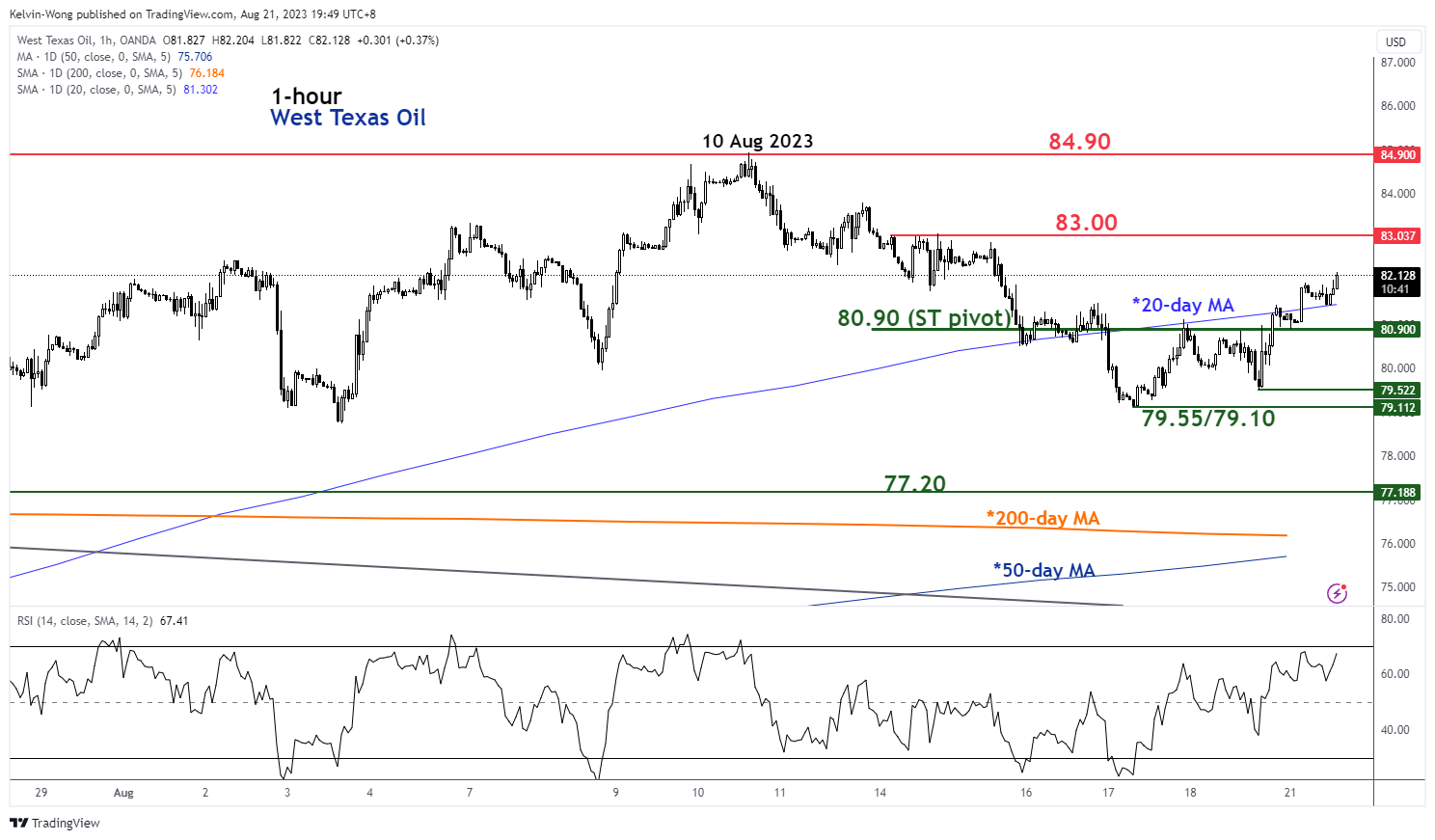
Fig 2: West Texas Oil minor short-term trend as of 21 Aug 2023 (Source: TradingView, click to enlarge chart)
Today’s price action has just surpassed the 20-day moving average which suggests the potential start of a minor short-term uptrend phase for West Texas Oil.
Watch the US$80.90 key short-term pivotal support to see the next intermediate resistance coming in at US$83.00 before a retest on the 10 August 2023 swing high of US$84.90.
However, a break below US$80.90 negates the bearish tone to expose the US$79.55/79.10 support.
Bundesbank: Germany economy to stagnate, inflation to stay above 2%
In its latest monthly report, Bundesbank paints a sobering picture of the German economy, which remains ensnared in a weak phase. Key factors hampering growth include tepid foreign demand combined with escalating financing costs. The bank foresees the economic output remaining largely stagnant for the summer quarter.
Yet, it's not all gloom. Bundesbank highlights several silver linings. Stable employment conditions paired with robust wage hikes amidst decreasing inflation rates are expected to stimulate private consumption, continuing its recovery trajectory. This, in turn, offers a promising uplift for the service sector.
Nevertheless, the manufacturing sector poses significant concerns. Weak industrial production, attributed to a continued slump in demand for industrial goods, threatens to stymie the nation's broader economic progress. Interestingly, the report underscores that the recent recovery in demand is predominantly driven by large orders, typically characterized by extended processing times. In the absence of these large-scale orders, demand, both domestically and internationally, would plummet more precipitously.
Peering into the future, Bundesbank's experts anticipate declining inflation rate in the autumn, largely influenced by dropping energy prices. On the flip side, the institution projects wage growth to persistently remain strong, extending beyond 2023. This dynamic of robust wage growth amid other economic pressures is pinpointed as a primary factor likely to keep the inflation rate hovering above the 2 percent mark for an extended duration.
Crude Oil Finds Stability Amidst Price Recovery
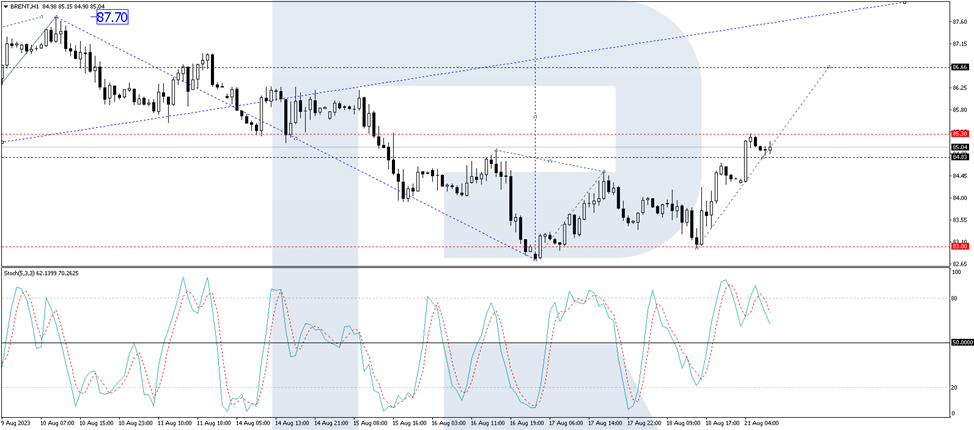
The commodity market has stabilised as the new week begins. The price of a barrel of Brent is hovering around 85.40 USD.
The price recovery is observed for the third consecutive day. Market expectations are tied to China: there are reasons to believe that the Chinese authorities will implement additional measures in their stimulus-driven economic policy.
Meanwhile, market players continue to exercise caution. The Federal Reserve System recently announced its readiness to continue tightening its monetary policy to combat inflation. At the same time, the economic outlook for China remains uncertain.
Technical analysis of Spot Brent Crude Oil:
On the H4 Brent chart, the price has rebounded from the support level and is now developing an ascending wave to 88.50. This is a local target. After the price reaches it, a link of declining correction to 85.75 might follow (with a test from above). Next thing, a rise to 94.50 could be expected. Technically, this scenario is confirmed by the MACD, whose signal line has left the histogram area and is aimed strictly upwards.
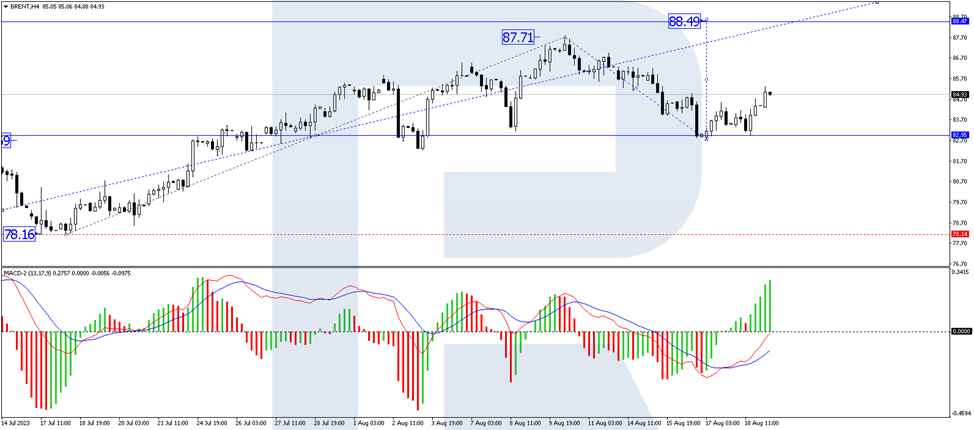
On the H1 Brent chart, a structure of an impulse to rise to 85.30 has formed. Today a narrow consolidation range is expected to develop below it. An escape from the range upwards might facilitate the development of a wave to 86.66, from where the trend could continue to 88.50. Technically, this scenario is confirmed by the Stochastic oscillator with the signal line under 80, ready to renew the highs.
German PPI’s Sharp Drop Lifts Peak-Rates Hopes
The sharp fall in German producer prices is both a signal of easing inflationary pressures and a warning of a sharp slowdown in demand.
The German producer price index fell by 1.1% in July, dwarfing the expected correction of 0.1%. Prices are 6% lower than a year ago, marking the sharpest annual decline since 2009.
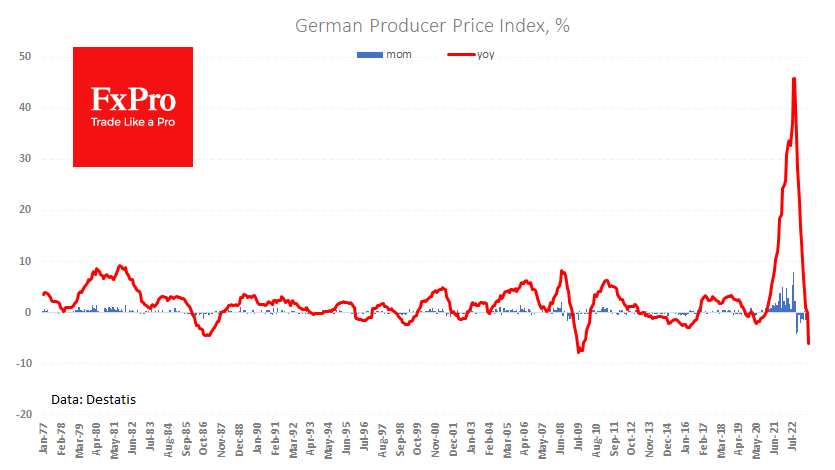
The data shows how quickly producers are cutting prices after the value of imports fell 11.4% y/y in June. This momentum raises hopes that inflation in Germany may not be as sticky as in other advanced economies, where rising service costs and a tight labour market are pushing up final prices.
Rapidly falling prices and weak business sentiment indicators have brought Germany’s title ‘Sick man of Europe’ back into the spotlight, although such comparisons seem premature. Germany, which has often been resolute in its fight against inflation, may soften its stance.
In that case, the chances of further rate hikes by the ECB may diminish. Signs of a slowdown in the German economy, which is more exposed to China and Russia than other major eurozone economies, point in the same direction.
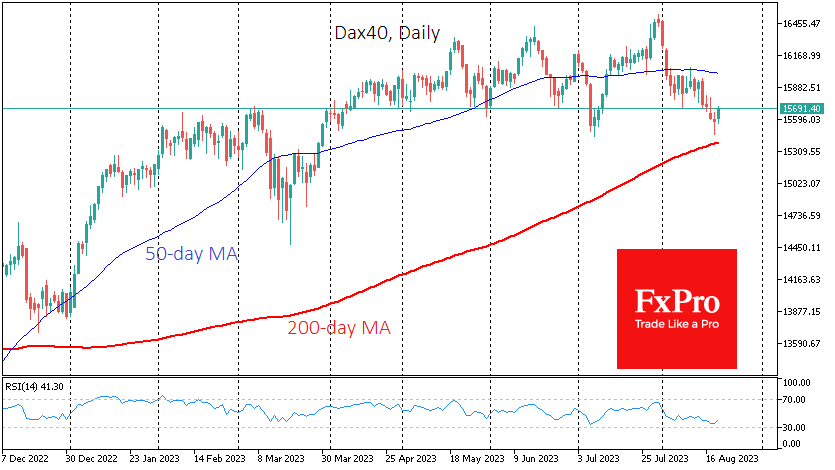
The German DAX40 is up 0.8% today, and the EuroStoxx50 is up over 1%, actively recovering from last week’s losses. This is fuelled by positive traction in US index futures and hopes the ECB rate hike is nearing its peak. Interestingly, the EURUSD is also rising, maintaining its positive correlation with equity market dynamics, temporarily having more weight on the market than the interest-rate differential perspective.
Another Rough Week for Australian Dollar
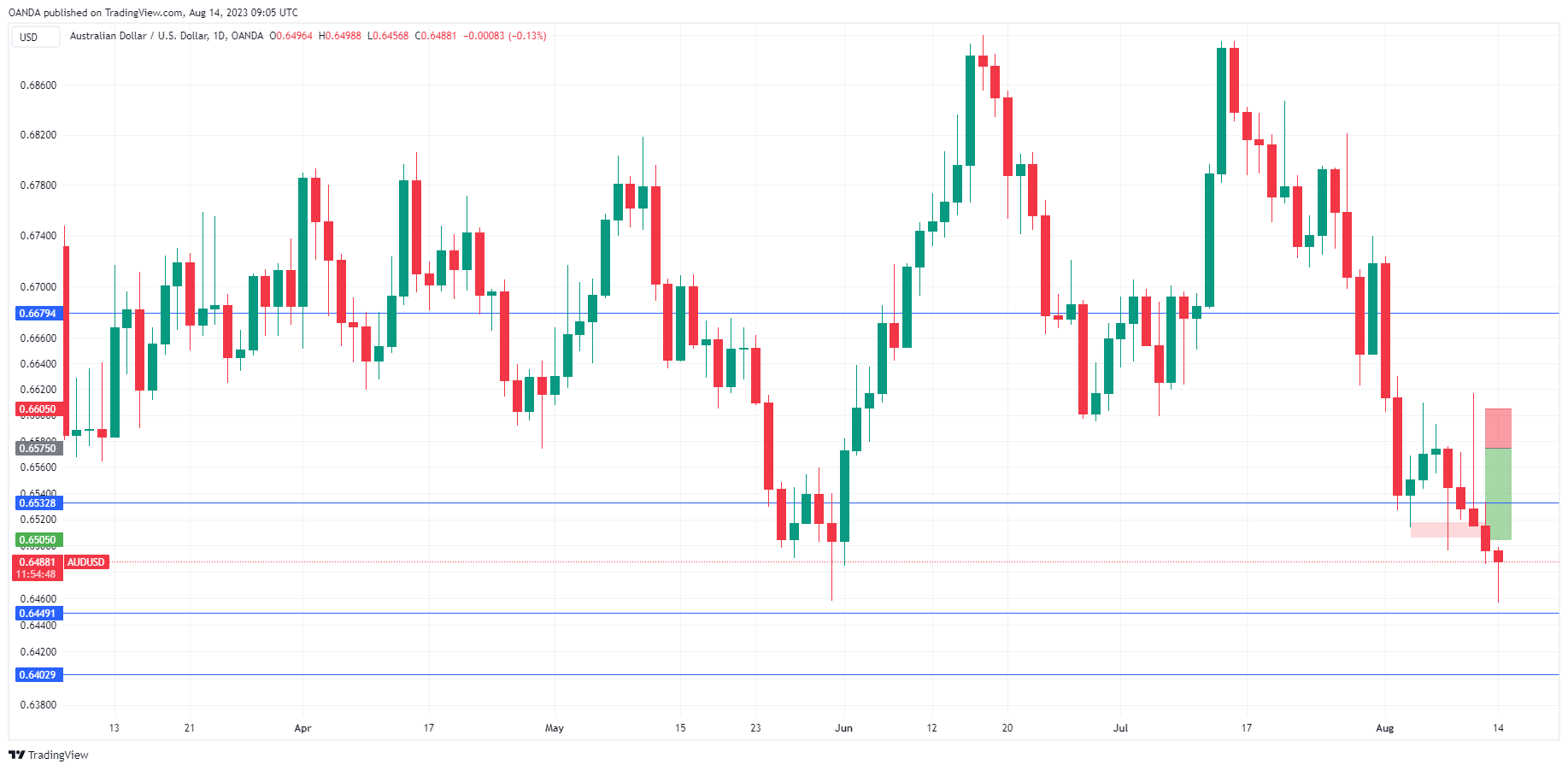
- AUD/USD close to 9-month lows
- China fails to cut 5-year LPR
The Australian dollar is steady at the start of the new trading week. In the European session, AUD/USD is unchanged at 0.6404. It’s a very quiet week for Australian releases, with no tier-1 releases. On Wednesday, Australia releases services and manufacturing PMIs for August. Services and manufacturing both contracted in July, with readings below the 50.0 level.
The Aussie has hit a rough patch and has reeled off five straight losing weeks against the US dollar, sliding over 400 basis points in that period. The economic picture in China continues to deteriorate, and this has been a major reason for the Australian dollar’s sharp deterioration.
China is Australia’s number one trading partner, and when China sneezes there’s a good chance Australia will catch a cold. China’s economic data has been pointing downward and the world’s second-largest economy is experiencing deflation. Last week, Evergrande, a huge Chinese property developer, filed for bankruptcy in New York, raising fears of contagion to other parts of the economy.
The People’s Bank of China (PBOC) responded to the economic slowdown with a surprise cut to the one-year medium-term lending rate. The central bank was expected to follow up with cuts to the one-year and five-year loan prime rates (LPR). On Monday, the PBOC trimmed its one-year LPR from 3.55% to 3.45%, but surprisingly, did not lower the 5-year LPR, a key lending rate that affects mortgages.
Lower lending rates are intended to boost credit demand, but the central bank’s lukewarm move is unlikely to provide much of a boost to China’s ailing economy. That does not bode well for the struggling Australian dollar, and if China’s economy continues to show signs of weakening, I would expect the Australian dollar to continue losing ground.
AUD/USD Technical
- AUD/USD is putting pressure on resistance at 0.6431. Next, there is resistance at 0.6496
- There is support at 0.6339 and 0.6274
NZD/USD pressing channel support, could it bounce from here?
In recent weeks, the antipodean currencies have encountered turbulent waters, contending for the title of the month's poorest performers. Reserve Banks of both Australia and New Zealand are widely perceived to have reached the peaks of their ongoing tightening cycles. In contrast, ECB and BoE (and less certaintly Fed) seem poised for further rate hikes. Also, the broader sentiment, underpinned by belief that global interest rates may remain elevated longer than previously anticipated, has notably dampened risk appetites.
However, recent economic concerns stemming from China have played a pivotal role in the accelerated depreciation of these currencies in the last fortnight. China's less-than-stellar economic recovery post its stringent Covid lockdowns, coupled with looming deflation risks and challenges in its property and finance sectors, have further intensified the pressure on the antipodean currencies. Additionally, PBoC milder than anticipated rate cut today further dampened sentiments towards these currencies.
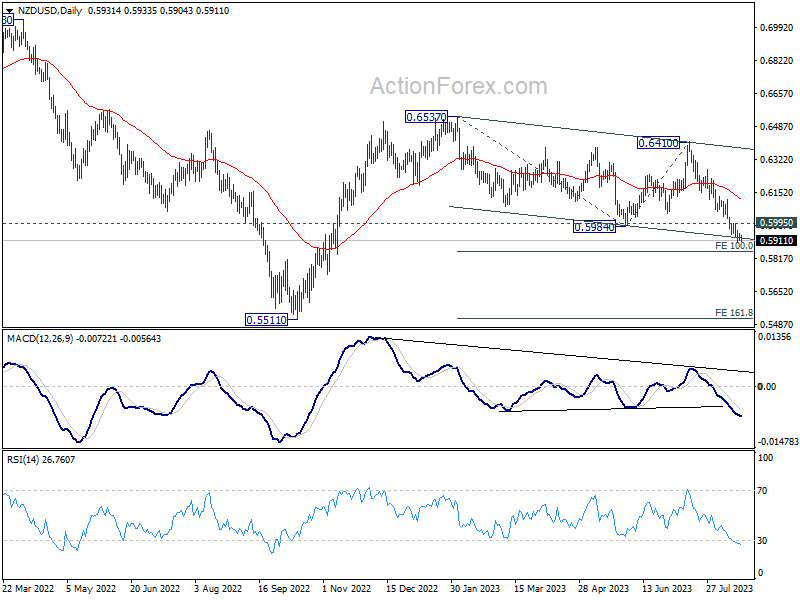
Technically speaking, however, there is prospect of a near term bounce in NZD/USD, given that it's now pressing a medium term channel support on oversold condition. Break above 0.5995 resistance will trigger a rebound to 55 D EMA (now at 0.6117). However, deeper decline and firm break of 100% projection of 0.6537 to 0.5984 from 0.6410 at 0.5857 could prompt downside acceleration to 161.8% projection at 0.5515, which is close to 0.5511 long term support (2022 low).
Gold Price Updates Minimum of the Year Against the Background of Rising Yields of US Govt Bonds
Treasury yields are rising, especially for long-term periods. For example, the yield on 10-year bonds today is 4.28%, and a month ago it was 3.88%, a year ago, 3.02%. Barron's writes that yields may continue to rise amid sustained inflation.
Rising US government bond yields are attracting investors who are diversifying their portfolios by moving capital away from the gold and equity markets, which is having a bearish effect on them.
So, according to information from MarketWatch, August could be the worst month in 2023 for the S&P 500 index precisely because of rising bond yields.
And according to Bloomberg, at the end of last week, the assets of exchange-traded funds (ETFs) investing in gold approached the level of 2.8 thousand tons, having updated the minimum since March 30, 2020.
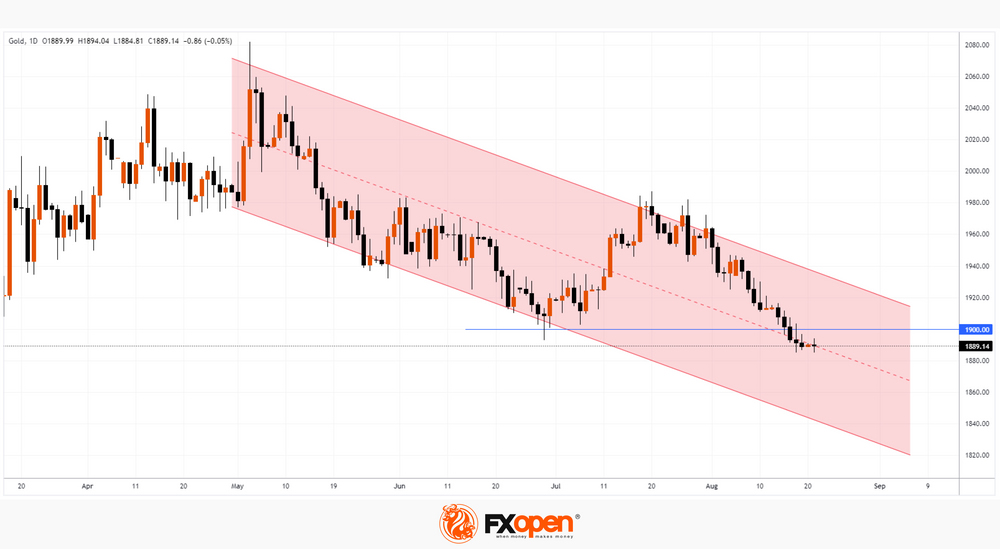
Today, as the chart shows, the price of gold has updated the minimum of the year.
Bearish arguments:
→ The price dynamics is developing within the bearish channel, which has been in effect since May.
→ The price has consolidated below the psychological level of 1900 dollars per ounce, from which we can now expect resistance to the price increase.
Bullish arguments:
→ The market is oversold, as evidenced by the daily RSI indicator. Therefore, the probability of a bullish correction increases.
This week, the BRICS summit and the Jackson Hole conference will take place, the news from which can have a significant impact on the price of gold.
And according to MarketWatch, August could be the worst month in 2023 for the S&P 500 precisely because of rising bond yields.
This article represents the opinion of the Companies operating under the FXOpen brand only. It is not to be construed as an offer, solicitation, or recommendation with respect to products and services provided by the Companies operating under the FXOpen brand, nor is it to be considered financial advice.
Crypto Market Fallen Victim to Safe-Haven Demand
Market picture
The financial markets have been under pressure due to the trend of moving out of risky assets as government bond yields rose. Cryptocurrencies seemed to be immune to this trend for a while, but last week, there was a switch to a sell-off mode amid rising US Treasury yields to 16-year highs and fears about China’s debt problems.
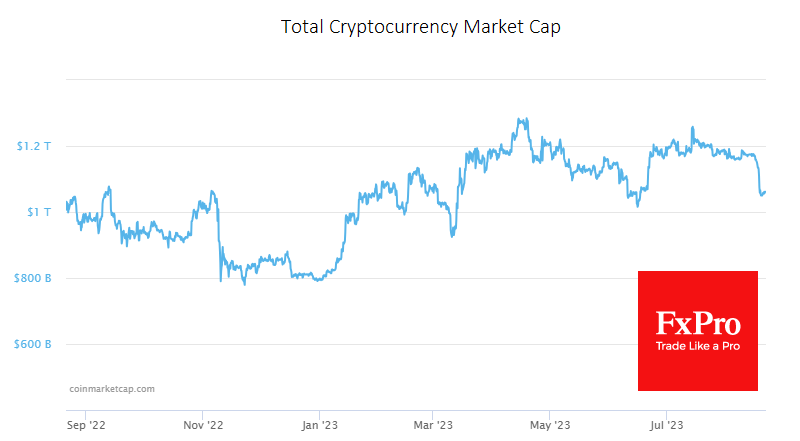
Crypto market capitalisation fell 9.7% last week to stabilise at $1.058 trillion, finding buyers on dips below $1.05 trillion. Technically, the market is still above the previous local lows of June, giving hope for a continued uptrend. However, it is worrying that July’s highs are lower than April’s.
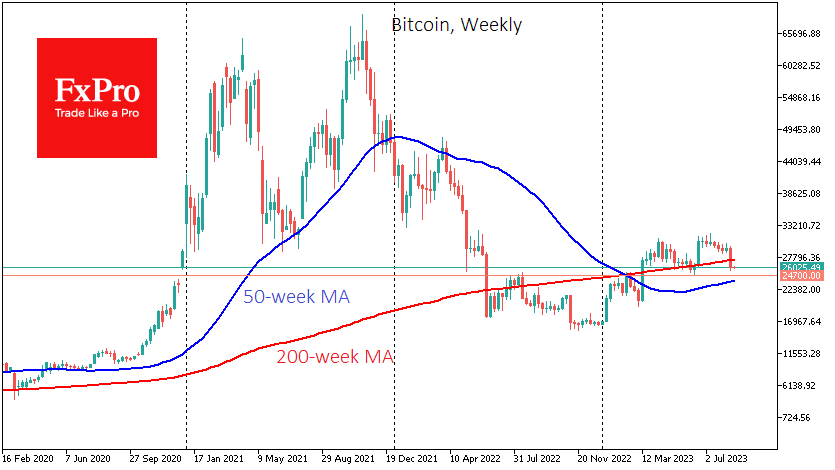
Bitcoin closed the week with a notable drop below its 200-week and 200-day moving averages, signalling a shift to a bearish trend. From current levels near $26.0K, the following area of decline appears to be the last pivot area at $24.7K.
News background
According to JPMorgan, Bitcoin miners are exploring new lines of business ahead of the halving. According to the bank, miners could find it lucrative to provide computing services in the fast-growing artificial intelligence market.
The US Securities and Exchange Commission (SEC) is ready to approve the first applications for Ethereum futures ETFs in October, Bloomberg reported, citing sources. The SEC is now reviewing 11 applications to launch such ETFs.
Payments giant Mastercard has launched a CBDC innovation research partner programme with companies in the blockchain industry, including Ripple, ConsenSys and Fireblocks. Mastercard notes that 93% of the world’s central banks are experimenting with digital currency, and four retail CBDCs are already in circulation.
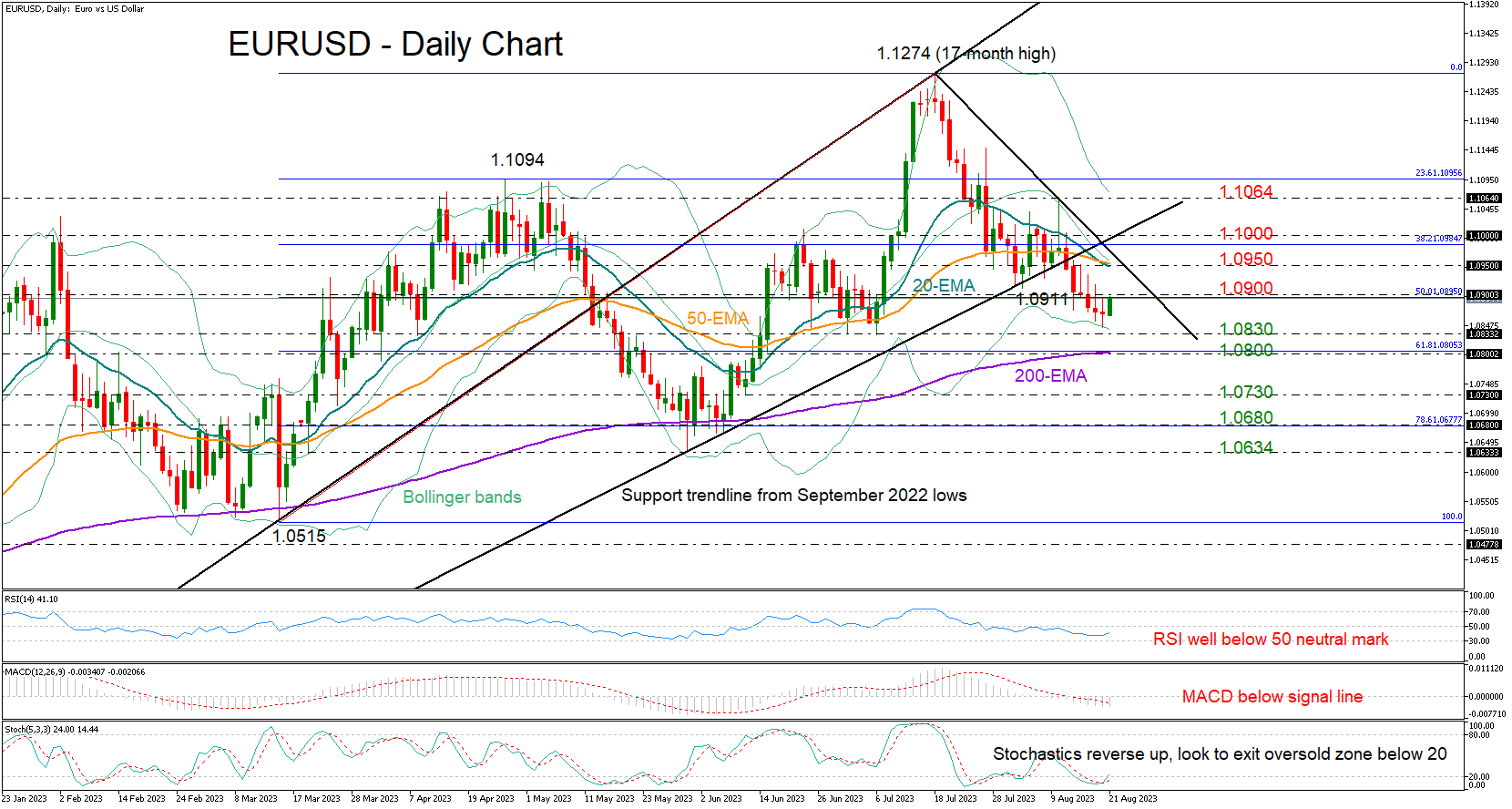
EURUSD Turns Up; Short-Term Outlook Still Cloudy
EURUSD opened moderately higher on Monday after almost touching the 1.0830 support area, which sparked the exciting rally to a 17-month high of 1.1275 last month.
The pair experienced five negative weeks in a row, retreating below the trendline that connects the lows from September 2022 and below its 20- and 50-day exponential moving averages (EMAs).
The recent small red candlesticks and an oversold stochastic oscillator suggest that selling pressure is dwindling. Also, the price bounced off the lower Bollinger band last Friday, making an upside correction possible in the coming sessions. That said, the RSI hasn’t touched its 30 oversold level, and the MACD remains negatively charged below its red signal line, suggesting that downside risks are still intact.
The 1.0900 level is currently acting as resistance, while slightly higher, the 1.0950 area, which encapsulates the 20- and 50-day EMAs and the tentative descending trendline from July’s top, could be a bigger hurdle. A decisive close above the latter could battle the broken support trendline around the 1.1000 psychological mark, a break of which is required to boost buying confidence and lift the price straight to August’s high of 1.1064. Then the focus could turn to the 1.1100 mark.
A downside reversal could get congested somewhere between 1.0830 and 1.0800. The 200-day EMA could cement that floor. If the bears breach the latter too, the sell-off could exacerbate towards the 1.0730 constraining zone, while lower, the price may stabilize within the crucial 1.0680-1.0635 area.
In brief, EURUSD seems to be looking for a rebound, but the cloudy short-term outlook may not change unless the pair successfully returns above 1.1000.
UK PMI Surveys on the Agenda But Focus Will be Across the Pond
With the market anxiously expecting this week’s Jackson Hole gathering, on Wednesday we will get the preliminary UK PMI survey results for August. As the pound remains one of the market’s favorites, a positive surprise at this week’s data releases could quickly reignite the BoE’s rate hike expectations and allow the euro/pound pair to record a new 2023 low.
BoE's next steps
Contrary to the Fed, the BoE is still trying to bring inflation under control in the UK. Despite the recent easing recorded, from the double-digit CPI level last seen in March 2023, both the headline and core inflation indicators remain extremely elevated when considering the 500bps of cumulative rate hikes announced since February 2022. The BoE’s own projections have inflation dropping to their target at the two-year horizon, but the recent oil price action is complicating both the short- and medium-term picture. This development could eventually cancel out the strong expectations for a continued inflation easing globally during the remainder of 2023.
In the meantime, the BoE is facing a double-edged sword regarding earnings growth. On the one hand, strong household earnings are extremely helpful amidst the current cost-of-life crisis, supporting consumer spending, and thus somewhat boosting the anemic growth outlook. Friday’s GfK consumer confidence is unlikely to show a significant improvement, but it will remain comfortably above its mid-2022 lows.
On the other hand, there is an increasing and credible risk of second and third round effects manifesting as the higher inflation rate could become part of the public’s mindset. The latter is mentioned in the August 3 meeting’s minutes revealing a real worry from certain BoE members. This could also explain why two BoE members voted for a 50bps rate move at the last meeting, with the 25bps decision reached by a majority vote.
A busy week has just started
The Rightmove house price index showed a -0.1% year-on-year growth, confirming other house price indices, and thus depicting the continued weakness seen in this sector, which is unlikely to abate any time soon considering the current BoE rate’s outlook. The main dish of the week will come on Wednesday with the release of the preliminary figures of the Manufacturing and Services PMI surveys. The former has been a source of concern globally as it remains stuck well below its 50-midpoint in most regions.
In the UK, the Manufacturing PMI survey has been on an acute downward trend since the June 2021 high. It is now preparing to complete a 12-month period of sub-50 prints since Wednesday’s figure is expected to record another small drop to 45 from 45.3 in July. On the flip side, the Services’ PMI survey figures have globally been more positive but the same cannot be said for the UK. The July print came at 51.5, showing an expanding sector, but its recent trend has been negative and thus increasing concerns that the remainder of 2023 could be an even weaker growth period.
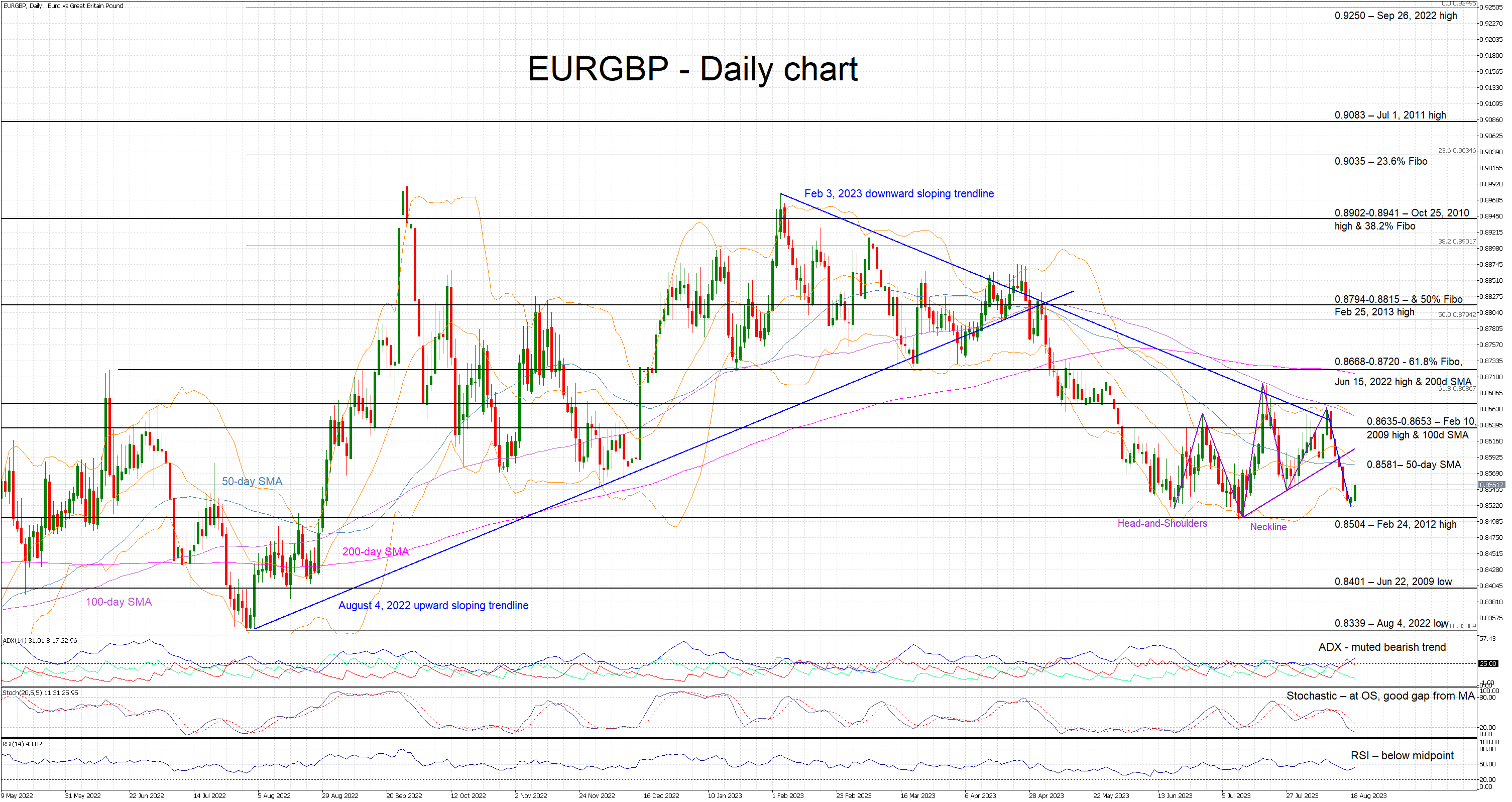
Euro/pound ready for a new 2023 low?
Despite the more hesitant BoE and the mixed data releases, the pound continued to exhibit significant strength against the euro. The overall technical picture appears to still favour the pound, especially considering the developing heads and shoulders structure. Therefore, a good set of PMI survey results on Wednesday morning could prove the boost needed for the euro/pound pair to record a new 2023 low, below the current 0.8503 low.