

Sample Category Title
WTI Futures Pull Back after Bouncing Off Restrictive Trendline
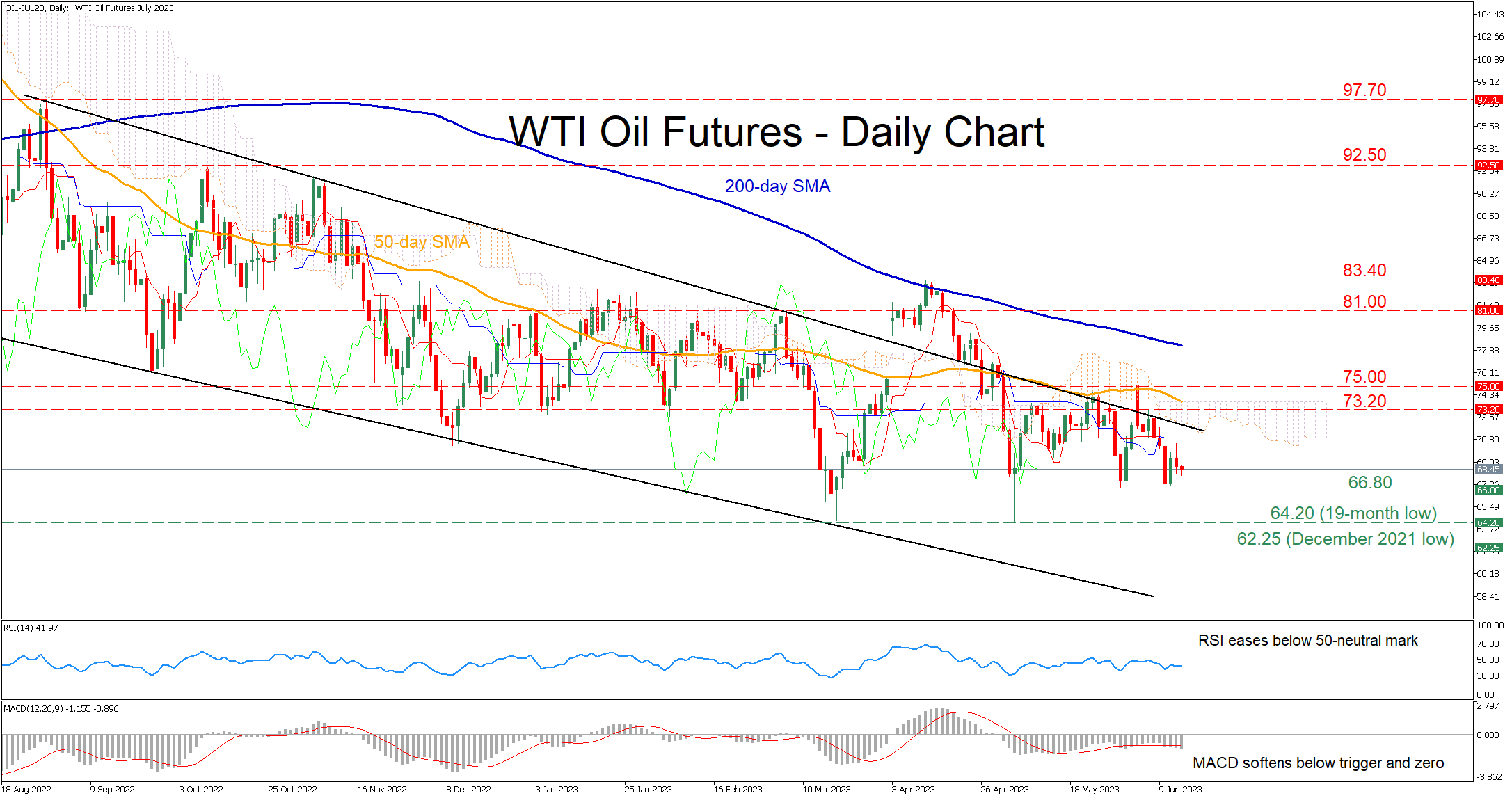
WTI oil futures (July delivery) have been moving within their downward sloping channel for the last 10 months, creating a structure of lower highs and lower lows. In the near term, the price is trading flat slightly below the 70.00 region following a moderate pullback from the upper boundary of their long-term bearish channel.
The momentum indicators currently suggest that bearish forces are strengthening. Specifically, the RSI has flatlined below its 50-neutral mark, while the MACD is softening below both zero and its red signal line.
Should the bears try to push the price lower, immediate support could be found at the June low of 66.80. A dive below that floor could open the door for the double-bottom region of 64.20, which is also a 19-month low. Failing to halt there, the price could decline to post a fresh multi-month low, where the December 2021 bottom of 62.25 could curb further downside attempts.
On the flipside, bullish actions could propel the price towards the recent resistance of 73.20. Breaking above that zone, WTI futures might face the 75.00 hurdle before the March peak of 81.00 comes under scrutiny. Conquering the latter, the bulls may then target the 2023 high of 83.40.
In brief, WTI oil futures retraced lower after failing to post a bullish breakout from their long-term descending channel. Nevertheless, the price has been trading sideways in the last couple of daily sessions, waiting for developments that could provide fresh directional impetus.
New Zealand Dollar Dips after Soft GDP Report
- New Zealand GDP declines by 0.1%
- Fed takes a pause, but sends hawkish message
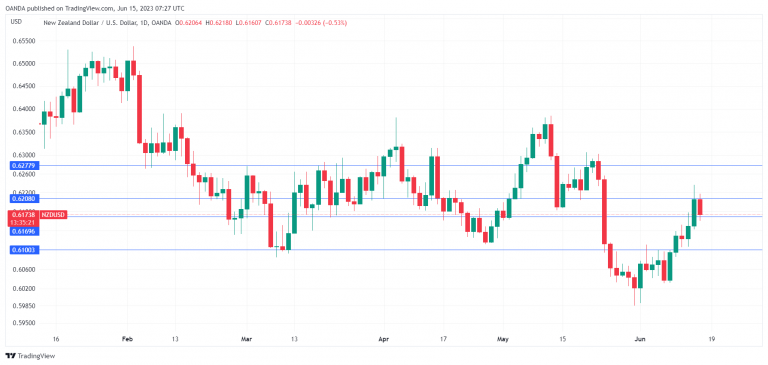
The New Zealand dollar is in negative territory on Thursday, after surging 0.9% higher on Wednesday. In the European session, NZD/USD is trading at 0.6171, down 0.57%.
New Zealand’s economy shrinks, a bit
With the financial markets fixated on the Federal Reserve on Wednesday, New Zealand’s GDP release was overshadowed by Jerome Powell & Co. The economy contracted by 0.1% q/q in the first quarter, matching the consensus and higher than the -0.7% reading in Q4 2022. This means that technically, New Zealand is in a recession, with two consecutive quarters of negative growth. Still, the market reaction has not been dramatic, as the 0.1% decline is marginal. On an annualized basis, GDP in Q1 rose 2.9%, up from 2.3% in the previous quarter.
The Reserve Bank of New Zealand raised rates by 25 basis points in May, bringing the benchmark rate to 5.5%. The central bank will have some time to gauge the effect of its rate tightening, as it does not meet again until July 12th. The IMF weighed in on the Bank’s rate policy ahead of the GDP release, urging more tightening in order to bring down high inflation.
Federal Reserve delivers a hawkish pause
The Federal Reserve held rates unchanged on Wednesday, which is what the markets had expected, especially after this week’s inflation report which showed inflation falling to 4.0%. At the same time, the rate statement and economic projections for the fourth quarter were hawkish. The Fed revised GDP growth and a key inflation gauge higher while revising the unemployment rate lower. As well, the dot plot indicated two more small rate hikes this year.
Powell said after the decision that the Fed had not made a decision about the July meeting, but his message was clearly hawkish, and the markets have priced in a 71% probability of a July hike, according to CME FedWatch. Powell may have inflation on the run, but there’s still a way to go before the 2% target is achieved.
NZD/USD Technical
- NZD/USD is testing support at 0.6169. Below, there is support at 0.6100
- 0.6208 and 0.277 are the next resistance lines
AUD/USD: May Collapse to a Minimum of 0.617
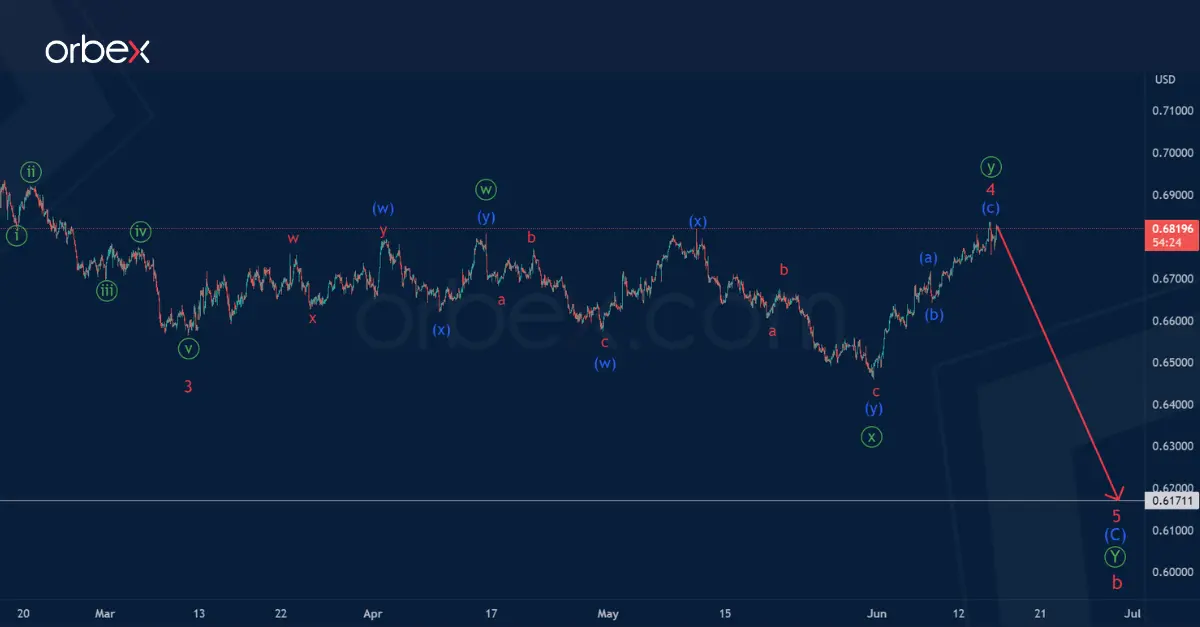
In the long term, the AUDUSD pair may form a large correction b of the cycle degree, which has the structure of a primary double zigzag Ⓦ-Ⓧ-Ⓨ.
Two parts, sub-waves (A)-(B), can be completed inside the actionary wave Ⓨ. The current chart shows the structure of wave (C).
Wave (C) is an impulse that consists of minor sub-waves 1-2-3-4-5. There is a high probability that the price inside the final minor wave 5 will reach a minimum of 0.617.
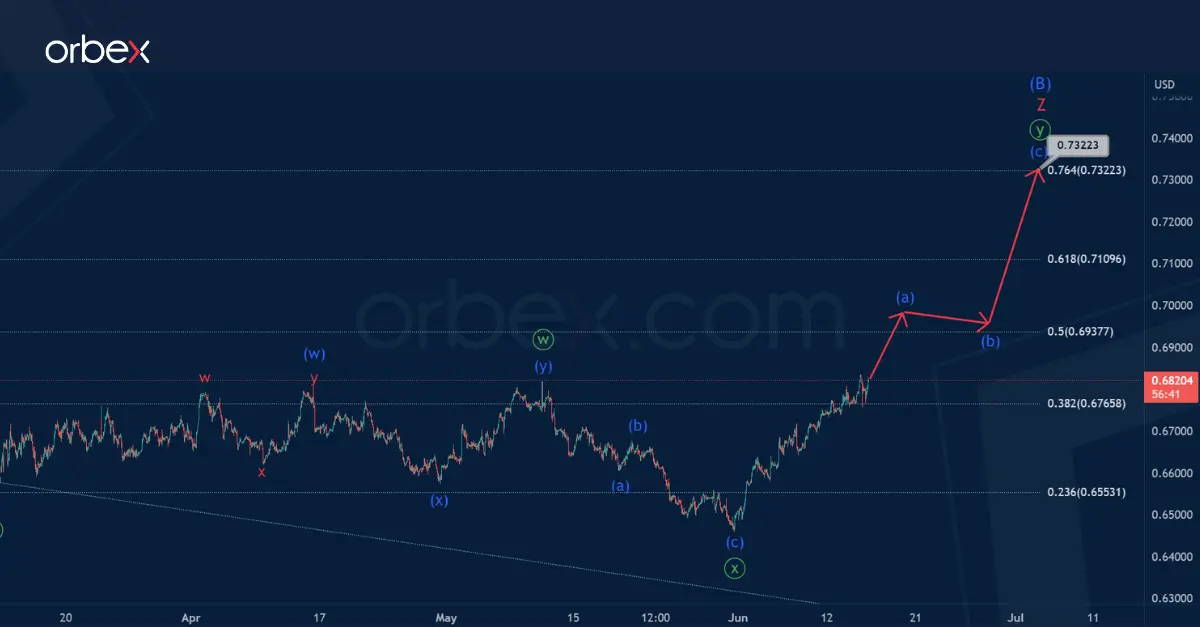
The current chart shows an alternative markup option in which we see an incomplete intermediate correction (B).
Wave (B) has a complex internal structure of a triple zigzag W-X-Y-X-Z.
There is a high probability that a minor wave Z is being built in the last section. This wave may end in the form of a minute double zigzag at 0.732, as shown on the chart.
At the level of 0.732, correction (B) will be at 76.4% of impulse (A).
USD Claws Back Losses
USD/JPY bounces back
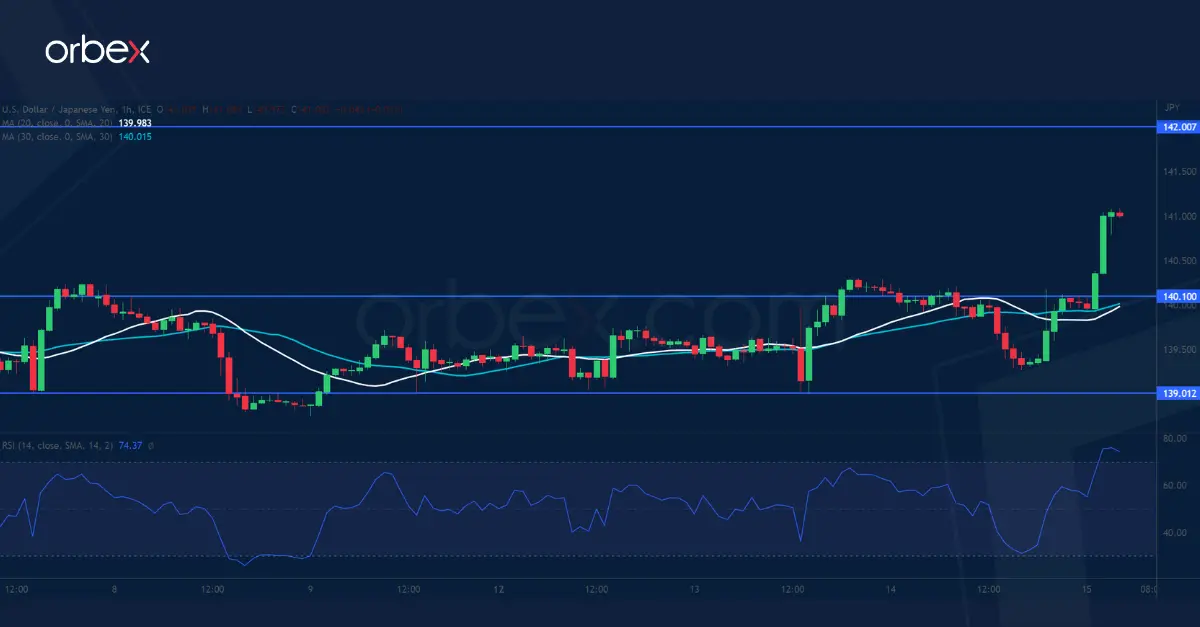
The US dollar bounced after the Fed signalled another 50 bp hike by year-end despite a pause. The pair has consolidated its gains along the 20-day SMA (139.00) after rising above the key supply zone around 138.00. The latest surge above 140.90 has prompted sellers to cover and could pave the way for a bullish continuation with 142.00 as the next threshold. This would confirm the upward skew and attract buyers in hope of an extension to 145.00. 140.10 is the closest support as the RSI shot into the overbought area.
NZD/USD turns lower
The New Zealand dollar softened after traders sold the news as the Fed held interest rates steady. The pair came under pressure at a previous demand zone 0.6240-0.6250 after clearing the former daily support of 6.1400. The RSI’s overbought condition has put a strain on follow-through bids as buyers started to take some chips off the table. 0.6140 is the closest support to see if there is any renewed interest. Failing that, a deeper retracement would expose the base of the breakout rally at 0.6080 from last week.
US30 sees correction
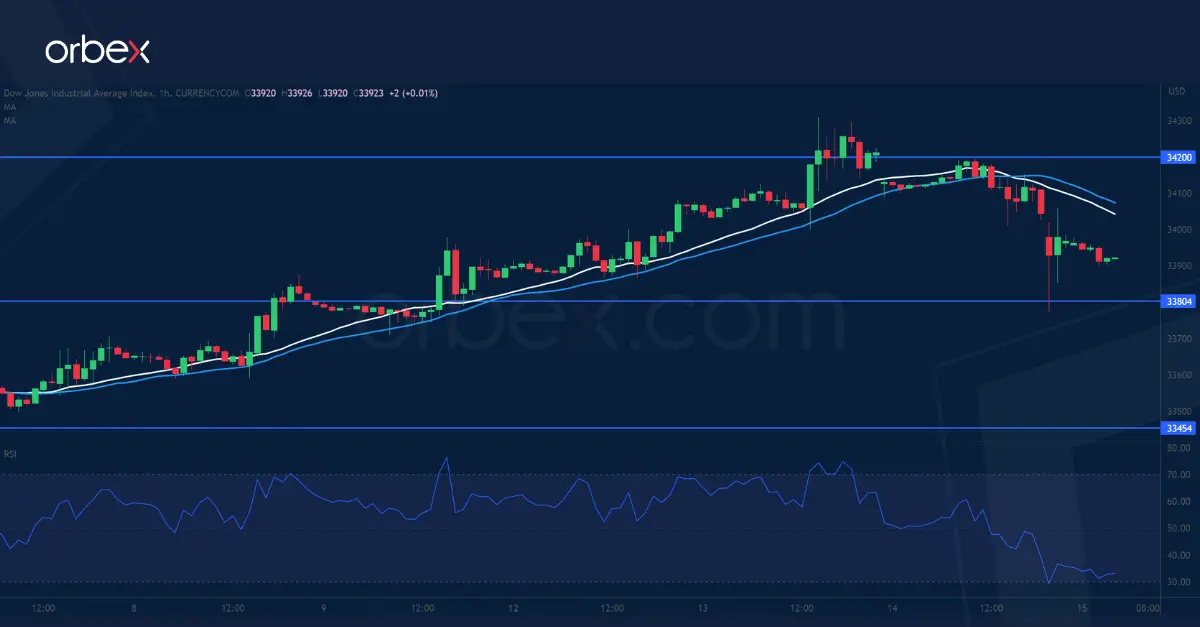
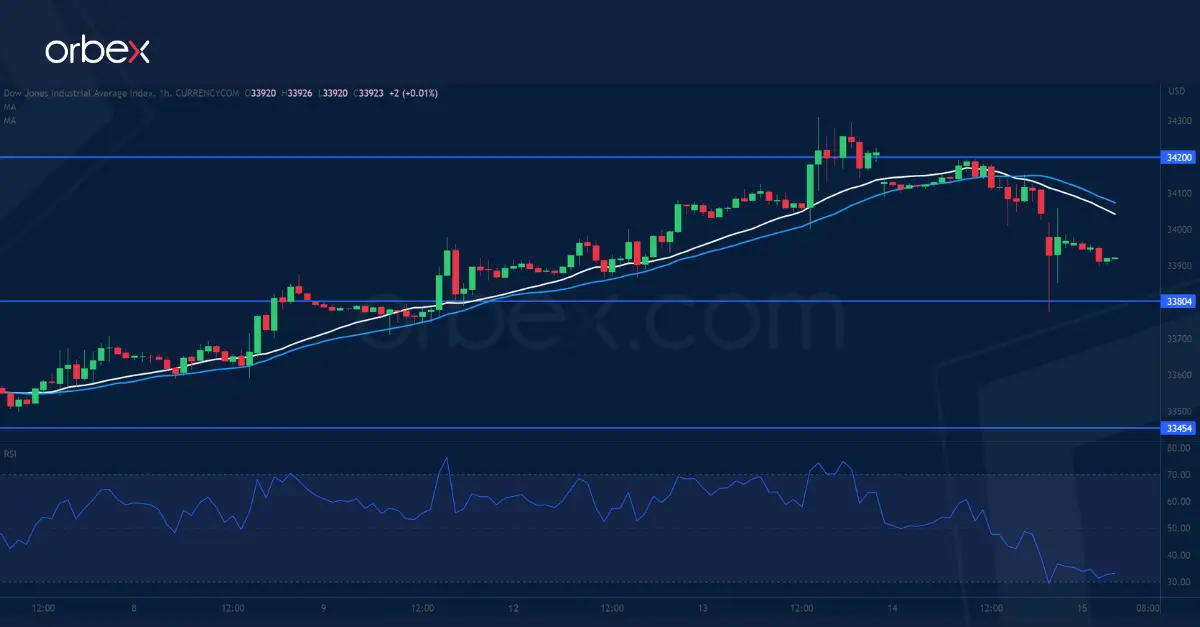
The Dow Jones broke lower on profit-taking after the FOMC kept options open in a mildly hawkish manner. A pop above the daily resistance of 34250 was a sign that the bulls had doubled down on the rebound, putting this year’s high of 34500 within reach. However, a break below the psychological level of 34000 at the base of the latest surge is an opportunity for the bulls to catch their breath, making 34200 a fresh resistance. 33800 is the next support and 33450 on the 20-day SMA the bulls’ second layer of defence.
Next Up is the ECB
Markets
The Fed skipped a rate rise but its updated dot plot signaled that there may be two more to come this year with a first one most likely in July (dubbed a “live” meeting). 12 of the 18 MPC members pushed for the higher peak rate at 5.5-5.75% later this year. 7 MPC members have also lifted their estimate of the neutral rate beyond 2.5%. That’s up from four in March and three in December last year. Are we seeing the contours of a(n implicit) higher inflation target? Anyway, growth and core inflation was revised higher for this year (1% and 3.9% respectively) and remain more or less unchanged further out. Ongoing labour market strength forced the Fed to lower the expected unemployment rate to just 4.1% end 2023 and 4.5% in the two years ahead. Why, then, go for a pause and not just hike yesterday? The Fed wishes to go slowly and more gradual after an aggressive tightening campaign. It also offers theoretically the best chances for cooling the economy rather than outright break it. But going easy also implies rates need to be high for a long enough period to dampen activity sufficiently and bring inflation back to target. The Fed sees next year’s policy level at 4.5-4.75% and at 3.25-3.5% in 2025. US markets finished the day surprisingly stoic with equities closing in a range of -0.7% and +0.4%. After a sharp, dot plot driven intraday reversal at the front end of the curve (+18 bps in the 2-y), the US 2-y yield close the day 2.2 bps higher. In a further curve inversion, the 30-y even lost 3.75 bps. The dollar left the lows of the day but no more than that. DXY closed around 103 and EUR/USD still took out the 1.08 level. Markets currently don’t buy the 50 bps additional tightening but we think that’s only a matter of time. The burden of the proof has shifted: it suffices for economic data to just meet the consensus bar to move markets towards the updated rate projections.
The PBOC this morning as expected also cut its 1-y medium term lending facility rate by 10 bps to 2.65%. It followed the unexpected 7-day reverse repo rate cut earlier this week. The moves are aimed at jolting a stalling Chinese economy. That was once again obvious from this morning’s monthly batch of data. Industrial production, retail sales, property and fixed asset investments all flopped in May. China’s yuan gapped lower at the open but in the meantime recovered to USD/CNY 7.15. Other markets, including US bonds (yields +2.3-4.9 bps) are affected by a stellar Australian jobs report (see below).
Next up is the ECB. A 25 bps rate hike to 3.5% is all but certain. We expect the central bank to hint at another move in July, as currently discounted by money markets, but to take a more neutral, data-dependent approach beyond that. There are a few events that warrant monitoring before committing to anything from September on. One is the full stop on the APP reinvestments from the second half of the year on. Another is the repayment of a big chunk of TLTROs at the end of this month. Yet another is the evolution of core inflation. There’s a good chance the “easing” in April and May may not continue, reverse even, over the summer months. Given what is priced in, the euro and yields could experience some profit-taking after the meeting. But being committed to kill off inflation, we believe they still have the backing of the ECB, which limits the downside potential.
News and views
The Australian Bureau of Statistics (ABS) published May employment data this morning. The Australian economy added 75.9k jobs (vs 17.5k expected) with the lion share of that amount being full time occupations (+61.7k). The increase in employment in May saw the number of employed people in Australia reach 14 million for the first time (almost 13 million pre-pandemic). The Australian participation rate hit a new high, rising from 66.7% to 66.9% with the unemployment rate dipping from 3.7% to 3.6%. The ABS head of labour statistics said that the whole range of indicators - strong growth in hours worked, the elevated employment-to-population ratio and participation rate, along with the low unemployment and underemployment rates – all point to a continuing tight labour market. Australian money markets further scaled up RBA tightening bets with a cumulative 50 bps of rate hikes now discounted by the October meeting. Risks are probably tilted to achieving that even earlier. AUD swap yields rise over 10 bps at the front end and 4 bps at the very long end. AUD/USD tries to take out the April and May tops around 0.68 which serve as resistance levels.
A Hawkish Smack
The Federal Reserve (Fed) refrained from raising interest rates at this week’s monetary policy meeting.
Yet the median forecast on the Fed’s dot plot suggested that there could be two more rate hikes before the end of this year. That came as a slap on the face of those expecting a rate cut by the end of the year, even though, I think that the doves haven’t said their last word just yet. The credit conditions in the US are tightening, inflation is falling. Yesterday’s PPI data revealed a faster than expected contraction in producer prices in May, while both headline and core CPI figures continued to ease over the same month.
Why, on earth, has the Fed started playing a guessing game, instead of hiking the rates right away?
It is because the US policymakers know that the idea of a 25bp hike - or two 25bp hikes - is more powerful than a 25bp hike itself, as future rate hikes are more effective in managing market expectations. The market is keen to go back to pricing the end of rate hikes - and rate cuts - when they know that the Fed is coming toward the end of the tightening cycle. To avoid that end-of-tunnel enthusiasm from jeopardizing tightening efforts, the Fed keeps the tightening suspense alive, without however acting on the rates. If all goes well - if inflation continues easing, and tighter financial conditions begin weighing on US jobs market - the Fed will have the option to step back and simply… not hike.
But for now, ‘nearly all policymakers’ remain concerned with the moderate cooling in core inflation, and they don’t see inflation going below 3% this year.
Mild reaction
The US 2-year yield continues pushing higher, while enthusiasm at the long end of the yield curve is lesser, as higher rates increase recession odds. The S&P500 hit a fresh high since last year but closed almost flat. The US dollar rebounded off its 100-DMA, and the EURUSD rallied above its own 100-DMA and holds ground above the 1.08 mark this morning, into the widely watched European Central Bank (ECB) decision.
A hawkish ECB hike?
The ECB is broadly expected to hike the interest rates by 25bp when it meets today, and ECB chief Lagarde will likely sound hawkish at the press conference following the decision and insist that despite the recent easing in inflationary pressures – and perhaps the deteriorating economic outlook, the ECB will continue its efforts to fight.
Note that 500-billion-euro TLTROS will mature on June 28th and will pull a good amount of liquidity out of the market. While there is still around 4 trillion euros of excess liquidity in the financial system, the draining liquidity could cause anxiety among investors, especially if some European banks fail to find enough financing in the market to replace their TLTRO funding – a scenario which could sap investors’ confidence and appetite in the coming weeks.
In this respect, Italian banks are under a close watch as they are behind their European pears in repaying their TLTRO and the funding through TLTROs are more than the excess cash its lenders parked with the ECB. That means that Italian banks must find money somewhere else – but where? – to repay their TLTROs.
I am not particularly worried about the stability of the European financial system, but I can hardly imagine European stocks extend rally in the environment of draining liquidity and rising rates. The Stoxx 600 index spiked above its 50-DMA yesterday, as a stronger euro may have reinforced appetite, yet European stocks will likely return to the 435-450 area.
China cuts
In China, we have a completely different ambiance when it comes to inflation and monetary policy. The Chinese inflation remains flat and under pressure near 26-month lows, growth is not picking up the anticipated post-Covid momentum, and the People’s Bank of China (PBoC) cut its one-year MLF rate by 10bp today, as broadly expected, to give a shake to the depressed Chinese economy. The problem is, there is now a talk that China could be entering a liquidity trap, meaning a period where lower rates fail to boost appetite and don’t translate into faster growth.
Focus Turns to ECB
Market movers today
The main event today is of course the ECB meeting. A 25bp rate hike is widely expected, so interest should centre on new staff projections and any signals about the future rate path, ECB preview: Looking beyond next meeting, 8 June.
We should get a rate decision from the Bank of Japan early Friday morning CET, although at the last meeting it dragged out. We expect that yield control will be relaxed at some point this year, but not already at this meeting.
There is a string of US data coming out - Philly Fed, retail sales, jobless claims, import prices, Empire PMI, industrial production and TICS capital flow data. Even though the median FOMC member now expects to do 50bp more hikes, the actual decision still depends on what the data will be telling us about the inflation picture ahead of the next meeting.
In the Nordics, both the Swedish Prospera inflation survey (large version) and the Norwegian regional network survey are key releases for the local markets.
The 60 second overview
Hawkish Fed surprise: The Federal Reserve paused its rate hiking cycle last night as widely anticipated. However, the updated median rate projection signaled two more 25bp rate hikes by the end of 2023, which was clearly more hawkish than anticipated. The initial market reaction faded somewhat during the press conference, when Powell suggested that the hikes might not be that certain after all, as 'the things we need for disinflation are coming into play'. The 2023 GDP forecast was lifted to 1.1% (from 0.4%), suggesting that the outlook for more rate hikes relies on a fairly optimistic growth assumption. As we remain more pessimistic on the macro outlook for H2, we also think that the projected rate hikes will not end up materializing, and stick to our previous forecast of no rate changes by the Fed for the remainder of the year. Read more from our Fed review: Powell's hawkish bluff, 14 June, and see also our thoughts on the latest inflation data and outlook from Global Inflation Watch - Euro area inflation pressures remain sticky, 14 June.
Weak Chinese data for May: Overnight China released its monthly batch of data for most sectors of the economy. As indicated by PMI's and other signals, the economy was struggling to keep momentum in May. Home sales dropped a bit further from April to May (chart) and property investments were weaker than expected at -7.2% y/y year-to-date (consensus -6.7%). Retail sales dropped from 18.4% y/y to 12.7% y/y (consensus 13.7%). However, the decline is due to base effects and looking at the m/m developments retail sales is still on a rising trend (chart), which rhymes with still strong service PMI's. Industrial production dropped to 3.5% y/y in May from 5.6% in April. It was in line with expectations but is weak growth rates for China and fits with the lower PMI for manufacturing lately. Overall the data confirms the image of a sputtering recovery due to manufacturing and housing, while consumption and services are holding up relatively well. The youth unemployment rate ticked higher yet again to 20.6% from 20.4% (chart), a key concern for policy makers. As expected the People's Bank of China lowered the policy rate the, 1-year Medium-Lending-Facility rate, from 2.75% to 2.65% as signalled by the cut in the reverse repo rate on Tuesday. More stimulus measures are likely in coming months.
Equities: Global equities mostly higher yesterday and remarkably resilient following the Federal Reserve's hawkish pause. Despite the Fed signalling two additional rate hikes, cyclical growth stocks managed to outperform while health care and energy were the only two sectors lower. In the US, Dow -0.7%, S&P 500 +0.1%, Nasdaq by 0.4% and Russell 2000 -1.2%. Asian markets are mostly higher this morning including Japanese markets (Nikkei 225 is up 8% in June alone and 30% YTD). European futures a tad lower while US futures are mixed this morning.
FI: Short end USD rates ended 8bp higher on a hawkish pause from the Fed. Although it was anticipated the extent of the hawkish communication surprised markets. While the short USD rates rose markedly, the 10y US treasuries were virtually unchanged seen through the day. After the meeting, markets now price an additional 20bp of rate hikes from the Fed to the peak policy rate. Regarding rate cuts, Powell said that we are 'talking about a couple of years out'. European rates were marginally higher in a flatter curve move amid stable intra-euro area spreads while waiting for the FOMC last night and ECB today.
FX: EUR/USD price action post the Fed announcement was V-like with the initial drop partly reversed later in the evening with EUR/USD settling around 1.0830 when the dust had settled. SEK, NOK and other cyclically sensitive currencies weakened on the Fed announcement while USD/JPY rebounded to the 140 mark on higher US yields.
Credit: Credit markets will use today to further digest the message from Fed and also have eyes on the ECB meeting. Overall, the interest in the asset class has been solid lately as underlying yields as well as credit spreads are at elevated levels compared to the levels seen in recent years. Overall, the secondary markets were calm with iTraxx Main unchanged at 77bp while iTraxx Xover tightened 2bp to 404bp.
Nordic macro
In Norges Bank's Q2 regional survey, growth is likely expected to remain moderate, but with big variations between sectors. Oil services and parts of the service sector are doing very well, but both retail and construction will probably report weak growth prospects. We nevertheless expect overall capacity utilisation to fall further, which will be key for Norges Bank as it is the main driver of domestic inflation in the medium term in the bank's models. Other leading indicators suggest that employment expectations may actually have improved slightly, but we are more interested to see what firms have to say about investment next year.
In Sweden we get the large version of Prospera's Inflation Expectations survey.
GBP/JPY Daily Outlook
Daily Pivots: (S1) 176.76; (P) 177.09; (R1) 177.74; More...
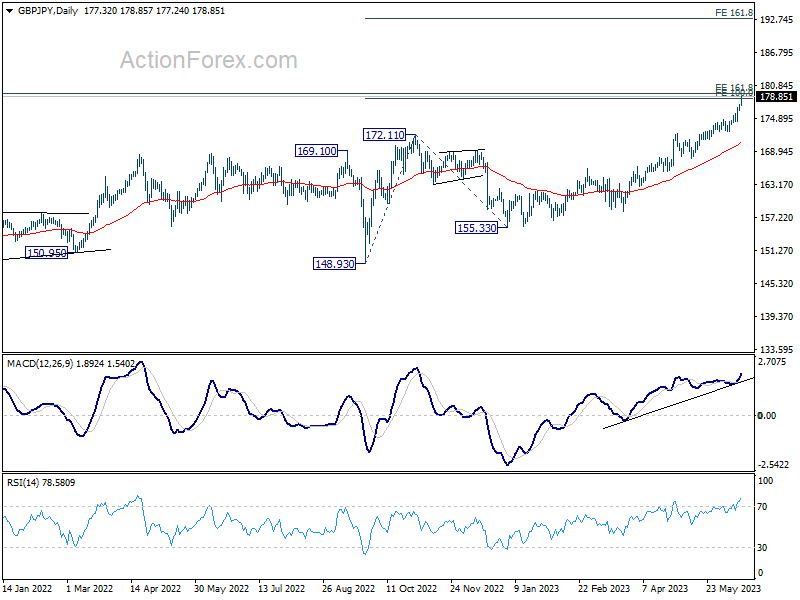
GBP/JPY's rally continues today and accelerates to as high as 178.83 so far. 100% projection of 148.93 to 172.11 from 155.33 at 178.51 is already met but there is no sign of topping yet. Intraday bias remains on the upside for the moment. Sustained break of 178.69 (as mentioned below) will carry larger bullish implication, and target 161.8% projection of 148.93 to 172.11 from 155.33 at 192.83 next. On the downside, though, break of 176.42 minor support will turn intraday bias neutral first.
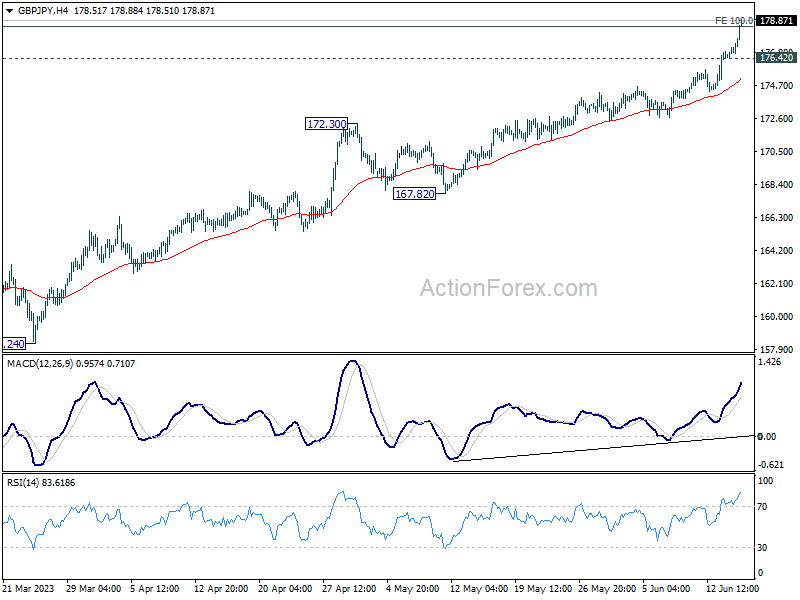
In the bigger picture, up trend from 123.94 (2020 low) is extending. Next target will be 161.8% projection of 122.75 (2016 low) to 156.59 (2018 high) from 123.94 at 178.69. Sustained break there will pave the way to 195.86 long term resistance (2015 high). For now, medium term outlook will remain bullish as long as 172.11 resistance turned support holds, even in case of deep pull back.
Markets Skeptical Despite Fed’s Hawkish Hold; Yen Plunges; ECB Next
Fed clearly delivered a hawkish hold overnight, signaling that two more rate hikes are underway. However, market participants appear skeptical about the Fed's aggressive posture. According to Fed funds futures, markets are still projecting interest rate to peak at 5.25-5.00%, anticipating just one more 25-basis point rate hike in July. Moreover, there's over 60% chance that rates will remain at this level by year-end.
This sentiment was also reflected in performance of major U.S. stock indices, which closed mixed. While NASDAQ and the S&P 500 managed to end the day with gains, 10-year yield declined and settled marginally below the 3.8% mark. Although Dollar has been recovering, its upside momentum appears limited against European majors and commodity currencies.
Meanwhile, Yen is taking the limelight from ECB rate decisions, experience steep selloff in Asia which triggered verbal intervention from the government. Euro also softens as markets await another ECB hike, but more importantly any forward guidance and the new economic projections. Australian Dollar is the strongest one as supported by strong job data, managing to shake off the impact of weaker than expected Chinese economic data.
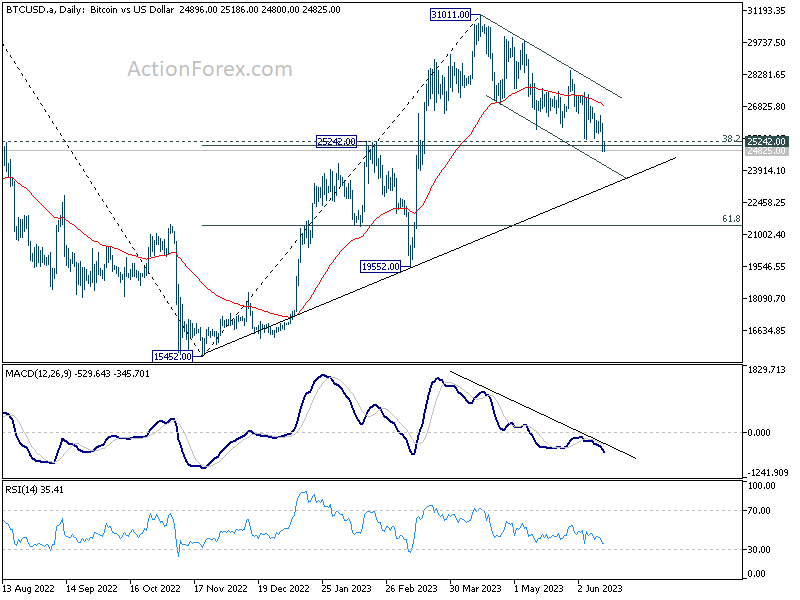
Technically, Bitcoin's break of 25242 cluster support (38.2% retracement of 15452 to 31011) is worth a note. The development argues that deeper correction is underway, with trend line support at around (now at 23230) as the first line of defense. Firm break there will pave the way to 61.8% retracement at 21393 or below. Any downside acceleration in Bitcoin could precede selloff in NASDAQ and overall stock markets. Let's see how it goes.
Fed stood pat, but projects two more hikes this year
Fed keeps interest rate unchanged at 5.00-5.25% as widely expected, by unanimous vote. The new economic projections are rather hawkish, with 2023 median rate projections raised to 5.6% (two more 25bps hikes). GDP growth and core PCE inflation were revised higher while unemployment rate was revised lower.
FOMC leaves the door open for more tightening, as "the Committee would be prepared to adjust the stance of monetary policy as appropriate if risks emerge that could impede the attainment of the Committee's goals.:
Fed added that the assessments will take into account information including "readings on labor market conditions, inflation pressures and inflation expectations, and financial and international developments.".
In the new economic projections, median federal funds rates for 2023 is raised from 5.1% to 5.6%, indicating two more 25bps hike. Median projections for 2024 was raised from 4.3% to 4.6%, for 2025 raised from 3.1% to 3.4%.
Regarding 2023 median economic projections, real GDP growth was raised sharply higher from 0.4% to 1.0%, unemployment rate sharply lower from 4.5% to 4.1%, core PCE inflation from 3.6% to 3.9%.
In the new dot plot, eleven members penciled in rate hikes to 5.50-5.75% this year, with four expecting rate at 5.25-5.50%, and only two at the current 5.00-5.25%.
Some reviews on FOMC:
Japan starts verbal intervention as USD/JPY surges pass 140
The steep decline in Japanese Yen in Asian session trigger verbal intervention by a top government official.
Chief Cabinet Secretary Hirokazu Matsuno said at a press conference,
"It is important for foreign exchange markets to move in a stable manner reflecting fundamentals, and excessive changes are undesirable."
"There is no change to the government's stance that we will closely monitor movements in the currency market and take appropriate steps if necessary," he added.
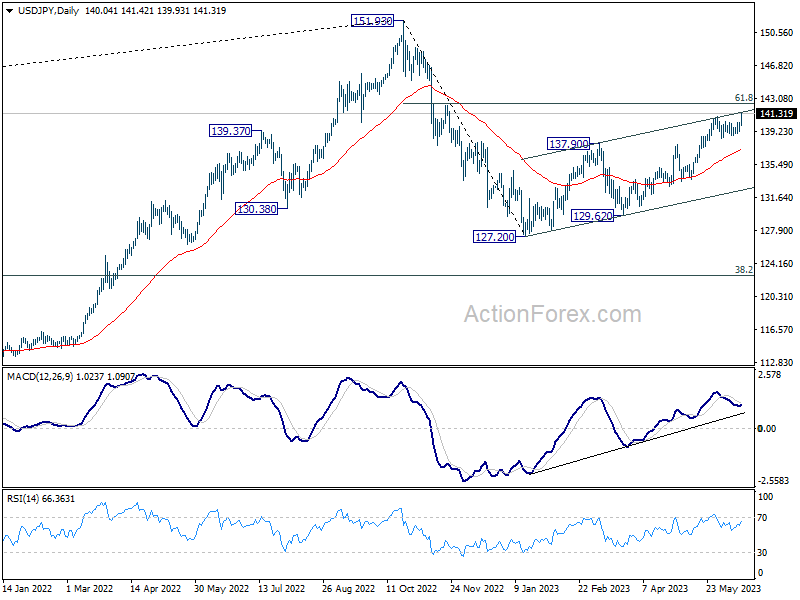
USD/JPY surges pass 140.90 resistance to resume whole rally from 127.20 (Jan low). 61.8% retracement of 151.93 Further rise should be seen to 127.20 at 142.48. But the pair might start to feel heavy above there, as the government could step up rhetorics on intervention further.
Australia employment grew 75.6k in May, unemployment rate back to 3.6%
Australia employment rose 75.6k in May, well above expectation of 16.5k. Full time jobs grew 61.7k while part-time jobs grew 14.3k.
Unemployment rate dropped from 3.7% to 3.6%, below expectation of 3.7%. Participation rate rose from 66.7% to 66.9%. Monthly hours worked dropped -1.8% mom. Employment-to-population ratio rose 0.2% to 64.5%, a record high.
Bjorn Jarvis, ABS head of labour statistics, said: "Looking over the past two months, the employment increases average out to around 36,000 extra employed people each month. This is still around the average over the past year of 39,000 people a month."
"Just before the start of the pandemic almost 13 million people were employed in Australia. In May 2023, this had risen to just over 14 million people."
NZ GDP down -0.1% qoq in Q1, driven by inventory rundown and services exports
New Zealand GDP contracted -0.1% qoq in Q1 as expected. Primary industries fell -0.5%. Service industries fell -0.6%. Goods producing industries fell -0.4%.
StatsNZ noted, "The expenditure measure of GDP fell 0.2 percent this quarter. This decline was driven by run downs in inventories held by businesses, and a fall in exports of services."
"A 2.4 percent increase in household consumption expenditure and 2.0 percent growth in investment in fixed assets partially offset the falls."
China production and investment data show struggling private sector
China's industrial production growth for May came in at 3.5% yoy, aligning with market expectations. However, a discrepancy was observed in growth rates of private and state-owned businesses. Industrial output from private businesses only managed to expand by 0.7% yoy, a stark contrast to the 4.4% yoy growth posted by state-owned enterprises.
Furthermore, China's fixed asset investment rose 4.0% ytd yoy, a figure falling short of the anticipated 4.4% and a marked deceleration from 4.7% recorded during the first four months of 2023. Notably, private businesses experienced a dip in their fixed asset investment by -0.1% ytd yoy, while state-owned enterprises reported robust growth of 8.4%.
Meanwhile, retail sales failed to meet expectations, recording a rise of 12.7% yoy, lower expectation of 13.9% yoy increase.
In a separate but related development, People's Bank of China announced a cut in rate on its one-year medium-term lending facility loans to financial institutions. The rate was lowered from 2.75% to 2.65%, following the bank's decision to cut seven-day reverse repo and standing lending facility rate earlier this week.
ECB to hike 25bps, can EUR/CHF extend rebound?
ECB is widely expected to raise interest rates today, and lift the main refinancing rate by 25bps to 4.00%, the highest level since 2001. The deposit rate, once negative, will correspondingly be raised to 3.50%. The bigger question is about forward guidance, but it's unlikely for President Christine Lagarde to shift from the "data-dependent", "meeting-by-meeting" approach for any future decisions. Nevertheless, the new economic projections could still reveal some hints on ECB's thought.
Some previews on ECB:
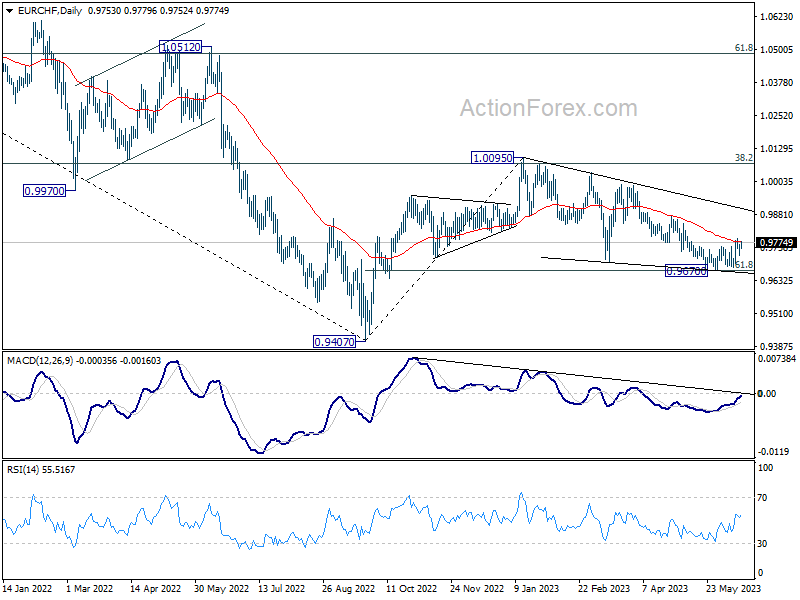
As for market reactions, we'd be closely watching EUR/CHF. A short term bottom should be in place at 0.9670, after hitting 61.8% retracement of 0.9407 to 1.0095 at 0.9670. Sustained trading above 55 D EMA will add to the case that whole correction from 1.0095 has completed today. Such development will also bolster the case that whole rise from 0.9407 (2022 low) is ready to resume later in the year. But, that might require something hawkish from ECB as a trigger.
GBP/JPY Daily Outlook
Daily Pivots: (S1) 176.76; (P) 177.09; (R1) 177.74; More...
GBP/JPY's rally continues today and accelerates to as high as 178.83 so far. 100% projection of 148.93 to 172.11 from 155.33 at 178.51 is already met but there is no sign of topping yet. Intraday bias remains on the upside for the moment. Sustained break of 178.69 (as mentioned below) will carry larger bullish implication, and target 161.8% projection of 148.93 to 172.11 from 155.33 at 192.83 next. On the downside, though, break of 176.42 minor support will turn intraday bias neutral first.
In the bigger picture, up trend from 123.94 (2020 low) is extending. Next target will be 161.8% projection of 122.75 (2016 low) to 156.59 (2018 high) from 123.94 at 178.69. Sustained break there will pave the way to 195.86 long term resistance (2015 high). For now, medium term outlook will remain bullish as long as 172.11 resistance turned support holds, even in case of deep pull back.
Economic Indicators Update
| GMT | Ccy | Events | Actual | Forecast | Previous | Revised |
|---|---|---|---|---|---|---|
| 21:45 | NZD | GDP Q/Q Q1 | -0.10% | -0.10% | -0.60% | |
| 23:50 | JPY | Trade Balance (JPY) May | -0.78T | -0.78T | -1.02T | -1.04T |
| 23:50 | JPY | Machinery Orders M/M Apr | 5.50% | 3.00% | -3.90% | |
| 01:00 | AUD | Consumer Inflation Expectations Jun | 5.20% | 5.00% | ||
| 01:30 | AUD | Employment Change May | 75.9K | 16.5K | -4.3K | -4.0K |
| 01:30 | AUD | Unemployment Rate May | 3.60% | 3.70% | 3.70% | |
| 02:00 | CNY | Retail Sales Y/Y May | 12.70% | 13.90% | 18.40% | |
| 02:00 | CNY | Industrial Production Y/Y May | 3.50% | 3.50% | 5.60% | |
| 02:00 | CNY | Fixed Asset Investment YTD Y/Y May | 4.00% | 4.40% | 4.70% | |
| 04:30 | JPY | Tertiary Industry Index M/M Apr | 1.20% | 0.50% | -1.70% | |
| 06:30 | CHF | Producer and Import Prices M/M May | -0.30% | 0.10% | 0.20% | |
| 06:30 | CHF | Producer and Import Prices Y/Y May | -0.30% | -0.20% | 1.00% | |
| 07:00 | CHF | SECO Economic Forecasts | ||||
| 09:00 | EUR | Eurozone Trade Balance (EUR) Apr | 5.7B | 17.0B | ||
| 12:15 | EUR | ECB Main Refinancing Rate | 4.00% | 3.75% | ||
| 12:30 | CAD | Manufacturing Sales M/M Apr | 0.70% | |||
| 12:30 | USD | Empire State Manufacturing Index Jun | -14.6 | -31.8 | ||
| 12:30 | USD | Retail Sales M/M May | 0.00% | 0.40% | ||
| 12:30 | USD | Retail Sales ex Autos M/M May | 0.10% | 0.40% | ||
| 12:30 | USD | Initial Jobless Claims (Jun 9) | 248K | 261K | ||
| 12:30 | USD | Import Price Index M/M May | -0.10% | 0.40% | ||
| 12:30 | USD | Philadelphia Fed Manufacturing Survey Jun | -12.7 | -10.4 | ||
| 12:45 | EUR | ECB Press Conference | ||||
| 13:15 | USD | Industrial Production M/M May | 0.10% | 0.50% | ||
| 13:15 | USD | Capacity Utilization May | 79.70% | 79.70% | ||
| 14:00 | USD | Business Inventories Apr | 0.20% | -0.10% | ||
| 14:30 | USD | Natural Gas Storage | 97B | 104B |
ECB to hike 25bps, can EUR/CHF extend rebound?
ECB is widely expected to raise interest rates today, and lift the main refinancing rate by 25bps to 4.00%, the highest level since 2001. The deposit rate, once negative, will correspondingly be raised to 3.50%. The bigger question is about forward guidance, but it's unlikely for President Christine Lagarde to shift from the "data-dependent", "meeting-by-meeting" approach for any future decisions. Nevertheless, the new economic projections could still reveal some hints on ECB's thought.
Some previews on ECB:
As for market reactions, we'd be closely watching EUR/CHF. A short term bottom should be in place at 0.9670, after hitting 61.8% retracement of 0.9407 to 1.0095 at 0.9670. Sustained trading above 55 D EMA will add to the case that whole correction from 1.0095 has completed today. Such development will also bolster the case that whole rise from 0.9407 (2022 low) is ready to resume later in the year. But, that might require something hawkish from ECB as a trigger.