

Sample Category Title
Sunset Market Commentary
Markets
A summer lull is the well-known phenomenon of a short period of calm in which little happens. Afterwards, business picks up again. Lesser known is the spring lull. In case you wondered, we’re in the middle of it. Core bonds are trading rangebound and stock markets cede some ground after testing important resilience levels earlier this year. The dollar manages to regain momentum as the relative yield spread (US/GE 2y) is correcting back in the greenback’s favour. EUR/USD fell to the lowest level since early April around 1.0820. The 100d simple moving average provides support as it did in March. EUR/GBP follows EUR/USD south with the pair remaining below support lost last week around 0.8720. BoE governor Bailey spoke at the Global Annual Conference of the British Chambers of Commerce, but his speech lacked guidance for June. “While we expect CPI inflation to fall quite sharply as energy costs begin to ease, albeit at a somewhat slower pace than projected in February given the near-term outlook for food prices, the outlook for inflation further out is more uncertain and depends on the extent of persistence in wage and price setting.” The UK central bank is firmly in data dependence mode. Bailey specifically mentioned trends in wages, job vacancies and core inflation.
The current spring lull bridges the period between May policy meetings by ECB/Fed and first relevant datapoints for the June updates. A 25 bps ECB rate hike and a conditional Fed pause are the benchmarks against which they’ll be checked. Next week’s EMU PMI’s are the amuse-bouche ahead of EMU inflation and US payrolls thereafter. Simultaneously with the eco pause, regional US banking shares are recovering from the lows as they gradually see some new deposit inflows. Everybody’s talking about the US debt ceiling debate with X-date (default date) early June, but apart from US T-bills and US CDS levels, there’s no sign of stress. Markets probably aren’t worrying until we’re effectively days/hours away from a default. All of this combined creates the low volatility spring lull we’re currently in.
News & Views
The deal under which Russia allows Ukraine safe grain export from its Black Sea ports lapses on Thursday. The UN and Turkey brokered the deal in July last year for an initial 120 days in a bid to prevent a global food crisis from escalating. The deal was extended in November for another 120 days and then for 60 days back in March, helping corn prices ease from multiyear highs of >$800/bushel mid-2022 to $571 currently. Russia had threatened to quit the deal as restrictions on payments, logistics and insurance posed a barrier to shipments, even as Russian exports of food and fertilizer are not subject to Western sanctions. Bloomberg, citing Turkish officials, in the meantime reported that the deal is set to be extended anyway. An official announcement should follow later today.
Hungary’s foreign minister Szijarto said it will block a further €500 million tranche of European financial assistance to Ukraine for now, adding that it is also reluctant to back further sanctions against Russia. One of the reasons underpinning the decision was Ukraine’s move to add Hungary’s largest lender to its list of international war sponsors and as such risk harming the lender’s reputation. As long as this is the case, Hungary “can’t support decisions requiring new economic and financial sacrifice on the part of the European Union and its member states”. The Hungarian forint lost ground after Szijarto ‘s comments with EUR/HUF bouncing of critical support just below 370 to 371.3 currently. Investors fear it will further complicate the disbursement of billions of EU funds to Hungary – which are officially blocked over a rule of law dispute. But the country’s stance vs Ukraine (aid) has often been to the dismay of the EU which has previously used the blocked resources as a leverage in the discussions.
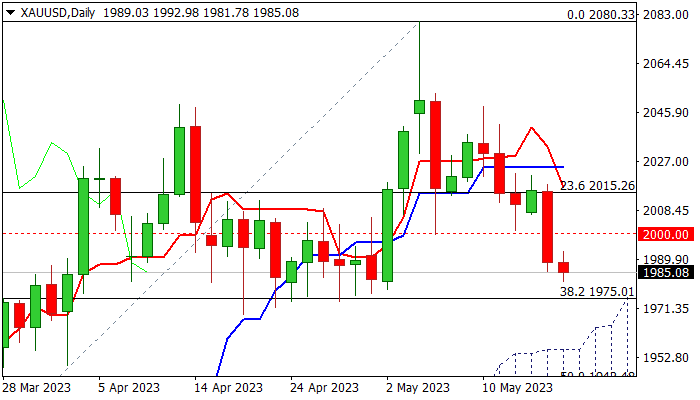
XAU/USD: Bears Firmed on Loss of $2000 But Face Significant Supports at $1975/55
Gold price remains at the back foot on Wednesday and hit new two-week low, in extension of Tuesday’s 1.3% fall which also registered a daily close below psychological $2000 level for the first time since May 1.
The metal came under increased pressure on the latest hawkish comments from Fed officials, who played down prospects for rate cuts this year, but pointed to central bank’s super strong stance in fighting high inflation.
This revived expectations for another rate hike, against still high percentage forecast that the Fed is about to pause its tightening cycle, as signaled after the last policy meeting, deflating the non-interest bearing metal.
Daily chart structure weakened on break of $2000 handle, daily Tenkan-sen crossed below Kijun-sen, 14-d momentum is at the border line and the action is weighed by Tuesday’s large bearish candle, but stochastic is oversold.
However, fresh bears still face strong supports at $1975 (higher base/Fibo 38.2% of $1804/$2080) and $1955 (top of rising daily Ichimoku cloud which underpins the action) where strong headwinds should be anticipated, and bears are unlikely to break them on first attempt.
Near-term bias is expected to remain with bulls while the action stays above $1975, though the downside would remain vulnerable while $2000 caps.
Bounce and close above $2000, as minimum requirement for initial reversal signal, would improve near-term picture, however verification of the signal will still require acceleration above daily Kijun-sen ($2024).
Res: 1992; 2000; 2015; 2024.
Sup: 1975; 1969; 1955; 1942.
US: Housing Starts Rose and Permits Fell in April
Housing starts rose by 2.2% month-on-month (m/m) in April to 1.40 million (annualized) units, in-line with consensus expectations. Revisions to the three prior months were negative, subtracting roughly 39k units from the previous reported tallies.
Starts in the single-family segment rose by 1.6% m/m (or 13k units) after falling by 0.2% in March. Multi-family starts also ticked up, rising by 3.2% m/m (or 17k units) after seeing a sharp decline in the previous month.
Residential permits fell in April by 1.5% m/m to 1.42 million units. The decline was led by a strong reduction in multi-family permitting which fell for a second consecutive month. Meanwhile, single-family permits rose for a third consecutive month in April, ticking up by 3.1% m/m.
Among the four Census regions, housing starts fell in the Northeast (-23.4% m/m) and the South (-6.3% m/m). The West and Midwest regions each recorded sizeable monthly gains of 34.6% m/m and 32.6% m/m, respectively.
Key Implications
Homebuilding activity was mixed in April, with starts picking up in both the single-family and multi-family segments, while permitting activity fell for a second month on multi-family weakness. However, single-family permitting activity has seen a solid rebound to start 2023 after contracting for most of last year. While there are some signs of positivity in this report, starts and permits each remain roughly 20% below year-ago levels.
The National Association of Home Builders' Housing Market Index – a measure of homebuilder sentiment in the single-family market – rose for a fifth consecutive month in May to its highest level since July 2022. Homebuilders have become increasingly optimistic about the outlook for residential construction as the past few years of excess demand has drained the housing market of supply. In addition, with mortgage rates remaining near a 15-year high, many potential sellers cannot afford to re-enter the market, which has kept the stock of existing homes for sale low. With new homes now making up roughly one-third of all sales, residential construction is expected to continue to play a large role in returning affordability to the U.S. housing market.
USD/CHF Mid-Day Outlook
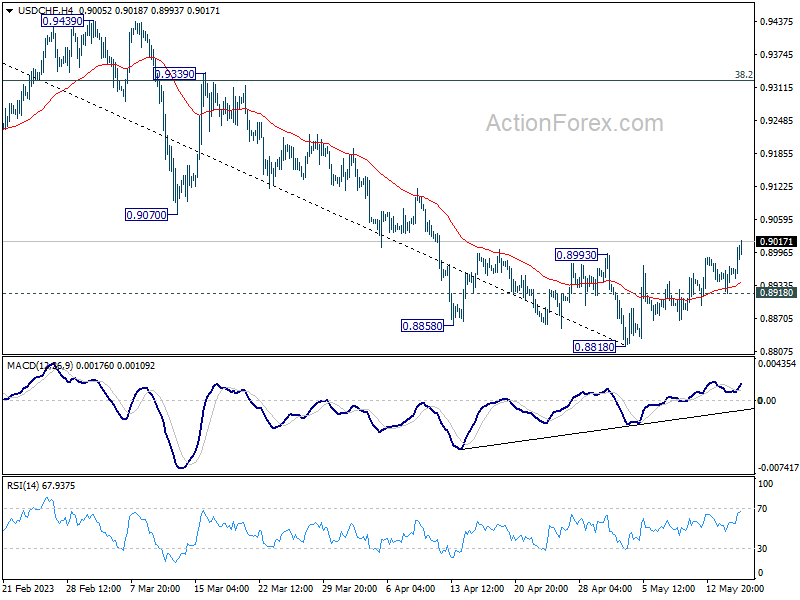
Daily Pivots: (S1) 0.8932; (P) 0.8951; (R1) 0.8983; More...
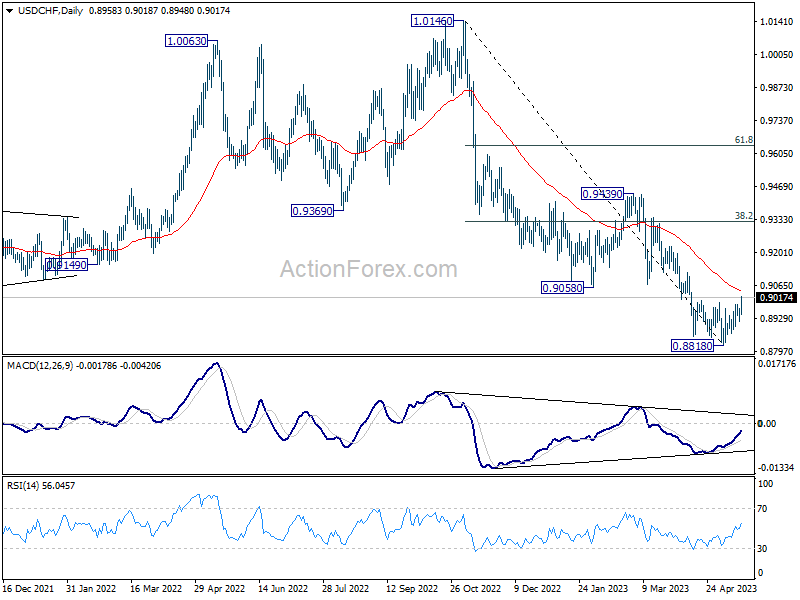
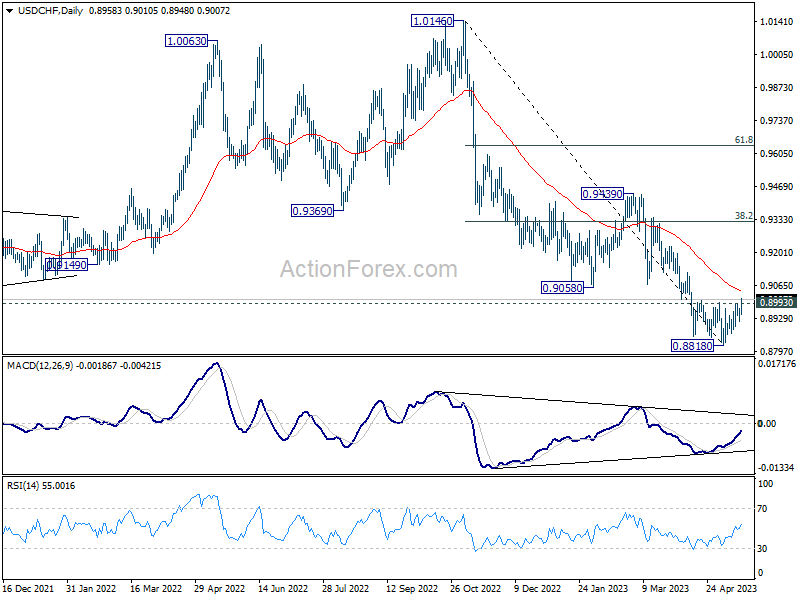
USD/CHF's break of 0.8993 resistance confirms short term bottoming at 0.8818, ahead of 0.8756 long term support. Intraday bias is back on the upside for 55 D EMA (now at 0.9045). Sustained break there should confirm that it's at least correcting whole down trend from 1.0146. Further rally would be seen to 38.2% retracement of 1.0146 to 0.8818 at 0.9325. On the downside, below 0.8918 minor support will turn intraday bias neutral first.
In the bigger picture, fall from 1.1046 (2022 high) is seen as a leg in the long term range pattern from 1.0342 (2016 high). So, downside should be contained by 0.8756 to bring reversal. Sustained break of 0.9058 support turned resistance will be the first sign of medium term bottoming. However, decisive break of 0.8756 will carry larger bearish implications.
USD/JPY Mid-Day Outlook
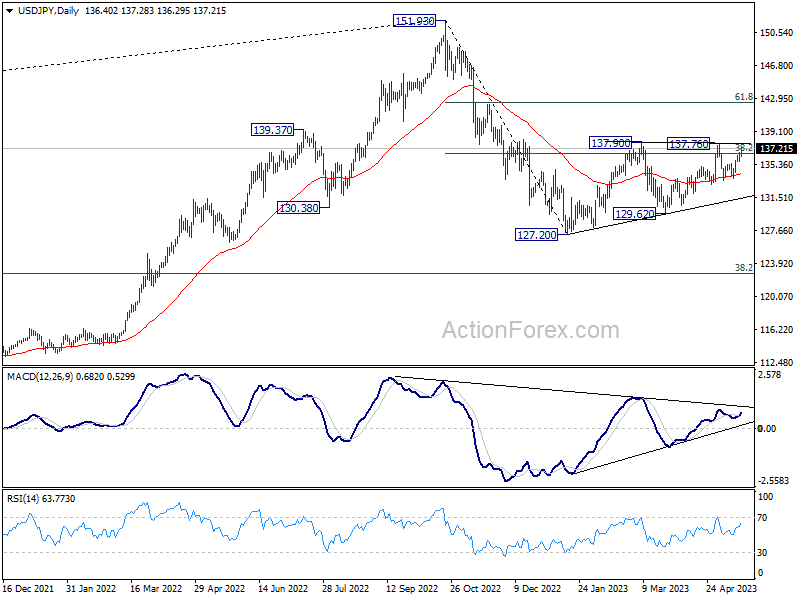
Daily Pivots: (S1) 135.82; (P) 136.26; (R1) 136.82; More...
Intraday bias in USD/JPY remains on the upside for the moment. Decisive break of 137.76/90 resistance zone will resume whole rebound from 127.20. Next target is 142.48 fibonacci level. On the downside, below 135.60 minor support will turn intraday bias neutral first.
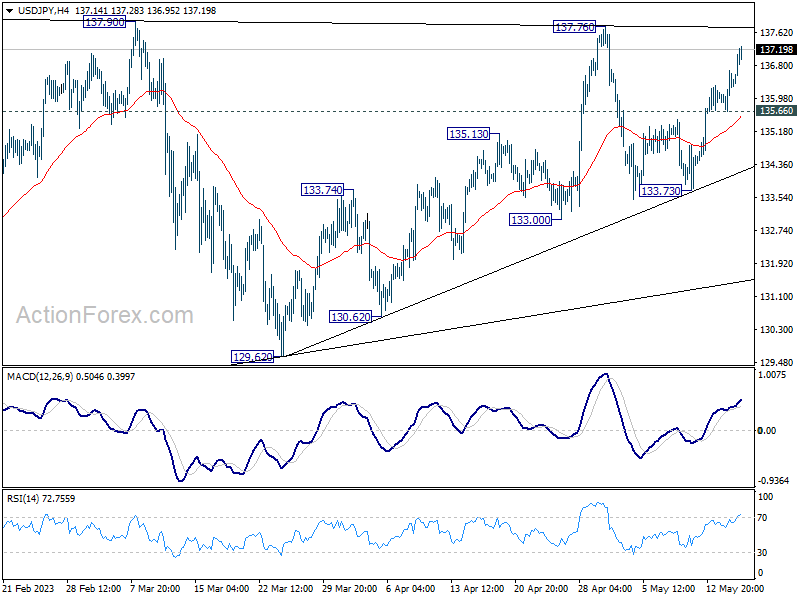
In the bigger picture, price actions from 151.93 high are currently seen as a corrective pattern to the long term up trend. The first leg should have completed at 127.20. Rebound from there is seen as the second leg. Sustained break of 38.2% retracement of 151.93 to 127.20 at 136.34 will bring stronger rise to 61.8% retracement at 142.48. Meanwhile, break of 129.62 will argue that the third leg is starting through 127.20 low.
GBP/USD Mid-Day Outlook
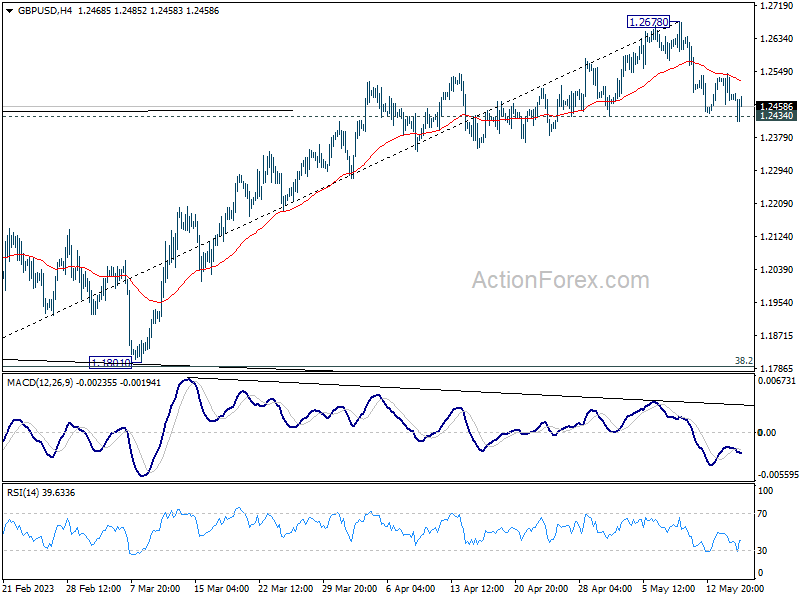
Daily Pivots: (S1) 1.2452; (P) 1.2499; (R1) 1.2532; More...
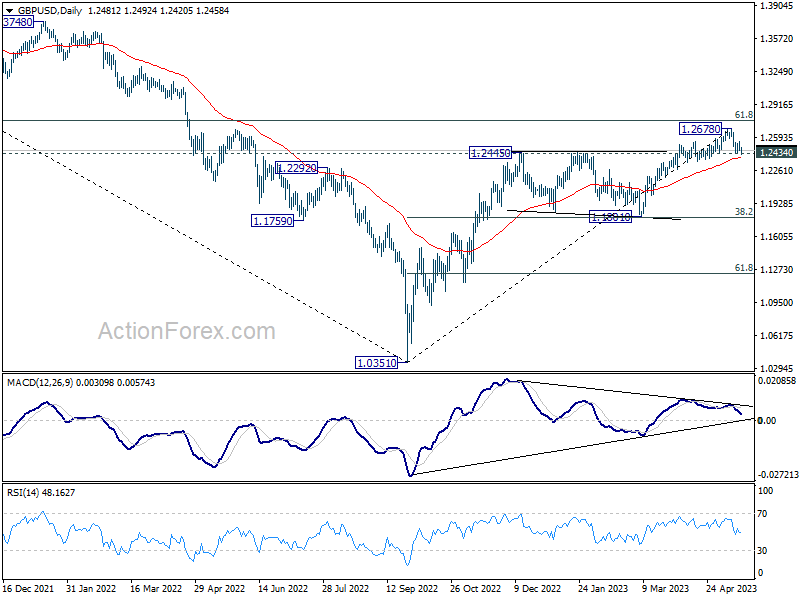
GBP/USD recovered after brief breach of 1.2434 support and intraday bias stays neutral first. On the downside, firm break of 1.2434 will confirm short term topping at 1.2678, on bearish divergence condition in 4H MACD. Intraday bias will be back on the downside for 1.1801 cluster support (38.2% retracement of 1.0351 to 1.2678 at 1.1789), as correction to whole up trend from 1.0351. On the upside, however, break of 1.2678 will resume larger up trend from 1.0351 instead.
In the bigger picture, as long as 1.1801 support holds, rise from 1.0351 medium term bottom (2022 low) is expected to extend further. Sustained break of 61.8% retracement of 1.4248 (2021 high) to 1.0351 at 1.2759 will add to the case of long term bullish trend reversal. However, firm break of 1.1801 will indicate rejection by 1.2759, and bring deeper decline, even as a correction.
EUR/USD Mid-Day Outlook
Daily Pivots: (S1) 1.0844; (P) 1.0874; (R1) 1.0894; More...
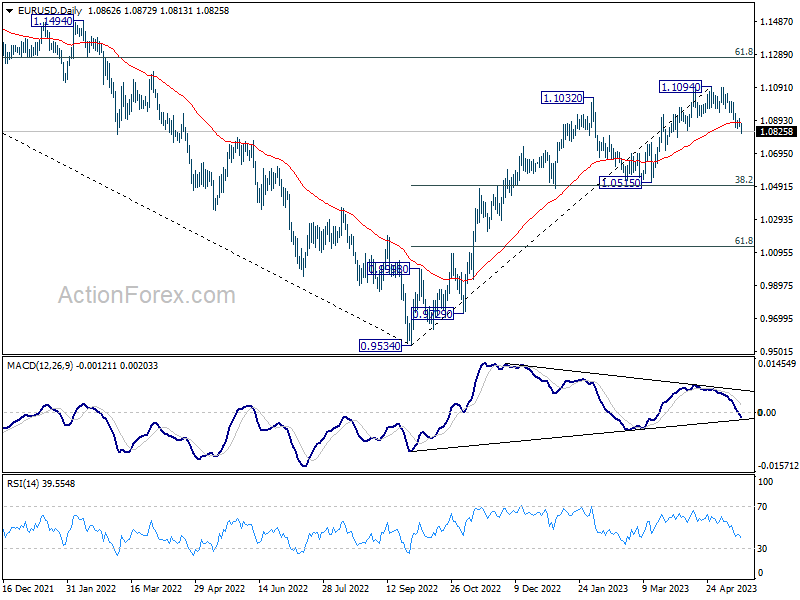
EUR/USD's fall from 1.1094 short term top resumed after brief consolidations. Intraday bias is back on the downside. Current fall is seen as correcting whole up trend from 0.9534. Deeper decline would be seen to 1.0515 cluster support, 38.2% retracement of 0.9534 to 1.1094 at 1.0498. On the upside, above 1.0903 minor resistance will turn intraday bias neutral first.
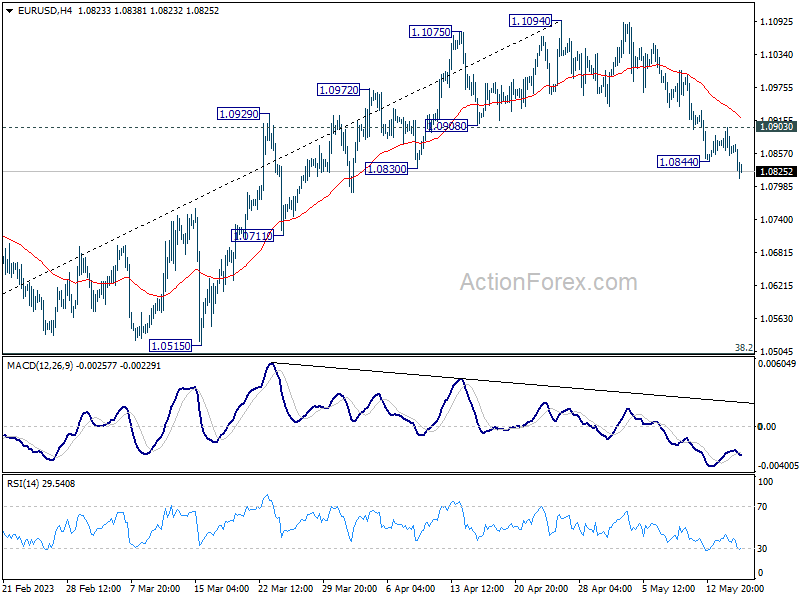
In the bigger picture, as long as 1.0515 support holds, rise from 0.9534 (2022 low) would still extend higher. Sustained break of 61.8% retracement of 1.2348 (2021 high) to 0.9534 at 1.1273 will solidify the case of bullish trend reversal and target 1.2348 resistance next (2021 high).
Dollar Extending Rally Against Euro and Swiss Franc, Sentiment Flip-Flops
Market sentiment continue to flip-flop on flowing headlines regarding US debt ceiling negotiations. But then, it should be remembered that it's not done until it's done. So uncertainties and volatility still lie ahead. Yen is the consistent one extending its near term decline. Commodity currencies are rebounding with Sterling. But the more important development is in Dollar's rally extension against Euro and Swiss France.
Technically, USD/CHF's break of 0.8993 resistance today now argues that rebound from 0.8818 might at least correcting whole fall from 1.0146. This is supported by bullish convergence condition in D MACD. Next focus is the resistance zone between 55 D EMA (now at 0.9044) and 0.9058 support turned resistance. Sustained break there will affirm this case and bring further rally to 38.2% retracement of 1.0146 to 0.8818 at 0.9325. Meanwhile, to aid the rally, EUR/CHF better takes out 0.9780 minor resistance too.
In Europe, at the time of writing, FTSE is down -0.05%. DAX is up 0.49%. CAC is up 0.15%. Germany 10-year yield is down -0.0424. Earlier in Asia, Nikkei rose 0.84%. Hong Kong HSI dropped -2.09%. China Shanghai SSE dropped -0.21%. Singapore Strait Times dropped -1.25%. Japan 10-year JGB yield dropped -0.0264 to 0.369.
BoE Bailey: Will adjust rate further if inflation pressures persist
BoE Governor Andrew Bailey pledged in a speech, "I can assure you that the MPC will adjust Bank Rate as necessary to return inflation to target sustainably in the medium term, in line with its remit."
"If there were to be evidence of more persistent pressures, then further tightening in monetary policy would be required," he added.
In the baseline modal projection of May Report, which is conditional on a market-implied path for interest to peak at 4.75% in Q4, inflation will fall materially below the 2% target in the medium term."
However, he noted, "risks to inflation are skewed significantly to the upside", primarily reflecting the possibility of more persistence in domestic wage and price setting. Also, the "unwinding of second-round effects may take longer than it did for them to emerge".
This "asymmetry" was not made as part of the baseline modal projection. Instead, "we think of this as a material upside risk to the inflation outlook over the medium term."
Eurozone CPI finalized at 7% yoy in Apr, CPI core at 5.6% yoy
Eurozone CPI was finalized at 7.0% yoy in April, up from March's 6.9% yoy. The highest contribution to came from food, alcohol & tobacco (+2.75%), followed by services (+2.21%), non-energy industrial goods (+1.62%) and energy (+0.38%). CPI core (excluding energy, food, alcohol & tobacco) was finalized at 5.6% yoy, down from prior month's 5.7% yoy.
EU CPI was finalized at 8.1% yoy. The lowest annual rates were registered in Luxembourg (2.7%), Belgium (3.3%) and Spain (3.8%). The highest annual rates were recorded in Hungary (24.5%), Latvia (15.0%) and Czechia (14.3%). Compared with March, annual inflation fell in twenty-two Member States and rose in five.
Japan's economy bounced back in Q1, up 1.6% annualized, 0.4% qoq
Japan's economy delivered a robust performance in Q1, expanding at annualized rate of 1.6%, which significantly surpassed expectation of 0.7%. This marks the first expansion in three quarters, thanks to a potent combination of strong private consumption and a rebound in inbound tourism.
In terms of real GDP, adjusted for inflation, there was an increase of 0.4% qoq, beating the forecast growth of 0.1% qoq. The positive data signals a welcome resurgence in Japan's economy, signaling a potential turn-around after short period of technical recession.
Looking into the details, private consumption for the quarter rose by 0.6%, driven by robust demand for cars and durable goods. Concurrently, consumers boosted spending on services such as dining out, culminating in the fourth consecutive quarterly gain. Meanwhile, capital spending rose by 0.9%, aided by increased car-related investments and marking the first increase in two quarters.
However, not all sectors exhibited positive trends. Exports took a hit, declining by -4.2% due to a slump in shipments of cars and machinery used for chip production. Imports also fell by 2-.3%. Public investment remained largely flat.
Australia wage growth accelerated to 0.8% in Q1, highest in over a decade
Australia wage price index posted 0.8% qoq increase in Q1 2023, slightly short of expected 0.9% rise. Despite this, annual wage growth accelerated to 3.7%, marking the highest level since Q3 2012. This uptick is attributable to a combination of factors, including low unemployment, tight labour market, and high inflation.
Private sector emerged as the primary engine of growth, with wages climbing 0.8% over Q1 and experiencing an annual rise of 3.8%. According to Leigh Merrington, ABS's acting head of prices statistics, several private sector industries witnessed an annual wage growth exceeding 4%, with the remaining industries all recording an annual growth above 3%.
In the public sector, the highest quarterly (0.9%) and annual (3.0%) wage growth in a decade was reported. Increase in public sector wages is attributed to outcomes from enterprise agreement bargaining, regular scheduled rises, and higher wage caps.
Merrington further highlighted wage outcomes for Q1 2023, stating, "There was a continued lift in the share of jobs receiving wage rises of between 4 and 6 per cent, which is the highest share since 2009. The share of jobs with a wage rise of 2 per cent or less has fallen from over 50 per cent in mid-2021 to less than 20 per cent."
EUR/USD Mid-Day Outlook
Daily Pivots: (S1) 1.0844; (P) 1.0874; (R1) 1.0894; More...
EUR/USD's fall from 1.1094 short term top resumed after brief consolidations. Intraday bias is back on the downside. Current fall is seen as correcting whole up trend from 0.9534. Deeper decline would be seen to 1.0515 cluster support, 38.2% retracement of 0.9534 to 1.1094 at 1.0498. On the upside, above 1.0903 minor resistance will turn intraday bias neutral first.
In the bigger picture, as long as 1.0515 support holds, rise from 0.9534 (2022 low) would still extend higher. Sustained break of 61.8% retracement of 1.2348 (2021 high) to 0.9534 at 1.1273 will solidify the case of bullish trend reversal and target 1.2348 resistance next (2021 high).
Economic Indicators Update
| GMT | Ccy | Events | Actual | Forecast | Previous | Revised |
|---|---|---|---|---|---|---|
| 23:50 | JPY | GDP Annualized Q1 P | 0.40% | 0.20% | 0.10% | |
| 23:50 | JPY | GDP Deflator Y/Y Q1 P | 2.00% | 2.00% | 1.20% | |
| 01:30 | AUD | Wage Price Index Q/Q Q1 | 0.80% | 0.90% | 0.80% | |
| 04:30 | JPY | Industrial Production M/M Mar F | 1.10% | 0.80% | 0.80% | |
| 08:00 | EUR | Italy Trade Balance (EUR) Mar | 7.54B | 2.50B | 2.11B | |
| 09:00 | EUR | Eurozone CPI Y/Y Apr F | 7.00% | 7.00% | 7.00% | |
| 09:00 | EUR | Eurozone CPI Core Y/Y Apr F | 5.60% | 5.60% | 5.60% | |
| 12:30 | USD | Housing Starts Apr | 1.42M | 1.40M | 1.42M | 1.43M |
| 12:30 | USD | Building Permits Apr | 1.42M | 1.44M | 1.43M | 1.37M |
| 14:30 | USD | Crude Oil Inventories | -1.5M | 3.0M |
BoE Bailey: Will adjust rate further if inflation pressures persist
BoE Governor Andrew Bailey pledged in a speech, "I can assure you that the MPC will adjust Bank Rate as necessary to return inflation to target sustainably in the medium term, in line with its remit."
"If there were to be evidence of more persistent pressures, then further tightening in monetary policy would be required," he added.
In the baseline modal projection of May Report, which is conditional on a market-implied path for interest to peak at 4.75% in Q4, inflation will fall materially below the 2% target in the medium term."
However, he noted, "risks to inflation are skewed significantly to the upside", primarily reflecting the possibility of more persistence in domestic wage and price setting. Also, the "unwinding of second-round effects may take longer than it did for them to emerge".
This "asymmetry" was not made as part of the baseline modal projection. Instead, "we think of this as a material upside risk to the inflation outlook over the medium term."
What about the Dollar? Debt Default Hangs in the Balance as the US Tries to Garner Confidence
The US government is currently actively engaged in attempting to talk its way out of a potential default on its national debt as the ceiling which is imposed by US law is being reached to the extent that if something is not done, the country's government could run out of money in just two weeks' time.
The myriad of reports which now adorn the internet cover all manner of potential outcomes, including that the calculations have been done and that the US government has enough to cover its debt until and beyond June 1.
This mantra is not necessarily to be taken at face value, however, because debt talks are currently in progress at the White House, meaning that there is a potential need for the government to raise the debt ceiling, something that can be done by the US government periodically if needed.
There is no current consensus on exactly which way the outcome will go; whether the US will actually default on its debt, whether the debt is serviceable and it can carry on as it is, or whether the ceiling will be raised and the country will borrow more money.
However, if a default were to happen, what would happen to the US dollar?
It is, after all, the currency issued by the indebted government, which the Federal Reserve is the central bank for.
Firstly, and perhaps most obviously, the US Dollar could potentially depreciate as investors lose confidence in the country's ability to meet its financial obligations, leading to a possible rise in value by the British pound and the euro against the US dollar.
Yes, the US economy has now got its inflation under control at approximately 6% compared to the European side of the Atlantic's 11% in the West to 25% in some parts of Eastern Europe, but a debt default by a national government is a very serious matter as it is a mark of national insolvency.
The second possible outcome is that forex traders and investors may dump the Dollar and head toward some safe-haven currencies, such as the Swiss franc, in order to trade on a more even keel than a potentially volatile US dollar.
Thirdly, traders of physical commodities that are traditionally regarded as stores of value may ramp up their portfolios. Gold, silver, and consumable commodities such as crude oil may become interesting asset classes as demand for oil is being created via the OPEC countries' current slowdown of production, and precious metals are often used as stores of value at times of national currency volatility.
The fourth area in which the markets may be affected is currency volatility. Major currencies are often subject to minor movements due to their widespread use as de facto settlement currencies and the global dominance of the central banks that issue them as bastions of stability in the financial markets ecosystem.
However, a debt default by the United States would represent the insolvency of the world's benchmark economy; therefore, sharp fluctuations between the US Dollar and its major peers such as the Yen, Euro, Pound, and Swiss Franc may occur.
Lastly, disruption of the global financial markets could be a factor to consider. The wider commodities, equities, stock, and bond markets may be subject to traders and investors dumping toxic US stocks or bonds and realising their value quickly in order to avoid any possible uncertainty of future value in a world in which the United States is insolvent.
Of course, it may come to pass that a default does not happen. It also may come to pass that in order to avoid a default, the US borrows more money.
If that occurs, we all have to ask ourselves if that is really a way out or if it is just a way to become even more burdened and nationally insolvent without actually having it written down by debt insolvency administrators.