Sample Category Title
BoE Pill acknowledges disappointing UK GDP data, cautions on inflation path
BoE Chief Economist Huw Pill commented on today's UK GDP release at an event hosted by MNI Connect, calling the 0% growth in February "somewhat disappointing from an overall point of view." However, Pill noted that the current data profile is much better than the Monetary Policy Committee's forecasts from the second half of last year.
Pill also addressed inflation concerns, stating that "recent releases serve as a reminder that the precise path of inflation may be bumpier than we expect." Despite this, he anticipates a decline in inflation in the second quarter as last year's significant energy price increases drop out of the annual comparison.
USD/JPY Mid-Day Outlook
Daily Pivots: (S1) 132.58; (P) 133.31; (R1) 133.88; More...
Intraday bias in USD/JPY remains neutral and outlook is unchanged. On the upside, break of 134.04 will resume the rebound from 129.62 towards 137.90 resistance again. On the downside, break of 130.62 should resume the fall from 137.90 through 129.62 to retest 127.20 low.
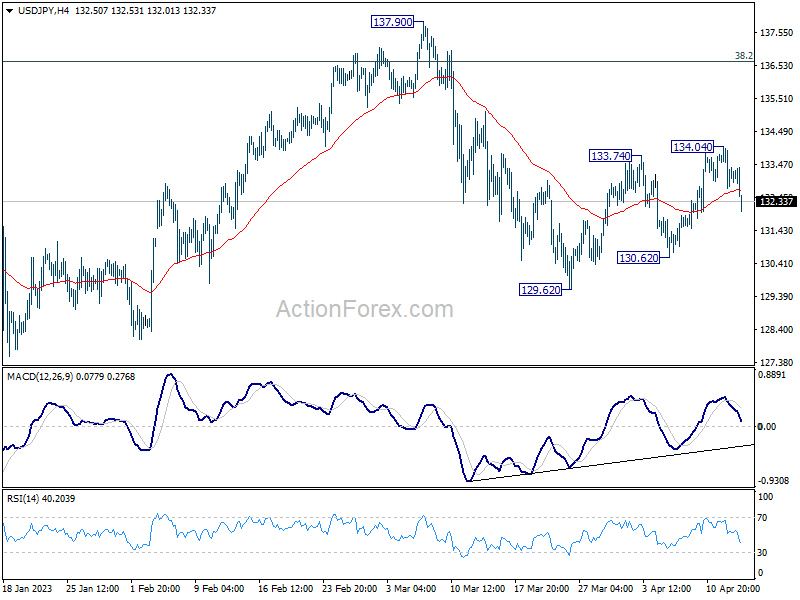
In the bigger picture, corrective pattern from 127.20 might be extending. But after all, down trend from 151.93 is expected to resume at a later stage. Break of 127.20 will resume this down trend and target 61.8% projection of 151.93 to 127.20 from 137.90 at 122.61. This will now be the favored case as long as 137.90 resistance holds.
USD/CHF Mid-Day Outlook
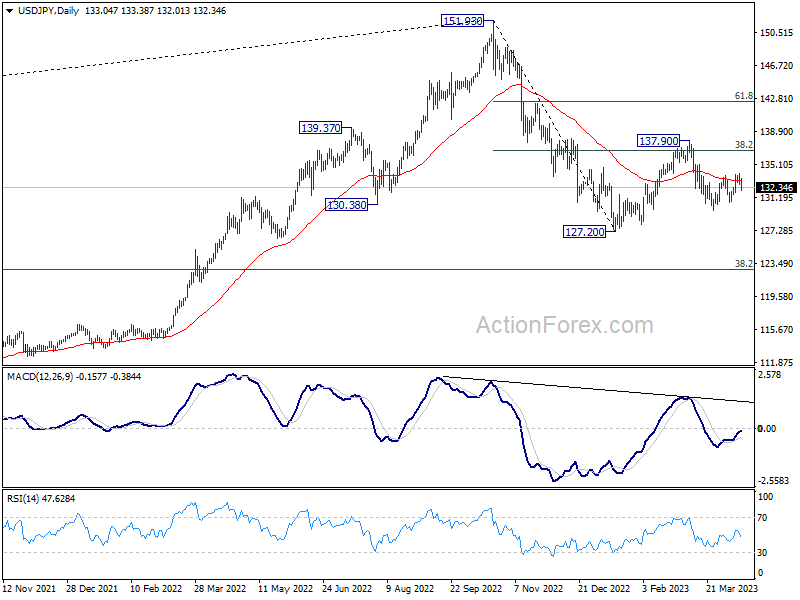
Daily Pivots: (S1) 0.9006; (P) 0.9055; (R1) 0.9081; More...
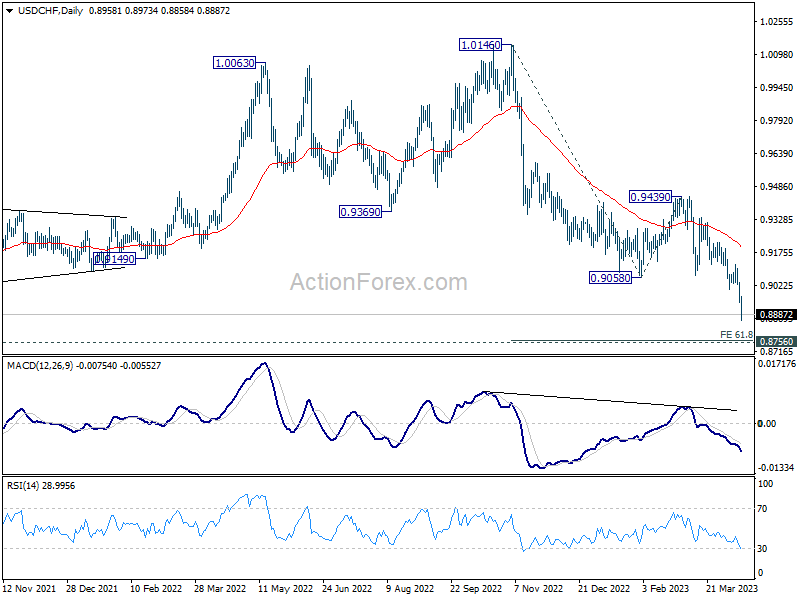
Intraday bias in USD/CHF remains on the downside at this point. Current down trend from 1.0146 should target 61.8% projection of 1.0146 to 0.9058 from 0.9439 at 0.8767, which is close to 0.8756 long term support. Strong support is expected there to bring rebound, at least on first attempt. On the upside, above 0.0973 minor resistance will turn intraday bias neutral first.
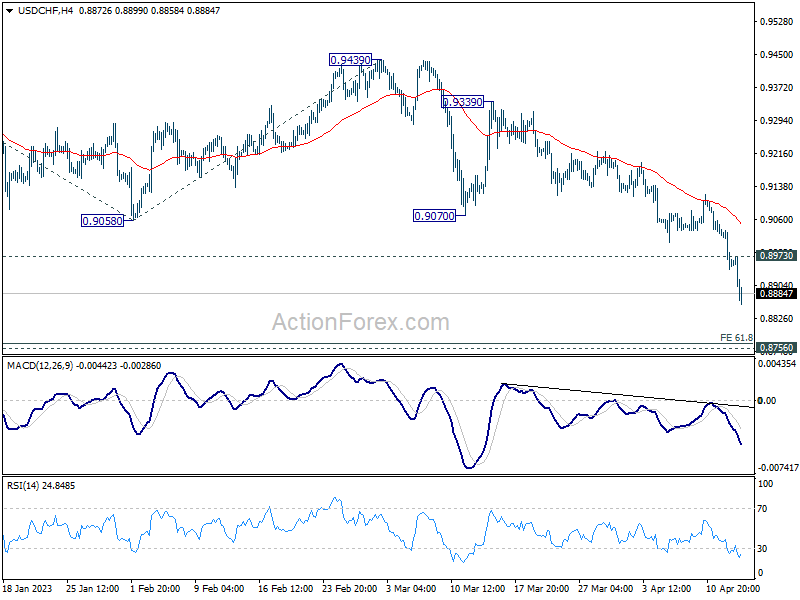
In the bigger picture, fall from 1.1046 (2022 high) is in progress for 0.8756 support (2021 low). But overall, this fall is still as a leg in the long term range pattern from 1.0342 (2016 high). So, downside should be contained by 0.8756 to bring reversal. Sustained break of 0.9058 support turned resistance will be the first sign of medium term bottoming. However, decisive break of 0.8756 will carry larger bearish implications.
GBP/USD Mid-Day Outlook
Daily Pivots: (S1) 1.2424; (P) 1.2459; (R1) 1.2520; More...
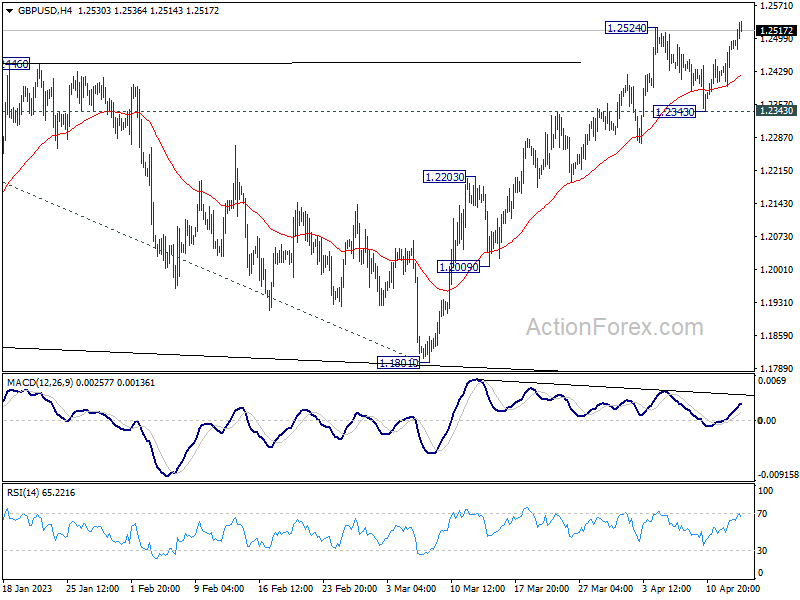
GBP/USD's break of 1.2524 resistance indicates resumption of recent rally and intraday bias is back on the upside. Up trend from 1.0351 should target 1.2759 fibonacci level first. Firm break there will target 61.8% projection of 1.0351 to 1.2445 from 1.1801 at 1.3095. For now, outlook will remain bullish as long as 1.2343 support holds, in case of retreat.
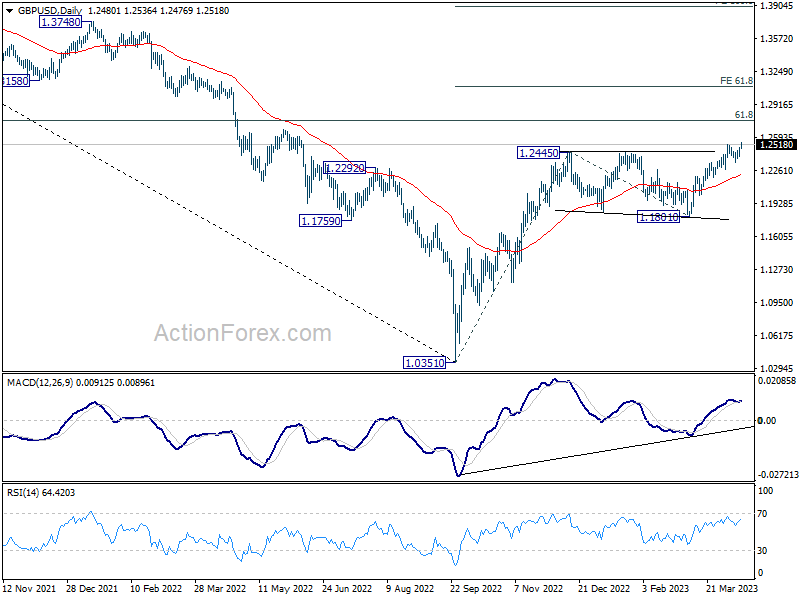
In the bigger picture, the rise from 1.0351 medium term term bottom (2022 low) is in progress for 61.8% retracement of 1.4248 (2021 high) to 1.0351 at 1.2759. Sustained break there will add to the case of long term bullish trend reversal. Further break of 61.8% projection of 1.0351 to 1.2445 from 1.1801 at 1.3095 could prompt upside acceleration to 100% projection at 1.3895. For now, this will remain the favored case as long as 1.1801 support holds, even in case of deep pull back.
EUR/USD: Euro Hits One-Year High after Disappointing US PPI/Jobless Claims Data
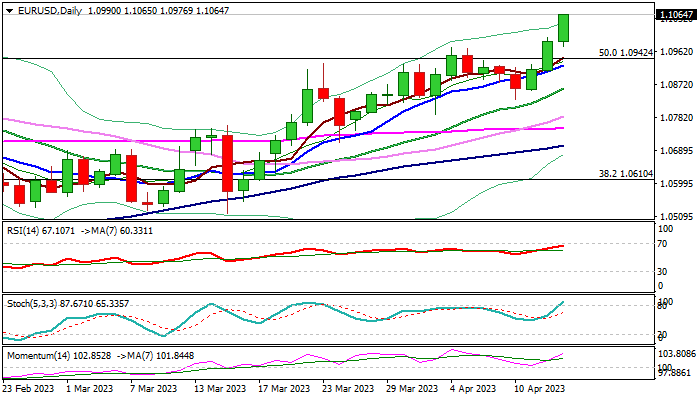
The Euro rose to one-year high on fresh acceleration through psychological 1.10 barrier and former top at 1.1032 (Feb2), lifted by weaker dollar on below-expectations US CPI and jobless claims/PPI miss.
Weekly close above broken pivot at 1.0942 (50% retracement of 1.2349/0.9535 / 100WMA) is needed to confirm bulls, with sustained break of former high (1.1032) to generate initial signal of bullish continuation, after larger uptrend paused for two-month (Feb/Mar) correction.
Bulls eye next targets at 1.1200/74 (200WMA/Fibo 61.8%), as the pair is on track for the fourth consecutive weekly gain.
Firmly bullish daily technical studies support the action, though overbought conditions warn that bulls may run out of steam and pause for consolidation in coming sessions.
Dip-buying is expected to remain favored in current conditions, with broken Fibo 50% barrier and rising 10DMA (1.0942/24) to contain extended dips and offer better levels to re-enter bullish market.
Only return and close below rising 20DMA (1.0861) would sideline bulls and risk deeper correction.
Res: 1.1100; 1.1154; 1.1200; 1.1274.
Sup: 1.1032; 1.1000; 1.0924; 1.0861.
Sunset Market Commentary
Markets
After yesterday’s minimal US CPI undershoot, attention for today’s March PPI release was perhaps slightly bigger than usual, if only because there was little other news hitting the wires. All three gauges again printed sub-consensus with the biggest miss for the headline figure (-0.5% m/m and 2.7% y/y vs 0.0% and 3% expected). The February reading was revised upwards a bit. US weekly jobless claims came in close to expectations at 239k (235k expected). Continuing claims eased from 1823k to 1810k, making it the fourth week straight to register a 1800k+ number. That hasn’t been the case since end 2021. Usually considered second tier, the data this time around do trigger yet another core bond yield intraday reversal. US rates swapped 3 bps gains at the front for losses after today’s data. Current changes vary between -5.4 bs (2-y) to -0.7 bps (30-y). Money markets in the area are close in pricing in a full percentage rate cuts from an expected 5-5.25% terminal rate by January 2024. German yields quickly erased opening losses but their move higher ran into resistance near the 50dMA’s - which coincide with the March correction highs - before joining US yields south again. Declines in the 2y5y sector mount to 3.4-3.8 bps. The slight Bund underperformance follows German and Belgian ECB members Nagel and Wunsch reiterating the need to do more on inflation. Wunsch said there’s a strong consensus to do so and kept both options of a 25 and 50 bps May hike firmly on the table. Much depends on the April inflation reading, which is published two days before the May 4 policy meeting.
The core bond yield decline lifts equity spirits. The Euro Stoxx 50 advances 0.40% and is on track for the highest close since the beginning of 2022. The post-pandemic high is a mere 1.5% away. WS opens with 0.1-0.9% gains. That’s giving EUR/USD the push it needed to surpass the symbolic 1.10 barrier. At 1.105, the pair is currently even extensively challenging the previous YtD high of 1.1033. We still have tomorrow’s US retail sales and consumer confidence due, but if the break is confirmed at the end of the week, we’re looking at EUR/USD 1.1185 as the next meaningful resistance area. The mirror image for the trade-weighted DXY (100.92) consists of losing 100.82 support (current YtD low) before returning to the 99.4 area. EUR/GBP simply followed the EUR/USD pair higher, appreciating from 0.8804 to 0.8822.
News & Views
Czech March inflation printed in line with market consensus. Monthly dynamics slowed from 0.4% to 0.1% with the annual figure sliding from 16.7% to 15%, the “slowest” pace since April of last year. The March inflation figure was 0.2 percentage point higher than expected in the Czech National Bank’s winter forecast. This was due mainly to substantially faster growth in food prices (17.7% Y/Y). Core inflation (11.5% Y/Y) and fuel prices (-17.6% Y/Y) were broadly in line with the forecast. Growth in prices of goods and services slowed and the contribution of the cost of owner-occupied housing in the form of imputed rent decreased further. The CNB expects inflation to fall below 10% Y/Y in the second half of the year. By early 2024, they expect both headline and monetary-relevant inflation (currently 15% Y/Y) to decline to close to the 2% target. Czech swap yields rise by 9 bps (10-yr) to 12.5 bps (2-yr). Apart from the CNB forecast beating CPI, there were comments by CNB Prochazka who said that Czech rates may rise if the job market stays overheated and that the central bank certainly won’t cut rates too soon. The Czech koruna rallies to a new multiyear high against the euro below 23.30.
The Bank of England published its quarterly credit conditions survey (Q1 2023). Lenders reported that the availability of secured credit to households was unchanged in the three months to end-February 2023 (Q1), but they expect availability to decrease over the next three months to end-May 2023 (Q2). Demand for secured lending for house purchase decreased in Q1, but was expected to increase in Q2. Lenders reported that default rates on secured loans to households increased in Q1, and were expected to increase further in Q2. Losses given default on secured loans increased in Q1, and were also expected to increase further in Q2.
EUR/USD Mid-Day Outlook
Daily Pivots: (S1) 1.0935; (P) 1.0968; (R1) 1.1024; More...
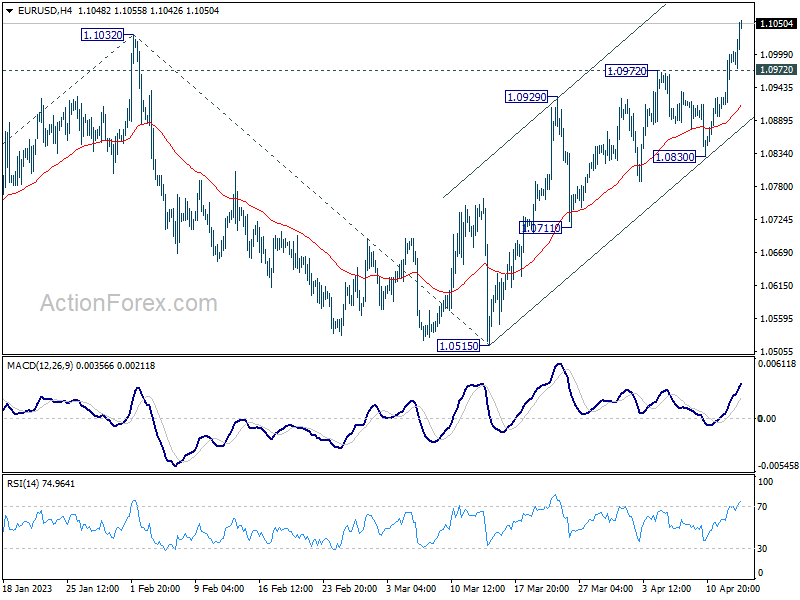
EUR/USD's break of 1.1032 resistance indicate resumption of whole up trend from 0.9534. Intraday bias is stay on the upside for 1.1273 fibonacci level. Break there will target 61.8% projection of 0.9534 to 1.1032 from 1.0515 at 1.1441. On the downside,e below 1.0972 support will turn intraday bias neutral and bring consolidations first. But near term outlook will stay bullish as long as 1.0830 support holds.
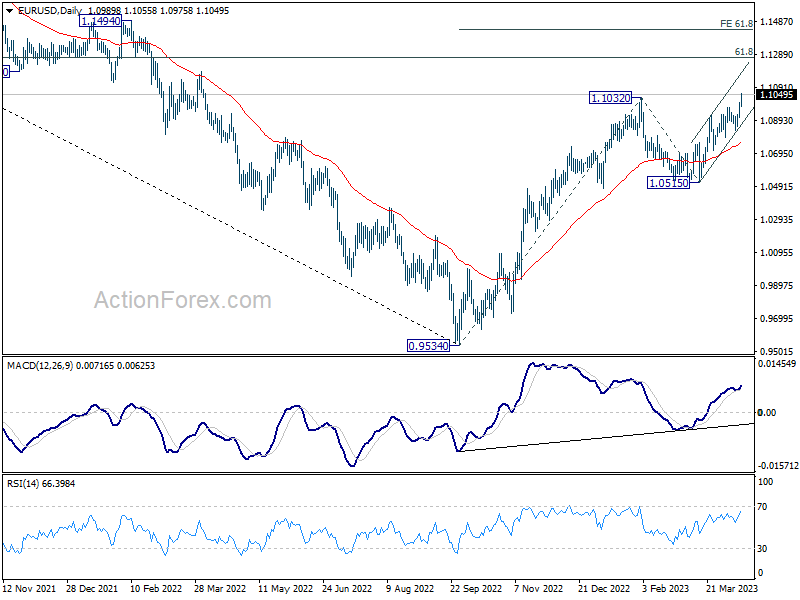
In the bigger picture, rise from 0.9534 (2022 low) is in progress for 61.8% retracement of 1.2348 (2021 high) to 0.9534 at 1.1273. Sustained break there will solidify the case of bullish trend reversal and target 1.2348 resistance next (2021 high). This will now remain the favored case as long as 1.0515 support holds, even in case of deeper pull back.
Dollar Selloff Deepens as Weak Upstream Inflation and Job Data Push Euro to New Highs
Dollar's decline continues in early trading, fueled by weaker-than-expected upstream inflation and job data, pushing the greenback to its lowest level against Euro this year. The Swiss Franc emerges as today's biggest winner, bolstered by falling benchmark yields in Germany and the UK. Meanwhile, Euro benefits from hawkish remarks by ECB officials, while Australian dollar remains strong thanks to robust employment data.
Conversely, Sterling faces headwinds following unexpected stagnation in UK GDP for February and weak production data. Canadian Dollar is trimming recent gains, while Yen softens on expectations of prolonged monetary easing by BoJ and an uptick in risk appetite.
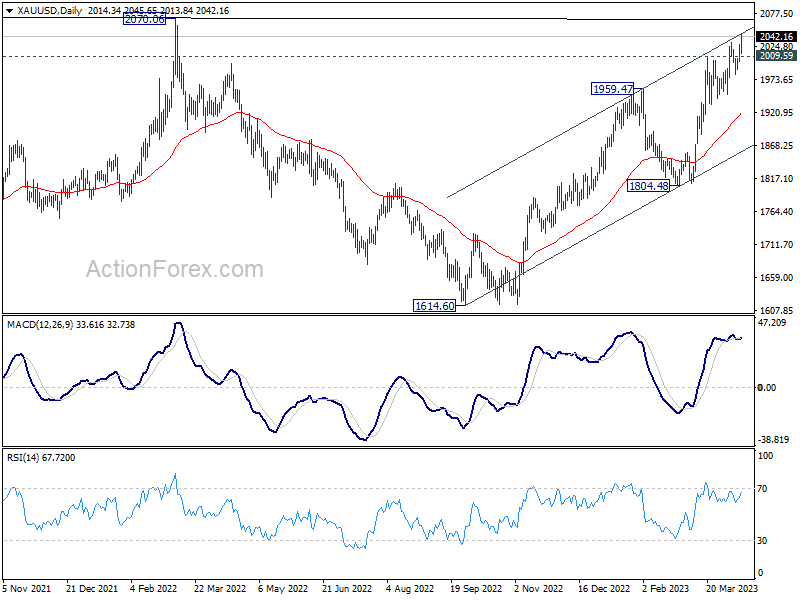
On the technical front, Gold has resumed its near-term rally, breaking through 2,032.05 and targeting resistance levels of 2,070.06 and record high of 2,074.84 set in 2020. A decisive break above these levels would confirm the resumption of the long-term uptrend. However, a drop below the 2,009.59 resistance-turned-support level would signal potential rejection by the 2,070.06/2,074.84 resistance zone and trigger a near-term pullback
In Europe, at the time of writing, FTSE is up 0.20%. DAX is up 0.02%. CAC is up 1.10%. Germany 10-year yield is down -0.009 at 2.358. Earlier in Asia, Nikkei rose 0.26%. Hong Kong HSI rose 0.17%. China Shanghai SSE dropped -0.27%. Singapore Strait Times rose 0.26%. Japan 10-year JGB yield dropped -0.0002 to 0.465.
US initial jobless claims rose to 239k, highest since Jan 2022
US initial jobless claims rose 11k to 239k in the week ending April 8, above expectation of 235k. That's the highest level since January 15, 2022. Four-week moving average of continuing claims rose 2k to 240, highest since November 20, 2021.
Continuing claims dropped -13k to 1810k in the week ending April 1. Four-week moving average of continuing claims rose 9.5k to 1814k, highest since November 13, 2021.
US PPI at -0.5% mom, 2.7% yoy in Mar
US PPI for final demand dropped -0.5% mom in March, well below expectation of 0.1% mom. Two-thirds of the decline in the PPI for final demand can be attributed to a -1.0% mom decrease in prices for final demand goods. The PPI for final demand services also moved down -0.3% mom. Prices for final demand less foods, energy, and trade services edged up 0.1% mom.
For the 12 months period, PPI dropped from 4.6% yoy to 2.7% yoy, below expectation of 2.7% yoy. PPI less foods, energy, and trade services was up 3.6% yoy.
Bundesbank Nagel: Monetary-policy have to stubborn to fight against inflation
Bundesbank President Joachim Nagel, in an interview with CNBC on the sidelines of the IMF Spring Meetings, described euro-zone price gains as "a very stubborn phenomenon" and emphasized the need for persistent action against inflation. Nagel stated, "it's definitely the case that we on the monetary-policy side have to be even more stubborn to fight against inflation."
Nagel acknowledged the necessity to do more on the inflation front, explaining that while headline inflation might be heading in the right direction, core inflation remains at a very elevated level. He expects core inflation to come down before summer but warned that it would likely stay at high levels for the next few months, requiring continued vigilance in addressing the inflation issue.
Regarding the German economy, Nagel expressed confidence in its ability to adapt and overcome challenges, stating that "the energy crisis is more or less solved." He added, "We had a really worried situation in the past, but this is now over, and the outlook is good.
UK economy stalls in Feb as GDP growth misses expectations
UK economy experienced a slowdown in February, with no monthly growth (0.0% mom) in GDP, falling short of the 0.1% mom growth expected by analysts. The disappointing result follows a 0.4% mom growth in January. The data reveals that services contracted by -0.1% mom after a 0.7% mom growth in January, while production fell by -0.2% mom following a -0.5% mom contraction in January. In contrast, construction sector saw growth of 2.4% mom, rebounding from a -1.7% mom contraction in January.
In the three months to February, GDP grew by a mere 0.1% when compared to the three months to November. During this period, services grew by 0.1%, production declined by -0.2%, and construction experienced growth of 0.9%. The lackluster performance raises concerns about the overall health of the UK economy.
Also published, industrial production came in at -0.2% mom, -3.1% yoy, versus expectation o f0.3% mom, -3.7% yoy. Manufacturing production was at 0.0%mom, -2.4% yoy, versus expectation of 0.3% mom, -4.7% yoy. Goods trade deficit narrowed slightly to GBP -17.5B, versus expectation of GBP -17.0B.
NIESR: UK GDP grew 0.1% in Q1, to expand 0.3% in Q2
NIESR estimated that UK GDP grew by 0.1% in Q1, an upgrade from prior forecasts -0.1% contraction. The early forecasts for Q2 sees quarterly growth rate picking up to 0.3%.
Paula Be jar a no Carbo Associate Economist, NIESR said: "The UK economic outlook for the first quarters of this year appears to be more resilient than previously thought, though broadly consistent with the longer-term trend of flatlining economic growth."
Australian employment grew solidly by 53k, bolstering case for more RBA tightening
Australian labor market continued to show strength in March, with employment growth significantly outperforming expectations. The strong employment data shows very few signs of weakness in the labor market, suggesting that RBA may need to resume tightening in May.
According to the today's data, employment increased by 53k in seasonally adjusted terms, well above expectation of 20k gain. Full-time jobs saw an increase of 72.2k, while part-time employment declined by -19.2k.
Despite expectations of a rise to 3.6%, unemployment rate remained unchanged at 3.5%. Additionally, the participation rate held steady at 66.7%, and monthly hours worked decreased by -0.2%. Lauren Ford, the ABS head of labor statistics, highlighted that the unemployment rate stayed at a near 50-year low of 3.5%.
Ford also noted that the employment-to-population ratio increased by 0.1 percentage point to 64.4%, with the participation rate remaining at 66.7%. Both indicators were close to their historical highs in November 2022, reflecting a tight labor market that has made it challenging for employers to fill the high number of job vacancies.
BoJ Ueda emphasizes divergent inflation path in Japan, pledges continued monetary easing
In the G7 central bank chief briefing in Japan, BoJ Governor Kazuo Ueda underscored the unique inflation situation in Japan compared to other countries. While elevated inflation rates are affecting many countries, Japan's price gains are expected to slow down to below 2%, prompting the BoJ to continue its monetary easing policies.
Ueda acknowledged the possibility of Japan falling behind the curve in addressing the risk of high inflation. However, he emphasized the importance of being more focused on the risk of inflation falling short of the 2% target. He stated, "As we guide monetary policy, it is appropriate to pay more attention to the risk of inflation undershooting 2 percent and thus moving away from the goal."
Ueda is set to have his first policy meeting on April 27-28, where he will likely further discuss Japan's distinct inflation trajectory and the country's monetary policy approach.
EUR/USD Mid-Day Outlook
Daily Pivots: (S1) 1.0935; (P) 1.0968; (R1) 1.1024; More...
EUR/USD's break of 1.1032 resistance indicate resumption of whole up trend from 0.9534. Intraday bias is stay on the upside for 1.1273 fibonacci level. Break there will target 61.8% projection of 0.9534 to 1.1032 from 1.0515 at 1.1441. On the downside,e below 1.0972 support will turn intraday bias neutral and bring consolidations first. But near term outlook will stay bullish as long as 1.0830 support holds.
In the bigger picture, rise from 0.9534 (2022 low) is in progress for 61.8% retracement of 1.2348 (2021 high) to 0.9534 at 1.1273. Sustained break there will solidify the case of bullish trend reversal and target 1.2348 resistance next (2021 high). This will now remain the favored case as long as 1.0515 support holds, even in case of deeper pull back.
Economic Indicators Update
| GMT | Ccy | Events | Actual | Forecast | Previous | Revised |
|---|---|---|---|---|---|---|
| 23:50 | JPY | Money Supply M2+CD Y/Y Mar | 2.60% | 2.50% | 2.60% | |
| 01:30 | AUD | Employment Change Mar | 53.0K | 20.0K | 64.6K | 63.6K |
| 01:30 | AUD | Unemployment Rate Mar | 3.50% | 3.60% | 3.50% | |
| 03:00 | CNY | Trade Balance (USD) Mar | 88.2B | 40.0B | 116.9B | |
| 03:00 | CNY | Exports Y/Y Mar | 14.80% | 3.10% | -6.80% | |
| 03:00 | CNY | Imports Y/Y Mar | -1.40% | 3.90% | -10.20% | |
| 06:00 | EUR | Germany CPI M/M Mar F | 0.80% | 0.80% | 0.80% | |
| 06:00 | EUR | Germany CPI Y/Y Mar F | 7.40% | 7.40% | 7.40% | |
| 06:00 | GBP | GDP M/M Feb | 0.00% | 0.10% | 0.30% | 0.40% |
| 06:00 | GBP | Index of Services 3M/3M Feb | 0.10% | -0.20% | 0.00% | 0.10% |
| 06:00 | GBP | Industrial Production M/M Feb | -0.20% | 0.30% | -0.30% | -0.50% |
| 06:00 | GBP | Industrial Production Y/Y Feb | -3.10% | -3.70% | -4.30% | -3.20% |
| 06:00 | GBP | Manufacturing Production M/M Feb | 0.00% | 0.30% | -0.40% | -0.10% |
| 06:00 | GBP | Manufacturing Production Y/Y Feb | -2.40% | -4.70% | -5.20% | -2.80% |
| 06:00 | GBP | Goods Trade Balance (GBP) Feb | -17.5B | -17.0B | -17.9B | |
| 08:00 | EUR | Italy Industrial Output M/M Feb | -0.20% | 0.50% | -0.70% | -0.50% |
| 09:00 | EUR | Eurozone Industrial Production M/M Feb | 1.50% | 1.00% | 0.70% | 1.00% |
| 11:00 | GBP | NIESR GDP Estimate (3M) Mar | 0.10% | -0.10% | -0.10% | 0.10% |
| 12:30 | USD | PPI M/M Mar | -0.50% | 0.10% | -0.10% | 0.00% |
| 12:30 | USD | PPI Y/Y Mar | 2.70% | 3.10% | 4.60% | |
| 12:30 | USD | PPI Core M/M Mar | -0.10% | 0.20% | 0.00% | 0.20% |
| 12:30 | USD | PPI Core Y/Y Mar | 3.40% | 3.30% | 4.40% | |
| 12:30 | USD | Initial Jobless Claims (Apr 7) | 239K | 235K | 228K | |
| 14:30 | USD | Natural Gas Storage | 25B | -23B |
USDCAD Approaching Important Support Level
A short digest of the fresh and saturated news background:
→ Inflation in the US coincided with analysts' expectations. Core CPI was 5.6% in annual terms. The main problem for suppressing inflation is the rise in prices for energy resources (oil has updated the maximum of the year). According to Bloomberg, the union of Russia and Saudi Arabia in the oil market can create problems in this regard.
→ Minutes of the Fed meeting showed that officials expect a mild recession.
→ The ECB believes that inflation has become more extensive in Europe, but the lion's share of increases is already behind.
→ The Bank of Canada left the rate unchanged at 4.5%, expecting a fall in inflation, but is ready for further increases if necessary.
Reacting to the above and other important news, the US dollar index fell to the lows of the year on the foreign exchange market. Accordingly, the euro, pound and Canadian dollar strengthened. The latter forms a pattern that attracts attention.
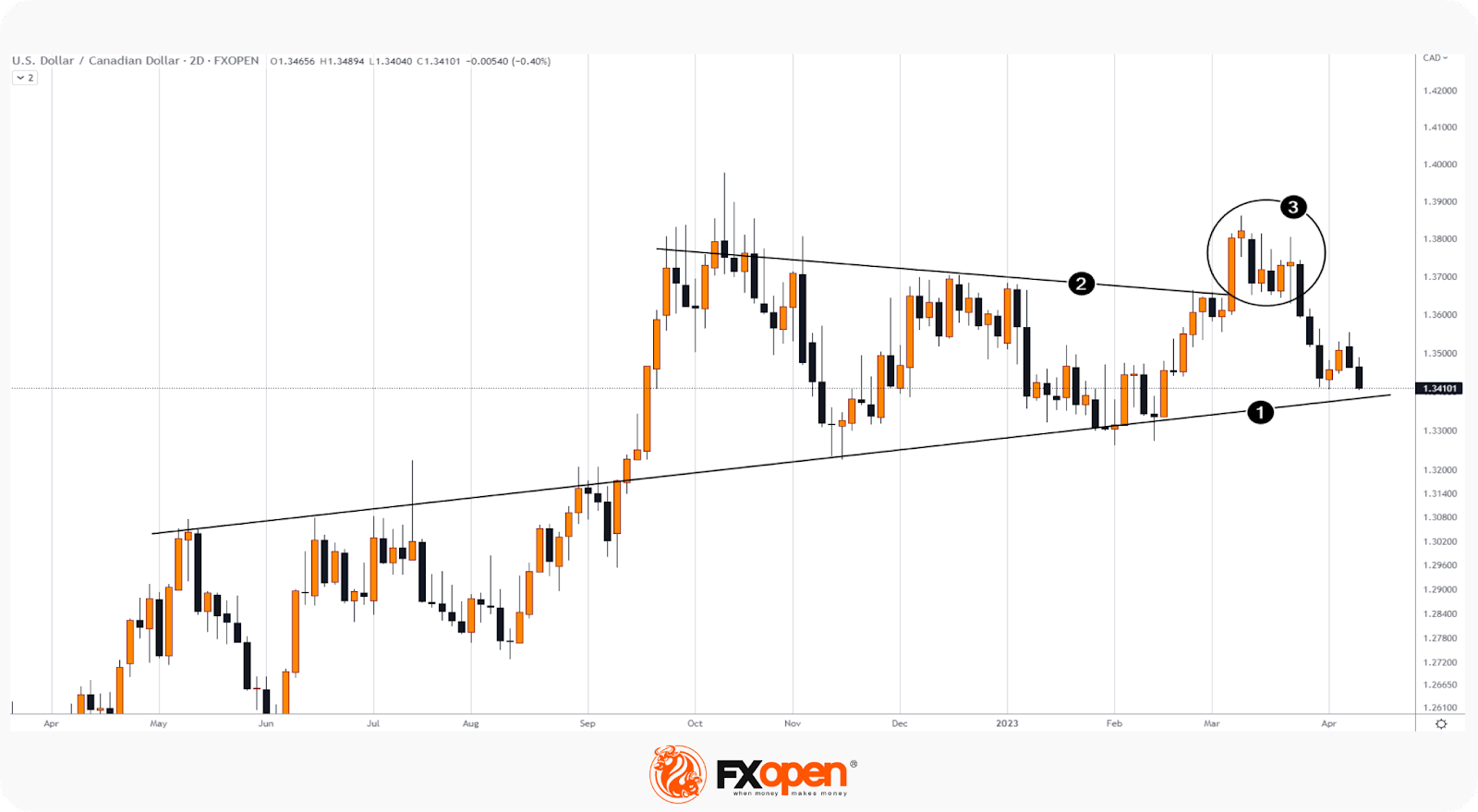
On the USDCAD chart, we can observe a narrowing triangle (1-2), indicating the balance of supply and demand. The breakdown of the (3) triangle in March turned out to be false. By its behaviour, the market suggests that the true exit from the triangle will take place in a bearish direction. And this could be the beginning of a long-term downtrend.
US 30 Cash Index Advance Stalls
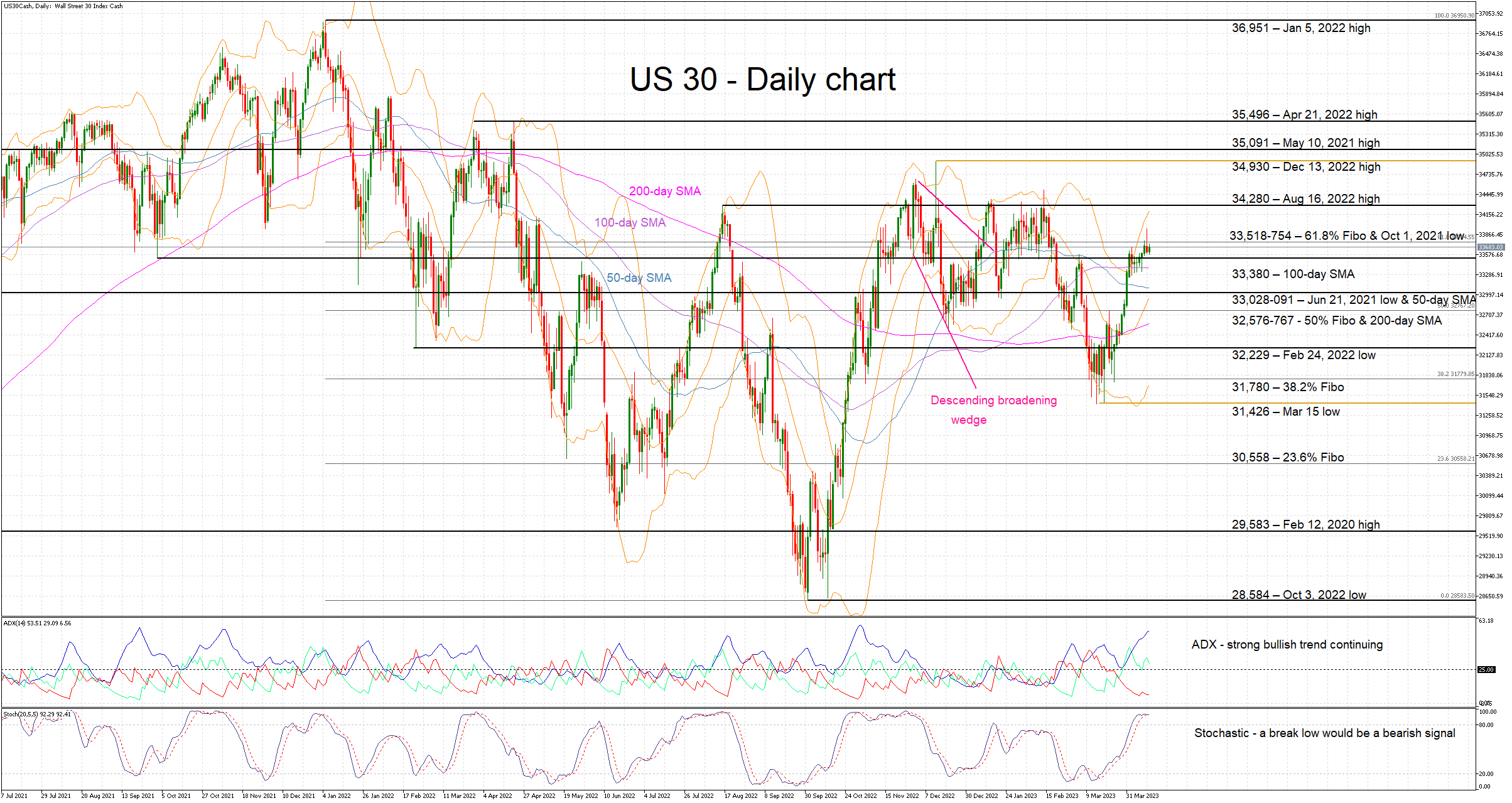
The US 30 cash index has enjoyed a strong rally since the March 15 low of 31,426, in line with other main stock markets. It managed to overcome some key levels with relative ease, but the rally appears to have stalled around the 33,650 area. This move higher felt like a relief rally with the bulls now preparing for the next leg higher.
The Average Directional Movement Index (ADX) continues to indicate a strong trend in the market as it is hovering at the highest level since the November 2022 upward move, bringing joy to the US 30 bulls. But the stochastic oscillator is once again ready to spoil the party. It is wandering at its overbought (OB) territory and battling with its own moving average (MA). A break below both the OB and MA could infuse confidence in the bears to take over the market and dictate the next move.
Should the bears manage to break the October 1, 2021 low of 33,518, they will be faced with the 100-day simple moving average (SMA) at 33,380. More importantly, the 33,028-33,091 range, defined by the June 21, 2021 low and the 50-day SMA, awaits them lower.
Should the bulls maintain the upper hand in the market and successfully clear the 33,518-33,754 range, they would set their eyes on the August 16, 2022 high at 34,280. Higher, a break of the 34,930 and 35,901 levels, set by December 13, 2022 and May 10, 2021 highs respectively, could be a significant signal that the bearish medium-term trend has potentially ended.
To sum up, the recent bullish short-term trend in the US 30 cash index appears to have stalled in a busy area. Bulls would love another move higher, but the technical picture is not as a straightforward as they would have hoped for.