Sample Category Title
Fed’s Williams suggests one more rate hike as “reasonable starting place”
In a Yahoo Finance interview, New York Fed President John Williams stated that one more rate hike could be a "reasonable starting place," noting that it aligns with the median expectation of his colleagues. However, Williams emphasized the importance of data-driven decisions, saying, "We have to be driven by the data... I will say that one thing that we're paying attention to is credit conditions but also do we really see signs of this underlying inflation coming down?"
Williams highlighted the challenges ahead, stating, "Some of this core services inflation excluding housing hasn't budged yet, so we've got our work cut out for us to get inflation back to 2%." He added that the central question revolves around determining what will be sufficiently restrictive on policy and whether additional measures are needed to achieve their goals, with data and outlook as the key drivers.
Australian Dollar Edges Higher as Consumer Sentiment Soars
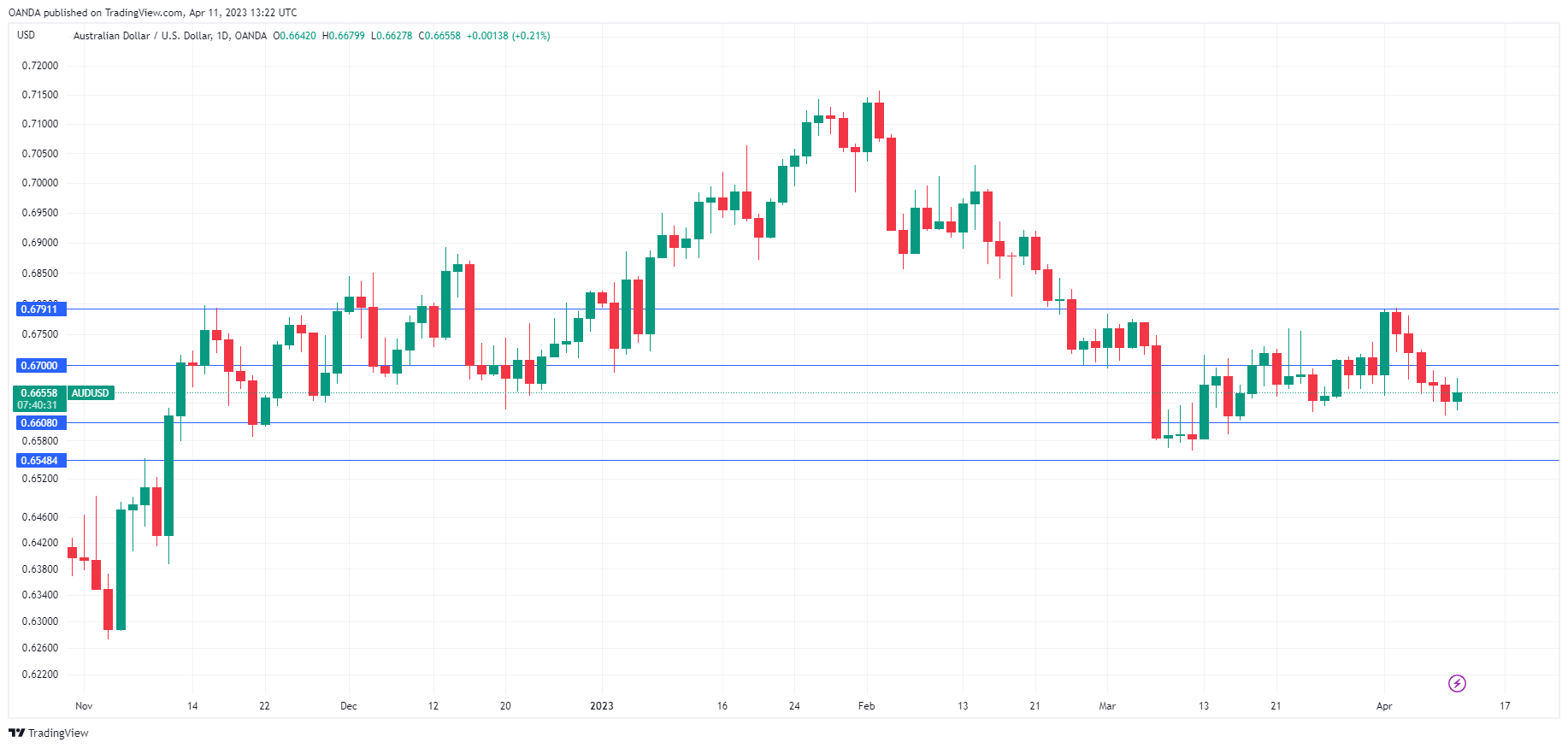
The Australian dollar has posted slight gains today. In the North American session, AUD/USD is trading at 0.6653, up 0.18%.
Australian consumer sentiment jumps
Australia’s Westpac Consumer Sentiment was red-hot in April, climbing 9.4% to 85.8, up from 78.4 a month earlier. This crushed the market consensus of 0.8% and follows a flat reading in March. This marks the highest reading since June 2022. Despite the impressive surge, consumer confidence remains weak, well below the 100-level which separates positive and negative territory.
Business indicators were also positive. The NAB Business Confidence index rose from -1 to -4 in March, close to the estimate of zero. Business Conditions was almost unchanged at 16, just shy of the estimate and the previous reading, both of which were 17 points.
The improvement in the consumer and business confidence data can be largely attributed to the Reserve Bank of Australia’s decision to pause rates at the April meeting, after ten straight rate increases. High interest rates have taken their toll on households and businesses, and the RBA would love nothing more than to extend the pause in rates at the May 2nd meeting. Still, inflation remains the central bank’s number one priority, and the battle promises to be a long one. CPI fell to 6.8% in February, down from 7.4% a month earlier but more than triple the target of 2%. The March inflation report will be released about a week before the RBA decision and will be a key factor as to whether the RBA extends its pause or raises rates by 25 basis points.
There are no tier-1 events on the calendar today, but Wednesday we’ll get a look at the US inflation report for March. The battle to contain inflation is making progress but has gone slower than the Fed had expected. This has meant extending the rate-tightening cycle and a 25-bp is likely at the May meeting. Headline inflation is expected to fall to 5.4% in March, down from 6% in February. The core rate is projected to inch higher to 5.6%, up from 5.5%.
AUD/USD Technical
- The round number of 0.6700 is a weak resistance line. Next, there is resistance at 0.6791
- AUD/USD has support at 0.6608 and 0.6548
Sunset Market Commentary
Markets
European investors had some catching up to do with the US, returning from the long Easter weekend. Last Friday’s US payrolls were the main event. They printed near consensus instead of the feared and positioned-for downward surprise after earlier below-consensus ISM’s, ADP employment and JOLTS. That way, payrolls avoided a break of key support levels in US yields. The US 2-yr yield returned to 4%. The US 10-yr yield bounced off 3.28% to currently trade around 10 bps higher. German Bunds thus underperform US Treasuries today with yields adding 8.8 bps (30-yr) to 14.8 bps (2-yr). US yield are merely flat across the curve. The 10-yr Bund-swap spread drops below 65 bps for the first time since the collapse of Silicon Valley Bank in a sign that market stress levels are receding. In the same vein, the VIX index (expected volatility of S&P 500) since last week trades back near YTD lows. Key European stock indices gain 0.5% to 1% today with the EuroStoxx50 for example testing the YTD top at 4347. Sentiment is dwindling going into the start of US trading though. Positive risk vibes are responsible for EUR/USD’s return above 1.09 as well. EUR/GBP holds within this month’s extremely narrow trading range between roughly 0.8750 and 0.88.
Today’s eco calendar was extremely thin with only outdated and at consensus February eurozone retail sales (-0.8% M/M). The IMF released its world economic outlook, subtitle “a rocky recovery”. It presents the bleakest growth outlook since 1990, as flagged by chief Georgieva last week. The baseline forecast is for growth to fall from 3.4% in 2022 to 2.8% in 2023 (from 2.9% in January), before settling at 3% in 2024 (from 3.1%). Advanced economies are expected to see an especially pronounced growth slowdown, from 2.7% in 2022 to 1.3% in 2023. In a plausible alternative scenario, stressing downside risks to the base case, with further financial sector stress, global growth declines to about 2.5% in 2023 with advanced economy growth falling below 1%. Global headline inflation in the baseline is set to fall from 8.7% in 2022 to 7% in 2023 on the back of lower commodity prices but underlying (core) inflation is likely to decline more slowly. Inflation’s return to target is unlikely before 2025 in most cases. In an earlier released chapter on the natural rate of interest – the real rate that neither stimulates nor contracts the economy – analysis suggests that once the current inflationary episode has passed, interest rates are likely to revert toward pre-pandemic levels in advanced economies.
News & Views
Norwegian headline inflation unexpectedly picked up in pace last month. Rising by 0.8% m/m brought the yearly figure from 6.3% to 6.5%, defying analyst and Norges Bank estimates for a further slowdown to 6.1% and 6% respectively. Core inflation advanced 0.6% m/m, keeping the y/y measure (6.2%) close the series high of 6.4% (January 2023). The increase was driven by durables (furnishings, household equipment), transport and clothing. Given the upward surprise (again), the Norges Bank’s flagged rate hike for May (to 3.25%) is all but cemented. The central bank’s projected a 3.5% terminal rate but kept the option for going higher on the table in case of more stubborn inflation and/or a weaker-than-expected Norwegian krone. The latter isn’t providing much comfort to the NB today. EUR/NOK gets catapulted above recent highs of 11.48 to trade at 11.53 currently – the weakest NOK level since April 2020. Norwegian swap yields are roughly unchanged, moving between -0.4 bps and +0.8 bps.
Minutes from the previous Czech National Bank policy meeting showed broad-based resistance amongst policymakers to cut rates anytime soon, labelling it as “not on the horizon”. The formal guidance instead remains to either keep rates steady at 7% or hike further. The latter option is favoured by only one member, Tomas Holub. He sees “insufficiently tight monetary policy and inflation staying above the target next year as a far greater threat than the risk of excessively tight monetary policy.” Kubelkova said the risk of de-anchoring inflation expectations is growing over time and that it could play a more important role in future decision-making. CNB governor Michl and deputy governor Zamrazilova both repeated their preference for a strong Czech koruna. The currency today however fell prey to some profit-taking after approaching the March 2023/15-year high around 23.30 over the previous days. EUR/CZK currently rises from 23.36 to 23.50.
IMF: Global growth to bottom at 2.8% this year
The IMF released its World Economic Outlook, projecting global growth to slow from 3.4% in 2022 to 2.8% in 2023 and bottom there, and then rise to 3.0% in 2024. Global inflation is expected to decelerate from 8.7% in 2022 to 7% in 2023 and further to 4.9% in 2024.
Pierre-Olivier Gourinchas, Economic Counsellor and Director of Research at IMF, said in a blog post, "The global economy's gradual recovery from both the pandemic and Russia's invasion of Ukraine remains on track. China's reopened economy is rebounding strongly. Supply chain disruptions are unwinding, while dislocations to energy and food markets caused by the war are receding. Simultaneously, the massive and synchronized tightening of monetary policy by most central banks should start to bear fruit, with inflation moving back towards targets."
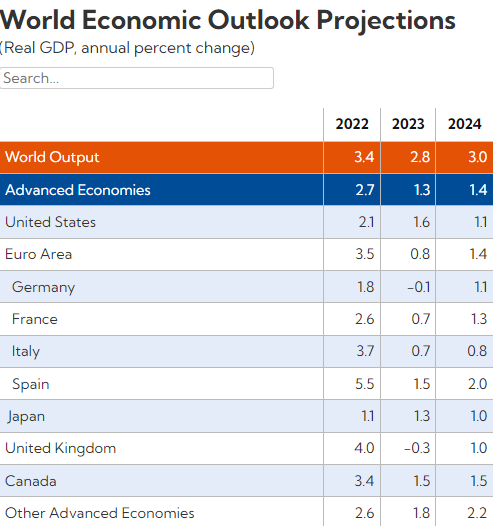
For 2023, global growth projections were reduced by 0.1% compared to January's forecast. US growth was revised up by 0.2% to 1.6%, Eurozone growth by 0.1% to 0.8%, and UK growth by 0.3% to -0.3%. However, Japan's growth projection was revised down sharply by 0.5% to 1.3%. Canada and China's growth forecasts remained unchanged at 1.5% and 5.2%, respectively.
Regarding interest rates, the IMF believes recent increases in real interest rates are likely temporary. Once inflation is under control, advanced economies' central banks are expected to ease monetary policy and bring real interest rates back towards pre-pandemic levels.
USD/JPY Mid-Day Outlook
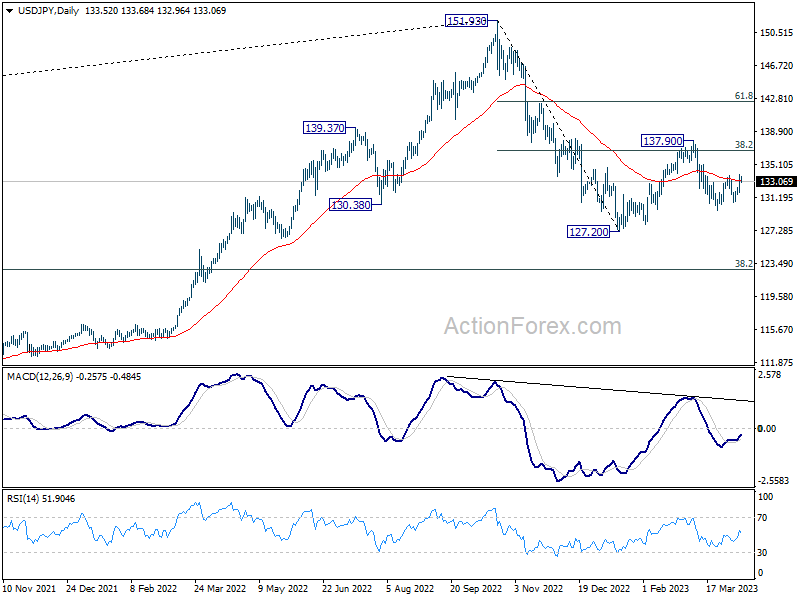
Daily Pivots: (S1) 132.33; (P) 133.10; (R1) 134.37; More...
Intraday bias in USD/JPY stays neutral with focus on 133.74 resistance. Firm break there will resume the rebound form 129.62 and target 137.90 resistance again. However, on the downside, below 130.62 will resume the fall from 137.90 through 129.62 to retest 127.20 low.
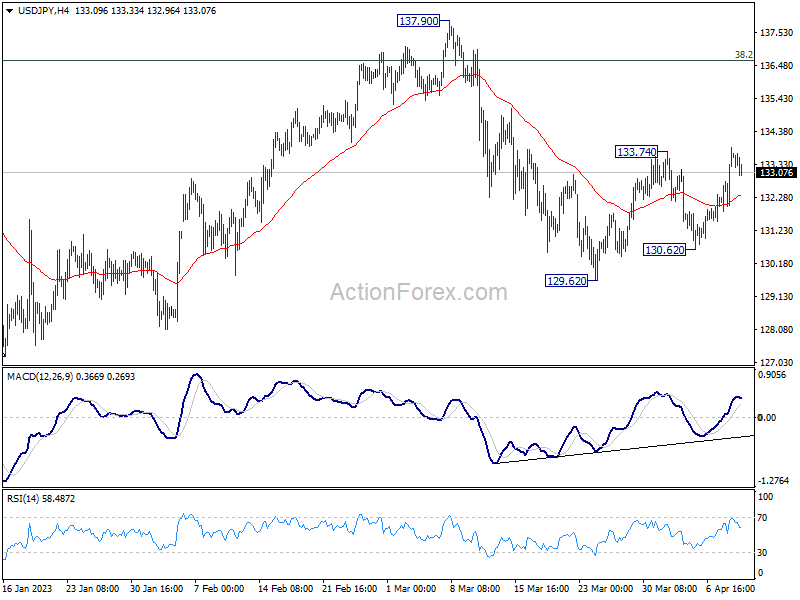
In the bigger picture, corrective pattern from 127.20 might be extending. But after all, down trend from 151.93 is expected to resume at a later stage. Break of 127.20 will resume this down trend and target 61.8% projection of 151.93 to 127.20 from 137.90 at 122.61. This will now be the favored case as long as 137.90 resistance holds.
USD/CHF Mid-Day Outlook
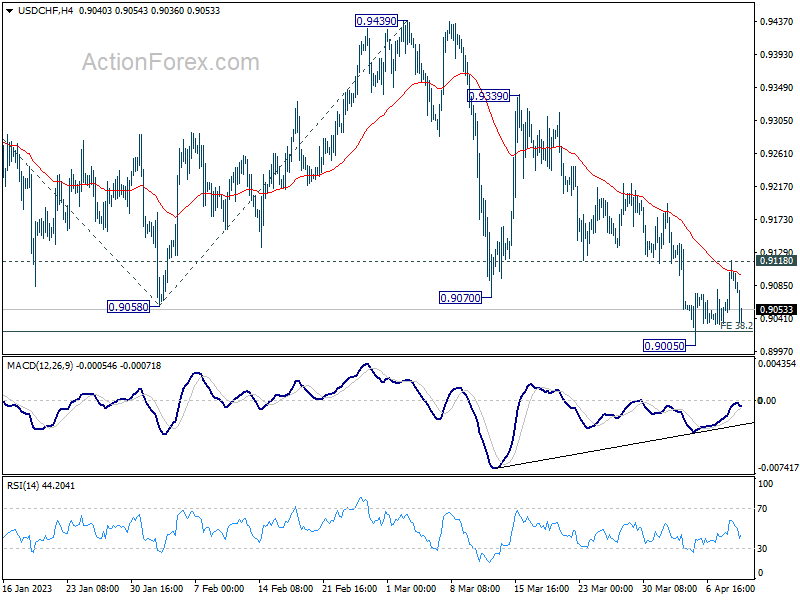
Daily Pivots: (S1) 0.9048; (P) 0.9084; (R1) 0.9131; More...
Intraday bias in USD/CHF remains neutral at this point. With 0.9118 resistance intact, further decline is expected. On the downside, break of 0.9005 and sustained trading below 38.2% projection of 1.0146 to 0.9058 from 0.9439 at 0.9023 will extend the down trend from 1.0146 to 61.8% projection at 0.8767. However, firm break of 0.9118 will indicate short term bottoming, and turn bias to the upside for stronger rebound.
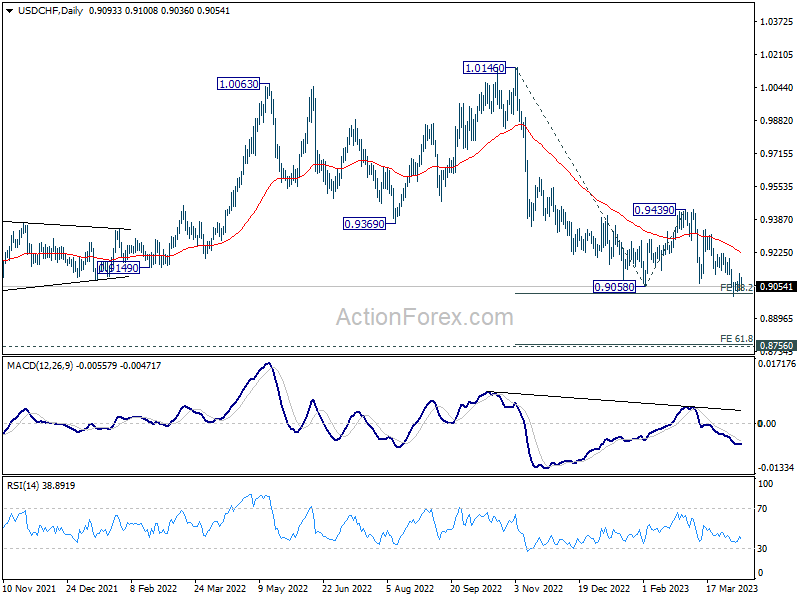
In the bigger picture, outlook will stay bearish as long as 0.9439 resistance holds, and fall from 1.1046 (2022 high) is still in progress. Prior rejection by 55 week EMA was a medium term bearish sign. Sustained of 0.9058 will resume such decline towards 0.8756 support (2021 low). But overall, this fall is still as a leg in the long term range pattern from 1.0342 (2016 high). So, downside should be contained by 0.8756 to bring reversal.
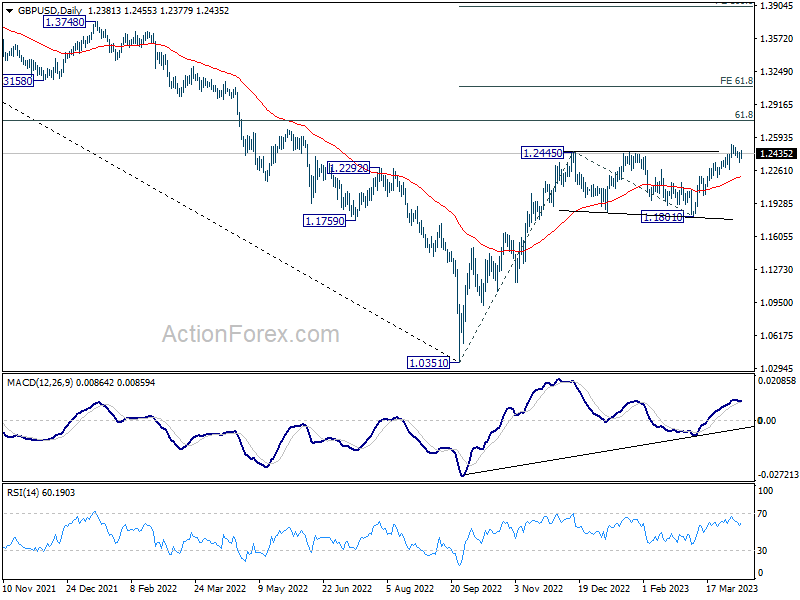
GBP/USD Mid-Day Outlook
Daily Pivots: (S1) 1.2338; (P) 1.2390; (R1) 1.2436; More...
Intraday bias in GBP/USD remains neutral as consolidation pattern from 1.2524 continues. Further rally is expected with 1.2203 resistance turned support intact. On the upside, break of 1.2524 will target 1.2759 fibonacci level first. Firm break there will target 61.8% projection of 1.0351 to 1.2445 from 1.1801 at 1.3095.
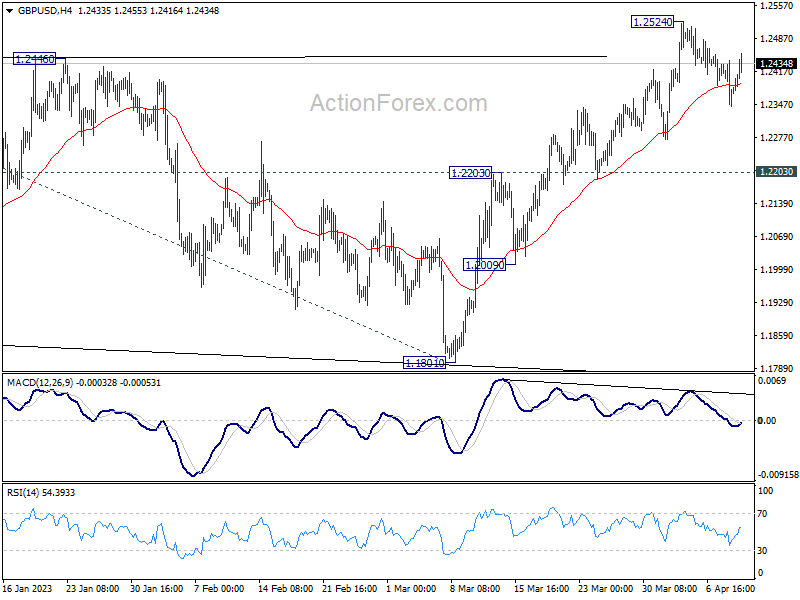
In the bigger picture, the rise from 1.0351 medium term term bottom (2022 low) is in progress for 61.8% retracement of 1.4248 (2021 high) to 1.0351 at 1.2759. Sustained break there will add to the case of long term bullish trend reversal. Further break of 61.8% projection of 1.0351 to 1.2445 from 1.1801 at 1.3095 could prompt upside acceleration to 100% projection at 1.3895. For now, this will remain the favored case as long as 1.1801 support holds, even in case of deep pull back.
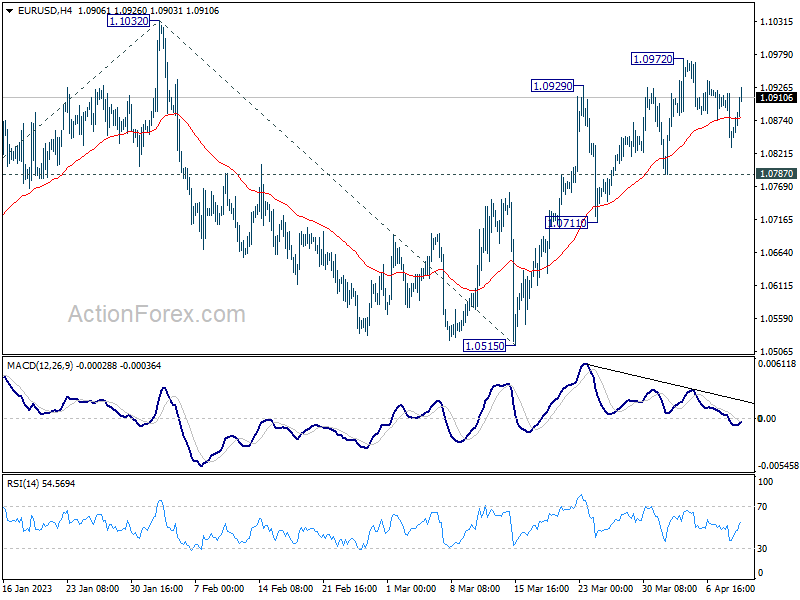
EUR/USD Mid-Day Outlook
Daily Pivots: (S1) 1.0823; (P) 1.0870; (R1) 1.0908; More...
EUR/USD recovers today but stays inside range below 1.0972. Intraday bias remains neutral for the moment. With 1.0787 support intact, further rally is expected. On the upside, above 1.0972 will resume the rally from 1.0515 to retest 01.1032 high. Firm break there will resume larger up trend from 0.9534. However, break of 1.0787 will turn bias back to the downside for 1.0711 support instead.
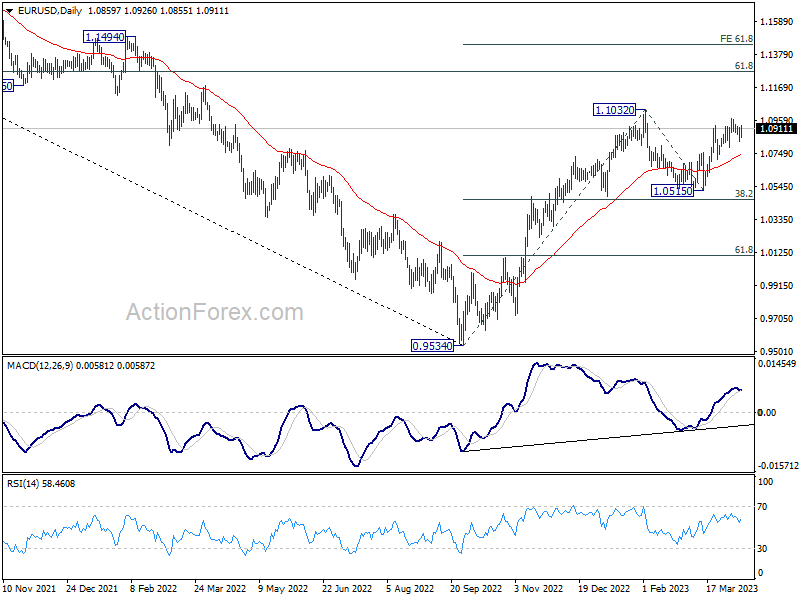
In the bigger picture, rise from 0.9534 (2022 low) is in progress with 38.2% retracement of 0.9534 to 1.1032 at 1.0460 intact. The strong support from 55 week EMA (now at 1.0625) was also a medium term bullish sign. Next target is 61.8% retracement of 1.2348 (2021 high) to 0.9534 at 1.1273. Sustained break there will solidify the case of bullish trend reversal and target 1.2348 resistance next (2021 high).
European Majors in Spotlight as Eurozone Investor Confidence Improves
European majors are taking center stage today as markets reopen after holidays. Although not spectacular, Eurozone data revealed improvements in investor confidence, which has bolstered overall market sentiment. Major European indexes and benchmark treasury yields are trading slightly higher. In contrast, commodity currencies and Dollar are trading on the softer side, while Yen is mixed for the day but remains the week's worst performer. It's important to note that volatility has been relatively low so far. Traders may remain cautious until tomorrow's US CPI release and Bank of Canada rate decisions.
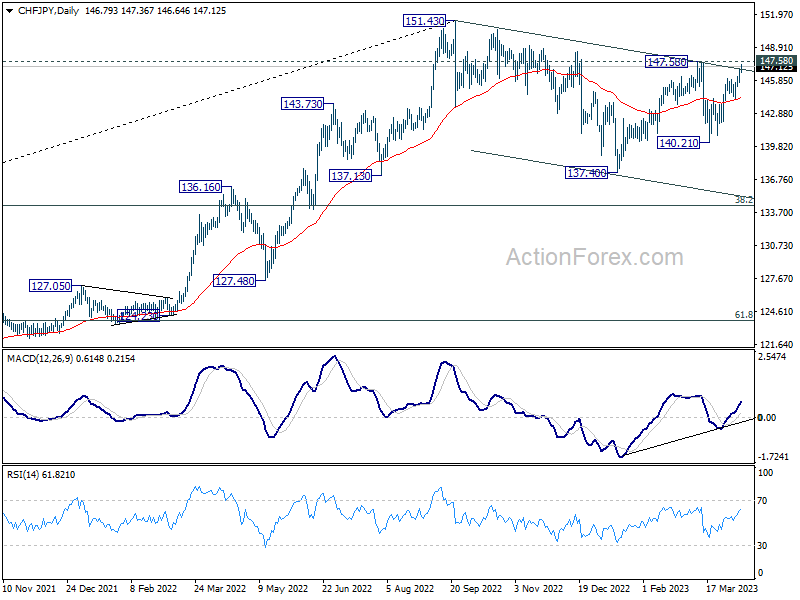
Meanwhile, the development in CHF/JPY is worth mentioning. The cross has entirely reversed the setback from the Credit Suisse turmoil in March, and it now appears ready to resume the rebound from 137.40. Technically, the corrective fall from 151.43 should have already completed at 137.40. A break of 147.68 should prompt a retest of the 151.43 high, a decisive break there would resume the larger uptrend. However, rejection by 151.43 could extend the corrective pattern from 151.43 with another falling leg, before an eventual upside breakout.
In Europe, at the time of writing, FTSE is up 0.24%. DAX is up 0.35%. CAC is up 0.81%. Germany 10-year yield is up 0.089 at 2.275. Earlier in Asia, Nikkei rose 1.05%. Hong Kong HSI rose 0.76%. China Shanghai SSE dropped -0.05%. Singapore Strait Times rose 0.10%. Japan 10-year JGB yield dropped -0.0142 to 0.454.
Bitcoin breaks out surpassing 30k, NASDAQ to follow?
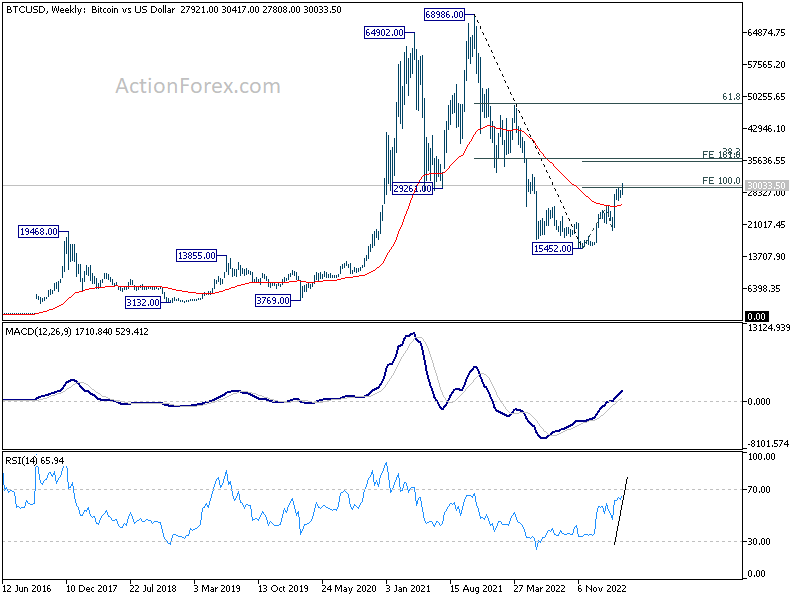
Bitcoin has finally broken through its recent range to the upside, surpassing 30k level for the first time since June 2022. While some observers may attribute the rally since mid-March to safe-haven flows amid banking turmoil, it seems more likely that Bitcoin is moving in tandem with tech stocks, in anticipation of Fed nearing a pause in tightening.
With 100% projection of 15452 to 25242 from 19552 at 29342 now surpassed, the next target is 161.8% projection at 35392. Even if a retreat occurs, outlook will remain bullish as long as 27,808 support holds.
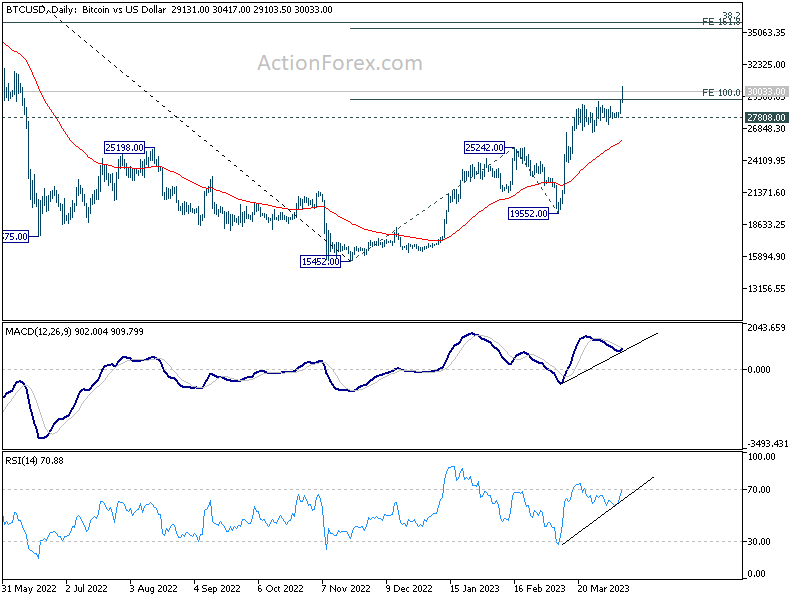
Focus now shifts to the upside momentum of the current move and the reaction to the 35392 projection target. This level is close to the 38.2% projection of 68986 to 15452 at 35901.
Strong upside momentum and a decisive break of the 35k/36k zone would suggest that the rise from 15452 is a of a medium-term impulsive up trend, potentially leading to further gains. Conversely, weak momentum and rejection by the 35k/36k zone would indicate that rebound from 15452 remains just a corrective move.
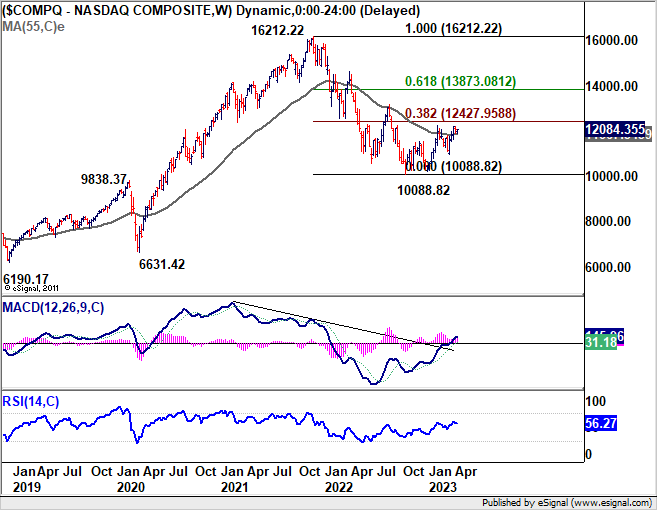
Another question arising is whether NASDAQ can follow suit and decisively break through 38.2% retracement of 16,212.22 to 10,088.82 at 12,427.95, confirming the underlying bullish momentum in tech-related sectors.
Eurozone Sentix Investor Confidence rose to -8.7, negative momentum weakening
Eurozone Sentix Investor Confidence increased from -11.1 to -8.7 in April, surpassing the expected -14.0. The Current Situation index experienced its sixth consecutive rise, moving from -9.3 to -4.3, reaching its highest level since March 2022. The Expectations index, however, remained unchanged at -13.0.
Sentix commented on the data, stating, "There is no doubt that the Eurozone economy has come through the winter months better than many feared in the autumn." However, when considering the future, investors are less optimistic, citing "still considerable uncertainty about the further course of the Ukraine war, concerns about a lasting burden on the energy-intensive industrial sector, and – new – question marks about the state of the US economy."
Despite these concerns, the Sentix Theme Barometer indicates that negative expectations regarding inflation and central bank policy have noticeably decreased. While not an all-clear signal, the negative momentum seems to be weakening.
Eurozone retail sales down -0.8% mom in Feb, EU down -0.9% mom
Eurozone retail sales volume dropped -0.8% mom in February, matched expectations. Volume of retail trade decreased by -1.8% for automotive fuels, by -0.7% for non-food products and by -0.6% for food, drinks and tobacco.
EU retail sales declined -0.9% mom. Among Member States for which data are available, the largest monthly decreases in the total retail trade volume were registered in Slovenia (-10.5%), Hungary and Poland (both -2.0%) and Sweden (-1.6%). The highest increases were observed in Cyprus (+1.6%), Luxembourg (+0.8%) and Belgium (+0.7%).
Australia consumer sentiment jumped 9.4% on RBA pause
Australia Westpac Melbourne Institute Consumer Sentiment Index witnessed a significant 9.4% increase in April, jumping from 78.4 in March to 85.8. This remarkable recovery can be largely attributed to RBA's decision to pause rate hikes during its April meeting, breaking a sequence of ten consecutive meetings with cash rate increases.
However, confidence remains weak, sitting -10.4% lower than April of the previous year, before the tightening cycle began. Respondents continue to exercise caution, with 34.11% still expecting the Standard Variable Rate to rise by more than 1% over the year, although this figure is down from 44.55%.
Regarding the RBA's meeting on May 2, Westpac noted that the central bank would benefit from a clean read on underlying inflation from the March quarter Inflation Report, set to be released on April 26, as well as staff's refreshed economic forecasts. Westpac anticipates that a final 0.25% increase in the cash rate during the May Board meeting would be the best policy approach, rather than waiting for additional information and risking higher rates later in the cycle.
Australian NAB business confidence improved, conditions remain resilient
Australia NAB Business Confidence improved from -4 to -1 in March, while Business Conditions dropped slightly from 17 to 16. Delving into some details, trading conditions rose from 25 to 26, profitability conditions dipped from 14 to 13, and employment conditions fell from 12 to 10.
NAB Chief Economist Alan Oster commented, "Business conditions have been resilient, slowly edging lower over the past few months but remaining well above their long-run average." He added that "trading conditions are particularly elevated, indicating that businesses continue to experience strong demand, and conditions are generally strong across states and sectors."
On the topic of confidence, Oster stated, "Confidence appears to have stabilized, but it remains below average at -1 index point." He noted that confidence was particularly poor in retail and wholesale sectors, likely due to firms being concerned about the sustainability of consumer spending.
In summary, the survey suggests the Australian economy is still holding up, with some easing in inflation. However, Oster emphasized that "there is still a long way to go to bring inflation back down to the RBA's target band and growth could be more volatile from there."
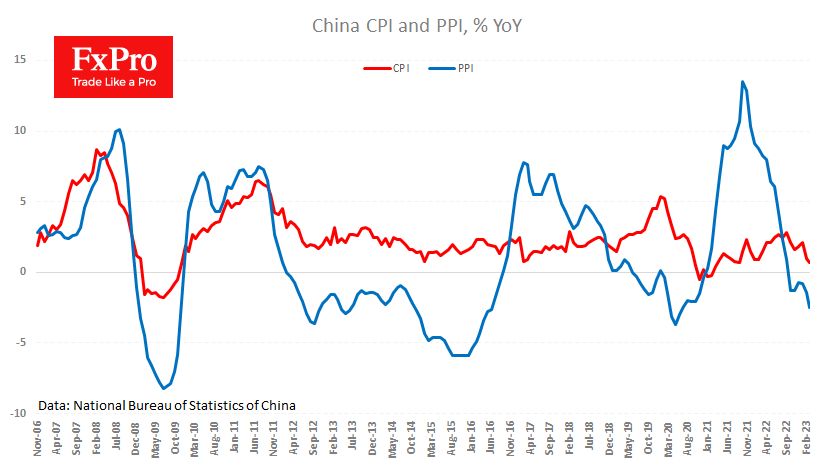
China CPI slows to 18-month low, PPI sees steepest decline since June 2022
China's CPI slowed from 1.0% yoy to 0.7% yoy in March, falling below the expected 1.0% yoy and marking the lowest level in 18 months since September 2021. Excluding food and energy, CPI increased from 0.6% to 0.7% yoy. Food prices rose by 2.4% yoy compared to a year ago, down from 2.6% yoy in February. Notably, pork prices surged by 9.6% yoy, up from a rise of 3.9% yoy in February.
Dong Lijuan, an NBS statistician, attributed the easing consumer inflation in March to "continued resumption of production and life as well as sufficient market supplies." He also mentioned that the fall in factory-gate prices was affected by a high comparison base in the previous year.
Meanwhile, PPI dropped from -1.4% yoy to -2.5% yoy, matching expectations and marking the steepest decline since June 2022. Dong Lijuan, senior NBS statistician, explained that "production and life continued to recover with sufficient supplies in March."
EUR/USD Mid-Day Outlook
Daily Pivots: (S1) 1.0823; (P) 1.0870; (R1) 1.0908; More...
EUR/USD recovers today but stays inside range below 1.0972. Intraday bias remains neutral for the moment. With 1.0787 support intact, further rally is expected. On the upside, above 1.0972 will resume the rally from 1.0515 to retest 01.1032 high. Firm break there will resume larger up trend from 0.9534. However, break of 1.0787 will turn bias back to the downside for 1.0711 support instead.
In the bigger picture, rise from 0.9534 (2022 low) is in progress with 38.2% retracement of 0.9534 to 1.1032 at 1.0460 intact. The strong support from 55 week EMA (now at 1.0625) was also a medium term bullish sign. Next target is 61.8% retracement of 1.2348 (2021 high) to 0.9534 at 1.1273. Sustained break there will solidify the case of bullish trend reversal and target 1.2348 resistance next (2021 high).
Economic Indicators Update
| GMT | Ccy | Events | Actual | Forecast | Previous | Revised |
|---|---|---|---|---|---|---|
| 00:30 | AUD | Westpac Consumer Confidence Apr | 9.40% | 0.00% | ||
| 01:30 | AUD | NAB Business Conditions Mar | 16 | 17 | ||
| 01:30 | AUD | NAB Business Confidence Mar | -1 | -4 | ||
| 01:30 | CNY | CPI Y/Y Mar | 0.70% | 1.00% | 1.00% | |
| 01:30 | CNY | PPI Y/Y Mar | -2.50% | -2.50% | -1.40% | |
| 06:00 | JPY | Machine Tool Orders Y/Y Mar P | -15.20% | -10.70% | ||
| 08:30 | EUR | Sentix Investor Confidence Apr | -8.7 | -14 | -11.1 | |
| 09:00 | EUR | Eurozone Retail Sales M/M Mar | -0.80% | -0.80% | 0.30% | 0.80% |
| 10:00 | USD | NFIB Business Optimism Index Mar | 90.1 | 89.6 | 90.9 |
Chinese Disinflation
Consumer inflation in China fell to 0.7% YoY in March from 1.0% in the previous month. Last month’s producer price index was 2.5% lower than a year earlier, accelerating its decline from 1.4% in February.
The hypothesis that China’s move away from a 0-covid policy is driving down prices rather than pushing them up, as has been the case in the developed world, remains valid. In this case, we are seeing a normalisation of the economy, which in turn is normalising prices after the spike of previous years.
The stabilisation of supply chains is also evident in the stabilisation of container prices, which have returned to the region of $1,500 (the norm, at least from October 2016 to April 2020) after spiking above $10,000 in the last quarter of 2021.
The normalisation of logistics complements the fall in producer prices, taking inflationary pressure off the developed world. And this is good news for risk demand, as it will allow the world’s biggest central banks to stop tightening policy more quickly.
However, falling producer prices may also signal a sharp contraction in demand in the developed world. Although it signals the end of the interest rate hike cycle in Europe and America, it promises more negativity. In this case, things will get worse before they get better.