

Sample Category Title
Markets Shown Asymmetric Reaction Function Since SVB Collapse
Markets
It was groundhog day on financial markets yesterday. Core bond yields – as on Monday – moved away from support levels up until the early US data release. On Monday, a disappointing manufacturing ISM started a core bond new short squeeze. Yesterday, JOLTS job openings were responsible for the turnaround. On both occasions, the market reaction is especially telling about general sentiment these days. US Treasuries rallied with the front end of the curve outperforming. US yields closed 13.8 bps (2-yr) to 3.3 bps (30-yr) lower with intraday swings even larger. Daily swings on the German yield curve varied between -7.4 bps (2-yr) and +3.1 bps (30-yr). US yields are now holding just above the March sell-off lows across the curve (technical support!). The dollar was already in a soft spot going into the data with EUR/USD taking out final resistance ahead of the 1.1033 YTD top at 1.0930 after JOLTS. The pair closed slightly above 1.0950. The trade-weighted greenback (DXY) closed below the March low (101.46) with the YTD low at 100.82 becoming the next reference. Sterling enjoyed a stellar start to the trading day with EUR/GBP dropping half a big figure to 0.8730 on… actually nothing, before pairing losses during US dealings in a copy-paste of the EUR/USD-move. Turning to the data, job openings unexpectedly fell from around 10.5 million to 9.93 million in February. It was the first <10mn reading since May 2021, coming off a 12mn peak in March 2022. However, this number compares to pre-pandemic levels of around 7 million and still outnumbers the 5.9 million unemployed Americans by a very wide margin. So instead of a cooling of the labour market, we’re more talking about an easing of tightness of the labour market. The vacancy-to-unemployment ratio fell to 1.7, the lowest level since November 2021 and compared to a December 2022 peak of 2, but very much above the pre-pandemic 1.2. The quits rate increased from 2.5% to 2.6% (vs 3% peak in April 2022) with the layoff rate down to 1% from 1.1%. Both thus point to more underlying strength compared to the headline number.
The set-up for today risks triggering yet another repeat of what we’ve seen so far with the onus on US March ADP employment change and the non-manufacturing ISM. Markets have shown an asymmetric reaction function since the SVB collapse, with outsized moves on disappointing economic numbers. The strength of this week’s bond rally and the proximity of technical support levels might have a dampening impact in case of weaker figures though. EUR/USD could aim for a first test of 1.1033.
News Headlines
The Reserve Bank of New Zealand surprisingly raised its policy rate by 50 bps from 4.75% to 5.25%. It was the eleventh consecutive rate hike since the start of the hiking cycle in October 2021. The RBNZ kept its analysis that such a rate hike is needed to return inflation to the 1-3% target range over the medium term. Inflation is currently still seen as too high and persistent while employment is beyond its maximal sustainable level. Q4 growth was softer than expected and capacity constrains in the economy are easing. Demand continues to significantly outpace supply though, maintaining pressure on inflation. Even as the economy is expected to slow in 2023, activity remains supported by rebuilding efforts after recent whether events, with resources demand expected to add to inflation more than previously expected. The Committee concludes that keeping the current level of lending rates for households and businesses is necessary to achieve the inflation target, along with a rise in deposit rates. The 2-y government yield jumped 12 bps to 4.7%. Markets still see a 50%+ chance for a final hike in Summer. That was the RBNZ’s own base scenario back in February. The kiwi dollar initially jumped 1%, but eased back to NZD/USD 0.635.
According to a quarterly survey of the British Chambers of Commerce, 52% of UK businesses questioned see sales growing over the next 12 months. However, positive expectations started from a low base as only 34% reported higher sales in Q1 2023. 24% saw a decline in sales. The BCC head of Research said the survey indicated ‘an improvement in business sentiment as political turmoil and inflationary pressures show some signs of easing’. With respect to inflation, BCC indicated that businesses' concerns on inflation eased for the first time in two years. The number of companies planning to raise prices was said to have dropped to 55% from 60%.
Surprise 50bp Hike from RBNZ Pours Cold Water on Doves
US yields tanked and the US dollar slipped yesterday, after the US JOLTS data showed that the job openings in the US fell below 10 million in February.
This is the first time the JOLTS number falls below the 10 million mark since May 2021.
The data triggered strong buying in the US treasuries on the expectation that the Federal Reserve (Fed) could consider ending policy tightening.
The 2-year yield came close to 3.80%, the 10-year yield fell to 3.35% and the US dollar index hit the lowest levels in two months. Expectations for FOMC’s May meeting flipped from around 60% chance of a 25bp hike to around 60% chance of no rate hike at all.
All this is ‘good news’ for the Fed, but diving a bit deeper into yesterday’s JOLTS data, we can’t really say that the US jobs market is in a bad shape yet, because:
1. obviously, the job openings remain at historically high levels. It’s not because we are below the 10-million psychological mark that the US jobs market is collapsing, and,
2. the very same report yesterday also showed that hiring remained steady, and the number of layoffs fell while people voluntarily quitting their jobs rose!
Today, the ADP report is expected to reveal around 208K new private job additions in the US last month. Any weakness in the data will clearly be cheered by the Fed doves and could lead to further weakness in the US treasury yields, whereas a stronger-than-expected ADP print could bring the Fed hawks back to the market.
And if the Reserve Bank of New Zealand (RBNZ) is any indication of the future of the global tightening cycle, the tightening is apparently not coming to an end.
The RBNZ surprised today with a 50bp hike, versus a 25bp hike expected by analysts. The bank pointed at high inflation and strong employment, and said that there is no conflict between lowering inflation by raising rates and financial stability.
The kiwi rallied against the US dollar after the surprising hawkish RBNZ decision today. The pair advanced to the highest levels since mid-February, and could reasonably target further advance past the 65 cents level.
Cold water on Fed doves
The RBNZ decision poured some cold water on dovish Fed expectations today in Asia, as the inflows into the US treasuries also slowed, and reversed.
Again, the ADP data today, and the US jobs figures on Friday will give a better picture on whether the recent decline in JOLTS figures points at a broader weakness in the US jobs market… or not.
For now, the dollar remains under selling pressure.
The EURUSD cleared the 1.0930 resistance yesterday and could well challenge and win over the 1.10 offers if the US ADP report comes in sufficiently soft to further back the Fed doves.
In the UK, the selloff in the US dollar sent Cable to levels not seen since summer 2022. The pair rallied on stops to 1.2525 in London yesterday.
This morning, Cable is back below the 1.25 mark, but if the US dollar continues giving back field – which looks like the base case scenario at this point, we could see sterling sustainably sit above the 1.25, and target 1.2850 – the long-term downtrending channel top against the US dollar.
In commodities, appetite in oil stabilized within the $80/82 range, as the soft economic data spurred recession worries, which in return weighed on global demand prospects.
In precious metals, the falling US yields and the broadly weaker US dollar pushed gold to a fresh year-high, above $2000 per ounce.
It’s not the first time gold trades above the $2000 level. It already happened in the summer of the pandemic - when the Fed slashed rates to support economy, in the first weeks of the Ukrainian war last year - when investors rushed to the safety of gold, and it happens now, on the banking stress and prospects of economic slowdown and softer Fed policy as a result of it.
The next natural resistance for the bulls stands at $2070/2075 range, the all-time-highs.
And the two important questions are, whether gold could break its record, and whether it could consolidate gains sustainably above the $2000 level.
I don’t have an answer to these questions, but the second question is more crucial for long-term investors than the first one. And I believe that if the $2000 support holds, we could see gold enter a new era of strength.
Equity Markets Turn Negative
Market movers today
Today we get the final PMIs from Europe and the US. In the US, ADP employment report and mortgage data will also be released ahead of non-farm payrolls on Friday.
Overnight, we will get March PMIs from China. In central bank calendar, we have Fed's Mester and ECB's Vujcic and Lane on the wires.
The 60 second overview
This morning the Central Bank of New Zealand (RBNZ) raised its monetary policy rate by 50bp. This was a surprise as the consensus expectations for was for a 25bp rate hike, but the RBNZ stated that inflation was too high and persistent.
One of the Federal Reserve officials Loretta Mester has stated that US policy rates should be raised above 5% and stay there for some time. The exact level and timing depends on how quickly the price pressure eases, but in her view monetary policy needs to move "somewhat further into restrictive territory".
The oil price continued up, but it was a modest rise. US Treasury yields rose very modestly in Asian trade after the solid decline yesterday.
Equities: Global equities lower yesterday, dragged down by US and partly Europe. Bear in mind the setback came after equities rallying in 7 out of the last 8 sessions. However, the interesting part yesterday was the sector rotation and cross asset performance. We got a softish macro number, yields pulling lower, VIX higher and a deep defensive rotation. In other words, what would be ultra-classic dynamics when recession fear is increasing. Hence, this is very different from the correlations seen over that last three weeks where lack of banking confidence was the main driver for markets. In US yesterday, Dow -0.6%, S&P 500 -0.6%, Nasdaq -0.5% and Russell 2000 -1.8%. Asian markets are mixed this morning with the Japanese market pulling lower. European and US futures are fluctuating between gains and losses.
FI: Up until the poor US JOLTS release in the afternoon, it was a broad risk on in global markets that sent rates 8bp higher in a curve steepening move since the morning with little news flow generally. Also the significant supply from Germany, Austria and the Netherlands on top of the 8y Italian green deal contributed to the move higher in yields as well. However, the JOLTS report reversed all the aforementioned moves and left the 10y point broadly unchanged on the day. Front end rallied 6-8bp.
FX: Yesterday, the USD broadly weakened sending EUR/USD above 1.095 on the back of weaker-than-expected US job openings and factory orders, which led US yields to decline. EUR/SEK fell to 11.26 while EUR/NOK increased to 11.30. EUR/GBP sharply declined but recovered during the day and ended around 0.876. USD/JPY fell below 132.
Credit: The liquidity in the credit markets remained underwhelming yesterday. The overall mood took a turn for the worse towards the end of the day, fuelled by renewed worries about the US economy and its banking sector. ITraxx Main shed 1.8bp ending at +87.5bp while Xover widened 11.5bp ending at 457bp. The primary markets continued its decent activity, with especially the SEK market being quite active as exemplified by a three tranced SEK1.5bn Sveaskog print, where the 5 year tenor fixed at a coupon of 4.235%.
USD/CHF Daily Outlook
Daily Pivots: (S1) 0.9031; (P) 0.9087; (R1) 0.9118; More...
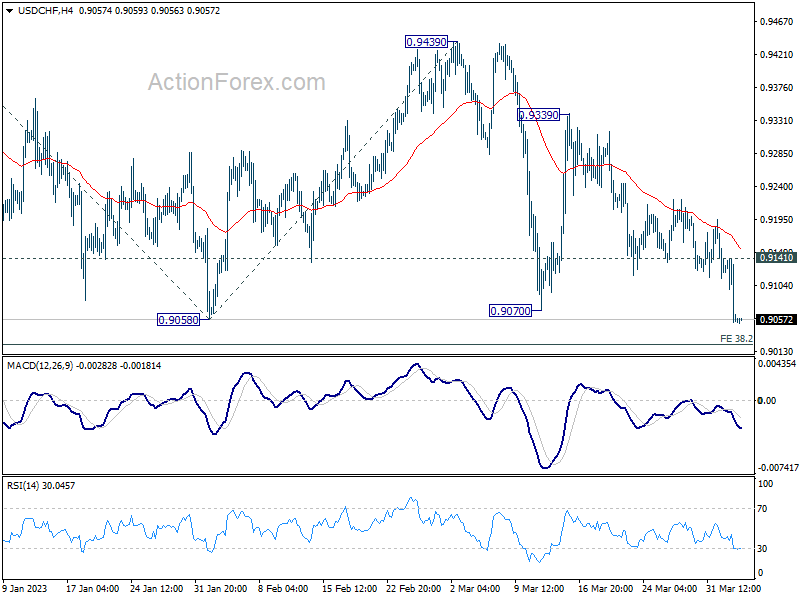
USD/CHF's break of 0.9058 support suggests that the down trend from 1.0146 is finally resuming. Intraday bias is now back on the downside. Sustained break of 38.2% projection of 1.0146 to 0.9058 from 0.9439 at 0.9023 will pave the way to 61.8% projection at 0.8767.On the upside, above 0.9141 minor resistance will delay the bearish case and turn intraday bias neutral again.
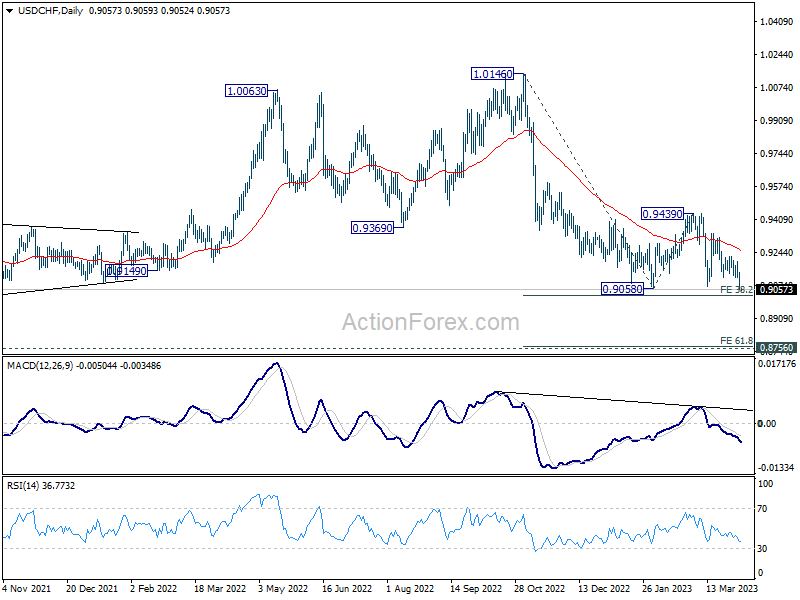
In the bigger picture, outlook will stay bearish as long as 0.9439 resistance holds, and fall from 1.1046 (2022 high) is still in progress. Prior rejection by 55 week EMA was a medium term bearish sign. Sustained of 0.9058 will resume such decline towards 0.8756 support (2021 low). But overall, this fall is still as a leg in the long term range pattern from 1.0342 (2016 high). So, downside should be contained by 0.8756 to bring reversal.
Diverging Fortunes for Commodity Currencies; Gold Resumes Uptrend
New Zealand Dollar rises broadly after RBNZ surprised the market with a 50bps interest rate hike. In contrast, Australian Dollar is suffering from cross-selling, extending the post-RBA selloff. Canadian Dollar is taking a breather as oil prices plateau following an earlier surge this week, with WTI still struggling around 80 handle. This divergence in commodity currencies is noteworthy as they respond to different market factors.
European majors are showing more unity in their movements, with Euro and Swiss Franc following Sterling's lead in extending recent rallies against Dollar. But they are sluggish against Yen for now. The early advantage that Sterling held against other European currencies has reversed, and it remains unclear whether they will establish a clear direction against each other. The greenback is currently the weakest performer for the week, along with the Aussie.
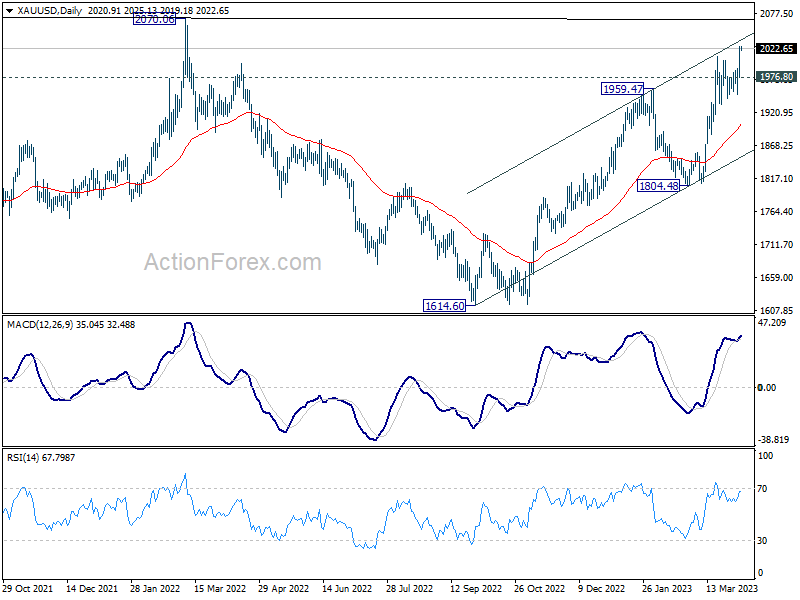
Technically, Gold resumed its recent uptrend, breaking through 2,009.59 resistance level. As long as 1,976.80 support holds, near-term outlook remains bullish, with the next target at 2,070.06 resistance and 2,074.84 record high. A decisive break above these levels could indicate a resumption of the long-term uptrend and potentially signal an intensified selloff in Dollar. Market participants will be closely watching to see if this scenario unfolds.
In Asia, at the time of writing, Nikkei is down -1.67%. Japan 10-year JGB yield is up 0.590 at 0.475, heading back to BoJ's 0.5% cap. Singapore Strait Times is up 0.47%. Hong Kong and China are both on holiday. Overnight, DOW dropped -0.59%. S&P 500 dropped -0.58%. NASDAQ dropped -0.52%. 10-year yield dropped -0.093 to 3.337.
RBNZ hikes 50bps after considering a 25bps move too
In an unexpected move, RBNZ raised the Official Cash Rate by 50bps to 5.25%, doubling the anticipated 25bps hike. This bold step reflects the central bank's concerns about persistently high inflation and employment levels.
The RBNZ statement highlighted that "inflation is still too high and persistent, and employment is beyond its maximum sustainable level." Despite lower-than-expected economic activity in the December quarter, demand continues to outstrip supply, exerting further pressure on annual inflation.
The statement also noted that severe weather events in the North Island have contributed to higher prices for some goods and services. This increased near-term CPI inflation poses a risk of inflation expectations remaining above the target range.
In the meeting minutes, the Committee emphasized the need to continue raising the OCR to bring inflation back to the 1-3% target and fulfill their remit. They discussed both 25 and 50 basis point increases, ultimately opting for the more aggressive 50 basis point hike. This decision aims to maintain current lending rates for businesses and households while supporting an increase in retail deposit rates, countering the downward pressure on lending rates caused by falling wholesale interest rates since the February Statement.
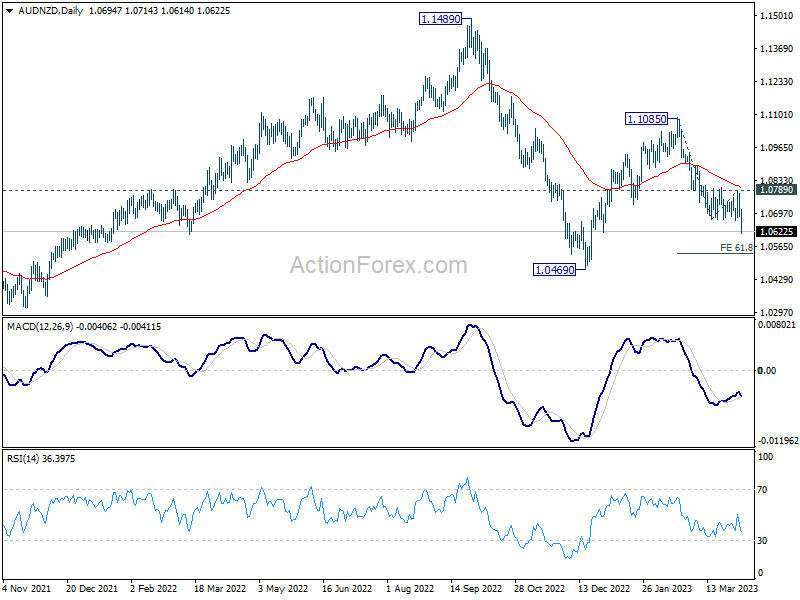
Powerful downside breakout in AUD/NZD, 1.0534 next
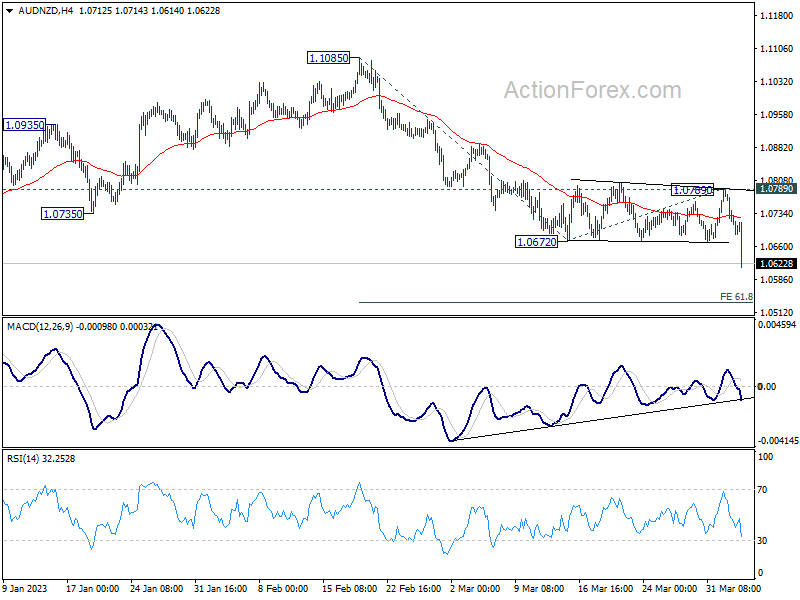
AUD/NZD powered through 1.0672 support to resume the decline from 1.1085 after larger than expected rate hike by RBNZ. Tightening is not finished with RBNZ yet, another 25bps hike could be delivered to bring the OCR from today's 5.25% to 5.50 within first half of the year. Any movements in the OCR beyond that point will be data-dependent. Meanwhile, RBA has started the pause yesterday by holding cash rate target unchanged at 3.60%. There are talks that this level could be RBA's peak rate in the current cycle.
From technical point of view, near term outlook will now stay bearish as long as 1.0789 resistance holds in AUD/.NZD. Next target is 61.8% projection of 1.1085 to 1.0672 from 1.0789 at 1.0534. In the larger picture, the down trend from 1.1489 (2022 high) could be ready to extend through 1.0469 if monetary policies diverge further.
RBA Lowe: To hold doesn't imply tightening is over
RBA Governor Philip Lowe, in a speech today, clarified that the decision to keep interest rates unchanged yesterday does not mark the end of tightening measures.
"The decision to hold rates steady this month does not imply that interest rate increases are over. Indeed, the Board expects that some further tightening of monetary policy may well be needed to return inflation to target within a reasonable timeframe," he said.
Acknowledging that monetary policy is now in restrictive territory, Lowe said it was time to hold interest rates steady and gather more information. He also mentioned that RBA will review its monetary policy stance at the next meeting, taking into account updated forecasts and scenarios.
Fed Mester sees monetary policy turning more restrictive this year
In a speech yesterday, Cleveland Federal Reserve President Loretta Mester highlighted her expectation that monetary policy will move "somewhat further into restrictive territory this year," with the fed funds rate surpassing 5% and the real fed funds rate remaining in positive territory for an extended period.
Mester explained that the precise extent and duration of the federal funds rate hike will depend on how inflation and inflation expectations are affected by demand slowing, supply challenges being resolved, and price pressures easing. She noted that her forecast aligns with the modal forecasts of FOMC participants released two weeks ago, although she sees "somewhat more persistent inflation pressures than the median forecast among participants."
According to Mester, inflation will show a substantial improvement, as price pressures are expected to decline from their current 5% yoy increase to 3.75% by the end of 2023 and 2% by 2025. She also anticipates a slowdown in economic growth this year, followed by a rebound in 2023. In terms of unemployment, Mester projects a rise from the current 3.6% to a range of 4.5% to 4.75% by the conclusion of 2023.
Looking ahead
Germany factory orders, France industrial output, Eurozone PMI services final and UK PMI services final will be released in European session. Later in the day, Canada will release trade balance. US will release ADP employment, trade balance and ISM services.
USD/CHF Daily Outlook
Daily Pivots: (S1) 0.9031; (P) 0.9087; (R1) 0.9118; More...
USD/CHF's break of 0.9058 support suggests that the down trend from 1.0146 is finally resuming. Intraday bias is now back on the downside. Sustained break of 38.2% projection of 1.0146 to 0.9058 from 0.9439 at 0.9023 will pave the way to 61.8% projection at 0.8767.On the upside, above 0.9141 minor resistance will delay the bearish case and turn intraday bias neutral again.
In the bigger picture, outlook will stay bearish as long as 0.9439 resistance holds, and fall from 1.1046 (2022 high) is still in progress. Prior rejection by 55 week EMA was a medium term bearish sign. Sustained of 0.9058 will resume such decline towards 0.8756 support (2021 low). But overall, this fall is still as a leg in the long term range pattern from 1.0342 (2016 high). So, downside should be contained by 0.8756 to bring reversal.
Economic Indicators Update
| GMT | Ccy | Events | Actual | Forecast | Previous | Revised |
|---|---|---|---|---|---|---|
| 02:00 | NZD | RBNZ Interest Rate Decision | 5.25% | 5.00% | 4.75% | |
| 06:00 | EUR | Germany Factory Orders M/M Feb | 0.40% | 1.00% | ||
| 06:45 | EUR | France Industrial Output M/M Feb | 0.60% | -1.90% | ||
| 07:45 | EUR | Italy Services PMI Mar | 53 | 51.6 | ||
| 07:50 | EUR | France Services PMI Mar F | 55.5 | 55.5 | ||
| 07:55 | EUR | Germany Services PMI Mar F | 53.9 | 53.9 | ||
| 08:00 | EUR | Eurozone Services PMI Mar F | 55.6 | 55.6 | ||
| 08:30 | GBP | Services PMI Mar F | 52.8 | 52.8 | ||
| 09:00 | EUR | Italy Retail Sales M/M Feb | 0.50% | 1.70% | ||
| 12:15 | USD | ADP Employment Change Mar | 200K | 242K | ||
| 12:30 | CAD | Trade Balance (CAD) Feb | 2.2B | 1.9B | ||
| 12:30 | USD | Trade Balance (USD) Feb | -68.5B | -68.3B | ||
| 13:45 | USD | Services PMI Mar F | 53.8 | 53.8 | ||
| 14:00 | USD | ISM Services PMI Mar | 54.5 | 55.1 | ||
| 14:30 | USD | Crude Oil Inventories | -1.6M | -7.5M |
RBA Lowe: To hold doesn’t imply tightening is over
RBA Governor Philip Lowe, in a speech today, clarified that the decision to keep interest rates unchanged yesteday does not mark the end of tightening measures.
"The decision to hold rates steady this month does not imply that interest rate increases are over. Indeed, the Board expects that some further tightening of monetary policy may well be needed to return inflation to target within a reasonable timeframe," he said.
Acknowledging that monetary policy is now in restrictive territory, Lowe said it was time to hold interest rates steady and gather more information. He also mentioned that RBA will review its monetary policy stance at the next meeting, taking into account updated forecasts and scenarios.
Powerful downside breakout in AUD/NZD, 1.0534 next
AUD/NZD powered through 1.0672 support to resume the decline from 1.1085 after larger than expected rate hike by RBNZ. Tightening is not finished with RBNZ yet, another 25bps hike could be delivered to bring the OCR from today's 5.25% to 5.50 within first half of the year. Any movements in the OCR beyond that point will be data-dependent. Meanwhile, RBA has started the pause yesterday by holding cash rate target unchanged at 3.60%. There are talks that this level could be RBA's peak rate in the current cycle.
From technical point of view, near term outlook will now stay bearish as long as 1.0789 resistance holds in AUD/.NZD. Next target is 61.8% projection of 1.1085 to 1.0672 from 1.0789 at 1.0534. In the larger picture, the down trend from 1.1489 (2022 high) could be ready to extend through 1.0469 if monetary policies diverge further.
RBNZ hikes 50bps after considering a 25bps move too
In an unexpected move, RBNZ raised the Official Cash Rate by 50bps to 5.25%, doubling the anticipated 25bps hike. This bold step reflects the central bank's concerns about persistently high inflation and employment levels.
The RBNZ statement highlighted that "inflation is still too high and persistent, and employment is beyond its maximum sustainable level." Despite lower-than-expected economic activity in the December quarter, demand continues to outstrip supply, exerting further pressure on annual inflation.
The statement also noted that severe weather events in the North Island have contributed to higher prices for some goods and services. This increased near-term CPI inflation poses a risk of inflation expectations remaining above the target range.
In the meeting minutes, the Committee emphasized the need to continue raising the OCR to bring inflation back to the 1-3% target and fulfill their remit. They discussed both 25 and 50 basis point increases, ultimately opting for the more aggressive 50 basis point hike. This decision aims to maintain current lending rates for businesses and households while supporting an increase in retail deposit rates, countering the downward pressure on lending rates caused by falling wholesale interest rates since the February Statement.
Fed Mester sees monetary policy turning more restrictive this year
In a speech yesterday, Cleveland Federal Reserve President Loretta Mester highlighted her expectation that monetary policy will move "somewhat further into restrictive territory this year," with the fed funds rate surpassing 5% and the real fed funds rate remaining in positive territory for an extended period.
Mester explained that the precise extent and duration of the federal funds rate hike will depend on how inflation and inflation expectations are affected by demand slowing, supply challenges being resolved, and price pressures easing. She noted that her forecast aligns with the modal forecasts of FOMC participants released two weeks ago, although she sees "somewhat more persistent inflation pressures than the median forecast among participants."
According to Mester, inflation will show a substantial improvement, as price pressures are expected to decline from their current 5% YoY increase to 3.75% by the end of 2023 and 2% by 2025. She also anticipates a slowdown in economic growth this year, followed by a rebound in 2023. In terms of unemployment, Mester projects a rise from the current 3.6% to a range of 4.5% to 4.75% by the conclusion of 2023.
(RBNZ) Official Cash Rate increased to 5.25 percent
The Monetary Policy Committee today increased the Official Cash Rate (OCR) by 50 basis points, from 4.75 percent to 5.25 percent.
The Monetary Policy Committee today increased the Official Cash Rate (OCR) by 50 basis points, from 4.75 percent to 5.25 percent.
The Committee agreed the OCR needs to increase, as previously indicated, to return inflation to the 1-3 percent target range over the medium term. Inflation is still too high and persistent, and employment is beyond its maximum sustainable level.
The level of economic activity over the December quarter was lower than anticipated in our February Monetary Policy Statement and there are emerging signs of capacity pressures in the economy easing. However, demand continues to significantly outpace the economy's supply capacity, thereby maintaining pressure on annual inflation.
The recent severe weather events in the North Island have led to higher prices for some goods and services. This higher near-term CPI inflation increases the risk that inflation expectations persist above our target range.
Over the medium term, the Committee anticipates economic activity to be supported by rebuilding efforts in the aftermath of the weather events. The demand on resources is expected to add to inflation pressure by more than assumed in the February Monetary Policy Statement.
Global growth is expected to be below average, contributing to lower demand for New Zealand's key commodity exports. Continued growth in New Zealand's service exports, in particular tourism, is assumed to provide some offset to this drop in export revenue.
New Zealand's economic growth is expected to slow through 2023, given the slowing global economy, reduced residential building activity, and the ongoing effects of the monetary policy tightening to date. This slowdown in spending growth is necessary to return inflation to target over the medium-term.
The Committee agreed that the OCR needs to be at a level that will reduce inflation and inflation expectations to within the target range over the medium term. The Committee agreed that maintaining the current level of lending rates for households and businesses is necessary to achieve this, along with a rise in deposit rates. New Zealand's financial system is well positioned to manage through a period of slower economic activity.
Monetary Policy Committee Record of Meeting
The Monetary Policy Committee discussed developments affecting the outlook for inflation and employment in New Zealand. On balance, recent data, including a fall in GDP in the December 2022 quarter, suggest the level of economic activity is lower than assumed in the February Statement. Committee members observed that inflation is nevertheless still too high and persistent, and employment is beyond its maximum sustainable level. The Committee agreed it must continue to increase the Official Cash Rate (OCR) to return inflation to the 1-3 percent target and to fulfil its Remit.
The Committee discussed recent developments in international financial markets and their implications for New Zealand. Recent banking stress in the United States and Europe has resulted in lower wholesale interest rates and an increase in credit spreads. This reflects, to some degree, the potential for tighter global credit conditions and a weaker outlook for global demand.
New Zealand's financial system (including banks, other deposit takers and insurers) is well placed to keep supporting New Zealanders through a time of global financial market volatility and a slowdown in domestic economic activity. New Zealand's banks are well capitalised, profitable, and have strong liquidity positions, with plenty of cash on hand. They also have comparatively little exposure to interest rate risk on their balance sheets, and hedge or insure against such risks. New Zealand banks are also required to hold capital against this risk to the extent it exists, and are not as susceptible to a concentrated run on deposits, unlike in the US where some banks had very large deposits held by just a few savers.
The Committee's assessment is that there is no material conflict between lowering inflation and maintaining financial stability in New Zealand. In particular, credit conditions have not tightened substantially and while increasing, arrears on mortgages and other debts remain at low levels. In addition, the Reserve Bank has other policy tools available to address financial stability risks which can be used if needed, including providing liquidity to banks and supporting market functioning. Further to this, tightening monetary policy now to reduce inflation improves the outlook for financial stability by limiting the need for even higher interest rates in future.
The Committee discussed the global economic outlook. In many countries, headline inflation has steadied or begun to decline. However, core inflation remains high, reflecting significant broad-based capacity constraints. Global growth is expected to be below average through 2023. Weakening global growth is contributing to weaker demand for New Zealand's key commodity exports, such as dairy and meat. Continued growth in New Zealand's service exports, in particular tourism, is assumed to provide some offset to this drop in export revenue.
Committee members discussed the effects of recent severe weather events. Daily spending data show that these events resulted in a short-lived drop in household spending in affected areas, with a relatively quick bounce back to pre-event levels. At the same time, these events have resulted in an increase in some prices. Over the medium-term, the inflationary impacts of these events are likely to be somewhat larger than assumed at the time of the February Statement as more information has come to light about the scale of rebuild activity. The Committee considered the medium-term impact that these events will have on inflation and maximum sustainable employment when setting policy.
Housing market developments and domestic financial conditions were considered. It was noted that annual household credit growth has slowed significantly in recent months. It was noted that this is consistent with declining house prices and the transmission of past monetary tightening. The Committee noted current monetary policy settings would continue to put downward pressure on house prices, consistent with prices returning to more sustainable levels.
The Committee discussed recent domestic economic developments. There are early signs that growth in the domestic economy is beginning to slow. The economy contracted over the fourth quarter of 2022. Higher frequency indicators point to modest yet positive growth over the first quarter of 2023. Overall, the Committee's assessment is that the economy is starting from a slightly weaker position than assumed in the February Statement. However, demand continues to outpace supply, and this continues to be reflected in persistently high domestic inflation. In addition, near-term inflationary pressures have increased, boosted by short-term price pressures resulting from recent severe weather events and reflected in business survey indicators of costs and pricing intentions.
The Committee discussed the New Zealand labour market noting that it remains strong, with employment continuing to expand. Job advertisements have fallen, but remain at high levels. Net inward migration is rising rapidly from low levels last year, and will likely help fill worker shortages, subject to sufficiently matching current skill shortages.
The Committee considered updated economic projections. Economic growth in New Zealand is anticipated to slow through 2023. This reflects the impact of slowing global growth, the weaker housing market, and the effects of monetary tightening to date. Increased private and public sector activity associated with rebuilding following recent extreme weather events will provide a boost to activity and inflation, as will rising long-term net migration. The current projection assumes Government consumption and investment will fall as a share of the economy in coming years. However, members viewed the risks to inflation pressure from fiscal policy as skewed to the upside, particularly given the ongoing demand for government services in an environment of rising costs of provision. The economic impact of the Government response to recent severe weather events will depend on the scale of damage, fiscal reprioritisation decisions, timing of activity and how Government spending is funded.
Members agreed that the sooner supply and demand were better matched in the economy, the lower the overall cost of reducing inflation. The Committee discussed the extent of additional monetary tightening required to achieve its Remit. Members noted the rapid pace and extent of tightening to date implies monetary policy is now contractionary. The Committee agreed that the full impact of this monetary tightening is yet to be fully realised. Committee members agreed that the OCR needed to reach a level where the Committee could be confident it would reduce actual inflation to within the 1-3 percent target range over the forecast horizon.
The Committee agreed that a further increase in the OCR is needed at this meeting to ensure core inflation and inflation expectations begin to fall. The Committee discussed 25 and 50 basis point increases at this meeting. In aggregate, economic projections were little changed relative to the February Statement. The Committee was comfortable that current lending rates faced by businesses and households will help ensure core inflation and inflation expectations begin to moderate. However, wholesale interest rates have fallen significantly since the February Statement, and this could put downward pressure on lending rates. As a result, a 50 basis point increase in the OCR was seen as helping to maintain the current lending rates faced by businesses and households, while also supporting an increase in retail deposit rates.
Looking ahead, the Committee is expecting to see a continued slowing in domestic demand and a moderation in core inflation and inflation expectations. The extent of this moderation will determine the direction of future monetary policy.
On Wednesday 5 April, the Committee reached a consensus to increase the OCR by 50 basis points from 4.75% to 5.25%.
Attendees: Reserve Bank members of MPC: Adrian Orr, Christian Hawkesby, Karen Silk, and Paul Conway.
External MPC members: Bob Buckle, Peter Harris and Caroline Saunders.
Treasury Observer: Tim Ng.
MPC Secretary: Adam Richardson.