Sample Category Title
AUD/NZD ready for downside breakout after AU CPI
AUD/NZD is trading slightly lower following the release of Australia's lower-than-expected monthly CPI data, which bolsters the case for a pause in RBA's tightening cycle next week. While there are talks of another 25bps RBA rate hike in May, taking rate to 3.85%, it would still be 90bps below RBNZ's current rate of 4.75%. Furthermore, RBNZ is expected to increase rates by an additional 25bps to 5.00% in April, further widening the gap between the two central banks.
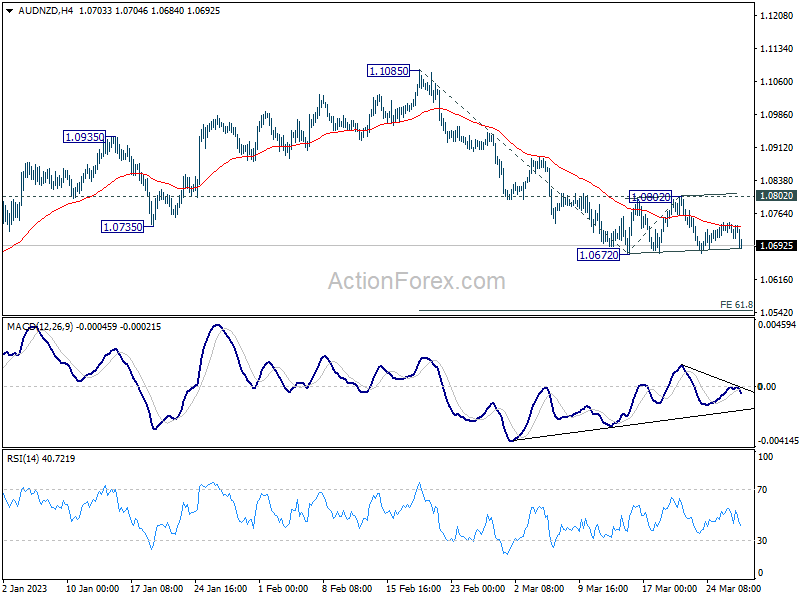
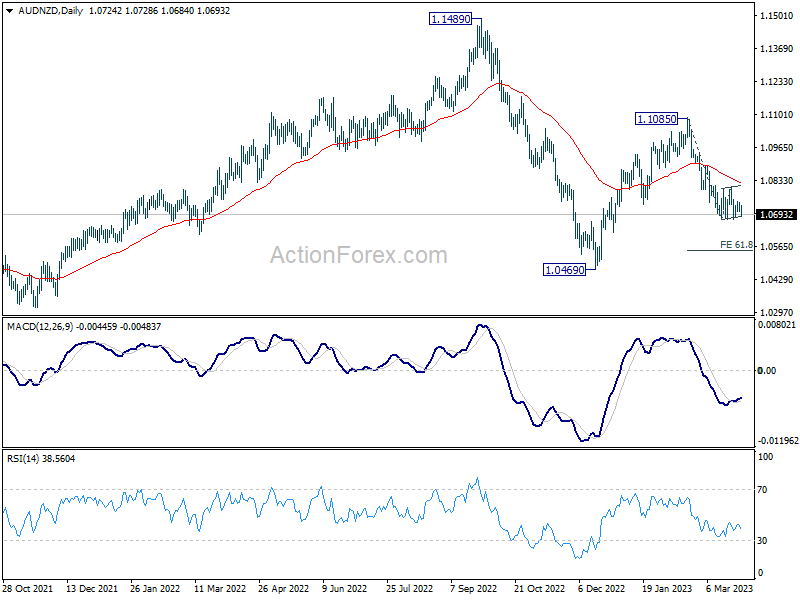
Technically speaking, AUD/NZD's price movements from 1.0672 appear to be corrective in nature. Rejection by 4 hour 55 EMA suggests that the decline from 1.1085 could resume soon. A break below 1.0672 would confirm the resumption of the fall and target 61.8% projection of 1.1085 to 1.0672 from 1.0802 at 1.0547. In any case, outlook will remain bearish as long as 1.0802 resistance level holds.
Australia CPI slowed to 6.8% yoy, supports RBA pause next week
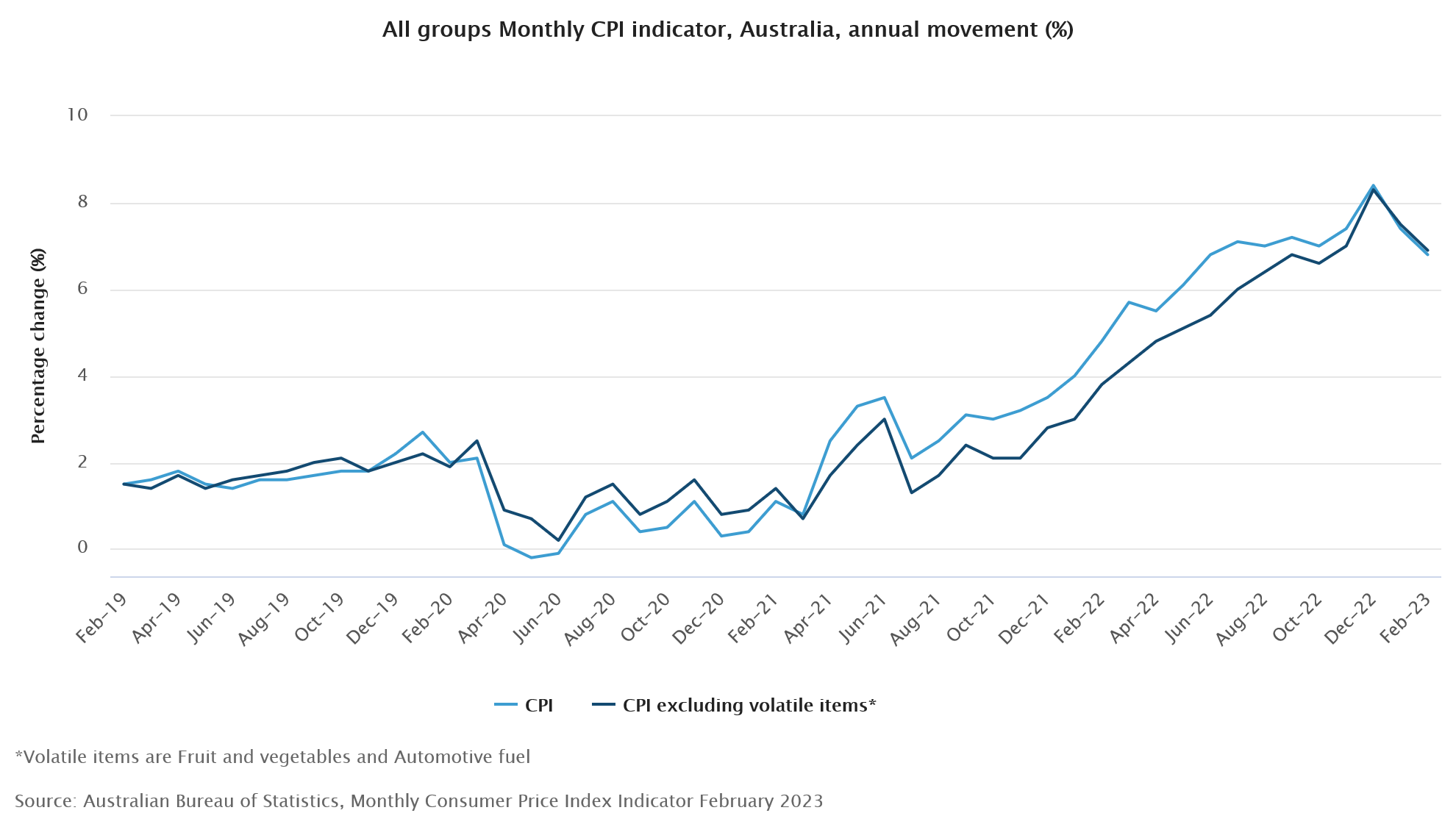
Australia's monthly CPI in February eased from 7.4% yoy to 6.8% yoy, below expectation of 7.2% yoy. CPI excluding volatile items such as fruit, vegetables, and automotive fuel also slowed from 7.5% yoy to 6.9% yoy.
Michelle Marquardt, Head of Prices Statistics at the Australian Bureau of Statistics (ABS), noted that "this marks the second consecutive month of lower annual inflation, also known as 'disinflation', from the peak of 8.4% in December 2022."
Although inflation remains well above RBA's target band of 2-3%, the start of disinflation process could increase the likelihood of a pause in the RBA's tightening cycle during their next meeting. The continued easing of inflationary pressures may prompt the central bank to take a more cautious approach in the near term.
Incoming BoJ Deputy Governor Uchida Stresses Importance of Trend Inflation in Monetary Policy
Incoming BoJ Deputy Governor Shinichi Uchida emphasized the significance of trend inflation in a parliamentary session today, stating that the central bank will conduct a comprehensive assessment of various data, including trend inflation developments, to guide monetary policy.
Uchida said that "trend inflation is an extremely important factor for us in judging on achievement of 2% inflation target in a stable manner." He also mentioned that the BoJ will "make comprehensive judgment by looking at various price indicators."
In addition, Uchida highlighted the importance of communication between the central bank and the markets, saying, "We will strive to communicate firmly with markets to gain understanding" regarding the BoJ's policy approach. This statement underscores the commitment of the BoJ to transparency and open dialogue in shaping its monetary policy.
Gold Price Continues To Struggle Near $2K, Oil Price Recovers
Key Highlights
- Gold price is facing a strong resistance above $2,000.
- A connecting bullish trend line is forming with support near $1,945 on the 4-hours chart.
- Crude oil price climbed higher and recovered above $71.20.
- EUR/USD and GBP/USD might aim more upsides.
Gold Price Technical Analysis
Gold price failed again to gain pace above the $2,000 resistance against the US Dollar. The price corrected lower and traded below the $1,965 support zone.
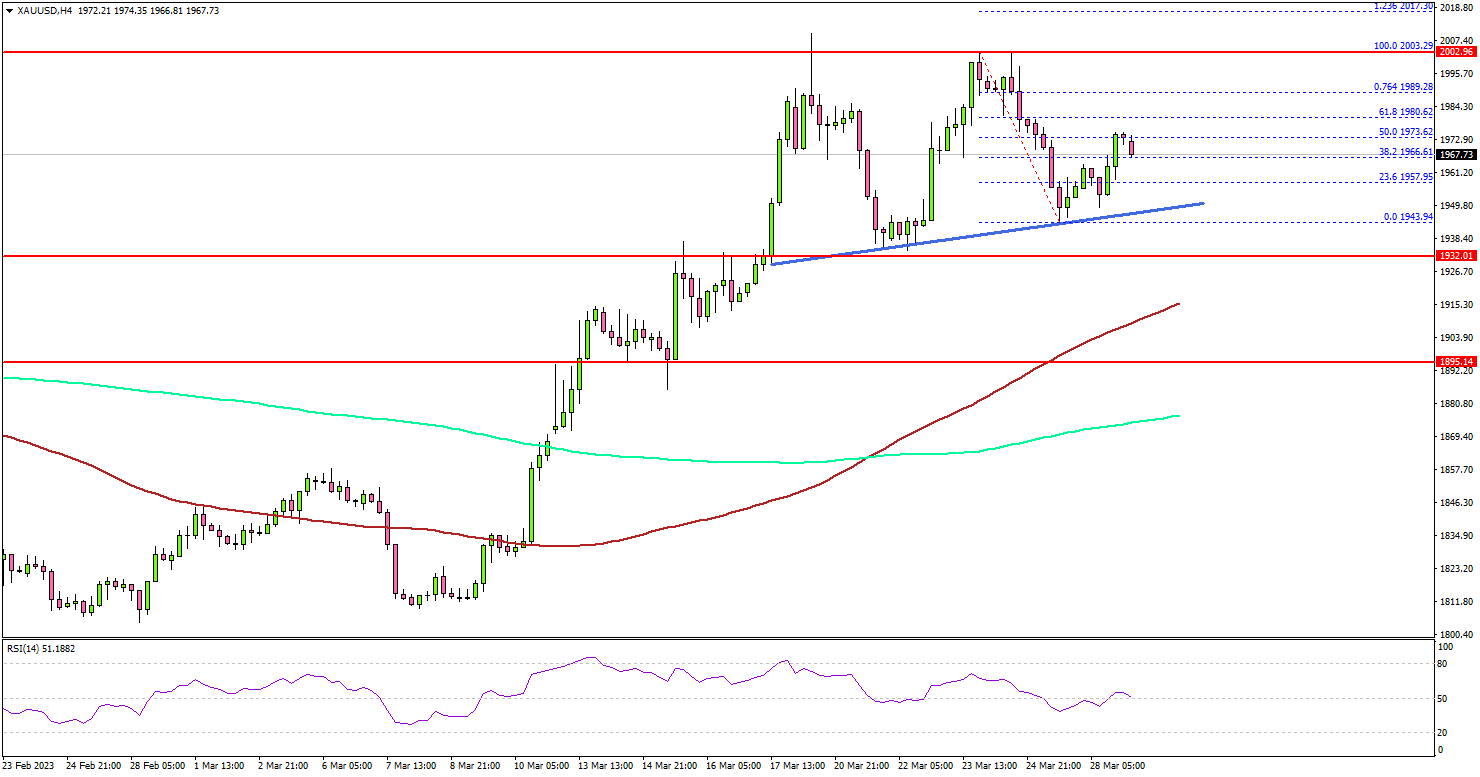
The 4-hours chart of XAU/USD indicates that the price tested the $1,940 zone. It remained stable above the $1,932 support, the 100 simple moving average (red, 4-hours), and the 200 simple moving average (green, 4-hours).
It is now consolidating, with an immediate resistance near the $1,975 level. The next major resistance is near the $1,988 level.
The main resistance is near the $2,000 zone. A successful weekly close above the $2,000 resistance start a strong increase. In the stated case, the price might test $2,065 or even $2,120.
On the downside, an initial support is near the $1,945 level. There is also a connecting bullish trend line forming with support near $1,945 on the same chart. The next major support is near the $1,932 level, below which there is a risk of a move towards the $1,915 level.
The next major support is near the $1,900 level, below which gold price might struggle to stay above the $1,880 zone. In the stated case, gold price could slide towards the $1,850 support.
Looking at EUR/USD, the pair might soon attempt an upside break and it could even clear the 1.0900 resistance zone.
Economic Releases to Watch Today
- US Pending Home Sales for Feb 2023 (YoY) - Forecast -29.4%, versus -24.1% previous.
Will PCE Inflation Numbers Add Credence to Fed Pivot Bets?
Following last week’s FOMC decision, market participants are assigning a decent chance for the Committee to take the sidelines at its upcoming gathering. More importantly, they anticipate a series of rate reductions for the remainder of the year, despite the new dot plot and Fed Chair Powell indicating otherwise. Now, dollar traders may closely watch upcoming economic numbers, especially the PCE inflation figures due out on Friday as they are the Fed’s favorite inflation gauge.
Fed hints at pause, investors see cuts by year end
Last Wednesday, Fed officials decided to deliver another 25bps hike, but in the statement accompanying the decision, there was a change in forward guidance that was interpreted as hinting that they are on the verge of pausing due to the recent turbulence in the banking sector.
Instead of noting that “ongoing increases in the target range will be appropriate”, they said that “some additional policy firming may be appropriate”. The word ‘may’ was interpreted as opening the door to a pause, and that’s why the dollar fell. Currently, investors are evenly split between taking the sidelines and delivering another quarter-point hike at the upcoming meeting in May, while they are anticipating a series of rate cuts in the next 8 months, seeing interest rates ending the year at around 4.15%.
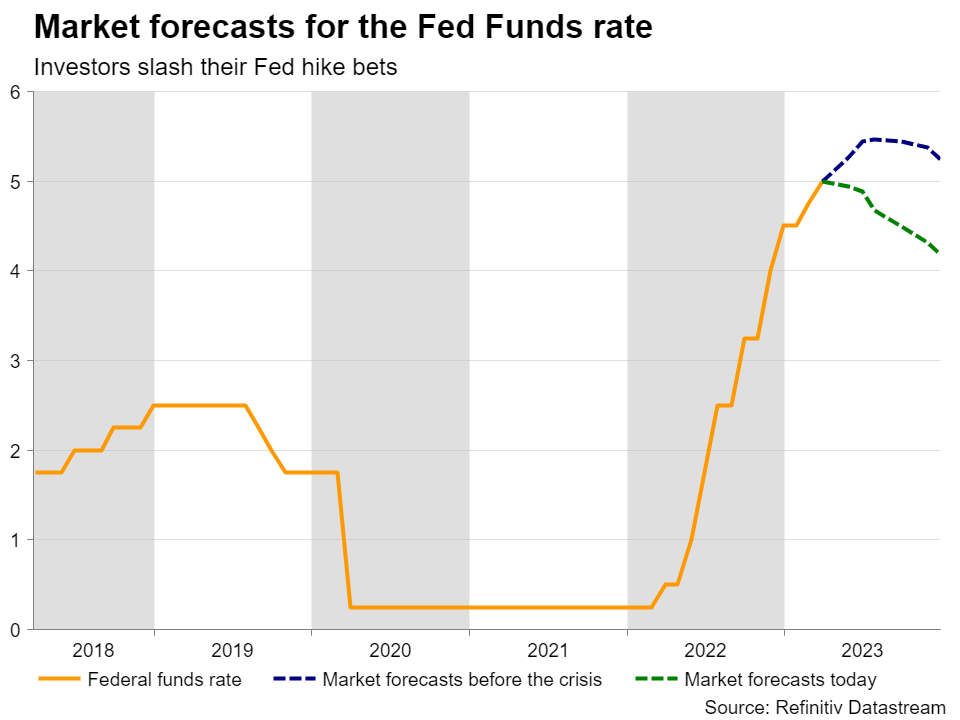
So, apart from trying to figure out whether another hike is warranted, market participants will also try to better assess the probability of rate reductions. At the press conference following the decision, Fed Chair Powell said that they don’t expect any rate cuts this year, adding that if they have to raise rates further, they will.
Will the data corroborate the pivot view?
Thus, upcoming data could constitute another piece of information to the rate-path riddle. Traders may pay more attention to the PCE inflation numbers for February, which are considered the Fed’s preferred inflation metric and come alongside the personal income and spending data for the month. Both income and spending are forecast to have slowed notably, but with retail sales sliding during the month, the risks surrounding spending may be tilted to the downside. A potential slowdown in income is corroborated by a slowdown in the monthly average hourly earnings. As for the PCE rates, currently, there is no forecast for the headline, but the core is expected to have held steady at 4.7% y/y.
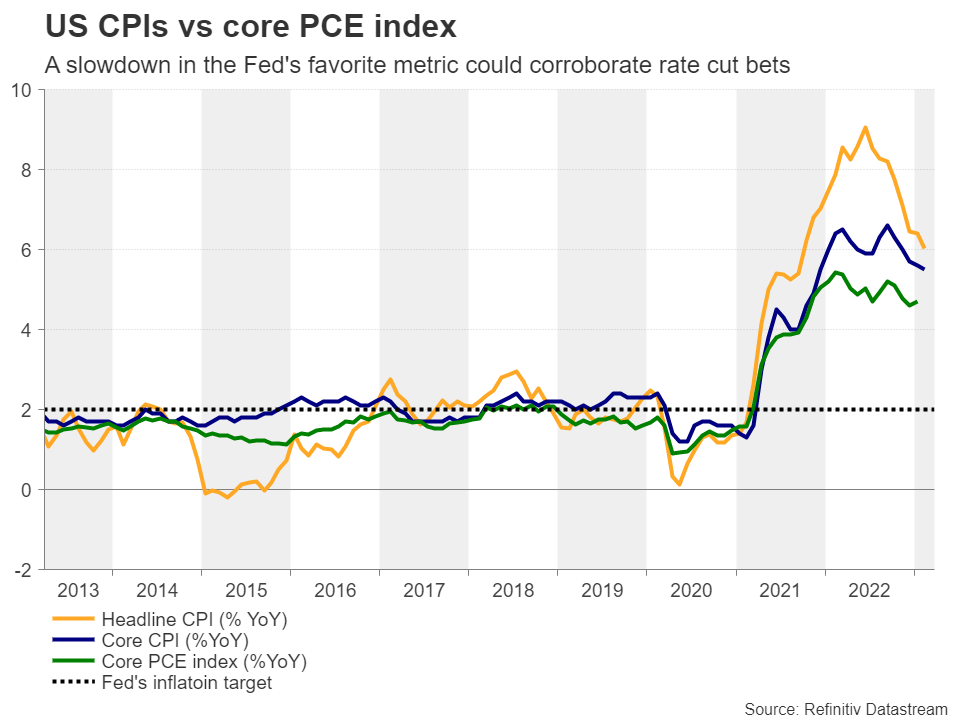
That said, judging by the slowdown in the core CPI for the month, a similar outcome in this release may not come as a surprise. So, a further slowdown in the core PCE could add more credence to investors’ view that a pause is nearing, thereby weighing again on the US dollar and Treasury yields. At the same time, equities could benefit as expectations of rate cuts later this year mean lower borrowing costs for firms and higher valuations. And with the full effect of the prior hikes not fully transmitted into the real economy, investors could maintain the view that inflation could continue to cool in the coming months.
Other data on the calendar this week include the Conference Board consumer index for March, due out on Tuesday, the pending home sales for February on Wednesday, and on Thursday, the final GDP for Q4.
Fed speakers to enter the spotlight as well
Apart from the data, expectations around the Fed’s future course of action could also be affected by policymakers’ remarks. On Thursday, traders will get to hear from Richmond Fed President Thomas Barkin, while on Friday, after the PCE numbers, New York Fed President John Williams will step onto the rostrum. It will be interesting to see whether they will sing from Powell’s choir sheet and push back against rate cuts bets, but also whether the market will be convinced.
Even the smallest hint that they could consider reductions at some point this year could reinforce the market’s interpretation and magnify the dollar’s losses, especially against the yen, which has been attracting haven flows recently due to the latest banking turmoil. Also, with Japanese companies agreeing with unions to raise wages by the most in about three decades, the chances for the BoJ to remove further accommodation in the coming months may have increased.
Dollar/yen may be poised to continue drifting south
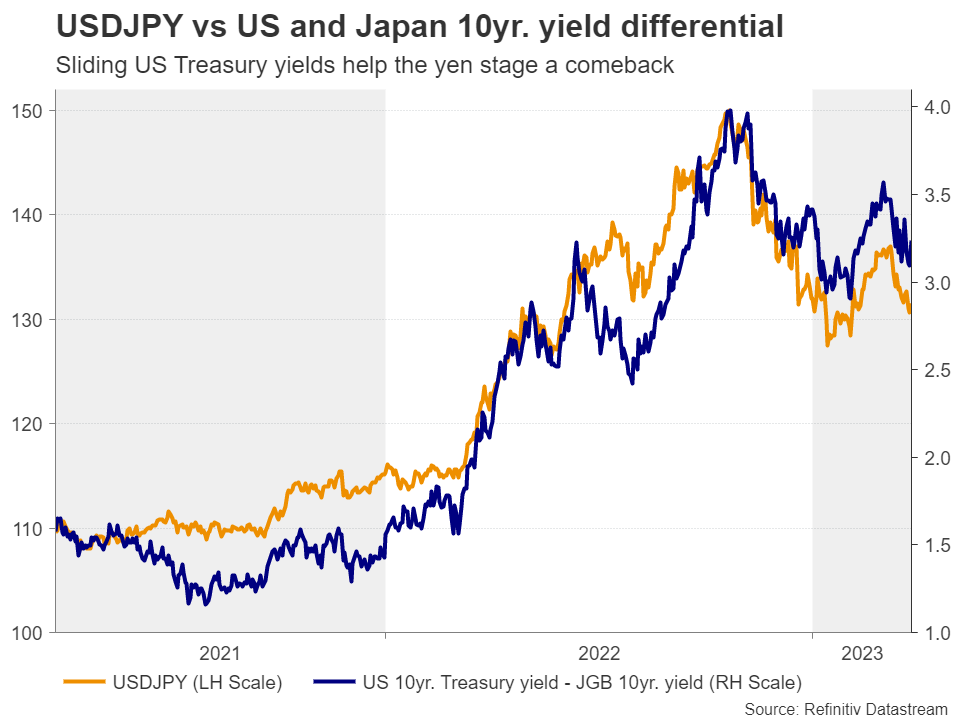
From a technical standpoint, dollar/yen has been in a sliding mode since March 8, when it hit resistance near the 138.15 barrier, which is marked by the peak of December 15. Currently, the pair is hovering near the round number of 130.00, where a clear break could allow the bears to test the low of January 16 at 127.20. A move lower would confirm a lower low on the bigger timeframes and may see scope for declines all the way down to the low of March 30, at 121.25.
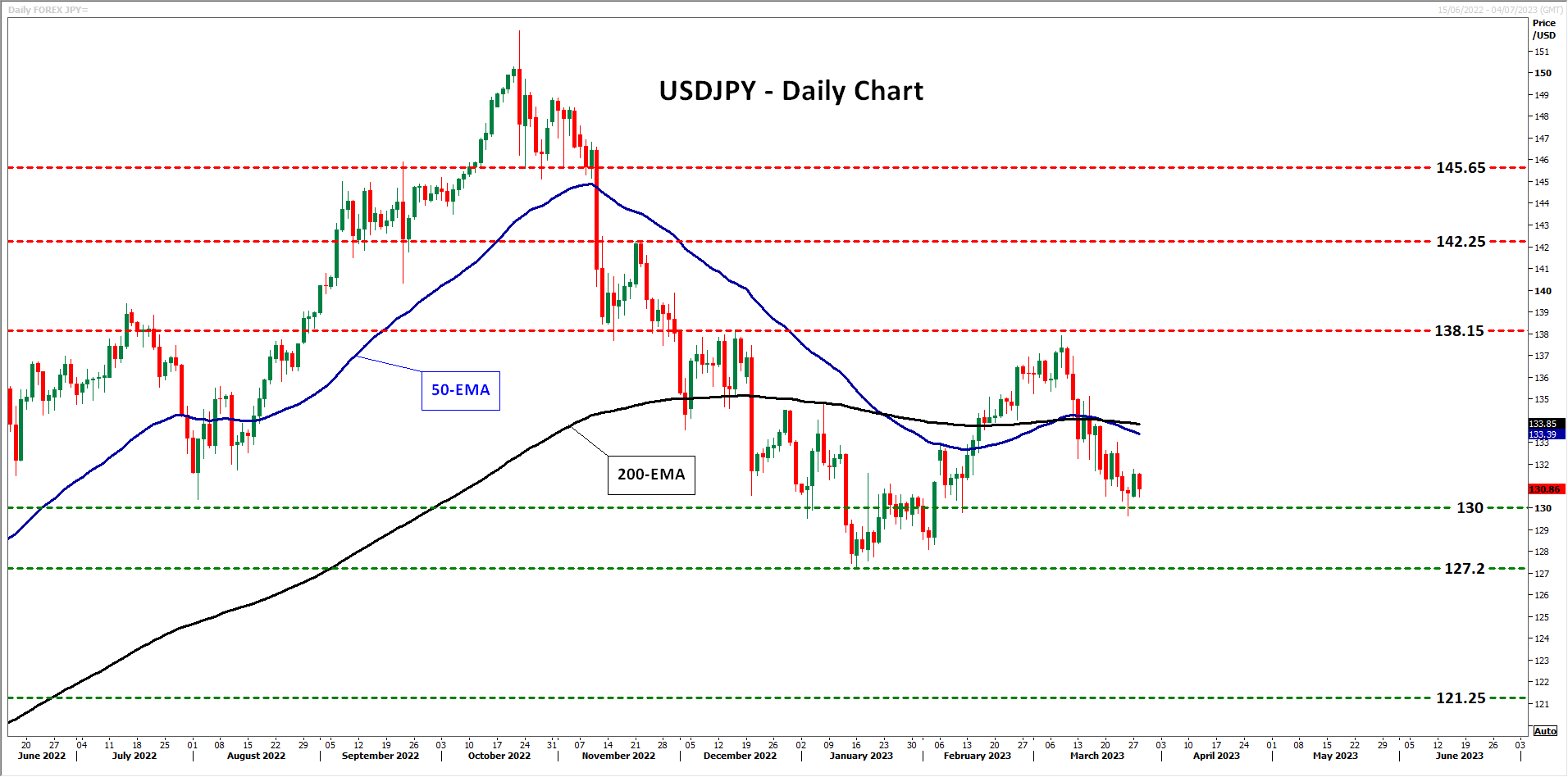
For the picture to brighten, the pair may need to climb above the 138.15 area. Should that happen, a higher high will be confirmed and the bulls may feel confident to aim for the peak of November 21 at around 142.25. If they don’t stop there, their march may extend until they meet the 145.65 area, which provided support between October 24 and November 9.
Sunset Market Commentary
Markets
Markets today initially continued building on yesterday’s positive momentum as stress in the banking sector/financial stability subsided further. Trading was mainly sentiment/order driven with again hardly any data with market moving potential scheduled for release. First national EMU CPI data (Germany, Spain, Belgium) will only be published on Thursday. The first estimate for core and headline EMU will be released on Friday. Friday afternoon the US PCE deflators also might help to decide whether markets will give more weight to CB’s anti-inflationary narrative. US yields initially rebounded up to about 7 bps, but sentiment dwindled as US investors joined. US yields currently rise between 4.0 bps (5-y) and 0.5 bps (30-y). The US 2-y yield tries to regain the 4.0% barrier. Contrary to yesterday, German bonds underperform the US Treasuries with yields rising 4-5 bps across the curve (was 8.00/10.0 bps earlier today). ECB’s Muller repeated recent ECB mantra that underlying inflation remains an area of concern. Intra-EMU spreads versus Germain remained era of relative calm even during recent period of heightened market stress. Changes in 10-y spreads against Germany were again modest today (Italy + 3 bps, Greece +4 bps). In a broader perspective, the Italian 10-y spread versus Germany still holds the rather tight range roughly between 170 and 200 bps which is already in place since the start of the year (cf graph infra). For now financial stability concerns didn’t really affect sentiment on intra-EMU bond markets. Later today we still keep an eye at the US consumer confidence release and a $ 43 bln sale of US 5-y US Treasuries. (European) equites again opened about 0.8% higher, but gains gradually evaporated. The 4200 area apparently is a hard nut to crack. US indices even open with a moderate loss. If even financial stability concerns subside, the combination of yields staying higher than recently assumed while at the same time growth concerns continue to linger, might temper enthusiasm to really push a new protracted upleg in risk assets.
Even as the rally in risk assets subsided intraday, it again didn’t really help the dollar. DXY dropped further to trade in the 102.5 area. After a one day, risk-on correction yesterday, the yen again shows resilience today (USD/JPY 130.8 from a close at 131.6 yesterday). EUR/USD in a protracted intraday uptrend currently trades near 1.084 (from 1.08 early this morning). However, the 1.093 correction top for now stays out of reach. Sterling started strong this morning (EUR/GBP 0.8775 area) after record yearly rise in the BRC shop price index (8.9%). However, initial gains could not be sustained. In a hearing before Parliament, BoE’s Bailey indicated that recent developments might cause some tightening of financial conditions which the BoE takes into account when deciding on monetary policy.News & Views
European Union energy ministers have backed a plan to extend gas demand reductions by a year in a bid to ensure enough supplies for next winter. The current voluntary 15% gas demand cut is about to phase out by the end of the month. With the extension, it now applies until March 2024. The target could become binding if there are severe supply shortages. The rules were introduced last year after Russia’s invasion sparked concerns for shortages during the winter. In the period between August and January, the European bloc succeeded a 20% gas demand cut.
The Hungarian central bank kept its base rate steady at 13%. It also keeps a range of emergency measures in place, including the O/N tender (de facto policy) rate at 18%, as it improves the monetary policy transmission. To that end, it further raised the reserve requirement ratio to 10%. A system of tiered interest rates will be applied to the reserve account, which encourages an increase in the share of liquidity tied up on a long-term basis, further enhancing monetary policy transmission. The MNB has been saying for some months now that it takes persistent changes in risk perceptions into account when setting the parameters of its (emergency) instruments. It sheds some light on the rationale of today’s decision as investor sentiment deteriorated recently. Today’s meeting was also accompanied by new forecasts. GDP is seen increasing by 0-1.5% this year with growth picking up in the second half of the year. The expansion in 2024 is seen at 3.5-4.5% and 3-4% in the year thereafter. Inflation should ease slowly first before the pace accelerates in coming months. CPI is projected to be 15–19.5% in 2023, 3–5% in 2024 and 2.5–3.5% in 2025. The forint outperforms peers today. EUR/HUF eases from 386.3 to 381.57 currently. Hungarian swap yields extend an intraday advance, adding between, 10.3-29.5 currently with the front end underperforming.
US consumer confidence rises in March, yet expectations remain subdued
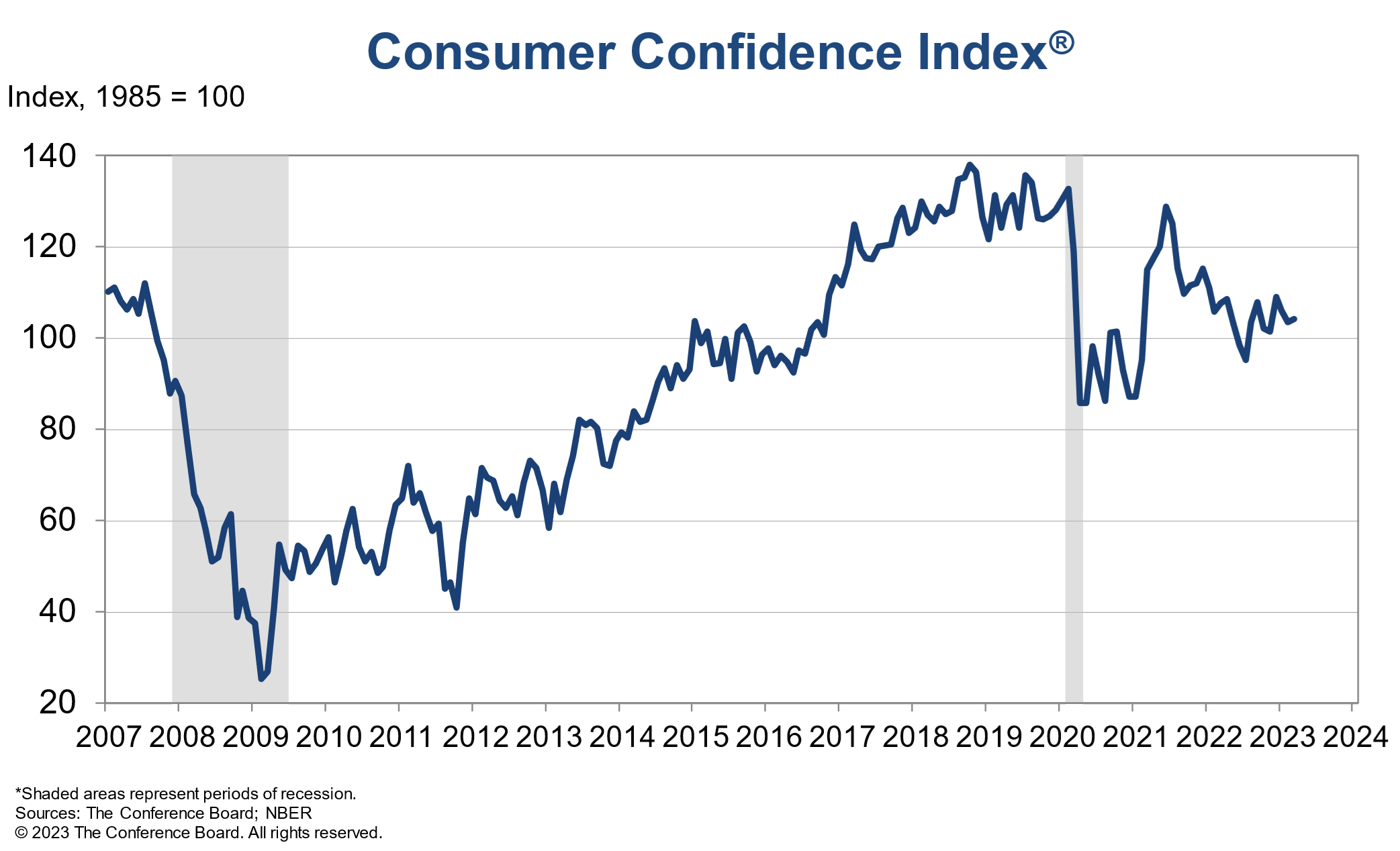
US Conference Board Consumer Confidence rose to 104.2 in March, surpassing the expected 101.7, and up from February's 103.4. The Present Situation Index dipped from 153.0 to 151.1, while the Expectations Index climbed from 70.4 to 73.0. Notably, the Expectations Index has remained below 80 for 12 of the past 13 months since February 2022, a level that often indicates an impending recession within the next year.
Ataman Ozyildirim, Senior Director of Economics at The Conference Board, said that the March gain "reflects an improved outlook for consumers under 55 years of age and for households earning $50,000 and over." However, he also noted that consumers are "slightly less optimistic about the current landscape," as the share of consumers stating jobs are "plentiful" declined and those saying jobs are "not so plentiful" increased.
Moreover, consumers' expectations of inflation over the next 12 months remain elevated at 6.3%. Purchasing plans for appliances continued to soften, while automobile purchases saw a slight increase. Despite the improvement in March, consumer confidence remains below the average level of 104.5 seen in 2022, indicating cautious optimism for the future.
USD/JPY Mid-Day Outlook
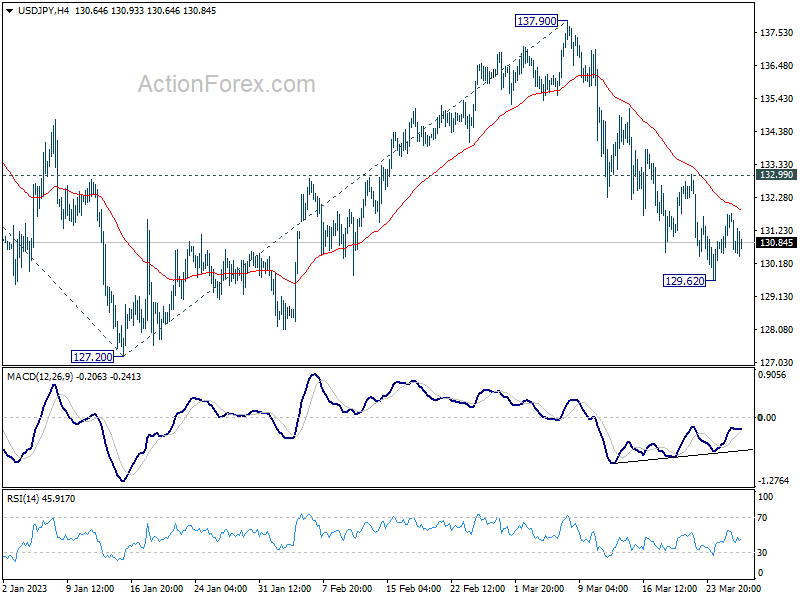
Daily Pivots: (S1) 130.79; (P) 131.27; (R1) 132.06; More...
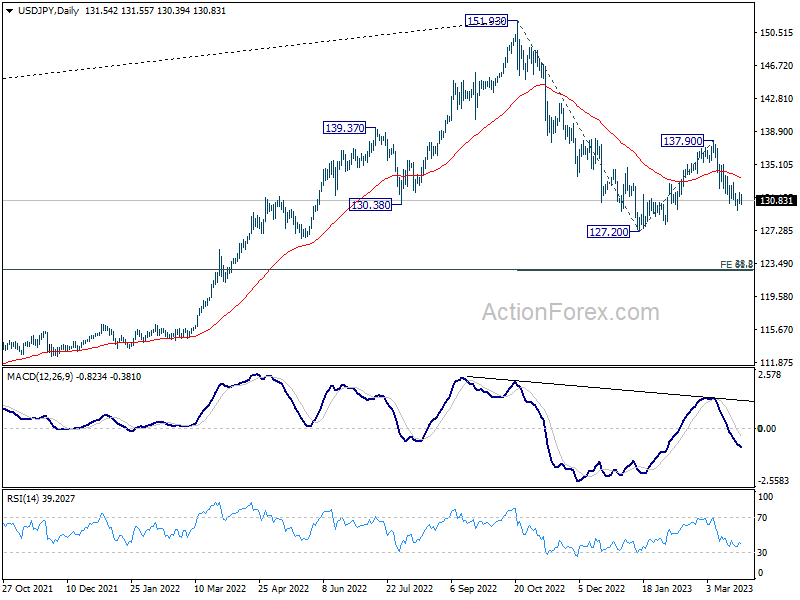
Intraday bias in USD/JPY remains neutral as consolidation from 129.62 is extending. Outlook remains bearish as long as 132.99 resistance holds. Break of 129.62 will target a test on 127.20 low. Decisive break there will resume larger decline from 151.93 to 61.8% projection of 151.93 to 127.20 from 137.90 at 122.61.
In the bigger picture, rebound from 127.20 should have completed at 137.90 as a corrective move. The down trend from 151.93 (2022 high) is still in progress. Break of 127.20 will resume this down trend and target 61.8% projection of 151.93 to 127.20 from 137.90 at 122.61. This will now be the favored case as long as 137.90 resistance holds.
USD/CHF Mid-Day Outlook
Daily Pivots: (S1) 0.9140; (P) 0.9170; (R1) 0.9186; More...
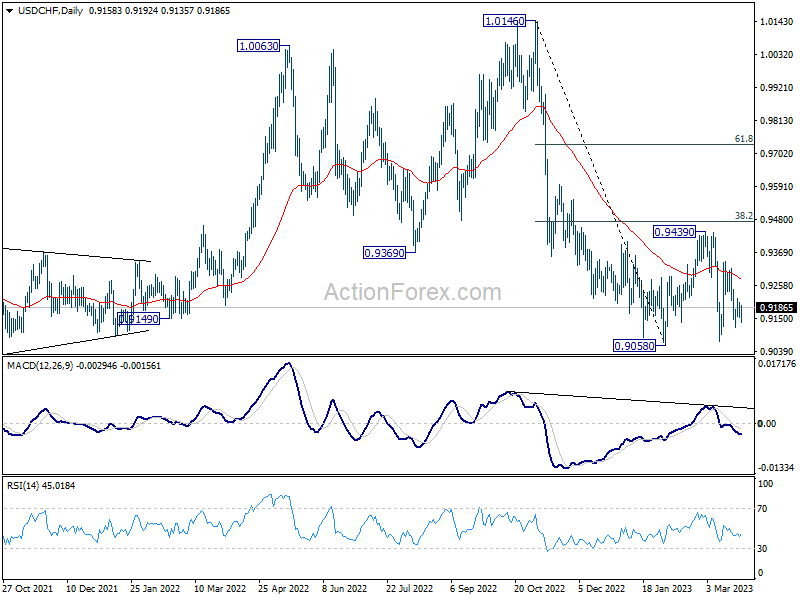
Outlook in USD/CHF is unchanged and intraday bias stays neutral. Corrective pattern from 0.9058 low is in extending. Another rise cannot be ruled out, but upside should be limited by 0.9474 fibonacci level. On the downside, firm break of 0.9058 will resume larger down trend from 1.1046.
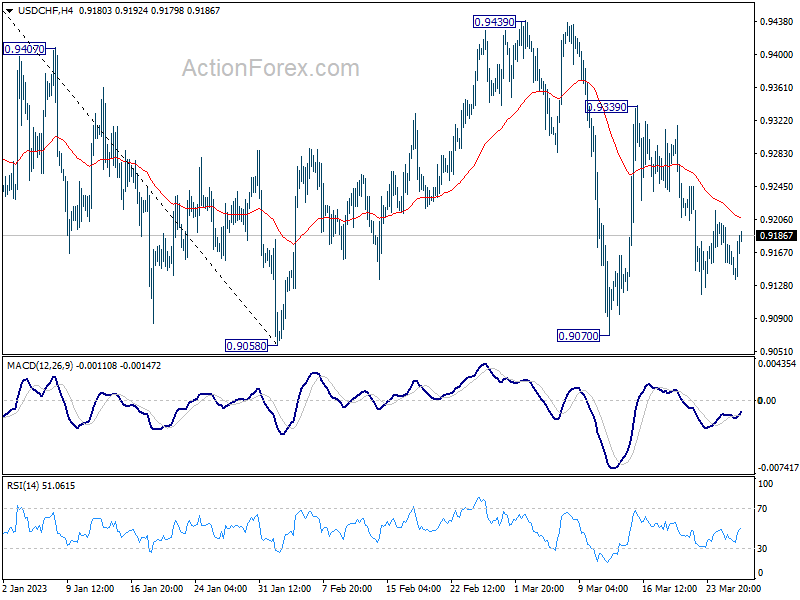
In the bigger picture, fall from 1.1046 (2022 high) should still be in progress with 38.2% retracement of 1.0146 to 0.9058 at 0.9474 intact. Prior rejection by 55 week EMA was a medium term bearish sign. Break of 0.9058 will resume such decline towards 0.8756 support (2021 low). But overall, this fall is still as a leg in the long term range pattern from 1.0342 (2016 high). So, downside should be contained by 0.8756 to bring reversal.