Sample Category Title
Aussie Dips as Inflation Expectations Jump
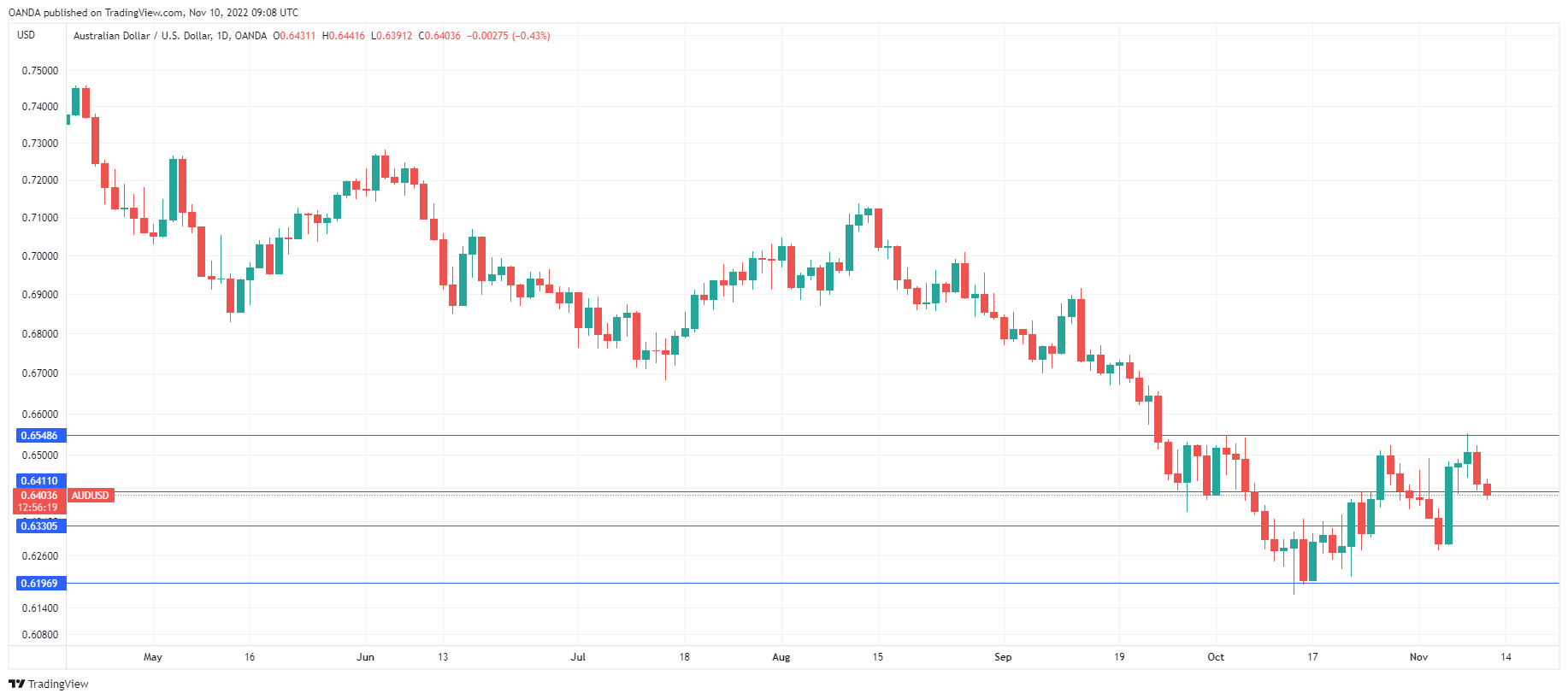
The Australian dollar has extended its losses today. AUD/USD is trading at 0.6412, down 0.29%.
The US dollar has rebounded after a 3-day slide, which saw the Australian dollar climb over 200 points. The Aussie has coughed up half of those gains since Tuesday, and we could be in for further volatility in today’s North American session, as the US releases the October inflation report. Investors are somewhat confused, thanks to mixed signals from both the Federal Reserve and last week’s US employment report.
The Fed meets next in mid-December, and it’s close to a toss-up as to whether the Fed will raise rates by 0.50% or 0.75%. At the last meeting, at which the Fed hiked by 0.75%, Fed Chair Powell hinted at easing up on rates but also said that the terminal rate would likely be higher than previously expected – this mixed message makes it difficult to peg the Fed as being hawkish or dovish.
US inflation expected to remain hot
Last week’s employment report was mixed, as unemployment and wage growth climbed, while nonfarm payrolls fell but still exceeded expectations. This makes today’s inflation report all the more important for the Fed ahead of the December meeting. A hot inflation report would likely boost the likelihood of a 0.75% hike, which would be bullish for the US dollar. CPI is expected to dip to 8.0%, down from 8.2%, which although a slight improvement, would indicate that inflation remains very high.
Australia is also dealing with high inflation, and Melbourne Institute Inflation Expectations for October reinforced concerns that inflation is yet to peak. Inflation Expectations rose to 6.0%, up sharply from 5.4% in September, and the first acceleration in four months. The economy is showing signs of slowing down, and a report from the National Australian Bank on Wednesday projected that GDP would fall to 0.8% in 2023 and interest rates would peak at 3.6% next year. The cash rate is currently at 2.85%, which means that the RBA is likely to continue raising rates into 2003.
AUD/USD Technical
- AUD/USD is testing resistance at 0.6411. Above, there is resistance at 0.6549
- There is support at 0.6239 and 0.6196
Dollar Index: Dollar Remains at the Front Foot But Eyes US Inflation Data for Stronger Signal
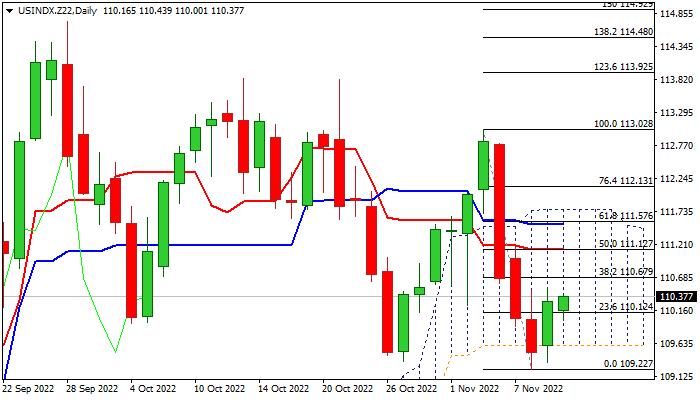
The dollar index remains constructive in early Thursday’s trading, following Wednesday’s 0.65% bounce (the first bullish close after three days of heavy losses), after the action was repeatedly rejected at ley support at 109.35 (Oct 27 low) and also failed to register a clear break below the base of thick daily cloud (109.61).
Thursday’s action is so far holding above broken psychological 110 level, but gains were limited during Asian/early European session, as traders turn focus towards today’s key event – US inflation data.
Economists expect the headline CPI to ease to 8.0% in October from 8.2% previous month, though wide expectations that the Fed may ease its aggressive stance in policy tightening, are very likely not to materialize, as the Fed is not in the position to abandon its hawkish stance with inflation being still four times above the central bank’s 2% target.
Daily studies show a slight improvement, but remain bearish overall, with current recovery to be seen as positioning for fresh weakness while the action stays below 111 zone (daily Tenkan-sen / 50% retracement of 113.02/109.22 bear-leg).
Break here would sideline downside risk and open way for further recovery towards key barriers at 111.52/76 (daily Kijun-sen/daily cloud top), violation of which would bring bulls fully in play.
Res: 111.53; 111.67; 111.12; 111.52.
Sup: 110.00; 109.61; 109.22; 108.92.
EURUSD Fails to Remain Above 1.0000; Neutral in Medium-Term
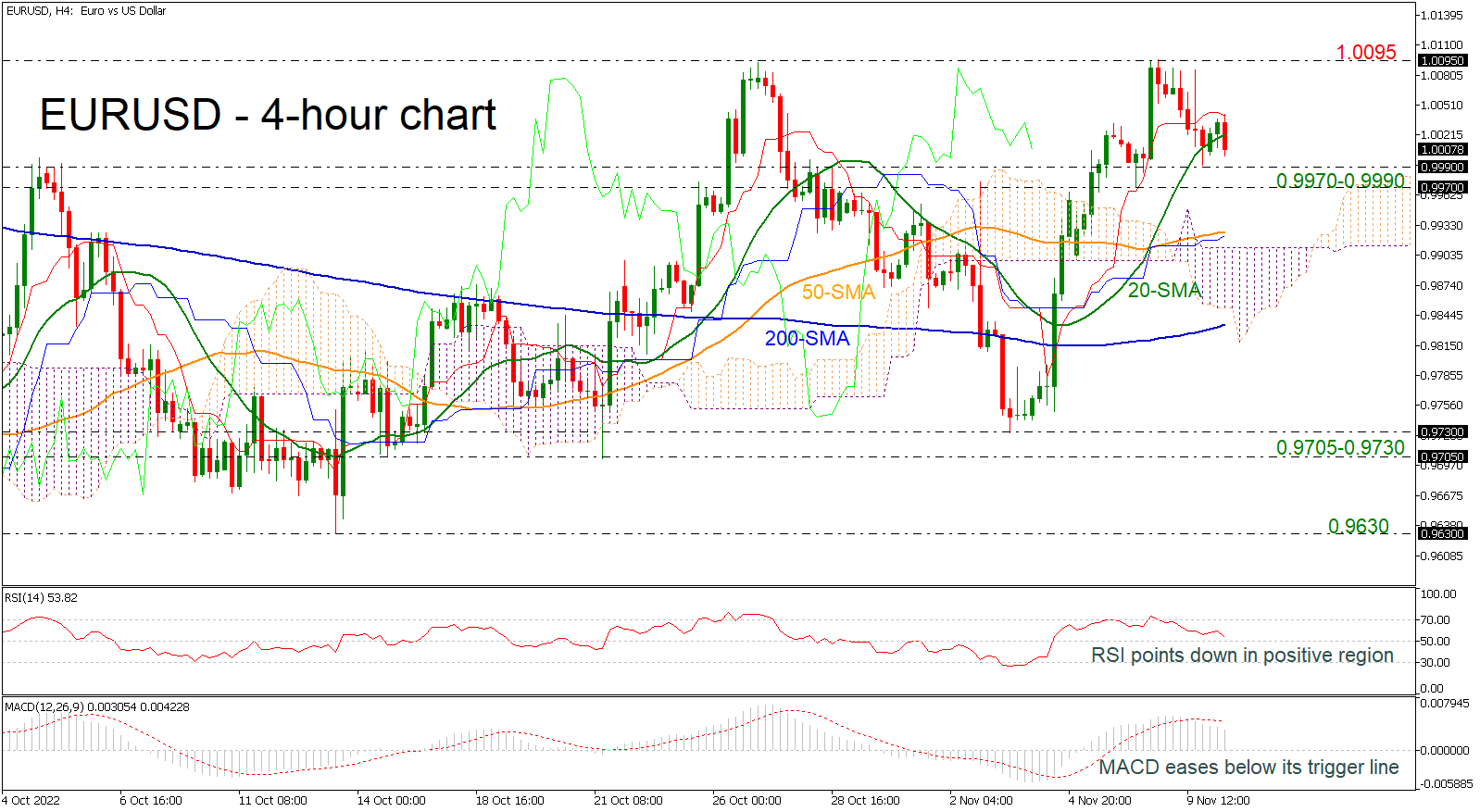
EURUSD is meeting the parity level again, dropping beneath the 20-period simple moving average (SMA) after the pullback from the 1.0095 resistance. In the medium-term timeframe, the pair is failing to have a clear directional movement as it has been moving sideways since mid-October.
The technical oscillators are suggesting a negative movement as the RSI is pointing down in the positive region following the decline from the overbought region, while the MACD is losing momentum beneath its trigger line.
Further losses should see the 0.9970-0.9990 support region acting as a major support ahead of the 50-period SMA and the upper boundary of the Ichimoku cloud around 0.9920. A slip lower would challenge the 200-period SMA at 0.9835, reinforcing the bearish structure in the short-term and open the ways towards the next key support region of 0.9705-0.9730.
In the event of an upside reversal, the 1.0095 resistance could be the next target before being able to re-challenge the 1.0200 obstacle and the 1.0370 peak, registered on August 10.
Overall, EURUSD is bearish in the very short-term timeframe, while the bigger picture is neutral. Any moves beneath the 200-period SMA may switch the outlook back to negative.
AUDUSD Misses Bullish Target; Bias Neutral-to-Bearish
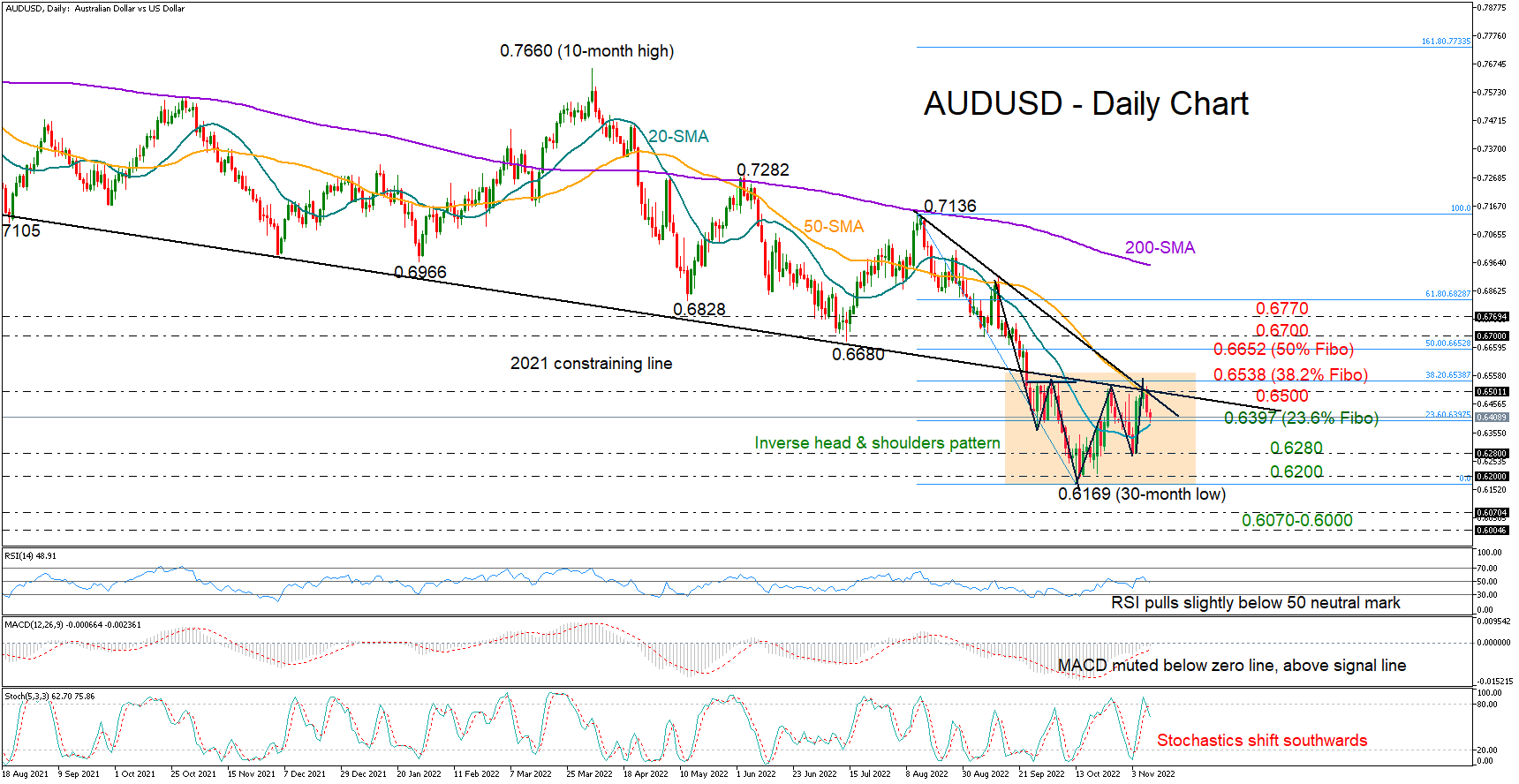
AUDUSD turned red after facing a strong rejection around the 0.6500 level on Wednesday. Notably, the pullback took place at the crossroads of two constraining lines, signaling a potential downside reversal.
The technical oscillators reflect a neutral-to-bearish bias as the RSI is sliding gradually below its 50 neutral mark and the stochastics are changing direction to the south. Meanwhile, the MACD remains muted marginally below its zero line.
The 23.6% Fibonacci retracement of the 0.7136-0.6139 downleg could provide immediate protection against selling pressures along with the 20-day MA around 0.6397. Otherwise, the price could tumble towards last week’s support of 0.6280. Even lower, the bears will attempt to worsen the broad negative outlook below the 30-month low of 0.6169 and towards the 0.6070-0.6000 region taken from March 2020.
A bounce on 0.6397 will push for an extension above the 0.6460-0.6500 key zone, where the two lines are currently positioned. Yet only a sustainable close above the 38.2% Fibonacci of 0.6538 would confirm a bullish inverse head and shoulders pattern, likely fortifying buying appetite up to the 50% Fibonacci of 0.6652. Then another successful battle with the 0.6700 handle could bring the 0.6770 barrier next into view.
In short, downside risks remain intact in AUDUSD following the latest failure near 0.6500. Unless the 0.6397 number comes to the rescue, the sell-off may continue.
US Oil Struggles for Support
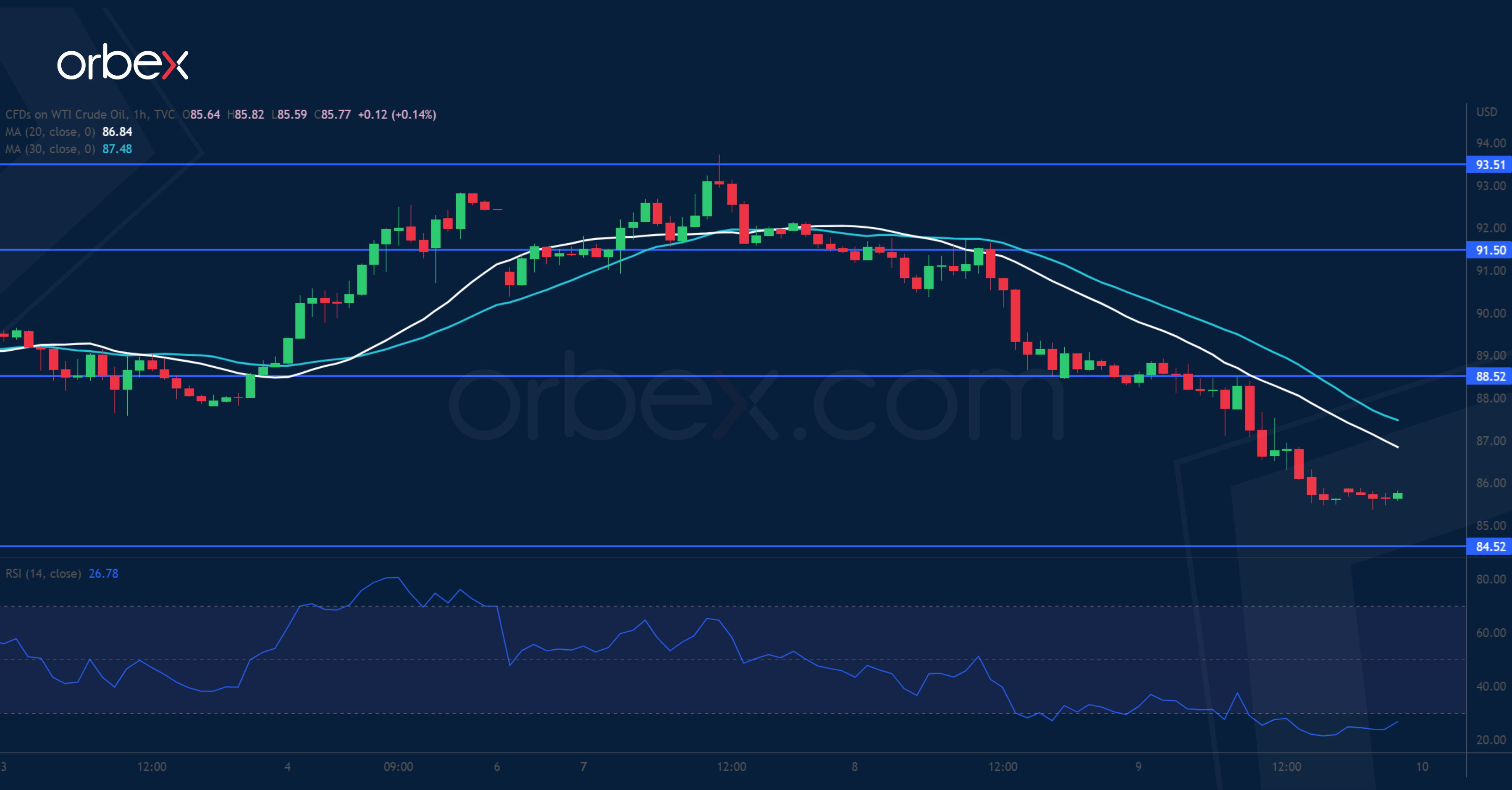
WTI crude plunges over a buildup in US storage. The price turned south after it met stiff selling at the October high of 93.50. A fall below the psychological level of 90.00 has forced some leveraged positions to liquidate. An invalidation of 88.00 is more worrisome as it indicates a lack of follow-up bids. 84.50 is the last support to gauge the bulls’ commitment. A bearish breakout would deepen the correction towards 81.00. 88.50 is a fresh resistance and the bulls will need to reclaim 91.50 before they could turn things around.
XAUUSD Tests Key Resistance
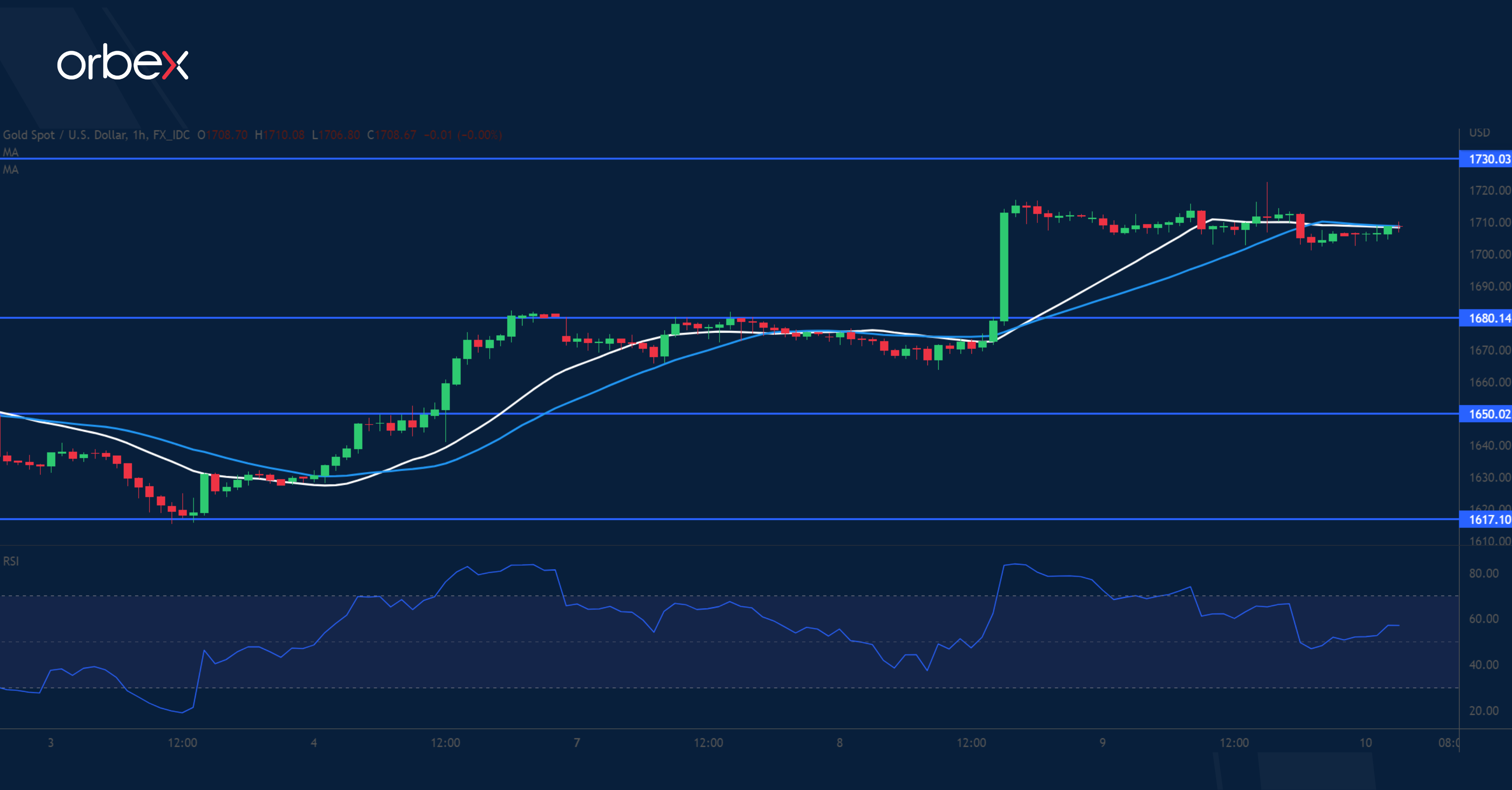
Bullion pulls lower as traders reposition ahead of US inflation data. The price has recouped losses from the October sell-off and is now retesting the daily resistance at 1730 . A break above this ceiling could relieve the bearish pressure in the weeks to come and send gold to 1800. Until then, a strong cap could be expected from a mix of profit-taking and fresh selling. The RSI’s overbought condition might temper the enthusiasm and 1680 is the closest support in case the precious metal starts to take a breather.
AUDUSD Consolidates Gains
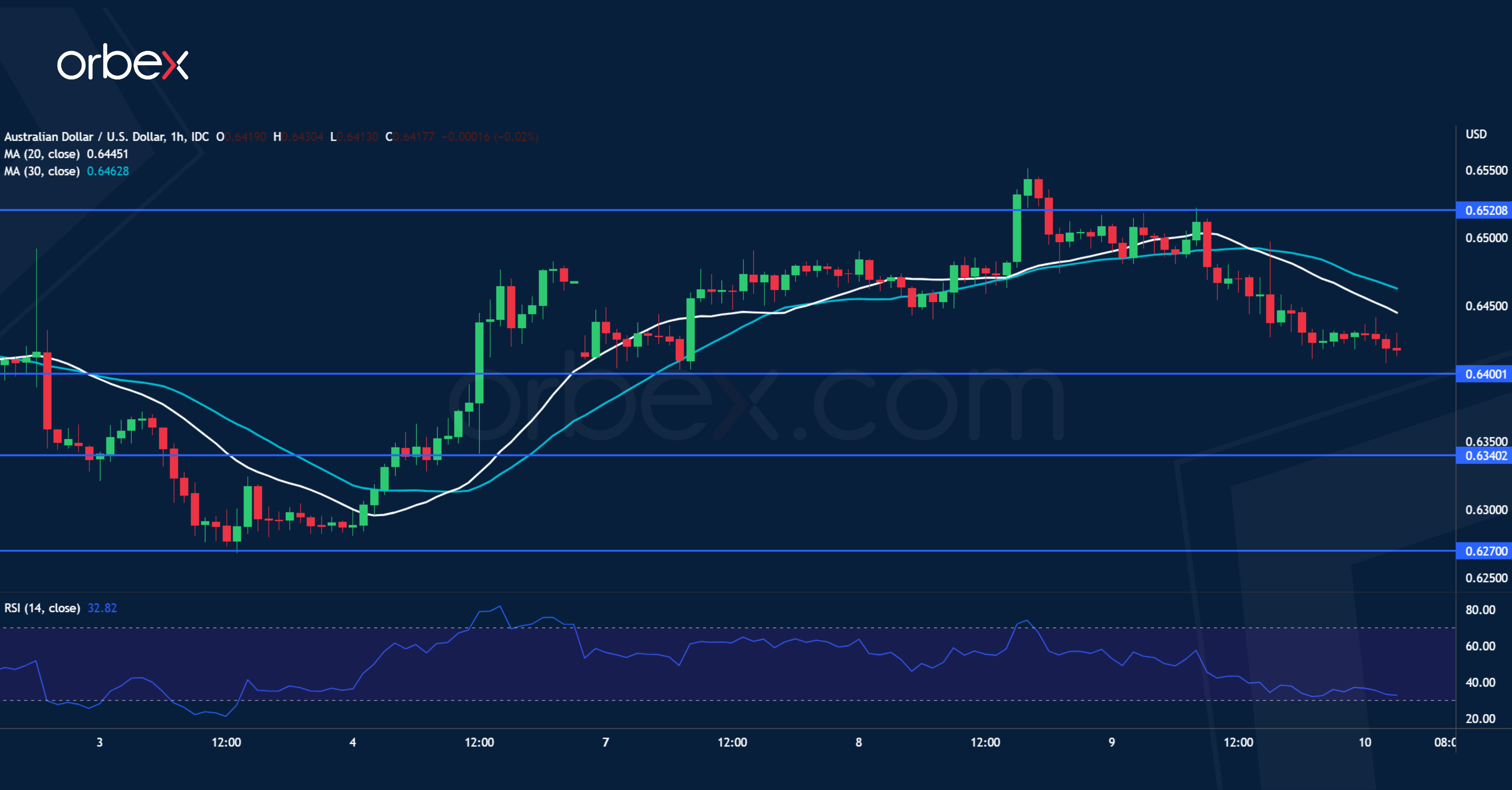
The Australian dollar steadies as inflation expectations beat estimates. After the pair found support over 0.6270, a lack of new lows suggests the sell-off has lost steam. Then a close above the major supply area 0.6520 may have reversed the situation by putting the bears on the defensive. The RSI’s double top may cause a pullback as momentum buyers take profit. 0.6400 is the first support and 0.6340 a key level to keep buyers interested. A bounce back above 0.6520 would extend the recovery towards 0.6650.
Hope Fades Ahead of CPI Data
We're seeing some risk aversion in financial markets on Thursday as we await inflation data from the US later in the week.
It probably won't come as a surprise to many that we're seeing stock markets in the red considering how well they've performed in recent days and weeks. It would appear we've seen a lot of buying on the hope of a Fed pivot and some weaker inflation and labour market figures.
Well, the Fed kind of pivoted but indicated that the terminal rate may be higher. The labour market is still extremely tight and Friday delivered another hot report. Big tech seems to find itself in the minority in terms of its decision to let go of large numbers of staff, with Twitter and Meta most notably making huge redundancies in recent weeks.
With neither the Fed nor the labour market fully delivering - and one could argue they never were likely to - today's inflation report becomes ever more important. Another hot reading could be the latest in a growing list of setbacks for investors, who have been all too keen to buy at discounted levels in the hope the data rewards them. So far it hasn't.
That will turn at some point of course and this could be that moment. The million-dollar question is how fast will it fall. As this will ultimately determine the Fed's response. The best thing about a slower pace of tightening is that it allows time for the data to justify smaller rate hikes and an eventual end to the tightening process. Without it, the Fed will be in a very uncomfortable position of blindly weighing up inflation, recession and overtightening risks.
Oil slides amid Chinese COVID-19 restrictions
Oil prices fell again on Wednesday, taking losses over the last couple of days to more than 5%. Brent and WTI are basically flat on the day at the time of writing, settling towards the lower end of their recent trading ranges.
While the narrative in recent weeks has focused on the potential for Chinese Covid restrictions to be relaxed, which has driven Chinese equities higher and lifted oil prices, the reality has seen case numbers soaring, restrictions reimposed and mass testing undertaken. This doesn't exactly add substance to the rumours and we may be seeing some unwinding of those positions.
Gold steadies ahead of CPI data
Gold has steadied over the last 24 hours or so after surging late last week and early this in the hope that inflation data delivers what the Fed, and investors, crave so much. It's a very hopeful-looking move and one that could end badly if the CPI data continues this year's trend of disappointing to the upside. I just wonder at this point what investors need to see because the recovery of the last week has been strong - more than 5% - which suggests expectations are quite high. Time will tell if hopeful traders will be burned once more.
Is FTX a one-off?
Bitcoin is trading up more than 5% today but that comes following two terrible days for cryptos. Bitcoin fell more than 25% from the start of trade on Monday before finding some support around $15,500 and recovering slightly. The situation at FTX has unravelled at a remarkable pace, culminating on Wednesday evening with Binance bailing on its rescue offer following some due diligence and new allegations.
The ripple effects throughout the industry have been severe so far, with the fear not just being which other tokens could be exposed but whether similar vulnerabilities exist elsewhere. As Warren Buffett says, it's only when the tide goes out that you learn who has been swimming naked. Well, it may well be on its way out and traders are fearing what it will uncover.
Long-Awaited US CPI Release Will Take Center Stage Today
Markets
Yesterday, a rather inconclusive outcome of the US midterm elections initially left markets looking for a clear driver. Sentiment gradually turned outspoken risk-off in US dealings with persistent uncertainty on the reopening of the Chinese economy due to COVID restrictions and noise spilling over from crypto markets as potential drivers. US equities ceded between 1.95% (Dow) and 2.48% (Nasdaq). The risk-off also caused Treasuries to reverse modestly initial losses. At the end of the session, US yields eased between 7.1 bps (2-y) and -0.75 bp (30-y). Even so, the sale of the $ 35 bln of 10-y US bonds went far less easy compared to Tuesday’s 3-year sale. It caused a temporary pause in the yield decline but didn’t change the trend. Fed speakers gave some mixed signals. Outgoing Chicago Fed president Evans favours a slowdown in the pace of rate hikes. Fed’s Barkin and Kashkari continue to advocate decisive action to arrest inflation and preventing inflation expectations to settle at a too high level. Bunds already outperformed Treasuries earlier in the session and maintained their bid with German yields easing between 11.3 bps (2-y) and 9.5 bps (30-y). The risk-off also helped the dollar to rebound from nearby support levels. DXY at 110.55 closed clearly above the 109.53 area (previous low/neckline). EUR/USD gave up its attempt to conquer the 1.0094/1.00 resistance area. A brief intraday spike on headlines that Russian troops will exit Kherson didn’t prevent to pair to close at 1.0011 (open 1.0074). The risk-off and markets pondering whether a more restrictive fiscal policy could lead to more benign BoE inflation response pushed EUR/GBP back to the 0.88 area.
Yesterday’s WS risk-off this morning also spills over to Asian markets (Nikkei -1.0%, Hang Seng-1.9%). The dollar is taking a breather of yesterday’s rebound (EUR/USD 1.003, USD/JPY 146.18). Evidently, the long-awaited for US CPI release will take center stage today. The headline inflation is expected to slow from 8.2% to 7.9%. Core inflation might ease from 6.6% to 6.5%. However, even this ‘topping out process’ still assumes monthly rises of 0.6% and 0.5% respectively. Such a pace for sure doesn’t meet the Fed’s aim to bring inflation on a sustained downward trajectory. Admittedly, we are a bit indecisive on the market reaction function. Up until now, it didn’t yield much to preposition for a softer inflation figure. At the same time, despite last week’s hawkish Fed guidance, markets reacted rather soft e.g. to a still solid labour market report, implicitly doubting the Fed’s resolve to bring the policy rate substantially above the 5.0% barrier next year. For the 10-y US yield, the 3.90% area remains very solid support. For the dollar we continue to monitor the 109.53 DXY level. For EUR/USD 1.0095/1.00 remains strong resistance. A break would open the way to 1.0198 September top.
News Headlines
The National Bank of Poland defied analyst and market expectations for a hike and kept the policy rate steady at 6.75% instead. Inflation increased to 17.9% y/y in October and new projections show upward revisions across the horizon: 14.4-14.5% in 2022, 11.1-15.3% in 2023 and 4.1-7.6% in 2024. First estimates for 2025 range between 2.1-4.9%. Growth forecasts were lowered though, especially for next year, as the NBP’s earlier tightening as well as weakening external economic conditions weigh. The central bank believes that such circumstances will support a decline in inflation towards target, albeit gradually. It would go quicker if the zloty appreciated towards levels seen consistent with economic fundamentals, the NBP added. While it hasn’t done so in recent months, the NBP to that end remains committed to FX interventions. The currency was disappointed following the decision. EUR/PLN rebounded from sub 4.7 to 4.71, surpassing resistance (zloty-support) from the 200MdA. Polish swap yields fell between 10-13.5 bps across the curve in a move that mostly followed earlier core bond yield trends.
The Hungarian government in draft legislation proposes to change the rules that force it to recapitalize the central bank’s (MNB) losses in a matter of days. Due to the MNB’s aggressive tightening cycle, it has accumulated huge losses (into several hundreds of billions forint) on, amongst others, its QE portfolio. Under current rules, the government is required to compensate the MNB in cash over a period of eight days. This comes at a time when the country is struggling to rein in a gaping budget deficit and several billions of euro funds are blocked over the rule-of-law spat with the EU. The government seeks to extend that to 5 years. This makes it easier to plan the budgetary effect, the Finance Ministry said.
EUR/CHF Daily Outlook
Daily Pivots: (S1) 0.9826; (P) 0.9882; (R1) 0.9909; More....
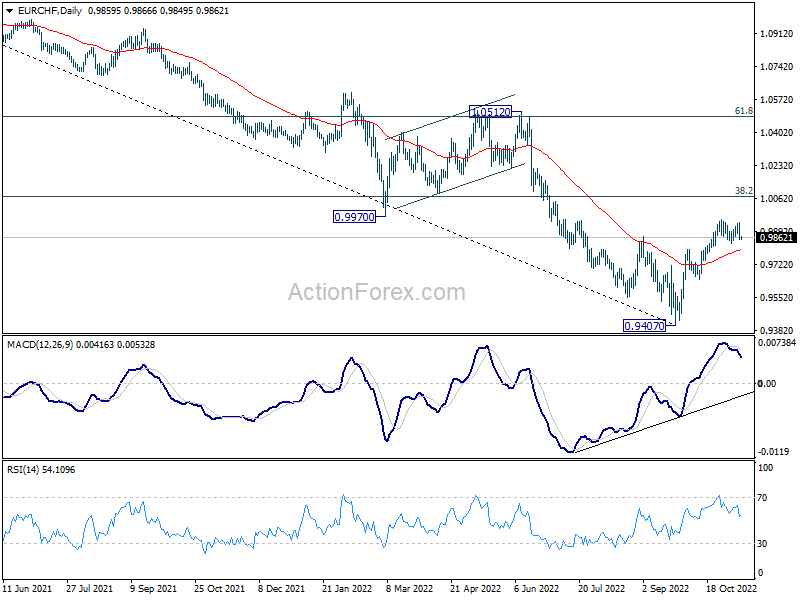
EUR/CHF is still extending the consolidation pattern from 0.9953 and intraday bias stays neutral. Deeper retreat cannot be ruled, but downside should be contained by 0.9798 resistance turned support to bring rebound. On the upside, break of 0.9953 will resume the rise from 0.9407 to 1.0072 fibonacci level.
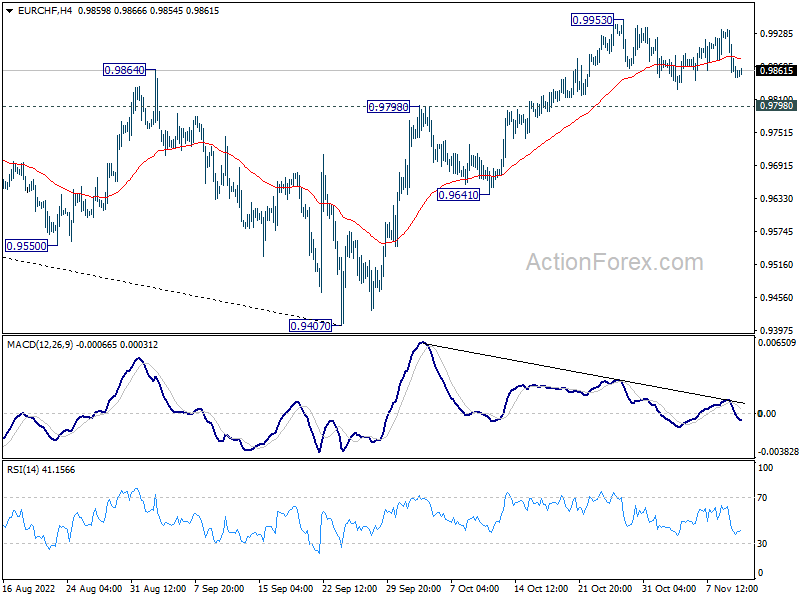
In the bigger picture, a medium term bottom should be in place at 0.9407. Further rally is expected as long as 0.9641 support holds, even as a corrective rebound. Next target 38.2% retracement of 1.1149 to 0.9407 at 1.0072. Reaction from there, as well as 55 week EMA (now at 1.0121) will reveal whether the trend is reversing.