Sample Category Title
USD/CHF Daily Outlook
Daily Pivots: (S1) 0.9461; (P) 0.9488; (R1) 0.9522; More...
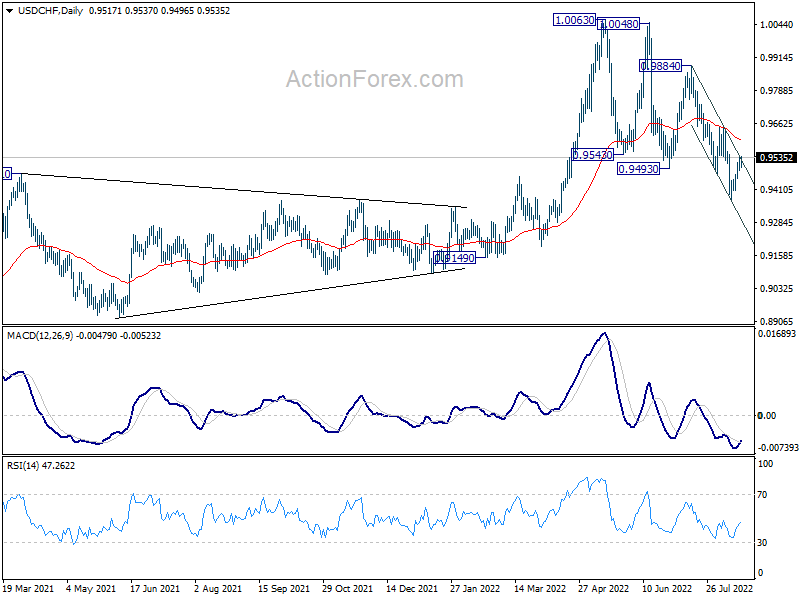
Intraday bias in USD/CHF remains neutral for the moment. Recovery from 0.9369 should be limited well below 0.9648 resistance to bring another fall. On the downside, break of 0.9369 will resume larger decline from 1.0063 towards 0.9149 support next. However, firm break of 0.9648 will turn bias back to the upside for 0.9884 resistance instead.
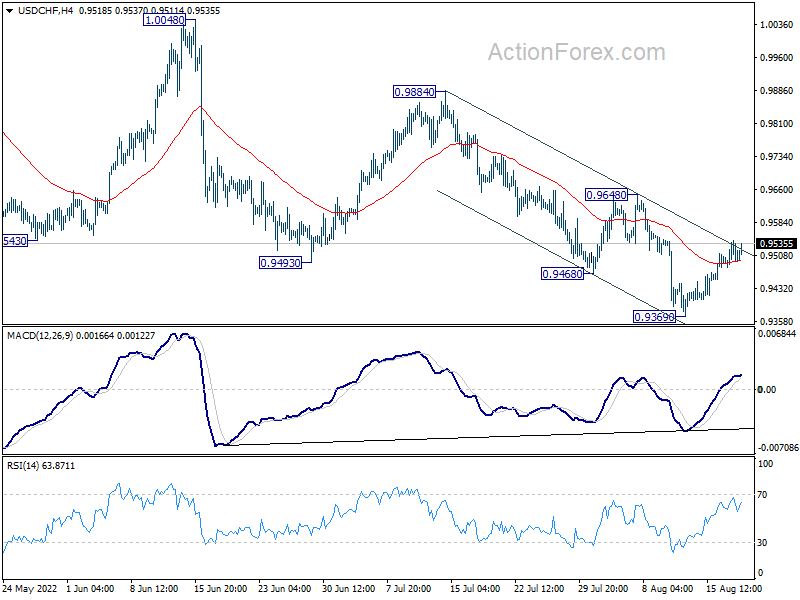
In the bigger picture, break of 0.9471 support turned resistance argues that medium term up trend from 0.8756 has completed with three waves up to 1.0063. Long term sideway pattern might have started another falling leg. Deeper decline would now be in favor as long as 0.9648 resistance holds, to 0.9149 structural support. Sustained break there could pave the way back to 0.8756.
USD/JPY Daily Outlook
Daily Pivots: (S1) 134.15; (P) 134.83; (R1) 135.74; More...
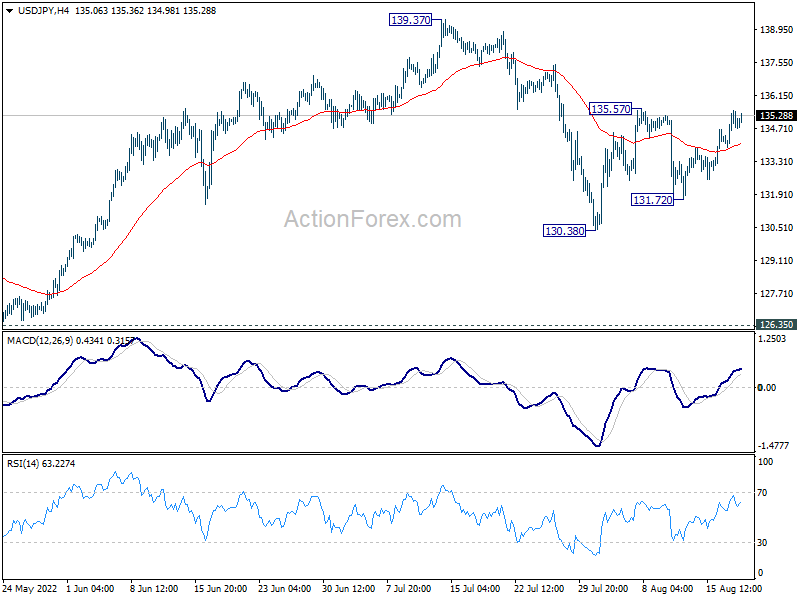
Range trading continues in USD/JPY and intraday bias stays neutral first. Overall, corrective pattern from 139.37 will extend further. On the upside, above 135.57 will resume the rebound to retest 139.37 high. But a decisive break there is not expected this time. On the downside, below 131.72 will resume the fall from 139.37 through 130.38 support.
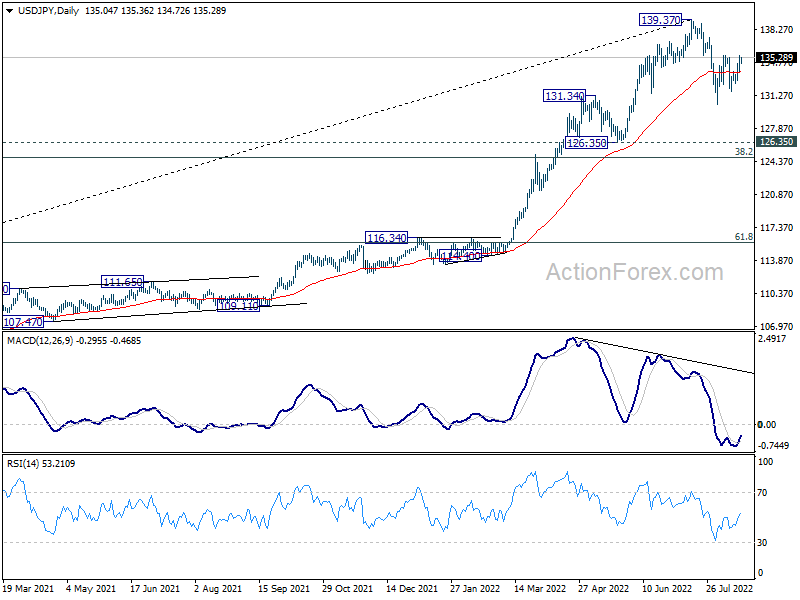
In the bigger picture, fall from 139.37 medium term top is seen as correcting whole up trend from 101.18 (2020 low). While deeper decline cannot be ruled out, outlook will stays bullish as long as 55 week EMA (now at 122.70) holds. Long term up trend is expected to resume through 139.37 at a later stage, after the correction finishes.
USD/CAD Daily Outlook
Daily Pivots: (S1) 1.2850; (P) 1.2893; (R1) 1.2959; More...
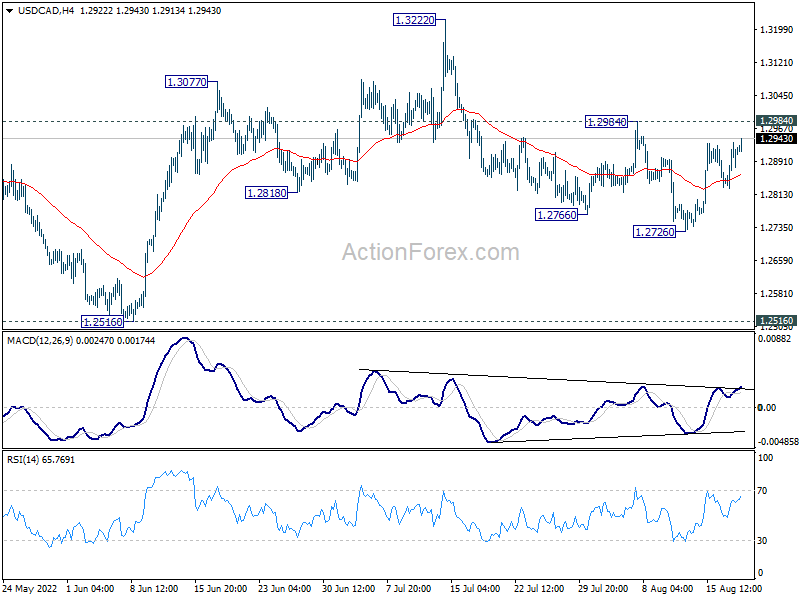
Intraday bias in USD/CAD stays neutral first. On the upside, firm break of 1.2984 resistance will argue that corrective fall from 1.3222 has completed with three waves down to 1.2726. Further rally would be seen back to retest 1.3222 high. On the downside, break of 1.2726 will resume the fall from 1.3222 to 1.2516 key support instead.
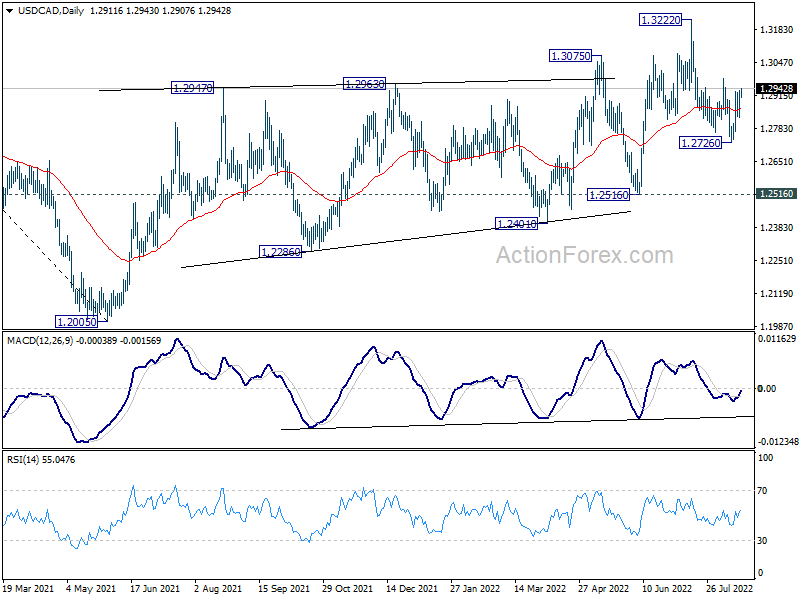
In the bigger picture, down trend from 1.4667 (2020 high) should have completed at 1.2005, after defending 1.2061 long term cluster support. Rise from there should target 61.8% retracement of 1.4667 to 1.2005 (2021 low) at 1.3650. This will remain the favored case now as long as 1.2516 support holds.
The Pendulum Between Inflation and Growth Fears Swung from One Extreme to the Other
Markets
Since the beginning of the year up until mid-June, investors turned a blind eye to growth risks, focusing solely on inflation developments and changing reaction functions of central banks (normalization/tightening). This resulted in an unseen core bond sell-off. Ever since even the SNB hiked its policy rate, attention turned to economic consequences of these price and monetary shocks. Especially with the European energy crisis adding a layer. Core bonds recovered, arguing that central banks would take this economic concerns into account during the inflation crusade.
The pendulum between inflation and growth fears swung from one extreme to the other. A chain of events this week triggered the start of a more neutral positioning. Better-than-expected earnings by US retailers – confirmed by July US retail sales – set things in motion. An hawkish signal from tightening-frontrunner RBNZ and especially the first double digit UK inflation outcome did the rest.
UK Gilts underperformed German Bunds and US Treasuries yesterday. UK yields rose by up to 25 bps at the front end of the curve yesterday, the 2-yr yield taking out the mid-June top. The German yield curve bear flattened with yields adding 6.2 bps (30-yr) to 15.4 bps (2-yr). The German 10-yr yield broke out of the downward corrective trend channel in place since Mid-June, suggesting more upside. Peripheral yield spreads showed weakness to the strong bond sell-off, widening by 7 bps for Greece and Italy.
Another victim from the selling was the stock market. They enjoyed a nice comeback over the past month and a half softer growth ironically beats the alternative of high inflation/extreme monetary tightening. Yesterday’s losses were up to 2% for Europe and up to 1.25% for the US. US yields rose by 2.4 bps (2-yr) to 9.9 bps (7-yr) with the belly of the curve underperforming the wings.
The front end performed better after dovish interpreted FOMC Minutes from the July meeting. The key sentence was that “Participants judged that, as the stance of monetary policy tightened further, it likely would become appropriate at some point to slow the pace of policy rate increases while assessing the effects of cumulative policy adjustments on economic activity and inflation”. We don’t want to read too much into this though as Minutes continue to flag the significant risk that the Fed might need to raise rates more than anticipated if inflation spreads more broadly than feared as well.
Action on main FX markets remained subdued in the volatile market environment. EUR/USD closed a tad higher at 1.018 (from 1.0171). EUR/GBP ended at 0.8448, up from 0.8408. Today’s eco calendar contains US Philly Fed Business Outlook and initial jobless claims. Markets recall the very weak Empire Manufacturing Survey earlier this week. It will be interesting to see whether a disappointing outcome will put the onus back on the growth fear. The Norwegian central bank meeting will be watched in a same vein as the New Zealand gathering earlier this week. An hawkish signal won’t go unnoticed.
News Headlines
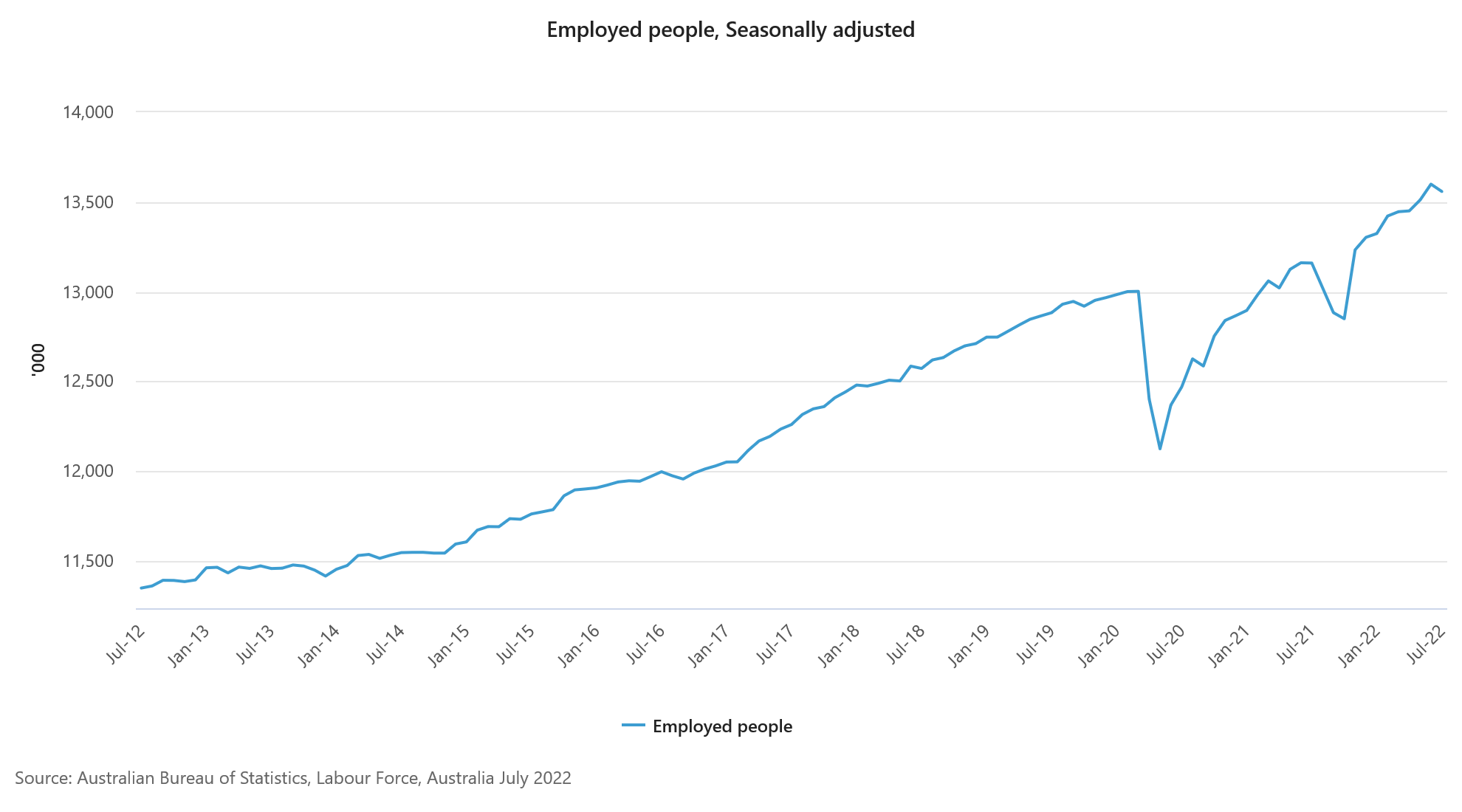
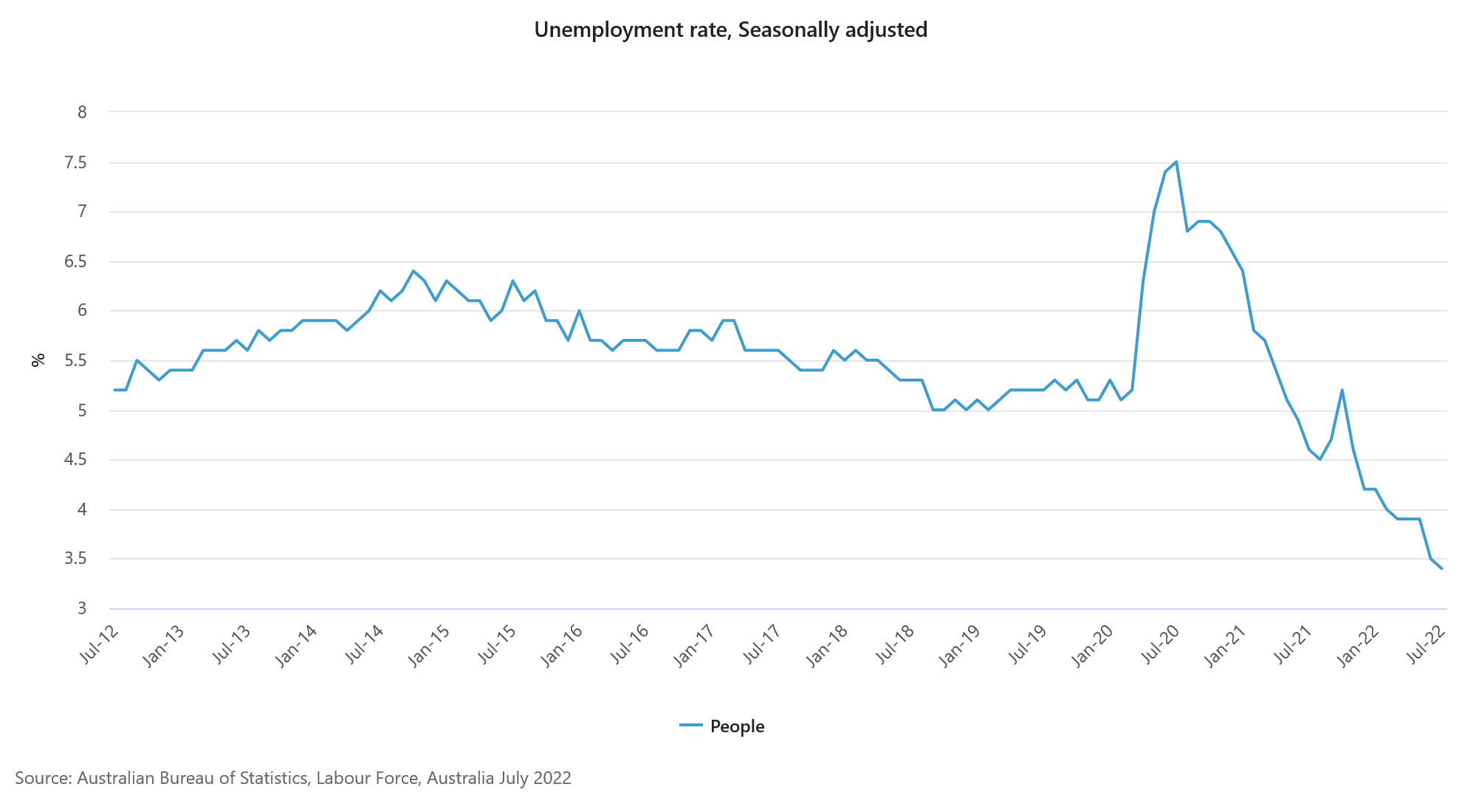
July Australian labour market data disappointed. The Australian Bureau of Statistics reported the first fall in employment (-40.9k) since October 2021. Markets expected a 25k net job gain. Details were even worse as 86.9k full time jobs went bust whereas part time employment increased by 46k. The unemployment rate nevertheless fell from 3.5% to 3.4%, a 48-yr low, as the participation rate fell. Floods in New South Wales, winter school holidays and worker absences associated with Covid and other illnesses were at play. Head of labour statistics at ABS, Jarvis, pointed to an increasingly tight labour market, including high job vacancies and ongoing labour shortages. In July, there were fewer people unemployed (474k) than there were job vacancies (480k in May).The Aussie dollar barely reacted to the labour market, holding near sell-off lows around 0.6930 against the US dollar. AUD swap rates lose 4.8 bps (3-yr) to 2.2 bps (12-yr) with the belly of the curve outperforming the wings.
XAU/USD Tests Support
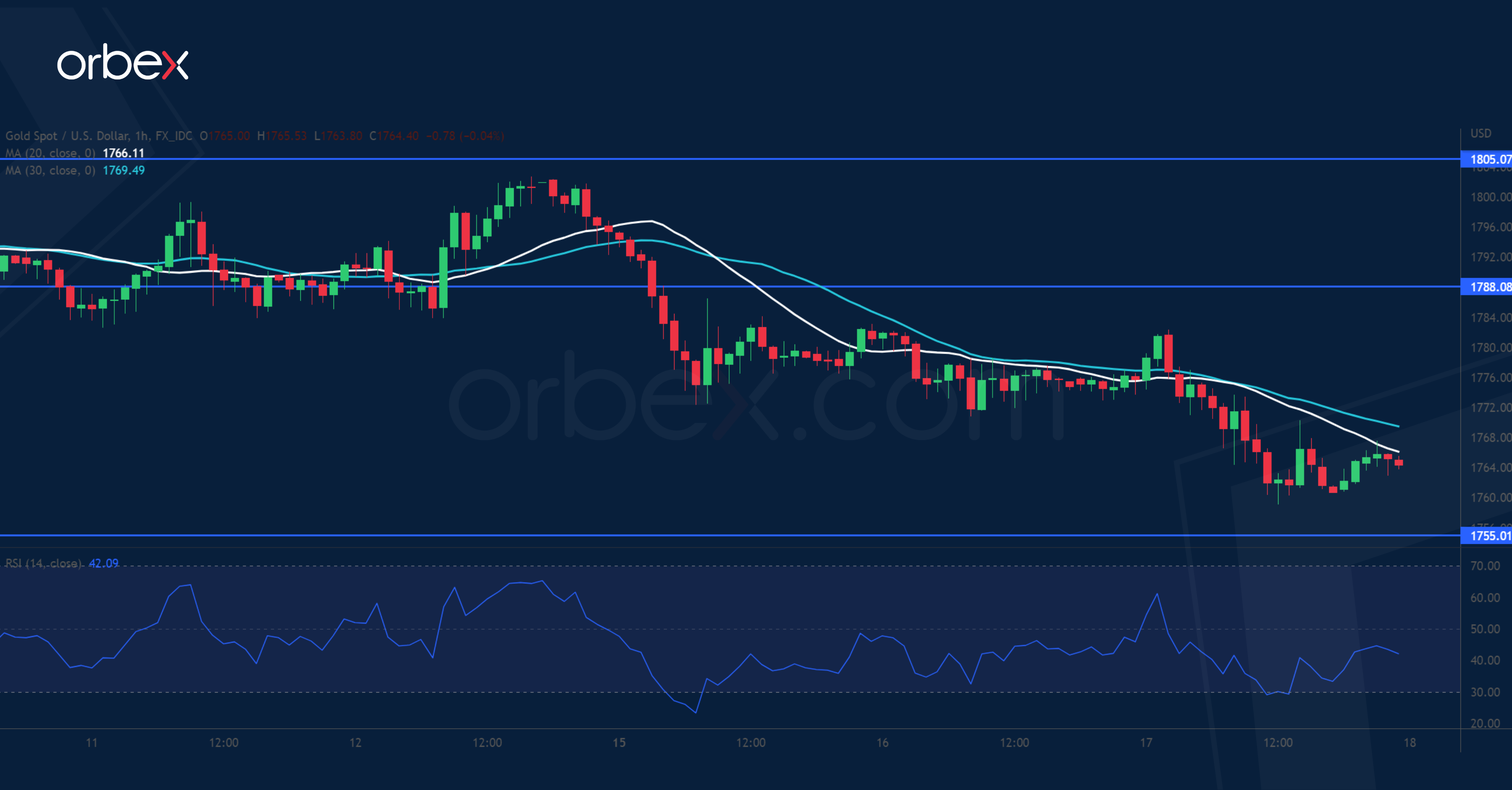
Gold consolidates as FOMC minutes hint at a slower pace of rate hikes. The price has met stiff pressure at the support-turned-resistance (1805), which lies at the origin of the July sell-off. A fall below 1785 prompted some buyers to close their positions. 1755 next to the daily MA cross is an important congestion area where bulls and bears would fight for control. A bearish breakout could trigger a liquidation towards 1720. 1788 is the immediate resistance and a rally back above 1805 would send the precious metal to 1840.
EUR/GBP Tests Supply Zone
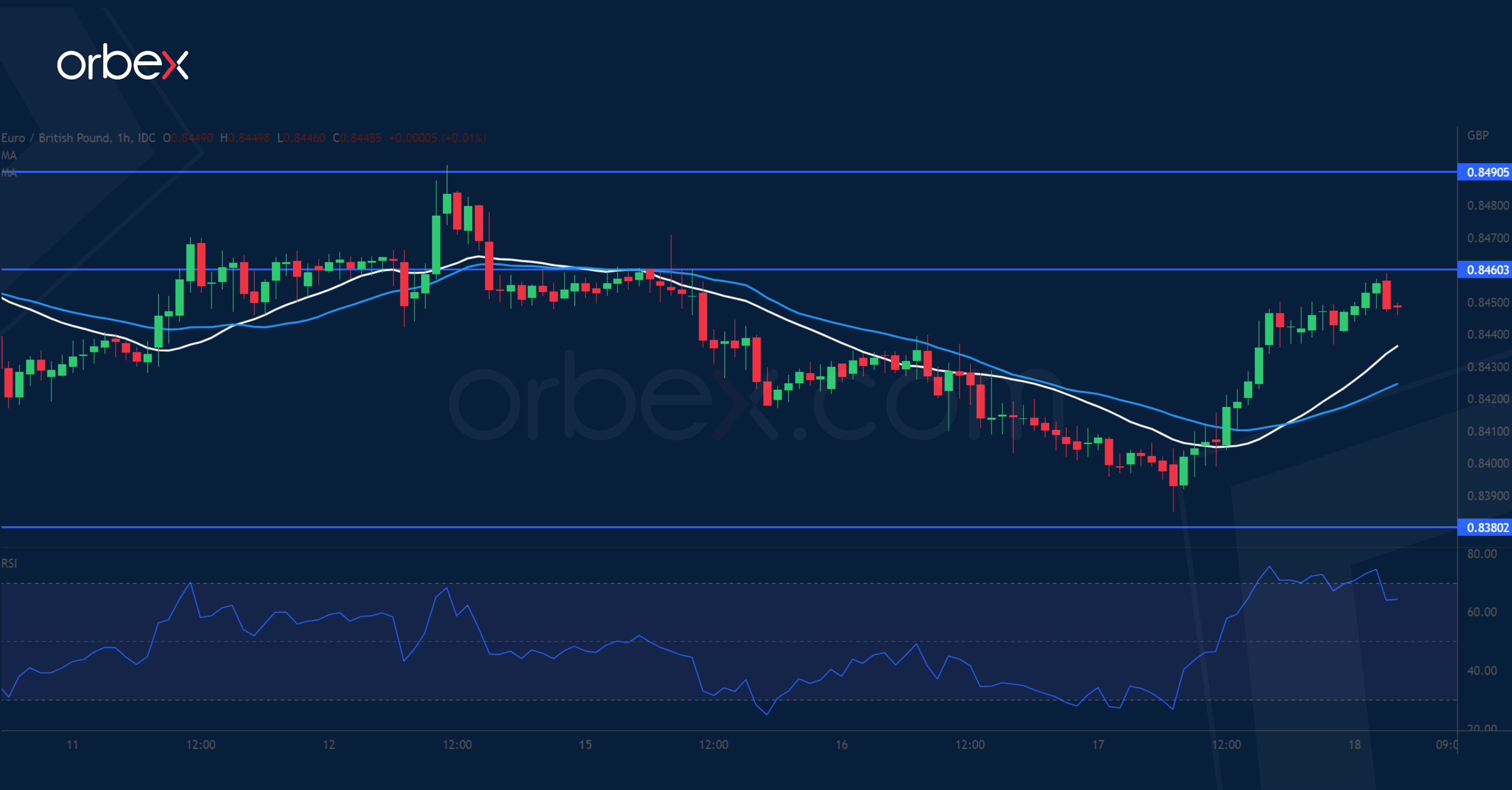
The pound softens as a 40-year high inflation rate could threaten Britain’s economic growth. After failing to hold above 0.8420, the euro has retreated to the start of the previous bullish breakout. 0.8380 is a demand zone to see whether there is strong enough interest. Further down, 0.8340 is a critical floor to keep the single currency afloat. The RSI’s oversold condition has attracted some buying interest, and the bulls will need to lift offers around 0.8460 and 0.8490 before a sustained rebound could materialise.
NZD/USD Breaks Support
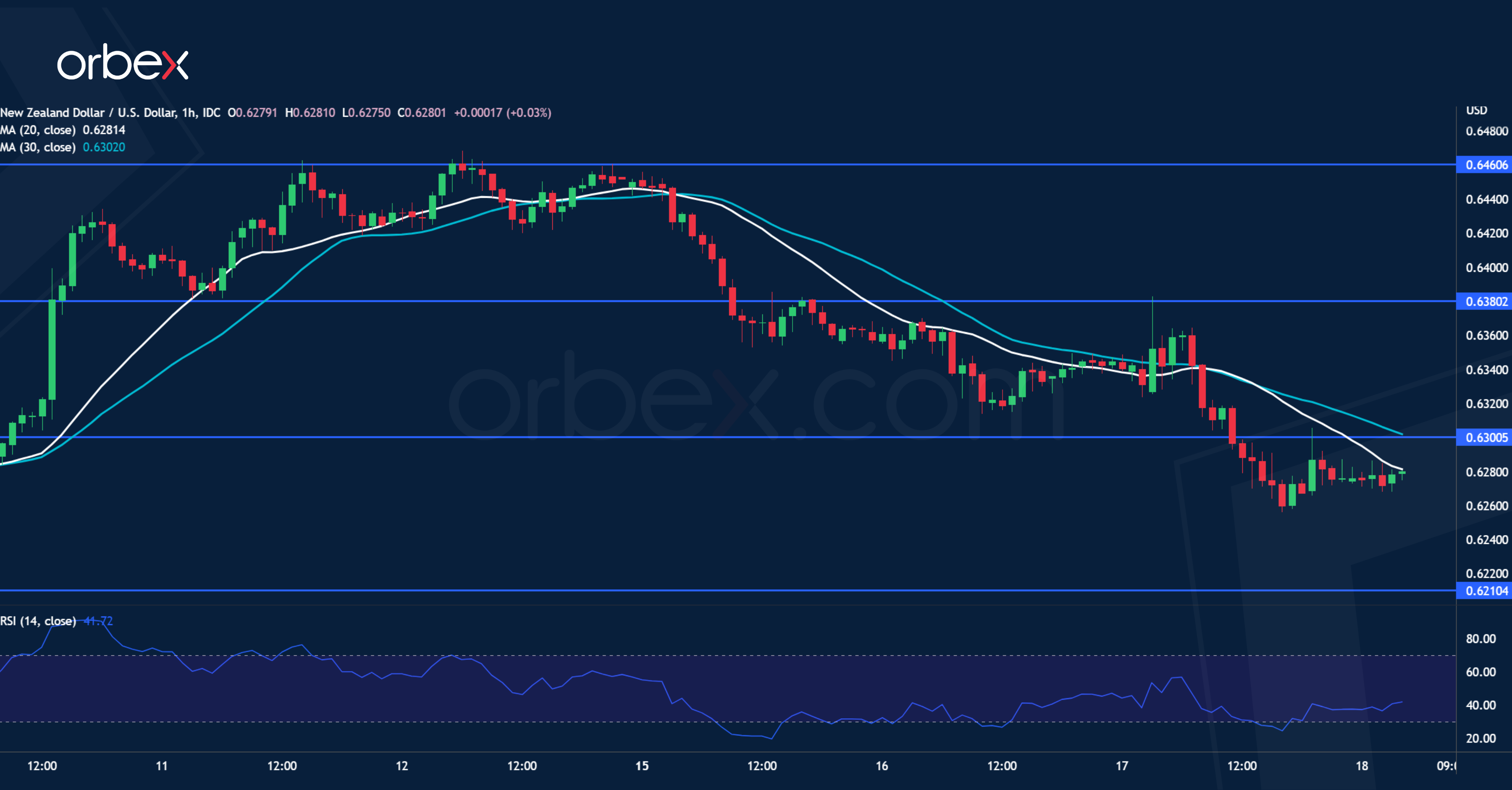
The New Zealand dollar weakened despite a 50bp hike by the RBNZ as risk sentiment fades. The pair hit resistance at 0.6460 and has given up most of its recent gains. A drop below 0.6300 at the base of last week’s bullish breakout shows a lack of commitment from the long side, putting a dent to the market’s optimism by invalidating the rebound. August’s lows near 0.6210 is the bulls’ last stronghold and its breach would send the kiwi to 0.6100. 0.6300 is the first hurdle as the RSI recovers to the neutrality area.
AUD/USD Daily Report
Daily Pivots: (S1) 0.6889; (P) 0.6959; (R1) 0.7008; More...
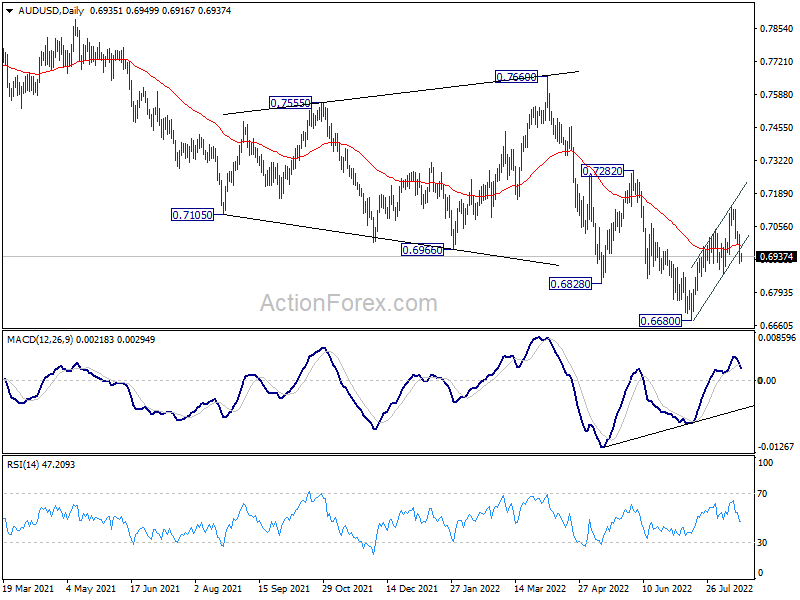
AUD/USD's fall from 0.7135 is still in progress and intraday bias stays mildly on the downside for 0.6868 support. Firm break there argue that whole rebound from 0.6680 is finished, and bring retest of 0.6680 low. On the upside, above 0.7030 minor resistance will turn intraday bias neutral first.
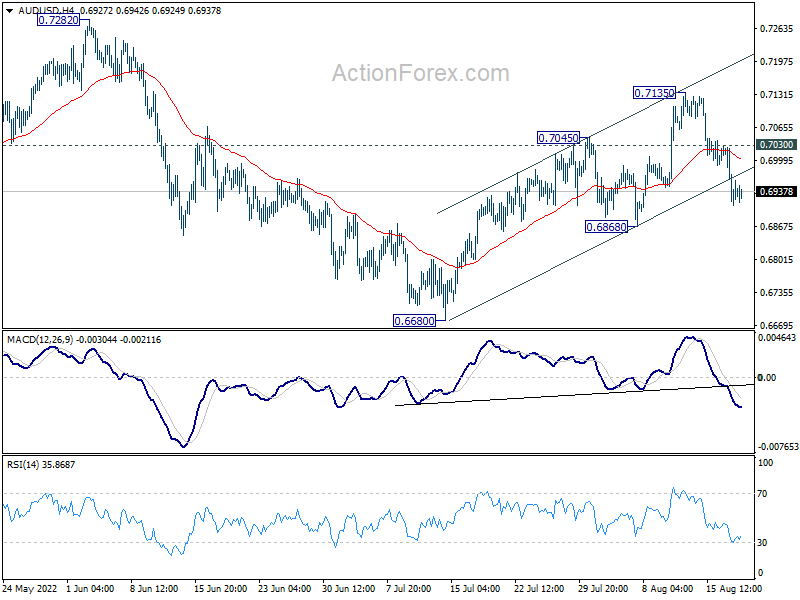
In the bigger picture, price actions from 0.8006 (2021 high) is seen more as a corrective pattern to rise from 0.5506 (2020 low). Or it could be a bearish impulsive move. In either case, outlook will remain bearish as long as 0.7282 resistance holds. Next target is 61.8% retracement of 0.5506 to 0.8006 at 0.6461.
Aussie Soft after Employment Data, Dollar On the Strong Side in Quiet Trading
Dollar is on the strong side in quiet trading in Asia, together with Yen and Swiss Franc. But the greenback is just staying in familiar range against. On the other hand, Euro and Sterling are the softer ones. Aussie is also trading with an undertone after mixed job data. But overall, most major pairs and crosses in the forex markets are still stuck inside last week's range for now.
Technically, attention will be on whether Dollar could break through near term resistance levels before the week ends. The levels include 1.2002 support in GBP/USD, 0.6868 support in AUD/USD, 135.57 resistance in USD/JPY, and 1.2984 resistance in USD/CAD.
In Asia, at the time of writing, Nikkei is down -0.85%. Hong Kong HSI is down -0.54%. China Shanghai SSE is down -0.46%. Singapore Strait Times is up 0.50%. Japan 10-year JGB yield is up 0.0079 at 0.194. Overnight, DOW dropped -0.50%. S&P 500 dropped -0.72%. NASDAQ dropped -1.25%. 10-year yield rose 0.069 to 2.893.
Australia lost -40.9k jobs, but unemployment rate dropped to 3.4%
Australia employment contracted -40.9k in July, much worse than expectation of 25.0k growth. Full time jobs decreased by 86.9k while part time jobs rose 46k.
Unemployment rate dropped from 3.5% to 3.4%. Participation rate dropped notably from 66.8% to 55.4%. Monthly hours worked in all jobs dropped -16m hours, or -0.8% mom.
"The fall in unemployment in July reflects an increasingly tight labour market, including high job vacancies and ongoing labour shortages, resulting in the lowest unemployment rate since August 1974," Bjorn Jarvis, head of labour statistics at the ABS, said.
RBNZ Orr: Monetary policy was too loose for a period
RBNZ Governor Adrian Orr told a parliamentary committee, "our core inflation is too high and that suggests at some point monetary policy was too loose for a period."
"I have already apologized for the current level of inflation. I have already said that the Reserve Bank was party to that," he added.
However, "the worst mistake we could be having would be fighting deflation, unnecessary unemployment and economic collapse," he said. "We have ended up with the better problem -- but it is a problem -- which is inflation, core inflation of 4-6% that we need to put back in the bottle."
Looking ahead
Swiss trade balance and Eurozone CPI final will be released in European session. Later in the day, Canada will release IPPI and RMPI. US will release jobless claims, Philly Fed survey and existing home sales.
AUD/USD Daily Report
Daily Pivots: (S1) 0.6889; (P) 0.6959; (R1) 0.7008; More...
AUD/USD's fall from 0.7135 is still in progress and intraday bias stays mildly on the downside for 0.6868 support. Firm break there argue that whole rebound from 0.6680 is finished, and bring retest of 0.6680 low. On the upside, above 0.7030 minor resistance will turn intraday bias neutral first.
In the bigger picture, price actions from 0.8006 (2021 high) is seen more as a corrective pattern to rise from 0.5506 (2020 low). Or it could be a bearish impulsive move. In either case, outlook will remain bearish as long as 0.7282 resistance holds. Next target is 61.8% retracement of 0.5506 to 0.8006 at 0.6461.
Economic Indicators Update
| GMT | Ccy | Events | Actual | Forecast | Previous | Revised |
|---|---|---|---|---|---|---|
| 01:30 | AUD | Employment Change Jul | -40.9K | 25.0K | 88.4K | |
| 01:30 | AUD | Unemployment Rate Jul | 3.40% | 3.50% | 3.50% | |
| 06:00 | CHF | Trade Balance (CHF) Jul | 3.55B | 3.80B | ||
| 09:00 | EUR | Eurozone CPI Y/Y Jul F | 8.90% | 8.90% | ||
| 09:00 | EUR | Eurozone CPI Core Y/Y Jul F | 4.00% | 4.00% | ||
| 12:30 | CAD | Industrial Product Price M/M Jul | -1.10% | |||
| 12:30 | CAD | Raw Material Price Index Jul | -0.10% | |||
| 12:30 | USD | Initial Jobless Claims (Aug 12) | 261K | 262K | ||
| 12:30 | USD | Philadelphia Fed Manufacturing Survey Aug | -6.2 | -12.3 | ||
| 14:00 | USD | Existing Home Sales Jul | 4.85M | 5.12M | ||
| 14:30 | USD | Natural Gas Storage | 38B | 44B |
Australia lost -40.9k jobs, but unemployment rate dropped to 3.4%
Australia employment contracted -40.9k in July, much worse than expectation of 25.0k growth. Full time jobs decreased by 86.9k while part time jobs rose 46k.
Unemployment rate dropped from 3.5% to 3.4%. Participation rate dropped notably from 66.8% to 55.4%. Monthly hours worked in all jobs dropped -16m hours, or -0.8% mom.
"The fall in unemployment in July reflects an increasingly tight labour market, including high job vacancies and ongoing labour shortages, resulting in the lowest unemployment rate since August 1974," Bjorn Jarvis, head of labour statistics at the ABS, said.