Sample Category Title
Pound Yawns as UK Inflation Hits 10.1%
The British pound is almost unchanged today, trading just above the 1.21 level.
UK inflation hits double-digits
It hasn’t been a good week for the UK, with today’s inflation report following grim wage growth numbers. Headline inflation in July hit 10.1% YoY, up from 9.4% and above the estimate of 9.8%. It was a similar story with core CPI, which rose to 6.2% YoY, up from 5.8% and ahead of the forecast of 5.9%.
UK consumers, already hammered by the cost-of-living crisis, shouldn’t expect things to improve anytime soon. The energy price cap is expected to jump in October due to high gas prices, and the BoE is projecting that inflation will rise up to 13.3% in October. British 2-year Gilt yields have surged to 2.41%, its highest level since November 2008, as the markets brace for higher interest rates from the BoE.
To add to the misery, British workers are seeing a decline in their wages. Wage growth came in at 5.1% in Q2 on an annualized basis, but real wages, which are adjusted for inflation, fell by 3.2%, a record low. The cost of living is thus increasing at an even faster rate and is far outpacing wage growth.
The FOMC minutes will be released later today, and we can expect the Fed to continue to drum out a hawkish message that that the inflation battle is far from over and more hikes are coming. The markets have caught on to the idea that the Fed will pivot and reverse policy next year, and it will be interesting to see how investors react to the minutes. If there are any dovish comments in the minutes, the market may latch on to them and ignore the hawkish remarks which don’t fit into what the market wants to hear.
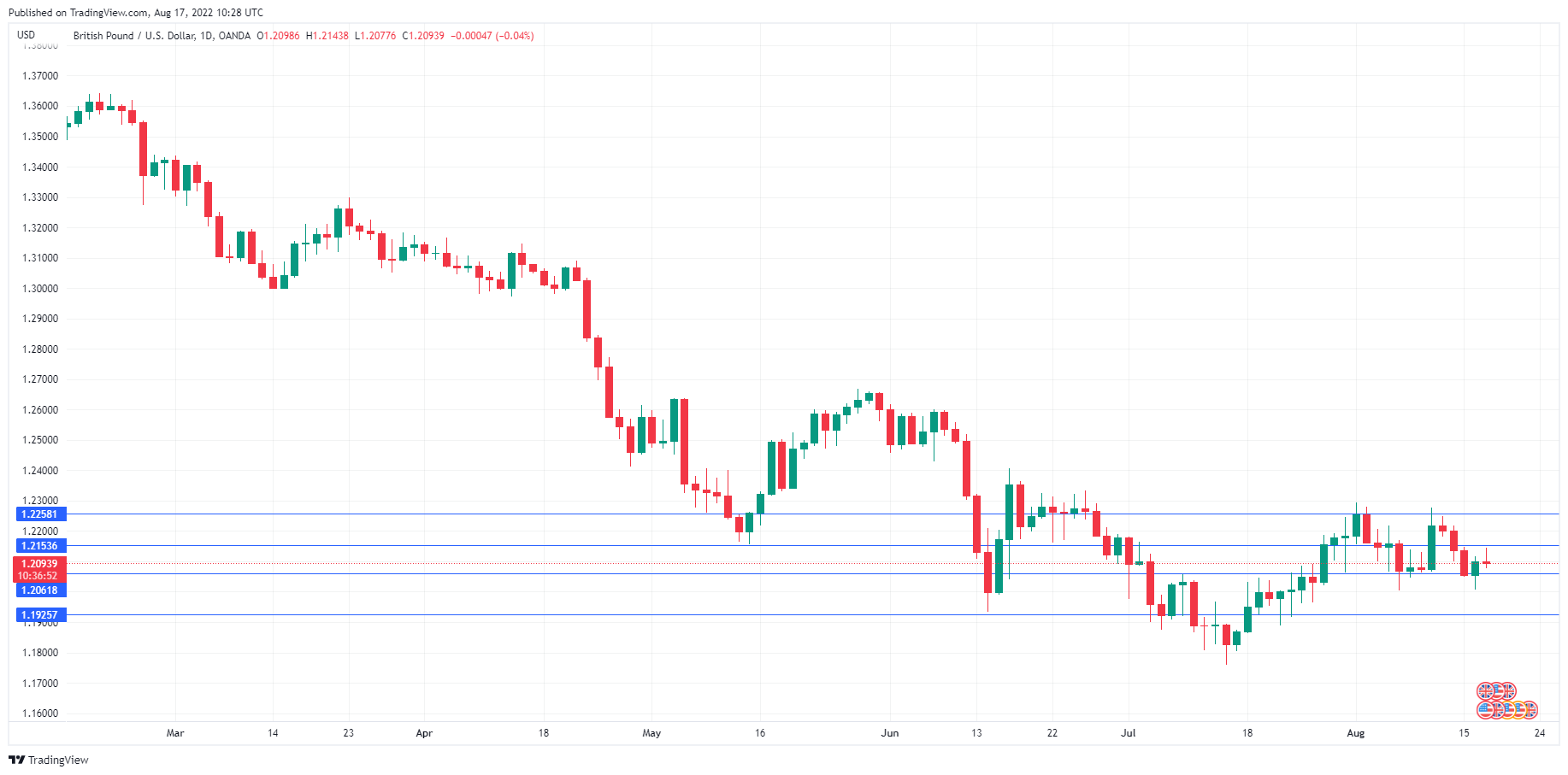
GBP/USD Technical
- GBP/USD is testing support at 1.2030. Below, there is support at 1.1925
- There is resistance at 1.2153 and 1.2258
WTI Price Holds Near 7-month Low on Renewed Concerns about Global Growth
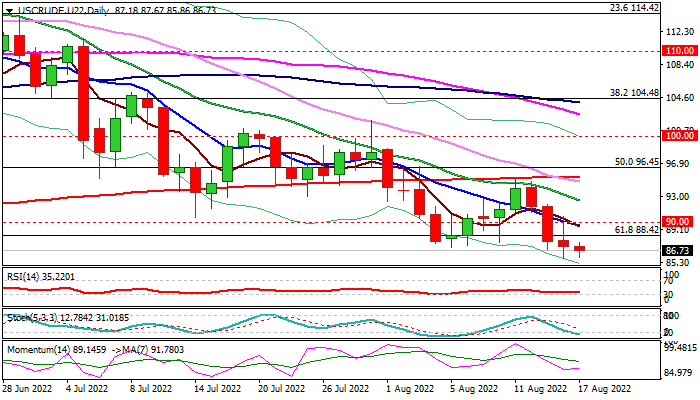
WTI oil price remains under pressure and holding near new seven-month low on Wednesday, following short-lived recovery attempt on Tuesday, which stalled at $90 zone.
The price action holds in red for the fourth straight day, driven by fresh negative sentiment of renewed concerns about global economic growth, as prospects of a global recession warn that demand for oil would weaken.
The most recent data from China showed that industrial production and retail sales unexpectedly slowed, adding to concerns about the recovery of the world’s second largest economy and the biggest oil importer from the slowdown in the second quarter and a narrow escape from contraction is running out of steam.
The negative sentiment was additionally fueled by unexpected and strong fall of the US Empire State Manufacturing Index which fell to the lowest since May 2020.
Positive signal from the US API report on Tuesday which showed a drop in crude inventories was offset by overall negative sentiment and made no significant impact on oil prices.
Technical studies on daily chart show moving averages in full bearish setup and rising negative momentum, while repeated close below broken Fibo support at $88.42 (61.8% of $62.42/$130.48 upleg) boost negative signal.
Also, completion of failure swing pattern on weekly chart add to bearish tone, with weekly close below $88.42 pivot to confirm.
Although bears are in control, oversold stochastic and headwinds from former high at $85.39 (Oct 25 2021) may slow the action for extended consolidation before bears resume towards targets at $80 (psychological) and $78.48 (Fibo 76.4% of $62.42/$130.48).
Broken Fibo support at $88.42 reverted to solid resistance which should ideally cap, with extended upticks to stay under $90.00/$90.36 (psychological / daily Tenkan-sen) to keep bears intact.
Res: 87.67; 88.42; 90.00; 90.36.
Sup: 85.71; 85.39; 81.89; 80.00.
Bitcoin, Ethereum corridor and new dog race
Market picture
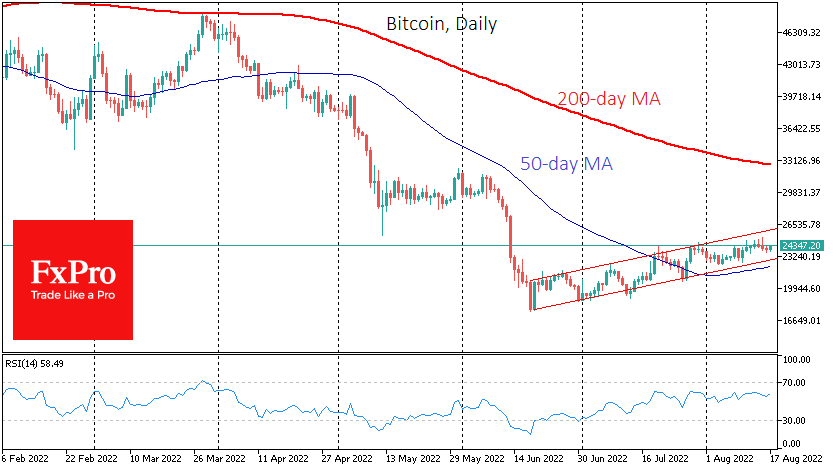
Bitcoin has added 1.5% to $24.3K in the past 24 hours. Over the past couple of hours, the first cryptocurrency has regained Tuesday’s slump, finding support from buyers at last Friday’s local lows.
Ethereum, following trends in recent weeks, is returning the drawdown even more vividly, adding 3.3% overnight to $1940. Top altcoins are rising between 1.7% (BNB) and 11.3% (Dogecoin).
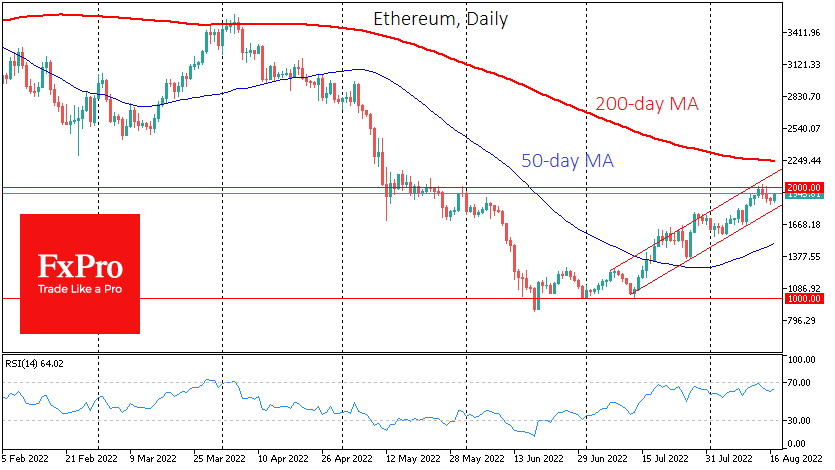
The total capitalisation of the crypto market, according to CoinMarketCap, rose 2% to $1.16 trillion overnight.
Gold and silver crypto are firmly in an uptrend corridor, turning to rise today before touching the lower boundary.
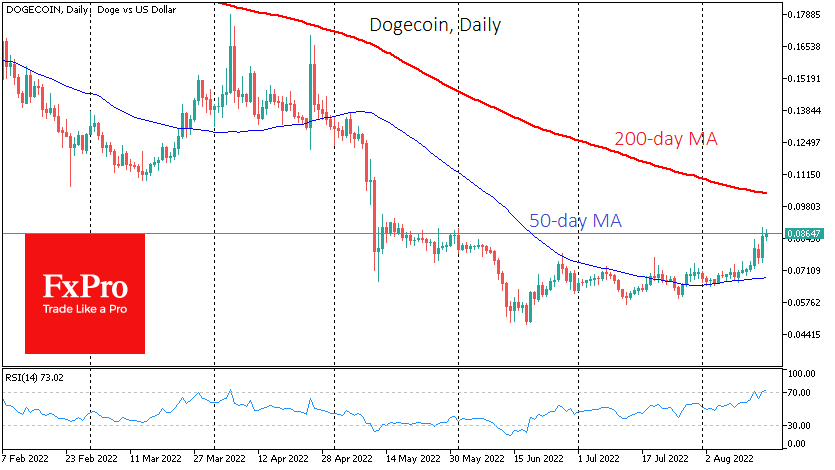
Dogecoin was the highest gainer in the top 100 crypto assets, adding around 30% for the week. Another dog coin, Shiba Inu, is also growing. The community has already managed to call it a dog race. In both cases, it is a manifestation of retail investor activity, like the run-up in meme stocks that is happening again in the stock markets.
News background
According to Arcane Research, miners have been selling more BTC than mining for three consecutive months since May. While bitcoin’s rise in July has eased the pressure on miners, they continue to sell off previously accumulated stockpiles.
PayPal, the largest electronic payment system, has added the ability to buy, sell and transfer cryptocurrencies via a mobile app. One of Brazil’s largest banks, BTG Pactual, has launched a platform for investing in cryptocurrencies.
The US Federal Reserve is issuing new rules for cryptocurrency banks, under which they can be granted master accounts, a key financial status, allows direct payments and access to the regulator.
The European Union authorities will create a new regulatory authority, AMLA, to directly oversee the industry.
Last Eurozone Inflation Data Before ECB Meeting
The ECB won't meet until September 8th, which is before the next release of inflation data. Meaning that they will likely be deciding monetary policy on the data that comes out tomorrow. And this could be a pretty big deal, because inflation in Europe is expected to surpass inflation in the US, while the ECB has rates still at zero. By comparison, the Fed's rate is at 2.5%.
However, what drives currencies is the real rate spread. That is, how much return investors can expect, taking into account inflation for both currencies. Even if interest rates are moving, inflation can move even more and shift the calculus. And that could be one of the driving forces for the currency pair and might mean the EURUSD makes another run at parity.
But first, let's go over the expectations before delving into rate spread
EuroZone inflation is expected to move up to 8.9% from 8.6% prior, once again, a record since the shared currency was created. Though, to be fair, not a record for the currencies of the countries that joined the Euro. The bright spot is that monthly inflation is expected to slow to 0.1% growth from 0.8% in June. But, that is expected to be almost entirely from the reduction in fuel costs, just like in the report from the US last week.
For ECB policy, however, we might want to look at the core inflation rate, which is expected to move up to 4.0% from 3.7% prior. That's also the highest ever, once again.
Also at the same time is the release of Construction Output for June, which is expected to slow to 1.8% from 2.9% in May. Not expected to influence the market directly, but it could be a sign of the impact the expected ECB policy has on one of the major economic sectors.
What the projections mean for the currency
Back to the analysis of pressure on the EURUSD. If the projections turn out to be correct, it would mean that the real interest rate for the dollar is -6.0%, while the real rate for the Euro is -8.9%. In other words, a 2.9% spread.
Last month, the real rate for the dollar was -7.4% while for the Euro it was -8.1% (taking into account before the latest moves by the Fed and the ECB respectively). That means the spread was just 0.7%.
So, given the differences in inflation and interest rates, having dollars has become a significantly better investment. Or, because both have negative real rates, the dollar is a significantly less bad investment. The pressure to hold dollars and not Euros would likely increase, especially going forward.
What it means for the future
Raising rates is meant to get inflation down. So, higher rates not only mean a better return on investment, but also that inflation would be expected to be less in the future. If the ECB is hesitant about raising rates, it could mean inflation keeps rising, making the Euro a worse investment.
The combination of these two factors could keep driving the spread between the currencies, and increased pressure on the EURUSD. That is, as long as the Fed doesn't pivot, or the ECB doesn't start raising rates at least as fast as the Fed.
GBP/USD Pair Climbed above the 1.2050 Resistance
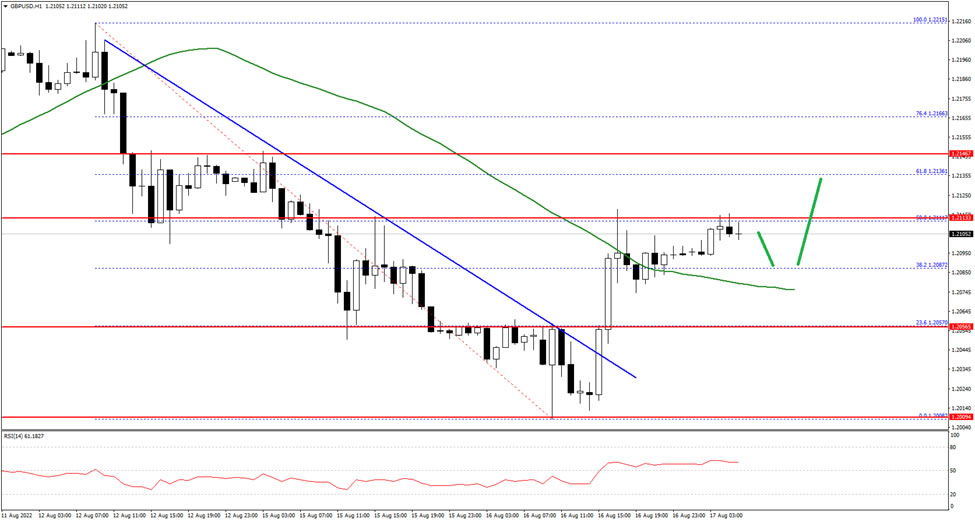
The British Pound started a short-term recovery wave from the 1.2000 support zone against the US Dollar. The GBP/USD pair climbed above the 1.2050 resistance.
The pair even climbed above a major bearish trend line with resistance near 1.2055 on the hourly chart. It is now trading above the 1.2080 level and the 50 hourly simple moving average. An immediate resistance is near the 1.2110 level.
The first major resistance sits near the 1.2140 zone. If there is a clear upside break above the 1.2140 resistance, the pair could rise steadily towards the 1.2200 level in the near term.
On the downside, an initial support is near 1.2080 on FXOpen. The main support is forming near the 1.2055 level. A break below the 1.2055 support could even push the pair below the 1.2000 support.
Mixed Ahead of Fed Minutes
A mixed start to trade in Europe after a more promising session in Asia overnight where stocks may have been boosted by talk of more pro-growth policies in China.
That followed disappointing data late last week and early this from the world's second-largest economy so the comments came at a good time. Still, we're not seeing investors getting too carried away by comments alone, action needs to follow and small rate cuts from the PBOC don't really fall into that category.
More misery for the UK as prices rise by the most since the early 80s
UK inflation hit its highest level in 40 years last month, with the annual CPI jumping 10.1% and the core reading 6.2%, both faster than expected. Double-digit inflation was inevitable but it has come earlier than expected which will leave households and businesses worrying about what that ultimately means for peak inflation later this year and how sustained it will be.
The data today has probably locked in a 50 basis point hike from the Bank of England as a minimum, especially when combined with yesterday's wage growth numbers. Real incomes are still falling at a rapid rate but the central bank will have little choice but to persevere regardless and the economy will suffer the consequences.
RBNZ committed to tackling price rises as it raises the cash rate peak
The New Zealand dollar is trading a little lower on the day but the session has been quite volatile. We've seen some big swings in response to the RBNZ announcement despite the rate decision itself falling in line with expectations. The central bank now expects the cash rate to peak higher and earlier than previously anticipated, hitting 4.1% in the second quarter of next year, compared with 3.95% in Q3.
The RBNZ still firmly believes though that the actions it's taken will both return inflation to the midpoint of its 1-3% target range in 2024 and not trigger a recession, although it did caution that the country will likely experience sub-par growth. That all sounds very hopeful but BoE aside, that appears to be the view of central banks still.
Fed minutes eyed as traders seek dovish pivot clues
There's plenty more to look forward to today but the FOMC minutes naturally stand out. What's interesting about them is that despite the supposed "dovish pivot" from the Fed, the commentary since has been anything but. Rather than talking up the prospect of falling inflation allowing for slower tightening, the message remains hawkish. What's more, policymakers are continually pushing back against the policy u-turn next year that markets have been flirting with the idea of.
I expect any hawkish components of the minutes will be overlooked today and instead traders will dissect them for any additional dovish concessions that could further fuel the stock market recovery. That's very much what we've seen in recent weeks and the decline in CPI last week only encouraged it.
Oil rebounds off support as JCPOA talks continue
Oil prices are edging higher on Wednesday, bouncing off technical support over the last 24 hours as Chinese Premier Li pushed for more pro-growth measures from local officials. There are growing downside risks as a result of the growth outlook and ongoing uncertainty around Chinese Covid restrictions.
What's more, talks between the US and Iran are continuing around the nuclear deal which, if it gets over the line, could be a big positive for oil supply and therefore a negative for prices. There is no shortage of scepticism around the prospects for the JCPOA to be revived though but we may be reaching a point where that will become clear. For now, Brent appears to have decent support around $92.
Gold flat after a pullback
Gold is marginally lower on the day with focus fully on the Fed minutes later in the day. The yellow metal has been knocked back in recent days after briefly breaking through $1,800 resistance. It's remained quite resilient though against the backdrop of a strengthening dollar and the FOMC minutes later could potentially reward that.
Could Fed minutes be the catalyst bitcoin needs?
Bitcoin rallies have struggled to generate much momentum of late, with $25,000 proving to be a strong barrier to the upside. What's interesting is how shallow the pullback has so far been from that level which could be a bullish signal. Traders may be struggling to get on board with a break higher but they're perhaps not keen to cash out either. The FOMC minutes later may be the catalyst it needs, one way or another.
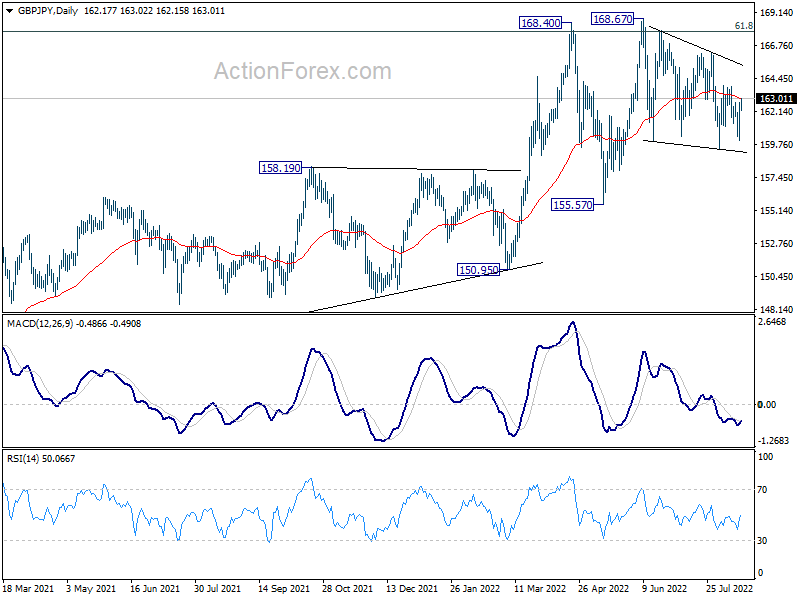
GBP/JPY Daily Outlook
Daily Pivots: (S1) 160.77; (P) 161.75; (R1) 163.41; More...
Overall, GBP/JPY is still extending the corrective pattern from 168.67. Intraday bias is back on the upside with break of 162.77 minor resistance. Further rise is in favor to 163.91 first. Break there will target 166.31 resistance next. On the downside, below 160.07 will turn bias to the downside for 159.42 and below.
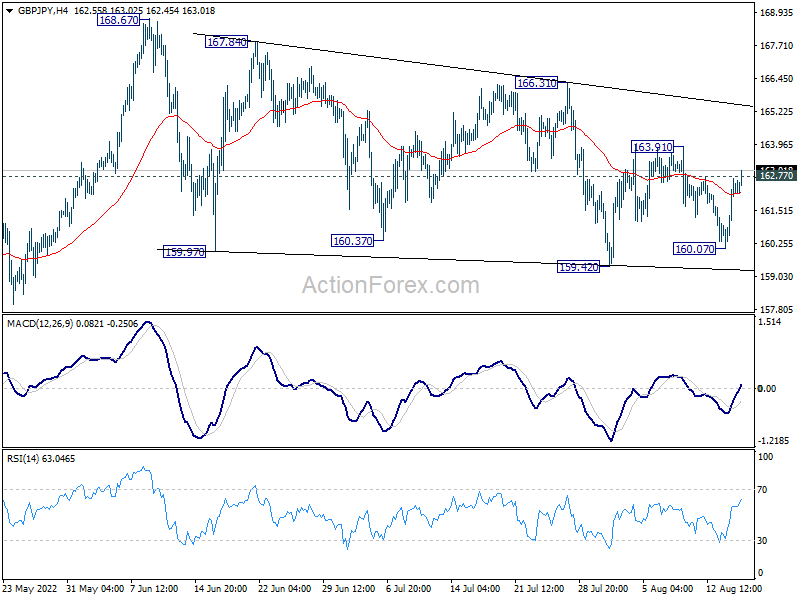
In the bigger picture, up trend from 123.94 (2020 low) is still in progress. Sustained break of 61.8% retracement of 195.86 (2015 high) to 122.75 (2016 low) at 167.93 will be a long term bullish signal, and could pave the way back to 195.86 high. This will remain the favored case as long as 155.57 support holds, even in case of deep pull back.
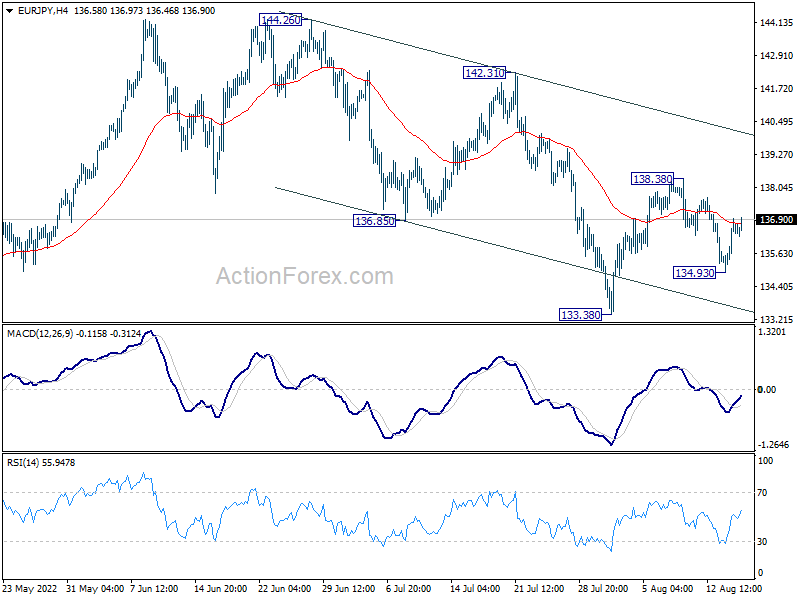
EUR/JPY Daily Outlook
Daily Pivots: (S1) 135.34; (P) 136.13; (R1) 137.31; More....
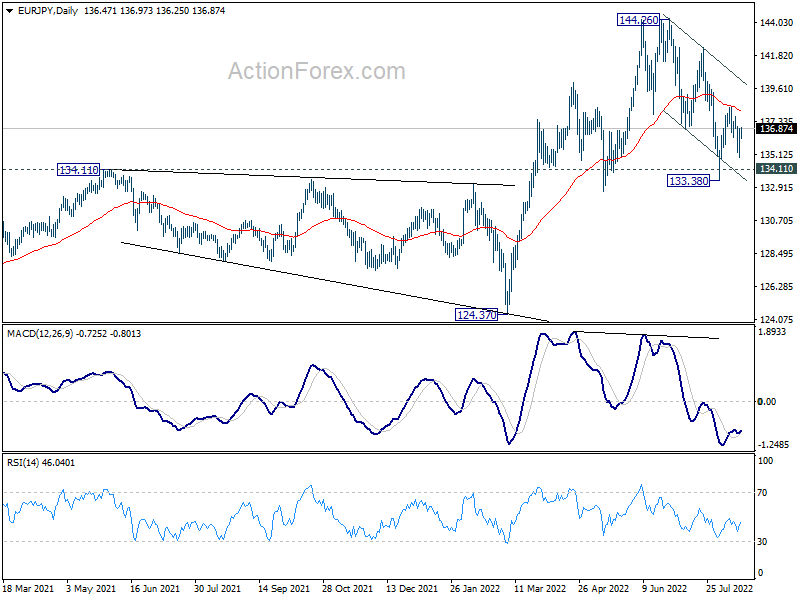
Intraday bias in EUR/JPY stays neutral at this point. Overall, it's staying in the corrective pattern from 144.26. On the upside, above 138.38 will resume the rebound from 138.38. On the downside, below 134.93 will turn bias back to the downside for 133.38 support.
In the bigger picture, up trend from 114.42 (2020 low) is seen as the third leg of the pattern from 109.30 (2016 low). Further rally is in favor as long as 134.11 resistance turned support holds, even in case of deep pull back. Next target is 149.76 (2015 high). However, sustained break of 134.11 will be a sign of medium term bearish reversal and turn focus to 124.37 support for confirmation.
EUR/GBP Daily Outlook
Daily Pivots: (S1) 0.8394; (P) 0.8417; (R1) 0.8429; More...
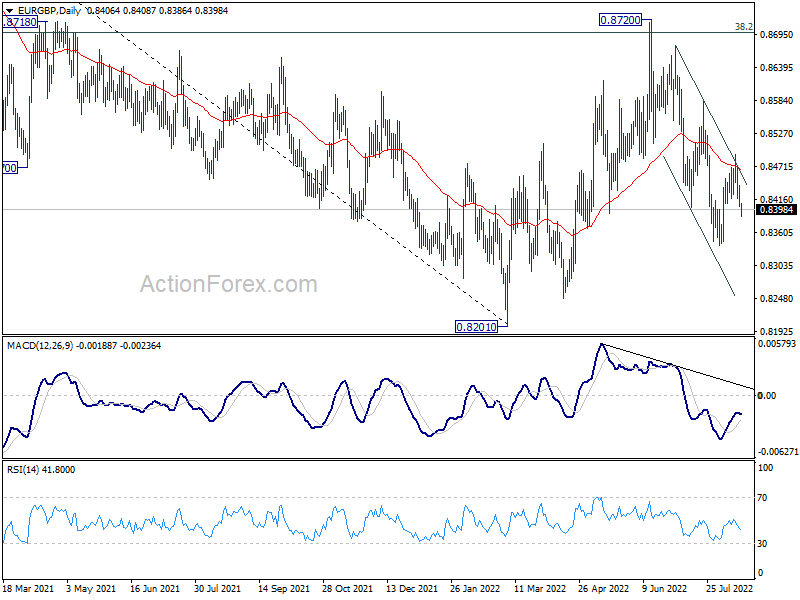
EUR/GBP's rebound from 0.8338 could have completed at 0.8491 already. Intraday bias is mildly on the downside for 0.8338 support first. Decisive break there will resume the fall from 0.8720 to retest 0.8201 low. On the upside, above 0.8439 minor resistance will turn intraday bias neutral first. But risk will stay on the downside as long as 0.8491 resistance holds.
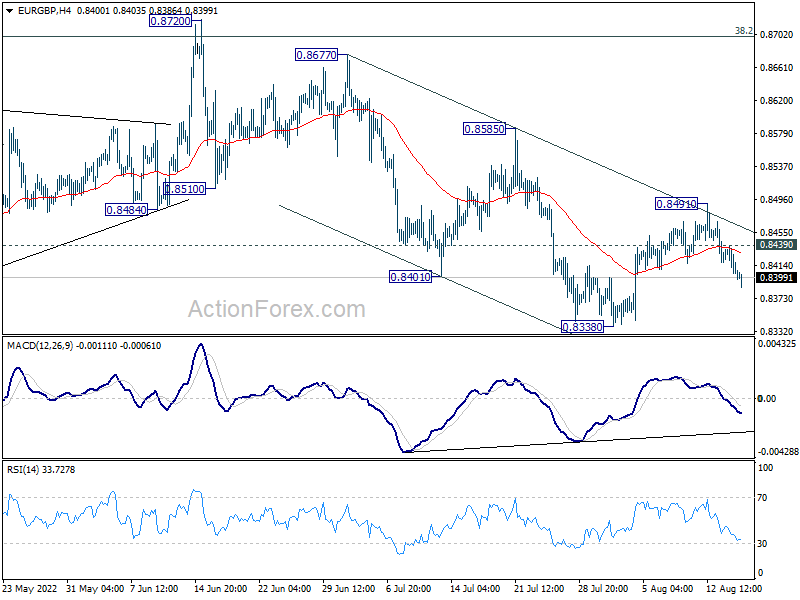
In the bigger picture, current development suggests rejection by 38.2% retracement of 0.9499 to 0.8201 at 0.8697. Medium term bearishness is maintained. Break of 0.8201 will resume larger down trend from 0.9499 (2020 high). Nevertheless, sustained break of 0.8697 will affirm the case that rise from 0.8201 is a medium term up trend itself.
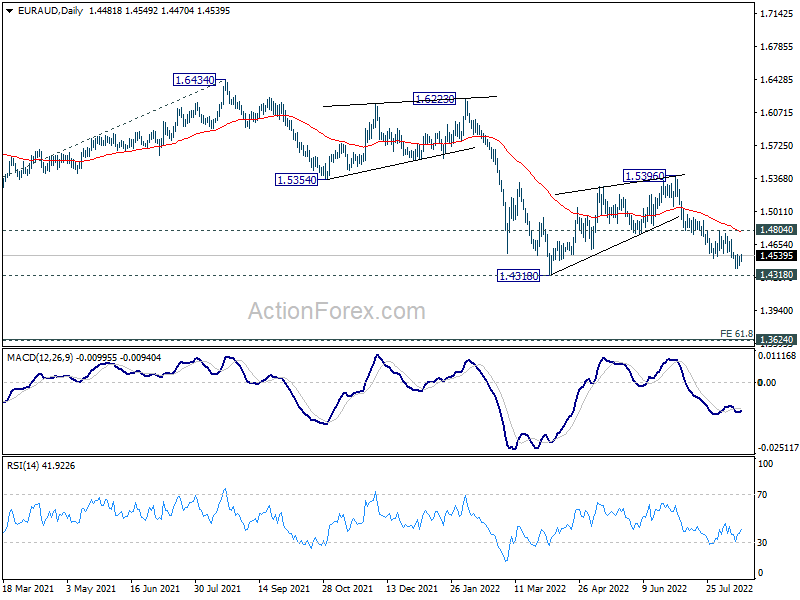
EUR/AUD Daily Outlook
Daily Pivots: (S1) 1.4429; (P) 1.4481; (R1) 1.4527; More...
EUR/AUD continues to lose downside momentum. But further fall is still expected with 1.4804 resistance intact, to retest 1.4318 low. Firm break there will resume larger down trend to medium term projection level at 1.3623. On the upside, break of 1.4804 resistance is needed to indicate short term bottoming. Otherwise, risk will stay on the downside in case of recovery.
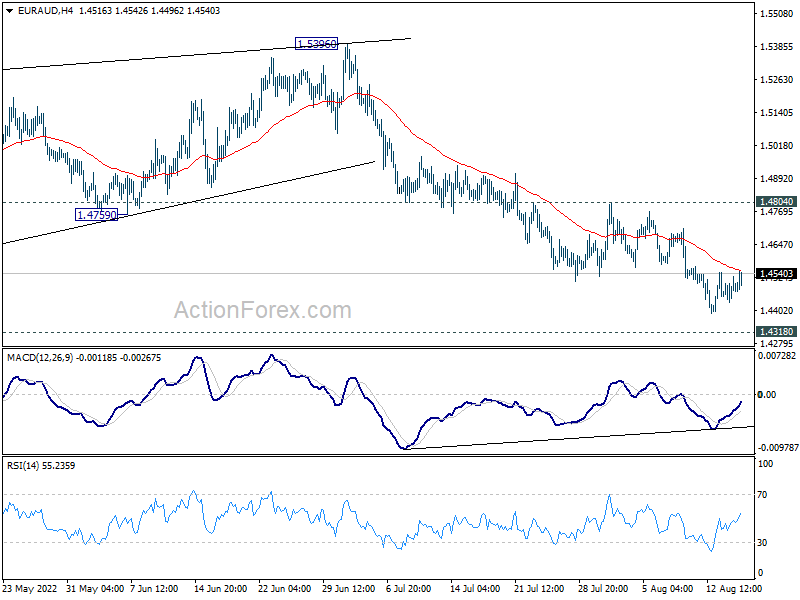
In the bigger picture, down trend from 1.9799 is still in progress. Break of 1.4318 low will target 61.8% projection of 1.9799 to 1.5250 from 1.6434 at 1.3623, which is close to 1.3624 long term support (2017 low). This will remain the favored case now as long as 1.5396 resistance holds.