

Sample Category Title
USD/CAD Seeks Support
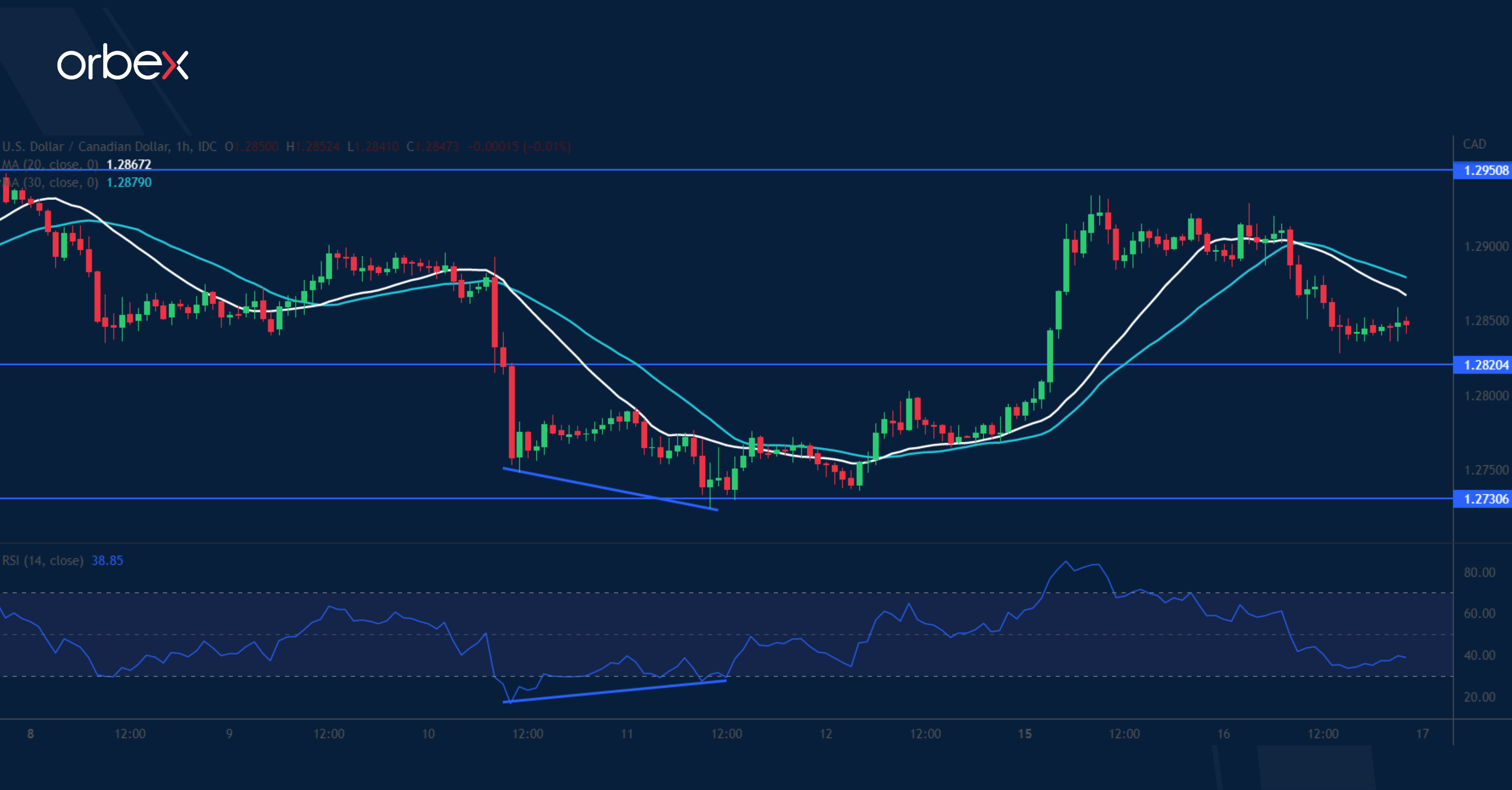
The Canadian dollar holds well against its US counterpart as July’s CPI remains stubbornly high. A bullish RSI divergence showed a deceleration in the sell-off. The greenback’s bounce above 1.2900 led sellers to close their positions. The initial momentum has dried up to let the RSI recover into the neutrality area. 1.2820 around the start of the bullish breakout is a demand zone to see whether there is enough follow up interest in pushing the US dollar higher. A close above 1.2950 could open the door to the recent peak at 1.3170.
GBP/USD Consolidates
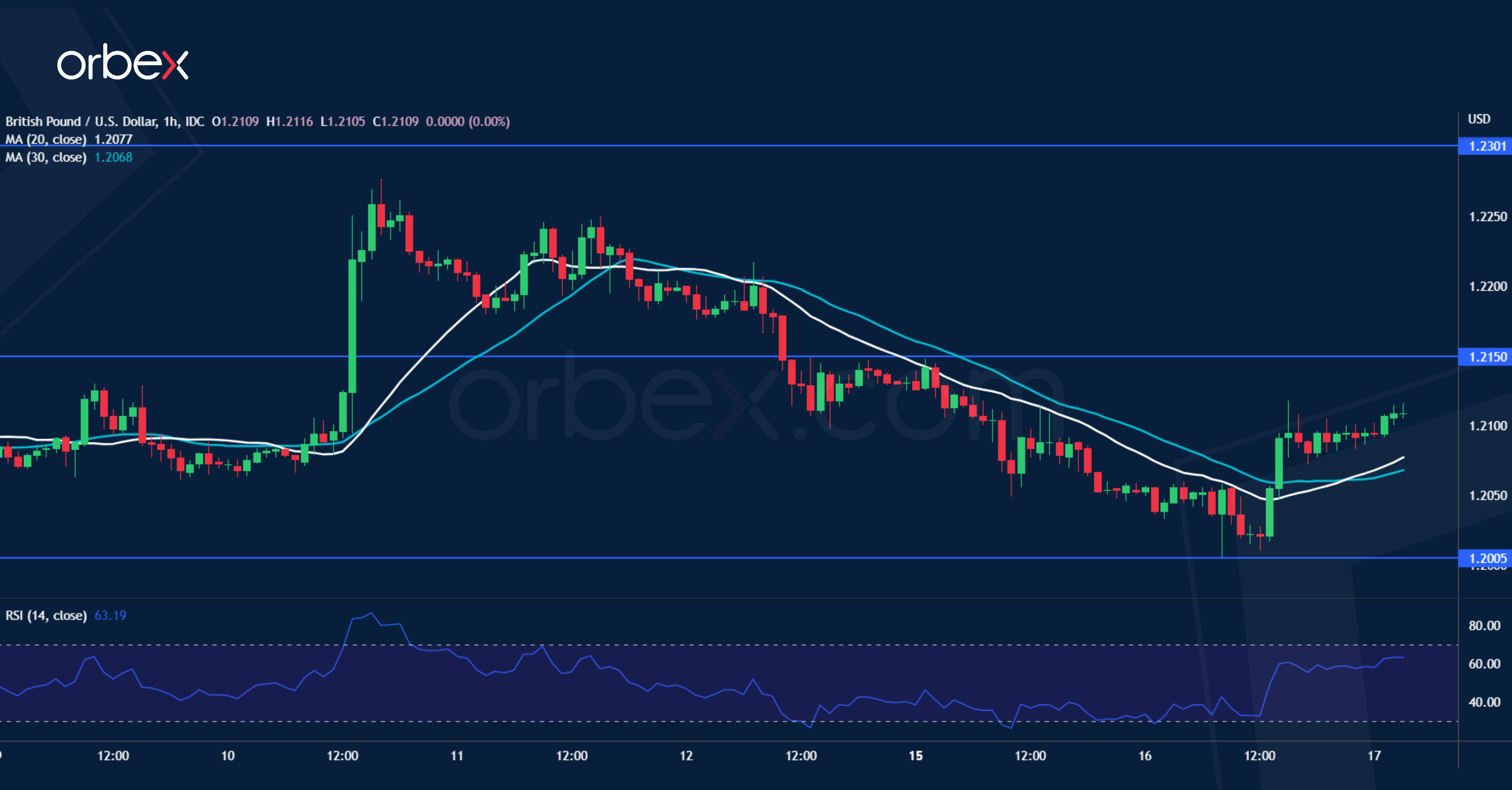
The pound steadies as wage growth argues in favour of further BoE tightening. The price action has been struggling to clear the daily resistance near 1.2300. Two consecutive failed rebounds show a lack of buying power. Sterling is resting over the psychological level of 1.2000 thanks to bargain hunting. Its breach would force the bulls out, leaving it vulnerable to momentum selling towards July’s lows around 1.1800, which is a major floor to safeguard the month-long recovery. 1.2150 is the first resistance the buy side needs to lift.
UK Inflation Once More Exceeded Consensus in July
Markets
Yesterday’s eco numbers (German ZEW investor sentiment, US housing numbers) played no role of intraday importance across markets. The main intraday move on bond markets occurred around the start of US trading hours. Bonds sold off following earnings by retailers Wall Mart and Home Depot. Both managed to beat expectations, though we must add that the former downplayed its guidance last month. Nevertheless, the results gave investors some courage that worst recession nightmares might be off the table as the (US) consumer holds stronger than feared. The proof of the pudding could be in today’s July US retail sales numbers. A second-session straight (late) swoon of oil prices (Brent fell from $96 to $92/b) failed to improve the intraday odds for core bonds. The US yield curve turned more inverse with daily yield changes ranging between -1.2 bps (30-yr) to +9.1 bps (3-yr). The German yield curve bear steepened with yields adding 4.6 bps (2-yr) to 7.5 bps (30-yr). From a technical point of view, the German 10-yr yield tested the psychologic 1% barrier, which coincides with last week’s high and with the topside of the downward corrective trend channel since mid-June. A break higher would be significant and call an end to that correction, making way for a further increase towards the 1.12% area. Stock markets continued their comeback higher after escaping from downward trend channels end July/early August. Main indices gained around 0.5% both in Europe and in the US. Ironically, a weak growth scenario (which eventually ends policy normalization cycles) does the trick. From a risk perspective, it beats the alternative of prolonged central bank tightening/inflation fighting. The US dollar failed to profit from yesterday’s relative yield dynamics. The trade-weighted greenback closed near unchanged at 106.50 with EUR/USD even winning some pips, closing at 1.0171 from an open at 1.0161.
Today’s eco data include this mornings Japanese trade numbers and UK inflation figures. Later today we’ll see the second reading of Q2 EMU GDP, US retail sales (see above) and Minutes of the previous FOMC meeting. Japan’s trade deficit hit a record high in July on surging imports. High commodities prices and a weak yen added to this. UK inflation once more exceeded consensus in July. The monthly dynamic remains strong at 0.6% M/M with the Y/Y figure accelerating from 9.4% to 10.1%, exceeding consensus (9.8%) and hitting double digits for the first time since 1982. Core inflation accelerated from 5.8% Y/Y to 6.2% Y/Y. Sterling spikes higher on the numbers as it strengthens the case for the Bank of England to hang on to its increased tightening pace. Governor Bailey and co in August pushed through a first 50 bps rate hike following 5 smaller steps (+25 bps) before. EUR/GBP trades below 0.84.
News Headlines
The Reserve Bank of New Zealand extended its tightening cycle this morning by lifting the policy rate by 50 bps, from 2.5% to 3%, the highest level since July 2015. It’s the fourth consecutive 50 bps rate hike, following three smaller 25 bps steps (inaugural move October 2021). In its new projections, the Monetary Policy Council (MPC) pencils in a more aggressive tightening path than in May. The policy rate is now forecast to peak just above 4% early next year and will only come down from 2025 onwards. More tightening “at pace” is necessary as the MPC judges core consumer inflation remains too high while labour resources remain scarce. Updated inflation forecast show a slowdown from the current 7.3% to 5.8% by the end of 2022 (5.5% forecast in May), to 3.8% by the end of 2023 and below the midpoint of the 1%-3% target range by mid-2024. Annual average projected growth in the year through March 2023 stands at 2.8%, before slowing to 0.8% in the year through March 2024 (from 1.3% in May). The kiwi dollar ticked higher on the decision, but fails to really build on this move. NZD/USD currently changes hands at 0.6360. The kiwi dollar swap curve is broadly unchanged, with yields up to 1.5 bps higher across the curve.
UK Inflation Exceeds 10%
European and US indices traded mostly in the positive on Tuesday. The DAX gained near 0.70% and is preparing to clear the major 38.2% Fibonacci resistance in on year-to-date selloff despite the deepening energy crisis, which has only worsened with the drying Rhine River this summer.
Equities in the US escaped negative pressure thanks to better-than-expected earnings report from Walmart yesterday. The US retail giant revealed that its profit came under pressure as costumers moved to groceries and essentials, with lower profit margin, but that was already priced in, because they had already given that warnings earlier this summer. The lack of further negative news from Walmart sent the retailer’s shares jumped more than 5% yesterday to $140 per share, a level which hasn’t been seen since March this year. And other retail giants gained on optimism.
On the index level, the S&P500 challenged its 200-DMA yesterday, for the first time since April. The index traded above its 200-DMA twice this year, once in early February, then late March, but couldn’t hold on to the gains and rapidly sold off.
We will see if the third time is a charm; earnings and the FOMC minutes will be decisive for the short-term direction. The minutes will likely sound more hawkish than expected, as the Federal Reserve (Fed) rate expectations softened probably too much after last week’s CPI report in the US surprised with a softer-than-expected 8.5% print. But, 8.5% is still very high; it’s more than four times the Fed’s 2% policy target.
Therefore, we don’t expect anything less than a Fed decided to win its war over inflation at today’s minutes.
US dollar re-gains field
US housing starts fell almost 10% last month, but a better-than-expected industrial production maintained the investor mood optimistic into the Fed minutes.
The producer prices in New Zealand eased last month, and the Reserve Bank of New Zealand raised its policy rate to 3% this morning for the first time in seven years. The Kiwi pared a part of past days’ losses against the US dollar.
The US 10-year yield stabilizes around the 2.80% mark, but the 2-year yield continues pushing higher above the 3.20% mark. The widening spread between the 2 and the 10-year yield is a sign that the market is pricing in a, perhaps unavoidable recession.
The US dollar index has been gaining territory since a couple of sessions and is now above the July-August downtrending channel.
Inflation in Canada eased to 7.6% as expected in July, down from the 8.1% printed a month earlier. There was no good surprise on the Canadian data front, there was no doves to be revived unfortunately, and the USDCAD eased as the Loonie strengthened.
Britain was not that lucky. July inflation in the UK came above the 10% mark, versus 9.8% expected by analysts. Surpassing the 10% psychological level revived the Bank of England (BoE) hawks, but it’s unsure whether the post-data rebound in sterling could last, as rising rates apply a decent negative pressure on the British economy, and the deep recession fears keep the pound under pressure against the dollar. From a technical standpoint, Cable is giving signs of a negative breakout from the last month triangle, rather than the contrary.
Elsewhere
The barrel of US crude rebounded from $85 level, as the API data showed a 448’000 barrel decline in the US oil inventories last week versus 117’000 decline expected by analysts. The more official EIA is due today and is expected to print a 300’000 rise in inventories. Remember, there was a 5.5 mio barrel build last week, which helped pushing prices lower. Lower US inventories could help crude recover above the $90 per barrel into the weekend.
Gold, on the other hand, is moving lower, under the pressure of a stronger US dollar into the Fed minutes. The price of an ounce eased back to around its 50-DMA, which stands near $1780 level. We have a clear negative trend in play since the March spike this year, and there is a stronger case for a softer gold than the contrary, until we see a positive breakout.
UK CPI jumped to 10.1% yoy in Jul, core CPI up to 6.2% yoy
UK CPI rose 0.6% mom in July, largest monthly rise between June and July since the start of the series in 1988. The food and non-alcoholic beverages, and transport divisions made the largest upward contributions.
For the 12 month period, CPI accelerated from 9.4% yoy to 10.1% yoy, above expectation of 9.8% yoy. Indicative models suggest that CPI was last high in 1982, estimated at around 11%. Core CPI accelerated from 5.8% yoy to 6.2% yoy, below expectation of 6.4% yoy.
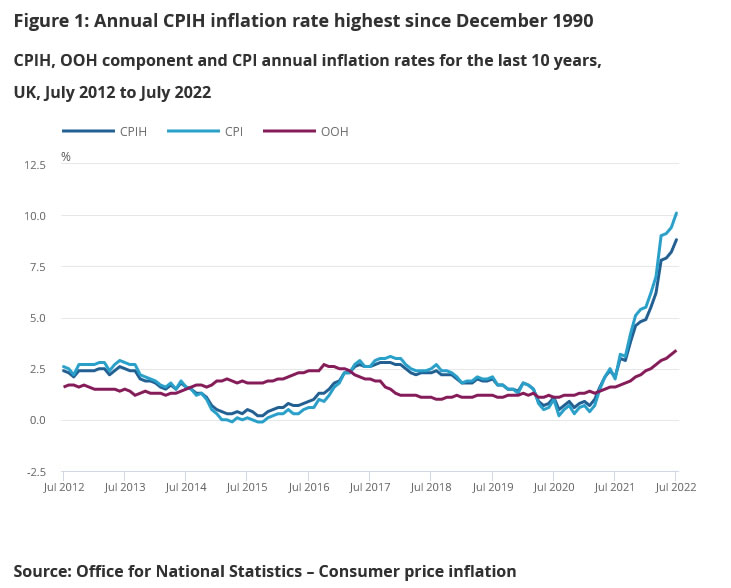
RPI rose 0.9% mom, 12.3% yoy, versus expectation of 0.8% mom, 12.9% yoy. PPI input came in at 0.1% mom, 22.6% yoy, versus expectation of 1.0% mom, 24.8% yoy. PPI output was at 1.6% mom, 17.1% yoy, versus expectation of 1.6% mom, 17.6% yoy. PPI core output was at 1.0% mom, 14.6% yoy, versus expectation of 0.0% mom, 15.9% yoy.
GBP/USD Daily Outlook
Daily Pivots: (S1) 1.2031; (P) 1.2075; (R1) 1.2141; More...
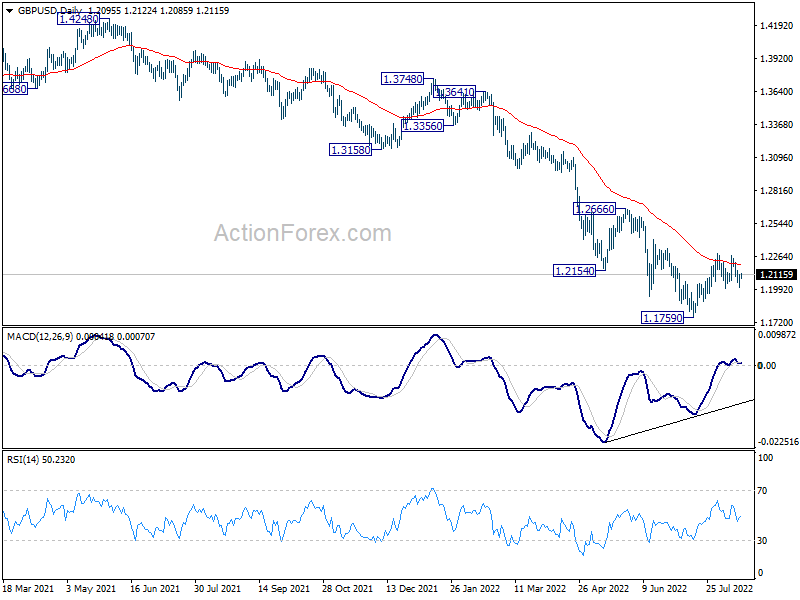
Intraday bias in GBP/USD remains neutral as it's still bounded in range of 1.2002/2292. On the downside, break of 1.2002 minor support will argue that rebound from 1.1759 has completed, after rejection by 55 day EMA. Intraday bias will be back on the downside for retesting 1.1759 low first. Break there will resume larger down trend. On the upside, above 1.2922 will resume the rebound from 1.1759 towards 1.2666 resistance.
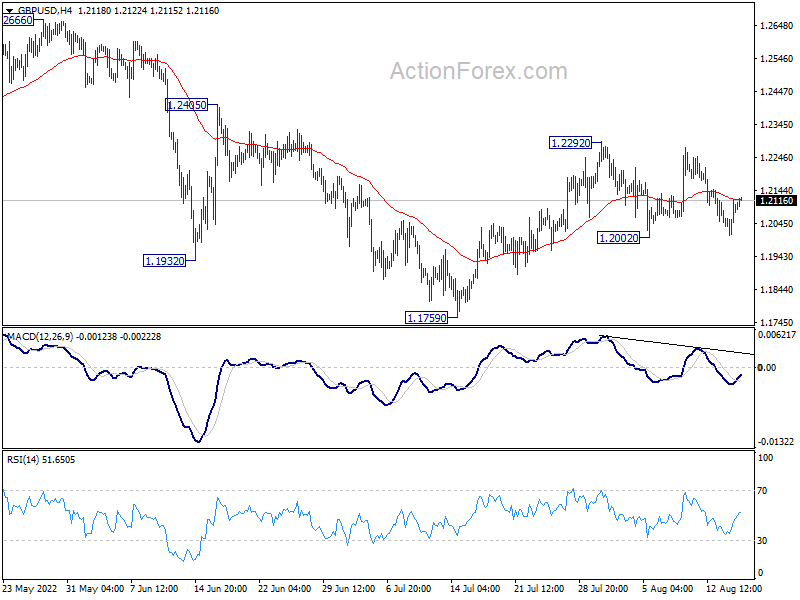
In the bigger picture, fall from 1.4248 (2018 high) could be a leg inside the pattern from 1.1409 (2020 low), or resuming the longer term down trend. Deeper decline is expected as long as 1.2666 resistance holds. Next target is 1.1409 low. However, firm break of 1.2666 will bring stronger rise back to 55 week EMA (now at 1.2897).
Kiwi Rebounds after RBNZ, Sterling Awaits Inflation Data
New Zealand Dollar trades broadly higher after RBNZ's rate hike today. But trading is mixed in other currencies. Commodity currencies are generally on the soft side for the week, but there is no follow through selling. Dollar is still the strongest, but it's struggling to extend the near term rally. Yen attempted for a bearish reversal, but there is no follow through selling. Sterling is firming up as UK inflation data is awaited, but it's mixed together with Euro and Swiss Franc. Overall, most major pairs and crosses are stuck inside last week's range.
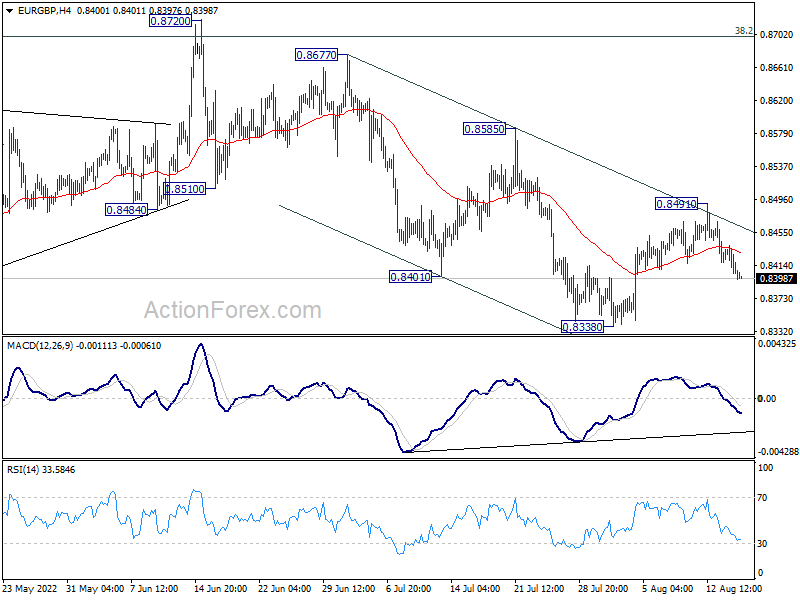
Technically, EUR/GBP's decline suggests that the recovery from 0.8338 might have completed at 0.8491. Deeper fall is mildly in favor towards 0.8338 low and possibly a break below there to resume the decline from 0.8720. The question is, if that's happening, whether it would be accompanied by deeper fall in EUR/USD towards 0.9951 low, or a bounce in GBP/USD back to 1.2292 minor resistance.
In Asia, at the time of writing, Nikkei is up 1.08%. Hong Kong HSI is up 0.98%. China Shanghai SSE is up 0.34%. Singapore Strait Times is up 0.43%. Japan 10-year JGB yield is up 0.0121 at 0.182. Overnight, DOW rose 0.71%. S&P 500 rose 0.19%. NASDAQ dropped -0.19%. 10-year yield rose 0.033 to 2.824.
RBNZ hikes 50bps, monetary conditions needed to continue to tighten
RBNZ raises the Official Cash Rate by 50bps to 3.00% as widely expected, as "core consumer price inflation remains too high and labour resources remain scarce". It also maintains hawkish bias as "committee members agreed that monetary conditions needed to continue to tighten until they are confident there is sufficient restraint on spending to bring inflation back within its 1-3 percent per annum target range."
The central bank noted domestic spending has "remained resilient", supported by a "robust employment level, continued fiscal support, an elevated terms of trade, and sound household balance sheets in aggregate." Production is being "constrained by acute labour shortages", heightened by seasonal illnesses and COVID-19. Spending and investment continues to "outstrip supply capacity". Wage pressures are "heightened". A range of indicators highlight broad-based domestic pricing pressures.
NZD/USD bounces after RBNZ hike, drawing support from HnS neckline
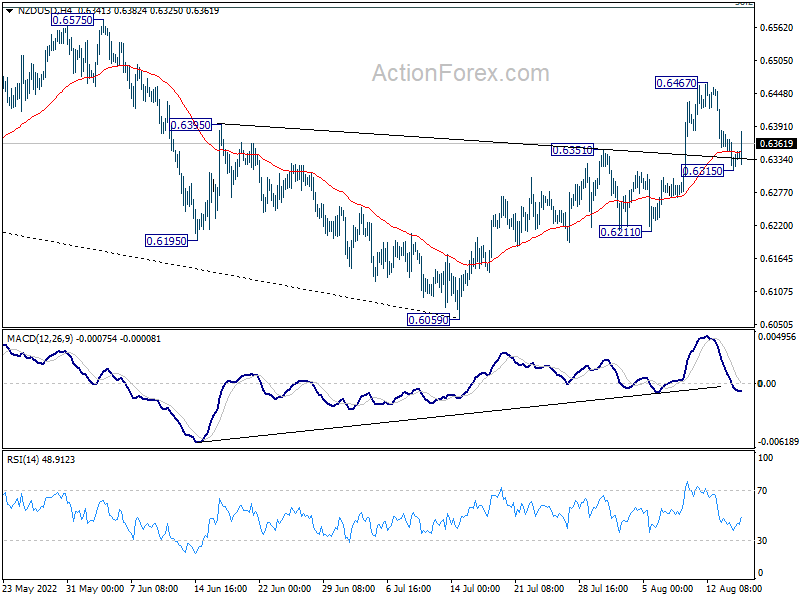
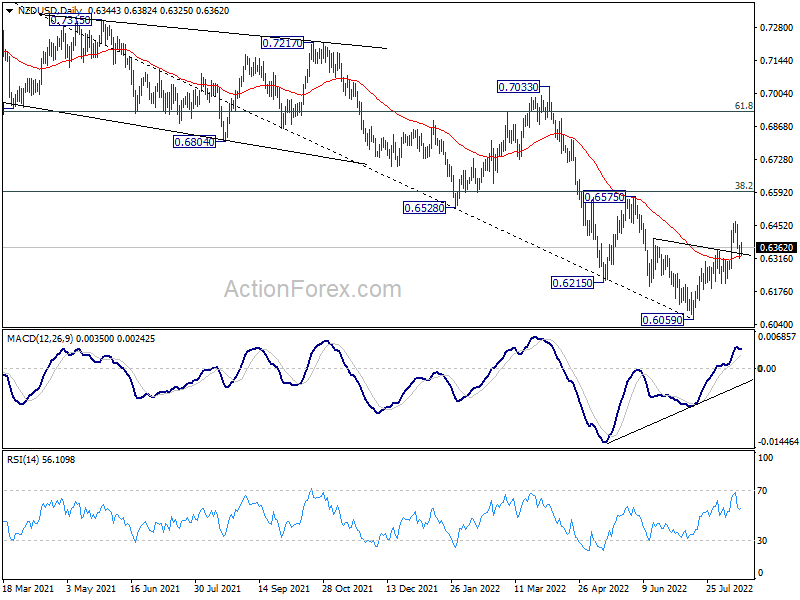
NZD/USD recovers notably after RBNZ rate hike, but stays in range below 0.6467 temporary top. Outlook is staying bullish for now, as NZD/USD is trying to draw support from head and shoulder neckline (ls: 0.6195, h: 0.6059, rs: 0.6211), as well as 55 day EMA (now at 0.6323). Another rise is in favor through 0.6467, sooner rather than later.
Either as a corrective rebound, or part of an up trend, rise from 0.6059 should target 0.6575 resistance zone, which is close to 38.2% retracement of 0.7463 (2021 high) to 0.6059 at 0.6595.
However, another decline, and sustained trading below 55 day EMA will invalidate this view and bring retest of 0.6059 low instead.
Japan export rose 19.0% yoy in Jul, imports rose 47.2% yoy
Japan exports rose 19.0% yoy to JPY 8753B in July, with gains led by auto shipments to US and chips to China. Imports rose 47.2% yoy to JPY 10190B, driven by higher costs of crude oil, coal and liquid natural gas. Trade deficit came in at JPY -1437B. July's figure marked a full straight year of monthly trade deficits, the longest streak since the 32-month run to February 2015.
In seasonally adjusted terms, exports rose 2.1% mom to JPY 8437B. Imports rose 3.5% mom to JPY 10570B. Trade deficit widened to JPY -2133B.
Looking ahead
UK CPI and PPI, Eurozone GDP and employment change will be released in European session. Later in the day, US retail sales and business inventories will be published, and then FOMC minutes.
GBP/USD Daily Outlook
Daily Pivots: (S1) 1.2031; (P) 1.2075; (R1) 1.2141; More...
Intraday bias in GBP/USD remains neutral as it's still bounded in range of 1.2002/2292. On the downside, break of 1.2002 minor support will argue that rebound from 1.1759 has completed, after rejection by 55 day EMA. Intraday bias will be back on the downside for retesting 1.1759 low first. Break there will resume larger down trend. On the upside, above 1.2922 will resume the rebound from 1.1759 towards 1.2666 resistance.
In the bigger picture, fall from 1.4248 (2018 high) could be a leg inside the pattern from 1.1409 (2020 low), or resuming the longer term down trend. Deeper decline is expected as long as 1.2666 resistance holds. Next target is 1.1409 low. However, firm break of 1.2666 will bring stronger rise back to 55 week EMA (now at 1.2897).
Economic Indicators Update
| GMT | Ccy | Events | Actual | Forecast | Previous | Revised |
|---|---|---|---|---|---|---|
| 22:45 | NZD | PPI Input Q/Q Q2 | 3.10% | 2.10% | 3.60% | 3.40% |
| 22:45 | NZD | PPI Output Q/Q Q2 | 2.40% | 1.90% | 2.60% | |
| 23:50 | JPY | Trade Balance (JPY) Jul | -2.13T | -1.94T | -1.93T | -1.95T |
| 23:50 | JPY | Machinery Orders M/M Jun | 0.90% | 1.30% | -5.60% | |
| 00:30 | AUD | Westpac Leading Index M/M Jul | -0.20% | -0.20% | ||
| 01:30 | AUD | Wage Price Index Q/Q Q2 | 0.70% | 0.80% | 0.70% | |
| 02:00 | NZD | RBNZ Interest Rate Decision | 3.00% | 3.00% | 2.50% | |
| 06:00 | GBP | CPI M/M Jul | 0.00% | 0.80% | ||
| 06:00 | GBP | CPI Y/Y Jul | 9.80% | 9.40% | ||
| 06:00 | GBP | Core CPI Y/Y Jul | 6.40% | 5.80% | ||
| 06:00 | GBP | RPI M/M Jul | 0.80% | 0.90% | ||
| 06:00 | GBP | RPI Y/Y Jul | 12.90% | 11.80% | ||
| 06:00 | GBP | PPI Input M/M Jul | 1.00% | 1.80% | ||
| 06:00 | GBP | PPI Input Y/Y Jul | 24.80% | 24.00% | ||
| 06:00 | GBP | PPI Output Y/Y Jul | 17.60% | 16.50% | ||
| 06:00 | GBP | PPI Output M/M Jul | 1.60% | 1.40% | ||
| 06:00 | GBP | PPI Core Output M/M Jul | 0.00% | 0.80% | ||
| 06:00 | GBP | PPI Core Output Y/Y Jul | 15.90% | 15.20% | ||
| 09:00 | EUR | Eurozone GDP Q/Q Q2 P | 0.70% | 0.70% | ||
| 09:00 | EUR | Eurozone Employment Change Q/Q Q2 P | 0.60% | 0.60% | ||
| 12:30 | USD | Retail Sales M/M Jul | 0.20% | 1.00% | ||
| 12:30 | USD | Retail Sales ex Autos M/M Jul | 0.10% | 1.00% | ||
| 14:00 | USD | Business Inventories Jun | 1.40% | 1.40% | ||
| 14:30 | USD | Crude Oil Inventories | 0.3M | 5.5M | ||
| 18:00 | USD | FOMC Minutes |
Japan export rose 19.0% yoy in Jul, imports rose 47.2% yoy
Japan exports rose 19.0% yoy to JPY 8753B in July, with gains led by auto shipments to US and chips to China. Imports rose 47.2% yoy to JPY 10190B, driven by higher costs of crude oil, coal and liquid natural gas. Trade deficit came in at JPY -1437B. July's figure marked a full straight year of monthly trade deficits, the longest streak since the 32-month run to February 2015.
In seasonally adjusted terms, exports rose 2.1% mom to JPY 8437B. Imports rose 3.5% mom to JPY 10570B. Trade deficit widened to JPY -2133B.
NZD/USD bounces after RBNZ hike, drawing support from HnS neckline
NZD/USD recovers notably after RBNZ rate hike, but stays in range below 0.6467 temporary top. Outlook is staying bullish for now, as NZD/USD is trying to draw support from head and shoulder neckline (ls: 0.6195, h: 0.6059, rs: 0.6211), as well as 55 day EMA (now at 0.6323). Another rise is in favor through 0.6467, sooner rather than later.
Either as a corrective rebound, or part of an up trend, rise from 0.6059 should target 0.6575 resistance zone, which is close to 38.2% retracement of 0.7463 (2021 high) to 0.6059 at 0.6595.
However, another decline, and sustained trading below 55 day EMA will invalidate this view and bring retest of 0.6059 low instead.
RBNZ hikes 50bps, monetary conditions needed to continue to tighten
RBNZ raises the Official Cash Rate by 50bps to 3.00% as widely expected, as "core consumer price inflation remains too high and labour resources remain scarce". It also maintains hawkish bias as "committee members agreed that monetary conditions needed to continue to tighten until they are confident there is sufficient restraint on spending to bring inflation back within its 1-3 percent per annum target range."
The central bank noted domestic spending has "remained resilient", supported by a "robust employment level, continued fiscal support, an elevated terms of trade, and sound household balance sheets in aggregate." Production is being "constrained by acute labour shortages", heightened by seasonal illnesses and COVID-19. Spending and investment continues to "outstrip supply capacity". Wage pressures are "heightened". A range of indicators highlight broad-based domestic pricing pressures.